Volume 6, Issue 2, 2019, pp. 1-17 Available online at www.jallr.com ISSN: 2376-760X
* Correspondence: Fahad Saud Albahlal, Email: escfahad gmail.com © 2019 Journal of Applied Linguistics and Language Research
The Impact of YouTube on Improving Secondary School
Students
’
Speaking
Skills: English Language Teachers
’
Perspectives
Fahad Saud Albahlal * Ministry of Education, Zulfi, Saudi Arabia
Abstract
The study aimed to identify English language teachers’ perceptions on using YouTube in
developing speaking skills and their attitudes towards YouTube usage as well as the best ways to use YouTube. In order to achieve these goals, the descriptive analytical approach was employed and the researcher designed a questionnaire as the data collection tool. The sample of the study comprised (40) Saudi EFL male English language teachers in Riyadh city. The results showed that English language teachers have positive perceptions of using YouTube to develop speaking skills. They expressed that YouTube videos help students guess the meaning of unfamiliar words and improve their speaking skills. Also, it was shown that YouTube videos
lower the students’ anxiety, help students learn faster, and retain the students’ attention
during the class. Furthermore, the results showed that there are different ways to use YouTube in the class such as using YouTube to ask students to mention some points or details they see in the videos and to give chances to the students to give information, comment, discuss, and understand the material. The researcher recommended that language teachers should use YouTube videos while teaching speaking.
Keywords: YouTube, Speaking, EFL, English Teachers, Secondary School
INTRODUCTION
The new internet-based modes of language learning have always been described as reliable sources for language learning. With internet-based applications, students can practice language learning through motivating activities such as games due to attractive features associated with games. The emergence of internet gave researchers an opportunity to facilitate language learning by using amusing and enjoyable games (Halic et al., 2010). YouTube is an internet-based educational tool which allows the learners to easily maintain content and motivate students to learn due to the videos and graphics it presents to the learners (Deng & Yuen, 2010).
month. Also, YouTube is available in more than sixty language and many countries in the world (Silviyanti, 2014). YouTube application can be found in many smart phones as well. The most prominent feature of YouTube is that it contains many videos on different subjects and in many languages. In a search box, the users can write the name of the video they need to watch and it will run on directly. Such videos are very important in the educational field. By using these videos, the language instructors can design lessons for their learners and give meaningful activities in language classes. For example, there are conversation activities such as "movie trailer" and "voice over" that can be employed to practice speaking and listening (Watkins and Wilkins, 2011: 115).
Many researchers have affirmed the role of YouTube in language learning. Barrs (2012) reported that YouTube plays a role in the cross-cultural knowledge since users from different cultures can upload videos. Also, Snelson & Perkins (2009) reports that the videos enhance motivation in L2 learning and the learners can exchange videos in a tension free environment. YouTube videos assist the learners to comment, share, express, speak, and think in a positive environment without the restrictions of the conventional classes in which the teacher is the only speaker in the class (Alhammai, 2013). According to Alastuey (2011), YouTube videos have a significant role in allowing the learners to speak and interact with their peers and teachers in class during watching the videos and understanding what is going on. Wagner (2007) supported the use of videos in teaching speaking since they allow the learners to remember the material and speak freely about it.
In addition, Wagner (2007) argued that YouTube-based materials allow the learners to master pronunciation, sound discrimination, and comprehending what is being said to them through the graphical and illustration means used in the videos. Also, Cakir (2006) informed that videos offer authentic language inputs which create a meaningful language learning environment. In such authentic contexts, the learners come across real objects, persons, and situations. This makes of YouTube a leading source of language learning. In EFL contexts, speaking skill has always been a challenge for EFL learners. The EFL students have frequently been taught through traditional methods of language teaching where they are not exposed to the target lanaguge or to the channels through which they can speak, communicate, and interact using the target language (Zeng and Takatsuka, 2009). Also, speaking is a difficult skill since it entails the learners to master a sum of other skills such as grammar, vocabulary, and comprehension. Silviyanti (2014) reported that YouTube videos are especially useful for speaking skills since they make the content comprehensive to the learner and enhance the learners’ motivation.
Speaking skill is one of the major challenges for Saudi EFL learners (Aljumah, 2011). The learners’ difficulties in speaking appear in the inability of the learners to respond to the teachers’ question, the learners cannot get the general idea of the text, and they confuse the speaker’s main points (Alhamami, 2013).
Some Saudi language teachers in the secondary stage ignored the great importance of using YouTube in teaching speaking. Due to the lack of creativity, learning and teaching English can be boring for both learners and teachers alike. This may be attributed to the classical methods of teaching English that focused more on the form and ignored communication and students’ motivation (Cheng, 2002).
YouTube was reported as a valuable source in teaching speaking (Silviyanti, 2014; Watkins & Wikins, 2011). Due to the important feature of YouTube in terms of videos, graphics, and animation, YouTube can be a tool to help learners comprehend what they listen to, speak freely without hesitation, and overcome their anxiety in speaking classes. Despite the importance of YouTube in teaching speaking, very few studies have been conducted to examine role of YouTube in developing the speaking skills. Moreover, no single study, to the researcher's knowledge, has investigated the use of YouTube from the perspective of English language teachers.
THE STUDY
Speaking has always been reported to be a problem for Saudi EFL learners (Aljumah, 2011). The traditional methods of teaching adopted by English teachers in the Saudi classes in the secondary stage produce poor speakers who are not able to engage in extended conversations with others (Alhamami, 2013). Also, the students suffer from the inability to speak with confidence in front of others and to ask and respond to the questions of their classmates and teachers.
YouTube is a useful technique that can be used to develop the students’ speaking skills (Silviyanti, 2014; Watkins & Wikins, 2011). Besides being motivating and interesting, YouTube allows the students to listen carefully, pronounce the words properly, and organize their ideas while speaking. Also, YouTube was reported to provide a tension-free environment in which the students can interact with their teachers and peers without anxiety and fear. However, YouTube was not put to much investigation with regard to the Saudi students. Also, very rare studies examined the role of YouTube on improving the speaking skills of the students from the perspective of Saudi EFL teachers. This study is an attempt to examine the impact of YouTube on developing the speaking skills as perceived by the English teachers.
The present study attempts to answer the below questions:
1. What are English languages teachers’ perceptions on using YouTube in developing speaking skill?
3. What are the best ways to use YouTube as perceived by English language teachers?
This study is of a great importance at the practical and theoretical levels. For SLA researchers, YouTube-based materials help in achieving the balance between fluency and accuracy in language learning. YouTube is a new language teaching mode that emphasizes the positive role of the learner in the learning process and corresponds with the sound theories of language learning that stress the learners' need to interact and communicate using the target language. Also, YouTube enhances the benefit from technology in education and sheds light on the benefits of using technology in EFL classes such as enhanced motivated, improved fluency, and better linguistic performance. Furthermore, this study is important as it cancels the main dependence on the traditional methods of learning and the mother tongue since YouTube videos support the concepts of learners' autonomy and learning styles-based learning.
The practical significance of this research is classroom-based. It also draws the attention of the teachers to YouTube and how it can be used in the teaching and learning of speaking. This method is also significant as it trains prospective EFL teachers on YouTube as an educational tool. It draws the attention of the in-service teachers to the efficacy of this technique in promoting the speaking skills of their students.
Finally, the current study is one of the few studies that examines the use of YouTube in developing speaking skills of in Arabic contexts. YouTube has rarely been examined in the context of Arab students. It fills an academic gap by investigating the impact of YouTube on speaking skills of the secondary school students from the perspective of English language teachers.
LITERATURE REVIEW
Technology has become the language of the age. The technological developments have contributed greatly to the success of mankind. Computers are changing the world, the size of knowledge acquired, and the way information are processed. Also, technology has eliminated many of the barriers to fast and easy learning and communication. In other words, the persons can now get what they want to know in not time and whatever resources they see appropriate.
YouTube has emerged as a video broadcasting facility in February 2005. This video facility was created for the purpose of creating and publishing videos online for the general public. YouTube was established in 2005 and in 2006, YouTube was purchases by Google for a deal amounting to more than one and a half billion dollars (Alwahabi, 2013: 2). So as to comprehend the role of YouTube in the learning process, there is a need to fully understand what YouTube represents. YouTube is a great video storing facility that fits the different goals of education (Wright, 2009).
(Lee, 2010; Noytim, 2010; Kelsen, 2009). Also, YouTube is the vehicle through which the students can be exposed to different dialects and, thus, cultural knowledge can be acquired (Brown, 2014).
Speaking is an interactive skills in which parties of speech engage together in order to convey a certain message (Brown, 2014). Speaking is one of the most complicated skills for EFL learners since it involves many skills. The ability to organize the discourse, the ability to discriminate ideas and content, the ability to pronounce words perfectly, and the ability to pursue discourse flow (Kelsen, 2009).
YouTube is the tool that helps students to upload and download videos about different materials. Not only does YouTube allow students to listen and watch the videos, but it allows the students to comment, share, edit, add, and discuss the videos they have watched. Also, YouTube creates a motivating environment in which the students can better understand what they listen to and their pronunciation and accent are improved. Engaging in a group discussion with the teacher and classmates after watching a video about a certain material or topic can allow the students to develop automaticity in speech and overcomes their speech anxiety and hesitation to speak in front of others (Noytim, 2010).
YouTube offers a great chance for the teachers inside the class. It is an authentic source for materials in the class (Lee, 2010). The teachers can select the videos that fit the class and the students’ level and engage the students in a series of questions and answers about what they have seen in the videos. The students’ vocabulary can also be improved since they listen to new words and they can guess the meaning of the unfamiliar words from the context. In addition, YouTube works as a source of update events and news. This allows the students to keep up with the recent information and knowledge.
Different studies were conducted to examine the impact of YouTube on language skills, especially the speaking skill. In a study conducted by Brown (2014), the teachers' perspective towards YouTube. The research sample consisted of a number of the master degree holders in a British university. The study employed an online questionnaire and a focus group in order to explore the perspectives towards the virtual world. The results of the study demonstrated that the participants see that technology is very important in their life, but YouTube still has a limited role in their life. Also, it was shown that the teachers still use YouTube poorly in the class although they do not have reasonable justifications for these decisions. The study recommended that the teachers should get training courses to effectively use YouTube in the class.
According to Castaneda (2011), a blended learning process with YouTube was used to help the university students develop their speaking skills. Within this research, forty-four participants took part in this study and more than eighty percent of the participants have been developed in the speaking skill and in understanding the meaning of different ideas. Also, it was shown that YouTube motivates the student to learn and speak with others without limitations.
using the YouTube in the speaking class. A proficiency test was given to the students after the use of YouTube in the class. The study revealed that YouTube is a useful tool in allowing the students to interact with the classmates and improving their speaking performance. Also, the students were better able to self-reflect and make posts. The main result was that the students reflected on their tasks in the class and could share this with their classmates.
A study conducted by Zorko (2009) stated that students in their first internet-based video games encountered some problems in speaking due to weak comprehension and vocabulary and grammatical errors. Since they progress in the instruction by YouTube, their performance got improved and they benefited from the comments of their classmates and teachers. This proves that YouTube videos allow the students to engage with their peers and improve in speech, vocabulary, and grammar.
In YouTube environment, the feeling of ownership stimulated students to read freely and improved self-refection, and construction of knowledge collaboratively (Noytim, 2010). The meaning served as the prominent focus rather than form in the internet environment and it showed that students apparently concentrate on the fluency more than the accuracy in their YouTube project. Additional interaction and exchanging ideas can be prompted by the peer's feedback on the internet.
The above literature shows that YouTube is an effective tool in developing the students' linguistic skills, especially the speaking skill. Many studies proved the usefulness of YouTube on the students' performance, but the teachers' perspectives on the use of YouTube in the class in under-researched. Also, as per the researcher's knowledge, very rare studies tackled the teachers' perspective on the use of YouTube in Saudi EFL classes. So, this study is a novel study since it discusses the use of YouTube in developing speaking skills from the teachers’ perspective in the Saudi context. In doing so, it attempts to fill a research gap.
METHOD
Design
The present study used descriptive approach with the analytical aspect that describes and analyses the use of YouTube in developing speaking skills. The research design is made based on the questions and the objectives of the study. Also, the study used a mix of the qualitative and quantitative approaches in order to give a descriptive and numerical representation of the data.
Subjects
Data Collection Instrument
The researcher prepared a questionnaire to collect data from the participants. The questionnaire was presented to the subjects of the study. The research questionnaire was prepared based on the past studies that focused on using YouTube to develop speaking skills and other related language learning skills.
The researcher prepared a questionnaire about using YouTube to develop speaking skills. The questionnaire consists of (26) statements, distributed on (3) fields. The researcher distributed (40) questionnaires got back (36) questionnaires answered by the participants. The rating scale used in this questionnaire is Likert scale that has five ratings.
The researcher conducted a pilot study before distributing the questionnaire to the entire research participants. The researcher sent the questionnaire to a randomly selected sample of (5) male English language teachers. They reported that the items were clear and easy to understand. Also, the researcher calculated the difference in time between the first and last one who finished the questionnaire in piloting it. The time was five minutes.
Questionnaire Validity and Reliability
Validity means that the questionnaire is suitable for the purpose for which the tool is meant. The researcher achieved the validity of the survey by presenting it to a number of juries in the field and asked them for their point of view on the appropriateness of the instrument to the goals of the study. The researcher conducted the proper amendments to the questionnaire based on the experts’ opinions and produced the questionnaire in its final form.
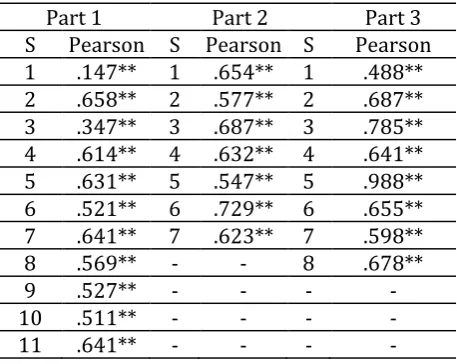
Also, the researcher verified the construct validity of the questionnaire by using the Pearson correlation coefficient. The can be seen in the following table:
Table 1. Correlation Coefficient Results
Part 1 Part 2 Part 3
S Pearson S Pearson S Pearson
1 .147** 1 .654** 1 .488**
2 .658** 2 .577** 2 .687**
3 .347** 3 .687** 3 .785**
4 .614** 4 .632** 4 .641**
5 .631** 5 .547** 5 .988**
6 .521** 6 .729** 6 .655**
7 .641** 7 .623** 7 .598**
8 .569** - - 8 .678**
9 .527** - - -
-10 .511** - - -
-11 .641** - - -
On the other hand, reliability means the consistency of findings. In order to fulfill the reliability of the research tool, Cronbach's Alpha coefficient is utilized for this purpose. The results of Cronbach's Alpha coefficient are seen as below:
Table 2. Questionnaire Reliability
Sections N Cronbach’s Alpha
English Language Teachers’ Perceptions on Using YouTube in Developing
speaking skills 11 0.745
English Language teachers' Attitudes toward YouTube 7 0.811
The Best Ways to Use YouTube as Perceived by English language teachers 8 0.952
Total 26 0.801
The above table shows that the questionnaire is a reliable tool since the correlation values for all the sections of the questionnaire ranged between (0.952) and (0745). All of these values are high values. The overall correlation value is (0.801) and this indicates that the questionnaire is fit for the purpose of this study.
Procedures of the Study
The researcher adopted the following steps in order to conduct the study.
1. The participants were made aware of the purpose of the survey and their approval was ensured in order to participate in the study. They were given the full contacts of the researcher to contact him in case of any inquiries.
2. The questionnaire was sent out to the participants and the researcher collected their responses electronically.
3. The researcher gathered the data during a one-week period.
4. The researcher gathered the participants' responses and analyzed them statistically. The data were analyzed and shown in tables so as to visually represent the responses in a clearer way. Then, findings were discussed and analyzed. The researcher presented recommendations and suggestions based on the research findings.
The researcher used a number of statistical tools in order to analyzed the collected data. The frequency and percentage tools were used to calculate the proportion of agreement or disagreement to each item of the questionnaire. Also, the arithmetic mean and standard deviation were employed by the researcher to see the degree of agreement and dispersion between the responses of the respondents.
RESULTS & DISCUSSION
Findings of the First Question
What are English language teachers' attitudes on using YouTube in developing speaking skills?
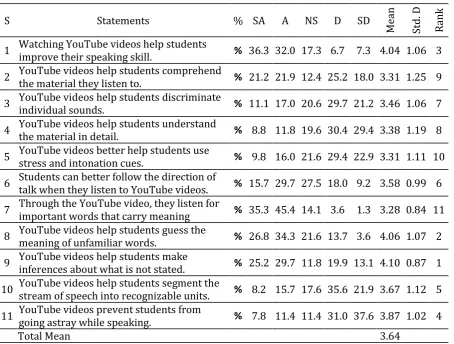
consists of eleven items and the participants’ answers to these items are presented in table 3 as follows:
Table 3. Findings of the First Section
S Statements % SA A NS D SD
Mean Std. D Ran
k
1 Watching YouTube videos help students improve their speaking skill. % 36.3 32.0 17.3 6.7 7.3 4.04 1.06 3
2 YouTube videos help students comprehend the material they listen to. % 21.2 21.9 12.4 25.2 18.0 3.31 1.25 9
3 YouTube videos help students discriminate individual sounds. % 11.1 17.0 20.6 29.7 21.2 3.46 1.06 7
4 YouTube videos help students understand the material in detail. % 8.8 11.8 19.6 30.4 29.4 3.38 1.19 8
5 YouTube videos better help students use stress and intonation cues. % 9.8 16.0 21.6 29.4 22.9 3.31 1.11 10
6 Students can better follow the direction of talk when they listen to YouTube videos. % 15.7 29.7 27.5 18.0 9.2 3.58 0.99 6
7 Through the YouTube video, they listen for important words that carry meaning % 35.3 45.4 14.1 3.6 1.3 3.28 0.84 11
8 YouTube videos help students guess the meaning of unfamiliar words. % 26.8 34.3 21.6 13.7 3.6 4.06 1.07 2
9 YouTube videos help students make inferences about what is not stated. % 25.2 29.7 11.8 19.9 13.1 4.10 0.87 1
10 YouTube videos help students segment the stream of speech into recognizable units. % 8.2 15.7 17.6 35.6 21.9 3.67 1.12 5
11 YouTube videos prevent students from going astray while speaking. % 7.8 11.4 11.4 31.0 37.6 3.87 1.02 4
Total Mean 3.64
Table 3 shows that the English language teachers' perceptions of using YouTube in developing speaking skills are high with a mean (3.64). The participants generally consider the role YouTube can have in developing speaking skills.
The above findings indicated that English language teachers have excellent perceptions on using YouTube to develop speaking skills. Their responses denoted that YouTube videos can help students guess the meaning of unfamiliar words, enable students to improve their speaking skills, and guide students. Also, the results referred to YouTube videos potentials that can help students in segmenting the speech into recognizable units, help students to comprehend the material they listen to, and help students to better discriminate the sounds. Generally, the participants see that YouTube is useful for the students in the areas of meaning, comprehension, and sounds identification.
Also, this finding is supported by Wagner (2007) argued that using videos in the classroom gives instructors to offer language learners to authentic cultural information. English speaking skills practice through movies is more applicable for the students who do not get any English class to learn cultures in the target language. The same result is revealed by Silviyanti (2014) who reported the positive effect of YouTube on developing speaking skills. It is important to know that YouTube can improve the language. The interesting and pleasant environment formed by YouTube encourages the class to learn. Furthermore, the present findings are supported by Snelson & Perkins (2009) who concluded that the usage videos in English language class is a useful in language learning. It motivates the learners to speak in the foreign language. There are so many advantages of using videos for developing students' speaking skill. It can be said that YouTube can be very helpful for them enhancing their speaking skill, it can also be a valuable tool in the cultures and vocabulary learning. The major benefit of using movies for learning English is that it amuses the learners. Thus, the students have to learn English by watching YouTube movies because it is already confirmed that they have many benefits.
Tu (2010) and Alimemaj (2010) supported that findings of this study by revealing that English language teachers are interested in the use of YouTube in their learning process since it represents to them a new way which they think it is going to help them in the educational setting and enrich their students’ English language knowledge.
Furthermore, this finding is confirmed by Barrs (2012) who emphasized that the teachers think that YouTube videos could be a solution to many problems such as boredom and routine. Additionally, Sun (2009) supported this finding by revealing that YouTube videos can be used as a new and authentic source for providing knowledge that learners can depend on for the purpose of gaining new information beside the teacher. YouTube videos can be a very useful way of practicing the speaking ability for EFL learners and provide them with new and exciting methods of learning the English language.
Findings of the Second Question
To what extent English language teachers have positive attitudes toward YouTube usage?
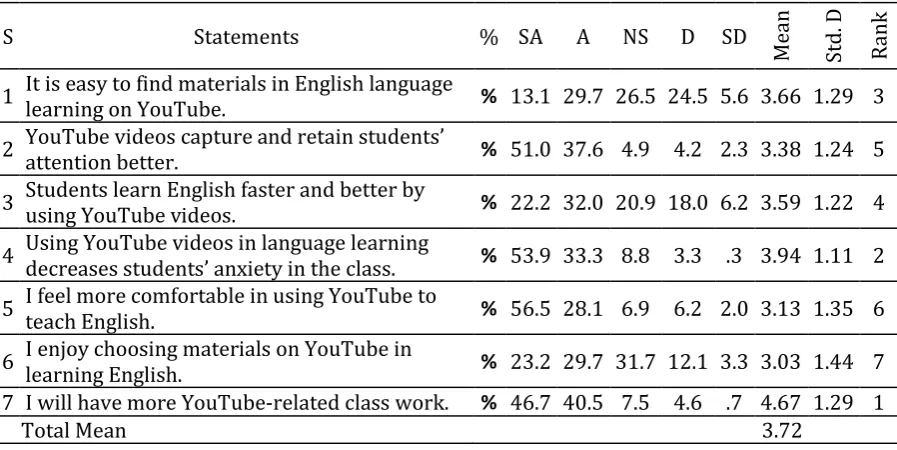
Table 4. Findings of the Second Section
S Statements % SA A NS D SD
Mean Std. D Ran
k
1 It is easy to find materials in English language learning on YouTube. % 13.1 29.7 26.5 24.5 5.6 3.66 1.29 3
2 YouTube videos capture and retain students’ attention better. % 51.0 37.6 4.9 4.2 2.3 3.38 1.24 5
3 Students learn English faster and better by using YouTube videos. % 22.2 32.0 20.9 18.0 6.2 3.59 1.22 4
4 Using YouTube videos in language learning decreases students’ anxiety in the class. % 53.9 33.3 8.8 3.3 .3 3.94 1.11 2
5 I feel more comfortable in using YouTube to teach English. % 56.5 28.1 6.9 6.2 2.0 3.13 1.35 6
6 I enjoy choosing materials on YouTube in learning English. % 23.2 29.7 31.7 12.1 3.3 3.03 1.44 7
7 I will have more YouTube-related classwork. % 46.7 40.5 7.5 4.6 .7 4.67 1.29 1
Total Mean 3.72
The above table shows that the teachers have positive attitudes towards the use of YouTube in developing the speaking skills of the students. The mean score for this section is (3.72) and this is a high mean score.
The above findings show that participants have positive attitudes towards using YouTube in developing speaking. It was shown that YouTube videos lower the students’ anxiety, help students learn faster, and retain the students’ attention during the class. Also, it was shown that the participants see that it is easy to find learning materials on YouTube and that they feel comfortable using YouTube in teaching English. Generally, the participants like to use YouTube in the class.
The results show that the English language teachers appear to be curious and positive towards the idea of considering YouTube videos as a good source for practicing speaking and they have shown their interest to experience the use of YouTube videos in the classroom as a teaching material.
Moreover, Silviyanti (2014) supported this research finding that YouTube Videos are a good source for teaching speaking; this is what all the participants agreed upon confirming that the authenticity of the videos gives them the privilege to be a good source for teaching speaking. All participants also think that using videos as a teaching material will attract the interest of the students and make them want to study and that because of the power of videos in putting the students inside the situation and make them live it, and also the videos ability to bring real life situations inside the classroom and this will break the routine that the students used to live in. Furthermore, the findings of this study showed that the use of YouTube videos in teaching speaking minimizes anxiety and makes the students feels comfortable. Entertainment is one of the things that bring good atmosphere to the classroom and teachers need it and this is what the findings show, videos are the solution for the teachers to bring a funny atmosphere to the class. Also, this finding is supported by Kelsen (2009) who reported that the teachers have a positive attitude towards YouTube videos owing to their interactivity, socialization, and cooperative learning.
Findings of the Third Question
What are the best ways to use YouTube as perceived by English language teachers?
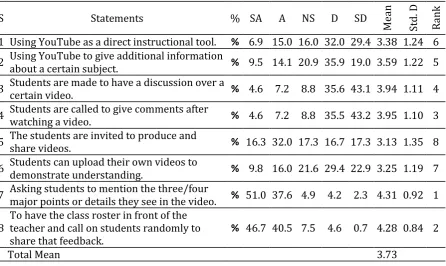
This part of the questionnaire comprises eight items that identify the perceptions of English language teachers of the best ways to use YouTube. This part consists of eight statements participants’ responses are seen in the below table:
Table 5. The Findings of the Third Section
S Statements % SA A NS D SD
Mean Std. D Ran
k
1 Using YouTube as a direct instructional tool. % 6.9 15.0 16.0 32.0 29.4 3.38 1.24 6
2 Using YouTube to give additional information about a certain subject. % 9.5 14.1 20.9 35.9 19.0 3.59 1.22 5
3 Students are made to have a discussion over a certain video. % 4.6 7.2 8.8 35.6 43.1 3.94 1.11 4
4 Students are called to give comments after watching a video. % 4.6 7.2 8.8 35.5 43.2 3.95 1.10 3
5 The students are invited to produce and share videos. % 16.3 32.0 17.3 16.7 17.3 3.13 1.35 8
6 Students can upload their own videos to demonstrate understanding. % 9.8 16.0 21.6 29.4 22.9 3.25 1.19 7
7 Asking students to mention the three/four major points or details they see in the video. % 51.0 37.6 4.9 4.2 2.3 4.31 0.92 1
8
To have the class roster in front of the teacher and call on students randomly to
share that feedback. % 46.7 40.5 7.5 4.6 0.7 4.28 0.84 2
Total Mean 3.73
The above findings show that there are different ways to use YouTube in the class. The participants show that one of the best ways to use YouTube is to ask students to mention some points or details they see in the video. Also, the teachers can have a class roster and get the students write comments after watching the video. Moreover, the a discussion can be made after watching the video and the students are given the specific tasks such as giving information from the videos they listened to. On the other hand, students can learn how to discriminate the individual sounds through the YouTube videos and they can upload, share, and comment on the videos. Generally, the findings show that the YouTube videos can be used to give chances to the students to give information, comment, discuss, and understand the material they listen to.
This finding corresponds with the findings of Snelson & Perkins (2009) who reported that YouTube videos can be utilized in different ways inside the language classroom. These videos can be used in some different learning situations. This is also supported by Wager (2007) and Alwahabi (2013) who demonstrated that authentic materials such as YouTube videos are always the best way to improve the students’ pronunciation and intonation. This is what the results of the participants showed and it appears that all the teachers agree on this point.
YouTube videos can be a resolution for the language learners who have problems in speaking. This can be justified that students, in YouTube videos-based classes, are given opportunities to speak freely and share opinions and comments with their teachers and friends (Brown, 2014). In traditional speaking classes, students are inactive in addition to the lack of participation and exchange of comments and opinions whether with their teachers or with their friends.
The findings showed that YouTube videos are useful than the traditional speaking strategy as it enables the learners to interact with the text, confer and discuss, solve problems with each other, derive meaning and make comments (Lee, 2010). All these skills that are available in the YouTube videos enable them to become better listeners. This finding is supported by the findings of Lou et al. (2010) and Zokoro (2009) who concluded that YouTube is of a great importance in the current classroom environment. YouTube videos make learners classroom-oriented and motivated to learn, participate, and interact. Also, YouTube videos kill the boredom that accompanies traditional language classes where all students are passive and the teacher makes all the efforts. Also, this finding corresponds with Zokoro (2009) who revealed that the students can use YouTube videos at their own place at home at any time of the day. This gives them more independence from classrooms and they practice as much as they need. Moreover, students benefit greatly through the authentic materials provided by YouTube videos and interaction is enhanced.
against the usage of YouTube videos in language classes is the costs associated with modern technology. When computers become an essential requirement for student to buy, low budget schools and low-income students generally cannot afford one.
CONCLUSION
Based on the findings of the study, English language teachers have positive perceptions of using YouTube to develop speaking. They expressed that YouTube videos help students guess the meaning of unfamiliar words, help students improve their speaking skills, and prevent students from going astray while speaking and listening to the videos. English language teachers also have positive attitudes towards using YouTube in developing speaking. It was shown that YouTube videos lower the students’ anxiety, help students learn faster, and retain the students’ attention during the class. The participants see that it is easy to find learning materials on YouTube and that they feel comfortable using YouTube in teaching English. There are different ways to use YouTube in the class. The participants show that one of the best ways to use YouTube is to ask students to mention some points or details they see in the video. YouTube videos can be used to give chances to the students to give information, comment, discuss, and understand the material they listen to.
IMPLICATIONS
YouTube is a new technique that concentrate on the interactive nature of speaking. It includes a lot of elements that provide students change their learning styles from a dependent to an independent one. This changing must built with planning, encouragement, observation, and self-regulation. Students gain from this active, reliable and self-regulated learning. They will link their goals with a particular learning to improve their goals. They will display self-discipline, set task before entertainment, diligently complete homework in classroom or at home.
YouTube is essential for EFL teachers themselves. They regularly need to think about their teaching strategies and used activities. Thus, they need to construct and evaluate their own way of teaching and make sure that their goals and expectations are achieved. YouTube is a flexible method to organize the class according to the time available and the needs of EFL students.
English language teacher should make their students always be aware of the strategies that work best for them. Their confidence and motivation for learning will increase if they are aware of what good skills they have. Student failure usually comes from low self-confidence and low motivation. Students with low self-self-confidence do not have motivation to complete their tasks, as well as they do not want to risk failure.
There are implications for language courses, programs, and universities as well. The importance of the speaking skill is that this skill means the success in making the learner a good language learner. Language programs and universities may take into consideration how to train students to improve their speaking skills.
Therefore, teachers should use YouTube videos as teaching materials in EFL classroom, in order to add variety to the learning environment and to attract the learners’ attention. Furthermore, the use of YouTube videos may also inspire and engage the learners to learn English language independently outside the classroom. Meanwhile, it is also recommended that learners of EFL to use YouTube videos as one of the tools in independent English language learning. EFL learners need to be aware of the educational aspect of YouTube videos, besides entertainment. If used for the right purposes, YouTube videos can be very effective in English language learning
RECOMMENDATIONS
The researcher recommends the following:
1. EFL teachers can use YouTube videos while teaching speaking materials so that the students can communicate effectively in a tension-free and motivating environment.
2. EFL/ESL teachers can learn how to produce videos and upload them on YouTube with a consideration for the purposes they aim to achieve with their students. 3. The teacher should be well aware of how to integrate YouTube videos in teaching
speaking and into the syllabus in general.
4. YouTube should be integrated with normal instruction in the classroom as a complementary activity.
5. Students should be assessed based on their ability to learn, benefit and interact with their class peers using YouTube-based speaking materials and other ICT language learning utilities.
6. Using YouTube should be used not only to develop speaking skill but also the other language skills (reading, writing, and listening).
7. Students must be trained of how to use the new technologies to improve their language skills.
8. Teachers should be aware of how to use such technologies to develop their teaching ways and to achieve their objectives.
9. Old ways of teaching should be replaced with the new and useful ones instead of the traditional learning methods.
REFERENCES
Alastuey, M. C. B. (2011). Perceived benefits and drawbacks of synchronous voice-based computer-mediated communication in the foreign language classroom. Computer Assisted Language Learning, 24, (5), 419– 432.
Alhamami, M. (2013). Observation of YouTube language learning video (YouTube LLVS).
Teaching English with Technology, 13, (3), 3-17.
Alimemaj, Z. (2010). YouTube, Language Learning and Teaching Techniques. The Magazine of Global English Speaking Higher Education 2 (3).
Aljumah, F. (2011). Developing Saudi EFL Students’ Oral Skills: An Integrative Approach. English Language Teaching, 4, 3.
Alwahabi, O. H. (2013). The impact of Using YouTube in EFL Classroom on Enhancing EFL Students. Content Learning. The Clute Institute Academic Conference. Paris.
Barrs, K. (2012). Fostering computer-mediated L2 interaction beyond the classroom.
Language Learning & Technology, 16, (1), 10–25.
Brandl, K. (2012). Effects of required and optional exchange tasks in online language learning environments. ReCALL, 24, (1), 85–107.
Brown, J. (2014). Teachers’ perceptions and uses of online gaming and virtual worlds for English language learning. Master thesis. Exeter University. UK.
Cakir, I, dr. (2006). The use of video as an audio-visual material in foreign language teaching classroom. The Turkish Online Journal of Educational Technology, 5, (4): 67-73.
Castaneda, D. A. (2011). The effects of instruction enhanced by games on learning the distinctions of the Spanish preterite and imperfect. Foreign Language Annals, 44 (4), 692–711.
Cheng, Y.S. (2002). Factors associated with foreign language speaking anxiety. Foreign Language Annals, 35, 647-656.
Deng, L. & Yuen, A. (2010). Towards a framework for educational affordances of blogs.
Computers & Education, (1), 3.
Halic, O., Lee, D., Paulus, T. & Spence, M. (2010).To blog or not to blog: Student perceptions of blog effectiveness for learning in a college-level course. Internet and Higher Education. Computers & Education, (8), 3.
Herring, S. (1996). Introduction, in: Herring S. (ed.), Computer-Mediated Communication: Linguistic, Social and Cross-Cultural Perspectives, 1-10, Amsterdam, John Benjamins. Kelsen, B. (2009). Teaching EFL to the iGeneration: A survey of using YouTube as supplementary material with college EFL students in Taiwan. CALL-EJ Online, 10,
(2), 1-18.
Lee, L. (2010). Fostering reflective speaking and interactive exchange through blogging in an advanced language course. ReCALL, 22(2), 212–227.
Lou, S. Wu, S, Shih, R. & Tseng, H. (2010). Adoption of blogging by a Chinese language composition class in a vocational high school in Taiwan. Australasian Journal of Educational Technology, 26, (6), 898-900.
Miller, L., Hafner, C. A., & Fun, C. N. K. (2012). Project-based learning in a technologically enhanced learning environment for second language learners: Students' perceptions. E-Learning and Digital Media, 9, (2), 183– 195.
Noytim, U. (2010). Weblogs enhancing EFL students’ English language learning. Procedia Social & Behavioral Sciences, 2(1), 127–1,132.
Silviyanti, T. (2014). Looking into EFL Students’ Perceptions in Listening by Using English Movie Videos on YouTube. Studies in English Language and Education, 1, 1, 42 -58. Snelson, C, and Perkins, R.A. (2009). From silent on film to YouTube: Tracing the historical
Sun, Y. (2009). Voice blog: An exploratory study of language learning. Language Learning & Technology, 13, 2, 88-103.
Tu, C. (2010). The impacts of text-based CMC on online social presence. The Journal of Interactive Online Learning, 1,(2), 1-24.
Wagner, E. (2007). Are they watching? Test-taker viewing behavior during an L2 video listening test. Language Learning and Technology, 11, (1), 67-86.
Watkins, J, and Wilkins, M. (2011). Using YouTube in the EFL classroom. Language Education in Asia, 2, (1), 113-120.
Wright, P. (2009). Trainee Teachers’ e-Learning Experiences of Computer Play. Innovate: Journal of Online Education, 5, (4), 12 – 26.
Zeng, J & Takatsuka, S. (2009) Text-based peer–peer collaborative dialogue in a computer-mediated learning environment in the ESL context. System 37, 434–446. Zhang, W. (2009). Blogging for Doing English Digital: Student evaluations. Journal of
Computers and Composition, 27, (4), 266-283.