Applied Animal Behaviour Science (2008) Volume 112: 1-32
12
doi: 10.1016/j.applanim.2008.02.007
Final Revision – NOT EDITED by the journal
34
5
6
7
8
9
10
11
12
13
14
15
16
17
18
What is it like to be a rat? Rat sensory perception and its
implications for experimental design and rat welfare
Charlotte C. Burn
Department of Clinical Veterinary Science, University of Bristol, Bristol BS40 5DU,
UK
Running title: Rat sensory perception and its implications
Correspondence address: Department of Clinical Veterinary Science, University of
Abstract
1920
21
22
23
24
25
26
27
28
29
30
31
32
33
34
35
36
37
38
39
40
41
42
43
44
45
This review of rat sensory perception spans eight decades of work conducted across
diverse research fields. It covers rat vision, audition, olfaction, gustation, and
somatosensation, and describes how rat perception differs from and coincides with
ours. As Nagel’s seminal work (1974) implies, we cannot truly know what it is like to
be a rat, but we can identify and acknowledge their perceptual biases. These primarily
nocturnal rodents are extremely sensitive to light, with artificial lighting frequently
causing retinal degeneration, and their vision extends into the ultraviolet. Their
olfactory sensitivity and ultrasonic hearing means they are influenced by
environmental factors and conspecific signals that we cannot perceive. Rat and human
gustation are similar, being opportunistic omnivores, yet this sense becomes largely
redundant in the laboratory, where rodents typically consume a single homogenous
diet. Rat somatosensation differs from ours in their thigmotactic tendencies and highly
sensitive, specialised vibrissae. Knowledge of species-specific perceptual abilities can
enhance experimental designs, target resources, and improve animal welfare.
Furthermore, the sensory environment has influences from neurone to behaviour, so it
can not only affect the senses directly, but also behaviour, health, physiology, and
neurophysiology. Research shows that environmental enrichment is necessary for
normal visual, auditory, and somatosensory development. Laboratory rats are not
quite the simple, convenient models they are sometimes taken for; although very
adaptable, they are complex mammals existing in an environment they are not
evolutionarily adapted for. Here, many important implications of rat perception are
highlighted, and suggestions are made for refining experiments and housing.
Keywords: Animal Welfare; Communication; Olfaction; Perception; Rats;
46
47
48
49
50
51
52
53
54
55
56
57
58
59
60
61
62
63
64
65
66
67
68
69
70
71
1
Introduction
The stimuli that an animal can perceive depend on the available sensory apparatus,
while the way stimuli are evaluated in terms of their biological relevance depends on
the animal’s innate biases, cognitive abilities and experiences. Perception is therefore
a subjective distortion of reality, differing between species and even between
individuals within a species. Since rats and mice, which have similar perceptual
abilities to each other, constitute over 80% of all research animals in the European
Union (Commission of the European Communities, 2003), and they have been bred
for research since the late 1800s (Krinke, 2000; Whishaw & Kolb, 2005), much is
known about their perceptual biases. However, the information is scattered through
time and across different research fields, so it is not easily available to researchers, rat
caretakers, and other rat specialists. The resulting lack of awareness can have
serious implications, sometimes leading to poorly designed experiments and harming
rat welfare. This review brings current information together, to help inform and refine
rodent experiments and housing.
The review concentrates on the laboratory rat, Rattus norvegicus, since summaries of mouse sensory perception are included within several other review
papers (Sherwin, 2002; Olsson et al., 2003; Latham & Mason, 2004). Much of the
information will also be true for mice and other rodents, but care should still be taken
if extrapolating between species. The species’ natural ecology – such as whether they
are diurnal or nocturnal, social or solitary, arboreal, burrowing or terrestrial – will
profoundly affect their sensory perception. These ethological considerations are
highly relevant in laboratory rats despite their domestication; adult laboratory rats
72
73
74
75
76
77
78
79
80
81
82
83
84
85
86
87
88
89
90
91
92
93
94
95
96
their resulting community and behaviour rapidly resembles that of their wild relatives
(Berdoy, 2002).
This review is organised around the classic ‘five senses’: vision, audition,
olfaction, gustation and somatosensation. It should be remembered that these are
actually not the only senses; indeed rats may even possess a magnetic compass, like
mice (Muheim et al., 2006) and hamsters (Deutschlander et al., 2003), but most
published information currently covers the aforementioned five senses. For each
sense, the rat’s sensory biases relative to humans are first described, then some
practical implications of its perception with respect to welfare and experimental
design are discussed. This is an applied review, focussing on the known or suspected
implications of each sense, and aiming to provide enough information to allow readers
to extrapolate to their own situations. The review cannot be completely
comprehensive, and it will become clear that in many cases, rat sensory perception is
still poorly understood.
2
Vision
An obvious difference between human and rat vision is that rats’ eyes are
located on the sides of their heads, rather than the front. They therefore have a wider
field of view, but less binocular overlap than us: wild rats have a binocular overlap of
35o, domestic rats 76o, and humans 105o (Heffner & Heffner, 1992a).
Wild rats usually inhabit burrows or other enclosed environments, and tend to
be nocturnal or crepuscular, so most of their activities occur under low light
conditions (e.g. Calhoun, 1963). Consequently, rats rely relatively little on vision, but
they are dramatically more sensitive to dim light than we are, able to discriminate tiny
increments in intensity, indiscernible to us, including discriminating ‘total
Rats, especially albinos, have much poorer visual acuity (Lashley, 1938; Creel
et al., 1970; Prusky et al., 2002) and narrower depth perception than humans
(O'Sullivan & Spear, 1964; Routtenberg & Glickman, 1964). For example, human
acuity can be around 30 c/d (‘cycles per degree’ – a measure of spatial resolution
accounting for stimulus size and distance), while pigmented rats’ acuities are only 1–
1.5 c/d and albino strains have even lower acuities of 0.5 c/d (Prusky et al., 2002).
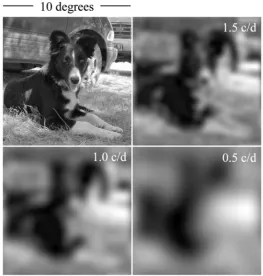
This presumably gives an extremely blurred image by human standards (Figure 1,
reprinted from Prusky and colleagues, 2002). Poor acuity in rats is probably partly
due to their eyes’ relatively small size, and partly because their eyes appear to
have very limited abilities to focus light from different distances or angles
compared with human eyes (Artal et al., 1998). Rats often bob their heads which
may help them gain motion cues about the distance of objects (Legg & Lambert,
1990). 97
98
99
100
101
102
103
104
105
106
107
108
109
110
111
112
113
114
115
116
117
118
119
120
121
122
123
124
Experiments in the 1930s suggested that, contrary to popular belief, rats possess
colour vision (e.g. Munn & Collins, 1936; Walton & Bornemeier, 1938), which has
recently been confirmed through electroretinograms and quantitative behavioural tests
(Jacobs et al., 2001). Rod cells comprise 99% of rat photoreceptors, but rats also have
two cone cell types (Szel & Rohlich, 1992). Around 93% of the cones respond
maximally to blue–green light (around 510 nm), while the remaining 7% respond to
ultraviolet (UV) (around 360 nm) (Jacobs et al., 2001; Akula et al., 2003). Cone
responses are normally distributed, so rats actually perceive hues ranging from
ultraviolet (400 nm) to orange-red (around 635 nm) (Jacobs et al., 2001), but they are
most responsive to colours near their peak sensitivities (Jacobs et al., 2001; Akula et
al., 2003).
Flicker fusion thresholds (when emitted light flickers rapidly enough to appear
constant) for rats are not yet known, but are relevant for their perception of video
images and artificial lighting (D'Eath, 1998). Flicker fusion thresholds decrease with
cells, like rats, generally have high flicker fusion thresholds, so rats might perceive
videos, computer monitors, and some fluorescent lighting as flickering (Jarvis et al.,
2003). 125
126
127
128
129
130
131
132
133
134
135
136
137
138
139
140
141
142
143
144
145
146
147
148
149
150
151
Discussion of the implications of rat vision is separated according to sensitivity
to light generally, colour vision, periodicity, and acuity.
2.1 Sensitivity to light
The sensitivity of rats to light (Campbell & Messing, 1969) means that light levels
comfortable for humans can rapidly cause retinal atrophy (reviewed in Schlingmann
et al., 1993a; Schlingmann et al., 1993b) and cataract formation in rats (Rao, 1991).
Albinos are particularly susceptible because they lack protective melanin in the iris
and retinal epithelium, and the entire eyeball is slightly transparent (Schlingmann et
al., 1993b). Consequently, even when the iris contracts in bright light, most of the
light still enters the eye (Williams et al., 1985). In fact, albino rats may be the most
susceptible of all laboratory animals to light-induced retinal degeneration (Bellhorn,
1980).
To illustrate the relevant range of light intensities, the UK code of practice for
the care and use of laboratory animals suggests that “350–400 lux at bench level is
adequate for routine experimental and laboratory activities” (Home Office, 1989).
Light intensities within cages are commonly between about 150 and 550 lux
(Schlingmann et al., 1993c), but are higher in laboratory rooms, with upper limits
approaching 10,000 lux due to current technological limitations (e.g. Light Therapy
ProductsTM, 2006; Outside In Ltd., 2006). Humans can tolerate still higher intensities
– outdoors on sunny days light often exceeds 50,000 lux, and only at this order of
magnitude are discomfort and potential retinal damage likely in humans.
Light intensities of only 65 lux can cause retinal degeneration in albino rats,
even on a 12 h light-dark cycle (Semple-Rowland & Dawson, 1987). Half the
152
153
154
155
156
157
158
159
160
161
162
163
164
165
166
167
168
169
170
171
172
173
174
175
176
177
178
179
pigmented rats were less susceptible, with equivalent damage occurring at 950 lux
(Williams et al., 1985). Rod cells are particularly vulnerable to light destruction, but
cones often survive even after all rods have been destroyed (Cicerone, 1976; La Vail,
1976). Long-term cyclical light intensities of about 500 lux within an animal room
can also cause cataracts in albino rats (Rao, 1991). These problems are worst in rats
housed closest to the light source, usually those highest in the rack (Rao, 1991; Perez
& Perentes, 1994).
Surprisingly, some vision can remain after constant long-term light exposure,
even when no intact photoreceptor cells can be observed (e.g. Lemmon & Anderson,
1979). This might be conferred by a few remaining cones that may be so sparse that
they were undetectable by the quantitative techniques used (Cicerone, 1976; La Vail,
1976). Even so, under ‘ordinary’ laboratory conditions, visual impairments can
confound some tests. For example, in the Morris water maze – a test of cognitive
function – rats with incidental light-induced retinal damage perform as poorly as rats
with cognitive deficits, both groups displaying difficulties locating the platform
(Osteen et al., 1995; Lindner et al., 1997). Also, in commonly used ‘anxiety’ tests,
such as open field tests and light-dark boxes, visually impaired individuals might
venture into the exposed/light areas more than fully sighted ones, through their lesser
ability to discriminate light from dark, but this requires experimental confirmation.
Therefore, light-induced retinopathy should be controlled for in such tests, or
non-visual tests used alongside the established non-visual ones.
Welfare problems might arise at even lower light levels than those causing
retinal damage, because of motivation to hide, as well as to avoid ocular discomfort
(Schlingmann et al., 1993c). Rats, especially albinos, reliably choose the lowest light
intensities available, even when all the choices are very dim, appearing
indistinguishable to humans (Campbell & Messing, 1969; Woodhouse & Greenfeld,
1985; Blom et al., 1995). Rats’ aversion to light was clearly demonstrated in a study
180
181
182
183
184
185
186
187
188
189
190
191
192
193
194
195
196
197
198
199
200
201
202
203
204
205
illumination at thresholds of only 60 and 25 lux, respectively (Schlingmann et al.,
1993c). Consistent with such behaviour, chromodacryorrhoea, an aversion-related
secretion from the Harderian gland (e.g. Mason et al., 2004), increases with brighter
light (Hugo et al., 1987).
There is clearly a conflict between human workers needing adequate light to
inspect rats, for example for signs of illness, and rats needing to avoid damaging or
aversive light levels. Schlingmann (1993a) therefore stresses the importance of
providing shelters within cages, allowing rats some control over their light exposure.
As described below, coloured shelters exist that allow humans to see rodents, while it
supposedly appears dark to the rodents inside the shelter, although their efficacy
requires confirmation.
Light levels affect commonly used psychological tests, such as elevated
plus-mazes in which exploration of the exposed arms is taken to indicate reduced anxiety;
rats explore the exposed arms more in dim than bright light (Cardenas et al., 2001;
Garcia et al., 2005). Moreover, some effects are only found under certain light
conditions. For example, the anxiolytic effects of gentling only emerge in brightly lit
open fields (Hirsjarvi & Valiaho, 1995), and some drug effects are influenced by plus
maze illumination (Clenet et al., 2006). Therefore, some control and careful
description of lighting conditions during these tests is necessary to account for its
influence on psychological measures.
Surgery presents a difficult situation because good lighting is essential for
delicate operations, but the anaesthetised, unblinking rat is unable to protect its eyes
from that light. Care should therefore be taken, not only to keep the eyes hydrated, but
also to protect them from prolonged bright light. Interestingly, the anaesthetic agent,
halothane, prevents retinal degeneration (Keller et al., 2001); other anaesthetics have
206
207
208
209
210
211
212
213
214
215
216
217
218
219
220
221
222
223
224
225
226
227
228
229
230
231
232
Despite the above evidence that bright light is harmful to rats, this aspect of
their biology is not always considered in some fields of research. An example is the
use of rats as models for seasonal affective disorder in humans, exploring whether
bright light therapy (up to 11,500 lux for 2 weeks) can cure depression in rats (e.g.
Dilsaver & Majchrzak, 1988; Giroux et al., 1991; Humpel et al., 1992; Overstreet et
al., 1995). Unsurprisingly, the depression was not cured, and the one study that
considered the effects of light on rat vision discovered massive destruction of the
albinos’ photoreceptors (Humpel et al., 1992). These examples illustrate how crucial
knowledge of species-specific perception is for generating reasonable hypotheses and
preventing animal suffering.
2.2 Colour vision
Rats are not colour-blind (Muenzinger & Reynolds, 1936; Munn & Collins, 1936;
Walton & Bornemeier, 1938; Lemmon & Anderson, 1979; Jacobs et al., 2001).
However, relative to humans, they perform poorly when discriminating between
colours of similar wavelengths (Walton, 1933), and they take longer to learn colour
discriminations than light intensity ones (Jacobs et al., 2001).
To discuss the implications of rats’ colour sensitivity, the implications for
emitted light and that reflected by objects in the environment will be dealt with
separately, as their effects are quite distinct.
2.2.1 Emitted light
Standard artificial lighting rarely emits UV wavelengths (e.g. Bellhorn, 1980; Latham
& Mason, 2004), since human cones are insensitive to it. To date, no studies have
apparently investigated the effects of UV-deficient light on rats. In some birds, UV
light is important for their welfare (Moinard & Sherwin, 1999; Maddocks et al., 2001)
and normal behaviour (Bennett & Cuthill, 1994), but laboratory mice appear to have,
if anything, a slight aversion to it (C. M. Sherwin, personal communication). Also,
233
234
235
236
237
238
239
240
241
242
243
244
245
246
247
248
249
250
251
252
253
254
255
256
257
258
reproductive and circadian rhythms in rats (reviewed in Brainard et al., 1994). In fact,
the colour composition of artificial light can have large effects. In rats, blue light
(around 490 nm) causes most retinal degeneration (reviewed in Schlingmann et al.,
1993b), and also more disruption to fertility (Tong & Goh, 2000) than any other
wavelengths tested; UV light was not included in these studies, but is of a shorter
wavelength than blue light so may be more harmful.
At the opposite end of the spectrum, dim red light is sometimes used to observe
nocturnal behaviour in rats, because it is on the upper edge of the wavelengths visible
as colour to them (Jacobs et al., 2001). However, rats’ rod cells are stimulated by
similar wavelengths to human rod cells, including red light (Akula et al., 2003). This
means that, provided some rod cells remain intact, rats can see red light, even if only
as light and dark contrast. This may not be a problem in experiments if rats are
habituated to it, since moonlight would provide illumination in the wild. As an
alternative to red light, sodium lamps, which emit very narrow peaks of yellow–
orange (589 and 589.6 nm) light, can be used (McLennan & Taylor-Jeffs, 2004). Not
only is it more visible to humans than red light, but there were no long-term
differences between the activity levels of mice when illuminated by this lamp or in
darkness. However, in studies unequivocally requiring rats to behave as if in pitch
darkness, infra-red light and the necessary viewing equipment should be used.
It is also worth noting that most video equipment and computer monitors, which
create images using emitted light, include no UV emissions and the colour balance is
optimised for human vision (D'Eath, 1998). Even in black-and-white images and light
from white artificial light bulbs, ‘white’ is composed of red, green and blue light
adjusted for humans, and so would not appear as white to rats. Therefore, any such
images presented to species with different colour sensitivities, particularly
2.2.2 Colour in the environment
259
260
261
262
263
264
265
266
267
268
269
270
271
272
273
274
275
276
277
278
279
280
281
282
283
284
285
Caution is required when presenting images to rats in discrimination tests, even if the
cues reflect rather than emit light. Different inks have different spectral properties that
may be invisible to the human eye, and some might even reflect UV. Moreover,
different pigments might differ in their olfactory qualities, which could be more
salient to rats than their visual qualities. Even if this does not harm the experimental
purpose, it can make standardisation between experiments difficult.
Outside experimental situations, there are also some relevant implications of
rodent colour vision within the homecage. In recent years, manufacturers of rodent
environmental enrichments have produced transparent shelters in various colours (e.g.
Robbins, 2004; Datesand Ltd, 2005). The idea behind them is that, while rodents -
supposedly blind to the shelter’s colour - perceive themselves as being sheltered in a
dark environment, human carers can inspect them without disturbing them. However,
these shelters seem not to have been independently evaluated for their efficacy. Red
transparent material might make a suitable shelter, being the least visible colour to
rats (Jacobs et al., 2001), but as explained earlier, it would still stimulate rod cells and
possibly some cones.
The colour of the homecage itself might also affect rats. Sherwin and Glen
(2003) housed mice in different coloured cages and found that they had significantly
different preferences for cage-colours. Moreover, the colour affected their
food-to-body mass conversion rates and their elevated plus-maze anxiety. Assuming these
effects were due to the colours directly (rather than the scents, tastes, or textures of the
dyes used), this study shows that environmental colour can have surprisingly strong
effects on mouse behaviour and physiology, and so possibly that of rats too.
2.3 Periodicity
Rats tend to be most active at dusk and dawn, although their circadian rhythms are
286
287
288
289
290
291
292
293
294
295
296
297
298
299
300
301
302
303
304
305
306
307
308
309
310
311
experiments are carried out in the light, so much of our knowledge of this species
comes from individuals awakened during their resting period, and tested under much
brighter conditions than they would voluntarily experience. The implications of this
can be profound, but time-shifted experiments are still rare in some fields. The brain
state changes radically between sleep and activity, with whole populations of neurons
shifting between activity and inactivity (Hobson, 2005; Saper et al., 2005). The time
of testing can strongly influence the variables of interest in experiments. For example,
during the light phase, rats’ cardiovascular responses to various stressors are more
pronounced (Schnecko et al., 1998), and they show less exploratory behaviour in an
elevated plus-maze than in the dark phase (Andrade et al., 2003).
For most experiments, rats will be in a wakeful state provided they have
sufficient time to awaken, but little published information is available on how long
rodents require to fully awaken (i.e. be in the same state as during the active phase).
Any conclusions drawn from light phase studies of rats as human models could suffer
from interpretive problems, because it is unclear whether the observed state would
reflect a similar state in our light (active) phase or our (dark) resting phase.
Time shifted experiments and husbandry can be made possible by using red or
sodium illumination as described above, and also by feeding rats only during the
phase when we wish them to be active (cited in Saper et al., 2005); a situation that
sometimes occurs in the wild (Calhoun, 1963).
2.4 Acuity
As described above, rats have very poor acuity (Figure 1). Their image resolution is at
least 20 times poorer than ours (Artal et al., 1998). Note though that the studies
investigating rat visual acuity (Lashley, 1938; Creel et al., 1970; Artal et al., 1998;
Robinson et al., 2001; Prusky et al., 2002) have used laboratory rats, whose acuity
312
313
314
315
316
317
318
319
320
321
322
323
324
325
326
327
328
329
330
331
332
333
334
335
336
337
Apart from the damaging effects of light itself, several other factors can affect
rat vision, including the early environment. Complete lack of light impairs rats’ visual
development (Fagiolini et al., 1994), but providing environmental enrichment to these
dark-reared animals can eliminate this effect (Bartoletti et al., 2004). In mice,
enriched environments during rearing accelerate visual development and improve
adult acuity (Prusky et al., 2000; Cancedda et al., 2004).
Also, diet has a large influence on vision (Berson, 2000). For example, caloric
restriction can prevent cataracts (e.g. Wolf et al., 2000), and antioxidant intake and
consumption of certain vitamins can prevent retinal damage (Li et al., 1985; Berson,
2000). Dietary composition is discussed in more detail in the Gustation section of this
paper.
The research implications of rats’ poor visual acuity depends on the experiment
in question, but if visual cues are used they should be relatively large and high
contrast, but not too bright as to be aversive. Also, visual cues may not be as salient to
rats as cues in other modalities. Few experiments have tested this directly, but rats do
remember auditory associations for longer than equivalent visual ones (Wallace et al.,
1980), and can more rapidly learn discriminations using multimodal stimuli (floor
surfaces differing in appearance, smell, and texture Dymond, 1995; Dymond et al.,
1996) or olfactory or tactile cues (Birrell & Brown, 2000). However, vision is often
the most appropriate sense for guiding rats in water mazes (Prusky & Douglas, 2005),
for comparison with past studies, and for certain models of human activities.
3
Audition
Sound can be described in terms including its frequency, intensity, timbre (frequency
spectrum) and envelope (shape of sound pressure through time). While young
humans hear frequencies from about 0.02 kHz to 20 kHz (Moore, 2003), hearing in
338
339
340
341
342
343
344
345
346
347
348
349
350
351
352
353
354
355
356
357
358
359
360
361
362
363
lowest frequency rats have been reported to hear is 0.25 kHz and the highest is 80 kHz
(Kelly & Masterton, 1977; Heffner & Heffner, 1992b; Heffner et al., 1994). They can
also detect lower sound frequencies (Petounis et al., 1977), probably through contact
with vibrating surfaces, and can even perceive low frequency sounds using their
vibrissae (Neimark et al., 2003) (see the section on Somatosensation).
Auditory sensitivity decreases near the extremes of the detectable frequencies,
so sounds at the lower and higher extremes must be louder before rats can detect
them. The rat’s peak sensitivity is estimated to lie between about 8 and 50 kHz (Kelly
& Masterton, 1977; Heffner & Heffner, 1992b), although estimates vary, probably
due to factors including strain, age, and background noise. Even whether the
homecages of rats are barren or environmentally enriched can greatly affect hearing
sensitivity; auditory neurone performance is vastly improved by environmental
enrichment (Engineer et al., 2004).
The implications of rat auditory perception include what sound characteristics
are harmful, vocal communication between rats, perception of the human voice, and
experimental use of sound cues. There has also been debate about whether rats can
echolocate.
3.1 Audiogenic damage in the laboratory
Interactions between sound intensity and frequency (Fleshler, 1965; Voipio et al.,
1998; Björk et al., 2000) make it difficult to determine detection- and
safety-thresholds for sound intensities. The decibel (dB) scale is logarithmic, so even small
numerical increases represent large increases in the actual intensity. European
Union legislation (2003) states that advice and hearing-protection must be provided
for human workers frequently exposed to sounds of 80 dB or more. Above about 150
dB, auditory damage is inevitable with most perceivable sounds (Gamble, 1982).
364
365
366
367
368
369
370
371
372
373
374
375
376
377
378
379
380
381
382
383
384
385
386
387
388
389
390
sounds than older ones, and permanent audiogenic damage is most likely in pups
between about 12 and 22 days of age (Voipio, 1997).
In the laboratory, audible sounds as loud as 80–90 dB have been recorded; and
50–75 dB for ultrasound (Milligan et al., 1993), so conceivably, audiogenic damage
could occur in both humans and rats. Husbandry procedures cause the loudest sounds,
especially if metallic equipment is involved (Gamble & Clough, 1976; Milligan et al.,
1993; Sales et al., 1999). Filling metal food hoppers made 80 dB of (mostly
ultrasonic) sound, which would occur about once a week for the rats’ lifetimes (Sales
et al., 1999). This was measured from a distance of 50 cm, approximately the furthest
that a caged rat could get from the sound.
Many apparently silent activities or devices actually produce high levels of
ultrasound (Sales et al., 1988; Sales et al., 1999). Examples include computer
monitors, making 68–84 dB of broadband ultrasound (Sales et al., 1988), and some
fluorescent lighting (G. J. Mason personal communication, and personal observation).
Cage washers, hoses, running taps, squeaky chairs, and rotating glass stoppers (Sales
et al., 1988) produce both ultrasound and audible sound, as do some air-flow hoods
worn to prevent allergy in human workers (Picciotto et al., 1999). Similarly, standard
fire alarms produce loud high and low frequency sounds, which laboratory animals
cannot escape, so laboratories can be fitted with fire alarms that only emit sound
audible to humans but not rodents (Home Office, 1989); although note that even
frequencies below rats’ audible range can affect them (Petounis et al., 1977).
Whether common laboratory sounds affect rodent welfare has not been
investigated directly, but loud noises generally can trigger seizures, reduce fertility,
and cause diverse metabolic changes (Sales et al., 1988; Milligan et al., 1993).
Repeated short bursts of 2 kHz sound at 120 dB caused ‘behavioural despair’ in rats
(Bulduk & Canbeyli, 2004). Longer-lasting sounds can also affect animals, although
391
392
393
394
395
396
397
398
399
400
401
402
403
404
405
406
407
408
409
410
411
412
413
414
415
416
417
broadband noise increased cortisol, ACTH, noradrenaline:adrenaline ratios and time
lying down, and decreased growth and social interactions (Otten et al., 2004).
Conceivably then, a fluorescent light emitting loud ultrasound could cause significant
stress in rats housed near it.
The envelopes and timbres of sounds also determine how aversive or damaging
they are. Noise-type sounds, e.g. white noise or the sound of tearing paper, cause
stronger fear reactions in rats than equivalent harmonic or pure tones, or audible rat
vocalisations (Voipio, 1997). Sudden sounds are probably also more startling than
those with gradual onsets. It should be noted that avoidance of sound occurs at still
lower thresholds than those causing startle reactions (in Fleshler, 1965), or physical
damage.
Ultrasound detectors (e.g. bat detectors), which represent ultrasounds in a form
that humans can hear or visualise, would be useful as standard pieces of laboratory
equipment to regularly check whether ultrasound of certain frequencies is being
emitted in the animal rooms and to test experimental set-ups. Few experimenters
would choose to carry out experiments during loud building work, for example,
because of potential effects on the animals’ performances, and the same
meticulousness should apply to ultrasound. Indeed, background noise levels during
behavioural experiments do affect the apparent learning abilities of rats, with louder
white noise leading to faster completion of a maze task (Prior, 2006). Moreover, even
loud infrasound affects rat behaviour, reducing their activity and triggering sleep
(Petounis et al., 1977).
3.2 Vocalisations and communication
As well as audible ‘squeaks’, rats produce at least three types of ultrasonic
vocalisations. Firstly, juvenile rats produce a 40–50 kHz vocalisation (Noirot, 1968),
which together with olfactory cues, causes pup-retrieval by the mother (e.g. Allin &
418
419
420
421
422
423
424
425
426
427
428
429
430
431
432
433
434
435
436
437
438
439
440
441
442
443
444
445
The second ultrasonic vocalisation is the ‘22 kHz long-call’, which occurs
mainly in aversive situations and might therefore indicate negative affect (Knutson et
al., 2002). Examples of such situations include social defeat (Van der Poel & Miczek,
1991), exposure to cat odour (Blanchard et al., 1991), administration of naloxone or
lithium chloride (Burgdorf et al., 2001), arthritic pain without analgesia (Calvino et
al., 1996), acute pain (Jourdan et al., 1995), acoustic startle (Kaltwasser, 1990) and
electric shocks (Kaltwasser, 1991). However, male rats make a similar vocalisation
after ejaculation (Van der Poel & Miczek, 1991), so this call might occur in two
subtly different forms, or might not reliably indicate negative affect.
The third ultrasonic vocalisation is the ‘50 kHz chirp’, which is apparently
associated with positive events (Knutson et al., 2002), and has even been suggested as
a form of laughter (Panksepp & Burgdorf, 2000). It occurs in anticipation of positive
social contact (Knutson et al., 1998; Brudzynski & Pniak, 2002), rewarding ‘tickling’
by humans (Panksepp & Burgdorf, 2000; Burgdorf & Panksepp, 2001; Panksepp,
2006), amphetamine or morphine administration (Knutson et al., 1999), and feeding
or rewarding electrical stimulation of the brain (Burgdorf et al., 2000), and also during
play (Knutson et al., 1998; Brudzynski & Pniak, 2002; Burn, 2006). However, again,
this vocalisation does not reliably indicate positive affect because it occurs in some
aversive situations, e.g. during morphine withdrawal (Vivian & Miczek, 1991),
aggression (Sales, 1972), and in certain painful situations (Hawkins et al., 2005).
Surprisingly little work has investigated the audible squeak. There may in fact
be several different types of squeak, because subjectively there is variation in the
quality of sounds produced (O. H. P. Burman, personal communication; personal
observation). Pups and their mothers make audible squeaks in the nest (e.g. Voipio,
1997), but this may be different from squeaking in other contexts. Squeaks occur
during nociception as they persist even when central nervous system analgesics are
given, which might suggest that they are detached from the emotional experience of
446
447
448
449
450
451
452
453
454
455
456
457
458
459
460
461
462
463
464
465
466
467
468
469
470
471
472
1997; Burn et al., 2006a), and sometimes during handling, especially alongside
struggling behaviour (van Driel et al., 2004; Burn, 2006). They generally seem to
indicate negative affect, but do not necessarily occur alongside the 22 kHz long-call,
so there must be some qualitative or quantitative difference between the motivations
behind the two call types.
All of these vocalisations could have practical implications. Procedures or
environments that cause rats to vocalise could affect the behaviour and physiology of
all neighbouring rats within audible range. For example, playbacks of 22 kHz
long-calls caused freezing and decreased activity (Sales, 1991; Brudzynski & Chiu, 1995)
and increased latencies to emerge into an arena (Burman et al., 2007). Playbacks of
audible squeaks also caused conspecifics to orientate towards the speaker and
occasionally to squeak themselves (Voipio, 1997).
3.3 Perception of the human voice
An awareness that rats can hear our voices is important, because of affects on
experimental results and rat welfare. Rats can hear and discriminate many elements of
the human voice (e.g. Pons, 2006), and pet rats can learn to respond to verbal
commands (e.g. Fox, 1997). In fact, rats can distinguish between some languages
(Toro et al., 2003), so the pitches, rhythms and accents of different human workers
could be at least partly responsible for rats being able to distinguish between
individual humans (McCall et al., 1969; Morlock et al., 1971; Davis et al., 1997; van
Driel & Talling, 2005). Shouting causes stress responses in farm animals
(Hemsworth, 2003), so this may also be true for laboratory rats, especially because
when humans speak with more emotional content, the higher-pitched and ultrasonic
content of our speech increases (Mason, 1969).
3.4 Sound recordings and playbacks
By default, most standard recording devices and speakers include no ultrasound, so
473
474
475
476
477
478
479
480
481
482
483
484
485
486
487
488
489
490
491
492
493
494
495
496
497
498
499
microphones (Björk et al., 2000). White noise, although aversive to rats (Voipio,
1997), is commonly used to standardise background noise in experiments, but
different speakers differ in their ultrasonic output, so comparisons across studies
might sometimes be invalid. Even a study that specifically investigated how
background noise affected rat behaviour in a maze, neither mentioned their ultrasonic
hearing abilities, nor used specialist equipment to produce the experimental white
noise (Prior, 2006), indicating that awareness of these auditory issues may be lacking
in some fields.
3.5 Echolocation
There has been some debate about whether rats can echolocate (e.g. Rosenzweig
et al., 1955; Riley & Rosenzweig, 1957; Kaltwasser & Schnitzler, 1981; Forsman &
Malmquist, 1988). Blind rats can use self-generated sounds, reflected off solid
objects, to guide them in mazes (Rosenzweig et al., 1955; Riley & Rosenzweig,
1957). Also, sighted rats in darkness can discriminate between shelves close enough
to jump to and those too far away, but not if they are deafened (Chase, 1980). Some
studies described quiet ultrasonic ‘clicks’ (Chase, 1980; Graver et al., 2004), which
were produced more in darkness than in light, more before rats jumped to the platform
than after, and the decision to jump was faster in rats that clicked more (Graver et al.,
2004). However, rats seem not to have anything like the specialised echolocation
abilities of mammals such as bats or cetaceans. Indeed, some blind and blindfolded
humans can ‘echolocate’ using reflected sound, similar to rats (in Riley &
Rosenzweig, 1957), but there is no evidence that either species can use sound to build
up a detailed picture of their environment, as bats or cetaceans can.
4
Olfaction
Rats rely heavily on olfaction (e.g. Doty, 1986). They can quickly associate olfactory
cues with food rewards (Le Magnen, 1999a; Birrell & Brown, 2000), with this ability
500
501
502
503
504
505
506
507
508
509
510
511
512
513
514
515
516
517
518
519
520
521
522
523
524
525
526
substances (Otto et al., 2002). Rats can locate the direction of odorants, without
moving their heads, three orders of magnitude more quickly than we can (Rajan et al.,
2006). It is sometimes stated that albinism dampens olfaction, because albinos show
weaker avoidance of garlic than pigmented rats do (Keeler, 1942), but of course they
might simply be less averse to the scent.
Humans are unusual mammals because a much smaller proportion of our
genome is devoted to olfaction, than other species (Gilad et al., 2003; Emes et al.,
2004; Rat Genome Sequencing Project Consortium, 2004; Quignon et al., 2005), and
our vomeronasal organ is vestigial or non-existent (e.g. Brennan & Keverne, 2004). In
contrast, rats not only possess main olfactory epithelia, but also well-developed
vomeronasal organs. Although the two systems overlap (reviewed in Shepherd, 2006),
the vomeronasal organ seems specialised for instinctive recognition of pheromones
and evolutionarily relevant compounds (Dulac, 1997; Holy et al., 2000; Brennan &
Keverne, 2004), while the olfactory epithelium is specialised for learned associations
between volatile scents and their implications (Dulac, 1997). The vomeronasal system
detects relatively non-volatile compounds, requiring the rat to lick or imbibe some
compounds before it can detect them (Brennan & Keverne, 2004). Here ‘olfaction’
includes both systems, because in most cases the specific odorant or detection
mechanism is currently unknown. The focus is on olfactory communication, but some
significant scents within laboratory environments are also discussed.
4.1 Overview of rat olfactory communication
Rat olfactory communication is well-developed, yet remains little understood by
humans. Much communication is mediated through urine, but rats have many scent
glands, including the sebaceous, preputial, clitoral, perineal, salivary, anal, plantar,
and Harderian glands. Through scent, rats can gain information about each others’
gender (Alberts & Galef, 1973; Moore, 1985; Brown, 1992; Garcia-Brull et al., 1993),
527
528
529
530
531
532
533
534
535
536
537
538
539
540
541
542
543
544
545
546
547
548
549
550
551
552
553
genetic relatedness (Wills, 1983; Hurst et al., 2005), dominance (Krames et al., 1969),
health status (Zala et al., 2004), and individual identity (Hopp et al., 1985; Gheusi et
al., 1997). Rats also recognise familiar conspecifics using olfaction (Burman &
Mendl, 2003), not through a shared ‘colony scent’, but through remembering
individual odours (Alberts & Galef, 1973; Carr et al., 1976). These odours can be
determined genetically or be acquired from the environment (Schellinck et al., 1991;
Schellinck & Brown, 2000; Hurst et al., 2005).
Laboratory rats may not be completely isolated from conspecifics even when
individually housed, because scents from neighbouring cages, or experimental
apparatus and instruments can influence them (unless they are in individually
ventilated cages). These scents can profoundly affect rats, as described below,
although it should be mentioned that isolation itself also affects these social animals
(e.g. Day et al., 1982; Hurst et al., 1997; Sharp et al., 2002; Westenbroek et al., 2005).
4.2 Scent and reproduction
Much sexual behaviour in rodents is olfactorily mediated. The ‘Bruce effect’,
whereby female mice abort their offspring upon encountering the volatile scent of
unfamiliar males (Bruce & Parrott, 1960), seems not to occur in rats. However, the
‘Whitten effect’, in which volatile male scents trigger oestrus in females (Whitten,
1959), and the ‘Lee–Boot effect’, when females housed without males show
suppressed, irregular oestrus cycles (Van Der Lee & Boot, 1956) do occur relatively
weakly in rats. In rats and mice, male odour accelerates the onset of puberty in
females, in a phenomenon labelled the ‘Vandenbergh effect’ (Vandenbergh, 1969,
1976).
The scent of female rats, especially those in oestrus, stimulates male sexual
behaviour, but also urinary-marking (Manzo et al., 2002) and competitive aggression
(Alberts & Galef, 1973). It is possible therefore, that housing males where they can
554
555
556
557
558
559
560
561
562
563
564
565
566
567
568
569
570
571
572
573
574
575
576
577
578
579
580
might affect their welfare either way. The vomeronasal system, probably responsible
for detecting these scents, habituates to stimuli less easily than most sensory systems
(Holy et al., 2000), so the effects might be persistent. However, since the vomeronasal
organ requires direct physical contact to detect some pheromones (Brennan &
Keverne, 2004), the problem might only exist if the scent is volatile.
Other important scents here include those mediating the mother–pup
relationship. For example, diodecyl proprionate, a pup preputial gland pheromone,
induces maternal licking (Brouettelahlou et al., 1991). Mother rats produce various
odours aiding pup survival, including those guiding pups to the nipples, and those
deposited in the bedding that reduce pup activity, keeping them in the nest (Porter &
Winberg, 1999). Also, pregnant females release a non-volatile pheromone that
prevents infanticide by cohabiting males (Mennella & Moltz, 1988). Perhaps it is the
removal of these scents that increases the likelihood of pups being cannibalised when
rats’ cages are cleaned within the first few days of birth (Burn & Mason, in press).
4.3 Olfactory modulation of aggression
Aggression in male rodents can be triggered by novel (usually male) scents, so rats
rendered anosmic show little aggression in resident–intruder tests (Alberts & Galef,
1973). Habituation to familiar or self-scents plays a large role in reducing aggression
between familiar or related individuals. For example, aggression is reduced between
more familiar individuals (Alberts & Galef, 1973; Garcia-Brull et al., 1993) and
between more closely related individuals (Nevison et al., 2003). Some inbred mouse
strains cannot discriminate between familiar and unfamiliar conspecific odours,
resulting in reduced aggression (Nevison et al., 2003). This could also be true for rats.
In fact, unfamiliar male scents not only stimulate aggression, but also defensive
behaviour in subordinate males encountering dominant male odours. Rats defeated by
an alpha-male, subsequently show avoidance and fear behaviour upon encountering
581
582
583
584
585
586
587
588
589
590
591
592
593
594
595
596
597
598
599
600
601
602
603
604
605
606
607
This said, while cage-cleaning – which removes scent marks – provokes
aggression in male mice (Gray & Hurst, 1995; Van Loo et al., 2000), in familiar rats it
merely provokes non-aggressive skirmishing (Burn et al., 2006a; Burn et al., 2006b);
perhaps for this reason cage-cleaning frequency seemingly has no long-term effects
on male rat welfare.
When unfamiliar rats are to be housed together, exposing them to each other’s
scents for a few days before allowing physical contact may prevent aggression (e.g.
Bulla, 1999). Alternatively, aggression can sometimes be prevented by masking
unfamiliar conspecifics using another unfamiliar, neutral scent. In rats evidence is
anecdotal, but in a controlled study of mice, chocolate or sheep’s wool odours reduced
resident–intruder aggression (Kemble et al., 1995).
Finally, it is worth mentioning that odour-mediated aggression does not only
occur between males. For example, mother rats able to smell their own pups show
aggression towards intruders – neither visual, tactile, nor auditory cues from the pups
elicit this aggression (Ferreira & Hansen, 1986).
4.4 Communication about experiences
Rats are generally attracted to areas smelling of conspecifics (e.g. Galef & Heiber,
1976; Mackay-Sim & Laing, 1980), but scents released during negative or positive
experiences, can make those areas aversive or more attractive, respectively.
Rats produce ‘alarm’ odour when they experience electric shocks (Mackay-Sim
& Laing, 1980; Abel & Bilitzke, 1990; Williams & Groux, 1993; Kiyokawa et al.,
2004), transport between rooms (Beynen, 1992), and the events and disturbances
accompanying carbon dioxide euthanasia (Ware & Mason, 2003). They probably also
produce it in forced-swim tests (Abel & Bilitzke, 1990), but no unstressed controls
were used so rats may simply have been responding to odours left by an unfamiliar
male. Alarm odour is more powerful with more severe stressors (Mackay-Sim &
608
609
610
611
612
613
614
615
616
617
618
619
620
621
622
623
624
625
626
627
628
629
630
631
632
633
is 2-heptanone; more of this is present in urine from stressed rats, but diazepam during
the stressor does not reduce the amount produced (Gutiérrez-García et al., 2006).
In recipients, alarm odour increases freezing behaviour (Williams, 1999;
Kikusui et al., 2001), activity (Mackay-Sim & Laing, 1980; Abel & Bilitzke, 1990;
Kikusui et al., 2001; Ware & Mason, 2003), body temperature (Kikusui et al., 2001),
hypothalamic–pituitary–adrenal activity (Takahashi et al., 1990; but see Mackay-Sim
& Laing, 1980), urination (Stevens & Koster, 1972), and latency to approach rewards
(Mackay-Sim & Laing, 1981; Ware & Mason, 2003). It also causes avoidance
compared with the scent of unstressed conspecifics (Mackay-Sim & Laing, 1980).
Experience can affect responses to alarm odour, with rats avoiding the odour of
shocked rats more if they have experienced shock themselves, but not necessarily if
they have experienced defeat by an alpha-male (Williams & Groux, 1993).
A somewhat separate body of literature describes ‘frustration’ or ‘non-reward’
odour, produced when anticipated rewards are withheld (Collerain & Ludvigson,
1972; Ludvigson et al., 1985; Taylor & Ludvigson, 1987). Again this odour causes
avoidance, but unlike alarm odour, no fear responses to it have been reported. It seems
not to exist in urine (Collerain & Ludvigson, 1972), unlike alarm odour (Mackay-Sim
& Laing, 1981), but both are also produced from other bodily sources yet to be
identified (Mackay-Sim & Laing, 1981; Weaver et al., 1982).
Rats probably also produce a ‘reward’ odour, although this has mainly been
tested against non-reward situations (i.e. frustration odour), with no neutral rat odour
control. Nevertheless, a rat’s trail is more attractive if laid down after the rat receives
a reward than before (Galef & Buckley, 1996), and when it perceives a signal that
reliably predicts reward (Ludvigson et al., 1985). However, the attraction of rats to
reward odour is much weaker than the avoidance of frustration odour, when compared
634
635
636
637
638
639
640
641
642
643
644
645
646
647
648
649
650
651
652
653
654
655
656
657
658
659
660
The release of alarm odour means that rat welfare and experimental aims might
be compromised if neighbouring conspecifics are distressed by illness, injury, or
experimental procedures (Beynen, 1992). Any of these odours can bias rats’ decisions
in choice tests (Collerain & Ludvigson, 1972; Aoyama & Okaichi, 1994; Mitchell et
al., 1999), increase ‘baseline’ stress in subsequently tested rats or supposed control
ones (Beynen, 1992; Kikusui et al., 2001), and alter behaviour in tests such as swim
tests (Abel & Bilitzke, 1990), and open field or novelty tests (Mackay-Sim & Laing,
1981; Takahashi et al., 1990; Ware & Mason, 2003).
There has apparently been no evaluation of effective ways to clean experimental
apparatus; various cleaning agents are used, which probably vary in efficacy and may
have intrinsic odours that affect rats. Alcohol is commonly used, but in pigs, its
volatile components can reduce cortisol levels in open field tests (Thodberg et al.,
2006).
4.5 Communication about food
Rats can learn about specific foods from conspecific odours. Carbon disulphide,
present in rats’ breath (Galef et al., 1988), causes rats to strongly prefer novel foods
eaten by their cagemates versus other novel foods (e.g. Strupp & Levitsky, 1984). The
preferences can persist for at least 30 days, even without opportunity to sample the
foods during that time (Galef & Whiskin, 2003b).
Aversion to novel foods can be caused by the ‘poisoned partner effect’ (Lavin et
al., 1980). Here if a novel food is eaten by a rat, which then encounters the odour of a
poisoned conspecific, the healthy rat will subsequently avoid the novel food, even if
the poisoned rat did not eat it (Stierhoff & Lavin, 1982). Strangely, the healthy rat
only avoids food that it itself has eaten, rather than that eaten by the poisoned rat, and
therefore not necessarily the poisonous food (Galef et al., 1990). In fact, exactly as
described above, the healthy rat actually prefers novel foods after smelling them on
661
662
663
664
665
666
667
668
669
670
671
672
673
674
675
676
677
678
679
680
681
682
683
684
685
686
687
Lactating rats also avoid novel foods ingested just before their pups become ill,
because of an odour released by pups with gastrointestinal illness (Gemberling, 1984).
The odour causes no aversion in males or nulliparous females, and is not released by
pups stressed in other ways, so it seems more specific than the poisoned partner
effect.
4.6 Scents in the laboratory
Most of the scents relevant to laboratory rats are those within the cage itself. Apart
from those produced by conspecifics or food, others could include detergent residues,
bedding materials, and microbial products from the breakdown of food or excreta.
Cage-cleaning abruptly changes the olfactory environment, which might contribute to
post-cleaning changes in rat behaviour and physiology (Burn et al., 2006a). Also, like
gerbils, rats might more accurately discriminate scents in a test arena on days when
their cages are clean rather than soiled (Dagg et al., 1971).
Another salient source of smell for laboratory rodents might be their human
handlers. Rats respond differently towards different humans (McCall et al., 1969;
Morlock et al., 1971; Davis et al., 1997; van Driel & Talling, 2005), mostly because
of differences in odour (McCall et al., 1969). People smell different due to genetic
factors and environmental ones, such as diet, smoking, perfume, soap, and deodorant.
Regular rodent handlers may also be ‘marked’ with odours from previously handled
rodents, sometimes including reward or alarm odours.
Additionally, rats might fear humans carrying scents from their pets, especially
if the pet is a predatory species. Rats innately fear predator odours, including cats and
mustelids (reviewed in Blanchard et al., 2003), but apparently not dogs. Rats cannot
easily habituate to predator odours (Blanchard et al., 1998), showing increased
corticosterone, freezing and vigilance, elevated plus-maze anxiety and endogenous
opioid analgesia, and suppressed electric-prod burying, and impaired working
fear-688
689
690
691
692
693
694
695
696
697
698
699
700
701
702
703
704
705
706
707
708
709
710
711
712
713
related fast-waves and reduce cell-proliferation in the dentate gyrus (Heale et al.,
1994; Tanapat et al., 2001).
It is even possible that rats would instinctively fear human odour – wild rats
usually avoid close human contact, and any such fear of humans might have escaped
our notice, of course, it would require a controlled experiment not involving human
presence.
Many odours from synthetic products used in laboratories could affect rodents.
While several reviews compare the efficacy of detergents for cleaning animal cages
(e.g. Heuschele, 1995), none discuss their potential olfactory impacts on the animals.
Yet, some organic solvents (e.g. xylene, toluene, diethyl ether, and methyl
methacrylate) cause avoidance and fast-waves in the dentate gyrus, just as predator
odours do (Heale et al., 1994). These solvents constitute many everyday substances,
including some inks, glues, and paints; indeed, identification-marking rodents with
inks or dyes can affect their anxiety profiles (Burn et al., in press) and cause them to
become submissive to unmarked cagemates (Lacey et al., 2007).
Many odorants that smell subjectively pleasant to humans, often therefore being
present in perfumed products or human diets, can also influence
hypothalamo-pituitary-adrenal activity and immune responsiveness, positively or negatively
(Komori et al., 2003). Rose oil (de Almeida et al., 2004) and ‘green odour’, trans-2 -hexenal (Nakashima et al., 2004), are anxiolytic to rats. Citrus oils are analgesic
(Aloisi et al., 2002), but can have complex effects on rodent anxiety (Komori et al.,
2003; Ceccarelli et al., 2004). In rat pups, peppermint increases mortality and
decreases activity (Pappas et al., 1982), and rats avoid the scent of garlic (Keeler,
1942) and rosemary (R. M. J. Deacon, personal communication). Many of these
effects could inadvertently introduce variation between experiments, but some could
714
715
716
717
718
719
720
721
722
723
724
725
726
727
728
729
730
731
732
733
734
735
736
737
738
739
740
scents could be easily administered to rats in mildly stressful situations (de Almeida et
al., 2004; Nakashima et al., 2004).
5
Gustation
Like us, rats are opportunistic omnivores; their ecological niche is characterised by
sampling diverse food substances and remembering their nutritional consequences
(e.g. Capaldi, 1996). They rapidly learn aversions to harmful novel foods, which can
be a problem in pest control situations when they ingest sub-lethal quantities of bait.
Rats, particularly wild strains, are neophobic, being reluctant to consume novel food
(Galef & Whiskin, 2003a). They initially sample only small amounts of novel food (if
any at all), but if it proves safe, they later readily consume it, often in preference to
more familiar foods (Calhoun, 1963). Under natural conditions, this cautious but
explorative behaviour might help them obtain a full nutritional complement, reducing
reliance on any one food type, while avoiding poisoning.
Rats detect similar taste dimensions to humans, i.e. sweetness (carbohydrates
and artificial sweeteners), saltiness (sodium salts), sourness (hydrogen ions),
bitterness (quinine, caffeine, most natural toxins, and some others) (Grill & Norgren,
1978), and umami (amino acids, such as glutamate) (e.g. Smith & Margolskee, 2001).
As with humans, sweetness and umami are rewarding, bitterness is usually aversive,
and saltiness and sourness are only pleasant at low concentrations (Grill & Norgren,
1978; Berridge, 2000). They also initially strongly avoid capsaicin, the ‘hot’ taste of
chilli, but often consume it readily once it becomes familiar (Jensen et al., 2003).
However, rats do not perceive certain artificial sweeteners as being ‘sweet’ (Sclafani
& Abrams, 1986; Dess, 1993; Sclafani & Clare, 2004), and they may have separate
receptors for sugars and starch (Sclafani, 1987). Their bitterness thresholds for some
compounds differ from ours (Glendinning, 1994; Mueller et al., 2005), allowing
denatonium benzoate – which tastes less bitter to rats than to humans and some other
741
742
743
744
745
746
747
748
749
750
751
752
753
754
755
756
757
758
759
760
761
762
763
764
765
(Hansen et al., 1993). There are also some strain and sex differences in rat gustation
(Boakes et al., 2000; Clarke et al., 2001).
In fact, ‘flavour’ involves not only gustation, but also olfaction and tactile
sensations (Smith & Margolskee, 2001). For completeness, these senses are not
separated here when discussing the practical implications of rat gustatory biases.
5.1 Taste in the laboratory
Laboratory rodents usually have no opportunity to sample different foods, typically
being fed a palatable, dry, nutritionally complete diet, in powder form or as pellets.
These diets are easily stored, inexpensive, and require little preparation (Lane-Petter,
1975), and they aid standardisation between experiments. Laboratory rats will also
taste their mothers’ milk, bodily secretions from themselves or conspecifics (if
socially housed), their cage surfaces, and perhaps human hands or gloves, and
bedding material (if provided). Hence, scope for learning taste–nutrient associations is
very limited, rendering the gustatory sense largely redundant in laboratories.
For other sensory modalities, sensory deprivation reduces the volume and
functioning of the associated brain regions. For example, the visual cortices of rats
reared in darkness are permanently underdeveloped (Fagiolini et al., 1994), while
sensory deprivation only temporarily limits olfactory bulb (Cummings et al., 1997)
and barrel cortex development (Polley et al., 2004; but see Rema et al., 2003).
However, despite rats frequently being used as models in taste research, precisely
because their gustatory perception is supposedly similar to ours, the effects of
gustatory deprivation on the brain and behaviour are apparently unknown. The effects
may be minimal if taste is tightly genetically controlled, but alternatively, lack of
gustatory experience could, for example, exaggerate rats’ neophobia or diminish their
5.2 Nutritional regulation 766
767
768
769
770
771
772
773
774
775
776
777
778
779
780
781
782
783
784
785
786
787
788
789
790
It is unclear whether rats can appropriately self-regulate their nutritional intake, given
the opportunity. Most discrepancies between findings are probably due to differences
between the diets offered to rats (Naim et al., 1985; Sclafani, 1987; Prats et al., 1989),
and circadian variations in intake patterns (Larue-Achagiotis et al., 1992). Rats
generally do select foods appropriate for their changing nutritional needs, but like
humans, they are biased towards sugary or fatty foods. They are consequently also
prone to obesity if offered palatable, calorific diets (Naim et al., 1985; Sclafani, 1987;
Prats et al., 1989).
Because laboratory rodent diets are homogenous, they allow no qualitative
nutritional regulation. Generally, this is unproblematic because the diets have
sustained rodent populations for many decades, without apparent negative effects on
breeding, health, or longevity. However, although special formulations are available,
many widely used diets cover all age and sex categories: oestrus females, weanling
pups, and elderly males alike. Moreover, they are often common to rats and mice.
Thus, within this diversity, individuals might sometimes have different nutritional
requirements from that provided. In standardising diets to this extent, we might
inadvertently increase, rather than decrease, variation in rodents’ internal nutritional
states because they have no opportunity to regulate them.
Some dietary supplements can enhance laboratory rat health, calling into
question the completeness of homogenous diets. For example, blueberries, high in
antioxidants, prevent cognitive deficits in aging rats (Casadesus et al., 2004), and as
mentioned previously, other dietary supplements prevent retinal damage (Li et al.,
1985). Also, in hamsters, supplementation with seeds and rabbit chow increased pup