Journal of Applied Linguistics and Language Research Volume 3, Issue 4, 2016, pp. 282-295
Available online at www.jallr.com ISSN: 2376-760X
* Correspondence: Habib Soleimani, Email: [email protected] © 2016 Journal of Applied Linguistics and Language Research
The Relationship between Multiple Intelligences and Types of
Errors in L2 Writing
Susan Modaresi
Department of English, Sanandaj Science and Research Branch, Islamic Azad University, Sanandaj, Iran
Habib Soleimani *
Department of English Language and Literature, University of Kurdistan, Sanandaj, Iran.
Abstract
The present study was an attempt to seek whether there is a traceable significant relationship between eight various forms of multiple intelligences and types of errors (interlingual and intralingual) in writing. Multiple Intelligences Theory (MIT) presented by Gardner (1983) consists of eight intelligences, namely Linguistic, Logical/mathematical, Spatial, Musical, Bodily/kinesthetic, Interpersonal, Intrapersonal, and Naturalist. The participants of the study were 30 intermediate students (15 males and 15 females) majoring in English as a Foreign Language (EFL) in Islamic Azad University of Marivan, Kurdistan, Iran. To achieve the aims of the study, a 56-item MIT questionnaire was given to the participants followed by a writing composition. The result revealed that there was no significant relationship between the learners’ MIs and their types of errors except in Linguistic Intelligence (LI).
Keywords: multiple intelligences theory (MIT); linguistic intelligence (LI); error types; interlingual errors; intralingual errors; intermediate learners
INTRODUCTION
Contending that human beings were only able to store a single certain type of learning elements was followed by Gardner’s (1983, 1993) response which made for his Multiple Intelligences Theory (MIT) that “understands intelligences as tools that are changeable and trainable. Gardner (1993) defines intelligence as “the ability to solve problems or fashion products that are of consequence in a particular cultural setting or community” (Gardner, 1993, p.15). Gardner suggests that virtually everyone has the capacity to develop all eight intelligences to a reasonably high level of performance if given the appropriate encouragement, enrichment, and instruction.
teachers to know how to work with learners possessing different intelligences and how they can use various teaching methods. MI theory provides a model on whose basis you can activate your ignored intelligences and balance your use of all the intelligences. The key point in MI theory is that most people can develop all their intelligences to a relatively competent level of mastery by practicing on the ones they intend to increase. The Multiple Intelligences Theory and its applications to the educational settings are growing so rapidly. MI theory is a model that in the development of intelligences gives more weight or value to nurture than nature. MI identifies many uses of the mind and, in so doing, suggests enriched educational opportunities for all students (Campbell & Campbell, 1999). As Armstrong points out in Multiple Intelligences in the classroom, beyond the descriptions of the eight intelligences and their theoretical underpinnings, additional points of the model are important to remember: Each person possesses all eight intelligences. Of course, the intelligences function together in ways unique to each person. Most people fall somewhere in between two poles—being highly developed in some intelligences, modestly developed in others, and relatively underdeveloped in the rest. It is of the paramount importance that we recognize all of the varied human intelligences, and all of the combinations of intelligences (Loori, 2005).
MI theory is valuable, however, because it provides teachers with the means to sort through a broad range of behavioral strategies and discipline systems and offers guidelines for selecting a limited number of interventions to try out, based on the student’s individual differences. In a nutshell, applying MIT in language classrooms enables teachers better identify the areas their students can seek for success, as, by so doing, they can put individuals with their different ways of learning where they belong. With regard to the applicability of EA which is another key term in the current article, it is noteworthy that many scholars in this field have stressed the significance of second language learners' errors. Corder and his colleagues established the Error Analysis (EA) in the domain of Second Language Acquisition (SLA) in the 1970s. EA is regarded as a type of linguistic study that puts the errors learners make under its focus (Darus& Subramaniam, 2009). ). According to linguist Corder, the following are the steps in any typical EA research which are very important to be taken into account by different scholars: 1. Collecting samples of learner language 2. Identifying the errors 3. Describing the errors 4. Explaining the errors 5. Evaluating/correcting the errors.
There exist chiefly two major sources of errors in second language learning: The first source of errors is interlingual which is interference from the native language, i.e. errors of this type are made by the effect of an individual learner’s mother tongue on the language he/she is attempting to learn. The second source or errors, however, can be attributed to intralingual and developmental factors, that is, individuals’ first language plays no role in committing these types of errors but instead it is the second language which causes students produce errors.
writing errors that Iranian EFL learners made. The analysis of the results indicated that most of the errors were interlingual and that they were grouped into 12 categories. These were subsequently classified with respect to their text genre. In narration, for instance, the most common errors belonged to the following cases respectively: singular/plural form, modal auxiliary, subject-verb agreement, verb tense and infinitive gerund which is examples of interlingual errors. This was in line with the researchers’ aim, i.e. “analyzing writing errors caused by the interference of the Persian language, regarded as the first language (L1).” (P. 122). 1n 2011, Nayernia aimed at finding out the proportion of intralingual errors while attempting to ensure if learners’ first language played a key role in difficulties the learners faced with during the process learning a foreign language. Upon the analysis of 30 erroneous statements translated from Persian into English, she found out that only a small percentage of errors (16.7% to be exact) were made due to the influence of L1 and the remaining ones were intralingual which in fact shows most of the difficulty of learning a foreign language is accounted for by the target language system.
In order for teachers to understand how to recognize types of errors which incorporate multiple intelligences, they must be able to easily identify a student’s intelligence ranking. Significant relationships between MI and performance on writing performance has also been confirmed in the study undertaken by Hosseini (2012) within whose study the linguistic intelligence served as the best predictor of the writing performance of participants. In an attempt to discover whether there is any relationship between quantitative usage of logical connectors, in terms of both token and type, in Iranians' EFL essay writing and their logical/mathematical and linguistic intelligences was carried out by Rahimi and Qannadzadeh (2010). Overall, logical/mathematical intelligence was significantly related to the use of more logical-connectors in their essay writing.
Is there any significant relationship between multiple intelligences and types of errors in writing?
As this is general question, this research was responded by finding answers to the following sub-research questions:
1. Is there any significant difference between inter-lingual and intra-lingual errors of students with a kinesthetic intelligence?
2. Is there any significant difference between inter-lingual and intra-lingual errors of students with a naturalist intelligence?
3. Is there any significant difference between inter-lingual and intra-lingual errors of students with an intrapersonal intelligence?
4. Is there any significant difference between inter-lingual and intra-lingual errors of students with a linguistic intelligence?
5. Is there any significant difference between inter-lingual and intra-lingual errors of students with a logical/mathematical intelligence?
6. Is there any significant difference between inter-lingual and intra-lingual errors of students with a musical intelligence?
7. Is there any significant difference between inter-lingual and intra-lingual errors of students with an interpersonal intelligence?
8. Is there any significant difference between inter-lingual and intra-lingual errors of students with a spatial intelligence?
METHOD
Participants
The participants of this study comprised of 30 intermediate learners including 15 male and 15 female EFL learners at Islamic Azad University of Marivan, Kurdistan, Iran. The participants’ age, selected for the purpose of this study, ranged from 19 to 20 years. They were all fourth-term students in TEFL at Islamic Azad University of Marivan with Kurdish being their mother tongue and all the participants didn’t receive any English language instruction in English speaking countries.
Materials and Instruments
The data required for the present study was collected through utilizing the following instruments:
A multiple intelligence questionnaire
The present thesis took the advantage of Terry Armstrong’s questionnaire which contained 56 Likert-scale items. The purpose of utilizing this questionnaire was to measure the overall ability and talents of the EFL learners in order to recognize the difference between their intelligences. Anyway, in order to assess students' MI, the students read each statement and chose only one of the five for each individual item.
The participants were given a paper and a predetermined fixed-for-all-participants topic to write a composition. In order to identify the errors made in the compositions and subsequently collect the data on errors, the researcher measured the examinees’ Grammatical, Prepositional, and Lexical Interference and Transfer of Stylistic and Cultural Elements were checked to determine the interlingual errors and in order to classify the intralingual errors, Overgeneralization (Over-extension), Articles, Spelling, Redundancy, and Faulty Categorization were made use of to recognize the errors made in writing.
Data Collection Procedure
The major source of data used to find answers to the research questions is the written composition of 30 participants of Islamic Azad University of Marivan while taking students’ MI into account. These learners (15 male learners and 15 female learners) wrote writing papers on the same topic. The participants wrote their own compositions after answering the MI questionnaire and accordingly their compositions were analyzed to recognize the errors they made. The thesis struggles to find out whether using multiple intelligences in the classroom can give students an opportunity to explore their errors in writing. Upon the completion of the MI questionnaire, the students’ report card was created automatically on the screen of the computer. After this step, learners’ production was attempted to be collected. In order to analyze the collected data in this study SPSS 22 used. To do so, frequencies, expected and Residual values, and types of error were used to better analyze the data collected in the study.
RESULTS
As this thesis was guided by one main question containing eight more sub-research question, the researcher attempted to answer the sub-research question at first and then provide a synopsis of all the findings of the thesis as an answer for the main question.
Sub-Research Question 1
Is there any significant difference between inter-lingual and intra-lingual error of students with a kinesthetic intelligence?
An analysis of chi-square was run to compare the inter-lingual and intra-lingual errors of the students with a kinesthetic intelligence. Based on the results, displayed in Table 1, it can be claimed that the kinesthetic students made more intra-lingual errors (N = 88, Residual = 6) than inter-lingual errors (N = 76, Residual = -6).
Table 1. Frequencies, Expected and Residual values; Types of Error
Observed N Expected N Residual
Inter-Lingual 76 82.0 -6.0
Total 164
The results of chi-square (χ2 (1) =.878, p =.349, r =.073 representing a weak effect size) (Table 2) indicated that there was not any significant difference between inter-lingual and intra-lingual errors of the students with a kinesthetic intelligence. Thus the first research question was supported.
Table 2. Chi-square Test; Kinesthetic Students’ Error Type
Type
Chi-Square .878a
Df 1
Asymp. Sig. .349
a. 0 cells (0.0%) have expected frequencies less than 5. b. The minimum expected cell frequency is 82.0.
Sub-Research Question 2
Is there any significant difference between inter-lingual and intra-lingual error of students with a naturalist intelligence?
An analysis of chi-square was run to compare the inter-lingual and intra-lingual errors of the students with a naturalist intelligence. Based on the results displayed in Table 3 it can be claimed that the naturalist students made more inter-lingual errors (N = 29, Residual = 1.5) than intra-lingual errors (N = 26, Residual = -1.5).
Table 3. Frequencies, Expected and Residual values; Types of Error
Observed N Expected N Residual
Inter-Lingual 29 27.5 1.5
Intra-Lingual 26 27.5 -1.5
Total 55
The results of chi-square (χ2 (1) =.164, p =.686, r =.054 representing a weak effect size) (Table 4) indicated that there was not any significant difference between inter-lingual and intra-lingual errors of the students with a naturalist intelligence. Thus the second null-hypothesis was supported.
Table 4. Chi-square Test; Naturalist Students’ Error Types
Type
Chi-Square .164b
Df 1
Asymp. Sig. .686
c. 0 cells (0.0%) have expected frequencies less than 5. d. The minimum expected cell frequency is 27.5.
Sub-Research Question 3
An analysis of chi-square was run to compare the inter-lingual and intra-lingual errors of the students with an intrapersonal intelligence. Based on the results displayed in Table 5, it can be claimed that the intrapersonal students made more intra-lingual errors (N = 57, Residual = 2.5) than inter-lingual errors (N = 52, Residual = -2.5).
Table 5. Frequencies, Expected and Residual values; Types of Error
Observed N Expected N Residual
Inter-Lingual 52 54.5 -2.5
Intra-Lingual 57 54.5 2.5
Total 109
The results of chi-square (χ2 (1) =.229, p =.632, r =.076 representing a weak effect size) (Table 6) indicated that there was not any significant difference between inter-lingual and intra-lingual errors of the students with an intrapersonal intelligence. Thus the third null-hypothesis was supported.
Table 6. Chi-square Test; Intrapersonal Students’ Error Types
Type
Chi-Square .229c
Df 1
Asymp. Sig. .632
c. 0 cells (0.0%) have expected frequencies less than 5. The minimum expected cell frequency is 54.5.
Sub-Research Question 4
Is there any significant difference between inter-lingual and intra-lingual error of students with a linguistic intelligence?
An analysis of chi-square was run to compare the inter-lingual and intra-lingual errors of the students with a linguistic intelligence. Based on the results displayed in Table 7 it can be claimed that the linguistic students made more intra-lingual errors (N = 43, Residual = 9) than inter-lingual errors (N = 25, Residual = -9).
Table 7. Frequencies, Expected and Residual values; Types of Error
Observed N Expected N Residual
Inter-Lingual 25 34.0 -9.0
Intra-Lingual 43 34.0 9.0
Total 68
The results of chi-square (χ2 (1) = 4.76, p =.029, r =.26 representing an almost moderate effect size) (Table 4.8) indicated that there was a significant difference between inter-lingual and intra-inter-lingual errors of the students with a linguistic intelligence. Thus the fourth null-hypothesis was rejected.
Type
Chi-Square 4.765d
Df 1
Asymp. Sig. .029
d. 0 cells (0.0%) have expected frequencies less than 5. The minimum expected cell frequency is 34.0.
Sub-Research Question 5
Is there any significant difference between inter-lingual and intra-lingual error of students with a logical/mathematical intelligence?
An analysis of chi-square was run to compare the inter-lingual and intra-lingual errors of the students with a logical/mathematical intelligence. Based on the results displayed in Table 9 it can be claimed that the logical/mathematical students made more intra-lingual errors (N = 46, Residual = 4.5) than inter-intra-lingual errors (N = 37, Residual = -4.5).
Table 9. Frequencies, Expected and Residual values; Types of Error
Observed N Expected N Residual
Inter-Lingual 37 41.5 -4.5
Intra-Lingual 46 41.5 4.5
Total 83
The results of chi-square (χ2 (1) =.976, p =.323, r =.108 representing a weak effect size) (Table 10) indicated that there was not any significant difference between inter-lingual and intra-lingual errors of the students with a logical/mathematical intelligence. Thus the fifth null-hypothesis was supported.
Table 10. Chi-square Test; Logical/Mathematical Students’ Error Types
Type
Chi-Square .976e
Df 1
Asymp. Sig. .323
e. 0 cells (0.0%) have expected frequencies less than 5. The minimum expected cell frequency is 41.5.
Sub-Research Question 6
Is there any significant difference between inter-lingual and intra-lingual error of students with a musical intelligence?
An analysis of chi-square was run to compare the inter-lingual and intra-lingual errors of the students with a musical intelligence. Based on the results displayed in Table 4.11 it can be claimed that the musical students made more intra-lingual errors (N = 43, Residual = 5) than inter-lingual errors (N = 33, Residual = -5).
Observed N Expected N Residual
Inter-Lingual 33 38.0 -5.0
Intra-Lingual 43 38.0 5.0
Total 76
The results of chi-square (χ2 (1) = 1.31, p =.251, r =.131 representing a weak effect size) (Table 12) indicated that there was not any significant difference between inter-lingual and intra-lingual errors of the students with a musical intelligence. Thus the sixth null-hypothesis was supported.
Table 12. Chi-square Test; Musical Students’ Error Types
Type
Chi-Square 1.316f
Df 1
Asymp. Sig. .251
f. 0 cells (0.0%) have expected frequencies less than 5. The minimum expected cell frequency is 41.5.
Sub-Research Question 7
Is there any significant difference between inter-lingual and intra-lingual error of students with a spatial intelligence?
An analysis of chi-square was run to compare the inter-lingual and intra-lingual errors of the students with a social intelligence. Based on the results displayed in Table 13 it can be claimed that the social students made more inter-lingual errors (N = 13, Residual = 2) than intra-lingual errors (N = 9, Residual = -2).
Table 13. Frequencies, Expected and Residual values; Types of Error
Observed N Expected N Residual
Inter-Lingual 13 11.0 2.0
Intra-Lingual 9 11.0 -2.0
Total 22
The results of chi-square (χ2 (1) =.727, p =.394, r =.181 representing a weak effect size) (Table 14) indicated that there was not any significant difference between inter-lingual and intra-lingual errors of the students with a social intelligence. Thus the seventh null-hypothesis was supported.
Table 14. Chi-square Test; Spatial Students’ Error Types Type
Chi-Square .727g
Df 1
Asymp. Sig. .394
g. 0 cells (0.0%) have expected frequencies less than 5. The minimum expected cell frequency is 11.0.
Is there any significant difference between inter-lingual and intra-lingual error of students with a spatial intelligence?
An analysis of chi-square was run to compare the inter-lingual and intra-lingual errors of the students with a spatial intelligence. Based on the results displayed in Table 4.13 it can be claimed that the spatial students made more intra-lingual errors (N = 6, Residual =.5) than inter-lingual errors (N = 5, Residual = -.5).
Table 15. Frequencies, Expected and Residual values; Types of Error
Observed N Expected N Residual
Inter-Lingual 5 5.5 -.5
Intra-Lingual 6 5.5 .5
Total 11
The results of chi-square (χ2 (1) =.091, p =.763, r =.090 representing a weak effect size) (Table 16) indicated that there was not any significant difference between inter-lingual and intra-lingual errors of the students with a spatial intelligence. Thus the eighth null-hypothesis was supported.
Table 16. Chi-square Test; Spatial Students’ Error Types
Type
Chi-Square .091h
Df 1
Asymp. Sig. .763
h. 0 cells (0.0%) have expected frequencies less than 5. The minimum expected cell frequency is 5.5.
In a nutshell, with regard to the existence of any significant relationship between multiple intelligences and types of errors in writing, it is worth noting that no significant relationship was found based on the investigated samples of the study.
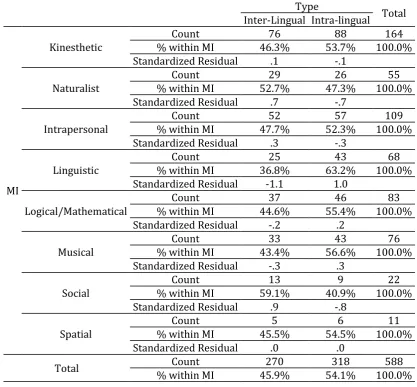
Table 17 displays the frequencies, percentages and standardized residual (Std. Residual) values for the inter-lingual and intra-lingual errors committed by students enjoying different intelligences. Unlike the former two indices, the Std. Residual is a standardized index based on which frequencies can be compared. Any Std. Residual higher than +/- 1.96 indicates significant differences between frequencies. As displayed below, none of these values were higher than +/- 1.96. Thus it can be claimed that there was not any significant relationship between multiple intelligences and types of errors in writing.
The results of chi-square (χ2 (7) = 5.29, p =.628, r =.094 representing a weak effect size) (Table 18) indicated that there was not any significant relationship between multiple intelligences and types of errors in writing. Thus the null-hypothesis was supported.
Type
Total Inter-Lingual Intra-lingual
MI
Kinesthetic
Count 76 88 164
% within MI 46.3% 53.7% 100.0%
Standardized Residual .1 -.1
Naturalist
Count 29 26 55
% within MI 52.7% 47.3% 100.0%
Standardized Residual .7 -.7
Intrapersonal
Count 52 57 109
% within MI 47.7% 52.3% 100.0%
Standardized Residual .3 -.3
Linguistic
Count 25 43 68
% within MI 36.8% 63.2% 100.0%
Standardized Residual -1.1 1.0
Logical/Mathematical
Count 37 46 83
% within MI 44.6% 55.4% 100.0%
Standardized Residual -.2 .2
Musical
Count 33 43 76
% within MI 43.4% 56.6% 100.0%
Standardized Residual -.3 .3
Social
Count 13 9 22
% within MI 59.1% 40.9% 100.0%
Standardized Residual .9 -.8
Spatial
Count 5 6 11
% within MI 45.5% 54.5% 100.0%
Standardized Residual .0 .0
Total Count 270 318 588
% within MI 45.9% 54.1% 100.0%
Table 18. Chi-Square Tests
Value df Asymptotic Significance (2-sided)
Pearson Chi-Square 5.262a 7 .628
Likelihood Ratio 5.291 7 .624
Linear-by-Linear Association .108 1 .742
N of Valid Cases 588
a. 0 cells (0.0%) have expected count less than 5. The minimum expected count is 5.05.
DISCUSSION AND CONCLUSION
The results of the present study will support those of Hegarty (2004) who found that creating documents that allow students to browse the information in any order was more useful than being constrained by the linear ordering of information in printed books.
This study confirmed the results of Mayer and Moreno (2002) who examined the role of animation visualization in multimedia learning including multimedia instructional messages and micro world games.
The impact of infographic provides interesting facts from the research on how teachers can impact the lives of students. The results of the study indicated that the use of infographic along with current teaching methodologies is effective in improving grammar learning of Iranian EFL learners. Participating in a class in which infographic instruction is predated helped learners improve their grammatical knowledge.
The results of this study proved that teaching grammar items while using infographic instruction would lead to better comprehension among EFL learners. Infographic instruction increased the motivation of learners to improve their grammatical knowledge as they experienced different ways to learn vocabulary items. In addition to the fact that infographic instruction was innovative for the participants of the study, it could provide opportunities for them to be more successful in their grammar learning. This study might have clarified some issues attributable to some infographic activities in terms of collaborative and cooperative learning techniques in addition to their effects on EFL learners’ language learning.
From theoretical point of view, this study represented an infographic instruction, i.e., integrating infographics into traditional teaching strategies, as one of the effective and interesting ways for improving grammatical knowledge of EFL learners. It also provides the best conditions for learners to learn grammatical points profoundly and to extend their knowledge of grammar.
The application of blended instruction, from a pedagogical point of view, presented helpful insights for EFL teachers, EFL learners and syllabus designers. Syllabus designers can also integrate software programs, such as the one constructed and applied in the present study, in their products to bring variety, create multipurpose productions, and prepare textbooks which do not need instructors and can be used in students’ self-studies.
The findings of this study would help the EFL teachers to get insights to design and adapt language learning materials for enhancing grammatical knowledge of participants. Furthermore, as the current grammar learning activities take the teacher’s energy and most of the class time, the task of grammar instruction could be presented through infographic instruction framework.
and responsibilities, and if their teacher tells them they have done a good job, they will develop the habit of working hard.
As the only type of MI in the current study which significantly influenced the participants’ writing performance with regard to the type of errors committed was LI, other scholars are highly recommended to investigate the relationship between LI and errors committed in writing or even put the relationship between LI and other language skills either productive ones or receptive ones under their investigation.
Another suggestion is replicating the research while focusing on elementary and advanced learners as the main focus of the current thesis was on intermediate learners. By so doing, one can ensure about the generalizability of the results even more as caution should be made regarding overgeneralizing the findings of the current study to beginners or advanced learners.
REFERENCES
Aripin, R. Mahmood, Z. Rohaizad, R. Yeop U. & Anuar. M. (2008, July 15). Students’
Learning Styles and Academic Performance. Paper presented at the 22nd Annual SAS Malaysia Forum, Kuala Lumpur.
Atkinson, R., Herrnstein, R., Lindzey, G., Duncan Luce, R. (1988). Stevens’ Handbook of
Experimental Psychology. Learning and Cognition. New York, NY: John Wiley and Sons.
Cowan, R. (2008). Teachers grammar of English with answers. Cambridge: Cambridge University Press.
Doughly, C. (2003). Instructed SLA: constrains, compensations, and enhancement. In M. Long and C. Doughty (Eds.). The hand book of second language acquisition (pp. 256-310). New York: Black Well.
Farhady, H. (1995). Research Method in Applied Linguistic. Tehran: Payamnoor university publisher.
Hasler, B. S., Kersten, B., & Sweller, J. (2007). Learner control, cognitive load and instructional animation. Applied Cognitive Psychology, 21, 713-729.
Hegarty, M. (2004). Dynamic visualizations and learning: Getting to the difficult questions. Learning and Instruction, 14(3), 343–351.
Hoffler, T. N., & Leutner, D. (2010). The role of spatial ability in learning from instructional animations-Evidence for an ability-as-compensator hypothesis.
Computers in Human Behavior, 4(2), 56-62.
Lim, D. H., & Morris, M. L. (2009). Learner and Instructional Factors Influencing Learning Outcomes within a Blended Learning Environment. Educational
Technology & Society, 12 (4), 282–293.
Mayer, R. E. & Chandler, P. (2001). When learning is just a click away: Does simple user interaction foster deeper understanding of multimedia messages? Journal of
Mayer, R. E. & Moreno, R. (2002). Aids to computer-based multimedia learning. Learning
and Instruction, 12, 107-119.
Moreno, R. (2007). Optimizing learning from animations by minimizing cognitive load: Cognitive and affective consequences of signaling and segmentation methods.
Applied Cognitive Psychology, 21, 765-781.
Murphy, R. (2011). English grammar in Use (3rd ed.). Cambridge: Cambridge University Press.
Stokes, D. (1997). Pasteur’s quadrant: Basic science and technological innovation. Washington, DC: Brookings Institution Press.
Tufte, E. (2001). Visual Explanations. Cheshire, CT: Graphics Press.