RESEARCH ARTICLE
Effects of temperature, time, and solvent
ratio on the extraction of phenolic compounds
and the anti-radical activity of
Clinacanthus
nutans
Lindau leaves by response surface
methodology
Intan Soraya Che Sulaiman
1*, Mahiran Basri
1*, Hamid Reza Fard Masoumi
1,3, Wei Jian Chee
1, Siti Efliza Ashari
1and Maznah Ismail
2Abstract
Background: Clinacanthus nutans Lindau is a well-known plant, native to tropical Asian countries. Reports on this plant that is rich in phenolic compounds have focused on its therapeutic anti-inflammatory, anti-herpes simplex, antioxidant, and anti-cancer characteristics. In this paper, the influence of the extraction parameters—temperatures (60–80 °C), times (80–120 min), and solvent ratios (70:30–90:10) of water:ethanol were investigated using response surface methodology in order to determine the optimum extraction conditions that could produce maximum extrac-tion yields of the phenolic compounds and the highest anti-radical activity of the C. nutans extract.
Results: The optimum conditions suggested by the predicted model were: an extraction temperature of 60 °C, an extraction time of 120 min and a water:ethanol solvent ratio of 90:10 v/v%. The residual standard error of 0.2% indi-cated that there was no significant difference between the actual and predicted values and it proved that the models were adequate to predict the relevant responses. All the independent variables had a significant effect (p < 0.05) on all the responses which indicated that all extraction parameters employed in this study were important in the opti-mization process. The R2 values for three responses, extraction yields, DPPH radical scavenging activity and TPC were 0.9999, 0.9999 and 0.9983 respectively, suggesting that the quadratic polynomial models developed were satisfacto-rily accurate to be used in analyzing the interactions of the parameters (response and independent variables). Conclusion: This study could be useful in the development of cosmeceutical products containing extracts of C. nutans.
Keywords: C. nutans, Central composite rotatable design (CCRD), Total phenolic content, 1,1-diphenyl-2-picrylhydrazyl (DPPH), Optimization, Anti-radical activity
© The Author(s) 2017. This article is distributed under the terms of the Creative Commons Attribution 4.0 International License (http://creativecommons.org/licenses/by/4.0/), which permits unrestricted use, distribution, and reproduction in any medium, provided you give appropriate credit to the original author(s) and the source, provide a link to the Creative Commons license, and indicate if changes were made. The Creative Commons Public Domain Dedication waiver (http://creativecommons.org/ publicdomain/zero/1.0/) applies to the data made available in this article, unless otherwise stated.
Background
Clinacanthus nutans Lindau (C. nutans) is a plant that is
commonly known in Malaysia as Sabah Snake Grass, and is widely used in folk medicine. Native to tropical Asian
countries such as Malaysia, Thailand and Singapore, C.
nutans has traditionally been used as an herbal remedy
for insect bites [1, 2], detoxification [3, 4], herpes zoster infections [5] and to reduce the progression of cancer
[6]. Numerous reports have documented the biological
activity of C. nutans, including its anti-viral [7–9], anti-inflammatory [10], antioxidant [11], antinociceptive [12], antiaging [13] and anti-cancer [14, 15] properties. Previ-ous investigations have established the presence of variPrevi-ous
Open Access
*Correspondence: [email protected]; [email protected]
1 Nanodelivery Group, Department of Chemistry, Faculty of Science,
polyphenols such as vitexin, isovitexin, shaftoside, isomol-lupentin-7-O-beta-glucopyranoside, orientin, isoorientin, kaempferol, sinapic acid, vanillin, quercetin, rutin trihy-drate, syringic acid, protocatechuic acid, 4-vinylphenol and 7-hydroxyflavone in the extracts of C. nutans leaves [14, 16–18]. The ethnomedicinal uses of the C. nutans plant, its chemical constituents and pharmacological properties associated to its therapeutic potential has been of much research focus [19–21]. Plant polyphenols have drawn increasing attention due to their potent antioxidant properties and their marked effects in the prevention of oxidative stresses [22, 23].
As plants survive in environments with massive expo-sure to ultraviolet radiation, they are perfect antioxidant sources due to their rich endogenous antioxidants [24]. In addition, most quality products formulated from nature-based ingredients have had excellent safety records in the marketplace, which has led to a growing interest in herbal formulations [24]. Due to their relative safety and wide acceptance, plant polyphenols have been incorporated into pharmaceuticals and cosmeceuticals as alternatives to synthetic antioxidants [25]. Moreover, antioxidants can enhance the biological functions of cells by virtue of their radical scavenging activities [26]. About 1.5–5% of our consumed oxygen is converted into reactive oxygen species (ROS). ROS are harmful free radicals that are constantly being produced as by-products in the electron transport chain of aerobic metabolism in the mitochon-dria [27]. The imbalanced production of ROS and anti-oxidative defense in the body can led to anti-oxidative stress which can result in serious cell damage [28]. Plant poly-phenols are an example of non-enzymatic antioxidants. They work by interrupting free radical chain reactions [29]. The antioxidant compounds react by binding to the free radicals, thus preventing them from reaching their biological target [29, 30]. As a result, polyphenols offer protection against various diseases which are caused by oxidative damage due to the harmful effects of ROS to the body [28].
Many factors can influence the efficiency of antioxidant phenolic extractions from the plant matrices. Due to the unstable nature of phenolic compounds, each phenolic source demands an individual approach for extraction and optimization [31]. No universal extraction technique is ideal due to the diversity of polyphenols [32]. There-fore, extraction conditions are important to maximize extraction yields and enrich the phenolic components. Several factors need to be considered when employing extraction techniques including the solvent types and ratios, extraction temperatures, extraction times, and solid to liquid ratios to ensure a complete extraction of the compounds of interest, while avoiding chemical modification [31, 33–35]. In practice, ethanol is often
more preferred for food and pharmaceutical processing compared to other solvents due to its safety and afford-ability [36, 37]. Previous investigations established that extractions with binary solvents or aqueous alcoholic mixtures contributed to high antioxidant capacities [38]. This could be explained by the inability of ethanol to extract 100% of the phenolic compounds, some of which are more water-soluble (hydrophilic). Therefore, the presence of water in the extraction eases the release of hydrophilic antioxidants [38]. Reflux extraction is a sim-ple, rapid, and economical technique for the extraction of antioxidant secondary metabolites from C. nutans which allows a better control of the extraction parameters such as extraction time, temperature and solvent ratio. Fur-thermore, extraction conditions play a critical role in pharmaceutical productions, especially for extracts that are produced in low yields [39].
Response surface methodology (RSM) is a systematic design for process development and optimization. It helps in evaluating the relative significance of variables that influence the process [40]. RSM is widely used to overcome classical optimization limitations which is time consuming, expensive and lacks data evaluation [41, 42].
There are no known optimization studies on the
extrac-tion of antioxidant compounds from C. nutans leaves.
The objective of this study is to optimize the extraction conditions (extraction temperature, extraction time, and solvent ratio) needed to extract the phenolic components
in C. nutans leaves and to determine the optimum
condi-tions for the maximum extraction yields and the highest anti-radical activity of the extracts.
Methods Materials
All the chemicals and reagents used were of analytical grade. Ethanol, 1,1-diphenyl-2-picrylhydrazyl (DPPH) and Folin–Ciocalteu phenol reagents were obtained from Sigma-Aldrich (Germany). Sodium carbonate (Na2CO3)
was purchased from Merck (Darmstadt, Germany). Dis-tilled water was purified in our laboratory.
Plant material
Fresh leaves of C. nutans were collected from a botanical farm in Jelebu, Negeri Sembilan, Malaysia in January 2014. The plant was authenticated by biologist Associate Prof. Dr. Rusea Go and the specimen voucher (RG5125) was depos-ited at the Herbarium Unit of Universiti Putra Malaysia.
Extraction
solid to liquid ratio of 1:10 (w/v) in a reflux system with a magnetic stirrer and a temperature-controlled water bath. All the experiments were performed in triplicate. After the reflux extraction, the samples were filtered, and concentrated using a rotary evaporator (Rotavapor R-210, Buchi, Switzerland) at approximately 60 °C, weighed and stored at −20 °C prior to further analysis.
Free radical scavenging activity (DPPH assay)
Radical scavenging activity was performed accord-ing to the protocol by Ramadan et al. [43]. A 0.2 mM methanolic solution of 1,1-diphenyl-2-picrylhydrazyl (DPPH) was freshly prepared. Initially, 0.6 ml of sample (2000 ppm) was mixed with 2.34 mL of DPPH solution. After being vortexed for 20 s, the resulting mixture was allowed to stand for 30 min in the dark. The UV–Visible absorbances of the reaction mixture were recorded at 515 nm using a spectrophotometer (Shimadzu UV-1601). Trolox was used as a standard and the DPPH scavenging activity of C. nutans extracts was expressed as an inhibi-tion percentage. The inhibiinhibi-tion percentage was calculated according to the following equation.
Determination of the total phenolic content (TPC)
The TPC of C. nutans extracts was determined according to Negi [44]. 0.5 mL of the sample was prepared in metha-nol and mixed with 2.5 mL of diluted Folin–Ciocalteu’s reagent (tenfold). 2 mL of 7.5% of Na2CO3 was added. The
mixture was allowed to stand for 30 min at room tem-perature before the absorbance was measured at 760 nm using a UV–Visible spectrometer (Shimadzu UV-1601).
Experimental design for the response surface procedure
A three-factor-five level central composite rotatable design (CCRD) was employed to determine the optimum extraction conditions of the C. nutans leaves. The inde-pendent variables selected in this study were extraction temperature (°C), extraction time (min) and solvent ratio (water: ethanol) (v/v%) toward the responses; extrac-tion yield (weight %), DPPH radical scavenging activity
(1)
%Inhibition
= (Absorbance of control−Absorbance of sample)
Absorbance of control ×100
(inhibition %) and total phenolic content (mg gallic acid equivalent/g extract). A total of 20 experiments were gen-erated using the Design Expert® software (Version 7, Stat. Ease Inc., Minneapolis, USA). Experiments with three independent variables consisting of eight factorial points, six axial, and six center points were carried out. Experi-ments were run randomly in order to minimize the effects of unexplained variability in the actual responses due to extraneous factors [45]. A summary of the independent variables and their coded levels are shown in Table 1.
Statistical analysis
Analysis of variance (ANOVA) was performed to deter-mine the significant differences between the independent variables. Reduced model (p < 0.05) and multiple regres-sions were employed in analyzing the experimental data. The design was expressed by polynomial regression as shown in Eq. 2.
where Y is the predicted response, β0 is constant, βi, βii and βij represent the regression coefficients for the
response surface model, xi and xj represent the
independ-ent variables and ε is the residual associated to the exper-iments [46]. Only non-significant (p < 0.05) values were involved in constructing a reduced model, while signifi-cant (p > 0.05) values were eliminated.
Verification of the models
In order to assess the adequacy of the constructed model, some random extractions were prepared to validate the model predictions. Actual values were compared with the predicted values to check the adequacy of the final reduced models. The percentage of the residual standard error (RSE) was calculated for each response.
Results and discussion
Model fitting and analysis of variance
RSM was employed with CCRD to investigate the effects of extraction temperature, extraction time and solvent ratio on the extraction yield, DPPH radical scavenging
(2)
Y =β0+ 3
�
i=1
βixi+ 3
�
i=1
βiixi2+ 2
�
i=1 3
�
j=i+1
βijxixj+ε
Table 1 Coded independent variables used in CCRD design
Symbol Independent variables Coded level
−1.68 −1 0 +1 +1.68
A Extraction temperature (°C) 53.18 60.00 70.00 80.00 86.82
B Extraction time (min) 66.36 80.00 100.00 120.00 133.64
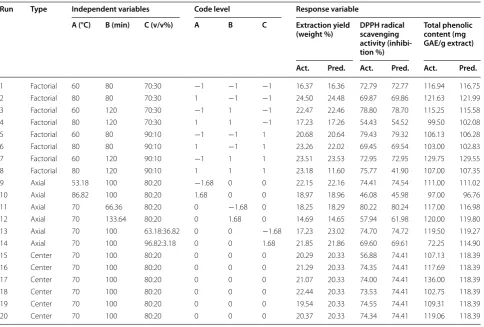
activity and total phenolic content (TPC) of the C. nutans leaves. Table 2 presents the design matrices of the actual experiments using CCRD and the predicted data for the response variables. The actual values of the response variables; extraction yields, DPPH scavenging activity, and TPC of C. nutans varied from 14.69–24.50% of dry weight, 46.08–80.22% inhibition and 72.25–136.00 mg GAE/g of the extracts, respectively.
By applying multiple regression analysis on the actual data, models for each of the three responses were expressed by the following quadratic polynomial model as shown in Eqs. 3–5 (Table 3). The generated equations
demonstrated the empirical relationship between the dependent and independent variables for each response. A statistical method based on ANOVA was used to obtain the coefficient of determination (R2) for the extraction
yields, DPPH scavenging activity and TPC responses which were 0.9999, 0.9999, and 0.9983, respectively. According to Jumbri et al. [47] and Hamzaoui et al. [48], a good fit with high correlation is achieved if the regression model has an R2 value of above 0.9. The R2 values obtained
indicated that more than 99% of the response variables (extraction yields, DPPH scavenging activity and TPC) could be described by the RSM model. The high values of
Table 2 Design matrices of actual and predicted values of extraction temperatures (A), extraction times (B) and solvent ratios (water: ethanol) (C) for the extraction conditions of C. nutans leaves using the CCRD design
Run Type Independent variables Code level Response variable A (°C) B (min) C (v/v%) A B C Extraction yield
(weight %) DPPH radical scavenging activity (inhibi-tion %)
Total phenolic content (mg GAE/g extract)
Act. Pred. Act. Pred. Act. Pred.
1 Factorial 60 80 70:30 −1 −1 −1 16.37 16.36 72.79 72.77 116.94 116.75
2 Factorial 80 80 70:30 1 −1 −1 24.50 24.48 69.87 69.86 121.63 121.99
3 Factorial 60 120 70:30 −1 1 −1 22.47 22.46 78.80 78.70 115.25 115.58
4 Factorial 80 120 70:30 1 1 −1 17.23 17.26 54.43 54.52 99.50 102.08
5 Factorial 60 80 90:10 −1 −1 1 20.68 20.64 79.43 79.32 106.13 106.28
6 Factorial 80 80 90:10 1 −1 1 23.26 22.02 69.45 69.54 103.00 102.83
7 Factorial 60 120 90:10 −1 1 1 23.51 23.53 72.95 72.95 129.75 129.55
8 Factorial 80 120 90:10 1 1 1 23.18 11.60 75.77 41.90 107.00 107.35
9 Axial 53.18 100 80:20 −1.68 0 0 22.15 22.16 74.41 74.54 111.00 111.02
10 Axial 86.82 100 80:20 1.68 0 0 18.97 18.96 46.08 45.98 97.00 96.76
11 Axial 70 66.36 80:20 0 −1.68 0 18.25 18.29 80.22 80.24 117.00 116.98
12 Axial 70 133.64 80:20 0 1.68 0 14.69 14.65 57.94 61.98 120.00 119.80
13 Axial 70 100 63.18:36.82 0 0 −1.68 17.23 23.02 74.70 74.72 119.50 119.27
14 Axial 70 100 96.82:3.18 0 0 1.68 21.85 21.86 69.60 69.61 72.25 114.90
15 Center 70 100 80:20 0 0 0 20.29 20.33 56.88 74.41 107.13 118.39
16 Center 70 100 80:20 0 0 0 21.29 20.33 74.35 74.41 117.69 118.39
17 Center 70 100 80:20 0 0 0 21.07 20.33 74.00 74.41 136.00 118.39
18 Center 70 100 80:20 0 0 0 22.44 20.33 73.53 74.41 102.75 118.39
19 Center 70 100 80:20 0 0 0 19.54 20.33 74.55 74.41 109.31 118.39
20 Center 70 100 80:20 0 0 0 20.37 20.33 74.34 74.41 119.06 118.39
Table 3 Quadratic polynomial equations for the three responses in terms of coded factors
In these equations, Y is the predicted response, A, B and C are the values of the independent variables, extraction temperature (°C), extraction time (min) and solvent ratio (water: ethanol) (v/v%), respectively
Responses Equations
Extraction yield Y=20.33−0.95A−1.08B−0.35C−3.33AB−1.68AC−0.80BC+0.082A2 −1.36B2
+0.75C2 (3) DPPH radical scavenging activity Y=74.41−8.49A−5.43B−1.52C−5.32AB−1.72AC−3.08BC−5.01A2−1.17B2−0.80C2 (4)
TPC Y=118.39−4.24A+0.84B−1.30C−4.69AB−2.17AC+6.11BC−5.13A2
−0.0027B2
R2 for each response indicated that the CCRD design fitted
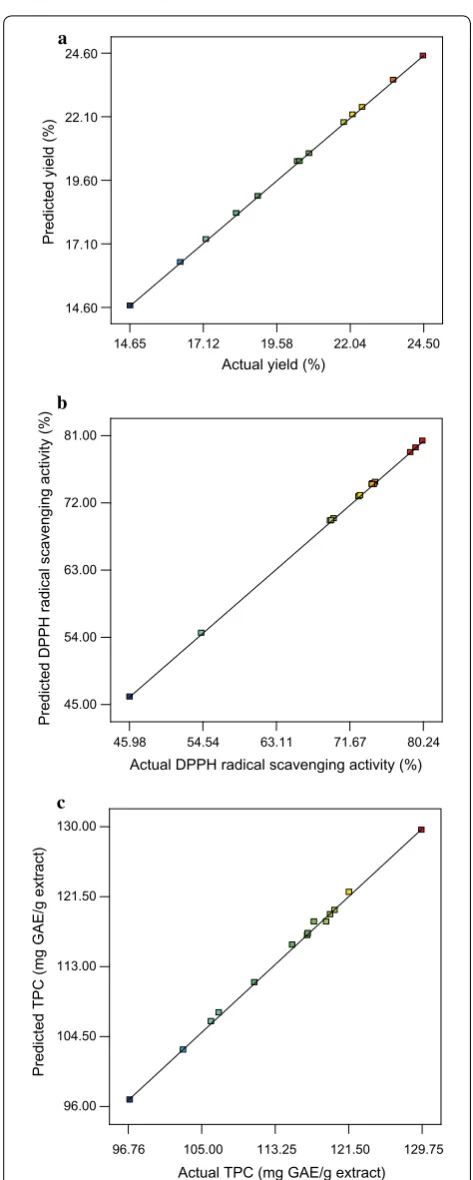
well into the quadratic polynomial models that were devel-oped. These results confirmed the predictability of the models in determining the optimum conditions needed to obtain the highest antioxidant activity and maximum extraction yields of the C. nutans leaves extracts (Fig. 1).
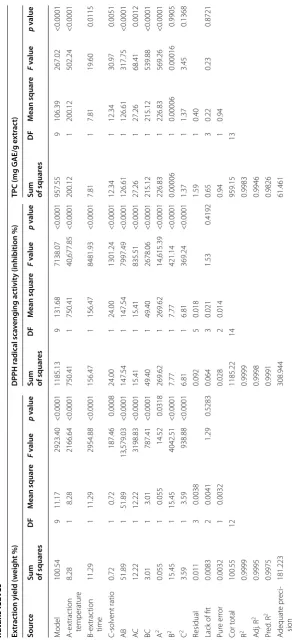
Table 4 represents the regression analysis and ANOVA employed in the model fitting design in order to exam-ine the statistical significance of the terms for all the responses. A number of runs in each response; extraction yields (6, 8, 13, 16, 17, 18 and 19), DPPH scavenging activ-ities (8, 12, 15, 17, and 18) and TPC (4, 14, 15, 17, 18, and 19) were defined as missing independent variables (outli-ers) and were therefore not applied in the model design. The F values of 2923.40, 7138.07 and 267.02 for extraction yields, DPPH scavenging activity, and TPC respectively, indicated that all the models were significant. There was only a 0.01% chance that the values could be attributed to noise. The probability (p value) was relatively low in all the model responses (<0.0001), which was less than 0.05, indi-cating the significance of the models. A large F value and small p value is indicative that the independent variables have a significant impact on the respective response vari-ables [49]. ANOVA revealed that all the independent vari-ables had a significant effect (p < 0.05) on all responses. The extraction temperature had the most significant effect on all the responses (p < 0.0001). This was followed by the extraction time which had a significant value of p < 0.0001 towards both extraction yields and DPPH scavenging activity whereas a value of p = 0.0115 was obtained for TPC. Likewise, solvent ratio exhibited significant effects on DPPH scavenging activity (p < 0.0001), extraction yields (p = 0.0008) and TPC (p = 0.0051).
The predicted R-square (Pre. R2) value indicates how
well a regression model predicts response values; while the adjusted R-square (Adj. R2) indicates the
descrip-tive power of the regression models while including the diverse numbers of variables. Every variable added to a model will increase the R2 value, regardless of statistical
significance. Therefore, considering the Adj. R2 value is
important to evaluate the adequacy of the model because the value tally only increases if the variables enhance the model beyond what would normally be obtained by prob-ability. According to Koocheki et al. [50], Adj. R2 values
above 0.9 may be used to indicate the adequacy of the model. Furthermore, a difference of less than 0.2 between Adj. R2 and Pre. R2 demonstrates the effectiveness of the
model. In this study, the Adj. R2 values were found to be
0.9995, 0.9998 and 0.9946 for extraction yields, DPPH scavenging activity, and TPC of C. nutans respectively and thus, the difference in values of Adj. R2 and Pre. R2
for all the responses was less than 0.2.
Actual yield (%)
Predicted yield (%)
14.60 17.10 19.60 22.10 24.60
14.65 17.12 19.58 22.04 24.50
Actual DPPH radical scavenging activity (%) Predicted DPPH radical scavenging activity (%) 45.00
54.00 63.00 72.00 81.00
45.98 54.54 63.11 71.67 80.24
Actual TPC (mg GAE/g extract)
Predicted TPC (mg GAE/g extract)
96.00 104.50 113.00 121.50 130.00
96.76 105.00 113.25 121.50 129.75 a
b
c
Fig. 1 Comparison between predicted and actual values of the
Table 4 ANO VA f or the quadr atic p olynomial mo dels de velop ed f or the r esp onse v ariables; e xtr ac tion yields
, DPPH r
adic al sc av enging ac tivit y and TPC of C. nut ans lea ves DF
is the deg
ree of fr
eedom,
A
is the e
xtr ac tion t emper atur e, B
is the e
xtr
ac
tion time
,
C
is the solv
en t r atio (w at er : ethanol) Ex tr ac
tion yield (w
eigh t %) DPPH r adical sca veng ing ac tivit
y (inhibition %)
TPC (mg GAE/g e
xtr
ac
t)
So
urce
Sum of squar
es DF M ean squar e F v alue p v alue
Sum of squar
es DF M ean squar e F v alue p v alue
Sum of squar
es DF M ean squar e F v alue p v alue M odel 100.54 9 11.17 2923.40 <0.0001 1185.13 9 131.68 7138.07 <0.0001 957.55 9 106.39 267.02 <0.0001 A-ex trac tion temperatur e 8.28 1 8.28 2166.64 <0.0001 750.41 1 750.41 40,677.85 <0.0001 200.12 1 200.12 502.24 <0.0001 B-ex trac tion time 11.29 1 11.29 2954.88 <0.0001 156.47 1 156.47 8481.93 <0.0001 7.81 1 7.81 19.60 0.0115 C-solv ent ratio 0.72 1 0.72 187.46 0.0008 24.00 1 24.00 1301.24 <0.0001 12.34 1 12.34 30.97 0.0051 AB 51.89 1 51.89 13,579.03 <0.0001 147.54 1 147.54 7997.49 <0.0001 126.61 1 126.61 317.75 <0.0001 AC 12.22 1 12.22 3198.83 <0.0001 15.41 1 15.41 835.51 <0.0001 27.26 1 27.26 68.41 0.0012 BC 3.01 1 3.01 787.41 <0.0001 49.40 1 49.40 2678.06 <0.0001 215.12 1 215.12 539.88 <0.0001 A 2 0.055 1 0.055 14.52 0.0318 269.62 1 269.62 14,615.39 <0.0001 226.83 1 226.83 569.26 <0.0001 B 2 15.45 1 15.45 4042.51 <0.0001 7.77 1 7.77 421.14 <0.0001 0.00006 1 0.00006 0.00016 0.9905 C 2 3.59 1 3.59 938.88 <0.0001 6.81 1 6.81 369.24 <0.0001 1.37 1 1.37 3.45 0.1368 Residual 0.011 3 0.0038 0.092 5 0.018 1.59 1 0.40
Lack of fit
0.0083 2 0.0041 1.29 0.5283 0.064 3 0.021 1.53 0.4192 0.65 3 0.22 0.23 0.8721 Pur e er ror 0.0032 1 0.0032 0.028 2 0.014 0.94 1 0.94 Cor t otal 100.55 12 1185.22 14 959.15 13 R 2 0.9999 0.9999 0.9983 A dj
. R
The validity of the models was also confirmed using the Lack of Fit analysis, where an insignificant p value of more than 0.05 was indicative that the model could accurately fit with the actual data [51]. The results of this study showed that the lack of fit p value for extraction yields, DPPH scavenging activity and TPC were 0.5283, 0.4192 and 0.8721, respectively, indicating that all the developed quadratic polynomial models were reliable and accurate for predicting the relevant responses.
Effects of the parameters
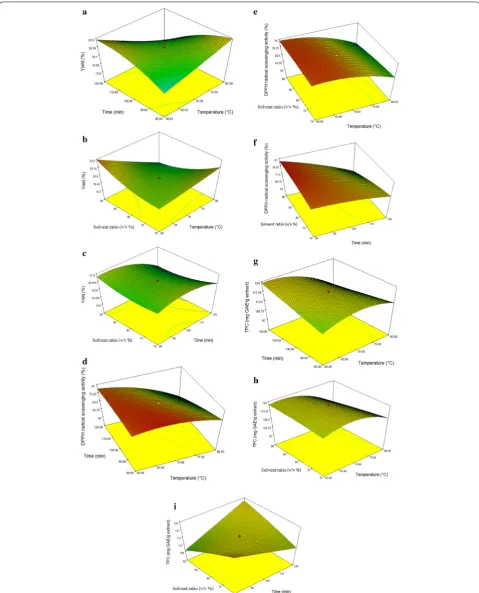
As shown in Fig. 2, extraction times, extraction tempera-tures and solvent ratios were interpreted in the ranges of 80–120 min, 60–80 °C and 70:30–90:10 (water: ethanol), respectively. The confidence interval for each response was 95% in the mentioned ranges on the plots. At a con-stant water to ethanol ratio (80:20), the extraction yield was found to be the highest under two conditions; a max-imum temperature of 80 °C at a minmax-imum time of 80 min and a minimum temperature of 60 °C at a maximum time of 120 min (Fig. 2a). Theoretically, under high tem-peratures, plant tissues are softened and the weak inter-actions affect the cell membranes. As a result, phenolic compounds can be easily extracted into the solvent [52]. However, a prolonged extraction time at 80 °C decreases the extraction yield because the high temperature causes the oxidation and degradation of the desired compounds [53, 54]. Conversely, by keeping the temperature at a minimum level (60 °C) for a maximum extraction time period of 120 min produced the highest yields. Hence, a prolonged exposure of the sample in the solvent, allowed sufficient time for the desired compounds to migrate into the solvent.
Figure 2b represents the effect of extraction tempera-tures and solvent ratios on the extraction yields. The response surface plot was generated with an extraction time fixed at 100 min. The highest yield (23.5%) was obtained at a solvent ratio of 90:10 (water: ethanol) at 60 °C. Increasing the water content in the solvent system caused swelling in the plant material which resulted in increased contact between the plant matrix and the sol-vent, thus contributing to an increased yield [36]. How-ever, increasing the temperature to 80 °C significantly decreased the yield since the compounds are heat-sen-sitive. In contrast, at a similar temperature (80 °C) using a different solvent system (70:30), greater yields were obtained. Thus, the extracted compounds from C. nutans leaves could be classified into two dominant groups: the polar, water-rich compounds which were heat sensitive, and the less polar compounds that could tolerate high temperatures.
Figure 2c illustrates the effect of solvent ratios and extraction times on the yields. At a fixed temperature of
70 °C, an increase in extraction time slightly decreased the yield. The highest yield was approximately 21.9% at a solvent ratio of 90:10 (water: ethanol) and an extraction time of 80 min. Solvent ratios alone had little effect on the yield.
Figure 2d shows the interaction between extraction
times and temperatures on DPPH radical scavenging activity. The lowest percentage of DPPH radical scav-enging activity was observed at extraction conditions of 80 °C and 120 min at a fixed solvent ratio of 80:20 (water: ethanol). Similar observations were noted in Fig. 2a, g, where long exposure times of the samples at high tem-peratures produced lower yields. This could be due to the decomposition of the antioxidant compounds associated with the phenolic compounds. The lowest total phenolic
content was attained under high heat (Fig. 2g). Most
phenolic compounds are heat-sensitive and easily oxi-dized [55, 56], hence a upper limit temperature must be observed to preserve its useful components. At a similar extraction time of 120 min but with a minimum extrac-tion temperature of 60 °C, DPPH radical scavenging activity was observed to be greater (72.25%). A decrease in extraction time had little effect on the DPPH radi-cal scavenging activity. A similar trend was observed in Fig. 2e, where DPPH radical scavenging activity was not affected by the solvent ratio if the extraction process was conducted at the same temperature (60 °C).
DPPH radical scavenging activity under different solvent ratios and extraction times at a constant tem-perature of 70 °C is presented in Fig. 2f. The lowest percentage of DPPH radical scavenging activity was obtained at a solvent ratio of 90:10 (water: ethanol) using a prolonged extraction time of 120 min. As the extrac-tion time decreased, the DPPH radical scavenging activ-ity was greatly increased until the highest activactiv-ity was reached, at above 76.25% using the same solvent ratio (90:10) but with a minimum extraction time of 80 min. Decreasing the water ratio to 70:30 (water: ethanol) led to a slight decrease in the DPPH radical scavenging activity.
According to Saito and Kawabata [57] and Sharma and
Bhat [58], in addition to pH and the chemical structure of the radical scavenger, DPPH radical scavenging activ-ity could also be influenced by the polaractiv-ity of the reaction medium. A water-rich solvent system (90:10) increased the antioxidant activity, which suggested that the samples were rich in antioxidant compounds.
Fig. 2 Response surface plots; a–c the interaction effect of extraction yield as a function of extraction temperature, extraction time and solvent ratio, d–f the interaction effect of DPPH radical scavenging activity as a function of extraction temperature, extraction time and solvent ratio and
recorded in Fig. 2a, g, and this can be attributed to the heat-sensitive properties of some phenolic compounds.
Figure 2i depicts the TPC values with respect to solvent ratios and extraction times at a fixed extraction tempera-ture of 70 °C. An increase in the extraction time slightly decreased the TPC value at a solvent ratio of 70:30 (water: ethanol). However, at a solvent ratio of 90:10 (water: etha-nol), the TPC value increased to 121 mg GAE/g extract per time increment. A comparison of DPPH radical scaveng-ing activity and TPC values in Fig. 2f, i for runs conducted using a solvent ratio of 90:10 at 80 min, indicated that DPPH radical scavenging activity was at its highest while TPC value was at its lowest. It is possible that the phenolic groups had no effect on the anti-radical activity measured by the DPPH radical scavenging activity assay in the stated region but other groups of antioxidant contributors had an effect. Previous investigations on C. nutans have estab-lished the presence of numerous potential antioxidant constituents such as fatty acids (i.e. linoleic acid, stearic acid, oleic acid, palmitic acid, myristic acid) [14], lupeol, stigmasterol, beta-sitosterol [59], chlorophylls [1] and sul-fur-containing glucosides (i.e. Clinacoside A, Clinacoside B, Clinacoside C, Cycloclinacoside A1, Cycloclinacoside A2 and Triacetylcycloclinacoside A2) [60] that could be involved in neutralizing free radical damage.
Verification of the models
In order to determine the adequacy of the final model, three randomized validation sets were performed to verify the models (Table 5). The results were compared to predicted values by calculating the RSE percentages
(Eq. 6). RSE values lower than ±5 were considered to
be agreement with the predicted values. The RSE values obtained indicated no significant differences between
the actual and predicted values, proving that the models were adequate.
Optimized conditions of the extraction parameters
Optimized conditions for the simultaneous maximum extraction yields, DPPH radical scavenging activity and TPC were determined. From CCRD analysis, the opti-mized conditions using an extraction temperature of 60 °C, an extraction time of 120 min, and a solvent ratio (water: ethanol) of 90:10 v/v% could produce the opti-mum extraction yields, DPPH radical scavenging activity and TPC of 23.51, 72.95% and 129.75 mg GAE/g extract,
respectively. Table 6 shows the predicted and actual
response values for the optimized conditions. Under optimum conditions, the actual responses showed that the models were in good agreement with the predicted values with RSE values of less than 0.2%.
The range of parameters was selected based on our pre-liminary studies (data is not shown). Considering the need to minimize the costs of actual production, it is reasonable to estimate the economic conditions that are required in order to allow minimum energy and solvent consumption but at the same time, achieving the desired output. Thus, the extraction conditions of the C. nutans leaves from this study were obtained by limiting the extraction parameters to a temperature range of 60–80 °C for 80–120 min and a water-rich ratio of water to ethanol 70:30–90:10 v/v%. Water remains the cheapest and safest, eco-friendly sol-vent to extract bioactive substances such as polyphenols,
polysaccharides, proteins and glycosides [61]. Among
these water-soluble (hydrophilic) compounds, some have
(6) Residual standard error(%)
= (
Actual value−Predicted value)
Predicted value ×100
Table 5 Predicted and actual response values for the verification model
Set Extraction
tem-perature (°C) Extraction time (min) Solvent ratio (water: ethanol) (v/v %)
Extraction yield (%) DPPH radical
scaveng-ing activity (%) Total phenolic content (mg GAE/g extract) Act.
value Pred. value RSE (%) Act. value Pred. value RSE (%) Act. value Pred. value RSE (%)
1 75 100 80:20 19.82 19.87 0.26 70.27 68.92 1.96 117.75 114.99 2.40
2 70 100 75:25 20.69 20.69 0 73.7 74.98 1.70 116.88 118.93 1.72
3 70 100 83:17 20.18 20.29 0.55 71.28 73.89 3.53 115.25 117.69 2.30
Table 6 Predicted and actual response values for the optimized extraction parameters
Parameter no. Responses Actual value Predicted value RSE (%)
1 Extraction yield (%) 23.51 23.53 0.09
2 DPPH radical scavenging activity (%) 72.95 72.95 0
shown good potential as free-radical scavengers and anti-oxidant agents [61]. The temperature was limited to 80 °C to preserve the useful components in the C. nutans leaves because above this temperature, the phenolic compounds are subject to decomposition. Although, one must bear in mind that the limitations of TPC assay include poor speci-ficity and that antioxidant activity can be influenced by any substance that can be oxidized by the Folin reagent, not only just polyphenols [62]. There are other variations to extraction parameters that can be used for the extraction of plant extracts. Thus, the selection of parameters employed in this study was focused on hydrophilic antioxidants.
Conclusions
This study demonstrated that RSM is an effective tool for optimizing the extraction conditions of C. nutans leaves and allows a better understanding of the relation-ship between independent variables and response vari-ables. The model was verified statistically with ANOVA. Under the optimum conditions, the actual values were in good agreement with the predicted values as RSE values for the optimum conditions were less than 0.2%. All the independent variables had a significant effect (p < 0.05) on all the responses which indicated that all extraction parameters employed in this study were important in the optimization process. The R2 values for three responses,
extraction yields, DPPH radical scavenging activity and TPC were 0.9999, 0.9999 and 0.9983 respectively, sug-gesting that the quadratic polynomial models developed were satisfactorily accurate to be used in analyzing the interactions of the parameters (response and independ-ent variables). The optimum conditions generated from RSM (an extraction temperature of 60 °C, an extraction time of 120 min, and a solvent ratio (water: ethanol) of 90:10 v/v%) could be used for future upscale extrac-tions of C. nutans leaves by considering the temperature, extraction time, and solvent ratio for economical evalu-ation. This study could be useful in the development of cosmeceutical products containing extracts of C. nutans.
Abbreviations
RSM: response surface methodology; CCRD: central composite rotatable design; DPPH: 1,1-diphenyl-2-picrylhydrazyl; C. nutans: Clinacanthus nutans; Na2CO3: sodium carbonate; ANOVA: analysis of variance; R2: determined
coef-ficient; Pre. R2: predicted R-square; Adj. R2: adjusted R-square; DF: degrees of
freedom; A: extraction temperature; B: extraction time; C: solvent ratio (water: ethanol); TPC: total phenolic content; GAE: gallic acid equivalent; RSE: residual standard error.
Authors’ contributions
ISCS and WJC had prominent roles in the implementation of the experimental section and the writing of the manuscript. MB supervised and funded the entire project. HRFM taught and also performed the statistical analysis. SEA and MI assisted in solving problems that arose in the implementation of this work and also in the scientific editing of the manuscript. All authors read and approved the final manuscript.
Author details
1 Nanodelivery Group, Department of Chemistry, Faculty of Science, Universiti
Putra Malaysia, 43400 Serdang, Selangor, Malaysia. 2 Laboratory of Molecular
Biomedicine, Institute of Bioscience, Universiti Putra Malaysia, 43400 Serdang, Selangor, Malaysia. 3 Department of Biomaterials, Iran Polymer and
Petro-chemical Institute, Tehran, Iran.
Acknowledgements
We acknowledge financial support from Universiti Putra Malaysia in terms of a GP-IPS research grant (Vote. No GP-IPS/2014/9438735).
Competing interests
The authors declare that they have no competing interests.
Publisher’s Note
Springer Nature remains neutral with regard to jurisdictional claims in pub-lished maps and institutional affiliations.
Received: 21 January 2017 Accepted: 7 June 2017
References
1. Sakdarat S, Shuyprom A, Pientong C et al (2009) Bioactive constituents from the leaves of Clinacanthus nutans Lindau. Bioorganic Med Chem 17:1857–1860
2. P’ng X, Akowuah G, Chin J (2012) Acute oral toxicity study of Clinacanthus nutans in mice. Int J Pharm Sci Res 3:4202–4204
3. Siew YY, Zareisedehizadeh S, Seetoh WG et al (2014) Ethnobotanical survey of usage of fresh medicinal plants in Singapore. J Ethnopharmacol 155:1450–1466
4. Uawonggul N, Chaveerach A, Thammasirirak S et al (2006) Screening of plants acting against Heterometrus laoticus scorpion venom activity on fibroblast cell lysis. J Ethnopharmacol 103:201–207
5. Charuwichitratana S, Wongrattanapasson N, Timpatanapong P, Bunjob M (1996) Herpes zoster: treatment with Clinacanthus nutans cream. Int J Dermatol 35:665–666
6. Farooqui M, Hassali MA, Shatar AKA et al (2016) Use of complementary and alternative medicines among Malaysian cancer patients: a descrip-tive study. J Tradit Complement Med 6(4):321–326
7. Kunsorn P, Ruangrungsi N, Lilipun V et al (2013) The identities and anti-herpes simplex virus activity of Clinacanthus nutans and Clinacanthus siamensis. Asian Pac J 3:284–290
8. Yoosook C, Panpisutchai Y, Chaichana S et al (1999) Evaluation of anti-HSV-2 activities of Barleria lupulina and Clinacanthus nutans. J Ethnophar-macol 67:179–187
9. Direkbusarakom S, Ruangpan L, Ezura Y, Yoshimizu M (1998) Protective efficacy of Clinacanthus nutans on yellow-head disease in black tiger shrimp (Penaeus monodon). Fish Pathol 33:401–404
10. Wanikiat P, Panthong A, Sujayanon P et al (2008) The anti-inflam-matory effects and the inhibition of neutrophil responsiveness by
Barleria lupulina and Clinacanthus nutans extracts. J Ethnopharmacol 116:234–244
11. Yuann JMP, Wang JS, Jian HL et al (2012) Effects of Clinacanthus nutans
(Burm. f ) Lindau leaf extracts on protection of plasmid DNA from ribofla-vin photoreaction. MC-Trans Biotechnol 4:45–58
12. Abdul Rahim MH, Zakaria ZA, Mohd Sani MH et al (2016) Methanolic extract of Clinacanthus nutans exerts antinociceptive activity via the opi-oid/nitric oxide-mediated, but cGMP-independent, pathways. Evid Based Complement Altern Med 2016:1–11
13. Che Sulaiman IS, Basri M, Fard Masoumi HR et al (2017) Predicting the optimum compositions of a transdermal nanoemulsion system contain-ing an extract of Clinacanthus nutans leaves (L.) for skin antiaging by artificial neural network model. J Chemom. doi:10.1002/cem.2894 14. Che Sulaiman IS, Basri M, Chan KW et al (2015) In vitro antioxidant,
15. Yong YK, Tan JJ, Teh SS et al (2013) Clinacanthus nutans extracts are anti-oxidant with antiproliferative effect on cultured human cancer cell lines. Evid Based Complement Altern Med 2013:1–8
16. Teshima K, Kaneko T, Ohtani K et al (1997) C-glycosyl flavones from Clina-canthus. Nat Med 51:557
17. Mustapa AN, Martin Á, Mato RBB, Cocero MJ (2015) Extraction of phy-tocompounds from the medicinal plant Clinacanthus nutans Lindau by microwave-assisted extraction and supercritical carbon dioxide extrac-tion. Ind Crops Prod 74:83–94
18. Chelyn JL, Omar MH, Mohd Yousof NSA et al (2014) Analysis of flavone C-glycosides in the leaves of Clinacanthus nutans (Burm. f.) Lindau by HPTLC and HPLC-UV/DAD. Sci World J 2014:1–6
19. Zulkipli IN, Rajabalaya R, Idris A et al (2017) Clinacanthus nutans: a review on ethnomedicinal uses, chemical constituents and pharmacological properties. Pharm Biol 55:1093–1113
20. Da Tsai H, Wu JS, Kao MH et al (2016) Clinacanthus nutans protects cortical neurons against hypoxia-induced toxicity by downregulating HDAC1/6. Neuromol Med 18:274–282
21. Huang D, Li Y, Cui F et al (2016) Purification and characterization of a novel polysaccharide-peptide complex from Clinacanthus nutans Lindau leaves. Carbohydr Polym 137:701–708
22. Dai J, Mumper RJ (2010) Plant phenolics: extraction, analysis and their antioxidant and anticancer properties. Molecules 15:7313–7352 23. Maestri DM, Nepote V, Lamarque A, Zygadlo J (2006) Natural products as
antioxidants. In: Imperato F (ed) Phytochemistry advances in research. Research Signpost, Trivandrum, pp 105–135
24. Draelos ZD (2009) Cosmeceuticals: undefined, unclassified, and unregu-lated. Clin Dermatol 27:431–434
25. Mota I, Pinto PR (2012) Extraction of polyphenolic compounds from Euca-lyptus globulus bark: process optimization and screening for biological activity. Ind Eng Chem Res 51:6991–7000
26. Jayaprakasha GK, Girennavar B, Patil BS (2008) Radical scavenging activi-ties of Rio Red grapefruits and sour orange fruit extracts in different in vitro model systems. Bioresour Technol 99:4484–4494
27. Casteilla L, Rigoulet M, Penicaud L (2001) Mitochondrial ROS metabolism: modulation by uncoupling proteins. IUBMB Life 52:181–188
28. Irshad M, Chaudhuri PS (2002) Oxidant-antioxidant system: role and significance in human body. Indian J Exp Biol 40:1233–1239
29. Nimse SB, Pal D (2015) Free radicals, natural antioxidants, and their reac-tion mechanisms. RSC Adv 5:27986–28006
30. Poljšak B, Dahmane RG, Godić A (2012) Intrinsic skin aging: the role of oxidative stress. Acta Dermatovenerol Alp Pannonica Adriat 21:33–36 31. Majeed M, Hussain AI, Chatha SAS et al (2016) Optimization protocol
for the extraction of antioxidant components from Origanum vulgare
leaves using response surface methodology. Saudi J Biol Sci 23:389–396 32. Silva EM, Rogez H, Larondelle Y (2007) Optimization of extraction of
phenolics from Inga edulis leaves using response surface methodology. Sep Purif Technol 55:381–387
33. Lee JW, Mo EJ, Choi JE et al (2016) Effect of Korean Red Ginseng extrac-tion condiextrac-tions on antioxidant activity, extracextrac-tion yield, and ginsenoside Rg1 and phenolic content: Optimization using response surface method-ology. J Ginseng Res 40(3):229–236
34. Hammi KM, Jdey A, Abdelly C et al (2015) Optimization of ultrasound-assisted extraction of antioxidant compounds from Tunisian Zizyphus lotus fruits using response surface methodology. Food Chem 184:80–89 35. Wu X, Yu X, Jing H (2011) Optimization of phenolic antioxidant
extrac-tion from wuweizi (Schisandra chinensis) pulp using random-centroid optimazation methodology. Int J Mol Sci 12:6255–6266
36. Hemwimon S, Pavasant P, Shotipruk A (2007) Microwave-assisted extrac-tion of antioxidative anthraquinones from roots of Morinda citrifolia. Sep Purif Technol 54:44–50
37. Guo Z, Jin Q, Fan G et al (2001) Microwave-assisted extraction of effective constituents from a Chinese herbal medicine Radix puerariae. Anal Chim Acta 436:41–47
38. Thoo YY, Ho SK, Liang JY et al (2010) Effects of binary solvent extraction system, extraction time and extraction temperature on phenolic antioxi-dants and antioxidant capacity from mengkudu (Morinda citrifolia). Food Chem 120:290–295
39. Aziz R, Sarmidi M, Kumaresan S et al (2003) Phytochemical processing: the next emerging field in chemical engineering—aspects and opportu-nities. J Kejuruter Kim Malays 3:45–60
40. Asfaram A, Ghaedi M, Goudarzi A et al (2015) Magnetic nanoparticle based dispersive micro-solid-phase extraction for the determination of malachite green in water samples: optimized experimental design. New J Chem 39:9813–9823
41. Myers R, Montgomery D (2004) Response surface methodology: a retro-spective and literature survey. J Qual Technol 36:53–77
42. Amado IR, Franco D, Sánchez M et al (2014) Optimisation of antioxi-dant extraction from Solanum tuberosum potato peel waste by surface response methodology. Food Chem 165:290–299
43. Ramadan M, Kroh L, Mörsel J (2003) Radical scavenging activity of black cumin (Nigella sativa L.), coriander (Coriandrum sativum L.), and niger (Guizotia abyssinica Cass.) crude seed oils and oil. J Agric Food Chem 51:6961–6969
44. Negi PS (2012) Plant extracts for the control of bacterial growth: efficacy, stability and safety issues for food application. Int J Food Microbiol 156:7–17 45. Ngan CL, Basri M, Lye FF et al (2014) Comparison of Box-Behnken and
central composite designs in optimization of fullerene loaded palm-based nano-emulsions for cosmeceutical application. Ind Crops Prod 59:309–317
46. Bezerra MA, Santelli RE, Oliveira EP et al (2008) Response surface meth-odology (RSM) as a tool for optimization in analytical chemistry. Talanta 76:965–977
47. Jumbri K, Al-Haniff Rozy MF, Ashari SE et al (2015) Optimisation and characterisation of lipase catalysed synthesis of a kojic monooleate ester in a solvent-free system by response surface methodology. PLoS ONE 10:e0144664
48. Hamzaoui AH, Jamoussi B, M’nif A (2008) Lithium recovery from highly concentrated solutions: response surface methodology (RSM) process parameters optimization. Hydrometallurgy 90:1–7
49. Tan SF, Masoumi HRF, Karjiban RA et al (2016) Ultrasonic emulsifica-tion of parenteral valproic acid-loaded nanoemulsion with response surface methodology and evaluation of its stability. Ultrason Sonochem 29:299–308
50. Koocheki A, Taherian AR, Razavi SMA, Bostan A (2009) Response surface methodology for optimization of extraction yield, viscosity, hue and emulsion stability of mucilage extracted from Lepidium perfoliatum seeds. Food Hydrocoll 23:2369–2379
51. Montgomery DC (2013) Response surface methods and design. In: Mel-horn A (ed) Design and analysis of experiments, 8th edn. Wiley, New York, pp 478–544
52. Shi J, Yu J, Pohorly J et al (2003) Optimization of the extraction of poly-phenols from grape seed meal by aqueous ethanol solution. J Food Agric Environ 1:42–47
53. Naczk M, Shahidi F (2004) Extraction and analysis of phenolics in food. J Chromatogr A 1054:95–111
54. Silva EM, Souza JNS, Rogez H et al (2007) Antioxidant activities and poly-phenolic contents of fifteen selected plant species from the Amazonian region. Food Chem 101:1012–1018
55. Robards K (2003) Strategies for the determination of bioactive phenols in plants, fruit and vegetables. J Chromatogr A 1000:657–691
56. Khoddami A, Wilkes MA, Roberts TH (2013) Techniques for analysis of plant phenolic compounds. Molecules 18:2328–2375
57. Saito S, Kawabata J (2005) Effects of electron-withdrawing substituents on DPPH radical scavenging reactions of protocatechuic acid and its analogues in alcoholic solvents. Tetrahedron 61:8101–8108 58. Sharma O, Bhat T (2009) DPPH antioxidant assay revisited. Food Chem
113:1202–1205
59. Dampawan P, Huntrakul C, Reutrakul V (1977) Constituents of Clinacan-thus nutans and the crystal structure of LUP-20 (29)-ene-3-one. J Sci Soc Thail 3:14–26
60. Teshima K-I, Kaneko T, Ohtani K et al (1998) Sulfur-containing glucosides from Clinacanthus nutans. Phytochemistry 48:831–835
61. Meng L, Lozano Y (2014) Innovative technologies used at pilot plant and industrial scales in water-extraction process. In: Chemat F, Vian MA (eds) Alternative solvents for natural products extraction. Springer, Berlin, pp 269–315