From Solution Shop to Boutique Consulting? Capturing Recent
Developments on the German Consulting Market
Jörg Jasper DÖTSCH Andrássy University
Pollack Mihály tér 3, 1088, Budapest, Hungary [email protected]
Abstract. Digitalization, globalization, new technologies and shorter product life
cycles are only a few keywords underlining the fact that companies are under increasing pressure for faster adaptation, innovation and hence applying a higher knowledge intensity. We assume that these conditions require an increasingly important role of consulting companies, because they seem to be the intermediaries needed to bridge the faster growing gaps between existing business models, organizational structures and accelerating market change. Market pressure is growing on the market for consultant companies as well. New technologies and digitalization should influence both the structure of the consultancy market and the business models of consultancies. Christensen suggested a trend from “solution shop” to “boutique consulting”.To track current developments, we concentrate on the German consulting market as one of the most important consultant markets worldwide and explore changes of the last two years based on various studies. Processes of change seem to be both substantially driven by digitalization and to reflect change on the non-consultancy markets. A high willingness to switch among providers documents a high pressure on performance. The impact of digitalisation seems to be observable in structural and qualitative change. With regard to the German consulting market and the latest available data we cannot validate a tendency from a dominance of “solution shop” consultancies to “boutique” consultancy services.
Keywords: knowledge economy, knowledge intensity, consulting.
Introduction
Consulting Market
A main challenge of successful companies is to rapidly adapt to change to ensure organizational survival and prosperity. Several areas of change can be examined. Zehner (2000, p.283) identifies the three poles of the market, the organizations, and the people. All the three are exposed to the main driving forces: the emergence of new technologies, internationalization of markets and competition, and acceleration of the rate of change due to new communication technologies. These factors, first of all technical development and interconnectivity, describe the phenomenon which is exhaustively discussed under keywords as “knowledge economy” or the increase of “knowledge intensity” within businesses (e.g. Arvanitidis & Petrakos, 2012; Smith, 2002). However, knowledge intensity is affected by change and causes change.
It seems to be evident that facing the necessity to change means taking up a challenge regarding knowledge. But on the one hand there are natural boundaries regarding the number, quality and flexibility of human resources and regarding the potential to develop it. On the other hand market change emerges faster: the higher the knowledge intensity, the bigger the dynamics of the markets. So far successful companies with specialized knowledge, structures and processes may be more frequently forced to make demands on a third party to solve suddenly emerging problems the more developed or the more knowledge-intense a market is. This pressure on companies has grown, of course, significantly in the developed countries. It has generated a new demand – and thus the booming of a new market: consultancy. According to this we assume that general properties of a dynamic economy effect an increasing importance of the consultancy business in the broadest sense (e.g. Hu et al., 2013, pp.1437-1438). The market development of the last years underpins this assumption, as we will document later.
This article aims to shed light on recent developments on the German consulting market. We state that new technologies and digitalization are the driving forces regarding structural change and the business models of consultancies. We will first track recent developments by scrutinizing current data. Christensen et al. (2013) described a kind of paradigm shift from a dominance of “solution shop” consultancies towards more customized consultancy services, higher specialization and a higher
knowledge-intensity in the market. We will consider, if this paradigm shift is
observable on the basis of our data set.
economy. Against this background, the basic assumptions, the research objective and method are briefly specified and explained.
The third section records recent developments on the German consulting market. The first subsection focuses on specific characteristics of the German consulting market. It introduces the characteristics of the German situation shortly against the background of the European market and the development worldwide. We base our presentation on latest research findings of the European Federation of Management Consultancies Associations (FEACO) and the Federal Association of German Consultants (FAGC) which provide a sound methodical access regarding market segmentation and the analysis of segmental changes. We round the presented data by depicting the trends seen by the German market players.
The second subsection focuses on the main research objective and tries to capture qualitative change on the German consulting market, focusing on the inner perspective and presents two surveys carried out in order of the German brand eins magazine (BEM) and published in 2014 and 2015. In a first step the empirical basis is explained contrasting and completing with data from FEACO and FAGC where needed. Then, in the following subsection, general aspects of change are presented. We depict trends by identifying new and leaving players. The following two subsections focus on changes on the level of industry and working area. We localize in which industry or working area market dynamics is the highest regarding the ratio of drop out, the ratio of newcomers and chances of company growth. In our conclusion we summarize the results and review, to what extent the analyzed indicators could underpin a paradigm shift to “boutique consulting”.
Consulting in the knowledge economy
Key challenges
Consulting Market
growth of the salaries seems no wonder. Digital revolution, the effects of global networks, real-time communication and the fact of increasing market dynamics seem to be positive factors, because the companies even more need intermediaries to bridge the faster growing gaps between existing business models, organizational structures and accelerating market change.
The increasing importance of consultancy firms leads through the growing demand for consultancy services to a growing pressure on the consultancy market. Of course only those consultancies are going to survive, which will be able to fulfil the expectations of their clients – but in an increasingly different sense. Market dynamics always effects differentiation and specialization, but also, in the sense of Hayekian competition, create new knowledge. Because of this it is not only the personal fluctuation which challenges the business of consultancies. The personal knowledge of ex-managers from big consultant companies now working at former customers – Christensen et al. (2013, p.6) estimate over 50,000 – may lapse quickly. And former customers already know standard solutions.
Basic assumptions
We assume, that in highly differentiated markets the quality of the demand for consulting is going to change. The crucial question is in what way is this quality to change – and, from a theoretical point of view, how to measure it. Regarding the German consulting market this contribution will take some first steps. We assume, that the described situation influences both the structure of the consultancy market and the way consultancies do their job. Further research from e.g. Christensen et al. (2013) called the attention to this concerning the theoretical conception of disruptive innovation by using the term of boutique consulting (Christensen et al., 2013; Balduzzi, 2014, for IT e.g. Perkins, 2009). Generally, we work on the assumption that this process is accelerating. It should be perceivable in both the changes of the
market structure and the behavior of the market actors and should be
data and constructed our analysis as desk research based on the largest empirical study in Germany regarding both expert and customer evaluation of consultancies until now, ordered by the brand eins magazine (BEM) and published in May 2014 and June 2015.
Recent developments on the German consulting market
Structural change in European context
Germany is the biggest consultancy market in Europe regarding annual turnover (FEACO, 2012, p.6). In 2011 – the latest accessible data documented by FEACO – a third of the whole turnover of the consultant market in Europe was made in Germany (ibid., p.16). This is not only because of the sheer size of the German economy: in 2011 three countries recorded the ratio of the management consulting business to GDP reaching in excess of 1 %, namely Austria (1%), the United Kingdom (1%) and on the top Germany (1%) (ibid.). This ration underpins the assumption that higher knowledge-intensity of economies entails a growing importance of consultancies: Germany, UK as well as Austria all belong to the top twenty of the World Bank’s knowledge economy-index (World Bank, 2013) ranking for the same period. Moreover, we can observe a general trend all over Europe, which affirms our basic assumption: The development of the consultancy Market as percentage of European GDP approximately tripled in the last decade (FEACO, 2012, p.9).
In the last five years the German market showed a strong rate of market growth and is assessed as strong overall (Marketline, 2015, p.7; FEACO, 2012, p.15). With more than 15,000 registered consulting companies, the German market provides exceptionally harsh competition. The German consultancy market is booming continuously – overall, the turnover of consulting market doubled in the last ten years – and grew from 2012 with 22,3 billion Euro turnover to 2013 with 23,7 billion turnover with a ratio of 6%. A distinguishing characteristic is the importance of mergers and acquisitions as e.g. the one of PricewaterhouseCoopers and Booz & Company in 2014 to absorb the decreasing incomes from auditing by expanding into consulting themes (BDU, 2014, p.4). This structural change seems an important indication for a change regarding the quality of the market. We assume in this context that using a national focus – on Germany – seems to be a feasible method to track a general trend.
Consulting Market
size range covered by BDU (2014, p.5) with a turnover between 1 million and 2.5 million Euro: almost every forth consultancy registered an increase of turnover of more than 15 %. Overall, market shares hardly changed regarding company size. More than the half of the turnover belongs to the small consultancies with an annual turnover of less than 250,000 Euro. The share of companies without any changes regarding turnover is the biggest in the four smallest categories. Over 20% of consultancies with an annual turnover bigger than 250,000 Euro and smaller than 2.5 million Euro registered neither growth nor shrinkage in relation to 2012.
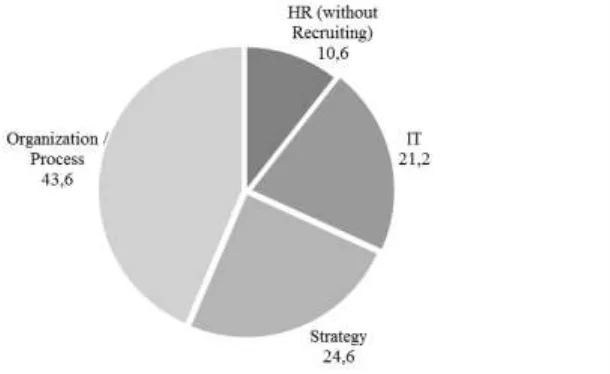
Regarding the market segmentation concerning industrial sectors, BDU (2014) provides two different overviews with two different grades of subdivision. The first overview, presented in Fig. 1, differentiates four market segments or working areas: HR-consulting (without recruiting), IT-Consulting, strategy-consulting and organization - or process-consulting.
Figure 1. Market segment and % ratio of turnover in Germany, 2014. Source: BDU (2014, p.9).
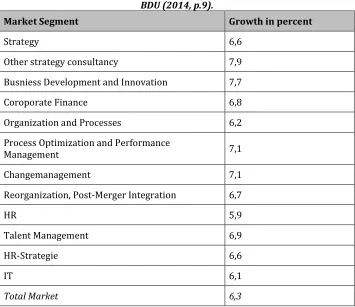
Table 1. Segmental growth on the German consultancy market in 2013. Source: BDU (2014, p.9).
Market Segment Growth in percent
Strategy 6,6
Other strategy consultancy 7,9
Busniess Development and Innovation 7,7
Coroporate Finance 6,8
Organization and Processes 6,2
Process Optimization and Performance
Management 7,1
Changemanagement 7,1
Reorganization, Post-Merger Integration 6,7
HR 5,9
Talent Management 6,9
HR-Strategie 6,6
IT 6,1
Total Market 6,3
Consulting Market
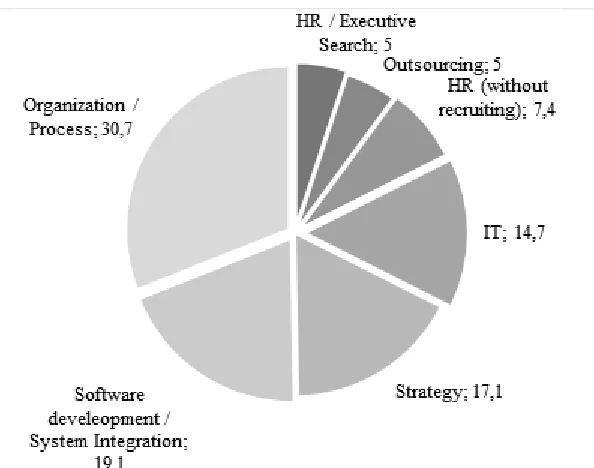
Figure 2. Extended overview of segmental growth on the German consultancy market in 2013 (BDU, 2014, p.11).
It seems striking that software development and system integration in 2013 holds a market share of 19.1%. Together with IT-consulting services referred to digital challenges hold a share of more than a third. BDU (2014, p.11) mentions recent trends as cloud computing, Big Data, social- and mobile-integration to be increasingly important: the potential of internet and data has to be integrated in existing business models. Hence consultants are needed to evaluate, analyze, to prepare and to use the data to understand clients and to optimize business. There is a need for both expert monitoring and new software.
These trends seem to confirm the insights of latest surveys of the European Federation of Management Consultancies Associations. After Business consulting, it is IT consulting which showed the most remarkable growth between 2009 and 2012 (FEACO, 2012, p.6).
We assume, that on the one hand the two general aspects of ratio of the consulting Market to GDP and the growth factor, and on the other hand the
detail aspect of segmental growth underscore the importance of the
Capturing qualitative change
We assume, that a comparison between data from 2014 and 2015 should shed light on recent trends, more precisely, on the way the quality of the demand for consulting changes. Starting from our general assumptions outlined in the first sections we state, that the conventional approach of measuring segmental change should be complemented by qualitative aspects. The actual study carried out by the German brand eins magazine (BEM) seems to provide a sound basis. The first subsection explains the methodology of the BEM-study. The second subsection presents general aspects of change revealed by the surveys. Subsection 3.2.3 and 3.2.4 shift the focus to changes on the level of working area and industries.
Empirical basis
This section presents the empirical basis and refers to extensive surveys carried out in 2014 and 2015 by order of BEM, published first in May 2014 and then in May 2015. According to the immense diversity of the German consultant market, the first aim of the study was to obtain transparency regarding the quality of the provided services. For market demarcation, recruitment agencies and headhunters were excluded and affiliates and brands have been treated separately. In addition to the traditional market segment the survey included IT-consultancies, auditing companies and agencies (BEM, 2014, p. 84). The generated top list is based on a study which covers both the perspective of consulting experts and clients: The survey of 2014 was addressed to 5172 partners and project managers from which 1426 answered, which means a recourse of 26 %. With 1500 clients surveyed in 2014, this is the largest survey regarding consulting conducted in Germany to date (BEM, 2014, p.82).
Consulting Market
market by depicting reputation and customer evaluation. The second survey of brand eins, carried out in 2015 employed the same methods. It is therefore comparable and a sound basis to identify trends.
General aspects of change
The fact that from 276 Companies listed in 2014, 57 dropped out, means an overall ratio of approximately 20%. This underpins the dynamics outlined in the first section, but from another point of view. This, first of all, seems to indicate a rapid change in the perception of the relevance of consultancies and provides a perspective on the driving forces of the structural change depicted by traditional market analysis. This data is, in addition, not only a strong indicator that the market is dynamic, but seems to be highly contestable. The analysis of the particular positions in the rankings provides a considerable insight in the shape of the actual developments as we will line out in the following subsections.
An overall drop out ratio of approximately 20% still doesn’t say too much about the direction of market development. The BEM-survey structured this problem and, to provide an appropriate overview regarding the structure of the branch, differentiated between 13 industries and 15 working areas. In the following subsections we depict the changes recorded by the BEM survey regarding first working area and then regarding industries. To ensure the link to the link to traditional market segmentation and to catch recent developments clearly, in each section we tried to take into account company size, breadth of portfolio of both firms dropped out and newcomers.
Identifying dynamics regarding working area
We took a closer look at the dynamics of different working areas. BEM differentiated among 15 working areas (strategy consulting, restructuring, interim-management, leadership and organization, sales/CRM, supply-chain management, mergers and acquisitions, finance & risk management, innovation and growth, marketing, brand & pricing, sustainability, IT-strategy, IT-implementation and operations management).
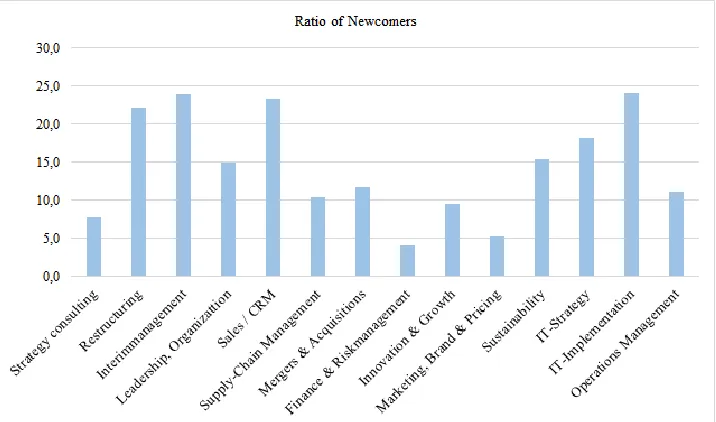
For the first view, there seems to be little dynamics regarding the sheer number of listed companies. More detailed, the number of companies active in the respective working areas over all changed at an average of 3%. But there are significant differences. The number of companies over all shrunk in only four working areas: Restructuring (29%), M & A (15%), Leadership and Organization (7%) and Operations Management (6%). In contrast, there is a significant growth in the areas of Innovation & Growth (40%), Sales & CRM (20%) and IT-Implementation (14%). We can learn more about the dynamics of the market if we focus on the ratio of newcomers to the number of consultancies active in each working area (See fig. 3).
Figure 3. Ratio of newcomers regarding working area (in %) (BME, 2014, 2015), own illustration.
Consulting Market
We have to emphasize here that this data does not depict changes in market structure. It provides solid information regarding the change of perception of the supply side, which may anticipate market change. First of all the eye catching changes seem to reflect the – exhaustively discussed – general tendency on the global markets driven by shorter product life cycles and the technology explosion. The changes in the areas of restructuring as well as interim management reflect the simple fact that recently a large number of companies have to manage change processes. And this change is obviously driven by digitalization, which generates a growing demand for IT-solutions. This seems to be visibly expressed by the dynamics of the area of IT-implementation. It seems noteworthy, that the market dynamics on the demand side not only lead to a higher demand, but to a high willingness to switch among providers quite easily. The factor mobility of the consulting business is hence high, which leads to harsh competition.
We analyzed the properties of the companies dropping out with regard to headcount, subsidiaries, portfolio and annual turnover in order to find empirical evidence for Christensen’s assumption that “there are increasingly sophisticated competitors with nontraditional business models” (Christensen, 2013, p.4) and to harden his thesis of the growing importance of “boutique consultancy services” (ibid.). But, as far as solid data was accessible, we could not assess remarkable differences among the named properties, which could have indicated the development of niche markets dominated by highly knowledge-intense and specialized providers. But – although there is a visible segmentation of dynamics – on the basis of the perception and recommendation captured by the BEM survey, we still cannot track trends towards new types of consultancies. The data of the survey at the most depicts the fact that certain challenges – as the role of IT – raise to bigger importance and that the demand side builds up a higher pressure by switching among suppliers. Though we still have no evidence for the emergence of “boutique consultancy services” the named processes are very likely to lead to a higher knowledge intensity.
Identifying dynamics regarding industry
From the point of view of industries we can detect remarkably higher dynamics than from the point of view of working areas. BEM differentiated among 13 industries (automotive/suppliers, banking, chemicals/pharmacy, energy & environment, healthcare, internet & media, FMCG, manufacturing, public sector & infrastructure, other industrial goods, technology and telecom, transport & sales, insurance).
insurance business (0%), technology and telecom (0%) as well as energy and environment (3%) and transport and sales (3%) show only – if any – little change rates, consultancy in the area of internet and media (63%), manufacturing (52%) and other industrial goods (19%) shows an impressive growth. Now looking at the change rates within the single industry sectors, there is an average of 18%.
Figure 4. Ratio of newcomers regarding industry (BEM, 2014, 2015), own illustration
From this perspective only the industries of energy & environment with a ratio of newcomers of 24%, and internet & media with a ratio of 35% are striking.
Consulting Market
resource. Is it therefore the more striking that the industry of internet and media shows the highest dynamic. We may argue that this, by enhancing interconnectivity, will in turn lead to higher dynamics of change in the long run.
Conclusions and perspectives
Starting point of the investigation was the clearly observable challenge of shortening product life cycles, technology explosion, global connectivity and the accelerating knowledge-intensity. Generally, the overview regarding growth rates and structural changes of the German consulting market underpins the assumption that higher knowledge intensity of the global economy leads to a higher importance of the consultancy business. These general changes seem to reflect the – exhaustively discussed – tendency on the global markets to higher knowledge intensity. The growth factor of the consulting market, its ratio to GDP as well as observable dynamics in particular segments underscore the increasing importance of the knowledge economy and its impact on the consulting market.
The results of the BEM surveys shed a new light on the impact of increasing knowledge intensity. By evaluating qualitative aspects as customer evaluation the surveys provide an alternative point of view on the development. It seems to be a feasible complement to traditional market observation. Focusing on the empirical data provided by BEM we get insight in qualitative changes, because the surveys depict the change of perception on the demand side. Analyzing the surveys we can observe that the eye-catching changes both regarding industry and working area show a clear-cut reflection of the non-consultancy markets by a higher dynamics in the areas of restructuring, interim, sales & CRM and IT-implementation as well as internet & media regarding industry. The extremely high willingness to switch among providers is a new quality and documents a rapid change in the perception of the relevance of consultancies. This means a high pressure on performance for every market player. Not accidentally, the survey displays considerable change in the areas of restructuring and interim management. This reflects the fact that recently a large number of companies have to manage change processes. And this change seems to be substantially driven by digitalization, which gets visible by the observable dynamics of the area of IT-implementation.
company size, growth seems to be extremely balanced. Indeed, the dynamics of the situation is clearly reflected by the growth of particular consulting areas such as IT and media – but it is not reflected by a change of players regarding headcount, turnover or count of subsidiaries. For the first step, neither by means of structural market analyses nor by means of analyzing the BEM surveys can we track a distinct change towards “boutique consulting” on the German market.
In a nutshell we may argue, that both the structural, quantitatively measurable change and the qualitative change captured by the surveys of BEM underpin the general assumption that new technologies and digitalization are the most important observable driving forces of the actual change. But with regard to the German consulting market and the accessible period, we cannot confirm Christensen’s thesis of a tendency from a dominance of “solution shop” consultancies to more customized, “boutique” consultancy services. If the observable processes force the market players to a paradigm change in the sense of customization in the long run seems a feasible assumption, which will have to be tested by further investigations in the next years. From our point of view data as provided by BEM seems to be a promising access to detect change of perception of the supply side, which may precede concrete market change.
The most important theoretical implication is that, in the long run, a periodic evaluation of the BEM survey – as if continued – may open a suitable opportunity to track changes on the German consultancy market precisely. Because of the importance and characteristics of the German market this could provide a deeper inside in globally relevant processes of change. As a next step this could be complemented by further investigations regarding the business models of consultancies, their size and structural change in e.g. certain working areas or industries. A deeper and more detailed insight in the relevant processes should enable us to identify trends more accurately which may have even a positive impact for consultancy practice.
References
Consulting Market
Balduzzi, J. (2014). Bigger Isn’t Always Better. Boutique consulting shops are working more large races than ever. Campains & Elections, March/April, 10– 12.
BDU (Ed.) (2014). Bundesverband Deutscher Unternehmensberater e.V. Facts & Figures zum Beratermarkt 2013/2014. Bonn.
BEM (Ed.) (2014). brand eins Thema. Unternehmensberater. Ein Branchenreport von brand eins Wissen und Statista.
BEM (Ed.) (2015). brand eins Thema. Unternehmensberater. Der Branchenreport von brand eins Wissen und Statista.
Christensen, Clayton M., Wang, Diana, Bever, Derek van (2013). Consulting on the Cusp of Disruption. Harvard Business Review, 91(10), 106–114.
Dobbs, R., Ramaswamy, S., Stephenson, E., and Viguerie, S.P. (2014). Management intuition for the next 50 years. McKinsey & Company. Retrieved from http://www.mckinsey.com/insights/strategy/management_intuition_for_th e_next_50_years.
FEACO (2012). Survey of the European Management Consultancy 2011/2012. Retrieved from
http://www.feaco.org/sites/default/files/sitepagefiles/Feaco%20Survey%2 02011-2012.pdf.
Hayek, F.A. (1945). The use of knowledge in society. American Economic Review, 35(4), 519–530.
Perkins, B. (2009). Boutique Bound? Computerword, 19, 35.
Smith, K. (2002). What is the ‘knowledge economy’? Knowledge intensity and distributed knowledge bases. INTECH Institute for new technologies discussion paper series, Paper Series 2002-6.
Werr, A., and Greiner, L. (2008). Collaboration and the Production of Management Knowledge in Research, Consulting, and Management Practice. In Shani A. B. et al. (Eds.), Handbook of Collaborative Management Research (pp.93–117). Thousand Oaks: Sage.
Zehner, W.B. II (2005). The Emerging Technology of Commercialization Degree. Integrated Design and Process Technology, IDPT-2005, June, 1-12.
Received: March 20, 2016 Accepted for publication: June 27, 2016 Hu, T., Lin, C., and Chang, S. (2013). Knowledge intensive business services and
client innovation. The Service Industries Journal 33(15/16), 1435–1455. Marketline Industry Profile (2015). Management & Marketing Consultancy in
Germany.
Mas-Machuca, M., and Martínez C. C. (2012). Exploring critical success factors of knowledge management projects in the consulting sector. Total Quality Management, 23(11), 1297–1313.