Available online at:
http://ejournal.upi.edu/index.php/IJAL/article/view/15261
doi: 10.17509/ijal.v8i3.15261
Cigarette advertisements: A systemic functional grammar and
multimodal analysis
Rizki Ananda
1, Siti Sarah Fitriani
2*, Iskandar Abdul Samad
3, and Andi Anto Patak
41
English Education Department, Faculty of Teacher Training and Education, Universitas Abulyatama, Jl. Blangbintang Lama, Aceh Besar, Indonesia
2, 3
English Education Department, Faculty of Teacher Training and Education, Universitas Syiah Kuala, Jl. Tgk. Hasan Krueng, Kalee, Darussalam, Banda Aceh, Indonesia
4
English Department, Faculty of Languages and Literature, Universitas Negeri Makassar, Jl. A.P. Pettarani, Kampus UNM, Gunungsari, Makassar, Indonesia
ABSTRACT
Drawing on a multimodality theory, this study attempted to investigate the various semiotic resources utilized by a giant Indonesian cigarette company, Sampoerna, and explore how these resources communicate meanings or messages in its billboard advertisements to persuade its potential customers to buy the product. The data were analyzed using Halliday’s systemic functional grammar focusing on ideational meta-function or also known as a representational function in multimodal discourse analysis. The findings revealed that the billboard advertisements were designed to persuade the audience to buy the advertised products implicitly through representational functions attained using narrative and conceptual processes. Whereas the former was realized by employing its typical sub-processes, actional and reactional processes, the latter employed its sub-processes such as classificational, analytical, and symbolic processes. Implicationally, this study has illuminated the possible application of systemic functional grammar within a multimodal discourse analysis domain to investigate implicit message(s) conveyed by an advertisement.
Keywords: Ideational/representational function; multimodality theory; semiotic resources; systemic functional grammar
First Received:
18 July 2018
Revised:
20 November 2018
Accepted:
30 November 2018
Final Proof Received:
25 January 2019
Published:
31 January 2019
How to cite (in APA style):
Ananda, R., Fitriani, S. S., Samad, I. A., & Patak, A. A. (2019). Cigarette advertisements: A systemic functional grammar and multimodal analysis. Indonesian Journal of Applied Linguistics, 8, 616-626. doi: 10.17509/ijal.v8i3.15261
INTRODUCTION
Words are not the only means by which we communicate with each other, and people use different modes of signs for meaning-making, a term referring to multimodality. The use of multimodal texts is now more preferable since the visual components and other semiotic resources in the text help viewers get the meaning and understand the information better. Li (2016) and Oyebode and Unuabonah (2013) acknowledged that although the spoken message is essential, the meaning of a certain message can be revealed by comprehending multiple semiotic materials such as color, fond, images, and icons.
Besides expressing messages to fulfill particular communicative functions such as to construct knowledge and to direct the public to commit violence in the name of religion (O’Halloran, 2008), some multimodal texts serve marketing-oriented purposes; these texts persuade viewers to do something or even buy the advertised products; one of the examples of this text type is an advertisement.
forms. The oral advertisement includes a speech on TV, radio or in real life; whereas the visual advertisement is photographs, posters, fliers, billboards, and websites. Moreover, what makes the advertisement influential is the unique and creative use of the semiotic resources by its creators, such as linguistic resources (e.g. verbal and written languages), paralinguistic resources (e.g. body languages and movement), visual resources (e.g. color, font, images, camera positioning and perspectives), and other semiotic resources (e.g. music) (Guo & Feng, 2017; Li, 2016). These are often referred to as multimodal resources which are commonly combined in the advertisement to make an effective means of communication to attract viewers to buy an advertised product. Therefore, Paltridge (2012) contended that we have hardly ever seen a single use of one method of communication when interacting with each other, including through advertisements.
Within the field of language and linguistic, advertisements can be analyzed to examine the communicative function; hence, the meaning can be understood. Ample studies have revealed the persuasive meaning behind various advertisements, such as the one found in Coca Cola advertisement (Li, 2016), Arcadia University Website (Michelson & Valencia, 2016), advertisement through a legal cartoon (Royce, 2015), advertisement through film trailers (Maier, 2011), and advertisement of news drought in China (Caple, 2009). All of these aforementioned advertisements have one thing in common; they directly persuade viewers to choose and buy the products due to their uncontroversial nature.
However, the persuasive purpose of some advertisements is very oblique, for instance, cigarette advertisement. Feng and Zhou (2016) contended that cigarette advertisement conveys persuasive messages through indirect ways by linking the used materials within the advertisement to social status, desirability, or pleasure. It is due to the fact that their products are not fully accepted to be sold in society. As widely known, the campaign to reduce the number of smokers has been conducted for years in most countries, such as Indonesia, a country which has spent much budget to push down the smoking rate. Nevertheless, cigarette companies are still allowed to keep advertising their products in both printed and electronic media to lure a large number of prospective Indonesian customers, including teenagers.
Previous studies have been conducted to explore how semiotic resources are combined in cigarette advertisements to create a persuasive effect on viewers. Triristina (2012) conducted a study on how a cigarette brand, Djarum L.A. lights, persuaded people to buy the product through billboard advertisement. Ononye (2014) undertook a study on how cigarette advertisements attract consumers from different cultural backgrounds. Using style and stylistics, systemic functional grammar, and Hymes’s SPEAKING, the author disclosed that diverse cigarette advertisements employ different advertising styles to persuade people
to buy their products. In a similar vein, Anderson, Dewhirst, and Ling (2006) analyzed how cigarette industries gain and retain their customers in various ways. Doing semiotic and content analysis on tobacco advertisement, they found that the advertisement contained positive messages (e.g., smoking shows masculinity, independence, women’s liberation, glamour).
Referring back to the previous studies mentioned above, we found that none of them have analyzed the covert ways of cigarette advertisements persuading their buyers by using ideational/representational meta-function in detail. Indeed, Triristina (2012) did employ it in her study, but her analysis did not cover all aspects of ideational/representational function. She merely analyzed one type of narrative process, which is a transactional process. The narrative process only reveals the meaning of unstable pictures, e.g., a man lifting a weight, while conceptual process involves the analysis of motionless pictures such as graphics and pictures. The latter is rich with meaningful messages, hence harder to be interpreted. Thus, the analysis of this study would be conducted not only on the narrative process but also on conceptual process. This study sought to investigate how multimodal resources are employed in the cigarette advertisement by its designers and how these resources communicate meaning and message. To attain this objective, the following guiding questions were formulated: What are the semiotic resources utilized by the cigarette advertisement designers to communicate meaning and to influence and persuade the audience to buy their products?
Smoking prevalence
Smoking has been ubiquitous throughout the world. Four countries with the highest number of smokers are China, Russia, the US, and Indonesia (Jong, 2016). The number of smokers in Indonesia is predicted to keep rising due to the indecisiveness of the Indonesian government to sign the treaty of the “World Health Organization Framework Convention on Tobacco Control (WHO FCTC).” Perdani (2016) revealed that WHO FCTC contains all necessary smoking-related policies, which can, in turn, help the government to push down the number of smokers.
percent increase in the proportion of young smokers over four years.
Although seemingly economically advantageous, smoking can bring some medical, social, and economical drawbacks to a nation, including Indonesia. As for the medical disadvantage, smoking can cause some fatal illness that can lead to death. For example, heavy smokers are susceptible to a heart attack which has claimed 1.6 million lives worldwide (The Jakarta Post, 2017b). In Indonesia, 200.000 people are dying due to smoking-related diseases (Jong, 2016), such as laryngeal and lung cancers.
Moreover, economically, Indonesia has suffered trillions of losses due to smoking-related diseases. Although Indonesian Ministry of Finance says that the tobacco excise has contributed 47.76 trillion rupiahs to national income per 29 June 2018 (Prasongko, 2018), the expenses that have to be spent by the government to cure the patients suffering from smoking-related illness surpass the revenue earned from the tobacco product, which reached USD 1.2 million (Goodchild, Nargis, d’Espaignet, 2017). It is because the nation has a responsibility to provide medical support to all citizens through its health care and social security program, also called BPJS (Badan Penyelenggara Jaminan Sosial), the Indonesian government program to provide the Indonesians with free costs of medical treatment.
Despite these facts, all brands of cigarettes still have easy access to keep advertising their products through online and printed media: on newspapers, website, television, in the magazine, and even in billboards on roads that can be easily seen by either smokers or non-smokers. It is interesting to explore how a product like a cigarette which is, in fact, harmful to people’s health can be attractive and even persuasive through advertisements.
Advertisement
The primary objective of an advertisement is to attract people to do an action as expected by its designer, which is congruent with the definition of advertisement, which originates from Latin word ‘advertere,’ meaning ‘turn around’ (Goddard, 2002, p. 9). An advertisement is used to raise people’s attention toward an advertised product. Moreover, MacRury (2009) contended that we need to understand the advertisement cautiously due to its provocative nature. It merely serves as a method which has a limited range of such purposes as increasing and preserving the consumer’s awareness, disseminating information, and commonly making a case for a certain product, service, and brand. In the same vein, Dyer (2008) noted that advertisement simply has a range of communicative purposes, such as to notify, convince, figure out similarities, and retell the audience about a product. However, the majority of the commercial advertisements’ objective is to persuade and convince viewers to buy their products. Thus, the company (e.g., a cigarette company), whose product is advertised, expects to see an increase in the sale of their product.
Advertisement can be found indoor and outdoor. The indoor advertisements include TV, radio, and website advertisement among others, while the outdoor advertisements are posters, billboards, and handbills. However, the latter deserves more attention in the discourse study as they have been commonly ignored by the previous researchers (e.g., Oyebode & Unuabonah, 2013). Moreover, besides the Internet, an outdoor advertisement can serve as one of the easily accessible media from which people can access the information because it can be found almost in every neighborhood. Ajayi (2005) and Oyebode and Unuabonah (2013) mentioned that outdoor advertising offers a chance for people to look at, making it the most reachable and least complicated method of advertisement. Moreover, Molina (2006, p. 9) added “outdoor advertising is a significant medium that deserves attention in its right, especially the way its “audience” is constructed as a public through discourses of “the public interest” and “social responsibility.” Departing from this fact, this study investigated cigarette advertisements on billboards as one type of outdoor advertisement by looking at how a smoking company utilizes different semiotic signs to present meaning and fulfill a commercial purpose.
Multimodal discourse analysis
Multimodal discourse analysis, according to Paltridge (2012), learns the way people employ the combination of various communication tools, for instance, pictures, films, videos, images, and sounds used simultaneously with written languages, into account to make meaning. O’Halloran, Tan, Smith, and Podlasov, (2011, p.110) added that multimodal discourse analysis attempts to delve into how the combination of semiotic resources such as “(spoken and written) language, gesture, dress, architecture, proximity (and in the film for example) lighting, movement, gaze, camera angle, and so forth” are used for meaning-making.
Multimodal discourse analysis is done by keeping some guiding questions in mind: What meaning is being made in the text?; How is the meaning being made in the text?; What resources have been drawn on to make the meaning of the text?; In what social environment is the meaning being made?; and Whose interest and an agency is at work in the making of the meaning? (Kress, 2010). As we look at these questions, three points are of interest. First, the multimodal discourse analysis seeks to understand the meaning exists behind a particular text and the semiotic resources available to represent such meaning. Second, the theory attempts to look at how particular semiotics are used in particular cultures in conveying meaning. Third, the multimodality theory attempts to reveal a particular agenda set behind a specific text by a specific group of people.
Besides analyzing the communicative events and the generic structure of the posters, they tried to look at how different semiotic resources such as the gaze, lighting, camera shots (e.g., close and long shots) and perspective (e.g., horizontal and vertical angle) were utilized to persuade and convince viewers to do an action. Additionally, Edwards (2012) employed the multimodal discourse analysis to analyze the photographs of Bush and Kerry as the presidential candidates in the 2004 debate. He looked at facial expressions, postures, gestures, clothing, and camera position found in some of the Bush’s negative non-verbal displays, influencing the people’s mindset in evaluating him.
Moreover, multimodality has been used in film and television genres. Iedema (2001) has proposed a multimodality analytical framework for film and television genres. It includes the analysis of frame, shot, scene, sequence, generic stage, work as a whole. Knox (2007) also utilized the multimodality theory to investigate the meaning-making in online newspapers. He examined the sections of their sections, such as home pages and section pages, and found that the designer made the information in each page salient to the readers through the text size, its place in the text, the headline font and size, and the image color and size. From all these studies, we can understand that multimodality has been widely used in the discourse study to understand the implicit meaning of a text.
Systemic functional grammar to the multimodal analysis of an image
Halliday and Matthiessen (2014) reveal that Systemic Functional Grammar (SFG) has been widely used to investigate the meaning denoted from every semiotic resource in a text. Halliday (1978) firmly believed that each text consists of the grammar that functions not only to make sentences grammatically correct, but also to serve as a means that we convey something about the world to others, designate a role for someone regarding others, and arrange our text in a suitable structure. These three functions are the semiotic system of the systemic functional grammar (Yang, 2016), commonly called meta-functions of a language. There are three meta-functions proposed by the systemic functional grammar. Firstly, ideational/experiential with the core premise that language is a tool to tell one’s experience about the world to others. Secondly, interpersonal, positing that language is a tool to give a role to someone about others. The research of these two meta-functions has been done by Hermawan and Sukyadi (2017) to look at the connection between the children and their experiences when they read the three selected Indonesian children picturebooks. Finally, textual, which aims at showing the cohesive nature of linguistics or non-linguistics resources used in a text so that someone can arrange a text in a structured manner. The analysis of these three meta-functions of a particular discourse can help unravel both explicit and implicit meaning.
SFG has become a useful framework employed by previous researchers in analyzing the metafunction of written discourse such as newspaper (Li, 2010), yet the use of such framework has been extended to the analysis of the image in multimodal analysis study. O’Halloran (2008) stated that the systemic functional grammar to multimodal discourse analysis (SF-MDA) deals with the theory and practice to investigate the meaning of various discourses, including written, printed, and electronic text, and image through the analysis of their different semiotic signs. Moreover, just as in the analysis of written language, SF-MDA explores the meaning of an image by analyzing three meta-functions above. The analysis of meta-functions of a written language focusing merely on the written text. However, the meta-function analysis of an image is conducted not only on the written text, but also on the other visual resources used in the text, such as color, font, camera positioning, image shot, gesture, things, people, and so forth.
who does look, whereas the phenomena are the participants toward which looking is done.
Furthermore, as for the conceptual analysis, it involves the analysis of motionless and stable participants. In other words, conceptual analysis is mainly used to analyze inanimate objects such as graphics and diagrams. Conceptual analysis, furthermore, has three processes: classificational process, analytical process, and symbolic process. Classificational process deals with the taxonomy relation between participants in the image in which participant(s) should be subordinate to the other(s) although this relationship can be both covert and overt. In covert taxonomy, the participants’ relationship, which is realized through the participants’ distance to each other (Yang, 2016) and size, is represented equally. Although the taxonomy of participants exists, viewers should draw an inference of the taxonomy of the participants. In contrast, in overt taxonomy, the participants’ relationship can be understood explicitly.
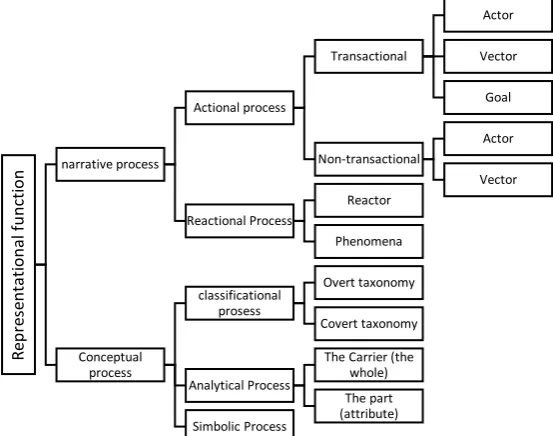
Additionally, the analytical process looks at the part-whole structure of participants. ‘The part-whole,’ also called the carrier, is the main focus of the image which is usually realized through the written words, while ‘the part’ or the possessive attribute is the combination of the participants in the image to form the primary focus. Moreover, the symbolic process is concerned with the meaning denoted by the participants in the image; for instance, the meaning of weight and traffic cone in a cigarette advertisement. To conclude, the conceptual analysis pertains to the analysis of inanimate participants in a text about their relationships to each other, the semiotic resources in the text and their combined use to form the primary focus of the image, and the meaning of each semiotic resource. Finally, since this study investigated the cigarette advertisements consisting of unstable and stable participants, it involved both narrative and conceptual analysis as in Figure 1.
Figure 1. The representational function of visual images
Figure 1 indicates that this study includes both narrative and conceptual processes of the visual image along with their sub-processes.
METHOD
This study analyzed the advertisements of A Mild cigarettes produced by Sampoerna Company posted on billboards found throughout Indonesia. This product was chosen because of A Mild among the most popular cigarette in the country. In addition, most A Mild’s advertisements on billboards present interesting, attractive and unique contents; making these contrary to the government's efforts to reduce the number of smokers.
The data were collected by running a Google search of various keywords related to A Mild advertising on Billboard. Having collected the data, the
study included six examples of billboard advertisement of A Mild cigarette (the first, the second, and the third billboard posted in 2012, the fourth in 2007, the fifth and sixth in 2010). Three of them contain the narrative process, while the rest are for the analysis of the conceptual process. The analysis was conducted based on the tool shown in Figure 1. Moreover, the analysis was divided into two phases, namely description, and interpretation (Al-Momani et al., 2016). In the description phase, all semiotic resources and their organization within the text were identified, meanwhile, in the interpretation step, attempts to link all those resources (e.g., pictures, words, font, color, and positions of those resources) were made.
RESULT AND DISCUSSION
R
ep
re
se
n
ta
ti
o
n
al
f
u
n
cti
o
n
narrative process
Actional process
Transactional
Actor
Vector
Goal
Non-transactional
Actor
Vector
Reactional Process
Reactor
Phenomena
Conceptual process
classificational prosess
Overt taxonomy
Covert taxonomy
Analytical Process
The Carrier (the whole)
As explained above, a visual image realizes its meaning through an ideational function. This function incorporates two main processes: (1) the narrative process; and (2) the conceptual process. Narrative process concerns unstable, active participants that deliver the meanings of the image through actional and reactional processes. Meanwhile, the conceptual process deals with the stable and motionless participants that express the meanings of the visual image through sub-processes: classificational, analytical, and symbolic processes. Now, we discuss the narrative process of the advertisement that we have selected.
Narrative process
Actional process
In the actional process, the participants do something to achieve a goal (Yang, 2016). This goal has a strong nature, especially in an image that has a commercial purpose. If an image has a participant actively conducting an action by using a vector, this is called transactional process (Yang, 2016). Just like in Triristina’s study (2012), this study also found that A Mild Company used actional-transactional process in advertising its cigarette product. Figure 2 shows how the transactional process is realized in A Mild cigarette billboard.
Figure 2. A Mild advertisement
In Figure 2, there are four people, three men, and one woman, trying to hang in an upward grass. They look as if they were about to fall. These people act like the actors, and their goal is the grass, whereas the act of hanging is an action. Moreover, their extending hands form a vector that directs viewers’ attention to where the action is aimed at (Lewis, 2004). With the help of the written language ‘KERJA KERAS GO AHEAD’ (hard-working go ahead), we can understand that these people are trying hard and showing no feeling of surrender to reach the top of the grass so that they will not fall. The picture above also signifies that with hard work, a thing thought impossible becomes possible.
Contextually, this image is used by Sampoerna Company to persuade their buyers to buy their products. From the picture above, viewers can probably understand that it remains possible even for people who smoke to work hard, such as those in the picture; they are working hard not to fall. Their action shows that smoking has no adverse effect on their physical well-being. Moreover, this picture includes both male and female actors, conveying the meaning that smoking is
also possible for a woman as she too can still work hard despite smoking.
Another feature of interest is the text ‘KERJA KERAS GO AHEAD’ (hard-working go ahead). They are written in the capital with a large font to make it more salient and attractive to the viewers (Al-Momani et al., 2016; O’Halloran, 2008). Furthermore, the saliency of the phrase ‘KERJA KERAS’ is achieved through the use of black color against a white background. As we know that Indonesia is a tropical country which has much sunlight so that a black word can be easily noticed if written against a bright color background (Petterson, 1982). Moreover, the ‘GO AHEAD,’ which is a tagline of A Mild Company is written in red to communicate a message to viewers that smokers are real gentlemen associated with bravery and strength. Kress and Leeuwen (2002, p. 343) stated that “color means” and red color represents bravery and strength (Rizqiyah, 2016). Moreover, in the very bottom, there is a warning ‘Merokok dapat menyebabkan kanker, serangan jantung, impotensi dan gangguan kehamilan dan janin’ that can be translated as
‘Smoking can cause cancer, heart attack, impotence, pregnancy, and fetal disorder.’ However, this warning is written in a smaller font than the ‘KERJA KERAS GO AHEAD,’ making the former insignificant to viewers as the size of the fonts in advertisement matters; it is communicating certain meaning (Al-Momani et al., 2016; O’Halloran, 2008).
Besides the transactional process, the actional process can also be accomplished through the non-transactional process, which has only an actor, but no goal (Lewis, 2004) as shown in Figure 3.
Figure 3. A Mild advertisement 2
‘A,’ in the A Mild emblem, is in the red. Again, it is to show that a smoker of A Mild cigarette is a real man who is brave and strong as implicitly suggested by the red color (Rizqiyah, 2016). Meanwhile, the black color of ‘GO AHEAD’ when used with the tattoo signifies the characteristics of masculinity, namely: power, strength, and authority (Harutyunyan, 2015). Thus, it can be assumed that ‘GO AHEAD’ tagline has a strong nature because it tries to influence people to keep smoking although this has been considered dangerous for health
Moreover, the picture is foregrounded, thus directing viewers’ attention to it, using a close-distance shot. Guo and Feng (2017) mentioned that a close distance shot is aimed at making pictures in advertisement easily noticeable to viewers. As is true of the previously shown advertisements, the designer of “A mild” advertisement consistently includes the warning written in a smaller font than others that the tag line in the bottom of the picture to create an insignificant effect of the warning.
Reactional process
The process is called reactional if the vector is built through the looking of the eyes done by one or more participants (Oyebode & Unuabonah, 2013). The following picture is the image of two animate objects, two young men, looking at each other (Figure 4). They act of looking is called reactional process.
Figure 4. A Mild advertisement 3
In Figure 4 above, two people are holding their hands and looking at each other. They choose to walk on the walls instead of on the street. Although this picture can be analyzed through the actional process (e.g., holding hands), the focus on this section is the reactional process through the participants’ eye direction that forms a vector (Oyebode & Unuabonah, 2013). They are looking to one another, meaning that they are both considered reactors, the participants doing an act of looking. Furthermore, as the message in visual representation is depicted through actors’ actions in the image, their holding hands in Figure 4 is what needs to be seen by viewers (Oyebode & Unuabonah, 2013).
If we focus on the verbal text in the passage, there are three texts included, the letter ‘A,’ ‘SETIA KAWAN
GO AHEAD,’ (loyal friend Go Ahead) and the warning message. The letter ‘A’ is written in red, using an extremely capital letter and big font because it is A Mild cigarette emblem so that people can notice it immediately when they look at this advertisement. Furthermore, the message ‘SETIA KAWAN GO AHEAD’ (loyal friend Go Ahead) is written in white
using capital letters and big font. The use of white is to show not only a contrast with the red background (Clarke III & Honeycutt, 2000), so it becomes an eye-catching message to viewers, but also honesty, purity, and sincerity (Harutyunyan, 2015; Kress & Leeuwen, 2002; Rizqiyah, 2016). Therefore, the use of the white color in the phrase ‘SETIA KAWAN’ may signify true friendship. Again, the warning label in the bottom is written much smaller than the main message above so that the advertisement can draw the viewers’ attention solely to the latter.
Moreover, if we look at the relationship between the verbal text and visual image carefully, the picture shows a difficult situation faced by two friends because they have to walk over the wall, facing upside down the However, because they are loyal friends, they are helping each other by holding hands to prevent them from falling. While holding the hands, the two gentlemen are looking at each other to induce a more feeling of loyalty, which is a prerequisite for a true friendship. This finding is consistent with that of the study conducted by Nichter et al. (2009) where they found that one of the Indonesian cigarette advertising themes is friendship. If we associate these semiotic resources to the A Mild cigarette, it tells viewers that A Mild cigarette is a loyal friend that will accompany its buyers even in a difficult situation.
Conceptual Process
The process is conceptual when the participants are motionless and stable. It means that in this process, the participants are inanimate objects. The conceptual process incorporates three sub-processes, namely classificational, analytical, and symbolic processes which will be discussed in the following sections.
Classificational process
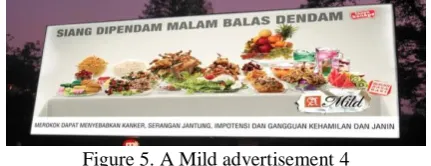
The classificational process shows the relationship between the participants in the image. Such relationship assigns a participant(s) a role of superordinate and the other(s) subordinate. It means that this process creates a taxonomy for the involved participants in the image. The taxonomy can be covert and overt. In the former, the participants are equally represented regarding their size, distance, framing, and number, whereas in the latter, the participants are not symmetrically composed regarding their size, distance, framing, and number. In Figure 5, we will see how covert and overt taxonomy is built in images.
Figure 5. A Mild advertisement 4
which they are close to each other, and thus this picture creates a covert taxonomy. This kind of taxonomy is used by the designer of the picture to suggest viewers having a balanced diet so that they can supply sufficient nutritive elements to their body.
Moreover, this image has a message in the top that says ‘Siang dipendam malam balas dendam’ (restrain at
days, revenge at nights). Each word in this message has a similar font size and space, and thus this message again creates a covert taxonomy that emphasizes the importance of the meaning of all words. The big font used for this message aims at making the message easily noticeable. Again, the warning label in the bottom is written smaller than the main message. From this perspective, the central message in the top plays a role of superordinate, while the warning in the bottom is assigned a role of subordinate, meaning that viewers should see the former as more vital than the latter.
To relate the meaning of this picture with the cigarette, we have to understand the contextual and cultural information of this picture. Ononye (2014) found that the cigarette companies in Nigeria also considered the cultural dimension of the society where the advertisement was published; thus it can be created based on the culture of the targeted customers. Going back to the image above, it was (or maybe will again be) published over Ramadhan month, a holy month for Muslim where they have to fast at daytime and break their fast after the sun sets. The images of food, fruit, and drink presented in the advertisement are real images, and most are Indonesian favorites when breaking the fast. This has made the images so appetizing for the viewers who are fasting. One may assume that the advertisement producer makes a kind of relation between these favorite foods and cigarettes. For smokers, a cigarette is like a favorite food; and in Ramadhan, they have to hold smoking until the sun sets. We also assume that the images of the appetizing food and drink in the advertisement have somehow replaced the image of a cigarette. In other words, the slogan ‘Siang dipendam malam balas dendam’ may
metaphorically mean ‘restrain smoking at days, revenge (smoke more) at nights). We can see here that the company tries to deliver the message that like food, people are much likely to smoke at night because it is impossible to do so over day times.
Analytical process
In the analytical process, the focus is turned on the part-whole structures that connect all participants in the image. Therefore, the participants are given two roles, the carrier (the whole) and the possessive attributes (the parts) as studied by Yang (2016) as can be seen in the A Mild cigarette advertisement in Figure 6.
Figure 6. A Mild Advertisement
Figure 6 shows a clear connection between the carrier (the whole) and possessive (the part), forming a relational attributive process. The carrier is the focus of the picture, while the possessive is the semiotic resources employed to form the whole or the focus (Yang, 2016). Here, the whole or the focus of this picture is the tagline of A Mild company cigarette, ‘GO AHEAD.’ Meanwhile, the possessive attributes are the people, the individual letters of the tagline, the flag, the sea water, and the sea coral reefs. Each letter of the tagline, except the letter ‘A,’ is formed by the people, enhancing the creativity of the picture and its attractiveness. Moreover, A Mild emblem ‘A’ is written in red using a huge font, and it is written on a white flag as the background, held by two people. In this case, the use of the white flag is not only to make the letter ‘A’ to be noticed by viewers, but also to signal purity, cleanliness, sincerity, and honesty (Harutyunyan, 2015; Kress & Leeuwen, 2002; Rizqiyah, 2016) to perhaps signify that A mild company is truly concerned with and has given the best quality of cigarettes for the consumers so far. The coral reef, furthermore, is to show the situation of the undersea, creating a picturesque view in which the picture is taken. To conclude, ‘the parts’ incorporate all crucial semiotic resources to build the whole or the focus of the image and to deliver the meaning of the focus creatively and engagingly.
If we analyze the advertisement more deeply, the involvement of all participants in the image to form an analytical process is also done to communicate a message. As we can see in the advertisement, the divers are doing a challenging attraction in the sea to form the ‘Go Ahead’ phrase. This formation is difficult to do, even more, when it is done under water. We assume that the message the advertisement tries to convey is the creativity of the A Mild company in marketing its products.
Symbolic process
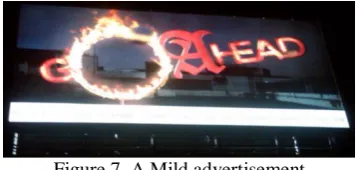
symbolic process is formed through ‘carrier’ and ‘symbolic attribute.’
Figure 7. A Mild advertisement
In Figure 7, the carrier is the A Mild cigarette company’s tagline ‘Go Ahead’ which is foregrounded by the close-up picture. The tagline is capitalized and written in red to have a contrast color with the dark night as the background so that viewers can easily identify them. Moreover, the symbolic attributes are the letter ‘O’ and ‘A.’ The letter ‘O’ is depicted as a fireball to instill a strong emotion of inspiration and spirit. This interpretation can be traced back to one of the conceptual meanings of ‘fire’ given by the Cambridge dictionary, 3rd edition, (2008), namely to cause strong emotion of inspiration and spirit. In other words, we can tentatively assume that the use of fireball in the advertisement above is to convey the message that smoking A Mild cigarette can give inspiration and spirit as also found in a study undertaken by Nichter et al. (2009). Moreover, the letter ‘A’ is written in a different font and with a bigger size so that people know the producer of this advertisement, which is the A Mild company. Therefore, carefully looking at the carrier and symbolic attribute, viewers may perceive that smoking A Mild cigarette can enhance and maintain their spirit to overcome any problems they encounter in their life; thus, the ultimate implicit meaning of this advertisement is ‘BUY THIS PRODUCT.’
As we have seen in the elaboration above, the advertisement designed by A Mild company has served its purpose, namely to attract people to buy A Mild cigarette. Dyer (2008) contended that advertisement expresses diverse communicative functions, one of which is to convince people to buy their products. Moreover, it is also proven that the outdoor advertisements which can be found easily in public places (Ajayi, 2005; Molina, 2006) as analyzed in this study are designed by combining diverse semiotic materials with the purpose of influencing potential buyers.
Apart from being reachable, A Mild Company has successfully created its cigarette billboard advertisements by creatively combining visual and verbal resources. This is what other experts, such as Paltridge (2012), called multimodality. Paltridge (2012) and O’Halloran et al. (2011) said that multimodal advertisement is designed by combining diverse communication tools such as pictures, films, videos, images, sounds, written languages, gestures, dress, architecture, proximity, lighting, movement, gaze, camera angle, and others. All these semiotic resources
are used for meaning-making as mentioned by Kress (2010).
The combination of various semiotic resources in product advertisements can probably influence people by driving their minds toward certain values so that they will be willing to buy the advertised products. A study by Nichter et al. (2008) has proven that creative design of cigarette advertisement can direct viewers’ mind to various themes/discourse, such as masculinity, strength, friendship, enjoyment, modernity, and so forth. The effect of semiotically creative design of advertisement on people’s willingness to buy advertised products either related to cigarette (Anderson et al., 2006; Ononye, 2014; Triristina, 2012) or non-cigarette (Caple, 2009; Li, 2016; Maier, 2011; Michelson & Valencia, 2016; Royce, 2015) has been empirically found. Moreover, at least one A Mild cigarette billboard found in this study was designed according to an Islamic principle regarding the fasting. It indicates the company’s awareness of the importance of incorporating the local value or culture in the advertisement, as suggested by Ononye (2014).
CONCLUSION
This study has shown that A Mild Company has creatively exploited various semiotic modes to persuade buyers. The presentation of the tagline and slogan always appear bigger with attractive colors, and so do the images; showing that the message shown by these resources is more significant compared to the message presented in the warning label. This is also reinforced by a significant gap regarding the size between the tagline (including the slogan and accompanying images) and the warning message. Interestingly, from the point of view of literal meaning, the messages shown in the advertisement do not have any relation to cigarettes or smoking activities; but if when looked at more closely, the inherent meaning is apparent in that the advertisement tries to sell cigarettes implicitly.
There are some limitations of this study that future research may follow up on. First, this study investigated only a small number of advertisements from one company so that the result is not generalizable to a broader context; thus, future studies may gather more data from multiple companies. Second, a future study may interview the advertisement designer to justify the researcher’s interpretation of the meaning behind every semiotic mode used in the images and thus, the result will be more verifiable. Finally, a future study may include the analysis of interactive meaning and compositional meaning of visual images, which corresponds to the interpersonal and textual function in the written language respectively to arrive at a more comprehensive picture.
REFERENCES
Al-Momani, K., Migdadi, F., & Badarneh, M. A. (2016). A semiotic analysis of intergeneric borrowings in print advertisements in Jordan.
Social Semiotics, 26(1), 36–58. doi: 10.1080/10350330.2015.1046217
Anderson, S. J., Dewhirst, T., & Ling, P. M. (2006). Every document and picture tells a story: Using internal corporate document reviews, semiotics, and content analysis to assess tobacco
advertising. Tobacco Control, 15(3), 254-261. doi: 10.1136/tc.2005.013854
Budiari, I. (2017, June). Bogor struggles to curb smoking in public spaces. Retrieved from
http://www.thejakartapost.com/news/2017/06/02/b ogor-struggles-curb-smoking-public-spaces.html Cambridge Advanced learner’s dictionary (3rd
Edition). (2008). Cambridge: Cambridge University Press. Caple, H. (2009). 12 Multi-semiotic communication in an Australian broadsheet: a new news story genre. In C. Bazerman, A. Bonini & D. Figueiredo (Eds.),
Genre in a Changing World (pp. 243-254). Fort Collins, Colorado: The WAC Clearinghouse and Parlor Press.
Chen, Y., & Gao, X. (2014). Interpretation of the representational meaning of movie posters from the perspective of multimodal discourse analysis.
Paper presented at theInternational Conference on Education, Language, Art and Intercultural Communication (ICELAIC-14). doi: 10.2991/icelaic-14.2014.87
Clarke III, I., & Honeycutt, E.D. (2000). Color usage in international business-to-business print
advertising. Industrial Marketing Management,
29(3), 255-261. doi: 10.1016/s0019-8501(99)00068-1
Dyer, G. (2008). Advertising as communication. London: Routledge.
Edwards, J. L. (2012). Visual literacy and visual politics: Photojournalism and the 2004 presidential debates. Communication Quarterly, 60(5), 681– 697. doi: 10.1080/01463373.2012.725000 Feng, Y., & Zhou, T. (2016). The indirect influence of
tobacco advertising on smoking susceptibility: A case of teenagers from hispanic communities. The International Journal of Communication and Health, 10, 59-72.
Goodchild, M., Nargis, N., & d'Espaignet, E. T. (2018). Global economic cost of smoking-attributable diseases. Tobacco Control, 27(1), 58-64. doi: 10.1136/tobaccocontrol-2016-053305 Goddard, A. (2002). The language of advertising:
Written texts. London: Psychology Press. Guo, F., & Feng, X. (2017). A Multimodal Discourse
Analysis of Advertisements-Based on Visual Grammar. Journal of Arts and Humanities, 6(3), 59-69. doi: 10.18533/journal.v6i3.1132
Halliday, M. A. K. (1978). Language as social semiotic. London: Arnold.
Halliday, M. A. K., & Matthiessen, C. M. I. M. (2014).
An introduction to functional grammar. London
and New York: Routledge.
Harutyunyan, K. (2015). Colour terms in advertisement.
Armenian Folia Anglistika, 2(14), 56-67. Hermawan, B., & Sukyadi, D. (2017). Ideational and
interpersonal meanings of children narratives in Indonesian picturebooks. Indonesian Journal of Applied Linguistics, 7(2), 404-412. doi:
10.17509/ijal.v7i2.8139
Iedema, R. (2001). Analysing film and television: A social semiotic account of hospital: An unhealthy business. Handbook of Visual Analysis, 183–204. doi: 10.4135/9780857020062.n9
Jong, H. N. (2016, June). Indonesia on track to world’s highest smoking rates. The Jakarta Post. Retrieved from
http://www.thejakartapost.com/news/2016/06/01/i ndonesia-on-track-to-worlds-highest-smoking-rates.html.
King, Y.M. (2016). The right-of-publicity challenges for tattoo copyrights. Nevada Law Journal, 16, 441-466.
Knox, J. (2007). Visual-verbal communication on online newspaper home pages. Visual Communication, 6(1), 19-53. doi: 10.1177/1470357207071464
Kress, G. R. (2010). Multimodality: A Social Semiotic Approach to Contemporary Communication. London: Routledge.
Kress, G., & Leeuwen, T. van. (2006). Reading images: The grammar of visual design. London and New York: Routledge.
Kress, G., & Van Leeuwen, T. (2002). Colour as a semiotic mode: Notes for a grammar of
colour. Visual Communication, 1(3), 343-368. doi: 10.1177/147035720200100306
Lewis, D. (2004). A word about pictures. In T. Grainger (Ed.), The Routledge Falmer reader in language and literacy (pp. 199–216). London: Psychology Press.
Li, D. (2016). Multimodal discourse analysis of the interpersonal meaning of TV advertisements.
International Journal of Social Science and Humanity, 6(12), 934-938. doi:
10.18178/ijssh.2016.V6.776
Li, J. (2010). Transitivity and lexical cohesion: Press representations of a political disaster and its actors.
Journal of Pragmatics, 42(12), 3444–3458. doi: 10.1016/j.pragma.2010.04.028
MacRury, I. (2009). Advertising. London: Routledge. Maier, C. D. (2011). Structure and function in the
generic staging of film trailers: A multimodal analysis. In R. Piazza, M. Bednarek, & F. Rossi (Eds.), Telecinematic discourse: Approaches to the language of films and television series.
Amsterdam: John Benjamins Publishing Company. Michelson, K., & Álvarez Valencia, J. A. (2016). Study
abroad: Tourism or education? A multimodal social semiotic analysis of institutional discourses of a promotional website. Discourse &
10.1177/1750481315623893.
Molina, J. R. (2006). Public spaces or private places? Outdoor advertising and the commercialisation of public space in Christchurch, New Zealand. (Unpublished Master’s Thesis). University of Canterbury.
Nichter, N., Padmawai, S., Danardono, M., Ng, N., Prabandari, Y., Nichter, M. (2009). Reading culture from tobacco advertisements in Indonesia.
Tobacco Control, 18(2), 98-107. doi: 10.1136/tc.2008.025809
O’Halloran, K. L. (2008). Systemic functional-multimodal discourse analysis (SF-MDA): Constructing ideational meaning using language and visual imagery. Visual Communication, 7(4), 443–475. doi: 10.1177/1470357208096210 O’Halloran, K. L., Tan, S., Smith, B. A., & Podlasov,
A. (2011). Multimodal analysis within an interactive software environment: Critical
discourse perspectives. Critical Discourse Studies,
8(2), 109–125. doi:
10.1080/17405904.2011.558687
Ononye, C. F. (2014). Socio-stylistics of cigarette advertisement in Nigerian print media discourse.
Uniuyo Journal of Humanities, 18, 197—200. Oyebode, O., & Unuabonah, F. O. (2013). Coping with
HIV/AIDS: A multimodal discourse analysis of selected HIV/AIDS posters in south-western Nigeria. Discourse & Society, 24(6), 810–827. doi: 10.1177/0957926513503269
Paltridge, B. (2012). Discourse analysis: An
introduction. London and New York: Bloomsbury Publishing.
Perdani, Y. (2016, January). Smoking recklessly and wastefully. The Jakarta Post. Retrieved from http://www.thejakartapost.com/news/2016/01/10/s moking-recklessly-and-wastefully.html.
Petterson, R. (1982). Cultural differences in the perception of image and color in pictures.
Educational Communication and Technology, 30(1), 43–53.
Rizqiyah, K. A. (2016). Analisis terhadap kontestasi makna warna merah dalam film “Undangan Kuning” karya Goetheng Iku Ahkin.
(Undergraduate Thesis). Institut Agama Islam
Negeri Purwokerto, Purwokerto.
Royce, T. D. (2015). Intersemiotic complementarity in legal cartoons: An ideational multimodal analysis.
International Journal for the Semiotics of Law - Revue Internationale de Sémiotique Juridique,
28(4), 719–744. doi: 10.1007/s11196-015-9421-1 Tempo.Co. (2018, December). Penerimaan cukai per
Juni 2018 capai Rp 50,21 triliun. Tempo.Co.
Retrieved from
https://bisnis.tempo.co/read/1103157/penerimaan-
cukai-per-juni-2018-capai-rp-5021-triliun/full&view=ok
The Jakarta Post. (2017a, May). Smoking threatens Indonesia’s demographic bonus. The Jakarta Post. Retrieved from
http://www.thejakartapost.com/news/2017/05/13/s moking-threatens-indonesia-s-demographic-bonus.html
The Jakarta Post. (2017b, May). Smoking weakens a gene that protects arteries: Study. Health. Retrieved from
http://www.thejakartapost.com/amp/life/2017/05/0 2/smoking-weakens-a-gene-that-protects-arteries-study.html
Triristina, N. (2012). The multimodality concept used in the Djarum L.A. Lights cigarette advertisement billboard in Central Surabaya. Anglicist, 1(1), 28-33.
White, C., Oliffe, J.L., & Bottorff, J.L. (2012). From the physician to the marlboro man: masculinity, health, and cigarette advertising in
America, 1946–1964. Men and Masculinities, 15(5), 526-547. doi: 10.1177/1097184X12461917 World Health Organization. (2018). WNTD: Indonesia
factsheet. Retrieved from
https://apps.who.int/iris/handle/10665/272673?sear
ch-result=true&query=indonesia&scope=&rpp=10&s ort_by=score&order=desc