D
SW
M
Za
1V Sa e-m 2Sh P. e-m 3A P. e-m Ma co co ma ma co Co Ge the ra app Th sel too ph SW sec ra cri de Ka str Ke In pro On hig of the ev Be an alt sho safDec
W
Moh
ava
Vilni aule mai hom O. mai mir O. B mai Mach omp omp anuf ach onsi onse ene e p tio pplie his lect ol. hysi WAR con nki iter ecis araj rate eyw ntro T odu ne o gh f ma eir very esid nd th tern oul fetycisi
WAR
ham
ad
ius etek il: m mal Bo il: m rkab Box ils: hine petit pany ufac hine ider equ ral res an ed f mo tion Eig ical RA nd p ing ria w ion j, Ir egie word odu Tod ucin of th com ach ou y co des, hey nativld c y, r
ion
RA
mm
ska
Ge kio a mh_ l Un ox 7 mh_ bir x 15 sa. htte to tive y sh ctur es w red uent ly, enc naly for odel n. L ght l, co is par ma whi mo ran es, r ds: uct day ng g he mpe hine utpu omp the y off ves con relia
n M
A a
mad
as
1 edim al. _ag nive 731, _ag Un 585 .has tp:// ools enes hou ring with as p tly MA ce o ysis ma l is Lite cri ompuse rt w ach ich ode n. Th reso Ma (S tion ev goo star etit e too uts pan ere ffer . A side abil
Ma
an
d H
1 mina 11, ghda ersi , Am ghda nive 5-44 she /dx.s ar ss in uld g co h dif par sel ADM
of u (S achi s a erat iter pati eful with ine are el. F This our ach SWA n very ods rtin iven ols dep ny s
are a w Also
er m lity
ak
nd
Ha
as T LT daie ity mol daie ersi 413 emk doi. re n th sel omp iffer rt of lect M m usua SWA ine hy ture ia f ibil l fo h C too e no For mo rces hine ARA y or ng p nes (Y pen sho e m wide o, a man y, ekin
CO
san
Tec T-10 @y l, M @y ity o 3, Te khan .org one he m lect pany ren of pr tion met ally ARA too ybri e sufor lity, or d COP ol a ot a illu odel s, po e to A); com pro poin ss in Yurd nds ould man e ra de ny tc.
ng i
OP
n A
chni 022 yaho Maza yaho of T Tehr ni@ g/10e of mar t th ny a nt b rop n of thod y co A) a ol e
d m urve eva saf dete PRA alte accu ustr l ca olic ol s Co mpa ovid nts o n m daku on d se ny m ange cisi fac for
in
PR
Agh
ical 23, oo. and oo. Tech ran, @gm 0.57of th rket
e b as it bran per m
f m ds d onfl and eval mod ey w alua afety erm AS-G erna ura rati an h cies sele mp any ding of m mar ul, n th elec mac e of ion ctor r ap
M
RA
hd
l U Viln com dara com hno , Ira mail 55/j he tpla best t he nds. ma mach dea flict d co luat del was atio y, p inin G i ativ ate. ion help s, et ecti plexy u g se man rket
200 heir ct t chin f ch ma rs, s ppr
Mac
AS-aie
Univ nius m, san, m olog an l.co j01. imp ace. t ma elps . B chi hin al w t obj omp tion wh s us on p prec
ng is u ves Gr of p m tc. f ion x PR uses erv ny c t ap 04) r m the ne p hoic ake suc ropr
ch
-G
e
1,2 vers s, L sa.h Ira gy om .ee.2 por . In ach s to esid inee t with bjec plex n an hich sed pro cisi the usef fro rey the ana for pro Rop
s t ice com ppro ). C mac be pro ces er (m
h a riate
in
G M
2
Sa
ity Lith has an 24.1 rtan n ad hine o re des too tool the ctive x p nd s h in d to oces on e im
ful om rela e pr age the obl port the s fo mpa opr Clea chin st m duc for man as p e m
e T
Me
arf
huan shem 1.28nt p ddit
e by each , th ol se l ca e pr es a prop sele nteg ide ss i and mpo for the atio ropo ers t eir o lem; tion ir or o anie iate arly nes mac cers sel nag prod mac
To
eth
far
nia mkh 822 part tion y it h h here elec an roce and port ectio gra enti ncl d pr ortar ev e be on a osed to e org ; M nal A ma own es fo e is
, th an chin s in lect ger duc chin
ool
hod
raz
hants o n, th tself igh e a ctio be ess d cr tion on. tes ify lude rod ance valu est ana d m eval gani Mult ASs ach n cu for a s a he q nd ne n th
ting or ctiv ne s
l S
ds
z H
ni@
of m he q lf. A h pr are on, s reg of rite nal tw the e co duct
e of uati to alys meth lua izat ti-a sess hine usto ach sel qua the by he m g ma eng vity, sele
ele
Has
@gm man qua Also rodu ma suc gar f sel eria ass wo Me m ost, tivi f ea ing the sis a hod te a tion attri sme es ome iev lect lity eref its mar ach gine , co ecti
ect
he
mail nufa lity o, a ucti any h a rded lect . In sess MA ost op ty. ach g al e woallo dolo and n. ibut ent for ers. ing tion y of fore elf. rket hine eer) ost, ion.
tio
mk
l.co factu y ofa ch ivity cri as co
d a tion n th sme ADM att pera Mo h cr ltern orst ows ogy, d sel te d wit r . g n f e . t e ) , .
on:
kh
m, urin f the hoic ty a iter ost, as a n of hisent M m
trac ativ ore p riter
nat t on
inc , a lect deci th G Fu pr pr m ac is m ob se (M sc th m ca
: A
an
ed ng eir o ce and ria , op a m f an stud of meth ctiv ve f pre rion tives nes corp cas t th isio Grey urth rod rofi mach cco ssue many bjec elec MA cien hem mult ategAn
i Z
dmu pro outp of eff wit pera mult n al dy f al hod ve c flexi ecis n a s m s. In por se s e b on m y re herm ductit. M hine
rdin e is y fe ctiv ctio ADM
nce m. A ti c gory
In
Zol
nda oce tput app ficie th r ativ tipletern two tern ds f crite
ibil sely and mor n ev rati stud est mak elat mor tivit Ma es ng t ve feas ves. n p M)
ha Also
crit y o
nte
fan
as.z ess ts d prop ency resp ve fl e-a nat o M nati for eria lity, y, th ca re pvalu ng dy w ma king tion re, ty, achi tha to O ry ible Fo proc p as m o, M teria of M
egr
ni
1 zava tha depe pria y. F pect flexi attri ive MAD ives im a w ma he f lcu prec uat the was achi g; s ns ( sel eff ine at a Onusop e m or t
ces prob
man MA
a d MC
rat
,3
E
ads
at c end ate Fur t to ibil ibut am DM s w mpro whic ain first lati cise tion e va exp ine step (CO ecti fici too are
ut e
phis mach
thes s a blem ny ADM dec CDM
ted
Ed
skas coul ds on ma rthe o nuity, te d mon M m with ovin ch i ntain
t pa ing ely n pr ague pla too p-w OPR ing enc ols use et a stica hin se r as a m.
sub M is cisio M i
d A
dmu
s@v
ld h n th ach erm ume saf dec ng n eth h gr ng influ nab art we tha roce e an aine ol a ise RAS a s cy, are ed
l., ( ated e to reas a m O b-di
s on on is m
Ap
un
vgtu help heir hine ore ero fety cisio num ods rey the uen bilit of t eigh an ess nd i ed in alter we S-G) suit eff e oin (200 d an ool sons multi Ope isci ne m mu
pp
da
u.ltp c r m e to e, m us y, et on mber s, s rel e qu nce ty a the ht o usu de imp n a rna eigh ) tabl ffect one ma 08) nd s fo s, w iple erati iplin of maki lti
ro
as K
t com ach ool mark alte tc. ma r of tep lati ual the and pro of e ual ecis prec a ma ative ht a le m tive of anu ) de tim or s we e at ion nes the ing objoac
Kaz
mpa hineis v ket ern akin f dif -wi ions ity e se d ser opo each cri ion cise anuf e ba asse mac ely, f th fact ecis me c sele con ttrib r s an e tw (M ject
ch
zim
ny es a very off nativ ng (iffer ise s (C
an elec rvic osed h c isp n ma
e inf ufac ase
essm
hin , qu
e i turi ion con ecti nsid bute rese nd wo m
MC tive
wi
mie
to and ry s fers ves (MA ren we COPd a ctio ce a d m crite CO ake nfor ctur ed o men ne to ual mp ing n ma sum ion dere
e d earc MA mai CDM
e d
ith
era
ach d the sign s va th ADM t al igh OPRA accu on oabi meth
erio OPR er h rma ring on o nt r ool ity, port pr akin min and ed m deci ch/M ADM in c M). deci
h
as
hie eref nific arieat s M) lter ht a
RAS-ura of a lity hod on, RAS has ation g co own atio can , sa ant roce
ng ng b d c mac isio Ma M cate T sion ving fore can ety k sho pr rnat asse -G) acy a m y, si dolo wh S a to n in omp n co o an n im afet t ki
ess. abo beca conf chin
n m anag
is ego The n m
g h e ev t fo kind ould robl tive essm
), w of mach ize ogy, hile and ass n to pany omp naly mpr ty inds . A out ause flic ne mak gem one orie o mak high very or a d of d be lem es in men were f the hine and i.e the d for sess o the ny in pany lysis rove and s o Also thi e o ting too king men
(MODM). In many decision-making problems, decision maker (DM) should deal with selecting an alternative among existing alternatives. Also, for making a decision by DM, alternatives should be compared and evaluated (Zavadskas et al., 2009).
Some of the most famous MADM tools include analytic hierarchy process (AHP) (Saaty, 1980), analytic network process (ANP) (Saaty & Vargas, 2001), technique for order preference by similarity to ideal solution (TOPSIS) (Hwang, Yoon, 1981), Elimination and Choice Translating Reality (ELECTRE) (Roy, 1968), MUSA (Grigoroudis & Siskos, 2002), VI sekriterijumska optimizacija i Kompromisno Resenje (VIKOR) (Opricovic, 1998), Preference Ranking Organization Method for Enrichment Evaluations (PROMETHEE) (Brans et al.,
1984), Simple Additive Weighting (SAW) (Churchman & Ackoff, 1954, Multi-Objective Optimization on basis of Ratio Analysis (MOORA) (Brauers & Zavadskas, 2006;), Complex Proportional ASsessment (COPRAS) (Zavadskas & Kaklauskas, 1996), Complex PRoportional ASsessment with Grey relations (COPRAS-G) (Zavadskas et al., 2009), Additive Ratio Assessment (ARAS) (Zavadskas & Turskis, 2010), Step-wise Weight Assessment Ratio Analysis (SWARA) (Kersuliene et al., 2010), Factor Relationship (FARE) (Ginevicius, 2011), Weighted Aggregated Sum Product Assessment (WASPAS) (Zavadskas et al., 2012).
The aim of this paper is proposing combined SWARA and COPRAS-G tools for evaluation and choosing of a machine tool. Weight of criteria is calculated by SWARA and the COPRAS grey is used to select a machine tool alternative. There are some reasons for selection of this study. In the literature, there were some papers about assessing the machine tool alternatives and selection. But among these studies a few of them have been used MADM methods for selection with consideration of human judgments, grey relations, finite, infinite and multi- criteria.
Besides, there is no evidence in the literature that any of them were prepared with the aim of the selection of the machine tool using the SWARA and COPRAS-G. Furthermore, there are hardly any studies that deal with machine tool selection in Iran and this study hopes to fill these gaps.
The remainder of this paper is organized as follows. Section 2 is summarized literature review of the most related studies. In Section 3 the proposed methodology is described. In this section, proposed SWARA – COPRAS-G integrated approach for selection of the machine tool is described and phases of the proposed approach and steps are presented in detail. How the proposed approach is used on a real world case study is explained in section “Case study”. The results of the case study are presented in section 5. Finally, section 6 concludes the paper.
Literature review
Over the past decades with rapid increase in the complexity of economical decisions, highlighting the importance of developing and implementing sophisticated and efficient quantitative analysis techniques for supporting and aiding economical decision-making has increased (Zavadskas & Turskis, 2011). Besides, the business world has changed and this situation becomes
more competitive and unforeseen so emphasizing on the importance of effective decision making is critical (Wallenius et al., 2008). Therefore, decision making become more and more sophisticated, time consuming with high risk and decision maker or makers should consider many factors for decision making.
According to aforementioned reasons, machines are one of the important parts of manufacturing companies to maintain ability to compete in the market. Usually, every process of making products should include machines so machines would influence on the companies outputs. Nowadays, many research projects are defining as improving productivity, quality, life cycle, etc. Besides, market offers variety of machines with different brands. Therefore, it is critical for every company to select appropriate machine for itself. Some general criteria such as axis movement, table size, power, spindle speed, axis speed, tool number, machine size and machine cost, work piece size, work piece material, work piece size, work piece complexity, material removal rate, finish tolerances, process type, etc. are often used for evaluating qualitative and quantitative criteria (Kalpakjian & Schmid, 2001; Maleki, 1991; Sun, 2002).
In the literature models for machine selection problems are proposed by researchers. Table 1 depicts the machine tool selection techniques, approaches and systems including analytic hierarchy process (AHP), analytic network process (ANP), technique for order preference by similarity to ideal solution (TOPSIS), elimination and choice translating reality (ELECTRE), preference ranking organization method for enrichment evaluations (PROMETHEE), DELPHI, multi-criteria weighted average (MCWA), decision support systems (DSS), rule-based techniques, Expert systems, goal programming (GP), simulation techniques, linear programming, integer programming, genetic algorithm (GA), Web-based manufacturing environments, Computer-aided tool selection (CATS), Computer-Computer-aided process planning (CAPP) systems, generative process planning (GENPLAN) systems, Ant colony optimization (ACO). In addition, fuzzy logic has been used in many studies for selection of machine tool because usually evaluations are vague and imprecise and nature of fuzzy logic is suitable for these evaluations. Some of these techniques include fuzzy multiple-attribute decision-making (FMADM), fuzzy analytic hierarchy process (FAHP), Fuzzy analytic network process (FANP), Fuzzy TOPSIS. Furthermore, Vasilash (1997) developed a computer program called “machine tool selector” which reaches a feasible set of machine tools by searching the data base and deleting in appropriate ones.
Proposed Methodology
The aim of this paper is use of MADM approaches to assess and choose the best machine tool for a
manufacturing company. There are some reasons for using MADM approaches.
Table 1
Machine tool selection techniques
Techniques Authors Techniques Authors
MCWA (Arslan et al., 2004) Two-stages ranking, Fuzzy sets
membership functions
(Devedzic & Pap, 1999)
AHP (Lin & Yang, 1996) ACO ,GP, Fuzzy (Chan & Swarnkar, 2006)
AHP (Yurdakul, 2004) AHP, Discrete- event simulation (Ayag, 2007)
AHP, Rule-based (Tabucanon et al., 1994) IP, GA (Moon et al., 2002)
AHP (Cimren et al., 2007) GP, Fuzzy (Mishra et al., 2006)
AHP,VIKOR, Fuzzy (Ilangkumaran et al., 2012) Web-based manufacturing
environments, CATS, CAPP
(Chung & Peng, 2004)
LP, IP (Atmani & Lashkari, 1998) AHP, Fuzzy (Duran & Aguilo, 2008)
MADM, Fuzzy (Wang et al., 2000) AHP,TOPSIS, Fuzzy (Onut et al., 2008)
Program design (Vasilash, 1997) ANP, Fuzzy (Ayag & Ozdemir, 2011)
Optimization, Simulation (Almutawa et al., 2005) TOPSIS, Fuzzy (Yurdakul & Ic, 2009b)
AHP, Fuzzy (Ayag & Ozdemir, 2006) Scoring model (Georgakellos, 2005)
step-by-step methodology
(Gerrald, 1988) ELECTRE III (Balaji, 2009)
AHP, Fuzzy PROMETHEE, Fuzzy
(Taha & Rostam, 2011) GA (Keung et al., 2001)
AHP,PROMETHEE, Delphi, Fuzzy
(Ozgen et al., 2011) GP,GA, Fuzzy (Rai et al., 2002)
AHP, GRA
TOPSIS, FAHP FAHP, FTOPSIS TOPSIS, Spearman’s rank correlation
(Samvedi et al., 2012) (Azadeh, 2011) (Lashgari et al., 2011) (Yurdakul & Ic, 2009a)
weighted sum model
AHP, PROMETHEE AHP, ANP TOPSIS, AHP, ANP
(Goh et al., 1995) (Dagdeviren, 2008) (Paramasivam et al., 2011) (Lashgari et al., 2012)
Secondly, determining and evaluating all these factors is a difficult task for decision maker. Besides, it is hard to select the exact number for every criterion and DM’s evaluations are subjective and imprecise. Therefore grey relations analysis can be a natural approach for dealing with this kind of issue.
After reaching consensus about needs for purchasing machine tool, alternatives for this decision are defined evaluation procedure. Figure 1 describes the evaluation procedure of this study which consists of three main phases:
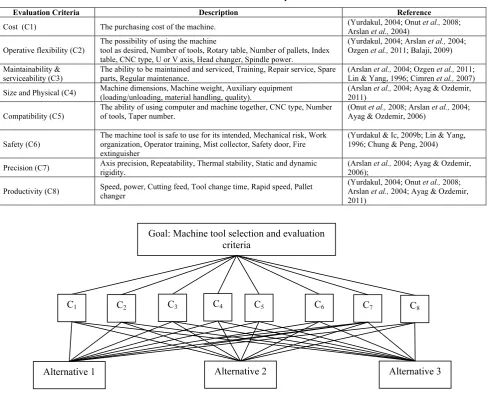
Phase I. After constructing decision making team, the most important criteria for machine tool selection was identified. Next, the qualitative and quantitative criteria were defined. The criteria listed in Table 2 are selected based on the literature survey. Finally, the project team constructed the selection criteria and problem structure (see Figure 2).
A step-wise weight assessment ratio analysis (SWARA) method (Kersuliene et al., 2010) There is a variety of approaches for assessing weights in the literature such as (Zavadskas et al., 2010), e.g. the eigenvector method, SWARA (Kersuliene et al., 2010), expert judgment method (Zavadskas et al., 2012), analytic hierarchy process (AHP) (Saaty, 1977, 1980), Entropy method (Susinskas et al., 2011, Kersuliene & Turskis, 2011), FARE (Ginevicius, 2011), etc.
Among these approaches, SWARA method is one of the brand-new ones. The most significant criterion is given rank 1, and the least significant criterion is given rank last. The overall ranks to the group of experts are determined according to the mediocre value of ranks (Kersuliene & Turskis, 2011).
Figure 1. The evaluation procedure
Phase II. Criteria weights were calculated by applying SWARA method and based on experts’ evaluations.
Phase III. In this stage, all alternatives were evaluated by project team and COPRAS-G method was applied to achieve the final ranking results.
Construction of selection criteria and problem structure
Criteria weights by SWARA Identification of selection criteria Constructing decision making team
Determining qualitative and quantitative criteria for evaluation process
Assigning evaluations via SWARA
Select the best machine tool Assigning evaluations for COPRAS Grey
computations
Ranking via COPRAS-G
Phase
I
Phase II
Table 2
Criteria and their descriptions
Figure 2. Problem structure, selection criteria and alternatives
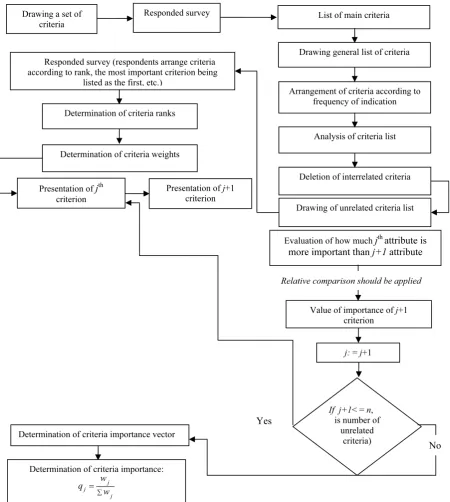
The step-wise weight assessment ratio analysis (SWARA) (Kersuliene et al., 2010) methodology is developed in 2010 and applied for the selection of rational dispute resolution method (Kersuliene & Turskis, 2011). The procedure for the criteria weights determination is presented in Figure 3. The ability to estimate experts’ opinion about importance ratio of the criteria in the process of their weights determination is the main element of this method (Kersuliene et al., 2010). This method is useful for coordinating and gathering data from experts. SWARA applications are uncomplicated and experts in various fields can contact with general idea of this method easily. All developments of decision making models based on SWARA method up to now are listed below:
− Kersuliene et al., (2010) in selection of rational dispute resolution method.
− Kersuliene and Turskis (2011) for architect selection.
− Hashemkhani Zolfani et al., (2012) in design of products.
The COPRAS-G method
In order to evaluate the overall efficiency of an alternative, it is essential to identify most important criteria, to evaluate alternatives and assess information with respect to these criteria; develop methods for evaluating the criteria to meet the DMs’ needs. Decision analysis is concerned with the situation in which a DM has to choose among several alternatives by considering a particular set of, usually conflicting criteria. For this reason Complex proportional assessment (COPRAS) method which was developed by (Zavadskas & Kaklauskas, 1996) can be applied. In real situations, the most of the criteria for evaluating alternatives deal with vague feature, and values of criteria cannot be expressed by exact numbers.
Therefore MADM approaches need to be functioned not only with exact criteria values, but with fuzzy values or with values in some intervals. (Zavadskas et al., 2008) presented the main ideas of complex proportional assessment method with grey interval numbers (COPRAS-G) method.
Evaluation Criteria Description Reference
Cost (C1) The purchasing cost of the machine. (Yurdakul, 2004; Onut et al., 2008; Arslan et al., 2004)
Operative flexibility (C2)
The possibility of using the machine
tool as desired, Number of tools, Rotary table, Number of pallets, Index table, CNC type, U or V axis, Head changer, Spindle power.
(Yurdakul, 2004; Arslan et al., 2004; Ozgen et al., 2011; Balaji, 2009)
Maintainability & serviceability (C3)
The ability to be maintained and serviced, Training, Repair service, Spare parts, Regular maintenance.
(Arslan et al., 2004; Ozgen et al., 2011; Lin & Yang, 1996; Cimren et al., 2007)
Size and Physical (C4) Machine dimensions, Machine weight, Auxiliary equipment (loading/unloading, material handling, quality).
(Arslan et al., 2004; Ayag & Ozdemir, 2011)
Compatibility (C5)
The ability of using computer and machine together, CNC type, Number of tools, Taper number.
(Onut et al., 2008; Arslan et al., 2004; Ayag & Ozdemir, 2006)
Safety (C6)
The machine tool is safe to use for its intended, Mechanical risk, Work organization, Operator training, Mist collector, Safety door, Fire extinguisher
(Yurdakul & Ic, 2009b; Lin & Yang, 1996; Chung & Peng, 2004)
Precision (C7) Axis precision, Repeatability, Thermal stability, Static and dynamic rigidity.
(Arslan et al., 2004; Ayag & Ozdemir, 2006);
Productivity (C8) Speed, power, Cutting feed, Tool change time, Rapid speed, Pallet changer
(Yurdakul, 2004; Onut et al., 2008; Arslan et al., 2004; Ayag & Ozdemir, 2011)
C1
Alternative 2 Alternative 1
Goal: Machine tool selection and evaluation criteria
C2 C3 C4 C6 C7 C8
Figure 3. Determining of the criteria weights based on (Kersuliene & Turskis, 2011)
The idea of COPRAS-G method with criterion values expressed in intervals is based on the real conditions of decision making and applications of the Grey systems theory (Deng, 1982). The COPRAS-G method uses a stepwise ranking and evaluating procedure of the alternatives in terms of significance and utility degree (Hashemkhani Zolfani et al., 2012a, b). The recent developments of decision making models based on COPRAS and COPRAS-G method are listed below:
− Hashemkhani Zolfani et al., (2011) in forest roads locating;
− Hashemkhani Zolfani et al., (2012a) in supplier selection;
− Hashemkhani Zolfani et al., (2012b) in quality control manager selection;
− Aghdaie et al., (2012) in prioritizing projects of municipality;
− Rezaeiniya et al., (2012) in greenhouse locating; − Bitarafan et al., (2012) in evaluating the
construction methods of cold-formed steel structures in reconstructing the areas damaged in natural crises;
− Das et al., (2012) in measure relative performance of institutions.
− Aghdaie et al., (2013) in market segment evaluation and selection;
− Chaterjee et al., (2011) in materials selection. Drawing a set of
criteria
Responded survey List of main criteria
Drawing general list of criteria Responded survey (respondents arrange criteria
according to rank, the most important criterion being listed as the first, etc.)
Determination of criteria ranks
Determination of criteria weights
Presentation of jth criterion
Presentation of j+1 criterion
Arrangement of criteria according to frequency of indication
Analysis of criteria list
Deletion of interrelated criteria
Drawing of unrelated criteria list
Determination of criteria importance vector
Evaluation of how much jth attribute is more important than j+1 attribute
Value of importance of j+1 criterion
j: = j+1
If j+1< = n, is number of
unrelated criteria)
Relative comparison should be applied
Yes
No
Determination of criteria importance: j
j j
w
q w
∑
− Maity et al., (2012) in materials selection.
The procedure of applying the COPRAS-G method consists of the following steps (Zavadskas et al. 2009):
1. Selecting the set of the most important criteria, describing the alternatives.
2. Constructing the decision-making matrix⊗X .
Here
⊗
x
ji is determinedx
ji (the smallest value, the lower limit) andx
ji(the biggest value, the upper limit).3. Determining significances of the criteriaqi.
4. Normalizing the decision-making matrix⊗X is calculated by formula 2.
[ ]
[ ]
[ ]
[ ]
[ ]
[ ]
[ ]
[ ]
[ ]
[
]
[
[
]
]
[ ] [
]
[
]
11 1 11 11 12 12 1 1 21 2 21 21 22 22 2 2
1 1 1 2 2
;
;
;
;
;
;
; 1, , 1,
;
;
;
m m m
m m m
n nm n n n n nm nm
x x x
x x x x x
x x x
x x x x x
x x x
x x x x x
X
j
n i
m
⊗
⊗
⊗
⊗
⊗ =
=
=
=
⊗
⊗
⎡
⎤ ⎡
⎤
⎢
⎥ ⎢
⎥
⎢
⎥ ⎢
⎥
⎢
⎥ ⎢
⎥
⎢
⎥ ⎢
⎥
⎢
⎥ ⎢
⎥
⎣
⎦ ⎣
⎦
K K
K
K K
K
M
K O
M
M
M
O
M
K K
K
(1) , 2 2 1 ~ 1 1
1 1 ⎟⎟⎠
⎞ ⎜⎜⎝ ⎛ + = ⎟⎟⎠ ⎞ ⎜⎜⎝ ⎛ + =
∑
∑
∑
=∑
= = jn= ji n j ji ji n j n j ji ji ji x x x x x x x ; ) ( 2 2 1 ~ 11 1
∑
∑
=∑
= = + = ⎟⎟⎠ ⎞ ⎜⎜⎝ ⎛ + = nj ji ji ji n j n j ji ji ji x x x x x x
x j=1,n;i=1,m (2)
In formula (2)
x
ji‒ the lower value of the I criterion in the alternative j of the solution;x
ji ‒ the upper value ofthe criterion i in the alternative j of the solution; m ‒ the
number of criteria; n ‒ the number of the alternatives, compared. Then, the decision-making matrix is normalized and determined according to the formula 3:
; ] ~ ; ~ [ ] ~ ; ~ [ ] ~ ; ~ [ ] ~ ; ~ [ ] ~ ; ~ [ ] ~ ; ~ [ ] ~ ; ~ [ ] ~ ; ~ [ ] ~ ; ~ [ ~ 2 2 1 1 1 2 22 22 21 21 1 1 12 12 11 11 ⎥ ⎥ ⎥ ⎥ ⎥ ⎦ ⎤ ⎢ ⎢ ⎢ ⎢ ⎢ ⎣ ⎡ = ⊗ nm nm n n n n m m m m x x x x x x x x x x x x x x x x x x X L M O M M L L (3)
5. Calculating the weighted normalized decision matrix⊗Xˆ . The weighted normalized values ⊗xˆjiare
calculated as follows:
or
q
x
x
ˆ
ji=
⊗
~
ji⋅
i;
⊗
x
ˆ
ji=
~
x
ji⋅
q
iand
x
ˆ
ji=
~
x
ji⋅
q
i (4)whereqiis the significance of the
i
-th criterion. Then, the normalized decision-making matrix is:; ] ˆ ; ˆ [ ] ˆ ; ˆ [ ] ˆ ; ˆ [ ] ˆ ; ˆ [ ] ˆ ; ˆ [ ] ˆ ; ˆ [ ] ˆ ; ˆ [ ] ˆ ; ˆ [ ] ˆ ; ˆ [ ] ˆ [ ] ˆ [ ] ˆ [ ] ˆ [ ] ˆ [ ] ˆ [ ] ˆ [ ] ˆ [ ] ˆ [ ˆ 2 2 1 1 2 2 22 22 21 21 1 1 12 12 11 11 2 1 1 22 21 1 12 11 ⎥ ⎥ ⎥ ⎥ ⎥ ⎦ ⎤ ⎢ ⎢ ⎢ ⎢ ⎢ ⎣ ⎡ = ⎥ ⎥ ⎥ ⎥ ⎦ ⎤ ⎢ ⎢ ⎢ ⎢ ⎣ ⎡ ⊗ ⊗ ⊗ ⊗ ⊗ ⊗ ⊗ ⊗ ⊗ = ⊗ nm nm n n n n m m m m nm n n m m x x x x x x x x x x x x x x x x x x x x x x x x x x x X L M O M M L L L M O M M L L (5)
6. Calculating the sums
P
j of criterion values, whose larger values are more preferable:);
ˆ
ˆ
(
2
1
1 ji k i jij
x
x
P
=
∑
+
=
(6)
7. Calculating the sums
R
jof criterion values, whosesmaller values are more preferable:
(
)
i k m mk
i ji ji
j
x
x
R
; ,2 1
1
ˆ
+ˆ
==
∑
+
= (7)
In formula (7), (m−k)is the number of criteria which must be minimized.
8. Determining the minimal value of
R
j as follows:n j R
Rmin=minj j, = ,1 (8)
9. Calculating the relative significance of each alternative
Q
j the expression:1 1 ; 1 n j j j j n j j j R Q P R R = = ∑ ∑ + = (9)
10. Determining the optimally criterion by
K
the formula:; , 1 , max Q i n
K = j j = (10)
11. Determining the priority order of the alternatives. 12. Calculating the utility degree of each alternative by the formula: %. 100 max × = Q Q N j j (11)
Case Study
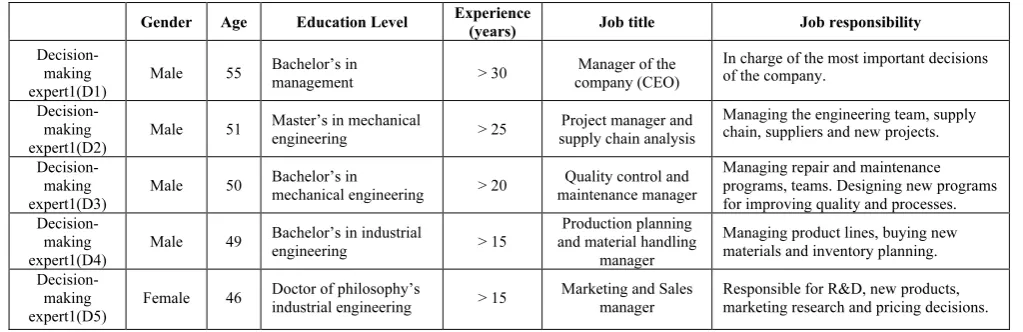
A real case study problem has been chosen to show the performance and application of the model. The study was conducted by a well-known company in manufacturing industry. This company is an average sized manufacturing company which has 80 employers and located in Simin Dasht Industrial area, Iran. This company makes some kind of press machines such as hydraulic and pneumatic, and casts of them. Besides, it is a supplier of Zamyad Automobile manufacturing Company. Recently, there has been a regular increase in request for products of this company and company needs to buy a new CNC machine for making new casts. Therefore, manager of the company has decided to buy a new CNC machine. After defining a new project for buying a new CNC, a project team including two industrial engineers, two mechanical engineer and manager of the company was collected (see table 3). The project team identified three potential machines as alternatives for purchase. The alternatives
were denoted as A1, A2, and A3, respectively. For receiving general agreement in every step of this project, face to face interviews and Delphi method were used. So, after a lot of discussions, a project team identified criteria for evaluation and they constructed problem structure. Then the project team accepted the criteria list that was explored from the literature study (see table 2). As mentioned before, in this paper SWARA was used for calculating criteria weights.
After determining all selection criteria and machine tool alternatives, SWARA method was used to tackle the ambiguities involved in the process of the linguistic assessment of the data. Like other similar methods (AHP and ANP), SWARA is also based on expert’s ideas or thoughts but experts can participate without difficulty in this method. Information about experts is shown in Table 3. Table 4 shows the results of criteria weights. The rank of criteria was shown in the first column and the last column was shown the weight of each criterion.
Table 3 The characteristics of the five decision-making experts
Gender Age Education Level Experience
(years) Job title Job responsibility
Decision-making expert1(D1)
Male 55 Bachelor’s in
management > 30
Manager of the company (CEO)
In charge of the most important decisions of the company.
Decision-making expert1(D2)
Male 51 Master’s in mechanical engineering > 25 supply chain analysis Project manager and
Managing the engineering team, supply chain, suppliers and new projects.
Decision-making expert1(D3)
Male 50 Bachelor’s in
mechanical engineering > 20
Quality control and maintenance manager
Managing repair and maintenance programs, teams. Designing new programs for improving quality and processes.
Decision-making expert1(D4)
Male 49 Bachelor’s in industrial
engineering > 15
Production planning and material handling
manager
Managing product lines, buying new materials and inventory planning.
Decision-making expert1(D5)
Female 46 Doctor of philosophy’s
industrial engineering > 15
Marketing and Sales manager
Responsible for R&D, new products, marketing research and pricing decisions.
Table 4 Final results of SWARA method in weighting criteria
Criterion
Comparative importance of average value
s
jCoefficient
k
j=
s
j+
1
Recalculated weightj j j k
x
w = −1 Weight
∑
=
j j
j w
w q
C1 1 1 0.191
C2 0.15 1.15 0.869 0.166
C7 0.16 1.16 0.749 0.143
C3 0.13 1.13 0.662 0.126
C4 0.14 1.14 0.580 0.112
C8 0.13 1.13 0.513 0.099
C5 0.15 1.15 0.446 0.086
C6 0.12 1.12 0.398 0.077
Results
After representing the case study, proposed model, selecting the project team, identifying most important criteria for evaluating, representing the decision model and using analytical techniques, the remaining part of the study will focus on the obtained numerical results. The hierarchical structure of decision problem consists of three
alternative according to each criterion and developed Table 5. The evaluations of these three alternatives according to the previously stated criteria, i.e., evaluation matrix, are displayed in Table 5.
Also, Table 5 indicates initial decision making matrix, with the criterion values described in intervals. For the weight ݍ of criteria, we used the weights in Table 4. As mentioned before, the aim of using SWARA is to determine importance weight of criteria that will be employed in COPRAS-G method.
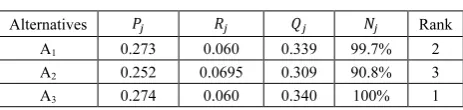
The initial decision making matrix, has been normalized first as discussed in section 3.2. The normalized decision making matrix is presented in Table 6 by using equations (6) to (11) or all the alternatives. Table 6 shows normalized weighted decision making matrix. According to results of Table 7, it shows evaluation of utility degree, A3>A1>A2. A3 is defined as the best alternative for this selection that a project team can choose for buying new CNC. Hybrid approach results indicate that
A3 is the best candidate with the highest degree and is the best machine tool alternative for selection.
Table 5 Initial decision making matrix with the criteria values described in intervals
⊗ ⊗ ⊗ ⊗ ⊗ ⊗ ⊗ ⊗
opt Min Max Max Max Max Max Max Max
0.191 0.166 0.126 0.112 0.086 0.077 0.143 0.099
Alternatives , , , , , , , ,
A1 60 70 50 60 80 90 70 80 60 70 60 70 80 90 80 90
A2 70 80 50 60 60 70 60 70 50 60 70 80 80 90 70 80
A3 60 70 70 80 60 70 60 70 60 70 60 70 90 95 70 80
Table 6 Normalized weighted decision making matrix
⊗ ⊗ ⊗ ⊗ ⊗ ⊗ ⊗ ⊗
Opt. Min Max Max Max Max Max Max Max
Alternatives , , , , , , , ,
A1 0.055 0.065 0.044 0.054 0.046 0.052 0.0380.043 0.0270.032 0.0220.026 0.043 0.049 0.0330.037
A2 0.065 0.074 0.044 0.054 0.035 0.041 0.0320.038 0.0230.027 0.0260.030 0.043 0.049 0.0290.033
A3 0.055 0.065 0.062 0.071 0.035 0.041 0.0320.038 0.0270.032 0.0220.026 0.049 0.051 0.0290.033
Table 7 Evaluation of utility degree
Alternatives Rank
A1 0.273 0.060 0.339 99.7% 2
A2 0.252 0.0695 0.309 90.8% 3
A3 0.274 0.060 0.340 100% 1
Conclusions and Discussions
Today machines are used for producing many goods in every company and they can be considered as an asset of a company. Machines can influence quality of the products so it is important to select the most appropriate machine for every company. Besides, the cost of buying a new machine is expensive so this decision should be considered as a critical decision for every organization. Therefore the evaluation and selection of new machine is a crucial managerial or political activity for every company. It helps a company to choose its own machine tool so lead to companies effectively satisfying customers’ needs and wants.
In this paper, a hybrid MADM methodology with three phases based on integrating two MADM methods for selecting the most suitable machine tool was proposed. According to the results of this study, DMs faced with critical factors that were found to influence an organization’s decisions about selecting a new machine tool. Based on this research, it was shown that DMs have a great impact on decisions in an organization so their
decisions could influence the final outcomes. Specifically, this study provides valuable view which DMs should selected as a decision making team.
Though DMs’ judgments, education and expertise play important roles in the success or failure of manufacturing decisions, sometimes their evaluations or judgments are vague and imprecise. These inaccuracies can cause difficulties in the process of decision making. Another meaningful contribution to this study is the proposed COPRAS-G, an effective mathematical model which uses grey relation analysis for dealing with vagueness. Although, the most important criteria and problem structure was constructed based on literature study, some of selected criteria and evaluations were qualitative. So for dealing uncertainty and improving lack of precision in evaluating criteria and machine tool alternatives, grey numbers were used. In COPRAS-G method, the score option can provide better insight to the DM by taking into account both the differences and similarities of the alternatives according to the best and the worse alternatives. The grey numbers enabled DM to get better results in the overall importance of criteria and real alternatives.
In general, the findings of this study have contributed towards providing important and advanced knowledge by various criteria and a simple, efficient method with which managers of a company or decision makers can increase their ability to choose an appropriate machine tool in their efforts to develop the firms’ outputs’ qualities. As a result of the study, we found that the proposed approach is practical for ranking machine tool alternatives with respect to multiple conflicting criteria.
This integration was proposed as an analytical model for dealing with uncertainly and imprecise information in conflict management situations. Therefore further research can apply this method as an adaptable approach to other situations. Also, further research could focus on using other multi-attribute decision making (MADM) approaches
including ARAS, VIKOR, ANP, and PROMETHEE, etc. and compare with the results of this paper.
The study results show that decision criteria significantly influence the choice of machine tool selection. However in this paper the most important criteria were selected based on the in-depth literature survey; another study can be designing a new structure with other criteria, sub-criteria and assessing alternatives with a new structure.
Acknowledgment
We gratefully acknowledge the Lolaiy Industrial Company for their participation on this project.
References
Aghdaie, M. H., Hashemkhani Zolfani, S., & Zavadskas, E. K. (2013). Market Segment Evaluation and Selection an Application of FUZZY AHP and COPRAS-G Method. Journal of Business Economics and Management, (In Press). Aghdaie, M. H., Hashemkhani Zolfani, S., & Zavadskas, E. K. (2012). Prioritizing Constructing Projects of Municipalities
Based on AHP and COPRAS-G: A Case Study About Footbridges in Iran. The Baltic Journal of Road and Bridge Engineering, 7(2), 145-153. http://dx.doi.org/10.3846/bjrbe.2012.20
Almutawa, S., Savsar, M., & Al-Rashdan, K. (2005). Optimum Machine Selection in Multistage Manufacturing Systems,
International Journal of Production Research, 43(6), 1109-1126. http://dx.doi.org/10.1080/00207540412331320544 Arslan, M. C., Catay, B., & Budak, E. (2004). A decision Support System for Machine tool Selection. Journal of
Manufacturing TechnologyManagement, 15, 101-109. http://dx.doi.org/10.1108/09576060410512374
Atmani, A., & Lashkari, R. S. (1998). A model of Machine-tool Selection and Operation Allocation in FMS. International Journal of Production Research, 36(5), 1339-1349. http://dx.doi.org/10.1080/002075498193354
Azadeh, A., Nazari-Shirkouhi, S., Hatami-Shirkouhi, L., A., & Ayyub, L. A. (2011). A Unique Fuzzy multi-Criteria Decision Making: Computer Simulation Approach for Productive Operators’ Assignment in Cellular Manufacturing Systems with Uncertainty and Vagueness. The International Journal of Advanced Manufacturing Technology, 56(1-4), 329-343. http://dx.doi.org/10.1007/s00170-011-3186-9
Ayag, Z. (2007). A Hybrid Approaches to Machine tool Selection through AHP and Simulation. International Journal of
Production Research, 45(9), 2029-2050. http://dx.doi.org/10.1080/00207540600724856
Ayag, Z., & Ozdemir, R. G. (2011). An Intelligent Approach to Machine tool Selection through Fuzzy Analytic Network Process. Journal of Intelligent Manufacturing, 22(2), 136-177. http://dx.doi.org/10.1007/s10845-009-0269-7
Ayag, Z., & Ozdemir, R. G. (2006). A Fuzzy AHP Approach to Evaluating Machine tool Alternatives. Journal of Intelligent Manufacturing, 17, 179-190. http://dx.doi.org/10.1007/s10845-005-6635-1
Balaji, C. M. (2009). Selection of a Machine Tool for FMS Using ELECTRE III; a Case Study. Proceedings of the Fifth
Annual IEEE International Conference on Automation Science and Engineering, CASE'09, 171-176.
BinduMadhuri, Ch., AnandChandulal, J., & Padmaja, M. (2010). Selection of Best Web Site by Applying COPRAS-G method. International Journal of Computer Science and Information Technologies, 1(2), 138-146.
Bitarafan, M., Hashemkhani Zolfani, S., Arefi, S. L., & Zavadskas, E. K. (2012). Evaluating the Construction Methods of Cold-Formed Steel Structures in Reconstructing the areas Damaged in Natural Crises, Using the Methods AHP and COPRAS-G. Archives of Civil and Mechanical Engineering, (12), 360-367.
Brans, J. P., Mareschal, B., & Vincke, P. H. (1984). PROMETHEE: A New Family of Outranking Methods in MCDM,
Operational Research, IFORS’84, North Holland, 477-90.
Brauers, W. K., & Zavadskas, E. K. (2006). The MOORA Method and its Application to Privatization in a Transition Economy. Control and Cybernetics, 35(2), 445-469.
Cimren, E., Catay, B., & Budak, E. (2007). Development of a Machine Tool Selection System Using AHP. The International Journal of Advanced Manufacturing Technology, 35(3-4), 363-376. http://dx.doi.org/10.1007/s00170-006-0714-0 Chan, F. T. S., & Swarnkar, R. (2006). Ant Colony Optimization Approach to a Fuzzy Goal Programming Model for a
Machine Tool Selection and Operation Allocation Problem in an FMS. Robotics and Computer - Integrated Manufacturing, 22, 353-362. http://dx.doi.org/10.1016/j.rcim.2005.08.001
Churchman, C. W., & Ackoff, R. L. (1954). An Approximate Measure of Value. Journal of the Operational Research Society of America, 2(2), 172-187. http://dx.doi.org/10.1287/opre.2.2.172
Chung, C., & Peng, Q. (2004). The Selection of Tools and Machines on Web-Based Manufacturing Environments.
International Journal of Machine Tools and Manufacture, 44(2/3), 317-326. http://dx.doi.org/10.1016/j.
ijmachtools.2003.09.002
Dagdeviren, M. (2008). Decision Making in Equipment Selection: an Integrated Approach with AHP and PROMETHEE.
Journal of Intelligent Manufacturing, 19(4), 397-406. http://dx.doi.org/10.1007/s10845-008-0091-7
Das, M. C., Bijan, S., & Ray, S. (2012). A Framework to Measure Relative Performance of Indian Technical Institutions Using Integrated Fuzzy AHP and COPRAS Methodology. Socio-Economic Planning Sciences, 46(3), 230-241. http://dx.doi.org/10.1016/j.seps.2011.12.001
Devedzic, G. B., & Pap, E. (1999). Multi-Criteria-Multi-Stages Linguistic Evaluation and Ranking of Machine Tools. Fuzzy Sets and Systems, 102, 451-461. http://dx.doi.org/10.1016/S0165-0114(98)00219-X
Deng, J. L. (1982). Control Problems of Grey Systems. Systems and Control, 1(5), 288-294. http://dx.doi.org/10.1016/S0167-6911(82)80025-X
Duran, O., & Aguilo, J. (2008). Computer-aided machine-tool selection based on a Fuzzy-AHP approach, Expert Systems with Applications, 34, 1787-1794. http://dx.doi.org/10.1016/j.eswa.2007.01.046
Georgakellos, D. A. (2005). Technology Selection from Alternatives: a Scoring Model for Screening Candidates in Equipment Purchasing. International Journal of Innovation. Technology Management, 2(1), 1-18. http://dx.doi.org/10.1142/S0219877005000393
Ginevicius, R. (2011). A new Determining Method for the Criteria Weights in Multi-Criteria Evaluation. International
Journal of Information Technology & Decision Making, 10(6), 1067-1095. http://dx.doi.org/10.1142/S021962
2011004713
Goh, C. H., Tung, Y. C. A., & Cheng, C. H. (1995). A Revised Weighted Sum Decision Model for Robot Selection.
Computers and Industrial Engineering, 30(2), 193-9. http://dx.doi.org/10.1016/0360-8352(95)00167-0
Gerrard, W. (1988). Selection Procedures Adopted by Industry for Introducing New Machine Tools, in Worthington, B. (Ed.), Advances in Manufacturing Technology III, Proceedings Fourth National Conference on Production Research, Kogan Page, London, 525-531.
Grigoroudis, E., & Siskos, Y. (2002). Preference Disaggregation for Measuring and Analysing Customer Satisfaction: the MUSA Method. European Journal of Operational Research, 143(1), 148-170. http://dx.doi.org/10.1016/S0377-2217(01)00332-0
Hashemkhani, Z. S., Rezaeiniya, N., Zavadskas, E. K., & Turskis, Z. (2011). Forest Roads Locating based on AHP- COPRAS-G methods- An Empirical Study based on Iran, E & M: Ekonomie a Management, 14(4), 6-21.
Hashemkhani, Z. S., Rezaeiniya, N., Aghdaie, M. H., & Zavadskas, E. K. (2012b). Quality Control Manager Selection based on AHP- COPRAS-G Methods: A Case in Iran. Economska Istrazivanja- Economic Research 25(1), 88-104. Hashemkhani, Z. S., Chen, I. S., Rezaeiniya, N., & Tamosaitiene, J. (2012a). A Hybrid MCDM Model Encompassing AHP
and COPRAS-G method for the Selection of Company Supplier: A Case in Iran. Technological and Economic
Development of Economy, 18(3), 529-543. http://dx.doi.org/10.3846/20294913.2012.709472
Hashemkhani, Z. S., Zavadskas, E. K., & Turskis, Z. (2012c). Design of Products with both International and Local Perspectives Based on Yin-Yang balance theory and SWARA Method. Economska-Istraživanja- Economic Research (In Press).
Hwang, C. L., & Yoon, K. (1981). Multiple Attribute Decision Making Methods and Applications, Springer-Verlag. Heidelberg, 1981. http://dx.doi.org/10.1007/978-3-642-48318-9
Ilangkumaran, M., Sasirekha, V., Anojkumar, L., & Boopathi Raja, M. (2012). Machine tool Selection Using AHP and VIKOR Methodologies Under Fuzzy Environment. International Journal of Modeling in Operations Management, 2(4), In press. http://dx.doi.org/10.1504/IJMOM.2012.049133
Kersuliene, V., Zavadskas, E. K., & Turskis, Z. (2010). Selection of Rational Dispute Resolution Method by Applying New Step‐Wise Weight Assessment Ratio Analysis (SWARA). Journal of Business Economics and Management, 11(2), 243-258. http://dx.doi.org/10.3846/jbem.2010.12
Kersuliene, V., & Turskis, Z. (2011). Integrated Fuzzy Multiple Criteria Decision Making Model for Architect Selection,
Technological and Economic Development of Economy, 17(4), 645-666. http://dx.doi.org/10.3846/20294913.
2011.635718
Kalpakjian, S., & Schmid, S. R. (2001). Manufacturing Engineering and Technology, 4th ed. Prentice-Hall Inc., Upper Saddle River, NJ.
Lashgari, A., Fouladgar, M. M., Yazdani-Chamzini, A., & Skibniewski, M. J. (2011). Using an Integrated Model for Shaft Sinking Method Selection. Journal of Civil Engineering and Management 17(4), 569- 580. http://dx.doi.org/ 10.3846/13923730.2011.628687
Lashgari, A., Yazdani-Chamzini, A., Fouladgar, M. M., Zavadskas, E. K., Shafiee, S., & Abbate, N. (2012). Equipment Selection Using Fuzzy Multi Criteria Decision Making Model: Key Study of Gole Gohar Iron Min. Inzinerine Ekonomika-Engineering Economics, 23(2), 125-136. http://dx.doi.org/10.5755/j01.ee.23.2.1544
Lin, Z. C., & Yang, C. B. (1996). Evaluation of Machine Selection by the AHP Method. Journal of Materials Processing Technology, 57, 253-258. http://dx.doi.org/10.1016/0924-0136(95)02076-4
Maity, S. R., Chatterjee, P., & Chakraborty, S. (2012). Cutting Tool Material Selection Using Grey Complex Proportional Assessment Method. Materials & Design, 36(4), 372-378. http://dx.doi.org/10.1016/j.matdes.2011.11.044
Maleki, R. A. (1991). Flexible Manufacturing Systems: The Technology and Management. Prentice-Hall, Englewood Cliffs, NJ, 1991.
Mazumdar, A., Datta, S., & Makapatra, S. S. (2010). Multicriteria Decision – Making Models for the Evaluation and Appraisal of Teachers' Performance. International Journal of Productivity and Quality Management, 6(2), 213-230. http://dx.doi.org/10.1504/IJPQM.2010.034406
Mishra, S., Prakash, Tiwari, M. K., & Lashkari, R. S. (2006). A Fuzzy goal-Programming Model of Machine tool Selection and Operation Allocation Problem in FMS: A Quick Converging Simulated Annealing- Based Approach. International Journal of Production Research, 44(1), 43-76. http://dx.doi.org/10.1080/13528160500245772
Moon,C., Lee, M., Seo, Y., & Lee, Y. H. (2002). Integrated Machine Tool Selection and Operation Sequencing with Capacity and Precedence Constraints Using Genetic Algorithm. Computers and Industrial Engineering, 43(3), 605-621. http://dx.doi.org/10.1016/S0360-8352(02)00129-8
Onut, S., Karar, S., & Tugba, E. (2008). A Hybrid Fuzzy MCDM Approach to Machine tool Selection. Journal of Intelligent Manufacturing, 19, 443-453. http://dx.doi.org/10.1007/s10845-008-0095-3
Opricovic, S. (1998). Multi-Criteria Optimization of Civil Engineering Systems. Faculty of Pennsylvania, Belgrade.
Ozgen, A., Tuzkaya, G., Tuzkaya, U. R., & Ozgen, D. (2011). A Multi-Criteria Decision Making Approach for Machine Tool Selection Problem in a Fuzzy Environment. International Journal of Computational Intelligence Systems, 4(4), 431-445. doi:10.2991/ijcis.2011.4.4.3
Paramasivam, V., Senthil, V., & Rajam Ramasamy, N. (2011). Decision Making in Equipment Selection: an Integrated Approach with Digraph and Matrix Approach, AHP and ANP. The International Journal of Advanced Manufacturing Technology, 54(9-12), 1233-1244. http://dx.doi.org/10.1007/s00170-010-2997-4
Rezaeiniya, N., Hashemkhani Zolfani, S., & Zavadskas, E. K. (2012). Greenhouse Locating Based on ANP-COPRAS-G Methods- An Empirical Study Based on Iran. International Journal of Strategic Property Management, 16(2), 188-200. http://dx.doi.org/10.3846/1648715X.2012.686459
Roy, B. (1968). Classement et Choix en Presence de Points de Vue Multiples (la method Electre). Revue Francaised’ Informatique et de Recherche Operationnelle, 8(1), 57-75.
Rai, R., Kameshwaran, S., & Tiwari, M. K. (2002). Machine–tool Selection and Operation Allocation in FMS: Solving a Fuzzy Goal-Programming Model Using a Genetic Algorithm. International Journal of Production Research, 40(3), 641-665. http://dx.doi.org/10.1080/00207540110081515
Saaty, T. L. (1977). A Scaling Method for Priorities in Hierarchical Structures. Journal of Mathematical Psychology 15, 234-281. http://dx.doi.org/10.1016/0022-2496(77)90033-5
Saaty, L. T. (1980). The Analytic Hierarchy Process. McGraw Hill Company, New York.
Saaty, L. T., & Vargas, L. G. (2001). Models, Methods, Concepts &Applications of the Analytical Hierarchy Process. Kluwer Academic. Publishers, Boston. http://dx.doi.org/10.1007/978-1-4615-1665-1
Samvedi, A., Jain, V., & Chan, F. T. S. (2012). An Integrated Approach for Machine Tool Selection Using Fuzzy Analytical Hierarchy Process and Grey Relational Analysis. International Journal of Production Research, 50(12), 3211-3221. http://dx.doi.org/10.1080/00207543.2011.560906
Sun, S. (2002). Assessing Computer Numerical Control Machines Using Data Envelopment Analysis. International Journal
of Production Research, 40(9), 2011-2039. http://dx.doi.org/10.1080/00207540210123634
Susinskas, S., Zavadskas, E. K., & Turskis, Z. (2011). Multiple Criteria Assessment of Pile-Columns Alternatives. The Baltic Journal of Road and Bridge Engineering, 6(3), 77-83. http://dx.doi.org/10.3846/bjrbe.2011.19
Tabucanon, M. T., Batanov, D. N., & Verma, D. K. (1994). Intelligent Decision Support System (DSS) for the selection process of alternative machines for Flexible Manufacturing Systems (FMS). Computersin Industry, 25, 131-143. http://dx.doi.org/10.1016/0166-3615(94)90044-2
Wang, T. Y., Shaw, C. F., & Chen, Y. L. (2000). Machine Selection in Flexible Manufacturing Cell: A Fuzzy Multiple Attribute Decision Making Approach. International Journal of Production Research, 38, 2079–2097. http://dx.doi.org/10.1080/002075400188519
Wallenius, J., Dyer, J. S., Fishburn, P. C., Steuer, R. E., Zionts, S., & Deb, K. (2008). Multiple Criteria Decision Making, Multiattribute Utility Analysis: Recent Accomplishments and What Lies Ahead. Management Science, 54(7), 1336-1349. http://dx.doi.org/10.1287/mnsc.1070.0838
Yazdani-Chamzini, A., & Yakhchali, S. H. (2012). Tunnel Boring Machine (TBM) Selection Using Fuzzy Multicriteria Decision Making Methods. Tunnelling and Underground Space Technology 30, 194-204. http://dx.doi.org/10.1016/j.tust.2012.02.021
Yurdakul, M. (2004). AHP as a Strategic Decision-Making Tool to Justify Machine Tool Selection. Journal of Materials Processing Technology 146, 365-376. http://dx.doi.org/10.1016/j.jmatprotec.2003.11.026
Yurdakul, M., & Ic, Y. T. (2009a). Application of Correlation Test to Criteria Selection for Multi Criteria Decision Making (MCDM) Models. The International Journal of Advanced Manufacturing Technology, 40(3-4), 403-412. http://dx.doi.org/10.1007/s00170-007-1324-1
Yurdakul, M., & Ic, Y. T. (2009b). Analysis of the Benefit Generated by Using Fuzzy Numbers in a TOPSIS Model Developed for Machine Tool Selection Problems, Journal of Materials Processing Technology, 209(1), 310-317. http://dx.doi.org/10.1016/j.jmatprotec.2008.02.006
Zavadskas, E. K., Vainiunas, P., Turskis, Z., & Tamosaitiene, J. (2012). Multiple Criteria Decision Support System for Assessment of Projects Managers in Construction. International Journal of Information Technology and Decision Making, 11(2), 501-520. http://dx.doi.org/10.1142/S0219622012400135
Zavadskas, E. K., & Turskis, Z. (2011).“Multiple Criteria Decision Making (MCDM) Methods in Economics: an Overview”,
Technological and Economic Development of Economy. 17(2), 397-427. doi:10.384 6/20294913.2011.593 291. ISSN
2029-4913.
Zavadskas, E. K., Kaklauskas, A., Turskis, Z., & Tamosaitiene, J. (2009). Multi-Attribute Decision-Making Model by Applying Grey Numbers. Informatica, 20(2), 305–320.
Zavadskas, E. K., Turskis, Z., Ustinovichius, L., & Shevchenko, G. (2010). Attributes Weights Determining Peculiarities in Multiple Attribute Decision Making Methods. InzinerineEkonomika–Engineering Economics, 21(1), 32-43.
Zavadskas, E. K., & Turskis, Z. (2010). A new Additive Ratio Assessment (ARAS) Method in Multi-Criteria Decision-Making. Technological and Economic Development of Economy, 16(2), 159-172. http://dx.doi.org/10.3846/tede.2010.10 Zavadskas, E. K., & Kaklauskas, A. (1996). Determination of an Efficient Contractor by Using the new Method of Multi Criteria Assessment”. In Langford, D. A.; Retik, A. (eds.) International Symposium for “The Organization and Management of Construction”. Shaping Theory and Practice. Vol. 2: Managing the Construction Project and Managing Risk. CIB W 65; London, Weinheim, New York, Tokyo, Melbourne, Madras. - London: E and FN SPON, 94-104. Zavadskas, E. K., Kaklauskas, A., Turskis, Z., & Tamosaitiene, J. (2008). Selection of the Effective Dwelling House Walls by
Applying Attributes Values Determined at Intervals. Journal of Civil Engineering and Management, 14(2), 85-93. http://dx.doi.org/10.3846/1392-3730.2008.14.3
Mohammad Hasan Aghdaie, Sarfaraz Hashemkhani Zolfani, Edmundas Kazimieras Zavadskas
Sprendimo priėmimas pasirenkant mechanines stakles: jungtinis SWARA ir COPRAS-G metodas
Santrauka
Šiais laikais beveik visos kompanijos, gamindamos gaminius naudoja savo stakles. Staklių kokybė gali daryti įtaką gaminių kokybei, todėl kiekvienai kompanijai svarbu pasirinkti pačias tinkamiausias stakles. Naujos staklės yra brangios, todėl siekį įsigyti stakles, reikėtų laikyti svarbiu kiekvienos organizacijos sprendimu. Naujų staklių įvertinimas ir pasirinkimas yra svarbi kiekvienos kompanijos valdymo arba politikos dalis. Mechaninės staklės yra viena iš svarbiausių gamybos proceso dalių, kuri gali padėti kompanijai pasiekti aukštą konkurencingumą rinkoje. Be to, kompanijos rezultatų kokybė priklauso nuo staklių ir todėl kiekviena kompanija turėtų pati pasirinkti joms tinkamiausias ir geriausias stakles. Tam tikrų staklių pasirinkimas yra labai reikšmingas gamybos kompanijai, nes tai padeda pasiekti aukštą našumą ir efektyvumą jų veikloje. Rinka siūlo daugybę skirtingų rūšių staklių. Tinkama staklių pasirinkimo dalimi reikėtų laikyti staklių kainą, saugumą, gamybinį lankstumą. Tai pagrindiniai kriterijai, į kuriuos reiktų atkreipti dėmesį renkantis stakles. Tinkamas staklių pasirinkimas ir įsigyjimas leidžia kompanijai efektyviau tenkinti vartotojų poreikius ir norus.
Taigi staklių pasirinkimą galima laikyti viena iš sprendimų priėmimo pagal daugelį savybių (MADM - multiple-attribute decision making)
problema. Dažniausiai, naudojant MADM metodus, susiduriama su daugybės skirtingų alternatyvų pasirinkimo procesu, kuris atsiranda esant konfliktui
tarp tikslų ir kriterijų. Šio darbo tikslas yra pasiūlyti jungtinę tinkamų žingsnių svorio įvertinimo santykio analizę (SWARA - step-wise weight
assessment ratio analysis) ir sudėtinį proporcingą alternatyvų įvertinimą grey santykiu (COPRAS-G - complex proportional assessment of alternatives with grey relations), kuris skirtas įvertinti ir pasirinkti stakles.
Šiame tyrime, pasirenkant ir įvertinant stakles, buvo panaudoti du MADM metodai, SWARA ir COPRAS-G. Norint nustatyti patraukliausius kriterijus, kurie daro įtaką pasirenkant stakles, buvo išsamiai išanalizuota teorinė literatūra. Išskirti aštuoni įvertinimo proceso kriterijai. Tai kaina, gamybinis lankstumas, eksploatavimo ir aptarnavimo galimybė, dydis ir fiziniai kriterijai: suderinamumas, saugumas, tikslumas ir našumas. Pasiūlytos metodikos pirmoji dalis, t. y. SWARA, yra naudinga nustatant kiekvieno kriterijaus svarbą ir apskaičiuojant kiekvieno kriterijaus svorį, o antroji dalis COPRAS-G, yra naudinga įvertinant alternatyvas daug tiksliau, nei įprastiniu glaustu COPRAS metodu ir surikiuojant staklių alternatyvas nuo geriausios iki blogiausios. Asmenų, priimančių sprendimus išsilavinimas yra labai svarbus . Nuo jų dažnai priklauso gamybos sprendimų sėkmė arba nesėkmė. Dažnai priimančių sprendimus asmenų įvertinimai arba sprendimai yra nemotyvuoti ir netikslūs. Tokie netikslumai gali sukelti sunkumų įvertinant ir
priimant sprendimus. Įvertinimo metu, spendimų priėmėjas turi įvertinti kriterijų, kuris yra netikslus. Grey santykio analizė leidžia įtraukti neaiškią ir
Šis modelis yra hibridinis modelis. Jį sudaro du MADM metodai, skirti pagerinti pasirinkimo kokybę ir tikslumą. Taip pat šį modelį sudaro trys fazės. Fazėje I, sudarius sprendimų priėmimo komandą, buvo nustatyti patys svarbiausi staklių pasirinkimo kriterijai. Toliau buvo nustatyti kokybiniai ir kiekybiniai kriterijai. Kriterijų sąrašas pasirinktas remiantis literatūros apžvalga. Galiausiai, projekto komanda sudarė pasirinkimo kriterijų ir problemos struktūrą. Fazėje II, kriterijų svoriai buvo apskaičiuoti taikant SWARA metodą bei remiantis ekspertų įvertinimais. Fazėje III, projekto komanda įvertino visas alternatyvas ir buvo pritaikytas COPRAS-G metodas, siekiant gauti galutinius rezultatus.
Norint pailiustruoti pasiūlytą metodiką, buvo atliktas tyrimas gamybinėje kompanijoje Karaj mieste, Irane. Kaip alternatyvos buvo trys kompiuterinio skaitmeninio valdymo staklės, kurias projekto komanda parinko įvertinti, ir viena iš jų turėtų būti pasirinkta kaip geriausia alternatyva.
Delphi metodika buvo panaudota, norint gauti bendrą daugelio šio modelio žingsnių variantą. Penki sprendimų priėmimo ekspertai buvo pasirinkti alternatyvoms įvertinti, prieš tai atsižvelgiant į nustatytus kriterijus. Šis modelis gali padėti vadovams įvertinti ir pasirinkti geriausią staklių alternatyvą, remiantis savo kompanijos strategija, resursais, politika ir t.t.
Šio tyrimo rezultatai leido nustatyti įvairius kriterijus, taip pat paprastą ir efektyvų metodą, kuriuo naudodamiesi kompanijos vadovai arba sprendimų priėmėjai turi galimybę pasirinkti atitinkamas stakles, stengdamiesi plėtoti kompanijų produkcijos kokybę. Tyrimo metu mes supratome, kad pasiūlytas metodas yra praktiškas, nes vertinant ir klasifikuojant staklių alternatyvas, remiamasi daugeliu prieštaringų kriterijų. Šiame darbe svarbiausi
kriterijai buvo pasirinkti remiantis išsamia literatūros apžvalga. Kitas tyrimas gali būti apie naujos struktūros kūrimą su kitais kriterijais, sub-kriterijais ir
įvertinant alternatyvas su nauja struktūra.
Remiantis šio tyrimo rezultatais, sprendimų priėmėjai susidūrė su svarbiais veiksniais, kurie darė įtaką organizacijos sprendimams renkantis naujas stakles. Remiantis šiuo tyrimu buvo parodyta, kad sprendimų priėmėjai turi didelę įtaką organizacijos sprendimams. Jų sprendimai turi įtaką ir galutiniams rezultatams. Tiksliau sakant, šis tyrimas pateikia vertingą nuomonę, kurią sprendimų priėmėjai turėtų pasirinkti kaip sprendimų priėmimo komanda.
Raktažodžiai: mechaninių staklių pasirinkimo problema; daugiakriteris sprendimų priėmimas; SWARA; COPRAS-G.
The article has been reviewed.