IJPHER
Action of Elaneer Kulambu on Presbyopia- A Case Study
1Preyadarsheni K, 2Swetha D, 3Anandhalakshmi D, 4Sasi S.K.
1,2,3III year BSMS, Government Siddha Medical College, Chennai, India
4Head of the Department (Noi Naadal), Government Siddha Medical College, Chennai, India
This was a case study conducted for the foremost reason of finding the most feasible and affordable way of management of presbyopia. So as to make available, the most ancient and concrete method of anjanam prescribed by siddhars to people’s usage. The study involved a limited population of 10 subjects and “ELANEER KUAMBU” was given for a period of over 40 days. Jaeger’s test was used as study tool for the assessment of visual acuity. Results showed that the elaneer kulambu had significantly reduced J value (jaegers’s chart value for near vision) on about 50% of sample population. It had moderate impact on about 30% of sample population and no significant change on 20% of sample population. By monitoring the regular usage of Elaneer kulambu on a large scale population and for a long time, these results could be further more productive.
Keywords: Elaneer kulambu, Anjanam, Presbyopia, External therapy, Siddha, Eye drops.
INTRODUCTION
World Health Organization in its bulletin (Oct 2015) has said, “Uncorrected presbyopia is the most common cause of visual impairment”. It is estimated that 108 million
people worldwide have impaired distance vision, while five times as many (517 million) have impaired near vision. It is estimated that over half of the one billion people affected globally cannot afford the spectacles needed to correct their eyesight. Worldwide in 2005 over 1.05 billion people were reported to be presbyopic which is expected to rise to 1.37 billion by 2020. An attempt has been made to find the significant, ancient, affordable and feasible method for management of presbyopia and its alarming breakthrough.Presbyopia is an eye condition in which eye slowly loses the ability to focus quickly on objects that are close. Itis a disorder that affects during natural aging process. The failure of accommodation becomes evident gradually. The printed page becomes indistinct and letters and words are confounded while reading. Sooner or later, symptoms of eye strain appear. In ancient times, Siddhars used anjanam for correcting refractive errors. According to
AGASTHIYAR NAYANA VITHI, a formulation called
“ELANEER KULAMBU” is prescribed for Presbyopia
(velleluthu).
OBJECTIVE
To determine the effect of “ELANEER KULAMBU” on presbyopia.
LITERATURE REVIEW
A clinical study to evaluate the efficacy of pratka yoga krya and eye exercises in management of timira (ammetropia and presbyopia) by G. Gopinath et al., (2012) concludes
that eye exercise acts as adjuvant therapy hence one should adopt pharmacological interventions (medical management), lifestyle and diet modifications to get better results in alarming refractive errors. A pharmacognostical and physicochemical analysis of Elaneer kuzhambu- an ayurvedic polyherbal formulation by Varma et al., (2013)
concluded that elaneer kuzhambu consists of prismatic crystals of yashtimadhu and daruharidra, fragments of mesocarp cells, sclereids, tannin of Haritaiki, starch grains of naalikeera, mesocarp, oleo resin of karpura, fibres of darvi, pH of 4.36, specific gravity of 1.39. A clinical study on evaluation of anti-cataract effect of Triphaladi Ghana vati and elaneer kuzhambuanjana in timira (immature cataract) by Dr. Hitesh Bhati,(2015) concludes that the test drugs can reduce and control the progress of cataract.
*Corresponding author: Preyadarsheni K. Krishnan, Government Siddha Medical College, Chennai, India. Email: [email protected]
International Journal of Public Health and Epidemiology Research
Vol. 4(1), pp. 035-039, January, 2018. © www.premierpublishers.org. ISSN: 1406-089X
MATERIALS AND METHODS
Among patients attending the IP department NOI NAADAL
(pathology), Aringar Anna Hospital, Government Siddha Medical college, Chennai, with signs and symptoms (as per siddha literature and Jaeger’s eye test) irrespective of sex, religion, status, occupation, education, etc., a total of 10 volunteering patients were selected for the study. An elaborate case proforma was particularly designed by incorporating all aspects of the disease on Siddha and modern basis. The formulated “ELANEER KULAMBU” as per literature is procured from GMP certified company. A case study is conducted for a period of 40 days by administering eye drops to the selected volunteer patients on an interval of 24 hours. Patients are well informed about the study and consent is obtained from them after clear explanation of pros and cons of the study. A pre and post clinical assessment was done by BSMS students using study tool over the period of 40 days.
The study is a case study and experimental in nature. “ELANEER KULAMBU” drops is given at a 24 hour interval.2-3 drops of the medicine should be administered once a day. Eye checkup is done before and after the administration of drops for consecutive 40 days.
Patients are requested not to sleep or roam in sunlight immediately after administration of drops and to wipe out tears (after dispensing drops for a while) using sterile cloth soaked in hot water. According to AGATHIYAR NAYANA
VITHI, drops are not advised to be administered after oil bath, during rainy days, menstruation, evening time and while consuming alcohol.
INCLUSION CRITERIA: Both men & women above the age of 40 are selected.
EXCLUSION CRITERIA: Patients with cataract, corneal ulcer, surgery are excluded.
STUDY PERIOD: July 14 – August 25 2017
Elaneer kulambu is an eye care formula, specified in Agathiyar Nayana Vidhi. It is used in treatment of corneal ulcer, pterygium, early stage of cataract, presbyopia and other eye related diseases. It is applied as a paste or eye drops to the inner side of eye lids. It is sometimes used as a collyrium. It balances Trithodam (Vadham - Pitham - Kabham) in eyes.
It is prepared by following method,
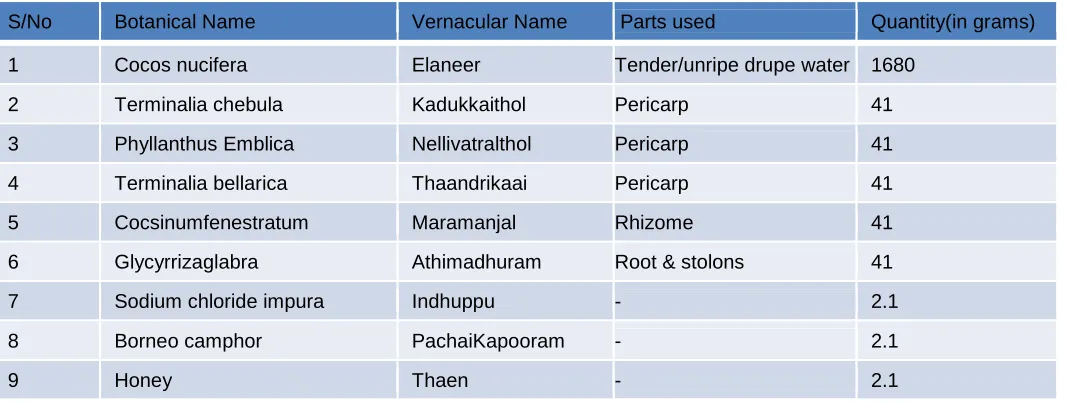
• No.2 to No.6 in Table 1 (dry ingredients) are powdered, filtered and soaked in Elaneer for three days.
• Fourth day, the mixture is boiled such that it is reduced to one-fourth of total quantity.
• The mixture is kept aside to cool and filtered.
• The liquid is again boiled to one-fourth.
• Then, No.6 and No.7 are powdered and added.
• The liquid mixture and honey are grinded in kalvam.
Table 1: Ingredients required for preparation of elaneer kulambu
S/No Botanical Name Vernacular Name Parts used Quantity(in grams)
1 Cocos nucifera Elaneer Tender/unripe drupe water 1680
2 Terminalia chebula Kadukkaithol Pericarp 41
3 Phyllanthus Emblica Nellivatralthol Pericarp 41
4 Terminalia bellarica Thaandrikaai Pericarp 41
5 Cocsinumfenestratum Maramanjal Rhizome 41
6 Glycyrrizaglabra Athimadhuram Root & stolons 41
7 Sodium chloride impura Indhuppu - 2.1
8 Borneo camphor PachaiKapooram - 2.1
Int. J. Public Health Epidemiol. Res. 037
OBSERVATIONS/RESULTS
The Main tool used to measure the changes in visual acuity of presbyopic patients before and after the study is “jaeger’s chart”in additionto siddha proforma. The results obtained from the respective 10 patients at the 41st day are listed below in Table 2.
Table 2: Observed changes in visual acuity of the sample population.
S.NO PRE-CLINICAL RESULT
POST-CLINICAL RESULT
CHANGES OBSERVED
1) J5 J5 Unchanged
2) J4 J3 Moderately changed
3) J6 J3 Markedly changed
4) J4 J3 Moderately changed
5) J4 J4 Unchanged
6) J7 J4 Markedly changed
7) J5 J4 Moderately changed
8) J8 J5 Markedly changed
9) J4 J1 Markedly changed
10) J5 J1 Markedly changed
Out of 10 subjects, 5 of the subject’s near vision has been observed to be reduced markedly, 3 of the subject’s near
vision are observed to be reduced moderately and two of the subject’s near vision remains unchanged.The results are tabulated in percentage. (See Table 3)
Table 3: Percentage of changes in visual acuity (%)
S.NO CHANGES PERCENTAGE (%)
1) Unchanged 20
2) Moderately changed 30 3) Markedly changed 50
The findings are represented in bar diagram. (See Table 4)
Table 4: Findings 0
0.5 1 1.5 2 2.5 3 3.5 4 4.5 5
Unchanged
Moderately
changed Markedly changed
FINDINGS
DISCUSSION
Quantitative variables are used.
The difference between the pre and post clinical results (variables) are enumerated as,
Unchanged -0,
Moderately changed-1,
Markedly changed-2 (See Table 5)
Table 5: Enumeration of data for statistical analysis.
S/NO PRE-CLINICAL POST-CLINICAL DIFFERENCE
1 1 1 0
2 1 2 1
3 1 3 2
4 1 2 1
5 1 1 0
6 1 3 2
7 1 2 1
8 1 3 2
9 1 3 2
10 1 3 2
NULL HYPOTHESIS: There is no significant difference between the respective subjects’ near visual acuity before and after the clinical administration of eye drops.
The t-paired test is used for the statistical analysis of the raw data. According to the SAS (Statistical Analysis System), the P value rests between 0.00037(one tail) and 0.00074(two tail) but the t-stat value is 4.9934 (modulus) which is greater than the P value. This concludes that the null hypothesis is rejected which paves the way for the alternative hypothesis.
Therefore, statistical analysis of the findings suggests that the eye drops have impact on visual acuity of the subjects. The eye drops have beneficial impact on 50% of the subjects; undeniable but moderate impact on 30% of the samples while in 20% of subjects have no impact.
Table 6: Statistical analysis (SAS)
t-Test: Paired Two
Sample for Means Variable 1 Variable 2
Mean 1 2.3
Variance 0 0.677777778
Observations 10 10
Hypothesized Mean
Difference 0
Df 9
t Stat -4.993438317
P(T<=t) one-tail 0.000372809 t Critical one-tail 1.833112933 P(T<=t) two-tail 0.000745618 t Critical two-tail 2.262157163
CONCLUSION
The sample results and the analogous analysis clearly show consummate and productive changes in the visual
acuity of the respective subjects. In that event, the corresponding eye drop formulation “ELANEER KULAMBU” is found to be beneficial, feasible, affordable and undeniably effective against presbyopia for the corresponding subjects. This case study establishes that the formulated drug can reduce and manage the progress of presbyopia.
LIMITATIONS
As this is a case study and involved only a limited population in a limited time, it may not be applicable to the whole population and varying age groups. But this case study is so absolute that it can be applied to further explorative researches.
ACKNOWLEDGEMENT
My sincere thanks to Dr. Kanagavalli. MD (S), the principal of Government Siddha Medical College, Chennai for permitting me access to IP department of Aringnar Anna Siddha Hospital, Chennai. My heartfelt thanks to my guide Dr.S.K.Sasi.MD(S) for her valuable guidance and moral support throughout the case study. I extend my thanks to Dr. Vijayapushpam, Research Officer (ICMR) for her constructive and constant guidance in statistical analysis. I also would like to thank Dr. R. Manickam, Scientist (ICMR), Dr. Shameem Fathima, (Research methodology Professor), Dr. S. Krishnan (Statistical officer) for helping me understand the basics of research. Finally, I extend my whole hearted thanks to Vice-Principal, all professors of our college, my family and friends for being my pillars of support throughout the case study.
REFERENCES
Adam T. Gerstenblith and Michael P. Rabinowitz (1990) “The wills eye manual: office and emergency room diagnosis and treatment of eye disease”, Wolters Kluwer health, Lippincott Williams and Wlikins.
Agathiyar, karanthai kan maruthuvar amirthalingampillai (1976), “Agathiyar nayana vithi”, palani thandayuthapani publications, Tamilnadu.
Hitesh Bhati, R. Manjusha(2015 jul-sep), “A clinical study on evaluation of anti-cataract effect of Triphaladi Ghana vati and elaneer kuzhambuanjana intimira (immature cataract)”,An International Quarterly journal of research in Ayurveda.
Holden Brien A (2007) “Uncorrected refractive error the major and most easily avoidable cause of vision loss,” Community Eye Health,20:37-9[PMC free article] [Pub Med].
Int. J. Public Health Epidemiol. Res. 039
Organization” 2015;93:667.
doi: http://dx.doi.org/10.2471/BLT.15.156844, vision and eye research unit, Anglia Ruskin university, Cambridge, England.
James C. Tsai, Alastair K.O. Denniston, Philip I. Murray, John J. Huang, Tamir S. Aldad, (2006) “Oxford American handbook of OPTHALMOLOGY”, Oxford university press inc.
NemaNithin, Nema H V, (2012), “Textbook of Ophthalmology”, 6th edition, Jaypee Brothers Medical Publications (P) Ltd.,doi:10.5005/jp/books/11511. R. Thiyagarajan. L.I.M (2013), “Gunapadam
Thadhu-Seeva Vaguppu”, The naadar Press Ltd., Sivakasi. Richard S Snell, “Textbook of clinical anatomy of the eye”,
2nd edition, Blackwell publishing company (1998). Robert L. Kane, Joseph G. Ouslander, Itamar B.A brass,
(2013) 7th edition, “Essentials of clinical geriatrics” Mc Graw hill, health professions decisions.
V. Viswanathan. L.I.M. (1976), “Agathiyar- Naagamuni Nayan vithi”, palani thandayuthapani publications for Dr. R. Thiyagarajan. L.I.M, Tamilnadu.
Vaithiyarathinam K.S.Murugesa muthaliyaar,(2013), “Gunapadam mooligai vaguppu”, The naadar Press Ltd., Sivakasi 5)Gopinath.G, Kartarsinghdhiman and Manjusha.R (2012 Oct-Dec); “A clinical study to evaluate the efficacy of pratka yoga krya and eye exercises in management of timira (ammetropia and
presbyopia)” 33(4):543-546; doi: 10.4103/0974-8520.110534.PMCID:PMC3665208.
Varma, Radhika K, Manjusha R, Harisha C R, Sukhla V J (2013), “A pharmacognostical and physicochemical analysis of Elaneerkuzhambu- an ayurvedic polyherbal formulation”, International journal of Pharmacy and life sciences Volume 4 issue 2, P2402-2406.
Accepted 18 December 2017
Citation: Preyadarsheni K, Swetha D, Anandhalakshmi D, Sasi S.K. (2018). Action of Elaneer Kulambu on Presbyopia- A Case Study. International Journal of Public Health and Epidemiology Research, 4(1): 035-039.