V
OLUMEN
O.
8
(2018),
I
SSUEN
O.
06
(J
UNE)
ISSN
2231-5756
A Monthly Double-Blind Peer Reviewed (Refereed/Juried) Open Access International e-Journal - Included in the International Serial Directories
Indexed & Listed at:
Ulrich's Periodicals Directory ©, ProQuest, U.S.A., EBSCO Publishing, U.S.A., Cabell’s Directories of Publishing Opportunities, U.S.A., Google Scholar, Indian Citation Index (ICI), J-Gage, India [link of the same is duly available at Inflibnet of University Grants Commission (U.G.C.)],
Index Copernicus Publishers Panel, Poland with IC Value of 5.09 (2012) & number of libraries all around the world.
V
OLUMEN
O.
8
(2018),
I
SSUEN
O.
06
(J
UNE)
ISSN
2231-5756
INTERNATIONAL JOURNAL OF RESEARCH IN COMMERCE, IT & MANAGEMENT
CONTENTS
Sr.
No.
TITLE & NAME OF THE AUTHOR (S)
Page
No.
1
.
EVALUATION OF INVESTMENT PERFORMANCE OF SELECT MUTUAL FUNDS: A CASE
OF WILLIAM SHARPE, TREYNOR AND JENSEN PARAMETERS
Dr. RAMESH.O.OLEKAR & MAHESH. AGASARA
1
2
.
PROFITABILITY DETERMINANTS OF SCHEDULED COMMERCIAL BANKS IN INDIA
A. R. RIHANA BANU & Dr. G. SANTHIYAVALLI
7
3
.
PERSONAL EFFECTIVENESS OF SALES MANAGERS IN PHARMACEUTICAL INDUSTRY:
A STUDY
ZEB O. WATURUOCHA
11
4
.
A STUDY ON CUSTOMER PERCEPTION TOWARDS E-BANKING WITH SPECIAL
REFERENCE TO VALANCHERRY TOWN
VIJAYAKUMARI.P & Dr. D.MAHILA VASANTHI THANKAM
16
5
.
AN ANALYSIS OF PROFITABILITY POSITION OF THE SELECT PRIVATE SECTOR BANKS
IN INDIA
Dr. V. MOHANRAJ & S.SUJITHA
19
6
.
A STUDY ON EMPLOYEES GRIEVANCE MANAGEMENT PROCEDURE FOLLOWED IN
BMTC, SOUTH DIVISION, BENGALURU
KAVYASHREE.M.B & RENUKACHARYA.H.S
22
7
.
EXAMINING THE INFLUENCE OF HUMAN RESOURCE PRACTICES ON EMPLOYEE
LOYALTY
KEERTHANA. K & Dr. V. KRISHNAMOORTHY
26
8
.
PRINT MEDIA STRATEGIES AND CONSUMER BEHAVIOUR: A STUDY ON FMCG
PRODUCTS
RAMBABU LAVURI
34
V
OLUMEN
O.
8
(2018),
I
SSUEN
O.
06
(J
UNE)
ISSN
2231-5756
INTERNATIONAL JOURNAL OF RESEARCH IN COMMERCE, IT & MANAGEMENT
CHIEF PATRON
Prof. (Dr.) K. K. AGGARWAL
Chairman, Malaviya National Institute of Technology, Jaipur
(An institute of National Importance & fully funded by Ministry of Human Resource Development, Government of India)
Chancellor, K. R. Mangalam University, Gurgaon
Chancellor, Lingaya’s University, Faridabad
Founder Vice-Chancellor (1998-2008), Guru Gobind Singh Indraprastha University, Delhi
Ex. Pro Vice-Chancellor, Guru Jambheshwar University, Hisar
FOUNDER PATRON
Late Sh. RAM BHAJAN AGGARWAL
Former State Minister for Home & Tourism, Government of Haryana
Former Vice-President, Dadri Education Society, Charkhi Dadri
Former President, Chinar Syntex Ltd. (Textile Mills), Bhiwani
CO-ORDINATOR
Dr. BHAVET
Former Faculty, Shree Ram Institute of Engineering & Technology, Urjani
ADVISOR
Prof. S. L. MAHANDRU
Principal (Retd.), Maharaja Agrasen College, Jagadhri
EDITOR
Dr. PARVEEN KUMAR
Professor, Department of Computer Science, NIMS University, Jaipur
CO-EDITOR
Dr. A. Sasi Kumar
Professor, Vels Institute of Science, Technology & Advanced Studies (Deemed to be University), Pallavaram
EDITORIAL ADVISORY BOARD
Dr. S. P. TIWARI
Head, Department of Economics & Rural Development, Dr. Ram Manohar Lohia Avadh University, Faizabad
Dr. CHRISTIAN EHIOBUCHE
Professor of Global Business/Management, Larry L Luing School of Business, Berkeley College, USA
Dr. SIKANDER KUMAR
Chairman, Department of Economics, Himachal Pradesh University, Shimla, Himachal Pradesh
Dr. JOSÉ G. VARGAS-HERNÁNDEZ
Research Professor, University Center for Economic & Managerial Sciences, University of Guadalajara,
Guadala-jara, Mexico
Dr. M. N. SHARMA
Chairman, M.B.A., Haryana College of Technology & Management, Kaithal
Dr. TEGUH WIDODO
Dean, Faculty of Applied Science, Telkom University, Bandung Technoplex, Jl. Telekomunikasi, Indonesia
Dr. M. S. SENAM RAJU
Professor, School of Management Studies, I.G.N.O.U., New Delhi
Dr. A SAJEEVAN RAO
Professor & Director, Accurate Institute of Advanced Management, Greater Noida
Dr. D. S. CHAUBEY
Professor & Dean (Research & Studies), Uttaranchal University, Dehradun
Dr. CLIFFORD OBIYO OFURUM
V
OLUMEN
O.
8
(2018),
I
SSUEN
O.
06
(J
UNE)
ISSN
2231-5756
INTERNATIONAL JOURNAL OF RESEARCH IN COMMERCE, IT & MANAGEMENT
Dr. KAUP MOHAMED
Dean & Managing Director, London American City College/ICBEST, United Arab Emirates
Dr. VIRENDRA KUMAR SHRIVASTAVA
Director, Asia Pacific Institute of Information Technology, Panipat
SUNIL KUMAR KARWASRA
Principal, Aakash College of Education, ChanderKalan, Tohana, Fatehabad
Dr. MIKE AMUHAYA IRAVO
Principal, Jomo Kenyatta University of Agriculture & Tech., Westlands Campus, Nairobi-Kenya
Dr. SYED TABASSUM SULTANA
Principal, Matrusri Institute of Post Graduate Studies, Hyderabad
Dr. BOYINA RUPINI
Director, School of ITS, Indira Gandhi National Open University, New Delhi
Dr. NEPOMUCENO TIU
Chief Librarian & Professor, Lyceum of the Philippines University, Laguna, Philippines
Dr. SANJIV MITTAL
Professor & Dean, University School of Management Studies, GGS Indraprastha University, Delhi
Dr. RAJENDER GUPTA
Convener, Board of Studies in Economics, University of Jammu, Jammu
Dr. SHIB SHANKAR ROY
Professor, Department of Marketing, University of Rajshahi, Rajshahi, Bangladesh
Dr. ANIL K. SAINI
Professor, Guru Gobind Singh Indraprastha University, Delhi
Dr. SRINIVAS MADISHETTI
Professor, School of Business, Mzumbe University, Tanzania
Dr. NAWAB ALI KHAN
Professor & Dean, Faculty of Commerce, Aligarh Muslim University, Aligarh, U.P.
MUDENDA COLLINS
Head, Operations & Supply Chain, School of Business, The Copperbelt University, Zambia
Dr. EGWAKHE A. JOHNSON
Professor & Director, Babcock Centre for Executive Development, Babcock University, Nigeria
Dr. A. SURYANARAYANA
Professor, Department of Business Management, Osmania University, Hyderabad
P. SARVAHARANA
Asst. Registrar, Indian Institute of Technology (IIT), Madras
Dr. MURAT DARÇIN
Associate Dean, Gendarmerie and Coast Guard Academy, Ankara, Turkey
Dr. ABHAY BANSAL
Head, Department of Information Technology, Amity School of Engg. & Tech., Amity University, Noida
Dr. YOUNOS VAKIL ALROAIA
Head of International Center, DOS in Management, Semnan Branch, Islamic Azad University, Semnan, Iran
WILLIAM NKOMO
Asst. Head of the Department, Faculty of Computing, Botho University, Francistown, Botswana
Dr. JAYASHREE SHANTARAM PATIL (DAKE)
Faculty in Economics, KPB Hinduja College of Commerce, Mumbai
SHASHI KHURANA
Associate Professor, S. M. S. Khalsa Lubana Girls College, Barara, Ambala
Dr. SEOW TA WEEA
Associate Professor, Universiti Tun Hussein Onn Malaysia, Parit Raja, Malaysia
Dr. OKAN VELI ŞAFAKLI
Professor & Dean, European University of Lefke, Lefke, Cyprus
Dr. MOHENDER KUMAR GUPTA
V
OLUMEN
O.
8
(2018),
I
SSUEN
O.
06
(J
UNE)
ISSN
2231-5756
INTERNATIONAL JOURNAL OF RESEARCH IN COMMERCE, IT & MANAGEMENT
Dr. BORIS MILOVIC
Associate Professor, Faculty of Sport, Union Nikola Tesla University, Belgrade, Serbia
Dr. LALIT KUMAR
Faculty, Haryana Institute of Public Administration, Gurugram
Dr. MOHAMMAD TALHA
Associate Professor, Department of Accounting & MIS, College of Industrial Management, King Fahd University
of Petroleum & Minerals, Dhahran, Saudi Arabia
Dr. V. SELVAM
Associate Professor, SSL, VIT University, Vellore
Dr. IQBAL THONSE HAWALDAR
Associate Professor, College of Business Administration, Kingdom University, Bahrain
Dr. PARDEEP AHLAWAT
Associate Professor, Institute of Management Studies & Research, Maharshi Dayanand University, Rohtak
Dr. ALEXANDER MOSESOV
Associate Professor, Kazakh-British Technical University (KBTU), Almaty, Kazakhstan
Dr. ASHOK KUMAR CHAUHAN
Reader, Department of Economics, Kurukshetra University, Kurukshetra
Dr. BHAVET
Former Faculty, Shree Ram Institute of Engineering & Technology, Urjani
YU-BING WANG
Faculty, department of Marketing, Feng Chia University, Taichung, Taiwan
SURJEET SINGH
Faculty, Department of Computer Science, G. M. N. (P.G.) College, Ambala Cantt.
Dr. MELAKE TEWOLDE TECLEGHIORGIS
Faculty, College of Business & Economics, Department of Economics, Asmara, Eritrea
Dr. RAJESH MODI
Faculty, Yanbu Industrial College, Kingdom of Saudi Arabia
Dr. SAMBHAVNA
Faculty, I.I.T.M., Delhi
Dr. THAMPOE MANAGALESWARAN
Faculty, Vavuniya Campus, University of Jaffna, Sri Lanka
Dr. SHIVAKUMAR DEENE
Faculty, Dept. of Commerce, School of Business Studies, Central University of Karnataka, Gulbarga
SURAJ GAUDEL
BBA Program Coordinator, LA GRANDEE International College, Simalchaur - 8, Pokhara, Nepal
FORMER TECHNICAL ADVISOR
AMITA
FINANCIAL ADVISORS
DICKEN GOYAL
Advocate & Tax Adviser, Panchkula
NEENA
Investment Consultant, Chambaghat, Solan, Himachal Pradesh
LEGAL ADVISORS
JITENDER S. CHAHAL
Advocate, Punjab & Haryana High Court, Chandigarh U.T.
CHANDER BHUSHAN SHARMA
Advocate & Consultant, District Courts, Yamunanagar at Jagadhri
V
OLUMEN
O.
8
(2018),
I
SSUEN
O.
06
(J
UNE)
ISSN
2231-5756
INTERNATIONAL JOURNAL OF RESEARCH IN COMMERCE, IT & MANAGEMENT
CALL FOR MANUSCRIPTS
We invite unpublished novel, original, empirical and high quality research work pertaining to the recent developments & practices in the areas of Com-puter Science & Applications; Commerce; Business; Finance; Marketing; Human Resource Management; General Management; Banking; Economics; Tourism Administration & Management; Education; Law; Library & Information Science; Defence & Strategic Studies; Electronic Science; Corporate Gov-ernance; Industrial Relations; and emerging paradigms in allied subjects like Accounting; Accounting Information Systems; Accounting Theory & Practice; Auditing; Behavioral Accounting; Behavioral Economics; Corporate Finance; Cost Accounting; Econometrics; Economic Development; Economic History; Financial Institutions & Markets; Financial Services; Fiscal Policy; Government & Non Profit Accounting; Industrial Organization; International Economics & Trade; International Finance; Macro Economics; Micro Economics; Rural Economics; Co-operation; Demography: Development Planning; Development Studies; Applied Economics; Development Economics; Business Economics; Monetary Policy; Public Policy Economics; Real Estate; Regional Economics; Political Science; Continuing Education; Labour Welfare; Philosophy; Psychology; Sociology; Tax Accounting; Advertising & Promotion Management; Management Information Systems (MIS); Business Law; Public Responsibility & Ethics; Communication; Direct Marketing; E-Commerce; Global Business; Health Care Administration; Labour Relations & Human Resource Management; Marketing Research; Marketing Theory & Applications; Non-Profit Or-ganizations; Office Administration/Management; Operations Research/Statistics; Organizational Behavior & Theory; Organizational Development; Pro-duction/Operations; International Relations; Human Rights & Duties; Public Administration; Population Studies; Purchasing/Materials Management; Re-tailing; Sales/Selling; Services; Small Business Entrepreneurship; Strategic Management Policy; Technology/Innovation; Tourism & Hospitality; Transpor-tation Distribution; Algorithms; Artificial Intelligence; Compilers & Translation; Computer Aided Design (CAD); Computer Aided Manufacturing; Computer Graphics; Computer Organization & Architecture; Database Structures & Systems; Discrete Structures; Internet; Management Information Systems; Mod-eling & Simulation; Neural Systems/Neural Networks; Numerical Analysis/Scientific Computing; Object Oriented Programming; Operating Systems; Pro-gramming Languages; Robotics; Symbolic & Formal Logic; Web Design and emerging paradigms in allied subjects.
Anybody can submit the soft copy of unpublished novel; original; empirical and high quality research work/manuscript anytime in M.S. Word format after preparing the same as per our GUIDELINES FOR SUBMISSION; at our email address i.e. [email protected] or online by clicking the link online submission as given on our website (FOR ONLINE SUBMISSION, CLICK HERE).
GUIDELINES FOR SUBMISSION OF MANUSCRIPT
1. COVERING LETTER FOR SUBMISSION:
DATED: _____________
THE EDITOR
IJRCM
Subject: SUBMISSION OF MANUSCRIPT IN THE AREA OF______________________________________________________________.
(e.g. Finance/Mkt./HRM/General Mgt./Engineering/Economics/Computer/IT/ Education/Psychology/Law/Math/other, please specify)
DEAR SIR/MADAM
Please find my submission of manuscript titled ‘___________________________________________’ for likely publication in one of your journals.
I hereby affirm that the contents of this manuscript are original. Furthermore, it has neither been published anywhere in any language fully or partly, nor it is under review for publication elsewhere.
I affirm that all the co-authors of this manuscript have seen the submitted version of the manuscript and have agreed to inclusion of their names as co-authors.
Also, if my/our manuscript is accepted, I agree to comply with the formalities as given on the website of the journal. The Journal has discretion to publish our contribution in any of its journals.
NAME OF CORRESPONDING AUTHOR :
Designation/Post* :
Institution/College/University with full address & Pin Code :
Residential address with Pin Code :
Mobile Number (s) with country ISD code :
Is WhatsApp or Viber active on your above noted Mobile Number (Yes/No) :
Landline Number (s) with country ISD code :
E-mail Address :
Alternate E-mail Address :
Nationality :
V
OLUMEN
O.
8
(2018),
I
SSUEN
O.
06
(J
UNE)
ISSN
2231-5756
INTERNATIONAL JOURNAL OF RESEARCH IN COMMERCE, IT & MANAGEMENT
NOTES:a) The whole manuscript has to be in ONE MS WORD FILE only, which will start from the covering letter, inside the manuscript. pdf. version is liable to be rejected without any consideration.
b) The sender is required to mention the following in the SUBJECT COLUMNof the mail:
New Manuscript for Review in the area of (e.g. Finance/Marketing/HRM/General Mgt./Engineering/Economics/Computer/IT/ Education/Psychology/Law/Math/other, please specify)
c) There is no need to give any text in the body of the mail, except the cases where the author wishes to give any specific message
w.r.t. to the manuscript.
d) The total size of the file containing the manuscript is expected to be below 1000 KB.
e) Only the Abstract will not be considered for review and the author is required to submit the complete manuscript in the first instance.
f) The journal gives acknowledgement w.r.t. the receipt of every email within twenty-four hours and in case of non-receipt of acknowledgment from the journal, w.r.t. the submission of the manuscript, within two days of its submission, the corresponding author is required to demand for the same by sending a separate mail to the journal.
g) The author (s) name or details should not appear anywhere on the body of the manuscript, except on the covering letter and the cover page of the manuscript, in the manner as mentioned in the guidelines.
2. MANUSCRIPT TITLE: The title of the paper should be typed in bold letters, centeredand fully capitalised.
3. AUTHOR NAME (S) & AFFILIATIONS: Author (s) name, designation, affiliation (s), address, mobile/landline number (s), and email/al-ternate email address should be given underneath the title.
4. ACKNOWLEDGMENTS: Acknowledgements can be given to reviewers, guides, funding institutions, etc., if any.
5. ABSTRACT: Abstract should be in fully Italic printing, ranging between 150 to 300 words. The abstract must be informative and eluci-dating the background, aims, methods, results & conclusion in a SINGLE PARA. Abbreviations must be mentioned in full.
6. KEYWORDS: Abstract must be followed by a list of keywords, subject to the maximum of five. These should be arranged in alphabetic order separated by commas and full stop at the end. All words of the keywords, including the first one should be in small letters, except special words e.g. name of the Countries, abbreviations etc.
7. JEL CODE: Provide the appropriate Journal of Economic Literature Classification System code (s). JEL codes are available at www.aea-web.org/econlit/jelCodes.php. However, mentioning of JEL Code is not mandatory.
8. MANUSCRIPT: Manuscript must be in BRITISH ENGLISH prepared on a standard A4 size PORTRAIT SETTING PAPER. It should be free from any errors i.e. grammatical, spelling or punctuation. It must be thoroughly edited at your end.
9. HEADINGS: All the headings must be bold-faced, aligned left and fully capitalised. Leave a blank line before each heading.
10. SUB-HEADINGS: All the sub-headings must be bold-faced, aligned left and fully capitalised.
11. MAIN TEXT:
THE MAIN TEXT SHOULD FOLLOW THE FOLLOWING SEQUENCE:
INTRODUCTION REVIEW OF LITERATURE
NEED/IMPORTANCE OF THE STUDY STATEMENT OF THE PROBLEM OBJECTIVES
HYPOTHESIS (ES)
RESEARCH METHODOLOGY RESULTS & DISCUSSION
FINDINGS
RECOMMENDATIONS/SUGGESTIONS
CONCLUSIONS LIMITATIONS
SCOPE FOR FURTHER RESEARCH
REFERENCES
APPENDIX/ANNEXURE
V
OLUMEN
O.
8
(2018),
I
SSUEN
O.
06
(J
UNE)
ISSN
2231-5756
INTERNATIONAL JOURNAL OF RESEARCH IN COMMERCE, IT & MANAGEMENT
12. FIGURES & TABLES: These should be simple, crystal CLEAR, centered, separately numbered & self-explained, and the titles must be above the table/figure. Sources of data should be mentioned below the table/figure. It should be ensured that the tables/figures are referred to from the main text.
13. EQUATIONS/FORMULAE: These should be consecutively numbered in parenthesis, left aligned with equation/formulae number placed at the right. The equation editor provided with standard versions of Microsoft Word may be utilised. If any other equation editor is utilised, author must confirm that these equations may be viewed and edited in versions of Microsoft Office that does not have the editor.
14. ACRONYMS: These should not be used in the abstract. The use of acronyms is elsewhere is acceptable. Acronyms should be defined on its first use in each section e.g. Reserve Bank of India (RBI). Acronyms should be redefined on first use in subsequent sections.
15. REFERENCES: The list of all references should be alphabetically arranged. The author (s) should mention only the actually utilised references in the preparation of manuscript and they may follow Harvard Style of Referencing. Also check to ensure that everything that you are including in the reference section is duly cited in the paper. The author (s) are supposed to follow the references as per the following:
•
All works cited in the text (including sources for tables and figures) should be listed alphabetically.•
Use (ed.) for one editor, and (ed.s) for multiple editors.•
When listing two or more works by one author, use --- (20xx), such as after Kohl (1997), use --- (2001), etc., in chronologically ascending order.•
Indicate (opening and closing) page numbers for articles in journals and for chapters in books.•
The title of books and journals should be in italic printing. Double quotation marks are used for titles of journal articles, book chapters, dissertations, reports, working papers, unpublished material, etc.•
For titles in a language other than English, provide an English translation in parenthesis.•
Headers, footers, endnotes and footnotes should not be used in the document. However, you can mention short notes to elucidate some specific point, which may be placed in number orders before the references.PLEASE USE THE FOLLOWING FOR STYLE AND PUNCTUATION IN REFERENCES:
BOOKS
•
Bowersox, Donald J., Closs, David J., (1996), "Logistical Management." Tata McGraw, Hill, New Delhi.•
Hunker, H.L. and A.J. Wright (1963), "Factors of Industrial Location in Ohio" Ohio State University, Nigeria.CONTRIBUTIONS TO BOOKS
•
Sharma T., Kwatra, G. (2008) Effectiveness of Social Advertising: A Study of Selected Campaigns, Corporate Social Responsibility, Edited by David Crowther & Nicholas Capaldi, Ashgate Research Companion to Corporate Social Responsibility, Chapter 15, pp 287-303.JOURNAL AND OTHER ARTICLES
•
Schemenner, R.W., Huber, J.C. and Cook, R.L. (1987), "Geographic Differences and the Location of New Manufacturing Facilities," Jour-nal of Urban Economics, Vol. 21, No. 1, pp. 83-104.CONFERENCE PAPERS
•
Garg, Sambhav (2011): "Business Ethics" Paper presented at the Annual International Conference for the All India Management Asso-ciation, New Delhi, India, 19–23UNPUBLISHED DISSERTATIONS
•
Kumar S. (2011): "Customer Value: A Comparative Study of Rural and Urban Customers," Thesis, Kurukshetra University, Kurukshetra.ONLINE RESOURCES
•
Always indicate the date that the source was accessed, as online resources are frequently updated or removed.WEBSITES
V
OLUMEN
O.
8
(2018),
I
SSUEN
O.
06
(J
UNE)
ISSN
2231-5756
INTERNATIONAL JOURNAL OF RESEARCH IN COMMERCE, IT & MANAGEMENT
EXAMINING THE INFLUENCE OF HUMAN RESOURCE PRACTICES ON EMPLOYEE LOYALTY
KEERTHANA. K
FINAL YEAR MBA STUDENT
KONGU ENGINEERING COLLEGE
PERUNDURAI
Dr. V. KRISHNAMOORTHY
ASST. PROFESSOR
KONGU ENGINEERING COLLEGE
PERUNDURAI
ABSTRACT
The main purpose of this study was to examine the influence of human resource practices (HRM) practices on employee loyalty. This study was conducted using self-administered questionnaire. Using a cross-sectional study, a total of 155 valid questionnaire were collected using systematic sampling method. The study has been conducted from the period of January 2018 to February 2018. This study identified eight important dimensions of human resource management practices. These are: Training and Development, Selection, Appraisal, Employee involvement, Human resource (HR) system, Employee participation and Job design. The find-ings revealed that employee participation, employee involvement and training and development are highly influencing the employee loyalty and thereby enhancing the internal efficiency.
KEYWORDS
appraisal, employee involvement, employee participation, human resource system, job design.
JEL CODE
O15
INTRODUCTION
uman resource is the management of people within the organisations, focusing on policies and on systems.HR departments concentrates on maximising the employee productivity Human resource activities emphasises “four generic activities of all organisations” namely selection/promotion/placement pro-cess, reward propro-cess, development process and performance appraisal. (Tichy et al., 1984).Good HRM practices are instrumental in helping achieve de-partmental objectives and enhance productivity. (Guest’s 1997). Human resource practices are functional activities and strategic plans that enable improved services to employees and increased profitability for the employer. Numerous studies found that the human resource (HR) practices enhance organisational performance (Marchington and Grugulis, 2000; Dyer and Reeves, 1995; Richardson and Thompson, 1999; Wood, 1999). Several studies examined the relationship between HR practices and organisational growth originates in US. (Arthur, 1994; Huselid, 1995; MacDuffie, 1995; Ichniowski et al., 1993; Youndt et al., 1996). Researchers established that the trust factor is found in every human resource activity- training and development, compensation, promotion, placement and performance appraisal (Robinson and Rousseau, 1994). In early 1980s, the concept of human resource management (HRM) emerged with two basic paths of research among the direct and indirect relationship between human resource management and organisational performance (Schuler and Jackson, 1999).Research shows that perception towards organisations HR activities directs the organisational inducement that has its direct impact on employee attitude and organisational relationship.(Allen et al., 2003).Employee loyalty can be measured by the factors like Employee turnover, employee productivity and customer feedback and these dimensions are considered as the interpersonal and social determinants of fairness (Greenberg 1993). Several studies conceptualized that the HRM practices are sometimes an alternative for unionisation. If the employees are provided with requirements, the need for trade unions will be reduced (Alina Ileana Petrescu and Rob Simmons, 2008, Eisenberger et al., 1986; Allen et al., 2003). HR practices has become the sources of competitive advantage by their impact on employees’ productivity and their involvement towards business objectives.(Huselid et al.1997.HR practices may moderate the association among human resource and achiev-ing enriched performance (Guest’s 1997). Hence it is concluded that the HR activities deliver the strong signals to employees about the organisations trust upon them and employees commitment towards the organisation. (Saini, D., and Budhwar, P.2004).The relationship between employee fairness and HR practices is significantly influenced by the organisational culture (Arthur, 1994), examines that the HR activities laid the base for employee behaviour and attitudes by enhanc-ing ‘psychological links’ among organisational and employee outcomes. Trust is considered to be the important factor and it allows the employees mutual rela-tionship upon the organisation to increase, thus breaking through the internal boundaries between management and employees (Mishra 2006).
REVIEW OF LITERATURE
Researchers have established different definition for influence of HRM practices. Arunprasad P (2017) analysed the influence of strategic HRM and knowledge management activities of software companies in India. The study concluded that innovation, creativity and HRM practices like employee retention, recruitment process, enhancing development of internal and external factors forms a positive advantage on the organisational growth. Jenny K Rodriguez and Paul Stewart (2017) examined HRM practices and its role in organisational culture in Chile. The study was conducted among 1299 samples in metropolitan region of Chile. Flexibility, motivation, communication, high performance, organizational culture are the variables used in this study. The study found that employees feel dissat-isfied in their work due to improper handling of HRM practices practiced in the organisation. Bard Kuvass (2017) examined the HR practices linked with the quality of employee development and employee outcome.The sample size of study was 593 employees in Norway. The study found that the HRM variables like effective organizational commitment and perceived organizational support will strongly constitute the employee commitment towards Organization. Mirta Diaz- Fernandez et.al.,(2017) analysed the relationship between innovation and HRM practices and the study was conducted in Spanish manufacturing organisations with the sample respondents of 200 through longitudinal analysis method. The study found that innovation and competitive advantage are inter-related between each other. Sherin Faruok et.al., (2016) examined the causes of HRM practice on organisational efficiency in United Arab Emirates with the sample of 168 employees. The study found that organisational innovation, performance appraisal, training, job design, recruitment & selection used are highly influencing organisational development. Alexandros G Psychogios et.al., (2016) examined the structural and organisational aspects in HRM practice in small and medium scale industries. The study conducted at South Eastern European countries with 168 sample respondents. This study identified responsibility, formality, planning, personnel func-tion, competencies, compensation systems have the positive impact on the human resource management practices. Vanthsala Wickramasinghe and Melanie Samratunga (2016) validated the dependence between HRM practices and post promotion activities by conducting survey among 391 respondents. The study found that job designation and the promotion activities had a significant influence with the performance after getting promoted as they gain the increased pay scale opportunities. Boselie et al., (2015) identified the positive effect of HRM practices among the individuals through structural equational modelling method and found that Human resource are the significant factor that influences the organisation to attain its vision and mission through innovation. The findings of the study identified that the HRM practices have positive effect on among the individuals of organisation. Lepak and Snell (2015) had identified the theory of human
V
OLUMEN
O.
8
(2018),
I
SSUEN
O.
06
(J
UNE)
ISSN
2231-5756
INTERNATIONAL JOURNAL OF RESEARCH IN COMMERCE, IT & MANAGEMENT
capital allocation and development using HRM dimensions of the organizations. The study was conducted using 800 respondents in Muscut securities market. The study found that there is high involvement of traditional HRM practices in organisational development and in the human capital resource. Shay.S.Tzafir et al.,(2014) examined the influences of growing HRM practices for employees trust. The study was conducted with the sample of 250 respondents using random sampling method. The study found that the trust of employees has been significantly influenced by the HRM practices like flow of communication, management stress, work place justice.
STATEMENT OF THE PROBLEM
HRM is a process of bringing people and organisation together in order to achieve organisational goals to meet the expectations of the employees. Human resource management practices bridges the gap between employee expectations and organisational needs by adopting appropriate HRM practices. The HR practices con-stitute the competitive advantage to perform activities more distinctively and effectively than rivals. With appropriate HRM practices an organisation can hire, develop and utilise best brains in the marketplace, realise its professed goals and deliver best results better than others. If the employee is satisfied by the HRM practices implemented by the organisation, the worker may continue in the organisation and thereby employee loyalty will be increased. In that circumstances, this study becomes essential.
RESEARCH GAP
Even though several studies has been conducted with regard to impact of HRM practices on employee loyalty most of the studies has been conducted in western perspective. Only limited studies has been conducted in Indian perspective. Therefore the researcher intended to fill the gap by the way of study the influences of HRM practices on customer loyalty in garment industries.
PROPOSED RESEARCH MODEL
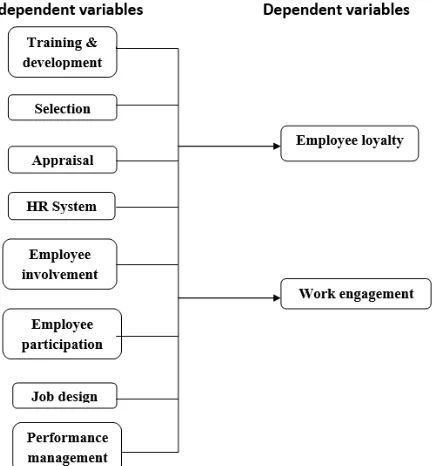
FIGURE 1: SHOWS THE RESEARCH FRAMEWORK OF THE PROPOSED STUDY
Based on the proposed research model, the objectives of the study is confined only to identify the important HRM dimension. Also to investigate the relationship between HRM practices on employee loyalty and work engagement. And to explain the impact of identified HRM dimensions on employee loyalty. Finally, to identify the impact of identified HRM dimension on work engagement.
OBJECTIVES OF THE STUDY
The objectives of the study is confined only 1. To identify the important HRM dimensions
2. To investigate the relationship between HRM practices on employee loyalty and work engagement. 3. To explain the impact of identified HRM dimensions on employee loyalty.
4. To identify the impact of identified HRM dimension on work engagement.
RESEARCH METHODOLOGY
An empirical method of analysis was adopted in this paper to examine the influence of HRM practices on employee loyalty. The study had been confined only to small scale garment companies. Data collected from lower and middle employees. Using systematic random sampling technique, the study was conducted during the period of January 2018 to February 2018 in Tripur town. The researchers collected 155 questionnaire from the respondents. The researcher adopted ques-tionnaire method for collecting data from the respondents. The statistical tools like exploratory factor analysis, regression and correlation were used. Before distributing the questionnaire to the respondents the researcher performed the content validity of the questionnaire. After formulating the questionnaire the researcher conducted the pilot study. Based on their feedback received from the respondents few items in questionnaire were deleted and some words has been modified in the questionnaire. The variables relating to the present study is drawn from the previous work of Delery and Doty (1996), Snell and Dean (1992) and Bae and Lawler (2000). Suitable modification has been made in the existing questionnaire to suit the requirements of the present study.
PROPOSED HYPOTHESIS
The study is approached with the following hypothesis
H01: Training & development has no significant impact on employee loyalty
H02: Selection has no significant impact on employee loyalty
H03: Performance management has no significant impact on employee loyalty
V
OLUMEN
O.
8
(2018),
I
SSUEN
O.
06
(J
UNE)
ISSN
2231-5756
INTERNATIONAL JOURNAL OF RESEARCH IN COMMERCE, IT & MANAGEMENT
H05: Employee participation no significant impact on employee loyalty
H06: HR systems has no significant impact on employee loyalty
H07: Employee involvement has no significant impact on employee loyalty
H08: Job design has no significant impact on employee loyalty.
H09: Training & development has no significant impact on work engagement
H10: Selection has no significant impact on work engagement
H11: Performance management has no significant impact on work engagement
H12: Appraisal has no significant impact on work engagement
H13: Employee participation no significant impact on work engagement
H14: HR systems has no significant impact on work engagement
H15: Employee involvement has no significant impact on work engagement
H16: Job design has no significant impact on work engagement
TABLE 1: DEMOGRAPHIC PROFILE OF THE RESPONDENTS Frequency Percent
Gender
Male 97 62.6 Female 58 37.4
Total 155 100
Age of the respondents
Below 25 years 31 20.0 25 to 35 years 72 46.5 35 to 45 years 29 18.7 Above 45 years 23 14.8
Total 155 100
Educational qualification
Higher secondary 61 39.4 Under graduation 53 34.2 Post graduation 9 5.8 Others 32 20.6
Total 155 100
Nature of departments
Stiching 23 14.8 Ironing 58 37.4 Sewing 15 9.7 Cutting 26 16.8 Checking 28 18.1 Packing 5 3.2
Total 155 100
Job status of the respondents
Part – time 63 40.6 Full – time 92 59.4
Total 155 100
Place of residence
Rural area 79 51.0 Urban area 76 49.0
Total 155 100
Monthly income of the respondents
Below Rs.15000 68 43.9 Rs.15000 to Rs.30000 52 33.5 Rs.30000 to Rs.45000 18 11.6 Above Rs.45000 17 11.0
Total 155 100
Work experience
Below 1 year 43 27.7 2 to 4 years 64 41.3 4 to 6 years 21 13.5 Above 6 years 27 17.4
Total 155 100
DESCRIPTIVE STATISTICS
The demographic profile of the respondent is depicted in TABLE NO. 1. Out of 155 sample respondents 62.6 percent was male and 37.4 percent is female. Regarding age of the respondents 20 percent are below 25 years, 46.5 percent are between 25 to 35 years of age, 18.7 percent are between 35 to 45 years and 14.8 percent are above 45 years. Regarding Educational qualification of the respondents, 39.4 percent of the respondents had higher secondary qualification. Followed by 34.2 percent of respondents had under graduation, 5.8 percent of respondents had completed post-graduation and 20.6 were others who fall under uneducated category. With reference to job status, 40.6 percent of respondents work part – time and 59.4 percent work full-time job. Regarding the place of residence of the respondents, 51 percent of the respondent residing s at rural area. Followed by 49 percent of the respondent residing is at urban area. From the income level, it was found that 43.9 percent earned below Rs. 15000, 33.5 percent earned between Rs. 15000 to Rs. 30000, 11.6 percent earned between Rs. 30000 to Rs. 45000 and 11.0 percent earned above Rs. 45000. Finally, work experience was measured with 27.7 percent is below 1 year, 41.3 percent of respondent work experience is between 2 to 4 year, 13.5 percent respondent experience is between 4 to 6 years and 17.4 percent work respondent experience is above 6 years.
RELIABILITY ANALYSIS
V
OLUMEN
O.
8
(2018),
I
SSUEN
O.
06
(J
UNE)
ISSN
2231-5756
INTERNATIONAL JOURNAL OF RESEARCH IN COMMERCE, IT & MANAGEMENT
TABLE 2: RELIABILITY STATISTICS
Cronbach's Alpha N of Items .900 36
ANTECEDENTS OF HRM PRACTICE IN GARMENT INDUSTRY
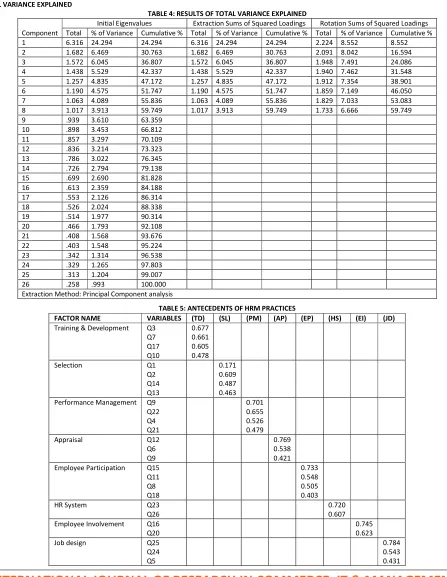
A principal component factor analysis with varimax rotation was performed on the 26 items that assessed the influence of HRM practices on employee loyalty. The statistical test result (KMO =.813, Bartlett’s test of = 1.043, significance=.000) revealed that the factor analysis was appropriate. Therefore 26 items with Eigen value higher than 1.0 with were retained for further analysis. The resultant factor analysis explained 59.749 percent of the item variance.
TABLE 3: KMO AND BARTLETT’S TEST
TOTAL VARIANCE EXPLAINED
TABLE 4: RESULTS OF TOTAL VARIANCE EXPLAINED
Component
Initial Eigenvalues Extraction Sums of Squared Loadings Rotation Sums of Squared Loadings Total % of Variance Cumulative % Total % of Variance Cumulative % Total % of Variance Cumulative % 1 6.316 24.294 24.294 6.316 24.294 24.294 2.224 8.552 8.552 2 1.682 6.469 30.763 1.682 6.469 30.763 2.091 8.042 16.594 3 1.572 6.045 36.807 1.572 6.045 36.807 1.948 7.491 24.086 4 1.438 5.529 42.337 1.438 5.529 42.337 1.940 7.462 31.548 5 1.257 4.835 47.172 1.257 4.835 47.172 1.912 7.354 38.901 6 1.190 4.575 51.747 1.190 4.575 51.747 1.859 7.149 46.050 7 1.063 4.089 55.836 1.063 4.089 55.836 1.829 7.033 53.083 8 1.017 3.913 59.749 1.017 3.913 59.749 1.733 6.666 59.749 9 .939 3.610 63.359
10 .898 3.453 66.812 11 .857 3.297 70.109 12 .836 3.214 73.323 13 .786 3.022 76.345 14 .726 2.794 79.138 15 .699 2.690 81.828 16 .613 2.359 84.188 17 .553 2.126 86.314 18 .526 2.024 88.338 19 .514 1.977 90.314 20 .466 1.793 92.108 21 .408 1.568 93.676 22 .403 1.548 95.224 23 .342 1.314 96.538 24 .329 1.265 97.803 25 .313 1.204 99.007 26 .258 .993 100.000 Extraction Method: Principal Component analysis
TABLE 5: ANTECEDENTS OF HRM PRACTICES
Kaiser-Meyer-Olkin Measure of Sampling Adequacy. .813 Bartlett's Test of Sphericity Approx. Chi-Square 1.043E3
Df 325 Sig. .000
FACTOR NAME VARIABLES (TD) (SL) (PM) (AP) (EP) (HS) (EI) (JD)
Training & Development Q3 Q7 Q17 Q10 0.677 0.661 0.605 0.478 Selection Q1
Q2 Q14 Q13 0.171 0.609 0.487 0.463 Performance Management Q9
Q22 Q4 Q21 0.701 0.655 0.526 0.479 Appraisal Q12
Q6 Q9
0.769 0.538 0.421 Employee Participation Q15
Q11 Q8 Q18 0.733 0.548 0.505 0.403 HR System Q23
Q26
0.720 0.607 Employee Involvement Q16
Q20
0.745 0.623 Job design Q25
Q24 Q5
V
OLUMEN
O.
8
(2018),
I
SSUEN
O.
06
(J
UNE)
ISSN
2231-5756
INTERNATIONAL JOURNAL OF RESEARCH IN COMMERCE, IT & MANAGEMENT
Table 5 resulted that, Factor one of HRM variables was labled as “Training & development” comprises of four items with the eigen value of 6.316 percent and 2.224 percent of total variance explained. The second factor, “Selection” comprises of four items with the eigen value of 1.682 percent and 2.091 percent of total variance explained. The third factor, “Performance management” comprises of four items with the eigen value of 1.572 percent and 1.948 percent of total variance explained. The fourth factor, “Appraisal” comprises of three items with the eigen value of 1.438 percent and 1.940 percent of total variance explained. The fifth factor,” Employee Participation” comprises of four items with the eigen value of 1.257 percent and 1.912 percent of total variance explained. The sixth factor,” HR System” comprises of two items with the eigen value of 1.190 percent and 1.859 percent of total variance explained. The seventh factor,” Employee Involvement” comprises of two items with the eigen value of 1.063 percent and 1.829 percent of total variance explained. Finally the Eight factor,” Job design” comprises of three items with the 1.017percent and 1.733 percent of total variance explained.
INFLUENCE OF HRM PRACTICE ON EMPLOYEE LOYALTY
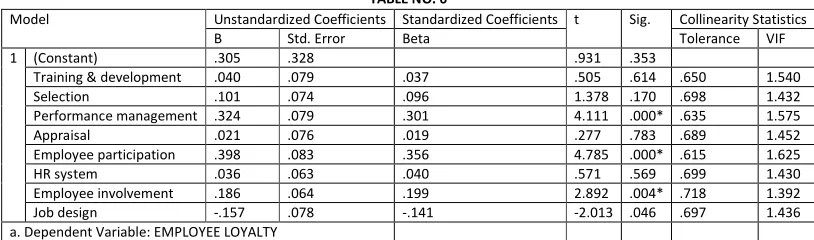
To study the influence of HRM practices on employee loyalty, multiple regression was carried out. The factor scores of the eight HRM variables obtained from the factor analysis represent the independent variables, whereas employee loyalty and work engagement represented the dependent variables.
TABLE NO. 6
From TABLE NO.6 the study stipulates that there is a significant influence of “Employee participation” on “Employee loyalty” with (β =.356, t = 4.785, p≤0.05). Followed by “Performance management” with (β =.301, t= 4.111, p≤0.05). Regarding “Employee Involvement” with (β = 0.199, t= 0.004, p≤0.05). The study also found that there is no significant impact regarding “Training and development” with (β =.037, t=.505,p≥0.05), “Selection” with (β =.096, t=1.378,p≥0.05), “Ap-praisal” with (β =.019, t=.277, p≥0.05), “HR system” with (β =.096, t=1.378,p≥0.05), “Job design” with (β =.141, t=2.013, p≥0.05).
TABLE NO. 7 reveals the influence of HRM practices on “Work engagement”
TABLE 7
Model
Unstandardized Coefficients Standardized Coefficients
t Sig.
Collinearity Statistics B Std. Error Beta Tolerance VIF 1 (Constant) .856 .222 3.851 .000
Training & development .134 .053 .182 2.510 .000* .650 1.540 Selection .006 .050 .008 .116 .908 .698 1.432 Performance management .092 .053 .126 1.719 .088 .635 1.575 Appraisal .127 .052 .174 2.472 .002* .689 1.452 Employee participation .097 .056 .128 1.714 .089 .615 1.625 HR system .117 .043 .192 2.744 .004* .699 1.430 Employee involvement .070 .044 .110 1.593 .113 .718 1.392 Job design .091 .053 .120 1.714 .089 .697 1.436 b. Dependent Variable: WORK ENGAGEMENT
With reference to Table no.7 revealed that there is significant influence of “HR system” on “Work engagement” with (β =.192, t= 2.744, p≤0.05). Followed by “Training & Development” with (β =.182, t = 2.510, p ≤ 0.05) And “Appraisal” with (β =.174, t= 2.472, p ≤ 0.05). The study also found that there is no significant impact on “Selection” with (β =.908, t=.116, p ≥ 0.05), “Performance management” with (β =.126, t= 1.719, p ≥ 0.05), “Employee participation” with (β =.128, t= 714, p ≥ 0.05), “Employee involvement” with (β =.110, t= 1.593, p ≥ 0.05), and “Job design” with (β =.120, t= 1.714, p ≥ 0.05).
Correlation matrix of HRM practice on employee loyalty exhibited in Table No 8
TABLE NO. 8: CORRELATION MATRIX
**Correlation is significant at the 0.05 level(2-tailed)) Dependant variable 1 : Employee loyalty
Notes: TD = Training & development, SL = Selection, PM = Performance management, AP = Appraisal, EP= Employee participation, HS= HR system, EI = Employee involvement, JD = Job design,
EL=Employee loyalty
With reference to Table No. 8, “Training and Development”, significant positive correlation is identified in case of Selection, Performance management, Appraisal, Employee participation, HR system, Employee Involvement and Job design at 5 percent significant level. In case of “Selection”, strong positive correlation is iden-tified among Performance management, Appraisal, Employee participation, HR system, Employee Involvement and Job design. Regarding “Performance manage-ment “had significant positive correlation with Appraisal, Employee participation, HR system, Employee Involvemanage-ment and Job design. With reference to “Appraisal” strong positive correlation had observed between Employee participation, HR system, Employee Involvement and Job design. The variable “Employee participa-tion” positive correlation is identified among HR system, Employee Involvement and Job design. In case of “HR System” positive correlation is identified with Employee Involvement and Job design. With reference to “Employee Involvement”, exact positive correlation is identified with Job design. Finally with reference
Model Unstandardized Coefficients Standardized Coefficients t Sig. Collinearity Statistics B Std. Error Beta Tolerance VIF 1 (Constant) .305 .328 .931 .353
Training & development .040 .079 .037 .505 .614 .650 1.540 Selection .101 .074 .096 1.378 .170 .698 1.432 Performance management .324 .079 .301 4.111 .000* .635 1.575 Appraisal .021 .076 .019 .277 .783 .689 1.452 Employee participation .398 .083 .356 4.785 .000* .615 1.625 HR system .036 .063 .040 .571 .569 .699 1.430 Employee involvement .186 .064 .199 2.892 .004* .718 1.392 Job design -.157 .078 -.141 -2.013 .046 .697 1.436 a. Dependent Variable: EMPLOYEE LOYALTY
V
OLUMEN
O.
8
(2018),
I
SSUEN
O.
06
(J
UNE)
ISSN
2231-5756
INTERNATIONAL JOURNAL OF RESEARCH IN COMMERCE, IT & MANAGEMENT
to “Job design” significant positive correlation is observed with the dependant variable employee loyalty. It is observed that all the independent variables are positively relationships with the dependant variable “EMPLOYEE LOYALTY”.
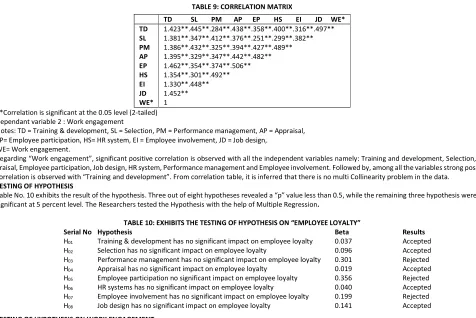
Correlation matrix of HRM practice on employee loyalty exhibited in Table No 9
TABLE 9: CORRELATION MATRIX
**Correlation is significant at the 0.05 level (2-tailed) Dependant variable 2 : Work engagement
Notes: TD = Training & development, SL = Selection, PM = Performance management, AP = Appraisal, EP= Employee participation, HS= HR system, EI = Employee involvement, JD = Job design,
WE= Work engagement.
Regarding “Work engagement”, significant positive correlation is observed with all the independent variables namely: Training and development, Selection, Ap-praisal, Employee participation, Job design, HR system, Performance management and Employee involvement. Followed by, among all the variables strong positive correlation is observed with “Training and development”. From correlation table, it is inferred that there is no multi Collinearity problem in the data.
TESTING OF HYPOTHESIS
Table No. 10 exhibits the result of the hypothesis. Three out of eight hypotheses revealed a “p” value less than 0.5, while the remaining three hypothesis were not significant at 5 percent level. The Researchers tested the Hypothesis with the help of Multiple Regression.
TABLE 10: EXHIBITS THE TESTING OF HYPOTHESIS ON “EMPLOYEE LOYALTY”
Serial No Hypothesis Beta Results
H01 Training & development has no significant impact on employee loyalty 0.037 Accepted
H02 Selection has no significant impact on employee loyalty 0.096 Accepted
H03 Performance management has no significant impact on employee loyalty 0.301 Rejected
H04 Appraisal has no significant impact on employee loyalty 0.019 Accepted
H05 Employee participation no significant impact on employee loyalty 0.356 Rejected
H06 HR systems has no significant impact on employee loyalty 0.040 Accepted
H07 Employee involvement has no significant impact on employee loyalty 0.199 Rejected
H08 Job design has no significant impact on employee loyalty 0.141 Accepted
TESTING OF HYPOTHESIS ON WORK ENGAGEMENT
Table No. 11 exhibits the result of the hypothesis. Three out of eight hypotheses revealed a “p” value less than 0.5, while the remaining one hypothesis were not significant at 5 percent level. Five variables out of eight were significant at 5 percent level as “p” value greater than 0.5.
TABLE 11
Serial No Hypothesis Beta Results
H09 Training & development has no significant impact on work engagement 0.037 Rejected
H10 Selection has no significant impact on work engagement 0.096 Accepted
H11 Performance management has no significant impact on work engagement 0.301 Accepted
H12 Appraisal has no significant impact on work engagement 0.019 Rejected
H13 Employee participation no significant impact on work engagement 0.356 Accepted
H14 HR systems has no significant impact on work engagement 0.040 Rejected
H15 Employee involvement has no significant impact on work engagement 0.199 Accepted
H16 Job design has no significant impact on work engagement 0.141 Accepted
CONCLUSION
The present study identified eight important dimensions of HRM practices, namely, training & development, selection, appraisal, employee involvement, employee participation, job design and HR system. Out of the identified dimension, this study found that there is significant influence of HRM practices on employee loyalty is identified with the HRM dimensions like employee participation, performance management, employee involvement, HR system and appraisal on employee loyalty that could increase the organisational efficiency.
ANALYSIS AND DISCUSSION
The primary purpose of the study is to examine the influence of HRM practices on employee loyalty towards garment companies in Tripur town, Tamilnadu. Factor analysis was performed to examine the underlying dimensions of HR practices. Factor analysis resulted eight factors namely training & development, selection, performance management, appraisal, employee participation, HR system, employee involvement and job design, which explained 59.749 percent of the variation. The findings of this study corroborate past research work, such as Choi and Lee (2013), and Jiang et al. (2012), who observed the impact of HRM practices on organisation and employee performance. This study findings coincide with the previous research works done by (Whitener, 1997; Bijlsma and Koopman, 2003; Tyler, 2003; Mo¨llering et al., 2004; Tzafrir, 2005). The study found that HRM practices build the employee fairness towards organisation thereby increasing the importance of HR practices. This study findings proved this by exhibiting that employees are subject to developmental and empowering HR practices like training & development, Appraisal, work engagement and organisational performance. The research findings throw light on HR practices and it is consistent with (Lado and Wilson, 1994; Becker and Gerhart, 1996; Jimenez and Valle, 2005) identified that work engagement has positive influence on employee loyalty.
MANAGERIAL IMPLICATIONS
This research makes several practical contributions. The influence of HRM practices on employee loyalty can direct the policy makers and future researchers to focus on employee satisfaction. Employee loyalty can be viewed on the managerial level leading to the value creation of the employees. The proposed model can help the management to analyze the extend of the alignment of their strategic HRM practices and its corresponding impact on employees loyalty. This study
TD SL PM AP EP HS EI JD WE* TD
SL PM AP EP HS EI JD WE*
V
OLUMEN
O.
8
(2018),
I
SSUEN
O.
06
(J
UNE)
ISSN
2231-5756
INTERNATIONAL JOURNAL OF RESEARCH IN COMMERCE, IT & MANAGEMENT
confirms that adoption of good HRM practices can develop a unique pool of employee’s behaviour that can boost organisation performance. With this knowledge, companies can target their efforts to develop HRM practices to enhance better employee loyalty and their morale. The study findings help the management to formulate suitable policies relating to HRM practices.
SCOPE FOR FUTURE RESEARCH
This study considers only small scale garment companies. In future this can be extended to large scale industries. Only limited number of variables of HRM practices are considered for this study. In future, more number of variables can be used.The study considers the total employees views on implementation of HRM practices. This may be modified in future studies to study male employee’s perception on implementation of HRM practices.The study employed only two dependent variables namely employee loyalty and work engagement. In future, these can be extended to other dependent variables like employee commitment, employee morale etc.
REFERENCES
1. Alexandros Psychogios, Leslie Thomas Szamosi, Rea Prouska, Christopher Brewster, (2016) "A three-fold framework for understanding HRM practices in South-Eastern European SMEs", Employee Relations, Vol. 38 Issue: 3, pp.310-331
2. Alina Ileana Petrescu, Rob Simmons, (2008) "Human resource management practices and workers' job satisfaction", International Journal of Manpower, Vol. 29 Issue: 7, pp.651-667.
3. Allen, D. G., Shore, L. M. and Griffeth, R. W. (2003). ‘The role of perceived organizational support and supportive human resource practices in the turnover process’. Journal of Management, Vol.29, pp.99–118.
4. Anastassova, L. and Purcell, K. (2007), “Human resource management in the Bulgarian hotel industry: from command to empowerment?”, International Journal of Hospitality Management, Vol. 14 No. 2, pp. 171-85.
5. Arthur, J.B. (1994) ‘Effects of Human Resource Systems on Manufacturing Performance and Turnover’, Academy of Management Journal, Vol.37(3): pp.670– 87.
6. Arunprasad P., (2017) "Inevitable knowledge strategy: A paradigm shift in strategic HRM practices to augment firm’s performance", Employee Relations, Vol. 39 Issue: 5, pp.753-774,
7. Bae, j. AND Lawler, J.J. (2000), “Organisational and HRM strategies in Korea: impact on firm performance in an emerging economy”, Academy of Management Journal, Vol. 43, pp. 502-17.
8. Bard Kuvaas (2007),”the study of HRM practices “The impact of HRM practices on linkages between perception of employee outcomes”, Journal of manage-ment studies.
9. Becker, B. and Gerhart, B. (1996), “The impact of human resource management on organizational performance: progress and prospectors”, Academy of Management Journal, Vol. 39 No. 4, pp. 779-801.
10. Becker, B.E., Huselid, M.A 2011 direct estimates of SD and the implications of utility analysis. Journal of applied psychology, Vol.77:22 pp.7-233
11. Bierly, P. and Chakrabarti, A. (1996), “Generic knowledge strategies in the U.S. pharmaceutical industry”, Strategic Management Journal, Vol. 17 No. 2, pp. 123-135.
12. Bijlsma, K. and Koopman, P. (2003), “Introduction: trust within organisations”, Personnel Review, Vol. 32, pp. 543-55.
13. Bondarouk, T.V. and Ruel, H.J. (2013), “The strategic value of e-HRM: results from an exploratory study in a governmental organization”, International Journal of Human Resource Management, Vol. 24 No. 2, pp. 391-414.
14. Boselie, P., Dietz, G. and Boon, C. (2005), “Commonalities and contradictions in HRM and performance research”, Human Resource Management Journal, Vol. 15 No. 3, pp. 67-94.
15. Cathy Sheehan, Brian K. Cooper, (2011) "HRM outsourcing: the impact of organisational size and HRM strategic involvement", Personnel Review, Vol. 40, pp.742-760
16. Cho, S., Wood, R.H. and Mayer, K.J. (2005), “Examining the impact of human resources management on organizational performance”, paper presented at the Annual Meeting of the Academy of Management, Honolulu, HI.
17. Choi, J.H. and Lee, K.P. (2013), “Effects of employees’ perceptions on the relationship between HR practices and firm performance for Korean firms”, Per-sonnel Review, Vol. 42 No. 5, pp. 573-594
18. Delery, J.E. and Doty, D.H. (1996), “Modes of theorizing in strategic human resource management: test of universalistic, contingency and configurational performance predictions”, Academy of Management Journal, Vol. 39, pp. 802-35.
19. Dyer, L. and Reeves, T. (1995) ‘Human Resource Strategies and Firm Performance: What Do We Know and Where Do We Need to Go?’, International Journal of Human Resource Management, Vol. 6(3): pp. 656–70.
20. Edgar, F. and Geare, A. (2005), “HRM practice and employee attitudes: different measures – different results”, Personnel Review, Vol. 34 No. 5, pp. 534-49 21. Eisenberger, R., Huntington, R., Hutchison, S. and Sowa, D. (1986) ‘Perceived Organizational Support’, Journal of Applied Psychology, Vol.71(3): pp.500–7. 22. Elise Marescaux, Sophie De Winne, Luc Sels, (2012) "HR practices and HRM outcomes: the role of basic need satisfaction", Personnel Review, Vol. 42
pp.4-27
23. Ellemers, N., de Gilder, D. and Haslam, S.A. (2004), “Motivating individuals and groups at work: a social identity perspective”, Academy of Management Review, Vol. 29 No. 3, pp. 459-478.
24. Fiona Edgar, Alan Geare, (2005) "HRM practice and employee attitudes: different measures – different results", Personnel Review, Vol. 34 Issue: 5, pp.534-549.
25. Folger, R. and M. A. Konovsky. 1989. “Effects of Procedural and Distributive Justice on Reactions to Pay Raise Decisions.” Academy of Management Journal 32:115-130.
26. Fu, N., Flood, P.C., Bosak, J. Morris, T. (2015),”How do high performance work systems influence organisational innovation in professional service firms”, Employee Relations Vol.37 No. 2, pp 209-231.
27. Fuller, J.B., Hester, K., Barnett, T., Frey, L., Relyea, C. and Beu, D. (2006), “Perceived external prestige and internal respect: new insights into the organizational identification process”, Human Relations, Vol. 59 No. 6, pp. 815-846.
28. Gomez, C.F. and Rodriguez, J.K. (2006), “Four Approximations to Chilean culture: Authoritarianism, Legalism, Fatalism and Compadrazgo”, Asian Journal of Latin American Studies, Vol. 19 No. 3, pp. 43-65.
29. Gould-Williams, J. (2007), “HR practices, organizational climate and employee outcomes: evaluation social exchange relationships in local government”, International Journal of Human Resource Management, Vol. 18 No. 9, pp. 1627-47.
30. Greenberg, J. 1993. “The Social Side of Fairness: Interpersonal and Informational Classes of Organizational Justice.” Pp. 79-103 in Justice in the Workplace, edited by R. Cropanzano. Hillsdale, NJ: Lawrence Erlbaum.
31. Guest, D. (1997) ‘Human Resource Management and Performance: A Review and Research Agenda’, International Journal of Human Resource Management, 8(3): pp.263–76.
32. Guest, D.E. (2002), “Human resource management, corporate performance and employee wellbeing: building the worker into HRM”, Journal of Industrial Relations, Vol. 44 No. 3, pp. 335-58.
33. Hanisch, K.A. and Hulin, C.L. (1990), “Job attitudes and organizational withdrawal: an examination of retirement and other voluntary behaviors”, Journal of Vocational Behavior, Vol. 37, pp. 60-78.