RISE-based Anti-Windup Control of Human
Lower Limb Using Electrical Stimulation
Yasunori Kawai and Yukimi Miyamoto
Department of Electrical Engineering, National Institute of Technology, Ishikawa College, Ishikawa, Japan Email: [email protected]
Hiroyuki Kawai
Department of Robotics, Kanazawa Institute of Technology, Ishikawa, Japan
Abstract—This paper considers the RISE-based control with the anti-windup compensator for the human lower limb using the electrical stimulation. Since the human limb has some uncertainties, it is difficult to design a controller for the electrical stimulation. In order to attenuate the disturbances, the RISE-based control is applied to the human limb. However, the magnitude or the pulse width of the current in the electrical stimulation is limited, because the human has the pain. Hence, the saturation of the control input exists. For the input saturation, the anti-windup compensator is needed for the RISE-based control. This paper proposes the anti-windup compensator for the RISE-based control. The integral component of the controller is converged to the limit value with the first-order lag. In the simulation and the experiment, the overshoot of the knee angle using the anti-windup compensator is smaller than the RISE-based control without the anti-windup compensator. By using the anti-windup compensator, the control performance can be improved.
Index Terms—control applications, robust control, input saturation, rehabilitation
I. INTRODUCTION
The electrical stimulation which means FES (Functional Electrical Stimulation) and NMES (Neuromuscular Electrical Stimulation) is used to improve the motor function of a human. As the same way as electrical impulses from the brain, the electrical stimulation makes muscles contraction by the external electrical impulses. If the stimulation is controlled, a desired movement can be achieved [1].
Since the human limb has some uncertainties, the robust controller is needed for the disturbances. In previous researches, the RISE (Robust Integral of Sign of the Error)-based control has been applied to the control of the human lower limb [2]. The FES-assisted cycling with velocity tracking control using the RISE-based control is considered in [3]. In [4], PID control and PID with the feedforward based on the inverse model are shown. In [5], the RISE-based control with the neural network has been investigated.
However, the magnitude or the pulse width of the current in the electrical stimulation has the upper bound, because the human has the pain by the large current from the electrical stimulation. Hence, the control input of the human lower limb has the input saturation when the electrical stimulation is used. In previous researches [2]-[5], the input saturation is not considered. In generally, an anti-windup control is known against the input saturation. In [6], robust control and nonlinear control have been indicated by using LMI. Additionally, the PI controller with anti-windup compensator has the good performance in the speed control of the AC servomotor [7].
This paper considers the RISE-based control with anti-windup compensator. The anti-anti-windup method in [7] is applied to the position control of the human lower limb, because the RISE-based control is similar to the PID control. Additionally, the RISE-based control is robust for the disturbances in comparison with PID control. Firstly, the RISE-based control with anti-windup compensator is indicated. It is indicated that the integral term of the controller approaches the upper bound or the lower bound. Next, the control performance is verified by using the human lower limb model in the simulation. From the step response, it is presented that the overshoot of the knee angle using the anti-windup compensator is smaller than the RISE-based control without the anti-windup compensator. Finally, the control performance is verified by the experiment as the same as the simulation. By using the anti-windup compensator, control the performance can be improved with respect to the decreasing of the overshoot.
II. RISE-BASED CONTROL WITH ANTI-WINDUP COMPENSATOR
The control system of a human lower limb with the input saturation is illustrated in Fig. 1, where is the reference position, is the position of the knee angle of
the human, is the position error,
is the controller output, is the control input. The controller in Fig. 1 is shown in Fig. 2. The RISE-based controller is represented as
where , , , denote the positive constant gains, the velocity error is defined as . The controller output is
composed of and . The anti-windup
compensator is illustrated as shown in Fig. 2. When the input saturation is occurred, the overshoot and destabilization is caused by the integral term. The anti-windup term is calculated by . The anti-windup compensator is applied to the integral term of the RISE-based control. In particular, the gain is important to design the anti-windup compensator.
Figure 1. Block diagram of control system of a human lower limb with the input saturation
Figure 2. Block diagram of RISE-based controller with anti-windup compensator
The integral term of the control input satisfies the following relation
(2)
By the cancellation of , Eq. (2) is rewritten as
(3)
According to the previous research [7], the gain of the anti-windup compensator should be selected as . However, the RISE-based controller has in the integral term. The cancellation of is derived by the gain . The controller output is obtained as follows
(4)
The input saturation has the following characteristics
(5)
When the input saturation works, the integral term becomes the following state from Eq. (4) with the first-order lag,
(6)
The integral term has the limit value. If the
controller output is except for ,
then the controller output approaches or in a short time in comparison with the RISE-based controller without anti-windup compensator. When the
controller output is in , the
stability is guaranteed by using the RISE-based control in [2]. Therefore, the RISE-based control with the anti-windup compensator may guarantee the control performance even if the input saturation exists.
III. SIMULATIONS
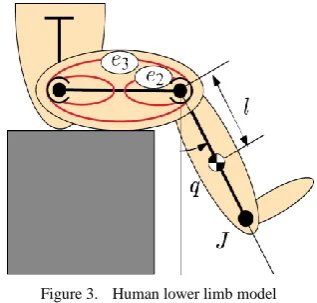
The human lower limb model which is indicated in Fig. 1 is illustrated in Fig. 3. The mathematical model is derived as follows
(7)
where is the inertia of the combined shank and foot, is the combined mass of the shank and foot, is the distance between the knee-joint and lumped center of the mass of the shank and foot, is the coefficient of the friction, and is the gravitational acceleration, respectively [8]. The control input is applied to the muscles and together, where and are called as vastus medialis, rectus femoris, respectively.
Figure 3. Human lower limb model
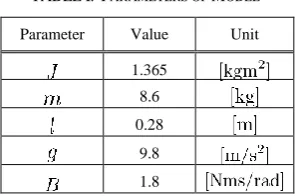
The parameters of the model are shown in Table I by the reference to [8]. The parameters of the saturation
function in (5) are and .
The control parameters of Eq. (1) are designed as ,
TABLE I. PARAMETERS OF MODEL
Parameter Value Unit
1.365
8.6
0.28
9.8
1.8
When the reference position is given as the dashed line in Fig. 4, Fig. 5, the simulation results are shown in Fig. 4-Fig. 7. The RISE-based control with the anti-windup compensator is shown in Fig. 4, Fig. 6. Fig. 5, Fig. 7 are the simulation results of only the RISE-based control. From Fig. 4, Fig. 5, the overshoot of the position of the knee angle which is illustrated by the solid line is small by using the anti-windup compensator. For the control input, the overshoot of the integral component is small when the input saturation works by using the anti-windup compensator, where is shown as the dashed line in Fig. 6, Fig. 7. Then, the control input can converge to the steady state quickly by using the anti-windup compensator.
Figure 4. Time responses of knee angle and reference of knee angle , error by using RISE-based control with anti-windup compensator.
(solid: , , dashed: )
Figure 5. Time responses of knee angle and reference of knee angle , error by using only RISE-based control. (solid: , , dashed: )
Figure 6. Time responses of controller output , control input , proportional term , and integral term by using the RISE-based control with anti-windup compensator. (solid: , , dashed: , )
Figure 7. Time responses of controller output , control input , proportional term , and integral term by using only RISE-based
control. (solid: , , dashed: , )
IV. EXPERIMENTS
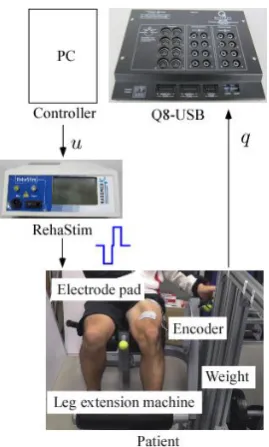
The experimental equipments are composed of the PC, the signal processing board: Q8-USB (Quanser), the electrical stimulus machine: RehaStim (HASOMED Gmbh), the leg extension machine with the encoder and a a weight 5 [LBS] (=2.3 [kg]) as shown in Fig. 8. A human sits on the leg extension machine. A pair of electrode pad is set on the quadriceps femoris. The knee angle which is measured by using the encoder is sent to the PC through the encoder of the Q8-USB. In the PC, the control input is calculated by using the RISE-based controller and the anti-windup compensator. In this paper, the saturation nonlinearity function has the same characteristics as the same as the simulation.
The control parameters in Eq. (1) are designed as , , , . The control input is sent to the RehaStim. In the RehaStim, the control input is transformed into the actual electrical stimulus signals like a square-wave pulse. The electrical stimulus signals are sent to a pair of the electrode pad, then the muscle contraction is yielded.
Overshoot is small.
Small.
Large.
Figure 8. Experimental equipments
The experimental results are shown in Fig. 9-Fig. 12. Fig. 9, Fig. 10 show the RISE-based control with the anti-windup compensator. Fig. 11, Fig. 12 are the only RISE-based control. The knee angle and error are the solid line, the reference is the dashed line in Fig. 9, Fig. 11, where the reference is given as the step function. In Fig. 10, Fig. 12, the controller output and the proportional term are the solid line, the control input and the integral term are the dashed line.
From Fig. 9, the overshoot of the knee angle using the windup compensator is smaller than the no anti-windup compensator in Fig. 11. From Fig. 10, the integral term using the anti-windup compensator has small overshoot compared to the only RISE-based control in Fig. 12. Then, the overshoot of the knee angle may be decreased by the integral term . Therefore, the anti-windup control is useful for the input saturation in the RISE-based control.
Figure 9. Time responses of knee angle and reference of knee angle , error by using RISE-based control with anti-windup compensator
in the experiment. (solid: , , dashed: )
Figure 10. Time responses of controller output , control input , proportional term , and integral term by using the RISE-based control with anti-windup compensator in the experiment. (solid: , ,
dashed: , )
Figure 11. Time responses of knee angle and reference of knee angle , error by using only RISE-based control in the experiment. (solid:
, , dashed: )
Figure 12. Time responses of controller output , control input , proportional term , and integral term by using only RISE-based
control in the experiment. (solid: , , dashed: , ) Overshoot is small.
Overshoot is large. Small.
V. CONCLUSIONS
This paper considered the RISE-based control with the anti-windup compensator for the human lower limb by using the electrical stimulation. By using the proposed controller, the controller output can approach the upper bound or the lower bound with the first-order lag when the input saturation is occurred. The overshoot of the knee angle is decreased compared to the no anti-windup compensator. In the simulation, it was confirmed the overshoot of the knee angle is decreased, because the overshoot of the integral term of the controller is small by using the human lower limb model. The experimental results also indicate the decreasing of the overshoot of the knee angle as the same as the simulation. Therefore, the control performance can be improved by using the proposed RISE-based control with the anti-windup compensator.
REFERENCES
[1] C. T. Freeman, E. Rogers, A. Hughes, J. H. Burridge, and K. L. Meadmore, “Iterative learning control in health care: Electrical stimulation and robotic-assisted upper-limb stroke rehabilitation,”
IEEE Control Systems Magagine, vol. 32, no. 1, pp. 18-43, 2012.
[2] N. Sharma, K. Stegath, C. M. Gregory, and W. E. Dixon, “Nonlinear neuromuscular electrical stimulation tracking control of a human limb,” IEEE Trans. on Neural Systems and
Rehabilitation Engineering, vol. 17, no. 6, pp. 576-584, 2009.
[3] Y. Kushima, H. Kawai, T. Murao, Y. Kawai, M. Kishitani, R. Suzuki, and M. Fujita, “FES-assisted cycling with velocity tracking control for hemiparesis rehabilitation,” in Proc. IEEE
International Conference on Advanced Intelligent Mechatronics,
2017, pp. 645-650.
[4] M. Ferrarin, F. Palazzo, R. Riener, and J. Quintern, “Model-Based control of FES-induced single joint movements,” IEEE Trans. on
Neural Systems and Rehabilitation Engineering, vol. 9, no. 3, pp.
245-257, 2001.
[5] N. Sharma, C. M. Gregory, M. Johnson, and W. E. Dixon, “Closed-Loop neural network-based NMES control for human limb tracking,” IEEE Trans. on Control Systems Technology, vol. 20, no. 3, pp. 712-725, 2012.
[6] S. Galeani, S. Tarbouriech, M. Turner, and L. Zaccarian, “A tutorial on modern anti-windup design,” European Journal of
Control, vol. 15, no. 3-4, pp. 418-440, 2009.
[7] K. Ohishi, E. Hayasaka, T. Nagano, M. Harakawa, and T. Kanmachi, “High-Performance speed servo system considering
voltage saturation of a vector-controlled induction motor,” IEEE
Transaction on Industrial Electronics, vol. 53, no. 3, pp. 795-802,
2006.
[8] Y. Kawai, K. Ejiri, and H. Kawai, “Tracking control using muscle contraction model for human lower limb,” in Proc. SICE Annual
Conference, 2016, pp. 1316-1319.
Yasunori Kawai is an Associate Professor in the department of electrical engineering at National Institute of Technology, Ishikawa College. He received the B.Eng. degree in electrical and computer engineering in 2000 from Kanazawa University, Japan, and received the M.Eng. and Ph.D. degrees in the Graduate School of Natural Science and Technology from Kanazawa University, in 2002 and 2005, respectively. His research focuses on the human motion control by electrical stimulation, bilateral teleoperation, and model predictive control.
Yukimi Miyamoto is currently studying for associate degree of electrical engineering in National Institute of Technology, Ishikawa College.