Oil point and mechanical behaviour of oil palm kernels in linear compression**
Abraham Kabutey1*, David Herak1, Rostislav Choteborsky2, Čestmír Mizera1,Riswanti Sigalingging3, and Olaosebikan Layi Akangbe1
1Department of Mechanical Engineering, 2Department of Material Sciences and Manufacturing Technology; Czech University of Life Sciences Prague, Kamycka 129, Praha 6, Czech Republic
3Department of Agricultural Engineering, University of Sumatera Utara, Prof. A. Sofyan 3, Kampus USU, Medan, Indonesia Republic
Received October 6, 2016; accepted May 29, 2017
*Corresponding author e-mail: [email protected]
**This work was financially supported by the Internal Grant Agency of the Faculty of Engineering, CULS Prague, IGA 2016: 31130/1312/3106.
A b s t r a c t. The study described the oil point and mechani-cal properties of roasted and unroasted bulk oil palm kernels under compression loading. The literature information available is very limited. A universal compression testing machine and vessel diam-eter of 60 mm with a plunger were used by applying maximum force of 100 kN and speed ranging from 5 to 25 mm min-1. The initial pressing height of the bulk kernels was measured at 40 mm. The oil point was determined by a litmus test for each deformation level of 5, 10, 15, 20, and 25 mm at a minimum speed of 5 mm min-1. The measured parameters were the deformation, defor-mation energy, oil yield, oil point strain and oil point pressure. Clearly, the roasted bulk kernels required less deformation ener-gy compared to the unroasted kernels for recovering the kernel oil. However, both kernels were not permanently deformed. The average oil point strain was determined at 0.57. The study is an essential contribution to pursuing innovative methods for process-ing palm kernel oil in rural areas of developprocess-ing countries.
K e y w o r d s: bulk palm kernels, compression loading, deformation energy, oil point, percentage kernel oil
INTRODUCTION
The oil palm (Elaesis guineensis) is a tree crop originating from the tropical climates of West Africa. It requires a minimum rainfall of 1 600 mm per year. After five years of cultivation, it starts to produce fruits bunch -es varying in weight from 10 to 75 kg. The structure of the individual fruit consists of the exocarp (outer skin), mesocarp (a pulp containing the red palm oil), endocarp a central nut with the shell) and the kernel (holding the kernel oil similar to coconut oil) (FAO Agricultural services bulletin). Presently, Indonesia and Malaysia are major
pro-ducers of palm oil in the world (Chang et al., 2014; Lam et al., 2009; Owolarafe et al., 2007; Ozumba and Obiakor, 2011). Generally, the palm oil is used in packaged edible products including cooking oils, margarine, mayonnaise, ice cream, cookies and chocolates as well as non-edible products such as soaps, detergents and cosmetics. Palm kernel oil is also used in commercial cooking, which is rel-atively cheaper and has a longer storage period. It can also be used for the manufacture of soaps and washing powder. The meal is used as a fertiliser and livestock feed (Morrison and Heijndermans, 2013; Oriaku et al., 2013).
The mechanical oil extraction method is commonly used in developing countries due to its relatively low-cost and non-contaminated oil. However, the oil recovery efficiency is between 60 and 80% (Chapius et al., 2014; Divisova et al., 2014; Khan and Hana, 1983). Solvent ex-traction, enzyme-assisted extraction and supercritical fluid extraction provide higher efficiency of oil recovery of 98%. Nevertheless, the disadvantage is that they provide much complexity and higher cost for application in rural areas (Achten et al., 2007; Chen et al., 2012; Subroto et al., 2015a,b). For the palm oil processing, the fresh fruit bunch undergoes sterilisation, striping, and digestion, leav-ing shelled palm nuts and fibres. The nuts are cracked to produce palm kernels and shells. Palm kernels are further processed to yield palm kernel oil. From the traditional point of view, the processing of palm kernel oil is energy -intensive and time-consuming as it involves drying of nuts, cracking of nuts, sieving of cracked nuts, separation of
nels, sun-drying of kernels, winnowing of kernels, removal of undesired materials, roasting of kernels, milling of roas-ted kernels into paste and cooking and, finally, collection of oil. The kernel cake or meal is a by-product.
In the literature, there is very limited information on compression loading test of oil palm kernels (Akinoso et al., 2009; Akinoso and Raji, 2011; Ozumba and Obiakor, 2011). The studies available, however, mainly focused on the effects of compressive force, speed, temperature, mois- ture content and loading positions of single or bulk ker- nels by evaluating the rupture force, deformation, energy and toughness. For instance, Ozumba and Obiakor (2011) indicated that rupture force of single palm kernels at vertical position increased from 181.23 to 208.60 N as moisture content increased from 5 to 10% w.b. while at the horizontal position, it increased up to 7% w.b. and then decreased at 10% w.b. However, at both horizon -tal and vertical positions, the rupture force first increased and then decreased as temperature increased from 70 to 110°C. Akinoso and Raji (2011) also reported that the force and energy of Tenera and Dura varieties of single palm kernels decreased with increased moisture content between 5 and 11% w.b. and temperature between 40 and 80°C. The deformation, on the other hand, increased for Tenera but decreased for Dura in relation to mois-ture content and temperamois-ture as already indicated above. For the bulk oil palm kernels under compression loading, our previously published studies indicated that a slight change in deformation of heat-treated or roasted bulk kernels was observed at a force of 100 kN and a speed of 60 mm min-1 (Kabutey et al., 2013). In addition, an opti-mal pressing force of 250 kN at a speed of 10 mm min-1 for maximum kernel oil was noticed after three repeated load-ings of both roasted and unroasted bulk oil palm kernels (Kabutey et al., 2016a).
In the industrial practice, however, optimization of the mechanical oil extraction has been also centred on process parameters namely pressure, feeding rate, speed of rotation, temperature, pressing time, moisture content, size reduc-tion and heat treatment (Akinoso et al., 2006, 2009; Deli et al., 2011; Karaj and Muller, 2011; Ogunsina et al., 2008). Akinoso et al. (2009) especially reported that maximum oil yield of 46.3 % was found at a compressive stress of 30 MPa, feed rate of 150 kg h-1 and rotational speed of 110 r.p.m. while minimum oil yield of 16.3 % was obtained at 10 MPa compressive stress, 50 kg h-1 feed rate and 110 r.p.m. of rotational speed employing the expeller Tite 002 (Tiny Plant, Rajkot, India) with 180 kg h-1 throughput and power of 30 kW electric motor with inter-changeable speed.
The concept of oil point pressure also provides rele-vant information for design and performance evaluation of mechanical oil expellers or presses (Mrema and McNulty, 1985; Ogunsina et al., 2008). The oil point is the stage at which the oilseed has been adequately squeezed onto the
surface of the seeds which is theoretically related to the ker-nel density of the oilseed (Faborade and Favier, 1996). The present study is a further continuation of our previously published studies, and now the objectives were to deter-mine the oil point pressure with the corresponding strain and the mechanical properties namely the deformation mm, deformation energy (J) and oil yield (%) of roasted and unroasted oil palm kernels in relation to varying speeds under compression loading.
MATERIALS AND METHOD
Samples of roasted and unroasted oil palm kernels were brought from New Tafo in the Eastern Region of Ghana. The standard oven method with a temperature setting of 105ºC and a drying time of 17 h was used for the moisture content determination (ISI, 1996). The initial mass of the samples before and after oven drying was weighed using an electronic balance (Kern 440-35, Kern and Sohn GmbH, Balingen, Germany) with an accuracy of 0.001 g. The test was repeated thrice and the results were averaged. Using Eq. (1) given by Blahovec (2008), the moisture content of roasted and unroasted oil palm kernels was determined as 3.33 ± 0.19% w.b. and 9.67 ± 0.196% w.b., respectively.
, 100
−
=
a b a
m m m C
M (1)
where: MC is the percentage moisture content on wet basis (% w.b.), ma and mb are the masses of samples before and
after heat treatment (g). A compression testing machine (ZDM 50, Czech Republic) and a pressing vessel of diam-eter 60 mm with a 170 mm long plunger were used for the test by applying a maximum compressive force of 100 kN and speed ranging from 5 to 25 mm min-1. The initial press-ing height of the bulk kernels was 40 mm. The oil point of the bulk kernels defined as the first drop of oil was determined by a litmus test for each deformation values of 5, 10, 15, 20, and 25 mm at a minimum speed of 5 mm min-1 (Faborade and Favier, 1996; Herak et al., 2013; ). The percentage oil yield was determined by Eq. (2) (Deli et al., 2011; Kabutey et al., 2015).
, 100
=
m w y OO
O (2)
where: Oyis the percentage oil yield, Owis the mass of
ker-nel oil (g), and Om is the mass of initial pressing height of
kernels (g). The mass of kernel oil Ow was calculated as
the difference between the mass of initial height of kernels Om and the mass of kernel cake. The deformation energy of
(
)
∑
=== +
+
−
+
= 1
0 1
1 ,
2 i
n
n n n
n
n F x x
F
E (3)
where: E is the deformation energy (J), Fn+1 + Fn and xn+1 – xnare the compressive force (N) and deformation (mm),
n is the number of data points and i indicates the number of sections of axis deformation. The oil point pressure of the bulk kernel was calculated using Eq. (4) (Kabutey et al., 2016b):
,
A F
Popt = (4)
where: Popt is the oil point pressure (N mm-2 equal to MPa),
F is the compressive force (N), and A is the cross-sectional area of the pressing vessel (mm2). The oil point strain was also calculated applying Eq. (5) (Herak et al., 2010).
, H XdL opt =
ε (5)
where: εopt is the oil point strain, Xdl is the deformation
level of bulk kernel (mm) and H is the initial height of bulk
kernel (mm). The data obtained was a repetition of two compression tests subjected to ANOVA analysis performed by employing STATISTICA 13 software (Statsoft, 2013).
RESULTS AND DISCUSSION
The determined amounts of roasted and unroasted oil palm kernels and their statistical evaluation are shown in
Tables 1 and 2. The results were statistically significant at
p < 0.05 or F > Fcrit with very high coefficients of determina
-tion R2 = 0.99 (Table 2). This explains that the compression speed influenced the values of deformation (mm), ener -gy (J) and oil yield (%) of both bulk kernels. Clearly, for roasted kernels, the amounts of deformation, energy and oil yield in relation to the different speeds ranged from 23.67 ± 0.03 to 22.82±0.18 mm, 488.79 ± 1.71 to 416.20 ± 0.14 J and 15.24 ± 0.04 to 10.85 ± 0.14% while that of unroast -ed kernels rang-ed from 23.83 ± 0.23 to 24.05 ± 0.09 mm, 553.43 ± 0.17 to 513.16 ± 0.41 J and 22.79 ± 0.37 to 18.32 ± 0.48%, respectively. The percentage oil yield and ener -gy of unroasted kernels were higher than those of roasted kernels, which could partly be due to the higher moisture content. Moreover, at the minimum speed of 5 mm min-1, the highest oil yield was observed (Table 1). This means that at a higher speed the processing time for the oil flow from the solids is reduced. The input pressure or compressive stress also determines the oil processing time and energy demand for maximum oil recovery (Akinoso et al., 2009; Karaj and Muller, 2011; Kabutey et al., 2015). Considering the energy-intensive and time-consuming nature of the tra-ditional oil processing of roasted kernels, direct processing of unroasted kernels would be less labour intensive and more environmentally friendly. Therefore, identifying the suitable compression speed and pressure for processing unroasted bulk oil palm kernels is vital for the design and development of optimal processing technology.
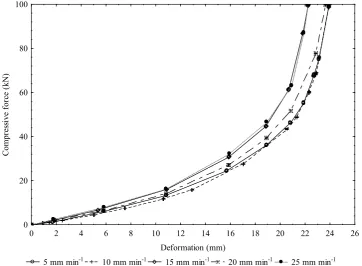
The force-deformation curves of unroasted oil palm kernels in relation to speeds similar to roasted kernels are displayed in Fig. 1. The behaviour of the force-deformation curves is useful for the description of the oil point threshold as well as the optimal energy for the oil recovery. No curves T a b l e 1. Measured parameters of roasted and unroasted bulk kernels at force 100 kN for different speeds
Speed (mm min-1) Deformation (mm) Energy (J) Oil yield (%)
Roasted kernels
5 23.67 ± 0.03 488.79 ± 1.71 15.24 ± 0.04
10 24.07 ± 0.07 462.48 ± 0.27 14.81 ± 0.16
15 23.31 ± 0.26 440.51 ± 0.50 12.93 ± 0.08
20 22.93 ± 0.09 414.52 ± 0.51 11.56 ± 0.06
25 22.82 ± 0.18 416.20 ± 0.14 10.85 ± 0.06 Unroasted kernels
5 23.83 ± 0.23 553.43 ± 0.17 22.79 ± 0.37
10 22.51 ± 0.38 530.77 ± 0.07 20.45 ± 0.64
15 24.09 ± 0.21 530.35 ± 0.31 19.81 ± 0.17
20 22.52 ± 0.36 520.68 ± 0.28 19.33 ± 0.06
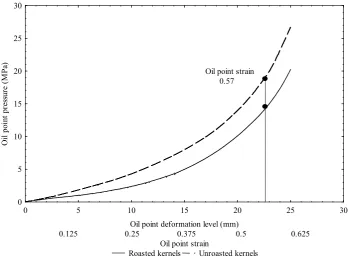
showed any serration characteristics, which is mostly caused by the higher moisture content, compressive force and diameter of the pressing vessel (Divisova et al., 2014). The amounts of oil point pressure and strain are indicat-ed in Table 3. These parameters were calculated using Eqs (4) and (5), respectively. The lower and upper oil points were observed at deformation levels of 20 and 25 mm with corresponding strain values of 0.5 and 0.63 of an average
value of 0.57 (Fig. 2). The lower and upper oil points
pres-sure of roasted kernels ranged from 10.08 ± 0.05 to 20.19
± 0.06 MPa while that of the unroasted ones ranged from
10.09 ± 0.05 to 26.60 ± 0.14 MPa. The average values were
15.14 ± 0.06 and 18.35 ± 0.10. In the literature, the average oil point strain of some selected oilseeds or kernels of jatro-pha, melon, rapeseed, cashew, soybean and oil palm has been reported (Sukumaran and Singh, 1989; Faborade and
Favier, 1996; Raji and Favier, 2004; Ogunsina et al., 2008; Herak et al., 2013). The values ranged between 0.38 to 0.69 at a moisture content between 4.3 and 8.5% w.b. For oil point pressure, it can be seen that roasted kernels showed a smaller amount compared to the unroasted ones, which explains the positive effect of heat treatment on oil flow from the oil-bearing cells. On the contrary, the higher oil point pressure of unroasted kernels could also be attribut-ed to the high moisture content. Ogunsina et al. (2008) and Tunde-Akintunde (2008) have indicated that oil point pressure increases with an increase in moisture content. For instance, oil point pressure of 0.157 MPa was found for fine cashew kernel at a moisture content of 4% w.b. while 0.166 MPa was recorded for coarse cashew kernel at a moisture content of 6% w.b. Clearly, at higher moisture levels, the cushioning effect of mucilage develops, and this
T a b l e 2. ANOVA analysis of measured parameters of roasted and unroasted bulk oil palm kernels
Parameters Roasted kernels Unroasted kernels
R2 F F
crit p-value R2 F Fcrit p-value
Deformation (mm) 0.97 22.17 2.246 <0.05 0.96 17.08 2.246 <0.05
Energy (J) 0.99 2 822.90 2.246 <0.05 0.99 5 877.49 2.246 <0.05
Oil yield (%) 0.99 867.48 2.246 <0.05 0.98 34.16 2.246 <0.05 p < 0.05 or F > Fcrit means significant.
5 mm min-1 10 mm min-1 15 mm min-1 20 mm min-1 25 mm min-1
0 2 4 6 8 10 12 14 16 18 20 22 24 26
Deformation (mm) 0
20 40 60 80 100
Co
m
pr
es
siv
e f
or
ce
(k
N
)
mucilage consumes energy generated by the pressure to compress the oil out of the oil-bearing cells thus increasing the oil point pressure (Ajibola et al., 2002). In this study, the average oil point strain of both kernels was higher in comparison with the findings of some of the above-men -tioned authors. The reason could be related to the variation in the structural integrity of the oil bearing materials, that is, the change in the physical (moisture content, initial bulk density, kernel density, porosity) and mechanical (contact and gradient pressure and compressibility) properties.
CONCLUSIONS
1. The average oil point strain of roasted and unroasted oil palm kernels was observed at 0.57 with correspond-ing oil point pressure of 15.14 ± 0.06 and 18.35 ± 0.10, respectively.
2. Roasted kernels required less deformation energy than unroasted kernels for recovering the kernel oil in rela-tion to the various speeds between 5 and 25 mm min-1.
3. The bulk kernels were not permanently deformed at a maximum force of 100 kN confirming previous findings that a repeated compression or a higher force would be needed to obtain greater percentage kernel oil.
4. There was no serration effect or undulation behaviour on the force-deformation curves in relation to the different speeds.
5. Identifying the specific compressive force, speed, oil point pressure and strain among other indicators is vital for the design and development of optimal processing technology.
Conflict of interest: The Authors do not declare
con-flict of interest.
0 5 10 15 20 25 30
Oil point deformation level (mm)
0.125 0.25 0.375 0.5 0.625 Oil point strain
Roasted kernels Unroasted kernels 0
5 10 15 20 25 30
O
il p
oi
nt
p
re
ss
ur
e (
M
Pa
)
Oil point strain 0.57
Fig. 2. Oil point pressure versus deformation level and strain of bulk roasted and unroasted kernels at pressing height 40 mm and speed 5 mm min-1.
T a b l e 3. Oil point strain and pressure of roasted and unroasted bulk kernels at speed 5 mm min-1
Oil point deformation level
(mm) Oil point strain
Oil point pressure (MPa)
roasted kernels unroasted kernels
20 0.50 ± 0.00a 10.08 ± 0.05 10.09 ± 0.05
25 0.63 ± 0.00b 20.19 ± 0.06 26.60 ± 0.14
Average 0.57 ± 0.00 15.14 ± 0.06 18.35 ± 0.10
REFERENCES
Achten W.M.J., Mathijs E., Verchot L., Singh V.P., Aerts R., and Muys B., 2007. Jatropha biodiesel fueling sustainabi- lity? Biofuels Bioprod. Biorefining, 1, 283-291.
Ajibola O.O., Okunade D.A., and Owolarafe O.K., 2002. Oil point pressure of soybean. J. Food Process Eng., 25, 407-416.
Akinoso R. and Raji A.O., 2011. Physical properties of fruit, nut and kernel of oil palm. Int. Agrophys., 25, 85-88.
Akinoso R., Raji A.O., and Igbeka J.C., 2009. Effects of com-pressive stress, feeding rate and speed on palm kernel oil yield. J. Food Eng., 93, 427-430.
Blahovec J., 2008. Agromaterials-Study Guide. Czech University of Life Sciences Prague, 7-8.
Chang S.K., Ismail A., Yanagita T., Esa N.M., and Baharuldin M.T.H., 2014. Biochemical characterisation of the soluble proteins, protein isolates and hydrolysates from oil palm (Elaeis guineensis) kernel. Food Bioscience, 7, 1-10. Chapuis A., Blin J., and Lecomte D., 2014. Separation efficien
-cy and energy consumption of oil expression using a screw- press: The case of Jatropha curcas L. seeds. Industrial Crops Products, 52, 752-761.
Chen C.R., Cheng Y.J., Ching Y.C., Hsiang D., and Chang C.M.J., 2012. Green production of energetic Jatropha oil from de-shelled Jatropha curcas L. seeds using supercritical carbon dioxide extraction. J. Supercrit. Fluids, 66, 137-143. Deli S., Farah Masturah M., Tajul Aris Y., and Wan Nadiah
W. A., 2011. The effects of physical parameters of the screw press oil expeller on oil yield from Nigella sativa L. seeds. Int. Food Research, 18, 1367-1373.
Divisova M., Herak D., Kabutey A., Sleger V., Sigalingging R., and Svatonova T., 2014. Deformation curve characteristics of rapeseeds and sunflower seeds under compression load -ing. Scientia Agriculturae Bohemicae, 45(3), 180-186. Faborade M.O. and Favier J.F., 1996. Identification and signifi
-cance of the oil-point in seed-oil expression. J. Agric. Eng. Res., 65, 335-345.
FAO Agricultural Services Bulletin, 2002. Small-scale palm oil processing in Africa, 148, pp. 1-59.
Herak D., Gurdil G., Sedlacek A., Dajbych O., and Simanjuntak S., 2010. Energy demands for pressing Jatropha curcas L. seeds. Biosystems Engineering, 106(4), 527-534.
Herak D., Kabutey A., and Hrabe P., 2013. Oil point determina-tion of Jatropha curcas L. bulk seeds under compression loading. Biosystems Eng., 116(4), 470-477.
Herak D., Kabutey A., Sedláček A., and Gűrdil G., 2012.
Mechanical behaviour of several layers of selected plant seeds under compression loading. Research Agric. Eng., 58(1), 24-29.
ISI, 1966. Indian standard methods for analysis of oilseeds, IS: 3579. Indian Standard Institute, New Delhi, India.
Kabutey A., Divisova M., Sedlacek L., Boatri W.E., Svatonova T., and Sigalingging R., 2013. Mechanical behaviour of oil palm kernels (Elaeis guineensis). Scientia Agriculturae Bohemica, 44, 18-22.
Kabutey A., Herák D., Chotěborský R., Sigalingging R., and Mizera Č., 2015. Effect of compression speed on energy requirement and oil yield of Jatropha curcas L. bulk seeds under linear compression. Biosystems Eng., 136, 8-13.
Kabutey A., Herak D., Dajbych O., Akangbe O.L., Napitupulu R., and Pandiangan S., 2016a. Mechanical behaviour of roast-ed and unroastroast-ed oil palm kernels under compression loading. Proc. Int. Symp. Mechanical and Agricultural Engineering, ISB-INMA TEH, October 27-29, Bucharest, Romania.
Kabutey A., Herak D., Hanus J., Choteborsky R., Dajbych O., Sigalingging R., and Akangbe O.L., 2016b. Prediction of pressure and energy requirement of Jatropha curcas L. bulk seeds under non-linear pressing. Proc. VI Int. Conf. Trends in Agricultural Engineering TAE, September 7-9, CULS Prague, Prague, Czech Republic.
Karaj S. and Muller J., 2011. Optimizing mechanical oil extrac-tion of Jatropha curcas L. seeds with respect to press capacity, oil recovery and energy efficiency. Industrial Crops and Products, 34, 1010-1016.
Khan L.M. and Hanna M.A., 1983. Expression of oil from oil-seeds – a review. Agric. Eng. Res., 28, 495-503.
Lam M.K., Tan K.T., Lee K.T., and Mohamed A.R., 2009. Malaysian palm oil: Surviving the food versus fuel dispute for a sustainable future. Renewable and Sustainable Energy Review, 13, 1456-1464.
Morrison A.K. and Heijndermans E., 2013. Palm Kernel Oil Production Process Characterization, An Energy, Poverty and Gender (EnPoGen) Initiative of SNV Ghana, 1-47.
Mrema G.C. and McNulty P.B., 1985. Mathematical model of mechanical oil expression from oilseeds. Agric. Eng. Res., 31, 361-370.
Ogunsina B.S., Owolarafe O.K., and Olatunde G.A., 2008. Oil point pressure of cashew (Anacardium occidentale) ker-nels. Int. Agrophysics, 22, 53-59.
Oriaku E.C., Agulanna C.N., Edeh J.C., and Nwannewuihe H.U., 2013. Determination of optimal angle of projection and separation of palm nut shell and kernel using a designed cracker/separator machine. Int. J. Sci. Tech. Res., 2(10), 289-292.
Oworlarafe O.K., Olabige M.T., and Faborade M.O., 2007. Physical and mechanical properties of two varieties of fresh oil palm fruit. J. Food Eng., 78, 1228-1232.
Ozumba I.C. and Obiakor S.I., 2011. Fracture resistance of palm kernel seed to compressive loading. J. Stored Products and Postharvest Res., 2(13), 248-253.
Raji A.O. and Favier J.V., 2004. Model for the deformation in agricultural and food particulate materials under bulk com-pressive loading using discrete element method II: Compression of oil seeds. J. Food Eng., 64, 373-380. Statsoft, 2013. Inc. Tulsa, OK74104, USA.
Subroto E., Manurung R., Heeres H.J., and Broekhuis A.A.,
2015a. Optimization of mechanical oil extraction of Jatropha curcas L. kernel using response surface method. Industrial Crops and Products, 63, 294-302.
Subroto E., Manurung R., Heeres H.J., and Broekhuis A.A.,
2015b. Mechanical extraction of oil from Jatropha curcas L. kernel: Effect of processing parameters. Industrial Crops and Products, 63, 303-310.
Sukumaran C.R. and Singh B., 1989. Compression of a bed of rapeseeds – the oil-point. J. Agric. Eng. Res., 42, 77-84. Tunde-Akintunde T.Y., 2008. Determination of oil point