Impact of anesthesia method on cortisol and
interleukin-6 concentration changes during and
after laparoscopic colorectal surgery
Diana Gasiūnaitė
1, 2,
Jūratė Šipylaitė
1, 2,
Eglė Kontrimavičiūtė
1, 2,
Eligijus Poškus
3¹Vilnius University Clinic of Anesthesiology and Intensive Care
²Vilnius University Hospital Santariškių Klinikos Centre of Anesthesiology, Intensive Care and Pain Treatment
³Vilnius University Clinic of Gastroenterology, Nephrourology and Surgery Centre of Abdominal Surgery
Correspondence to: Diana Gasiūnaitė, Centre of Anesthesio logy, Intensive Care and Pain Management, Vilnius University Hospital Santariskiu Clinics, Santariškių 2, LT08661 Vilnius, Lithuania. Email: [email protected]
Background. The surgicalstressinduced release of hormones, such as ca techolamines (norepinephrine and epinephrine), adrenocorticotropic hor mone (ACTH), and cortisol, via the autonomic nervous system and the hypothalamicpituitaryadrenal axis (HPA) mediates inhibitory effects on immune functions. Pain management may influence the immune response in the postoperative period. The goal of the present study was to examine to what extent postoperative pain management modulates the surgeryinduced alterations of the immune response, specifically, interleukin6, cortisol and C reactive protein (CRP); to compare effects of two pain management tech niques, based on NSAID and continuouos epidural infusion of a local anaes thetic and morphine mixture.
Results and discussion. There were statistically significant differences be tween the groups in pain score after surgery (p < 0.001) and 24 hours later (p < 0.000) and in bowel motility after anaesthesia (p < 0.001). In EA group bowel motility was observed in 96.2% of patients after surgery and lasted more than 24 hours despite of infusion of local anesthetic mixture with morphine. In the GA group only in 55.6% of cases bowel motility was observed after anaesthesia. No differencies in bowel motility was determined between the groups 24 hours later. We determined statistically significant differences in cortisol value after surgery comparing EA and GA groups (p < 0.003) and also between three groups, despite the duration of anaesthesia statistically signi ficant longer in the EA group. The highest cortisol value was determined in the conversion group. The interleukin6 concentration diferencies were found sig nificantly relevant comparing the EA group with CG and also comparing the GA group with CG (p < 0.000). Studying complications associated with intestinal anastomosis permeability using nonparametrical test some asso ciation between interleukin6 concentration after 24 hours and anastomosis problems (p < 0.039) was determined. No diferencies in CRP findings between EA and GA groups during the 6day postoperative period were determined.
Conclusions. Combined general anesthesia with epidural analgesia war rant better pain control after LCS and attenuate stress response reducing se cretion of cortisol and interleukine6.
Key words: laparoscopic colorectal surgery, cortisol, interleukin6, epidural analgesia
INTRODUCTION
The postoperative period is associated with neu
roendocrine, metabolic and immune alterations,
which are the combined result of tissue damage,
anesthesia, postoperative pain, and psychological
stress. Suppression of immune defense mechanisms
was de monstrated in the postoperative period. Such
immune compromise could affect the postopera
tive infection rate, healing process, and the rate and
size of tumor metastases disseminated during sur
gery (1). Pain management may influence the im
mune response in the postoperative period. Several
pain management techniques are frequently used in
the postoperative period. These techniques include
traditional systemic administration of opiates on a
regular schedule or on demand (IOR), patientcon
monocyte deactivation, decreased microbicidal acti
vity of phagocytes, and an overall imbalance between
proinflammatory and antiinflammatory cytokines
and immunocompetent cells (3). Epidural analgesia
may reduce infectious complications by reducing
lymphocyte suppression, attenuating proinflamma
tory cytokines, and by increasing surgical wound
oxygen tension to promote healing (1, 4), although
such positive effects may be negated by the more ex
tensive inflammatory response from more extensive
surgery (5, 6). General anesthesia accompanied by
surgical stress is considered to suppress immunity,
presumably by directly affecting the immune system
or activating the hypothalamicpituitaryadrenal
(HPA) axis and the sympathetic nervous system.
Proinflammatory cytokines, such as IL1, IL6, and
tumor necrosis factor (TNF)from monocytes and
macrophages and lymphocytes activated by surgical
stress can stimulate the HPA. Therefore, the neuroen
docrine system and proinflammatory cytokines and
antiinflammatory cytokines synergistically augment
their suppressive effects in the perioperative immune
system. Interleukin6 (IL6) is an important media
tor of the acute phase response and a sensitive mark
er of tissue damage (7). The surgicalstressinduced
release of hormones such as catecholamines (nore
pinephrine and epinephrine), adrenocorticotropic
hormone (ACTH) and cortisol via the autonomic
nervous system and the HPA mediates inhibitory
effects on immune functions (8, 9). The antiinflam
matory effects of anesthetics may be beneficial in
situations involving ischemia and reperfusion injury
or the systemic inflammatory response sindrome
(10). Awareness of these immunological properties
is helpful for daily anesthetic management.
The goal of the study was to examine to what
extent postoperative pain management regime
modulates the surgeryinduced alterations of the
immune response, specifically, interleukin6, corti
sol and C reactive protein; to compare effects of two
pain management techniques, based on NSAID and
continuouos epidural infusion of local anaesthetic
and morphine mixture.
MATERIALS AND METHODS
Patients, anesthesia and perioperative analgesia
techniques
Having received the Vilnius Regional Biomedical
Research Ethics Committee approval, participa
Statistical analysis
Collected data were stored in the data base and
were analysed using SPSS for Windows Ver
sion 19.0. Continuous data were summarized by
using descriptive statistics – number of cases,
mean, standard deviation, median, and range
(minimum and maximum). Categorical variables
were summarized by using frequency (counts)
and proportions. Differences in mean values be
tween the groups were analyzed with the Mann
Whitney U test and Student’s t test for comparison
of 2 groups and ANOVA for comparison of more
than two groups. Bonferroni adjustment was used
to detect pairwise differences between groups.
The Chisquare test was used to determine diffe
rences between categorical variables. Differences
be tween the groups were considered statistically
significant at p < 0.05.
RESULTS
The GA and EA groups were similar in the body
weight, body mass index, age, ASA groups and
duration of surgery (Table 1).
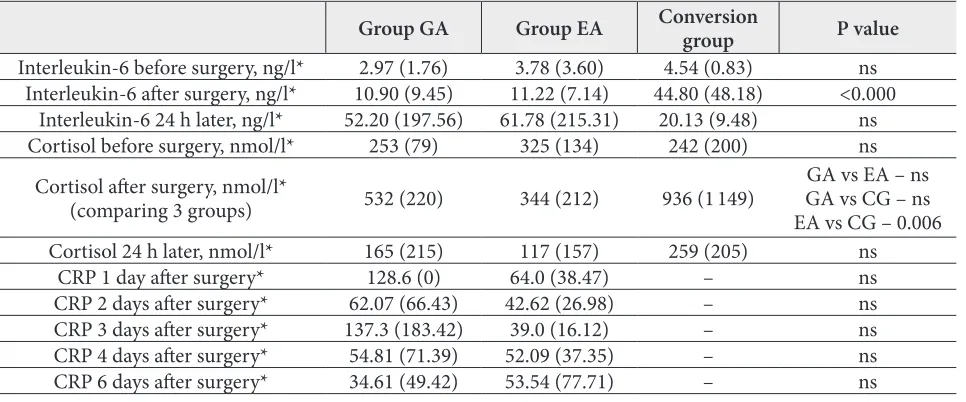
We determined statistically significant differ
ences in cortisol value after surgery (Table 2) com
paring EA and GA groups (p < 0.003) and also
among three groups, despite the duration of an
aesthesia statistically significant longer in the EA
group. The highest cortisol value was determined
Table 1. Characteristics of the patients according to the postoperative pain management group
Group GA Group EA P value
Body mass index* 67.78 (10.90) 67.51 (10.97) ns
Body mass* 24.03 (2.68) 24.54 (3.16) ns
Age* 62.22 (7.82) 65.08 (13.18) ns
Bowel motility after operation 55.6% 96.2% 0.001
Bowel motility 24 h later 96.3% 96.2% ns
Pain score after surgery (VAS)* 1.48 (1.70) 0.23 (0.82) 0.001
Pain score 24 h later (VAS)* 3.19 (1.98) 0.46 (0.65) 0.000
Morphine consumption (surgery)* 15.56 (6.41) 2.96 (0.20) 0.000
Morphine consumption (postoperatively)* 1.48 (4.56) 4.69 (0.68) 0.001
Anesthesia duration, min* 197.96 (61.82) 220.19 (44.06) 0.047
Surgery duration, min* 165.37 (59.90) 175.58 (44.21) ns
Anastomotic permeability 14.8% 11.5% ns
GA – general anaesthesia group, EA – continuos epidural analgesia group; ns – no statistically significant diferencies. *Values are expressed as mean (standart deviation(SD)).
Table 2. Interleukin6 and cortisol changes perioperativelly
Group GA Group EA Conversion group P value
Interleukin6 before surgery, ng/l* 2.97 (1.76) 3.78 (3.60) 4.54 (0.83) ns Interleukin6 after surgery, ng/l* 10.90 (9.45) 11.22 (7.14) 44.80 (48.18) <0.000
Interleukin6 24 h later, ng/l* 52.20 (197.56) 61.78 (215.31) 20.13 (9.48) ns
Cortisol before surgery, nmol/l* 253 (79) 325 (134) 242 (200) ns
Cortisol after surgery, nmol/l*
(comparing 3 groups) 532 (220) 344 (212) 936 (1 149)
GA vs EA – ns GA vs CG – ns EA vs CG – 0.006
Cortisol 24 h later, nmol/l* 165 (215) 117 (157) 259 (205) ns
CRP 1 day after surgery* 128.6 (0) 64.0 (38.47) – ns
CRP 2 days after surgery* 62.07 (66.43) 42.62 (26.98) – ns
CRP 3 days after surgery* 137.3 (183.42) 39.0 (16.12) – ns
CRP 4 days after surgery* 54.81 (71.39) 52.09 (37.35) – ns
CRP 6 days after surgery* 34.61 (49.42) 53.54 (77.71) – ns
in the conversion group. The interleukin6 concen
tration diferencies were found significantly relevant
comparing the EA group with CG and also compa
ring the GA group with CG (p < 0.000). Studying
complications associated with intestinal anastomo
sis permeability using the nonparametrical test as
sociation between interleukin6 concentration af
ter 24 hours and anastomosis problems (p < 0.039)
was determined. No differencies in CRP findings
between EA and GA groups during the 6day post
operative period were determined.
DISCUSSION
Surgery has major impact on patient homeostasis,
expressed mainly by an immune response compro
mise (11). The unavoidable inflammatory response
involves regional and systemic release of cytokines,
hormones, acutephase proteins, eicosanoids, and
other substances by surgical manipulationacti
vated immune cells (11, 12, 13) Epidural analgesia
is associated with a shorter duration of postopera
tive ileus, attenuation of the stress response, fewer
pulmonary complications, improved postoperative
pain control and mobility, and a quicker recove
ry from the patient’s viewpoint. It does not reduce
the incidence of anastomotic leak, intraoperative
blood loss or transfusion requirement, duration of
hospital stay, or risk of thromboembolism or car
diac morbidity compared with the use of conven
tional analgesia in unselected patients undergoing
gastrointestinal surgery. There is evidence that for a
subgroup of patients with a high risk of cardiac or
pulmonary morbidity, thoracic epidural analgesia
reduces hospital costs and stay after gastrointesti
nal surgery, and blockade at this level seems prefer
able for gastrointestinal operations (14). The present
study shows that patients in the EA group exhibi
ted reduced postoperative pain, reduced cortisol
response to laparoscopic surgery, and attenuated
proinflammatory cytokine interleukin6 response
to surgery. Interleukin6 is an important mediator
of the acute phase response and a sensitive marker
of tissue damage (10). Our findings have links with
this statement because some association between
anastomosis permeability ant rise of IL6 24 hours
after surgery (p < 0.039, nonparametrical test) was
found. In the study, the tight correlation between the
postoperative pain management type and postope
rative infection or anastomotic permeability was not
determined. Proinflammatory cytokines are key me
diators of illness symptoms (15); their attenuation in
the PCEA group may have contributed to attenua
ted illness response, to reduced postoperative pain,
and possibly to reduced risk of developing chronic
pain. In the present study, better postoperative pain
control in EA group, and lower cortisol after surgery
were determined. In Beilin et al. (1) study, ex vivo
production of the proinflammatory cytokines IL1
and IL6 was more increased in IOR and PCA with
morphine groups compared with the PCEA group,
especially at 24 hours after surgery. The patients of
the first two groups were treated with opiates, whe
reas patients of the PCEA group were treated with a
mixture of opiates and local anesthetics; this may ac
count for the attenuated levels of proinflammatory
cytokines in the PCEA group. Local anesthetics can
reduce the postoperative inflammatory response in
two ways: they block neural transmission at the site
of tissue injury and thus may attenuate the neuroge
nic inflammation (16), or they have systemic antiinf
lammatory properties of their own (17). Regarding
the findings, it may be possible to attribute the re
duced inflammatory using CEA, consisting of local
anesthetics and opiates (1) In the above mentioned
Beilin et al. (1) study, patients of the IOR and PCA
groups have reported higher levels of pain while de
monstrating larger production of IL1 and IL6. It
has been argued that nociception and proinflamma
tory cytokines play a mutual upregulatory role (21);
thus, increased production of proinflammatory cy
tokines may contribute to more severe pain and vice
versa. The proinflammatory cytokines IL1 and IL6
mediate hyperalgesia. IL1 and IL6 are involved in
the mechanisms of allodynia and possibly in the de
velopment of postoperative neuropathic and chronic
pain (22). The study confirms that epidural analgesia
effectively reduces postoperative pain, decreases the
endocrine response to surgery, and thus may attenu
ate surgeryinduced immune alterations.
CONCLUSIONS
Epidural analgesia in laparoscopic colorectal sur
gery effectively reduces postoperative pain and at
tenuates stress response reducing secretion of cor
tisol and interleukine6.
References
1. Beilin B, Shavit Y, Trabekin E, Mordashev B, Mayburd E, Zeidel A, et al. The effects of post operative pain management on immune response to surgery. Anesth Analg. 2003; 97: 822–7. 2. Hollman MW, Durieux ME. Local anesthetics and
the inflammatory response. Anesthesiology. 2000; 93: 858–75.
3. Sido B, Teklote JR, Hartel M, Friess H, Büch ler MW. Inflammatory response after abdominal surgery. Best Pract Res Clin Anaesthesiol. 2004; 18: 439–54.
4. Buggy DJ, Doherty WL, Hart EM, Pallett EJ. Post operative wound oxygen tension with epidural or intravenous analgesia: a prospective, randomized, singleblind clinical trial. Anesthesiology. 2002; 97: 952–8.
5. Yokoyama M, Itano Y, Katayama H, Morimatsu H, Takeda Y, Takahashi T, et al. The effects of con tinuous epidural anesthesia and analgesia on stress response and immune function in patients under going radical esophagectomy.Anesth Analg. 2005; 101: 1521–7.
6. Liu SS, Wu CL. Effect of postoperative analgesia on major postoperative complications: A systematic update of the evidence. Anesth Analg. 2007; 104: 689–702.
7. Homburger JA, Meiler SE. Anesthesia drugs, immunity, and longterm outcome. Curr Opin Anaesthesiol. 2006; 19: 423–8.
8. Vallejo R, Hord ED, Barna SA, SantiagoPalma J, Ahmed S. Perioperative immunosuppression in cancer patients. J Environ Pathol Toxicol Oncol. 2003; 22: 139–46.
9. Kelbel I, Weiss M. Anesthetics and immune func tion. Curr Opin Anaesthesiol. 2001; 14: 685–91. 10. Ozawa A, Konishi F, Nagai H, Okada M,
Kanazawa K. Cytokine and hormonal responses in laparoscopicassisted colectomy and conven tional open colectomy. Surg Today. 2000; 30: 107–11.
11. Koerner P, Westerholt A, Kessler W, Traeger T, Maier S, Heidecke CD. Surgical trauma and post operative immunosuppression. Chirurg. 2008; 79(4): 290–4.
12. Sammour T, Kahokehr A, Chan S, Booth RJ, Hill AG. The humoral response after laparoscopic versus open colorectal surgery: a metaanalysis. J Surg Res. 2010; 164(1): 28–37.
13. Buunen M, Gholghesaei M, Veldkamp R, Mei jer DW, Bonjer HJ, Bouvy ND. Stress response to laparoscopic surgery: a review. Surg Endosc. 2004; 18(7): 1022–8.
14. Fotiadis RJ, Badvie S, Weston MD, AllenMersh TG. Epidural analgesia in gastrointestinal surgery. Br J Surg. 2004; 91: 828–41.
15. Watkins LR, Maier SF, Goehler LE. Immune activ ation: the role of proinflammatory cytokines in inflammation, illness responses, and pathological pain states. Pain. 1995; 63: 289–302.
16. Torres A, Torres K, Paszkowski T, Staskiewicz GJ, Maciejewski R. Cytokine response in the post operative period after surgical treatment of benign adnexal masses: comparison between laparoscopy and laparotomy. Surg Endosc. 2007; 21: 1841–8. 17. Hollman MW, Durieux ME. Local anesthetics and
the inflammatory response. Anesthesiology. 2000; 93: 858–75.
18. Watkins LR, Maier SF. Illnessinduced hyperalge sia: mediators, mechanisms and implications. In: Watkins LR, Maier SF, editors. Cytokine and pain. Basel: Birkhäuser Verlag; 1999. p. 39–57.
19. Cui JG, Holmin S, Mathiesen T, et al. Possible role of inflammatory mediators in tactile hypersensi tivity in rat model of mononeuropathy. Pain. 2000; 88: 239–48.
Diana Gasiūnaitė, Jūratė Šipylaitė, Eglė Kontrimavičiūtė, Eligijus Poškus
ANESTEZIJOS METODO ĮTAKA KORTIZOLIO IR INTERLEUKINO-6 SEKRECIJAI PERIOPERACI-NIU LAIKOTARPIU TAIKANT LAPAROSKOPINĘ KOLOREKTALINĘ CHIRURGIJĄ
Santrauka
Įžanga. Operacijos sukeliamas stresas paveikia neuro endokrininį organizmo atsaką – katecholaminų, AKTH, kortizolio sekreciją, uždegimą skatinančių ir slopinan čių citokinų gamybą. Anestezijos komponentų bei būdų, mažinančių uždegimą, skatinančių citokinų gamybą, taikymas gali būti naudingas apribojant sisteminio už degiminio atsako sindromo vystymąsi. Il6 yra svarbus uždegimą skatinantis ūmios fazės citokinas ir audinių pažeidimo žymuo.
sukeliamą stresą. Tyrimo metu taikyti du perioperaci nės analgezijos metodai – NVNU ir epidūrinė vietinio anestetiko ir opiodo infuzija.
Tyrimo medžiaga ir metodai. Regiono biomedici ninių tyrimų etikos komitetui leidus, tyrime pasiūlyta dalyvauti ligoniams, kuriems tyrimo vykdymo laiko tarpiu VUL Santariškių klinikų Pilvo chirurgijos centre buvo atliktos laparoskopinės storosios žarnos rezekci jos operacijos. Buvo tiriami 58 I–III fizinės klasės pagal Amerikos anesteziologų asociacijos klasifikaciją (ASA) ligoniai, atsitiktinės atrankos būdu suskirstyti į dvi gru pes: bendros anestezijos (GA, N = 27) ir kombinuotos anestezijos su epidūrine analgezija (EA, N = 26). Abiejų grupių pacientams taikyta vienoda premedikacija, pyki nimo, vėmimo profilaktika, nuskausminimas nesteroi diniais vaistais nuo uždegimo (NVNU), anestezijos in dukcija intraveniniu anestetiku ir raumenų relaksantu, anestezijos palaikymui skiriamas tas pats inhaliacinis anestetikas Sevorane. Operacijos metu analgezija skir ta pagal poreikį taikant skirtingus metodus: GA grupės pacientams skirti intraveniniai narkotiniai analgetikai (fentanilis, morfinas); EA grupės pacientams pagal poreikį epidūraliai buvo leidžiamas vietinio anesteti ko bupivakaino (0,125–0,25 %) ir narkotinio analge tiko morfino mišinys. EA pacientams prieš anesteziją buvo kateterizuojamas epidūrinis tarpas krūtinės sri tyje. Buvo stebimos abiejų grupių gyvybinės funkcijos, taip pat tirtas kortizolis bei interleukinas6 veniniame kraujyje prieš anestezijos pradžią, po operacijos ir pra ėjus 24 val. nuo pradinio tyrimo. CRB tyrimas karto tas pirmą ir šeštą pooperacinę parą. Siekiant užtikrinti hemodinamiką prireikus buvo skiriami koloidai, kai jų nepakakdavo, į veną buvo leidžiamas efedrinas. Tyrimo metu kai kurios laparoskopiškai pradėtos operacijos dėl radinių operacijos metu buvo užbaigtos atlikus laparo tomiją, todėl buvo išskirta trečioji, konversijos, pacien tų grupė (CG). Šios grupės pacientams perioperacinė analgezija tęsta pradžioje numatytu būdu. Visų grupių pacientų skausmas vertintas pagal vizualią analogų ska lę (VAS) nuo 1 iki 10. Pooperaciniam epidūrinės grupės pacientų nuskausminimui nuolat buvo skiriama 0,25 % bupivakaino ir 5 mg morfino tirpalo infuzija. Pirmosios grupės pacientų skausmas buvo slopinamas nesteroidi
niais vaistais nuo uždegimo, o prireikus – tramadoliu arba morfinu į raumenis. Surinkti duomenys buvo lai komi kompiuterinėje duomenų bazėje ir apdoroti pa naudojant SPSS for Windows19.0 versiją. Kiekybiniams rodikliams aprašyti buvo apskaičiuotas bendras ste bėjimų skaičius (n), vidurkis, standartinis nuokrypis, mediana, minimali bei maksimali reikšmės. Kokybiniai rodikliai aprašyti pateikiant jų procentinį pasiskirsty mą. Siekiant palyginti dviejų grupių kiekybinius rodik lius, buvo taikomas parametrinis Stiudento t kriterijus arba neparametrinis MannWhitney U kriterijus, kelių grupių palyginimui buvo naudojamas ANOVA testas. Lyginant dviejų kokybinių rodiklių tarpusavio sąsają taikytas chi kvadrato kriterijus. Skirtumai laikyti statis tiškai reikšmingi, jeigu paklaidos tikimybės reikšmė p yra mažesnė nei 0,05.
Rezultatai. Laparoskopinių kolorektalinių opera cijų metu nustatytas statistiškai patikimai mažesnis (p < 0,003) kortizolio kiekis kraujyje, kai perioperaci nei analgezijai taikomas epidūrinis skausmo malšinimas bupivakaino ir morfino mišiniu. Didžiausias kortizolio kiekis po operacijos nustatytas konversijos grupėje; pra ėjus 24 val. nuo pradinio matavimo statistiškai patikimo skirtumo tarp grupių nenustatyta. Interleukino6 kon centracija po operacijos skyrėsi tarp GA ir konversijos bei EA ir konversijos grupių (p < 0,000). Tiriant kore liaciją tarp diagnozuoto anastomozės pralaidumo ir in terleukino6 kiekio pokyčių praėjus 24 val. po pradinio tyrimo, sąryšis (p < 0,039) nustatytas neparamet riniu testu, tačiau ANOVA testas to nepatvirtino. Per 6 poo peracines dienas nerasta reikšmingų CRB skirtumų tarp EA ir GA grupių. Nustatytas statistiškai patikimai ma žesnis skausmo intensyvumas EA grupėje vertinant iš kart po operacijos ir po 24 val. (0,23 ± 0,82 vs. 1,48 ± 1,70 iškart po operacijos ir 0,46 ± 0,65 vs. 3,19 ± 1,98 vėliau po operacijos).
Išvados. Kombinuota bendra anestezija su epidūri ne analgezija patikimai mažina pooperacinį skausmą, uždegimą skatinančio neuroendokrininio atsako dydį, kortizolio ir interleukino6 sekreciją laparoskopinių ko lorektalinių operacijų metu.