¥§
shun|hnl
{êw9±êtêz9ê
lêkê mêêwê |êêuO
kêê¾êtêê
SummaryDiscourse Intonation (DI) (Brazil 1997; Chun 2002) seems to be particularly well suited for use in the EFL classroom, much more so than the rather complex traditional models (e.g. O’Connor and Arnold 1973) or some recent phonological theories. Yet if L2 teachers are to be provided with clear guidelines on how to incorporate DI into communicative language teaching, much more empirical research is needed with L2 students of different L1 backgrounds to uncover the specific problems they face. The small-scale study presented here examines how 15 second-year students of the English Department in Niš manage intonation in a reading task. The analysis focuses on the components singled out by Chun (2002) as crucial for language learners: sentence stress (nuclear tone placement), terminal contour (direction of pitch change) and key (pitch range at transition points).
Key words: discourse functions of intonation, Serbian EFL students, teaching intonation
iêê
Povzetek
Model besedilne intonacije (BI) (Brazil 1997; Chun 2002) se je pri pouku angleščine kot tujega jezika izkazal primernejši od nekaterih tradicionalnih in kompleksnejših modelov (npr. O’Connor and Arnold 1973) oziroma najnovejših fonoloških teorij. Vendar pa je za to, da bi učiteljem angleščine lahko ponudili smernice, kako uporabiti BI v razredu, treba izvesti več empiričnih raziskav med študenti angleščine, ki govorijo različne materne jezike. Tako bi ugotovili, katere so njihove specifične težave. Članek predstavlja rezultate študije, v kateri je sodelovalo 15 študentov angleščine z Univerze v Nišu. Analiza njihove bralne intonacije se je osredinila na tiste komponente, ki jih Chunova (2000) navaja kot najbolj pomembne za učence angleščine: stavčni naglas (mesto intonacijskega jedra), končni potek intonacije in glasovna višina.
Ključne besede: besedilne funkcije intonacije, srbski študenti angleščine kot tujega jezika, pouk intonacije
|kr꣧ª¡¦®¨¡¡¡¡¡Ø¢¤£®¨¡¡¡¡¡Ø£¤¢©Â¤©§¡Ã
¥¨ {êw9±êtêz9êêkêê¾êtêê
kêê¾êtêê
¡êp
Although intonation has been gaining more and more recognition in L2 teaching for several decades, “as an integral part of language fluency, competence and proficiency” (Chun 2002, xiii), it still represents the most persistent challenge for language students and teachers alike. Students often do not have a clear idea of why exactly ‘the melody of speech’ should be important for communication, and therefore seem to lack the motivation to master it, while teachers do not seem to be theoretically or practically well-equipped to explain and illustrate its significance.
While traditional models, such as the British ‘intonation pattern’ approach, the traditional American ‘levels’ approach, or the more recent generative approaches have turned out to be too complex and difficult to ‘translate’ into everyday teaching practices, Discourse Intonation (DI) (Brazil 1997; Chun 2002) seems to be both more readily applicable in EFL pronunciation practice and more learner-friendly (Goh 2001) as it “helps to organize and demystify the teaching of intonation” (Chapman 2007, 6). The main reason may be the fact that it focuses directly on the relevance of intonation in communication, in line with the general shift of perspective towards setting communicative competence as the goal in ELT. With a “growing recognition that traditional sentence-level approaches may not be able to meet the needs of language teachers and learners, who need to develop awarenesses of explicit connections between intonational choices and the meanings communicated by those choices” (Levis and Pickering 2004), the pragmatic and discourse “interactional functions of intonation” (Chun 2002, 42) have come into focus, too.
Moreover, the pedagogical ‘bias’ is a central component of the model proposed by Chun (2002), based on the earlier DI model by Brazil (1997). Chun’s explicitly stated aim is to move on “from theory and research to practice”, by proposing a model for teaching intonation (Chun 202, 42), so she shifts the spotlight from intonation form to intonation functions. Relying heavily on descriptions by earlier authors, Chun’s systematization also moves the focus from the traditionally recognized grammatical and attitudinal/emotional functions to the ones she groups as sociolinguistic and discourse functions, the latter encompassing “a range of functions beyond the sentence level for the purpose of achieving continuity and coherence within a discourse” (Chun 2002, 56). These include intonation signals used to mark information structure (signalling sentence-level focus, emphasis and contrasts, distinguishing between new and given information), illocutionary/speech-act functions (signalling the speaker’s intentional force), textual/discourse functions (signalling coherence, shared knowledge, discourse-level prominence and boundaries in discourse, as well as the speaker’s expectations about the hearer’s reply), and interactive/discourse functions (signalling continuation/changing of topic, discouraging the hearer from replying, showing cooperation, facilitating repair).
¥©
shun|hnl there is a growing need for empirical research findings that would specify more narrowly the difficulties that learners of different L1 backgrounds encounter in mastering English intonation. The next section provides an overview of the research studies that examined how native and non-native speakers of English manage certain discourse functions of intonation.
¢êwê
A detailed overview of the relatively few earlier studies of intonation as used by native speakers of English is offered by Chun (2002); here, we focus on those immediately relevant for the components of intonation investigated in our study.
Concerning the phonetic cues used by native English speakers to mark information structure in terms of sentence-level focus, the major ones are pitch movement and pitch range (Johns-Lewis 1986), i.e. the pitch height of the syllable focused by the speaker (Chun 2002, 37). Pitch movement is the most relevant cue for signalling information structure in terms of finality or continuity, as well. Finality (at tone unit/sentence boundaries) is signalled primarily by a falling tone, usually to a rather low pitch at the end of a tone unit (Du Bois et al. 1993), while the intonational signals for continuity (at least in American English) include: a slight rise from its beginning at low or mid level; a level tone; or a slight fall (but not low enough to be considered final) (Chun 2002, 44). Pitch movement is also a significant phonetic cue signalling the speaker’s expectations about the hearer’s reply. For instance, research has shown that a high-rise at the end of the tone unit signals that the speaker is seeking confirmation from the hearer (DuBois et al. 1993).
It has also been suggested that pitch level and pitch movement play a significant role in marking boundaries at the sentence level and the discourse level (Johns-Lewis 1986). Sentence boundaries are signalled by the lowering of the pitch across an utterance (declination), while paragraph structure, as well as topic development, is indicated by using a downstepped contour, i.e. paragraph-initial sentences with comparatively higher F0 peaks (Lehiste 1979) followed by consecutively lower peach peaks (Chun 2002, 37).
The phonetic signals used to conclude a topic and/or introduce a new one, whether related to textual or interactive/discourse functions of intonation, have been investigated rather extensively. Studies have shown that the following phonetic cues are related to topic termination, as well as sentence, paragraph and conversation turn finality: segmental lengthening, creak (laryngealization) before a boundary, and pause length (Johns-Lewis 1986); downstepped contour (ibid.); dropping low in pitch range, “fading away in amplitude, and leaving a long pause at the end of the turn” (Brown et al. 1980 in Chun 2002, 64). On the other hand, initiality, or starting a new topic, is marked by relatively high pitch peaks (Johns-Lewis 1986; Yang 1995), high key (Brazil 1975), or relatively high pitch range (Brown et al. 1980).
¦ª {êw9±êtêz9êêkêê¾êtêê
In the studies of intonation conducted with non-native speakers, the most frequently investigated L2 has been English; still, the studies examining the problems that learners of different L1 backgrounds face in the process of acquiring English intonation are quite limited in number and not very recent. In addition, not many of the researchers explicitly refer to discourse functions of intonation. Nevertheless, we will include here the empirical findings that are in one way or another relevant for the components of intonation we have focused on in our study.
A list of the most commonly identified errors in the production of English intonation that have been detected across studies is provided by Mennen (2006). Some of the problems she points out include: a narrower pitch range used by non-native speakers (Backman 1979; Jenner 1976; Willems 1982), incorrect prominence placement (Backman 1979; Jenner 1976), inappropriate use of rises and falls (Backman 1979; McGory 1997; Willems 1982), a smaller declination rate (Willems 1982) and a number of pitch-related problems (Mennen 2006).
While some of the problems have been identified with speakers of different L1 backgrounds and might therefore be attributed to the specific features of English intonation, other problems are typical of learners sharing a common native language and could be accounted for by negative transfer (Mennen 2006).
The most commonly researched learner groups seem to have been native speakers of Japanese and Spanish. Conducted within Pierrehumbert and Hirshberg’s model, a study by Wennerstrom (1994) investigated how native speakers of Spanish, Japanese and Thai used intonation to structure their discourse. She concludes that these EFL speakers consistently fail to increase their pitch sufficiently on new information, giving almost equal prominence to items of different informational status, although she notes differences among native speakers of Spanish on the one hand and native speakers of Japanese and Thai on the other. A further problem identified with Thai and Japanese speakers is failure to mark boundaries appropriately. The features of intonation produced by Japanese speakers acquiring English were also investigated by Yamato (2004), who focused on the learners’ ability to express illocutionary force through intonation. The results show that the majority of Japanese learners use a falling tone regardless of intention, which is interpreted as a direct influence of the participants’ mother tongue. The author therefore suggests paying special attention to pragmatic aspects of pronunciation with Japanese learners.
¦¡
shun|hnl at work, adding that even more proficient learners of English seem to be virtually unaware of the pragmatic functions of intonation. Komar (2005) studied pitch level, pitch range and pre-tonic segments in Slovene learners of English; her results show that they use a much narrower pitch range when producing falling tones and a considerably smaller “step up in pitch from the end of the falling pre-tonic segment” to the beginning of the fall. Finally, when Serbian EFL learners are concerned, we are not aware of any similar researches.
Due to considerable differences in the number and backgrounds of the participants (L1-L2 combinations, levels of proficiency in L2) and the theoretical frameworks adopted, research results from different studies mentioned in this section are difficult to compare. Yet, they evidently investigate uses of intonation that are referred to as discourse functions in Chun’s framework, and they clearly point to specific problems of the learner groups investigated. Therefore, they can provide guidelines on the elements of English intonation to start from in investigating other L1 groups of learners. The aim of the study described in the next section is to examine how Serbian EFL learners manage certain discourse functions of intonation, especially the ones highlighted as problematic in previous research, and to explore the practical application of the findings in pronunciation practice with Serbian students.
£êwê
The research aimed to examine how rather proficient Serbian EFL students manage intonation in a reading task, especially those aspects relevant for discourse functions. The investigation focused on the components of intonation singled out by Chun (2002, 201-2) as “crucial for language learners to be able to identify and practice”: sentence stress (or accent) i.e. “syllables or words that are most prominent because they represent the information focus or point of contrast or emphasis in a sentence”; terminal contour i.e. the direction of pitch change, “particularly at sentence end or at so-called transition points”; and key i.e. “range of pitch used at points of transition (at both the beginning and end of an utterance) relative to preceding and succeeding utterances or parts of utterances”. Our aim, therefore, was to investigate how Serbian EFL students use intonation to signal information structure and pragmatic meanings at sentence and discourse levels.
The population comprised 15 second-year students of the English Department, Faculty of Philosophy in Niš (10 female and 5 male, aged 20-21). Their overall language proficiency level was approximately B2+ (CEF). The participants, therefore, were experienced EFL learners (8-12 years of studying English in a formal educational setting), but had had no explicit phonetics and phonology training.
The research was designed to answer the following research questions:
¦¢ {êw9±êtêz9êêkêê¾êtêê
¥êt
The data-gathering procedure consisted of a single reading task. The text was 230 words long
and comprised 42 to 54 possible tone groups (optimal 48). Each participant had enough time to prepare for the recording (silent reading); when ready, they read the text aloud and were recorded. The digital recording was stored directly into the Speech Filing System 4.6/Windows for subsequent analyses.
Although spontaneous conversations would yield results more directly relevant for spoken communication, a reading task was chosen for several reasons. Firstly, it was more economical: the text was adapted for this specific research and structured to contain specific discourse-structure signals so that a relatively short text would contain enough examples of the intonation components we wanted to investigate, which would be very difficult to achieve in a relatively short spontaneous conversation.1 Secondly, though especially designed for this research, the text resembled the kind
of texts students had a lot of experience with in their English language courses; therefore, they felt more comfortable and at ease reading a familiar kind of text than they would if asked to ‘talk’ in English into a microphone. Thirdly, a reading task provided a situation in which students did not have to make choices about using intonation signals, but rather, to recognize and interpret the intended signals already given in the text. They had the benefit of the context for interpreting the speaker’s intentions with respect to topic development, yielding the floor and turn taking, expecting a reply from the interlocutor, as well as discourse structure and information structure in general. All the signals could be inferred from either the syntactic and lexical context or from the punctuation of the text, which was supposed to make the task easier. Finally, Wennerstrom (1994, 419) points out that “[t]here is a trade-off between oral reading, which allows the researcher to control the content of the text but does not involve the creative function of language, and free speech, which is spontaneous, but does not necessarily yield the desired contrasts in meaning”; in her study “the results between the two tasks [were] mostly compatible.”
Data analysis. The acoustic analysis of the recordings was performed using the Speech filing
System 4.6/Windows (© M. Huckvalle, UCL). Data analyses was based on F0 measurements obtained through three program procedures (F0 track, F0 estimate and F0 autocorrelation) for each individual participant. The analysis focused on the following intonational cues: pitch movement across the tone unit, pitch level at tone unit boundaries (initial and final) and pitch range (the span between maximum and minimum F0 measurement). Pitch movement was transcribed in the traditional 5-tone system (fall-rise \/, fall \ , rise / , rise-fall /\ , level tone <). With respect to the key (H high, M mid, L low), F0 measurements for specific intonational signals were related to each individual participant’s pitch range, measured separately for two parts of the text (narrative/dialogue). Pitch level at tone unit boundaries was taken to signal transitional continuity (final, continuing, appealing, Chun 2002). Pause length at tone unit boundaries was measured where relevant for the intonation signal investigated.
¦£
shun|hnl whether the phonetic cues used by the participants could be interpreted as discourse signals were also included. It should be noted that these evaluations were not considered as empirical findings, but rather as an additional exploratory technique that could point to the relevance of some factors not in the immediate focus of analysis. These will be duly noted in the discussion of the research findings in the next section.
¦êyêê
Pitch range. To investigate students’ usage of the overall pitch range as a discourse-structure
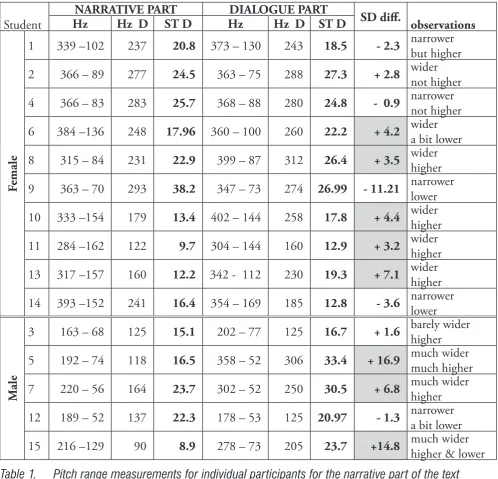
signal, the span of frequencies used was measured separately for the introductory narrative part and the dialogue part of the text for each participant. Table 1 summarizes the measurements for both parts of the text, for female and male students separately.
Bearing in mind that “for the study of intonation, pitch distances are more relevant than absolute pitch” (Nooteboom 1997, 645), in addition to traditional measurements in Hertz we used the algorithm for calculating pitch distance (D) between the highest and the lowest frequencies in semitones (D = 12*log2(f1/f2) = 12/log102*log10(f1/f2); cf. Nooteboom 1997, 645)2. In the
table, the measurements in Hertz (Hz), the span of frequencies (Hz D) and the differences in semitones (ST D) are presented for both parts of the text, as well as the differences in semitones between the dialogue-part pitch range and the narrative-part pitch range (SD diff.).
As can be seen from Table 1, in the dialogue part of the text ten participants used a pitch range either wider or higher, while five participants produced no difference or a narrower and/or lower pitch range. However, taking into account that “[i]t has been estimated that only pitch differences of more than 3 semitones can be discriminated reliably (‘t Hart, 1981; ‘t Hart, Collier and Cohen, 1990, 29)”, although some research findings show that “pitch differences of 1.5 semitones create reliable differences in the perception of prominence” (Rietveld and Gussenhoven 1985), we followed Nooteboom’s (1997, 645) suggestion that “pitch differences smaller than three semitones cannot play a role in speech communication” and considered them inadequate here.3 Thus, 8 participants
produced wider enough pitch ranges for the dialogue part of the text, whereas one more approximated the necessary difference (with 2.8 semitones difference). The other 6 subjects did not produce nearly adequate pitch range differences, or even used a narrower or lower pitch range.
Textual discourse function: marking discourse boundaries. Sentence declination (lowering of
F0 across an utterance to mark sentence end) and the downstepped contour (successively lower pitch peaks towards the end of the paragraph) are important signals not only for turn- and topic finality (Chun 2002, 37), but also for discourse structure. Therefore, we investigated whether our participants used declination and downstepping to mark sentences and paragraph endings.
¦¤ {êw9±êtêz9êêkêê¾êtêê
The narrative paragraph consisted of 3 sentences, each containing 3 to 6 tone units (TU). The quote in the last sentence was disregarded in this analysis. The F0 was measured at TU boundaries, i.e. for the first pitch peak and the last vowel in each TU, and initial pitch peaks were compared in successive TUs and across the whole paragraph. The measurements are summarized in Table 2 (Appendix 1), which, for ease of comparison, repeats the measurements of each participant’s pitch range in this part of the reading task.
Our participants produced three different kinds of results here. Six participants (No 2, 4, 6, 8, 3, and 5, cf. Table 2) showed a clear downstepped contour across the paragraph and a clear declination within sentences. These students also used other relevant phonetic cues to signal finality, e.g. the laryngeal creak and pause length. Four participants (No 1, 14, 7, and 15, cf. Table 2) showed a peculiar pattern in this part of the task; specifically, they produced a ‘shy beginning’, which can probably be attributed to their nervousness – their pitch range was
Student
NARRATIVE PART DIALOGUE PART
SD diff.
observations
Hz Hz D ST D Hz Hz D ST D
F
emale
1 339 –102 237 20.8 373 – 130 243 18.5 - 2.3 narrowerbut higher
2 366 – 89 277 24.5 363 – 75 288 27.3 + 2.8 widernot higher
4 366 – 83 283 25.7 368 – 88 280 24.8 - 0.9 narrowernot higher
6 384 –136 248 17.96 360 – 100 260 22.2 + 4.2 widera bit lower
8 315 – 84 231 22.9 399 – 87 312 26.4 + 3.5 widerhigher
9 363 – 70 293 38.2 347 – 73 274 26.99 - 11.21 narrowerlower
10 333 –154 179 13.4 402 – 144 258 17.8 + 4.4 wider higher
11 284 –162 122 9.7 304 – 144 160 12.9 + 3.2 wider higher
13 317 –157 160 12.2 342 - 112 230 19.3 + 7.1 wider higher
14 393 –152 241 16.4 354 – 169 185 12.8 - 3.6 narrower lower
M
ale
3 163 – 68 125 15.1 202 – 77 125 16.7 + 1.6 barely wider higher
5 192 – 74 118 16.5 358 – 52 306 33.4 + 16.9 much wider much higher
7 220 – 56 164 23.7 302 – 52 250 30.5 + 6.8 much wider higher
12 189 – 52 137 22.3 178 – 53 125 20.97 - 1.3 narrowera bit lower
15 216 –129 90 8.9 278 – 73 205 23.7 +14.8 much wider higher & lower { ê¡êê wêêêêêêêêêêêêê
¦¥
shun|hnl remarkably narrower in the first sentence, so the first pitch peak was not the highest one in the paragraph. As they relaxed, however, the range became wider and remained so throughout the paragraph, so the downstepped contour could be observed, as well as sentence declination patterns. Five participants (No 9, 10, 11, 13, and 12) used no clear signals for either sentence or paragraph structure - the successive TU initial peaks were not increasingly lower either within sentences or across the paragraph.
The next item investigated were the phonetic cues used by the participants to signal discourse structure in terms of paragraph-initiality – the beginning of the dialogue part of the text. What
we expected to find was a comparatively low pitch level at the end of the previous TU, the last one in the narrative introduction, against which the initial pitch peak of the first TU in the dialogue part of the text should stand out as rather high:
//…but then I myself tother/ and CALMly://
“ExCUSE me,/ are you /and are you DOing in my ffice?”//
The F0 was measured at the TU boundary - the pitch level at the end of TU 1 (‘...and asked more calmly:’) was compared to the F0 of the initial pitch peak in TU 2 (‘Excuse me,’). Table 3 sums up these frequency measurements: the difference between the two observed frequencies in Hertz and semitones.
Student
Hertz
semitones researchers’ judgement calmly excuse
me diff
F
emale
1 146 373 227 16.2 a clear signal of initiality
2 89 326 237 22.5 a clear signal of initiality
4 83 309 226 22.3 a clear signal of initiality 6 147 338 191 14.4 a clear signal of initiality
8 86 351 265 24.3 a clear signal of initiality 9
207 304 97 6.7 could be interpreted as a signal, but not clear
10 154 351 197 14.3 a clear signal of initiality
11 179 286 107 8.1 an ambiguous signal, not clear
13 157 284 127 10.2 a clear signal of initiality
14 168 240 72 6.8 no signal of initiality
M
ale
3
68 145 77 13.1 although the difference is perceptible, not a very clear signal, a bit ambiguous 5 71 210 139 18.8 a clear signal of initiality
7 56 302
246 29.1 a very clear signal of initiality, maximal pitch difference
12 120 147 27 3.5 no signal of initiality
15 129 218
89 9 functions as a signal of initiality, though not very clear
¦¦ {êw9±êtêz9êêkêê¾êtêê
Clear cues for the beginning of a new paragraph/ different part of the text were provided by ten participants, who produced differences ranging from 10 to almost 30 semitones. Another participant produced the difference of 9 semitones, which provided a less clear discourse signal, while the remaining 4 participants produced significantly smaller differences.
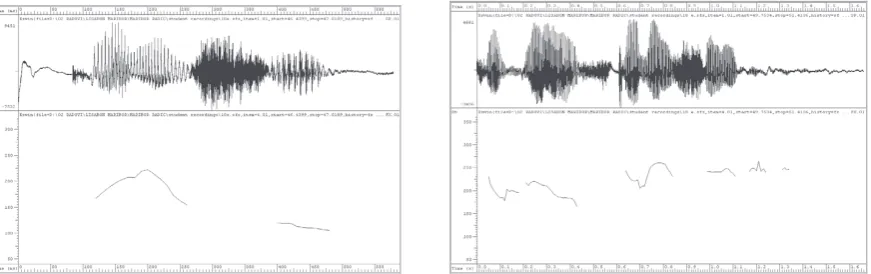
What should be noted here is that the researchers’ perceptual judgements were not in complete accordance with the acoustic measurements. As can be seen from Table 3, although participants No 9 and 14 produced almost the same difference in semitones (6.7 and 6.8 semitones), the researchers’ judgements of the signals were not the same, which suggests that absolute F0 values are not the only relevant factor in interpreting intonational cues. A closer observation of the acoustic data shows that a clear signal of initiality was provided only if the final pitch level in TU 1 was very low. No matter how high the initial pitch peak in TU 2, if the preceding pitch level was not low enough the signal was not perceived as unambiguous. On the contrary, the initial peak in TU 2 functioned as an unambiguous signal even if it was not very high in terms of the absolute F0 value if it was prominent enough and stood out locally, i.e. was different enough from the final pitch in TU 1. Figure 1 shows the F0 tracks of this TU boundary as produced by participants No 5 (left) and No 3 (right). While the former is a clear signal of initiality, the peak in the latter case, although higher than the final pitch of TU 1 (by 13 semitones), does not function as an unambiguous signal, since it is immediately followed by an even higher peak. These observations suggest that listeners’ interpretation of phonetic cues relevant for discourse functions of intonation depends on both the local and the broader context.
mê¡®êêê {êmªêêêê{|ê êê³êê®êµlê±êêêØê Âêuê¥êêêuê£Ã
The next item investigated was signalling the introduction of a new topic of conversation, one
of the interactive/discourse functions. We expected the phonetic cues to include using a rather
high pitch at the beginning of the TU, a high key or a wider/higher pitch range. The lexical context of the dialogue was designed to help the participants recognize this discourse function – the TU introducing a new topic was a typical interjection:
// ...D’ let us you from your WORK// …AH,/ and one called JANE / has
the PApers you for.//
¦§
shun|hnl
Student
pitch movement
key + tone range researchers’ judgement F0 Hertz semitones
F
emale
1 218 --- 0 M ― 373 – 130 not a signal
2 262 224 2.7 M-H \ 363 – 75 a signal, but not very clear 4 226 203 1.9 M \ 368 – 88 not a signal
6 280 190 6.7 H \ 360 – 100 a clear signal
8 285 230 3.7 M-H ― 399 – 87 a signal, but not very clear 9 249 --- 0 M ― 347 – 73 not a signal
10 252 173 6.5 M \ 402 – 144 not a signal
11 220 --- 0 M ― 304 – 144 not a signal 13 228 220 0.7 M ― 342 - 112 not a signal 14 233 167 5.8 M \ 354 – 169 not a signal
M
ale
3 184 69 17 H \ 202 – 77 a very clear signal 5 153 121 4.1 L-M \ 358 – 52 not a signal 7 142 114 3.8 M \ 302 – 52 not a signal
12 145 --- 0 H ― 178 – 53 a signal but ambiguous 15 151 --- 0 M ― 278 – 73 not a signal
{ ê¤êê mªêêêêêêêêê³hØêêê½ê êêêÀêêêêêê
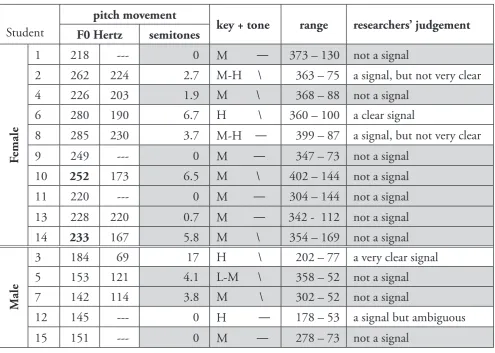
Table 4 summarizes the relevant data for this item and Figure 2 shows the F0 tracks of a high peak (left) and a high level tone (right).
mꢮêê mªêêêêêêêÂêuê¦ÃêêêêêêÂêuê©Ãêê ê³h·Øêêêêêêêêêê
The frequency change over the interjection ‘Ah!’ was measured in Hertz and semitones, the key was defined relating the highest peak to the pitch range used by the particular participant in the dialogue part of the text, and the tone movement was transcribed (Chun 2002). As with the previous item, we recorded the researchers’ perceptual judgements, too. The interjection was
¦¨ {êw9±êtêz9êêkêê¾êtêê
used with a discourse intonation signal by 5 participants, but only two of these were judged by the researchers to be completely clear. The measurements show that the phonetic cue interpreted as the best signal was a high falling tone, while pitch peaks which were not high enough (mid-to-high, e.g. student No 2) or high-pitched level tones that did not peak or fall (e.g. student No 12) were somewhat ambiguous. Mid-key tones, even if falling (cf. students No 10 and 14), and especially if level, were not interpreted as intonation signals for this discourse function. These observations indicate that for this discourse function the most important cues may be pitch peak and high key, and that level tones, even when rather high, do not seem to provide clear signals.
Probably due to a lack of awareness of the discourse functions performed by interjections, five participants just skipped the interjection but produced a clear intonational signal on the initial peak of the following TU, /...and SOMEone J.../. Figure 3 shows the F0 track of one such case:
m꣮êê mªêêê³h·êhêêêqØêÂêuê§Ãêêêêêê êêêêêêêêêêêê{|ê
The next item investigated was signalling textual/discourse and interactive/discourse functions in terms of contextualizing (Chun 2002). Discourse functions considerably overlap when
indicating expectations about the hearer’s reply is concerned (e.g. encouraging /discouraging a response) because different terminal pitch contours at TU boundaries (transitional continuity) can signal different kinds of interactive expectations. Of the three different terminal pitch contours – final, continuing and appealing – the last one is directly related to this interactive function and, as previous research indicates, is commonly signalled by a “non-descending high rise in pitch” at the end of the TU (DuBois et al. 1992). In our reading task, the appealing function of a rising pitch was expected to be used twice, as clearly indicated by both the semantic context and punctuation:
/Well,/ Mrs. Aton us…,// the his ,/ tching the of his .// YES?…//…we should the dow-frames…/ YES?…//
¦©
shun|hnl Table 5 sums up the measurements for the first occurrence ‘Yes?...’. Figure 4 shows the F0 tracks of a rise (left, student No15) and a high but falling pitch (right, student No 12).
m꤮êmªêêêêêÂêuê¡¥ÃêêêêêÂêuê¡¢Ãêêêê{|곸Ø
Student
pitch movement
key + tone range
F0 Hertz semitones
F
emale
1 334 148 14.1 H \ 373 – 130 2 203 296 - 6.5 H / 363 – 75 4 253 187 5.2 M \ 368 – 88 6 251 174 6.3 M-L \ 360 – 100 8 135 247 - 10.5 M / 399 – 87 9 220 221 - M ― 347 – 73 10 270 179 7.1 M \ 402 – 144 11 246 161 7.3 M \ 304 – 144 13 178 145-228 - 7.8 L-M \/ 342 - 112
14 202 174-230 - 4.8 L-M \/ 354 – 169
M
ale
3 92 132 - 6.3 M / 202 – 77 5 112 99 2.1 L \ 358 – 52 7 212 125 9.1 M \ 302 – 52 12 118 147 - 3.8 H / 178 – 53 15 126 184 - 6.6 M / 278 – 73
{ ê¥êê mªêêêêêêêêê{|곸Øêêê½êê êêÀêêêêê
With respect to the illocutionary function, we investigated signalling speaker’s expectations
about the hearer’s reply in one more item, the TU that contained a tag-question: ‘...couldn’t she?’. The interpretation clearly supported by the context was that the tag question was meant
§ª {êw9±êtêz9êêkêê¾êtêê
only to seek confirmation from the hearer so the appropriate phonetic signal would be a falling tone. It is commonly agreed that “a rising contour is used when the questioner really does not know the answer to the question, whereas with a rising-falling pattern the questioner presumes to know the answer and is merely trying to confirm the presumption” (Chun 2002, 218). Such tag-questions often require no reply from the hearer or just invite agreement.
//Mrs. Aton/could have me/about her / COULDN’T she?...//
Only three participants used the inappropriate rising pitch contour here, while as many as 12 of them used either falling tones or complex rise-fall tones, showing that they were familiar with this distinction in tag-question meanings. This was quite expected, since this distinction is usually explicitly taught in English language classes. The rising tones used by students can probably be accounted for by insufficient attention paid to the overall meaning of the text and the cues to meaning provided by the context, and probably not by their being unfamiliar with this particular intonation signal. Table 6 sums up the measurements for this item and Figure 5 shows F0 tracks of ‘... couldn’t she?’ produced with a falling tone (left) and a rising tone (right).
Student
pitch movement
key + tone range F0 Hertz semitones
F
emale
1 231 308 - 161 -5 / 11 M-H /
\ 373 – 130 2 289
229 [creak] 4 M \ 363 – 75 4 288
310-258 -1 / 3 M / \ 368 – 88
6 277 165 9
M-L \ 360 – 100
8 305 91 21
H-L \ 399 – 87 9 192 330 -9 M / 347 – 73 10 267 158 9 M \ 402 – 144 11 304 149 12 H \ 304 – 144 13 217 260 237 -3 M /< 342 - 112 14 280 176 - 190 8/-1.3 M \/ 354 – 169
M
ale
3 123 77 8 L \ 202 – 77 5 168- 218 -103 -4.5/13 M /\ 358 – 52 7 209 52 [creak] 24 M \ 302 – 52 12 124 114 1.5 M /\ 178 – 53 15 205 94 13.5 M \ 278 – 73
{ ê¦êmªêêêêêêêê{|ê³êØê¸Øê
The final part of our investigation included the way participants managed information structure in terms of sentence-level focus and final transitional continuity. The most
§¡
shun|hnl for multiple interpretations (contrastive or emphatic). For instance, in the sentence ‘As you might have noticed/I’m supposed to work here.//’ the context suggested that ‘work’ should be interpreted
as the intended focus, and indeed only two participants focused ‘here’ instead. But in both such unambiguous examples, and in those that did allow for multiple focusing possibilities, the F0 measurements of the focused syllables showed that the phonetic cue used to signal sentence focus most commonly was a falling pitch movement. A rather high pitch was used by 3 participants, while the others used the M key. The most important focusing cue proved to be pitch movement, i.e. simple or complex falling contours.
The last item investigated was marking sentence boundaries and transitional contours, i.e. final or continuing transitional continuity (Chun 2002). As pointed out in the review of previous research, finality at TU boundaries (final transitional continuity) is signalled by a falling tone, usually to a rather low pitch. Our F0 measurements (which due to space limitations will not be presented here) showed that both in the narrative and the dialogue parts of the text a falling pitch contour was used almost exclusively to mark sentence finality. For instance, in the example “… and maybe the doors, too, if there’s enough paint.” all the participants signalled finality using a
falling contour, though not always to a very low pitch. Some examples suggested that a low level tone at the terminal TU boundary, if the key for the whole TU was L, could also function as a finality signal.
On the other hand, the intonational signals used to mark continuing transitional continuity (the speaker’s intention to keep the floor and continue speaking) included rising contours, not always to a very high level, or M level tones. Five tone units from the text were measured, two in the narrative and three in the dialogue part. While these signals did not present a problem for our participants in the narrative part of the text, in the dialogue part they used ambiguous signals at TU boundaries where the context supported the interpretation with a continuing transition. For example, in the TU “Well,/ Mrs. Ashton called us…”, there was a clear indication in the context and punctuation that the speaker intended to go on speaking after the pause. Still, only five participants used a rising tone to signal continuing transition, one used a level tone (in M key), while nine participants used falling tones, and even a rather L key. These findings highlight an important difference in the participants’ usage of intonational signals in narrative texts as compared to dialogues.
§¢ {êw9±êtêz9êêkêê¾êtêê
§êjê
The research presented here aimed to investigate some aspects of intonation management in a reading task, namely, how Serbian EFL students used phonetic cues, singled out by previous research, to signal discourse functions of intonation. The findings indeed point to some problematic areas that should be focused on in Serbian EFL students’ pronunciation practice. One conclusion that our findings suggest is that there is a significant difference between the ways students use intonation cues at the sentence level and a significantly less appropriate usage of intonation signals at the discourse level. A similar observation can be made about the intonation cues used in narrative passages on the one hand and in dramatic dialogues on the other, with narrative text intonation cues used much more appropriately.
More specifically, the discourse functions of intonation which did not prove to be a problem for our participants were, firstly, marking information structure in terms of sentence-level focus and marking sentence boundaries. The textual/discourse functions did not present significant problems either, especially in the narrative part of the text, where paragraph boundaries were appropriately marked and both sentence declination and downstepping were observed with most participants. Similarly, final transitional continuity was signalled appropriately at all levels.
On the other hand, the findings clearly point to a number of discourse intonation functions our participants could not signal effectively. The most problematic ones have turned out to be the textual and interactive/discourse functions related to contextualising, primarily in the dialogue part of the text: starting a new topic (especially with interjections), marking discourse-level focus, signalling the speaker’s expectations about the hearer’s reply, together with the speaker’s intentions in conversation-turn taking and conversation management. And finally, the use of the overall pitch range as a prosodic feature of speech, for instance to signal different kinds of discourse (narrative/dialogue) and to introduce a new part of the text, proved to be a problem for almost half of our participants. Therefore, these intonation components should receive special attention in intonation practice with Serbian EFL students. In addition, students’ attention should be drawn to the important role of the context, local and broader, for the production and interpretation of intonational signals.
The research presented here was limited in scope with respect to the number of participants, the data gathering techniques, and the intonational components investigated, but we hope it has highlighted some important directions for further research. The findings of this study suggest that, in order to make intonation practice work, we need to investigate not only the use of intonational cues, but also, and even more importantly, the way intonational signals are perceived and interpreted. Therefore, further research should focus on both the acoustic analyses and the perception of intonational signals used by English speakers of different backgrounds.
§£
shun|hnl by different pitch contours. This supports Chun’s conclusion that “[i]n order for language learners to become more proficient communicators and comprehenders, they must be taught how to use and perceive discourse intonation” (Chun 2002, 100; emphasis added). Therefore, focusing on the areas singled out by empirical research and raising students’ awareness of the way intonational components of discourse function in different contexts could help us make Discourse Intonation work in the EFL classroom.
u
¡êê mê±êêêêêêêêê ê±êêêêê êê ê²êêêê±êêêêêêêêêêêêêêê²ê êêêêêêêê±êêêê±êêêêêê êêêê êêØê
¢êê hêêêêÂêêê êqyêêw±êpwv±êlÃê êêêêê êêêêêêêêêêêê±êê êêꮽ½ ½ú½½
£êêê yêêêêêêµêêêêꪣêoêêêêm
ªêêêmªêÓ
ê¡¢ªêo±ê êê
qukêÄê êÅêêêêêêꢪêoÃêêêm
ªêêêêêêê
£¢êo½Ã´êÂrê¡©§£Ãê{±êêêêêêêêêêêêê±êê ê êêêêê
y
i±êulê¡©§©êpêêêêêêêêzêêêêlê
pêzêiꤱꢮꢣ©À¦¦
i±êkê¡©©§ê{êjê}êêpêêlêj ®êj ê|êw i±ên±êrsêj±êêqêrê¡©¨ªêxêêpês®êo
j±êtꢪª§ê{êêêêêêêls{êqꦡ±ê¡®ê£¾¡¡ê®½½½ ½½½ùqùª§ùªªª
j±êkꢪª¢êkêpêês¢êmê{êêyêêwêh½w®êqêiê w êj
ki±êq~±êzêz¾j ±êzêj±êêkêwê¡©©£êvêêêêpê{êk®ê
{êêêêê±êêqhêlêêtkês±ê¤¥¾¨©êo±êuq®êl
n±êjꢪª¡êkêêêlêêtêêz®êpêêêêêê
ylsjêq꣢±ê¡®ê©¢¾¡ª¥ê
o±ê³êq±êyêj±êêhêjê¡©©ªÃêhêwêzêêpêhêl¾êhêêzê
têj ®êj ê|êw
o±êqê³ê¡©¨¡Ãêkêêêê±êêêêqêêêhêzêêhê ¦©±ê£®ê¨¡¡¾¢¡ê
q±êiê¡©§¦êpêêêêpêzêiꡱꢾ£®ê¡¦¦À©¥ q¾s±êj±êê¡©¨¦êpêêkêzêk®êjêo
§¤ {êw9±êtêz9êêkêê¾êtêê
r±êzꢪª¥ê{êêêêêêêêêêêêêzêêêlêw{sjꢪª¥ê
®½½½½½¢ªª¥½½£¡
s±êpê¡©§©êzê êêê êÀêêêpê{êl®êhêêê
êêêê©©¾¡ª©êj®êjêsêz
s±êq±êêsêwꢪª¤ê{êêêêêêêêz꣢±ê¤®ê¥ª¥¾¢¤ tn±êq{ê¡©©§êhêêêêêlê êzêrêêtêjêêwkê
±êvêzê|
t±êpꢪª¦êwêêwêpêêu¾êp®êhêvêêsê{êxt|jê zêzêyêjê~êwê~w©ê®½½½½ ½tù~w©ùuuù p
êu ±êzê¡©©§ê{êêê®êêêêpê{êo êêwêz±êê~êqê oêêqês±ê¦¤ª¾§£êv®êiêiêsꮽ½½úz u ½½ wyvz{lt
vØj±êqk±êênmêhê¡©§£êpêêjêlêi®êsênêsêêêê
y±êhjt±êêjênê¡©¨¥êvêêê êêêêêêqêêwê ¡£®ê¢©©¾£ª¨
}±êkyꢪª¥ê{êêêêêêê¾êêêêêêêê®ê wêêêqêêw꣧±ê¡¢®ê¢ª¨¦¾¡¡¥
{±êqꢪª£ê{êêêêlêêêê¾êêwꩮꡦ¥¾¦¨ê®½½ ½¢ªª£½½¡¦¥
~±êhê¡©©¤êpêêêlê®êhêêê¾êêhêsê¡¥±ê¤®ê £©©¾¤¢ª
~±êuqê¡©¨¢êlêêêêkêêêêk®êmêw
±êrꢪª¤êyêêêêêlêê êqêlmsêêwê¡©±ê£®ê¥¦¾§£ ±êsê¡©©¥êpêzêêtêkêwkê±ênê|±ê~±êkjê
§¥
shun|hnl
hê¡ê
Student No. pitch range ST D F0 at TU boundaries – initial peak and final pitch level in Hz
F
emale par
ticipants
2 366 – 89 24.5
1ê366 – 88ê / 310-224ê/ê292-194ê/ê278-83ê/ 251-194 /ê255-198
2ê354 -270ê/ê255 -215ê[creak]
3ê...ê/ê308ê- 98ê/ 260 – 89ê[creak below 75Hz]
4 366 – 83 25.7
1ê366 – 258ê/ê270ê242ê/ê257 – 238ê/ê249ê- 177ê/ê299 – 153 2ê303ê– 288ê/ê282 – 79
3ê...ê/ê281 – 250ê/ê204 – 83
6 384 –136 17.96
1ê384 – 254ê/ 316 –ê227ê/ê281 – 263ê/ 259 – 136 /ê286 – 148
2ê338 – 179ê/ê263 – 155 3ê...ê/ê268ê– 194 /ê255 – 147
8 315 – 84 22.9
1ê315 – 240ê/ê245 –ê215ê/ê230 – 198ê/ 213 – 161 /ê256 - 87 [creak]
2ê314 – 254ê/ 250 – 164ê[creak]
3ê...ê/ê260 – 210ê/ê155 – 86ê[creak]
1 339 –102 20.8
1ê318ê– 174ê/ê289ê– 204ê/ê272 – 175ê/ 237-180ê/ê275 -107 2ê339ê– 190ê/ê236ê- 102
3ê...ê/ê334ê– 188ê/ê212 – 146
14 393 –152 16.4
1ê357ê– 190ê/ê324-202êê/ê254 -204ê/ê239- 196-172ê/284ê- 152
2ê393ê–ê214ê/ê221ê- 161
3ê...ê/ê244 – 179ê/ê191 – 168
9 363 – 70 38.2
1ê363 – 100 / 262 - 214 /240 – 208ê/ 257 – 77[creak ] / 212ê- 73ê[creak] 2ê245 – 105ê/ê212
3ê...ê/ê257 –ê194ê/ê241 – 207ê[creak]
10 333 –154 13.4
1ê331 – 163ê/ê261 – 159ê/ê291 – 151 /ê261 – 1 63/ê224 - 165ê[creak] 2ê333 –ê170/ê262 – 164
3ê...ê/ê262 –ê247ê/ê310ê–ê154
11 284 –162 9.7
1ê284 –235/ 281 –207/ 230 -230 / 257– 274 / 249 – 237 / 279 - 85
[creak]
2ê247 – 272ê/ 260 – 162 3ê...ê/ê256ê–ê225ê/ 264ê–ê179
13 317 –157 12.2
1ê317 – 162ê/ê252ê- 230ê/ê245ê-ê150ê/ê210ê-ê157
2ê222 - 183ê/ê253ê- 157 3ê...ê/ê260ê- 245 /ê264 - 157
M
ale
3 163 – 68 15.1
1ê163ê93 /ê153ê– 114ê/ 124 –ê112 /ê119ê–ê84 [creak] / 142 –ê68
2ê152ê– 112 /ê122ê–ê87
3ê...ê/ê134ê–ê114ê/ê112ê– ,68ê[creak]
5 192 – 74 16.5
1ê192ê–ê84ê/ê145ê–111 /ê119 –118ê/1 22 – 95ê/ 107 –ê80/ê142ê– 74 2ê135ê– 82ê/ê119ê–ê80
3ê ...ê/ 124ê–ê141ê/ 128ê–ê71
7 220 – 56 23.7
1ê184 – 140ê/ 172 – 140/ 155 –147/ 168 – 134ê132 – 56 / 206 – 52 [creak]
2ê219ê–117 /ê162 – 148 /ê152 – 100 3ê...ê/ 190 –ê125 / 144 –ê56
15 216 –129 8.9
1ê205ê– 153/ê179 – 146ê/ 177 – 135ê/ê157 –ê138 /ê166ê– 132 2ê213ê– 142ê/ê162 – 181/ê166 – 133
3ê... /ê166 – 145 /ê149ê-ê129ê[creak]
12 189 – 52 22.3
1ê189ê– 118ê/ 124ê– 57 /ê134ê–ê120 /ê120 –ê55 cr/ 125 –ê93 [creak] 2ê149 –ê55 [creak] /ê121 – 52 [creak]
3ê...ê/ê143 –ê120 /ê136ê– 120ê