433
Najia BOUHA
1,, ETJ Volume 3 Issue 05 May 2018
Engineering And Technology Journal e-ISSN: 2456-3358
Volume 3 Issue 05 May-2018, Page No-433-442
DOI:10.31142/etj/v3i5.01, I.F. - 4.449
© 2018, ETJ
Road Traffic Modeling: The Interest of Warm-Up Detection in Dynamic
Simulations
Najia BOUHA
1,2, Zouhir MAHANI
31,3University Ibn Zohr, Faculté des Sciences, Laboratoire Image et Reconnaissance de Formes – Systèmes Intelligents et
Communicants (IRF – SIC), Agadir, Morocco.
2University of Artois, EA. 3926, Laboratoire de Génie Informatique et d'Automatique de l'Artois (LGI2A),
Béthune, F-62400, France.
Abstract:
The design, study and management of road traffic systems has become increasingly difficult and costly as existing configurations are multiple and complex. Our objective in this article is to present a state of the art on modeling techniques, namely macroscopic, microscopic and mesoscopic modeling. And we will see that in order to solve the space and time scale problems encountered in the aforementioned models, a new model named static hybrid has appeared. The latter aims to take advantage of classical models, adopting the model at the scale of the phenomenon studied. But the static hybrid approach cannot observe the phenomenon of congestion.To overcome these limitations, we have developed an approach to move from a macroscopic presentation to a microscopic presentation. The latter will create an empty section that will gradually be filled with vehicles. This phase called "initial transition" or "warm-up" marks an unstable state. The main objective is to eliminate the warming phase by dynamically transforming the macroscopic simulation into a microscopic simulation.
Keywords:-
Intelligent transportation systems, dynamic hybrid simulation, warm-up road traffic, multi-agents system, macroscopic, microscopic, mesoscopic and hybrid modeling,I. INTRODUCTION
The road occupies a privileged place in the transport sector, and plays a central role in the movement of goods and people.
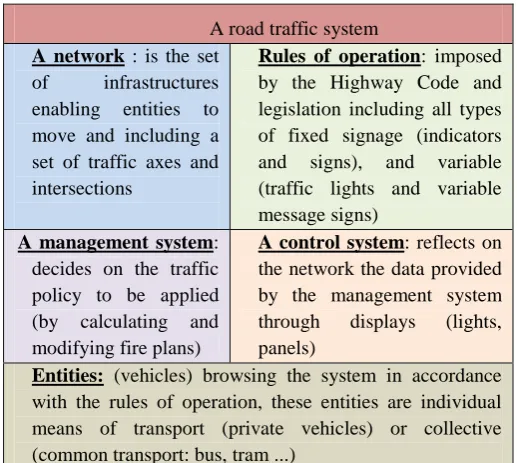
An urban road traffic system consists of a network, operating rules, a management and control system, and entities using the network. As shown in the following figure:
Table 1: Urban traffic system
A road traffic system
A network : is the set of infrastructures enabling entities to move and including a set of traffic axes and intersections
Rules of operation: imposed by the Highway Code and legislation including all types of fixed signage (indicators and signs), and variable (traffic lights and variable message signs)
A management system: decides on the traffic policy to be applied (by calculating and modifying fire plans)
A control system: reflects on the network the data provided by the management system through displays (lights, panels)
Entities: (vehicles) browsing the system in accordance with the rules of operation, these entities are individual means of transport (private vehicles) or collective (common transport: bus, tram ...)
In order to improve the performance of Road Traffic Systems, it is necessary to understand how they work, and above all the rules of operation. Users and technical services dot not have the same objectives:
-With regard to users, their objectives are: to choose the direction at crossroads, to minimize travel time, to reduce the waiting time at crossroads, to minimize the cost, and sometimes to take the shortest route to arrive at their destinations.
- Concerning the technical services of agglomerations, it is a question of maintaining a reasonable mean speed of flow, of minimizing the saturation, the waiting time at intersections, and to ensure the safety.
434
Najia BOUHA
1,, ETJ Volume 3 Issue 05 May 2018
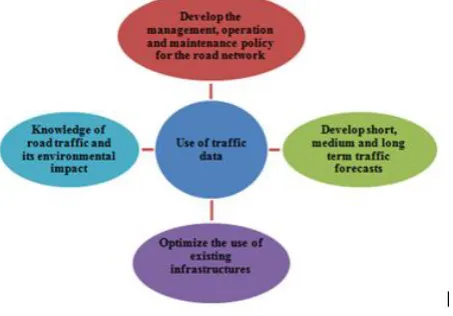
Fig 1: Knowledge of road trafficAnd in recent years, road traffic has attracted the attention of the public. With the rise of environmental concerns and the urgency of the situation, road congestion is less and less accepted by the stakeholders of the phenomenon and especially by users.
Today, urban expressways in major cities are experiencing significant and growing congestion. This represents many hours lost by users but also additional pollution of various kinds. This has an economic as well as an environmental cost. In order to improve traffic conditions without widening existing routes, network operators are now using control devices, such as access control or dynamic speed control.
But today, operators are also turning to new solutions that make the couples vehicles-drivers, real actors of the regulation systems. Indeed, with the rapid development of information and communication technologies in recent decades, the future of the automobile seems closely linked to the use of innovative systems that can, among other things, act on the behavior driving. We are talking about intelligent transport systems (also known as ITS for Intelligent Transport Systems) [1].
In order to help operators in their task of managing traffic and informing users, a number of tools have been developed, including dynamic traffic simulation tools. These make it possible to evaluate the impact of an action operating conditions, and thus put in place effective traffic management strategies. They are therefore decision support tools, but also evaluation of traffic management actions.
These dynamic traffic simulation tools are based on models whose purpose is to describe the behavior of traffic on the network. There are usually two main families of models: the macroscopic models, whose objective is to represent in a global way the flow of vehicles in a highway network, while the microscopic models allow to describe more finely the behavior of the vehicles in a road network.
There is also another type of model: the mesoscopic models.
These models use the vehicles but consider them in the form of packets. Their movements (lane changes ...) are governed by macroscopic models. They apply very well in economic studies or studies of motives [2].
The main difficulty encountered in traffic modeling is related to scale issues. Indeed, if we consider an urban network, it generally consists of fast lanes, requiring macroscopic modeling and intersections that require a microscopic representation. Scale problems are related to space and time. They can be illustrated simply by considering a large road network in which the fluidity of the traffic and very differently represented according to the parts considered. Indeed, a length of road of great length can be in congested state with travel times being measured in hours while another stretch of short length road is in a fluid state characterized by travel times being measured in seconds . This situation cannot be represented effectively using the models mentioned above [3].
To solve these scale problems and correct the shortcomings of the traffic models, a new community of researchers has been interested in another hybrid modeling concept. This approach uses both macroscopic and microscopic models [3].
The hybrid approach is inspired by gas studies. Indeed, a gas can be represented at the microscopic level if we want to treat interactions between molecules (study of local phenomena) and it can also be processed at the macroscopic level if we want to describe its global state (study of global phenomena). [4].
As part of this article, we will present in Session 2, consisting of four parts, a state of the art on modeling techniques. And we will define more precisely the problem of scales and analyze the answer given by classical models. We will then see that static hybrid modeling is a solution to extend the application possibilities of these models. In session 3, we will detail the interest of dynamic hybrid simulation for complex systems. Then we will present our approach on the importance of warm-up phase detection in a dynamic hybrid simulation. Section 4 is devoted to the methods of detecting a warm-up period. The implementation techniques used and the results are discussed in section 5. Finally, the conclusions and perspectives are given in section 6.
II. MODELING
Road traffic flow models are an effective way to describe the phenomena and behavior of vehicle flows in urban and inter-urban networks. The multiplication of the models developed to date makes it necessary to classify them in order to better judge their capacity to adapt to the treated problem [5].
A. Macroscopic modeling
Macroscopic modeling: considers traffic as a continuous phenomenon.
435
Najia BOUHA
1,, ETJ Volume 3 Issue 05 May 2018
Q: represents the flow (vehicle / second). V: Speed (in meters / second).
K: represents the density or concentration (vehicle / meter).
The macroscopic models are based on the analogy with fluid dynamics and are used when the study can be performed from volumetric traffic data and when such results are sufficient.
This type of model does not allow the analysis of individual movements. They offer a rough modeling of the traffic and make it possible to obtain results quickly (which makes them models adapted to short-term operational objectives).
Macroscopic models are more suitable for developing control laws or simulating a traffic flow in a large network. METANET [6] is a traffic flow simulator built around a macroscopic model. It is used in particular in Amsterdam and Paris to solve the traffic problems in these big cities. In addition, they are well suited for the analysis and reproduction of macroscopic flow characteristics such as shock waves and queues. Recently, work has been done to generalize the macroscopic models so as to support the different classes of vehicles running on a multi-channel infrastructure, but this remains for the moment very restricted and not very applicable. Moreover, the macroscopic representations are not adapted to the study of the microscopic behavior inherent to the flux, and the effect of the changes of the geometry of the infrastructure. Finally, the analytical resolution of the macroscopic models makes them better suited to tasks such as estimation of traffic flow prediction and control.
B. Microscopic modeling
Microscopic modeling: allows to study individual interactions. These models accurately describe the interactions between vehicles. And also, the reactions of a vehicle in relation to the perception it has of its environment [2].
These models are usually dedicated to a particular purpose (such as studying lane changes on a highway), but can be used for any type of study because macroscopic values can be calculated from microscopic results.
Microscopic models can be classified into two broad categories [1]:
Tracking models: There are four types of tracking models: the safe distance model, the optimal speed model, the stimulus-response model, and the psychological model.
Cellular automata models: Cellular automata represent an effective modeling tool for describing, finely and efficiently, the dynamic and complex behaviors of the traffic
Microscopic models are often used for offline simulation to test new infrastructure (entry / exit ramps, lane removal, etc.),
new automotive equipment (driver assistance system), or have a rough idea of flow data that are difficult to calculate empirically [3].
The application of microscopic models in the real-time regulation of the flow is very limited given the enormous computing times they require and the absence of an explicit model describing the relationship between the input and output data. Moreover, they are unable to accurately determine the macroscopic characteristics of the flow (capacity, length of the queue) [7].
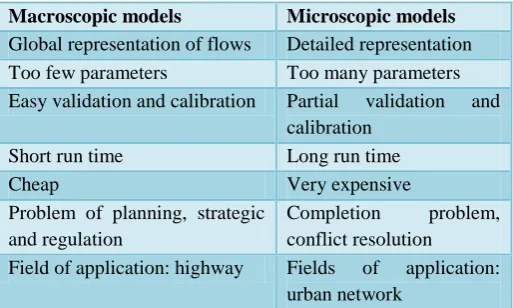
The following figure summarizes the main differences between the two broad categories of traffic flows; macroscopic and microscopic [3].
Table 2: Comparison between the 2 models
Macroscopic models Microscopic models
Global representation of flows Detailed representation Too few parameters Too many parameters
Easy validation and calibration Partial validation and calibration
Short run time Long run time
Cheap Very expensive
Problem of planning, strategic and regulation
Completion problem, conflict resolution
Field of application: highway Fields of application: urban network
C. Mesoscopic modeling
The mesoscopic models are based on the analogy with the kinetics of gases. These models have been developed to reduce the computation time of microscopic models. The calculation is reduced to the processing of (homogeneous) vehicle packages instead of individual vehicles. The movements of these packets are calculated using macroscopic models [8].
Mesoscopic models can be classified into three categories: 1. Models based on inter-vehicle time difference
distributions (the time between two successive vehicles) assume that these differences are evenly distributed. These models are considered to be mesoscopic models because they take into account inter-vehicle time differences without explaining the behavior of each vehicle, or tracing its trajectory [9]. 2. Cluster-type models are characterized by the concept
of vehicle packages. A package is a set of cars that share the same properties (same origin and destination for example). This is characterized mainly by: a dimension (the number of vehicles that make it up) that is dynamic, and a speed. The traffic conditions (speed, inter-vehicle deviation, etc.) inside a package are not explained; it is said that it is homogeneous.
436
Najia BOUHA
1,, ETJ Volume 3 Issue 05 May 2018
A traffic study must necessarily start with a choice of scale; indeed, the precision chosen for the study conditions the fineness of the data to be obtained, the necessary calculation times, but also the final precision of the results. Faced with the multiplicity of models, the user must make a choice by knowing the specificities of each of its models, their areas of validity, and specific cases of application. The problem of scale is a recurrent difficulty in the field of transport. In order to overcome this, some researchers have proposed other models such as mesoscopic models, adopting an "intermediate" scale. But for about ten years, the concept of model hybridization has grown considerably. The idea would be to be able to use the microscopic and macroscopic models on a case-by-case basis, while ensuring coherence of the approaches to the macro-micro and micro-macro interfaces [1].
Problems of scale
The problems of scale are found in the study of the flow of road traffic. The flow of traffic is the result of a sum of individual behaviors. Each driver will interact with his environment, that is, other drivers and the infrastructure on which he is traveling. The observation of this flow shows that there are two types of phenomena: local phenomena, and global phenomena [4].
A phenomenon is local if it involves only a small number of vehicles, over a relatively small spatio-temporal extent, of the order of a few meters and a few seconds.
A phenomenon is global, when the number of vehicles involved will have to be greater (at least several tens of vehicles) and occur on spatio-temporal extents of the order of a few hundred meters (or even kilometers), and the minute [4]. Take the case of ghost congestion ("phantom traffic jams"), the spread of congestion remains a global phenomenon because it concerns a significant number of vehicles, and a spatial and temporal extent that remains of the order of several hundred meters and the minute [4].
However, its origin is very local, and concerns only a limited number of vehicles. It is therefore a global phenomenon, but its origin is local in nature.
This example illustrates the fact that in traffic, there is no real separation of scale. While it is clear that there are global phenomena of flow as such, it also appears that these phenomena cannot be completely uncorrelated with certain local phenomena.
Therefore, to represent the dynamics of the flow, one must at the same time be interested in the local phenomena and the global phenomena.
And if we are in the case where we have two models, one microscopic, the other macroscopic, each correctly describing the phenomena either at the microscopic scale or at the macroscopic scale and that it is necessary for a given
application to take into account both types of phenomena, which model to apply? It is obvious that the macroscopic model will not be suitable because it does not correctly represent the microscopic phenomena. Conversely, the microscopic model may not be suitable, for various reasons: poor reproduction of macroscopic phenomena, too long computation time...
A solution is then to couple the two models; the system to be modeled is divided into different zones according to the characteristic phenomena of each one, and, for each zone, one uses the model most suitable to the description of these phenomena. This is what we will call model coupling or hybridization [3].
Fig 2: Coupling diagram [3]
D. Hybrid modeling
It consists in modeling the elements of the network that does not require too much detail at the macroscopic level and to focus on the parts sensitive to abrupt and discontinuous changes in the students at the microscopic level. Thus, we can reduce the number of vehicles treated while providing a clear and fine description of singular elements such as intersections, ramps entry and exit highway, etc.
The principle of communication between the two models is based on the calculation of the parameters characterizing the macroscopic part and the transmission of the boundary conditions to the transition zones. These parameters are considered constant throughout the macroscopic time step. For its part, the microscopic model evolves independently using the boundary conditions provided by the macroscopic model [3].
III. INTEREST OF DYNAMIC HYBRID
SIMULATION
The congestion of a road network usually occurs when vehicle traffic increases and consequently causes an overall slowdown. Consequently, the congestion results in the degradation of quality of service when the number of users increases. It is therefore characterized by the high frequency of delays and bottlenecks during periods of heavy traffic or rush hours, that is to say when the infrastructure capacity becomes insufficient to regulate the flow. The problem is very common locally and periodically, and particularly in large cities.
437
Najia BOUHA
1,, ETJ Volume 3 Issue 05 May 2018
Fig 3. The consequences of congestion.In order to improve traffic conditions without expanding the already existing infrastructures, computer simulations of road networks have been proposed. In fact, the final objective is to describe the behavior of the flow of traffic on the network. Therefore, a variety of simulation tools has been developed on the basis of these models so as to assist operators of road networks to ensure better traffic management.
Generally, there are two main sets of models: macroscopic models, which represent the flow of vehicles (in a highway system) in a global way. On the other hand, microscopic models describe the behavior of vehicles in a road network more accurately. There is also another type of model called mesoscopic, which uses explicit representations vehicles but they consider them as packets, their movements being governed by macroscopic models.
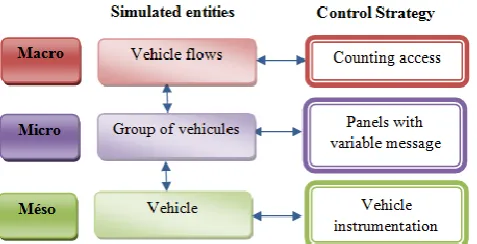
However, to simulate large road networks, it will be interesting to integrate these different representations in the same model as shown in Figure 4.
Fig 4. Simulation and hybrid control of traffic flows
The previous figure represents respectively the interactions between vehicles, groups of vehicles sharing some properties (such as a neighbor position or the same destination) and finally vehicle flows. Each approach is useful in a particular context: the micro and meso models make it possible to simulate networks with a complex topology such as urban areas, while the macro models make it possible to develop control strategies to prevent congestions on highways.
In such approaches, the road network is divided into several parts. In each part, the traffic flow is simulated using its own model (micro, macro or meso). The overall coherence of the simulation is ensured by the interconnection between the various parts and the exchange of data such as the density, the speed and the average flow of the vehicles. These heterogeneous models are called hybrid models. They are “static”: Each portion of the network is associated with a unique representation, which will not change during the simulation.
And as was mentioned at the beginning of this introduction, the many traffic problems such as traffic congestion and air pollution are mainly caused by the increase in traffic volume. In order to alleviate traffic congestion and improve network performance, there has been a great deal of interest in the analysis of the state of traffic and the spread of congestion.
However, static hybrid models cannot be used to adequately observe emerging phenomena such as formation and propagation of congestions. To overcome these limitations, we have developed an approach to allow the transition from a macroscopic presentation to a microscopic presentation.
We are interested in the latter which is more complex, because the passage from macro to micro will create an empty section that will be gradually filled with vehicles. This phase called "initial transition", or "warm-up" marks an unstable state, whose duration cannot be known in advance. Theoretically, there are several methods to detect a warm-up period, which differ according to the principle used, the simplicity of implementation and the precision.
The purpose of this paper is to present our approach on the importance of warming phase detection in a dynamic hybrid simulation, discussed in Section 1. Section 2 is devoted to methods for detecting a warm-up period. The implementation techniques used and the results are discussed in section 3.
Economic
• Congestions block the arteries of road communication.
• Because of the delays of people going to the workplace and, because of late deliveries of supplies or services.
Social
• Frequent traffic jams are subject to stress, anxiety and nervousness problems, leading to an increased risk of accidents.
• The increase in energy consumption. In the current context of soaring oil prices, this generates a net decrease in the purchasing power of users.
Environmental
438
Najia BOUHA
1,, ETJ Volume 3 Issue 05 May 2018
Finally, the conclusions and perspectives are given in section 4.
IV. WARM-UP IN THE DYNAMIC HYBRID SIMULATION
E. Dynamic hybrid simulation
The simulation of large road networks requires to integrate different representations (macroscopic and microscopic) in the same model [11]. Because this hybrid approach allows [12]:
To obtain quantitative and qualitative information on traffic conditions, using respectively macroscopic and microscopic simulation performances in the same simulation.
To switch between these representations locally to meet the needs of the simulation, for example, to determine the source of a traffic jam, or to manage the computational as managing the CPU load.
Explore dynamic routing algorithms traffic as part of the regulation of a flow network road or motorway traffic large. The principle is to establish a balance between all the choices of possible routes that may occur to users, so that we can minimize the risk of occurrence of congestion.
Switching from macro to micro goes through a transitional phase, where data traffic is unrealistic. The question that arise is how long is the duration of the warm-up?
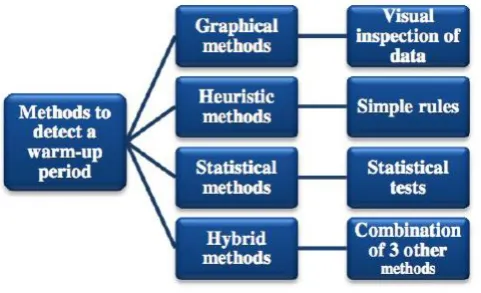
To determine the start of the equilibrium phase, many methods have been proposed [13].We found around a total of 44 methods in the literature. Generally, these methods for estimating the warm-up period can be classified into four main categories (See Fig 4):
Fig. 4. Methods for detecting the warm-up period
Several criteria were used to discuss the strengths and weaknesses of each class of these methods among which are: simplicity, ease of implementation, accuracy and parameter estimation. After a comparative study of different existing methods [14], it was concluded that the MSER-5 method was
the simplest, and works well for longer run lengths.
It is important to underline that a similar work on dynamic hybrid simulation, has been described by Sewall et al [15]. Nevertheless, the statistical nature of the instantiation technique, which rapidly alternates the simulation type of a zone, will likely result in inconsistent vehicles - quantities and distributions will be relatively stable, but not actual positions.
Among the techniques discussed above, we have chosen the MSER-5 heuristic that adapts well to dynamic hybrid simulation models.
F. Marginal Standard Error Rule (MSER)
Let are the observation values of a simulation, the optimal setting of the transitional period can be calculated as:
In this formula, the value is the variance of the sample of observed values:
With:
The rest of the series , is assumed to be stationary, and the range of marginal minimum confidence is
calculated from the formula:
If is the first value which is the minimum, we can take as the parameter optimal for the initial transient.
G. Marginal Standard Error Rule-5 (MSER-5)
MSER as described above is a simple heuristic for resolving the initialization problem in steady-state simulation output analysis. This is done through selecting the truncation point that minimizes the half-length of the confidence interval about the truncated sample mean. The method was first proposed by White et al.[16] as the MCR (Marginal Confidence Rule). Modifications of this method were presented in White et al., [17], Franklin [18] and Spratt [19].
Spratt (1998) suggests MSER-5, where instead of using the raw data to calculate the MSER statistic; the raw data is batched into non-overlapping batches of size 5 and the batch means are used to calculate the MSER statistic.
Then, for the output sequence of size N,
439
Najia BOUHA
1,, ETJ Volume 3 Issue 05 May 2018
From the Equation (5), the basic data items now are the batch means For any truncation point , the grand average and the sample variance of the data are given respectively, by:
Therefore, a has the form
Where denotes the quantile of the standard normal distribution. The statistic that MSER-5 tries to minimize is the half-length of the CI, since is a constant.
The optimal truncation point is defined as follows
Nevertheless, if , then MSER-5 fails because of insufficient data.
In the case when , White et al., (1994), suggest the application of the classical method of no overlapping batch means (NBM) to the truncated sequence . They suggest using “new” batches with the batch size:
Therefore with the truncation point and the new batch size , the lth new batch mean is:
For . And the corresponding grand average and sample variance of the new batch means are given by:
Finally, an approximate CI is:
Where denotes quantile of Student's
distribution with degrees of freedom.
440
Najia BOUHA
1,, ETJ Volume 3 Issue 05 May 2018
Fig. 5. Flow chart of MSER-5V. WARM-UP DETECTION IN DYNAMIC HYBRID SIMULATION: EXPERIMENTS
The dynamic simulation of road traffic is considered an interesting tool for decision-making. It makes it possible to model and to return the operation of a section of road over a determined duration.
Its objective is to test and evaluate different development scenarios in order to compare their performance in terms of travel time; average speed, congestion ...).
We are interested in the transition from a macroscopic simulation to a microscopic simulation, and more precisely, we will treat the case of congestion.
Fig.6. Congestion of road traffic
The Congestion of a road network occurs when vehicle traffic causes an overall slowdown of it. This phenomenon is characterized by the appearance of bottlenecks during periods of heavy traffic.
In other words, congestion occurs when the density (in vehicle number / km / lane) is greater than the critical density.
A macroscopic presentation provides quantitative information on traffic, including average speed and free flow velocity. A significant difference between these values indicates the presence of traffic jams. Finding the area where bottling is located focuses on those where average speed is significantly lower than that of free flow.
The approach we adopted is based on the agent paradigm. And this choice is justified by the advantages that multi-agent systems offer for the development of this type of application such as:
Adaptability: An agent can adapt his behavior to different situations based on his experiences.
Communication: allows agents to coordinate and cooperate.
441
Najia BOUHA
1,, ETJ Volume 3 Issue 05 May 2018
Reliability: solving local problems.
The rapidity: local processing of information, avoids the transfer of a large amount of data.
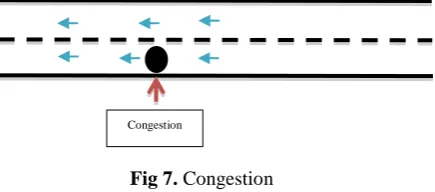
To briefly explain our approach, take the example of a section of macroscopic road.
Fig 7. Congestion
In what follows, we will describe the roles of simulation agents:
1) Congestion detection: An agent will be responsible for detecting congestion. That is, during the simulation, it controls the density. If the latter is greater than the critical density, it is congestion. 2) Identification of the area: an agent will identify the
area where there has been congestion, and also the agents that govern the operation of the model in the defined area.
3) In order to avoid interfering with the simulation, that is to say to avoid the interruption of the information feedback between this delimited zone and the outside of this zone, it is necessary to instantiate an application dedicated to the detection warm-up.
4) Generation of a simulation model containing only the delimited zone: this model includes the agents that govern the simulation of this delimited zone and more precisely an agent that simulates what happens in the simulated zone and another that simulates what happens passes out of the simulated area.
5) Perform the warm-up calculation until it is complete. This agent executes the warm-up algorithm and the result of this execution is to determine the time t from which the system becomes stable.
Indeed, we performed the MSER-5 algorithm on real data from a site chosen to perform a first hybrid simulation from the A25 to the Chapel of Armentieres in France. The output data (time, speed and speed of vehicles ...) from the simulation are exported to a file. We were particularly interested in road traffic during the period from 16:00 to 16:30.
For example, the variation of the average traffic flow and the preheating period for the first experiment are shown in Fig. 6. The warm-up period in this example ended at the instant 55 seconds.
Performing a local warm-up allows for more accurate speed, density and vehicle flow.
6) Remove the old agent that manages the simulated zone.
7) Recovery of the new agents obtained after the warm-up and who will manage the simulated zone. 8) The integration of this new area to the simulation.
Fig.8. The average traffic flow and the warm-up period (MSER-5)
VI. CONCLUSION
The purpose of this article was to present the importance of dynamic hybrid simulation, and primarily we addressed one of the most important issues called the "warm-up" period.
At the beginning we presented the traffic flow models, namely macroscopic, microscopic, mesoscopic and hybrid modeling.
Hybrid modeling has only recently been tackled by researchers in the field of road transport. Hybrid models developed so far are still relevant research topics. They are distinguished by the type of models used, and by the coupling procedure adopted as well as by the type of infrastructure studied. And we have focused on dynamic hybrid simulation for complex systems.
So we have our first approach to move dynamically from the macroscopic representation to the microscopic representation of the traffic flow in a hybrid traffic simulation. In this article, the focus has been on the MSER-5 algorithm.
MSER-5 is not a specific model or type of data and is therefore a very general method. It requires no parameter estimation and can work properly without user intervention. It has been shown that the robustness and efficiency of the majority of test datasets are very satisfactory. It is quick to implement and simple enough to understand. It is therefore an ideal candidate for automation and inclusion in an automated analysis system. It is important to emphasize that
442
Najia BOUHA
1,, ETJ Volume 3 Issue 05 May 2018
the purpose of this article is not to evaluate equilibrium phase detection techniques, but to present our approach to move from a macroscopic presentation to a microscopic presentation using the notion of warming up.
The integration of MSER-5 into a multilevel multi-agent simulator is being implemented. Other work will be oriented to define the rules of dynamic change from a macroscopic representation to a microscopic representation for several use cases such as: road accidents...
REFERENCES
1. G.SOSTESQUE. « Analyse et modélisation du trafic routier : Passage du microscopique au macroscopique », mémoire de mastert à l’université de Lyon – 2011.
2. Michelle Chabrol, David Sarramia « Modélisation orientée objets du système d'information des Systèmes de Trafic Urbain : une approche multi-agents ».
3. S. EL HMAM « Contribution μa la modélisation et à la simulation hybride du flux de trafic », thèse de doctorat à l’université d’Artois-Septembre 2006. 4. E.BOURREL « Modélisation dynamique de
l’écoulement du trafic routier : du macroscopique au microscopique », thèse de doctorat à l’institut national des sciences appliquées de Lyon-2003. 5. P.Serge,Hoogendoorn, H.L Piet, and Bovy « State
of the art of Vehicular Traffic Flow Modelling ».Journal of Systems and Control Engieering Special Issue On Road Traffic Modelling and Control, 215 N°4-2001.
6. A.Kotsialos « Optimal co-ordinated and Integrated Motorway Network Traffic Control »Proccedings of the 14th International Symposium of transportation and traffic theory-1999.
7. S Algers « Review Report of the SMARTEST project ; deliverable 3 »Review of Micro-Simulation Models-1997.
8. Marchal F De Palma A and Nesterov Y.Metropolis « A Modular System for dynamic traffic simulation »METROPOLIS-1996
9. SP.Hoogendoorn and Bovy « A New Estimation Technique For vehicle type specific Meadway Distribution »Transportation Research Record-1998
10. I Prigogine and R Herman « Kinetic theory of vehicular traffic. American Elsevier New-York-1971
11. N. Bouha, G. Morvan,H .Abouaissa, and Y. Kubera A First Step Towards Dynamic Hybrid Traffic Modeling Proc. of 29th European Conf. on modelling and simulation (ECMS), pp 64-70, mai 2015.
12. H. Abouaïssa, Y. Kubera, and G. Morvan. Dynamic Hybrid Traffic Flow Modeling CoRR, abs/1205.0561. Scientific report for the CISIT project, 2014.
13. S. Robinson. A statistical process control approach to selecting a warm-up period for a discrete-event simulation. European Journal of Operational Research, volume 176, pages 332-346, 2005.
14. K. Preston White, Jr.Michael J. Cobb, and Stephen C. Spratt : A comparison of five steady-state truncation heuristics for simulation, 2000.
15. J. Sewall., D., Wilkie and M.C. Lin. Interactive hybrid simulation of large-scale traffic. ACM Transaction in Graphics, Proc. of SIGGRAPH, Asia, 2011.
16. K. P., and M. A. Minnox. Minimizing initialization bias in simulation output using a simple heuristic. International Conference on Systems, Man, and Cybernetics, 215220. Piscataway, New Jersey: Institute of Electrical and Electronics Engineers, Inc, 1994.
17. K. P., White, S. Robinson. The problem of the initial transient (again), or why MSER works. Journal of Simulation volume 4, pages, 268-272, 2010.
18. W. Franklin William, and K.P. White. Stationarity tests and MSER-5: Exploring the intuition behind mean- squared-error reduction in detecting and correcting initialization bias. Proceedings of the Winter Simulation Conference, pages 541-546, 2008.
![Fig 2: Coupling diagram [3]](https://thumb-us.123doks.com/thumbv2/123dok_us/8867107.1811511/4.595.313.555.238.345/fig-coupling-diagram.webp)