Correlations of Biomechanical Characteristics with Ball Speed in Penalty Corner Push-In
Effects of Physical Exercises and Yogic Practice on Selected Health Related Physical Fitness of
Residential College Men Students
R. Sathish Kumar1 & Dr. M. Raj Kumar2
1Ph.D Scholar (Part Time), Department of Physical Education, Tamilnadu Physical Education and Sports University, Chennai, Tamil Nadu, India. 2Associate Professor, Department of Physical Education, Bharathiar University, Coimbatore, Tamil Nadu, India.
Received 26th May 2015, Accepted 17th July 2015
Abstract
The purpose of the study was to find out the effects of physical exercises and yogic practice on selected health related physical fitness of residential college men students. To achieve the purpose of the present study, sixty residential college men students from Sri Kaliswari College, Sivakasi, Tamilnadu, India were selected as subjects at random and their ages ranged from 18 to 25 years. The subjects were divided into three equal groups of twenty each. Group I acted as Experimental Group I (Physical Exercise), Group II acted as Experimental Group II (Yogic Practice) Group III acted as Control Group. Pre test was conducted for all the subjects on selected health related physical fitness. This initial test scores formed as pre test scores of the subjects. The groups were assigned as Experimental Group I, Experimental Group II and Control Group in an equivalent manner. Experimental Group I was exposed to physical exercises, Experimental Group II was exposed to yogic practice and Control Group was not exposed to any experimental training other than their regular daily activities. The duration of experimental period was 12 weeks. After the experimental treatment, all the sixty subjects were tested on their health related physical fitness. This final test scores formed as post test scores of the subjects. The pre test and post test scores were subjected to Analysis of Covariance (ANCOVA) to find out the significance among the mean differences, whenever the ‘F’ ratio for adjusted test was found to be significant, Scheffe’s post hoc test was used. In all cases 0.05 level of significance was fixed to test hypotheses. The physical exercises group showed significant difference on cardio respiratory endurance and muscular strength of residential college men students from their baseline to post training than the other groups.
Keywords: Physical Exercise, Yogic Practice, Cardio Respiratory Endurance, Muscular Strength, Residential.
© Copy Right, IJRRAS, 2015. All Rights Reserved.
Introduction
Physical exercise is any bodily activity that enhances or maintains physical fitness and overall health and wellness. It is performed for various reasons including strengthening muscles and the cardiovascular system, honing athletic skills, weight loss or maintenance, as well as for the purpose of enjoyment. Frequent and regular physical exercise boosts the immune system, and helps prevent the "diseases of affluence" such as heart disease, cardiovascular disease, Type 2 diabetes and obesity. It also improves mental health, helps prevent depression, helps to promote or maintain positive self esteem, and can even augment an individual's sex appeal or body image, which is also found to be linked with higher levels of self esteem. Childhood obesity is a growing global concern and physical exercise may help decrease some of the effects of childhood and adult obesity. Health care providers often call exercise the "miracle" or "wonder" drug alluding to the wide variety of proven benefits that it
Correspondence
R. Sathish Kumar,
E-mail: [email protected], Ph: +9199444 44987
provides (Gilmore, 1981).
Yoga is an ancient form of relaxation and exercise that has many health benefits, including lowering cholesterol. Pranayama also helps to connect the body to its battery, the solar plexus, where tremendous potential energy is stored. When tapped through specific techniques this vital energy, or prana, is released for physical, mental and spiritual rejuvenation. Regular practice removes obstructions, which impede the flow of vital energy. When the cells work in unison, they bring back harmony and health to the system. 20 to 25 minutes (every morning or 17 evening) of pranayama practice increases lung capacity, breathing efficiency, circulation, cardiovascular efficiency, helps to normalize blood pressure, strengthens and tones the nervous system, combats anxiety and depression, improves sleep, digestion and excretory functions, provides massage to the internal organs, stimulates the glands, enhances endocrine functions, normalizes body weight, provides great conditioning for weight loss, improves skin tone and complexion. (Sugumar & Raghavan, 2010).
International
35 International Journal of Recent Research and Applied Studies, Volume 2,Issue 7 (10) July 2015
Methodology
The purpose of the study was to find out the effects of physical exercises and yogic practice on selected health related physical fitness of residential college men students. To achieve the purpose of the present study, sixty residential college men students from Sri Kaliswari College, Sivakasi, Tamilnadu, India were selected as subjects at random and their ages ranged from 18 to 25 years. The subjects were divided into three equal groups of twenty each. Group I acted as Experimental Group I (Physical Exercise), Group II acted as Experimental Group II (Yogic Practice) Group III acted as Control Group. Pre test was conducted for all the subjects on selected health related physical fitness. This initial test scores formed as pre test scores of the subjects. The groups were assigned as Experimental
Group I, Experimental Group II and Control Group in an equivalent manner. Experimental Group I was exposed to physical exercises, Experimental Group II was exposed to yogic practice and Control Group was not exposed to any experimental training other than their regular daily activities. The duration of experimental period was 12 weeks. After the experimental treatment, all the sixty subjects were tested on their health related physical fitness. This final test scores formed as post test scores of the subjects. The pre test and post test scores were subjected to Analysis of Covariance (ANCOVA) to find out the significance among the mean differences, whenever the ‘F’ ratio for adjusted test was found to be significant, Scheffe’s post hoc test was used. In all cases 0.05 level of significance was fixed to test hypotheses.
Results
Table I. Computation of analysis of covariance of physical exercises, yogic practice and control groups on cardio respiratory endurance
PE Group
YP Group
Control Group
Source of
Variance Sum of Squares df Mean Squares F-ratio
Pre-Test
Means 2013.1 2014.2 2018.9
BG 377.23 2 188.61
0.009
WG 1214797.35 57 21312.23
Post-Test
Means 2274.0 2149.2 2019.0
BG 650090.43 2 325045.21
13.14*
WG 1409910.15 57 24735.26
Adjusted Post-Test Means
2276.0 2150.0 2016.0
BG 671869.06 2 335934.53
24.83*
WG 757516.84 56 13527.08
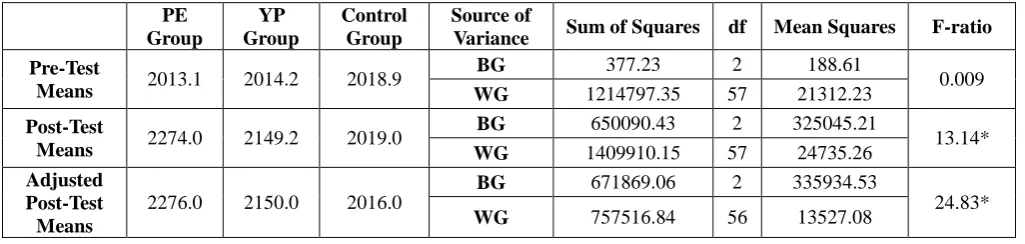
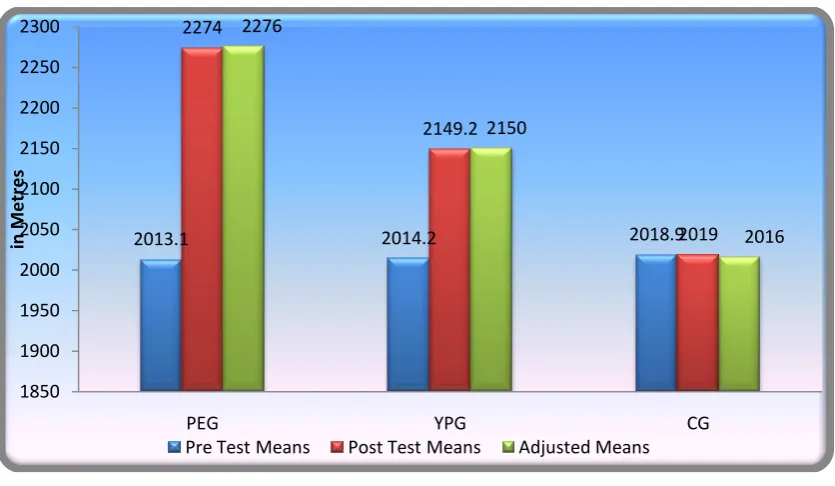
An examination of table – I indicates that the results of ANCOVA for pretest scores of the physical exercises group, yogic practice group and control group. The obtained F-ratio for the pre-test is 0.009 (P>0.05) indicating that the random sampling is successful and the table F-ratio is 3.158. Hence the pre-test mean F-ratio is insignificant at 0.05 level of confidence for the degree of freedom 2 and 57. The obtained F-ratio for the post-test is 13.141 (P<0.05) and the table F-ratio is 3.158. Hence the post-test mean F-ratio is significant at 0.05 level of confidence for the degree of freedom 2 and 57. The
Figure I. Bar diagram showing the pretest, posttest and adjusted posttest mean differences of physical exercises, yogic practice and control groups on cardio respiratory endurance
Table II. The scheffe’s test for the differences between the adjusted post test paired means on cardio respiratory endurance
Physical exercises group Group (N=20)
Yogic practice Group (N=20)
Control Group (N=20)
Mean
Difference CI value
2276.0 0 2150.00 --- 126.00*
92.47
2276.00 --- 2016.00 260.00*
--- 2150.00 2016.00 134.00*
*Significant
Table - II shows the ordered adjusted means and difference between the means of the physical exercises group, yogic practice group and control group. The mean values of physical exercises group, yogic practice group and control group are 2276.0, 2150.0 and 2016.0 respectively. The mean differences between physical
exercises group, yogic practice group and control group are 126.00, 260.00 and 134.00 respectively. Hence there is a significant difference seen between physical exercises group and yogic practice group; physical exercises group and control group; yogic practice group and control group.
Table III. Computation of analysis of covariance of physical exercises, yogic practice and control groups on muscular strength
PE Group
YP Group
Control Group
Source of Variance
Sum of Squares df
Mean
Squares F-ratio
Pre-Test
Means 11.90 11.95 12.05
BG 0.23 2 0.11
0.02
WG 247.70 57 4.34
Post-Test
Means 16.45 14.45 12.80
BG 133.63 2 66.81
10.84*
WG 351.10 57 6.16
Adjusted Post-Test Means
16.52 14.46 12.71
BG 145.11 2 72.55
51.34*
WG 79.13 56 1.41
2013.1 2014.2 2018.9
2274
2149.2
2019 2276
2150
2016
1850 1900 1950 2000 2050 2100 2150 2200 2250 2300
PEG YPG CG
in
M
e
tr
e
s
37 International Journal of Recent Research and Applied Studies, Volume 2,Issue 7 (10) July 2015
An examination of table – III indicates that the results of ANCOVA for pretest scores of the physical exercises group, yogic practice group and control group. The obtained F-ratio for the pre-test is 0.027 (P>0.05) indicating that the random sampling is successful and the table F-ratio is 3.158. Hence the pre-test mean F-ratio is insignificant at 0.05 level of confidence for the degree of freedom 2 and 57. The obtained F-ratio for the post-test is 10.847 (P<0.05) and the table F-ratio is 3.158. Hence the post-test mean F-ratio is significant at 0.05 level of confidence for the degree of freedom 2 and 57. The
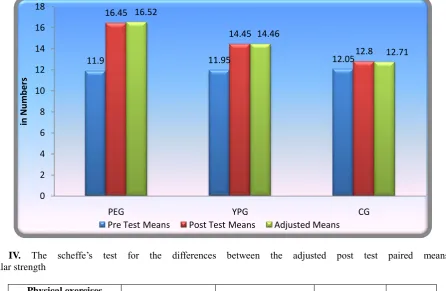
adjusted post-test means of physical exercises group, yogic practice group and control group are 16.520, 14.467 and 12.713 respectively. The obtained F-ratio for the adjusted post-test means is 51.346 (P < 0.05) and the table F-ratio is 3.161. Hence the adjusted post-test mean muscular strength F-ratio is significant at 0.05 level of confidence for the degree of freedom 2 and 56. Pre test, post test and adjusted post test mean difference of the physical exercises group, yogic practice group and control group on muscular strength is presented in Figure II.
Figure II. Bar diagram showing the pretest, posttest and adjusted posttest mean differences of physical exercises, yogic practice and control groups on muscular strength
Table IV. The scheffe’s test for the differences between the adjusted post test paired means on muscular strength
Physical exercises group Group (N=20)
Yogic practice Group (N=20)
Control Group (N=20)
Mean
Difference CI value
16.520 14.467 --- 2.053*
0.945
16.520 --- 12.713 3.807*
--- 14.467 12.713 1.754*
*Significant
Table - IV shows the ordered adjusted means and difference between the means of the physical exercises group, yogic practice group and control group. The mean values of physical exercises group, yogic practice group and control group are 16.520, 14.467 and 12.713 respectively. The mean differences between physical exercises group, yogic practice group and control group are 2.053, 3.807 and 1.754 respectively. Hence there is a significant difference seen between
physical exercises group and yogic practice group; physical exercises group and control group; yogic practice group and control group.
Conclusions
From the analysis of the data, the following conclusion was drawn:
1. The physical exercises group showed significant difference on cardio respiratory endurance and
11.9 11.95 12.05
16.45
14.45
12.8 16.52
14.46
12.71
0 2 4 6 8 10 12 14 16 18
PEG YPG CG
in
N
u
m
b
e
rs
muscular strength of residential college men students from their baseline to post training than the other groups.
References
1. Andre Van Lysebeth, (1987). Yoga Self – Taught, Delhi: Tarage Paper Back.
2. Chandrasekar.K (2003). Yoga for Health, Delhi; Khel Sathiya Kendra.
3. Eugene S.Rawles, (1967). Yoga for Beauty and Health. New York: Parker Publishing CompanyInc. 4. Gilmore C.P. (1981). Exercising for Fitness,
Canada: Time-Life Books Inc.,
5. Heyward, Vivian H., (2002). Advanced Fitness Assessment and Exercise Prescription, (4ED), Champaign Illinois: Human Kinetics Publishers Inc.
6. Joshi.K (2001). Yogic Pranayama, New Delhi: Orient Paper Backs.
7. Moorthy A.M. & David Manual Raju, J. (1983).
Yoga for Health. Madras: M.J.Publishers.
8. Morrow, James R. (2005). Measurement and
Evaluation in Human Performance, (3ED). Champaign Illinois: Human Kinetics Publishers Inc.,
9. Muscandar, S. (1966). Yogic Exercises. Calcutter Orient Longmans Ltd.
10. Swami Devaparsad. (1998). Yoga ; For integral Health and Growth. Bangalore, N.B.C.L.C.
11. Swami Kuvalayananda (1977). Asana, Lonavala: Kaivalya dhama.
12. William Caddic. (1964). 20th Century Dictionary. Bombay: Hilled Publisher.
13. Sugumar, C. & Raghavan, G. (2010). Effect of Pranayama Practice on Selected Variables. Yoga Mimamsa, XLII:2, pp.103-108.
14. Senthil Kumar. K (2013). Effect of physical combined physical cum yogic practices on selected
physical, physiological, psychological and
performance factors of kabaddi players.
Unpublished Master’s Thesis, Bharathidasan University, Tiruchirappalli.
15. Saravana Kumar.K & Balasubramanian.K. (2014). Effect of Yogic Practices on Selected Psychological Variables of Volleyball Players. International Journal of Recent Research and Applied Studies, 2 (8), 30-33.
16. Ramesh.V & .P.K. Subramaniam, (2010). Effect of Physical Activity and Aerobic Fitness on Health Related Physical Fitness Variables of Overweight and Obese Adolescence, Indian Journal of Yoga Exercise &Sport Science and Physical Education, pp.46-52.