THE LAST PLANNER
®SYSTEM PATH
CLEARING APPROACH IN ACTION:
A CASE STUDY
Paul J. Ebbs1, Christine L. Pasquire2, and Emmanuel I. Daniel3
ABSTRACT
The “Last Planner® System” (LPS) is commonly viewed as the foundation of Lean Project Delivery. It is increasingly used in certain parts of the globe. However, LPS implementation often fades off due to issues reported at organisational, project and external levels. The LPS Path Clearing Approach (PCA) offers an antidote to these issues.
The goal of this paper is to outline how the LPS-PCA helped restart a stalled implementation of the LPS through a “shallow and wide” organisational approach rather than a more traditional “narrow and deep” project approach. The LPS-PCA in action is documented within an on-going UK case study organisation. Action and covert research methods were used to introduce LPS principles, thinking and language without attributing them to LPS in response to resistance to the actual LPS. The 15 step actions within the LPS-PCA are expanded from a past, current and future state perspective. The study found that the LPS-PCA’s 15 step actions were useful as a benchmark to continuously remove constraints that blocked the implementation of the LPS. In summary, the use of the LPS-PCA is recommended before, during and after organisations engage with LPS Consultants if organisations are serious about sustaining the implementation of the LPS.
KEYWORDS
Last Planner System, Path Clearing, Lean Leadership, Facilitator, Shallow and Wide
INTRODUCTION
LPS can facilitate better project outcomes in the right environment and is a gateway to desirable Lean behaviours (Gehbauer, 2008; Fauchier & Alves, 2013). Successful LPS implementations have resulted in many direct and indirect benefits such as reduced schedules (Fauchier & Alves, 2013; Drysdale, 2013); continuous knowledge development within teams (Skinnarland & Yndesdal, 2012); better collaboration, communication and
1 Research Fellow, Centre for Lean Projects, Nottingham Trent University, [email protected] 2 Professor of Lean Project Management, Director of Centre for Lean Projects, Nottingham Trent
University, [email protected]
understanding (Fuemana & Puolitaival, 2013); simplification of design management, facilitation of better coordination and collaboration, improved schedules by reducing rework (Ebbs, 2015); and creating a more stable workflow with better matched availability of labour force and increased productivity (Barbosa et al., 2013). Therefore, the correct implementation of the LPS appears critical to successfully embedding Lean in Owner, Architecture Engineering, Construction and Facility Management (OAECFM)organisations. While the benefits of LPS are well documented in the literature, how to sustain implementations through a standard approach and how toover come barriers during the implementation are not as prevalent. The goal of this paper is to report how the LPS-PCA’s 15 Step Actions (Daniel, 2017) were used in action for the first time to address the gap in the literature on how to overcome resistance to the LPS by abstracting LPS principles, thinking and language from the LPS and using them to address organisational culture constraints. This paper does not report how to implement the LPS per se or the LPS-PCA in detail (see Daniel, 2017 and Daniel & Pasquire, 2017 for more robust guidance on the LPS-PCA). Rather how the LPS-PCA was used to remove prevailing current state issues to create the right environment and culture required to support LPS is documented.
Several studies (Daniel et al., 2016; Daniel, 2017;Brady et al., 2011; Hamzeh, 2011; Alarcónet al., 2014; Dave et al., 2015) together with the authors’ field observations show that the implementation of the LPS varies. The motivation behind Ballard and Tommelein’s Last Planner System Current Process Benchmark (2016) was to address misconceptions and inconsistent approaches to implementations and poor results of implementations (G. Ballard personal communication 28 February 2018). Additionally, the authors’ observed how some aspects of the LPS are discontinued over time without sufficient leadership, coaching and guidance which resulted in benefits not being fully realised. For instance, the case study reported here identified that if senior management insisted on implementing the LPS without sufficient buy-in and leadership from the Project/Site Manager to actively use the LPS, the implementation faded off once the external LPS facilitator stepped back. Additionally, several barriers were experienced in Organisation X (the case study)which prevented a sustainable implementation of the LPS. However, these did not surface until after the implementation of the LPS stalled six months later. This is when the LPS-PCA’s 15 Step Actions were used as a benchmark to identify what actions were being addressed and what future actions were required to embed LPS principles, thinking and language through an alternative organisational wide approach called the Business Delivery Meeting (BDM) which will be expanded on later.
deliver a range of projects on behalf of a UK government body. The projects are delivered in a highly regulated engineering environment and typically include civil, mechanical, electrical and demolition designers and contractors to coordinate desired action with various internal and external stakeholders and departments related to Organisation X. Approx. 50% of staff are direct employees (n=75), the rest are contractors (QS, PM, Project Engineer, Clerk of Works, Planner, Operations etc.).
RESEARCH METHODS
A researcher was embedded within Organisation X and along with the principal investigator are collectively referred to as NTU in this paper. The research was undertaken over two years to design, develop and test a Lean Project Delivery System to improve the reliability of schedules. Fundamental to this was the LPS. In advance of the NTU project commencing, an internal LPS champion (a Toyota trained Continuous Improvement (CI) Manager directly employed by the organisation) made two unsuccessful attempts to implement the LPS. In early 2016, NTU kick-started LPS after the unsuccessful attempts. In hindsight, more attention should have been paid to the factors contributing to failure at this point before restarting LPS with NTU. This would have provided a more holistic understanding of the underling social and technical architecture and prevailing issues (current state).
To identify prevailing issues qualitative research methods were used including interviews and focus groups (n=18), observation, listening, open surveys on “Last Minute Requests” (n=20), and thematic analysis. According to Creswell, (2009)qualitative approaches enable a study to develop a deeper understanding of the problem from the people’s perspective. An action research approach was also taken to implement interventions in practice so their effect could be clearly monitored and measured for effectiveness. Finally, as a result of initial findings covert research methods (Lugosi, 2006)using direct questioning (Socratic Method), listening, and introducing new language around commitments were used to counteract the passive resistance and innovation, initiative and meeting fatigue embedded in Organisation X. Although, covert research methods have been criticised for ethical reason (Herrera,1999), Lugosi (2006) argued this may not apply to all covert research approaches.In this case, the covert action was simply not using labels such as Last Planner System, Lean, Visual Management, Standard Work, Just-in-Time, etc. to describe what was being implemented as these labels had been used previously which set up a resistance with the organisation.
projects are not complex enough.” Many of the comments were from informal leaders who had privately and publicly dismissed the LPS before NTU were engaged because of prior negative experiences with the CI Manager.
LPS
-
PCA15
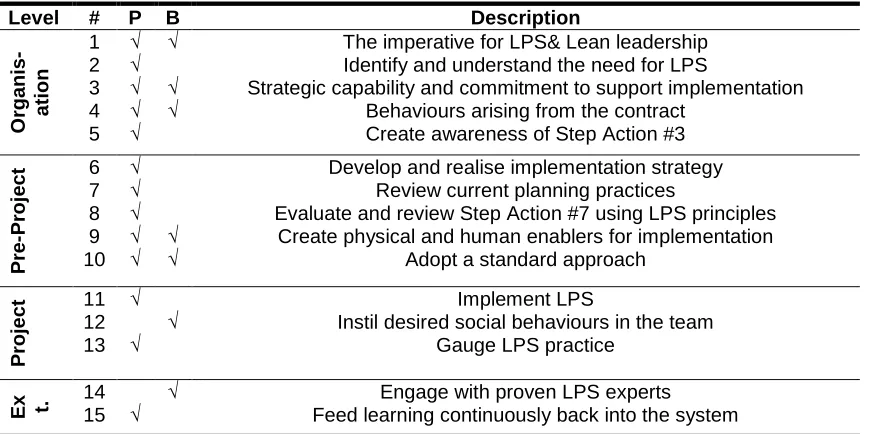
STEP ACTIONSThe Step Actions in Table 1were not designed to be used in a linear or hierarchal manner as many of them require interaction with each other. Numbers 1 through 15 describe the level where the step action applies together with a reference letter P or B which is related to a process (P) or desired behaviour (B) required to influence a process i.e. Step Action #1 requires Lean Leadership (B) and also a process (P) to educate leaders at organisational level to enable the smooth flow of other processes. Brackets and numbers show where the relevant step actions in Table 1 are discussed in the following paragraphs e.g. (#9 & #14) denotes where the physical space & infrastructure were created (#9) and where external LPS expertise was engaged (#14). Upon reflection the only LPS-PCA Step Action present from the outset of the NTU project was Organisation X engaging with proven LPS experts (#14 i.e. NTU). The next section outlines the context behind the first use of the LPS-PCA in Organisation X & highlights were step actions were missing.
Table 1: LPS-PCA Step Actions (after Daniel, 2017)
Level # P B Description
O
rg
anis
-atio
n
1 √ √ The imperative for LPS& Lean leadership 2 √ Identify and understand the need for LPS
3 √ √ Strategic capability and commitment to support implementation 4 √ √ Behaviours arising from the contract
5 √ Create awareness of Step Action #3
Pre
-Pr
o
jec
t 6 √ Develop and realise implementation strategy 7 √ Review current planning practices
8 √ Evaluate and review Step Action #7 using LPS principles 9 √ √ Create physical and human enablers for implementation
10 √ √ Adopt a standard approach
P
ro
je
ct 11 √ Implement LPS
12 √ Instil desired social behaviours in the team
13 √ Gauge LPS practice
Ex t.
14 √ Engage with proven LPS experts 15 √ Feed learning continuously back into the system
and physical infrastructure became available (#9). At the LPS restart (3rd), the existing phase plan had become irrelevant and a new phase plan was created. This was not well received by the team but they acknowledged the time lag as the key factor. A six week make ready plan was then created. Subsequently, the researcher facilitated a number of sessions and began coaching the PM on LPS (at his request) in order to transfer “ownership” of the LPS to the team. However, it became very clear that the required “buy-in”, Lean Leadership and strategy for LPS (#1, #3 ) were missing and the 3rd
implementation of the LPS stopped (this project was finally completed 10 months later than originally planned at the kick-off workshop).
Following this, leadership within Organisation X decided to abandon the implementation of the LPS on that project and start it again during the procurement phase of a land remediation project. Lessons from the previous implementation were learned (#15) and the next implementation was progressing well. The team were turning up autonomously to daily huddles and to update the make ready boards and the PM (different to previous implementation and initially resisting LPS) publicly acknowledged how LPS was beginning to deliver great benefits which included reducing the schedule by 25% and how the team gained a much better understanding of each other’s roles, responsibilities and activities through effective conversations at the wall (#2). It appeared a corner was turned and the narrow and deep approach was working (Arbulu and Zabelle, 2006). However, the biggest learning was yet to come.
A request (pull) was made to produce facilitator checklists and a “plan for Last Planner” (#10 & #13) to help the team while NTU were off-site. Eight of the various checklists were subsequently used but once the Head of Department was on holiday (#1) the team stopped using LPS and decided they would pick it up again once the physical works began. Despite such early positive results and feedback on the LPS the 4th implementation of the LPS had stalled by the time the researcher returned to site three weeks later. The internal LPS champion (unfamiliar with the LPS) requested NTU drive (push) LPS forward again – the request was declined and NTU stepped back to investigate why it had stalled yet again. The LPS-PCA was introduced at this point and covert research methods began using bi-weekly team hub meetings to introduce LPS principles, thinking and language but removing any direct references to the LPS and Lean (#10).The LPS-PCA step actions in Table 1 were used to design a covert approach to embed LPS thinking in Organisation X and influence future actions.
LPS-PCA
IN ACTIONLPS kept stalling when the NTU team stepped back. The interviewees (n=13) were from different functions in Organisation X who had taken some part in prior LPS sessions. The interviews were semi-structured and the results provided clear evidence that current production planning and control methods were insufficient. Pasquire and Ebbs (2017) outlined the themes identified during this data analysis. The findings triggered a review of the P6 schedules for eight projects during the next action research cycle in order to establish the average PPC (Percentage of Promises Completed) across the business. This was effectively 25% of the total number of items on the schedules. Additionally, 67% of the items on the P6 plans were not being worked on - essentially P6 plans were not reflecting actual work. Furthermore, P6 plans were only stored on a PC and were not readily accessible or transparent i.e. no visual management.
The review and evaluation of the transcripts (#7 ) provided rich data that influenced future interventions and presented some compelling evidence to encourage those passively resisting LPS to become more engaged. At this point, LPS-PCA Step Actions #2; #4; #6, #7, #8, #9, #10, #11, #13, were being used to implement the LPS on some of Organisation X’s projects. However, the narrow and deep approach was not working primarily due to a lack of Lean Leadership (#1),little awareness of strategic capability and a lack of commitment to support the implementation (#3 & #5), and discipline to adhere to a standard approach (#10). During the 4th LPS implementation a
procurement officer asked “if LPS is so good, why are we the only ones using it? Why are the rest of the organisation not using the LPS?” A covert “shallow and wide” approach and LPS implementation strategy (#6) followed that abstracted LPS principles, thinking and language but removed any references to Lean or the LPS.
BI
-
WEEKLY TEAM HUB MEETINGS:
A COVERT APPROACH TO LPSThe projects department already had morning meetings to share planned activities. However, these were unstructured, inconsistent and of little value to attendees. About a month after the 4thLPS implementation stalled NTU began a more covert unknown to the
majority of participants. NTU began by replacing the morning meetings with bi-weekly team hub meetings and abstracting the following elements from LPS:
Standard agenda and approach based on LPS thinking (#10 & #11)
Stand-up meetings
Visual management of plans (#9)& ownership of promises i.e. only the PM’s wrote and updated their project’s activities (a step towards Last Planners)
New language around making reliable promises
Rules for making commitments (Macomber and Howell, 2003)
Tracking PPC and variance i.e. Reasons for Missed Commitment (RMC)
Timekeeping – start and finish meetings on time
Gauging practice through facilitator checklists (#13)
Using meeting ground rules and rotating the facilitator (#9 & #12)
Experimentation through plus/deltas (#13)& taking action of deltas
Identifying constraints/support requests (making ready)
Cross functional participation in the meetings
Action research cycles were used to improve the structure and output of the meetings. Additionally, the meetingsalso provided an opportunity to gather RMC data and refine the categories through which the RMC were recorded against (#10).RMC is more commonly known as RNC (Reason for Non Completion) or Reasons for Variance (RV) in the literature. However, NTU decided that “commitment” was more powerful and a covert opportunity to introduce Lean language. The original plan with the bi-weekly team hub meetings was to use the projects department as a pilot, refine, and then roll out across Organisation X. However, another bottom up approach emerged that built on the success of the team hub meetings and encouraged LPS thinking by other departments/functions.
T
HEB
USINESSD
ELIVERYM
EETING:
LPS
T
HINKING&
M
ETRICS FROM ANO
RGANISATIONALP
ERSPECTIVECovert methods were re-employed with some middle and senior management using the book Team and Teams through a Study Action Team (SAT) format. SAT’s are an alternative approach to create a shared mind (Hill, Silvon, & Draper, 2007; Silvon & Macomber, 2010). In Team of Teams McChrystal et al. (2015) reported how silos were broken down between organisations fighting the same war against Al Qaeda by creating an environment to freely share information in order to deliver on a common purpose. They developed a daily meeting were 7,000 people heard the same information at the same time – similar to a daily huddle or weekly coordination meetings in the LPS but with significantly more people present. “[Their] thinking was that the value of this information and the power that came with it were greater the more it was shared” (p.167). The BDM emerged from the SAT discussions through direct questioning on how similar concepts in Team of Teams would work at Organisation X. The BDM was a cross functional weekly coordination meeting based on LPS thinking but from an organisational view rather than a project view. The facilitator rotated between the Head or Projects, Operations and SHEQ. Others facilitated in their absence (#1).The Project or Department Manager’s report out followed the same structured agenda listed below (#10):
What is your project’s PPC for last period i.e. # tasks promised: # tasks completed?
What are you doing to address missed commitments?
How many promises have you got for next week?
Which of these are your priorities?
Who do you need to support you with these?
Is there anything that will stop you from fulfilling your promises over the next 2 weeks? What can we do to remove any constraints?
Firstly, it suggested that LPS thinking and principles from an organisational perspective were effective to improve business delivery performance. PPC trended above 70% as a result of the BDM - a significant improvement on the 25% PPC alluded to earlier.
Secondly, to direct appropriate CI, the need to collect reliable data from a system perspective but from as close to the source possible was highlighted. It transpired during a Root Cause Analysis (RCA) workshop on the trending RMC at the time(not prioritised/bad planning) that RMC data and RCA must be collected and actioned at the project level. Furthermore, the PM’s realised that the “promises” recorded on the P6 schedules at the BDM were not theirs. Rather, they were their colleagues’ activities which were also not “promised” or made ready. The P6 schedule was producing the promises and when the PM asked the team if they were ok to deliver on the schedule, the usual “yes” was always heard. The weekly promises from the majority of PM’s respective teams were often not captured on P6 and the BDM team realised this i.e. P6 was still not accurately reflecting on-going or planned work. The Department Heads along with the PM on the $50m land remediation project agreed to use Post-its® on rolling wave six week make ready commitment boards along with the standard BDM agenda for each project team member to use at their weekly project meetings in order to bring LPS thinking, principles, language and metrics down to those closest to the work i.e. the Last Planners.
Finally, the BDM participants recognised and challenged unreliable language and began to understand that reliable promises were the pre-requisite for reliable workflow and ultimately reliable project delivery. For instance, where phrases such as hopefully, fingers crossed, that should happen etc. were heard, clarification was typically sought through the question “what makes that a yes or no?” (J. Klous personal communication 25 August, 2017). A PM recently noted that what was not heard anymore in Organisation X was “I did not know anything about that.”
CONCLUSIONS
This paper contributes to knowledge and practice by outlining how covert research methods were used to support a shallow and wide implementation of LPS thinking, principles, language and metrics in an organisation (X) to counteract resistance to the actual LPS. However, while positive results were recorded at an organisational level by abstracting LPS principles, thinking and language by implementing through the BDM, the study is incomplete and the use of the LPS in its true form has not yet been fully embedded at project level. Results of this will be reported in future IGLC proceedings.
will not build any capacity or ownership to sustain the LPS going forward.2) Organisations without a Lean Strategy Team (with CI Departments)do not foster the required Lean Leadership to sustain Lean transformations – informal leaders, senior and middle managers must be fully engaged to maintain momentum. Otherwise the responsibility for CI and LPS will be passed on rather than led from the top. 3) For example, beware that a Toyota trained expert in Lean with a manufacturing or production background is unlikely to be an expert in LPS. Relevant design and/or construction experience of the LPS facilitator is highly desirable in order to build credibility with the team. 4) The LPS or any associated LPS infrastructure such as the room, meeting, boards, metrics etc. should not “belong” to anyone. The team needs to own the system and be willing to learn and improve how they use it. A key sustainability test is when the proven LPS facilitator steps back and the team keep up momentum.5) Depending on the Lean maturity of an organisation the level of difficulty implementing LPS will differ. Step Actions #7 & #14 are safe places to start.6)Do not rush the implementation of the LPS. Carefully consider the most appropriate approach for each project/organisation. Before designing a Lean Project Delivery System identify the current state issues related to production planning in order to clearly understand the problem and demonstrate the need for LPS (#7 & #2). 7) In summary, the use of the LPS-PCA’s 15 Step Actionsis recommended before, during and after organisations engage with competent LPS Consultants if they are serious about sustaining the implementation of LPS.
REFERENCES
Alarcón, L.F., Salvatierra, J.L.,& Letelier, J.A. (2014).“Using Last Planner Indicators to Identify Early Signs of Project Performance.” In:, Kalsaas, B.T., Koskela, L. & Saurin,
T.A., 22nd Annual Conference of the International Group for Lean Construction. Oslo,
Norway, 25-27 Jun 2014. 547-558.
Arbulu, R.,& Zabelle, T.(2006).“Implementing Lean in Construction: How to Succeed.”
In: 14th Annual Conference of the International Group for Lean Construction. Santiago,
Chile. 553-565.
Ballard, G.,& Tommelein, I. (2016).“Current process benchmark for the Last Planner®
System.” Lean Construction Journal, 57-89.
Barbosa, G., Andrade, F., Biotto, C.,&Mota, B. (2013).“Implementing Lean Construction Effectively in a Year in a Construction Project.”In:, Formoso, C.T. & Tzortzopoulos,
P., 21th Annual Conference of the International Group for Lean Construction. Fortaleza,
Brazil, 31-2 Aug 2013. 1017-1026.
Brady, D. ,Tzortopoulos, P. &Rooke, J. (2011).“An Examination of the Barriers to Last
Planner Implementation.”In:,Rooke, J. & Dave, B., 19th Annual Conference of the
International Group for Lean Construction. Lima, Peru, 13-15 Jul 2011.
Creswell, J. (2009).Research Design: Quantitative and Qualitative Approach.3rd ed. London, :
Sage Publication.
Daniel, E.I. (2017).Exploratory study into the use of Last Planner® System and collaborative
planning for construction process improvement, Doctoral dissertation, Nottingham Trent
Daniel, E.I.,Pasquire, C., Dickens, G., & Ballard, G. (2017)“The Relationship between the Last Planner® System and Collaborative Planning Practice in UK Construction.”
Engineering Construction and Architectural Management Journal. 24(3),407-425.
Daniel, E, I., & Pasquire, C, L. (2017).“Last Planner System Path Clearing Approach (LPS-PCA): an approach to guide; clients, main contractors and subcontractors in the
implementation of the LPS.”Research report for external body. Nottingham: Nottingham
Trent University: Publications.
Dave, B., Hämäläinen, J-P., & Koskela, L. (2015). “Exploring the recurrent problems in the
Last Planner implementation on construction projects.” In: Proc. Indian Lean Const.
Conference, Mumbai, India.
Drysdale, D. (2013)“Introducing Lean Improvement into the UK Highways Agency Supply
Chain.”In:, Formoso, C.T. & Tzortzopoulos, P., 21th Annual Conference of the
International Group for Lean Construction. Fortaleza, Brazil, 31-2 Aug 2013. 1067-1074.
Ebbs, P., J.(2015).Three Reasons Why the Last Planner® System is Essential for Efficient
Design Management. Lean Construction Blog.
Fauchier, D. & Alves, T.D.C.L.(2013).“Last Planner® System Is the Gateway to Lean
Behaviors.”In:, C.T. Formoso & P. Tzortzopoulos, 21st Annual Conference of the
International Group for Lean Construction. Fortaleza, Brazil, 31-2 Aug 2013. 559-568.
Fuemana, J. &Puolitaival, T. (2013).“Last Planner System – a Step Towards Improving the
Productivity of New Zealand Construction.”In:, Formoso, C.T. & Tzortzopoulos, P., 21th
Annual Conference of the International Group for Lean Construction. Fortaleza, Brazil, 31-2 Aug 2013. 679-688.
Gehbauer, F. (2008).“Lean Organization: Exploring Extended Potentials of the Last Planner
System.”In:, Tzortzopoulos, P. &Kagioglou, M., 16th Annual Conference of the
International Group for Lean Construction. Manchester, UK, 16-18 Jul 2008. 3-13
Hamzeh, F.R. (2011).“The Lean Journey: Implementing the Last Planner ® System in
Construction.”In:,Rooke, J. & Dave, B., 19th Annual Conference of the International
Group for Lean Construction. Lima, Peru.
Herrera, C. D. (1999).“Two arguments for ‘covert research’ in social research.”British
Journal of Sociology, 50(2), 331-341.
Hill, K., Silvon, C. & Draper, J. (2007).“Another Approach to Transforming Project Delivery:
Creating a Shared Mind. In: C.L. Pasquire & P. Tzortzopoulos, 15th Annual Conference
of the International Group for Lean Construction. East Lansing, Michigan, USA, 18-20 Jul 2007. 417-422.
Lugosi, P. (2006). “Between overt and covert research: Concealment and disclosure in an
ethnographic study of commercial hospitality.” Qualitative Inquiry, 12(3), 541-561.
McChrystal, S., Silverman, D., Collins, T., & Fussell, C.(2015).Team of Teams: New Rules
for Engagement for a Complex World. New York. NJ. Penguin.
Pasquire, C. & Ebbs, P. (2017).“Shared Understanding: The Machine Code of the Social in a
Socio-Technical System.” In:, 25th Annual Conference of the International Group for
Lean Construction. Heraklion, Greece, 9-12 Jul 2017. 365-372
Skinnarland, S. &Yndesdal, S. (2012).“The Last Planner System as a Driver for Knowledge
Creation.”In:, Tommelein, I.D. & Pasquire, C.L., 20th Annual Conference of the