The Thirty-Third AAAI Conference on Artificial Intelligence (AAAI-19)
Deep Single-View 3D Object Reconstruction with Visual Hull Embedding
Hanqing Wang,
∗1,2Jiaolong Yang,
2Wei Liang,
1Xin Tong
21Beijing Institute of Technology,2Microsoft Research Asia
{hanqingwang,liangwei}@bit.edu.cn,{jiaoyan,xtong}@microsoft.com
Abstract
3D object reconstruction is a fundamental task of many robotics and AI problems. With the aid of deep convolutional neural networks (CNNs), 3D object reconstruction has wit-nessed a significant progress in recent years. However, possi-bly due to the prohibitively high dimension of the 3D object space, the results from deep CNNs are often prone to miss-ing some shape details. In this paper, we present an approach which aims to preserve more shape details and improve the reconstruction quality. The key idea of our method is to lever-age object mask and pose estimation from CNNs to assist the 3D shape learning by constructing a probabilistic single-view visual hull inside of the network. Our method works by first predicting a coarse shape as well as the object pose and silhouette using CNNs, followed by a novel 3D refinement CNN which refines the coarse shapes using the constructed probabilistic visual hulls. Experiment on both synthetic data and real images show that embedding a single-view visual hull for shape refinement can significantly improve the re-construction quality by recovering more shapes details and improving shape consistency with the input image.
Introduction
Recovering the dense 3D shapes of objects from 2D im-ageries is a fundamental AI problem which has many appli-cations such as robot-environment interaction, 3D-based ob-ject retrieval, recognition and functionality estimate (Wang, Liang, and Yu 2017; Zhu, Zhao, and Zhu 2015; Liang et
al. 2016),etc. Given a single image of an object, a human
can reason the 3D structure of the object reliably. However, single-view 3D object reconstruction is very challenging for computer algorithms.
Recently, a significant progress of single-view 3D recon-struction has been achieved by using deep convolutional neural networks (CNNs) (Choy et al. 2016; Girdhar et al. 2016; Wu et al. 2016; Yan et al. 2016; Fan, Su, and Guibas 2017; Tulsiani et al. 2017b; Zhu et al. 2017; Wu et al. 2017; Tulsiani, Efros, and Malik 2018). Most CNN-based meth-ods reconstruct the object shapes using 2D and 3D convo-lutions in a 2D encoder-3D decoder structure with the volu-metric 3D representation. The input to these CNNs are
ob-∗
Part of this work was done when HW was an intern at MSR. Copyright c2019, Association for the Advancement of Artificial Intelligence (www.aaai.org). All rights reserved.
Synthetic Data
Real Data
Input 3D-R2N2 Marrnet Ours Pseudo GT Input 3D-R2N2 Marrnet Ours GT
Figure 1: Some results reconstructed from synthetic data and real data by the baseline approach (Choy et al. 2016), Marr-Net (Wu et al. 2017) and our approach on the chair category. Note the inconsistency with input images and missing parts in the results of the former two methods.
ject images taken under unknown viewpoints, while the out-put shapes are often aligned with the canonical viewpoint in a single, pre-defined 3D coordinate system such that shape regression is more tractable.
Although promising results have been shown by these CNN-based methods, single-view 3D reconstruction is still a challenging problem and the results are far from being per-fect. One of the main difficulties lies in the object shape variations which can be very large even in a same object category. The appearance variations in the input images caused by pose differences make this task even harder. Con-sequently, the results from CNN-based methods are prone to missing some shape details and sometimes generate plausi-ble shapes which, however, are inconsistent with input im-ages, as shown in Figure 1.
In this paper, we propose an approach to improve the fi-delity of the reconstructed shapes by CNNs. Our method combined traditional wisdom into the network architecture. It is motivated by two observations: 1) while directly recov-ering all the shape details in 3D is difficult, extracting the
(R,T) Silhouette
Pose
Coarse Shape Final Shape
Single-view Visual Hull
CNN
CNN
CNN
Input Image
CNN
PSVH
La
ye
r
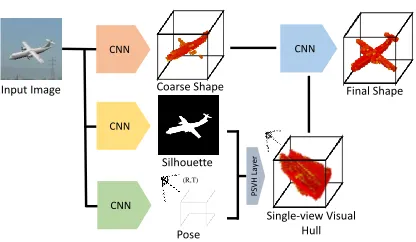
Figure 2: An overview of the proposed method. Given an input image, we first use CNNs to predict a coarse 3D vol-umetric shape, the silhouette and the object pose. The latter two are used to construct a single-view visual hull, which is used to refine the coarse shape using another CNN.
out the object from background in a relatively easy task us-ing CNNs; 2) for some common objects such as chairs and cars whose 3D coordinate systems are well defined with-out ambiguity, the object pose (or equivalently, the view-point) can also be well estimated by a CNN (Su et al. 2015; Massa, Marlet, and Aubry 2016). As such, we propose to leverage the object silhouettes to assist the 3D learning by lifting them to 3D using pose estimates.
Figure 2 is a schematic description of our method, which is a pure GPU-friendly neural network solution. Specifically, we embed into the network a single-view visual hull us-ing the estimated object silhouettes and poses. Embeddus-ing a visual hull can help recover more shape details by consid-ering the projection relationship between the reconstructed 3D shape and the 2D silhouette. Since both the pose and segmentation are subject to estimation error, we opted for a “soft” visual-hull embedding strategy: we first predict a coarse 3D shape using a CNN, then employ another CNN to refine the coarse shape with the constructed visual hull. We propose a probabilistic single-view visual hull (PSVH) con-struction layer which is differentiable such that the whole network can be trained end-to-end.
In summary, we present a novel CNN-based approach which uses a single-view visual hull to improve the qual-ity of shape predictions. Through our method, the perspec-tive geometry is seamlessly embedded into a deep network. We evaluate our method on synthetic data and real images, and demonstrate that using a single-view visual hull can sig-nificantly improve the reconstruction quality by recovering more shape details and improving shape consistency with input images.
Related Work
Traditional methods. Reconstructing a dense 3D object shape from a single image is an ill-posed problem. Tradi-tional methods resort to geometry priors for the otherwise prohibitively challenging task. For example, some meth-ods leveraged pre-defined CAD models (Sun et al. 2013). Category-specific reconstruction methods (Vicente et al. 2014; Kar et al. 2015; Tulsiani et al. 2017a) reconstruct a
3D shape template from images of the objects in the same category as shape prior. Given an input image, these meth-ods estimate silhouette and viewpoint from the input image and then reconstruct 3D object shape by fitting the shape template to the estimated visual hull. Our method integrates the single-view visual hull with deep neural network for re-constructing 3D shape from single image.
Deep learning for 3D reconstruction. Deep learning based methods directly learn the mapping from 2D image to a dense 3D shape from training data. For example, (Choy et al. 2016) directly trained a network with 3D shape loss. (Yan et al. 2016) trained a network by minimizing the difference between the silhouette of the predicted 3D shape and ground truth silhouette on multiple views. A ray consistency loss is proposed in (Tulsiani et al. 2017b) which uses other types of multi-view observations for training such as depth, color and semantics. (Wu et al. 2017) applied CNNs to first pre-dict the 2.5D sketches including normal, depth and silhou-ette, then reconstruct the 3D shape. A reprojection consis-tency constraint between the 3D shape and 2.5D sketches is used to finetune the network on real images. (Zhu et al. 2017) jointly trained a pose regressor with a 3D reconstruc-tion network so that the object images with annotated masks yet unknown poses can be used for training. Many existing methods have explored using pose and silhouette (or other 2D/2.5D observations) to supervise the 3D shape predic-tion (Yan et al. 2016; Tulsiani et al. 2017b; Gwak et al. 2017; Zhu et al. 2017; Wu et al. 2017; Tulsiani, Efros, and Malik 2018). However, our goal is to refine the 3D shape inside of the network using an estimated visual hull, and our vi-sual hull construction is an inverse process of their shape-to-image projection scheme.
Generative models for 3D shape. Some efforts are devoted to modeling the 3D shape space using generative models such as GAN (Goodfellow et al. 2014) and VAE (Kingma and Welling 2013). In (Wu et al. 2016), a 3D-GAN method is proposed for learning the latent space of 3D shapes and a 3D-VAE-GAN is also presented for mapping image space to shape space. A fully convolutional 3D autoencoder for learning shape representation from noisy data is proposed in (Sharma, Grau, and Fritz 2016). A weakly-supervised GAN for 3D reconstruction with the weak supervision from sil-houettes can be found in (Gwak et al. 2017).
3D shape representation.Most deep object reconstruction methods use the voxel grid representation (Choy et al. 2016; Girdhar et al. 2016; Yan et al. 2016; Tulsiani et al. 2017b; Zhu et al. 2017; Wu et al. 2017; 2016; Gwak et al. 2017),
i.e., the output is a voxelized occupancy map. Recently,
memory-efficient representations such as point clouds (Qi et al. 2017), voxel octree (H¨ane, Tulsiani, and Malik 2017; Tatarchenko, Dosovitskiy, and Brox 2017) and shape prim-itives (Zou et al. 2017) are investigated. (Richter and Roth 2018) proposes a memory-efficient shape representation for high-resolution reconstruction. Specifically, their core idea is orthogonal to ours.
several ways. First, the motivations of using visual hulls dif-fer: they use visual hulls as input to their multi-view stereo matching networks in order to reconstruct the object shape, whereas our goal is to leverage a visual hull to refine a coarse single-view shape prediction. Second, the object poses are given in their methods, while in ours the object pose is esti-mated by a CNN. Related to the above, our novel visual hull construction layer is made differentiable, and object seg-mentation, pose estimation and 3D reconstruction are jointly trained in one framework.
Our Approach
In this section, we detail our method which takes as input a single image of a common object such as car, chair and coach, and predicts its 3D shape. We assume the objects are
roughly centered (e.g. those in bounding boxes given by an
object detector).
Shape representation. We use voxel grid for shape repre-sentation similar to previous works (Wu et al. 2015; Yan et al. 2016; Wu et al. 2016; Zhu et al. 2017; Wu et al. 2017),
i.e., the output of our network is a voxelized occupancy map
in the 3D space. This representation is very suitable for vi-sual hull construction and processing, and it is also possible to extend our method to use tree-structured voxel grids for more fine-grained details (H¨ane, Tulsiani, and Malik 2017; Tatarchenko, Dosovitskiy, and Brox 2017)
Camera model.We choose the perspective camera model for the 3D-2D projection geometry, and reconstruct the object in
a unit-length cube located in front of the camera (i.e., with
cube center near the positive Z-axis in the camera coordinate frame). Under a perspective camera model, the relationship
between a 3D point(X, Y, Z)and its projected pixel
loca-tion(u, v)on the image is
Z[u, v,1]T =K R[X, Y, Z]T+t
(1)
whereK =
" f 0 u 0
0 f v0
0 0 1
#
is the camera intrinsic matrix
withfbeing the focal length and(u0, v0)the principle point.
We assume that the principal points coincide with image center (or otherwise given), and focal lengths are known. Note that when the exact focal length is not available, a rough estimate or an approximation may still suffice. When the object is reasonably distant from the camera, one can use a large focal length to strike a balance between perspective and weak-perspective models.
Pose parametrization. The object pose is characterized
by a rotation matrix R ∈ SO(3)and a translation vector
t= [tX, tY, tZ]T ∈R3in Eq. 1. We parameterize rotation
simply with Euler anglesθi, i = 1,2,3. For translation we
estimatetZand a 2D vector[tu, tv]which centralizes the
ob-ject on image plane, and obtaintvia[tu
f ∗tZ, tv
f ∗tZ, tZ] T.
In summary, we parameterize the pose as a 6-D vector
p= [θ1, θ2, θ3, tu, tv, tZ]T.
Sub-nets for Pose, Silhouette and Coarse Shape
Given a single image as input, we first apply a CNN to di-rectly regress a 3D volumetric reconstruction similar to pre-vious works such as (Choy et al. 2016). We call this network
the V-Net. Additionally, we apply another two CNNs for
pose estimation and segmentation, referred to asP-Netand
S-Net respectively. In the following we describe the main structure of these sub-networks.
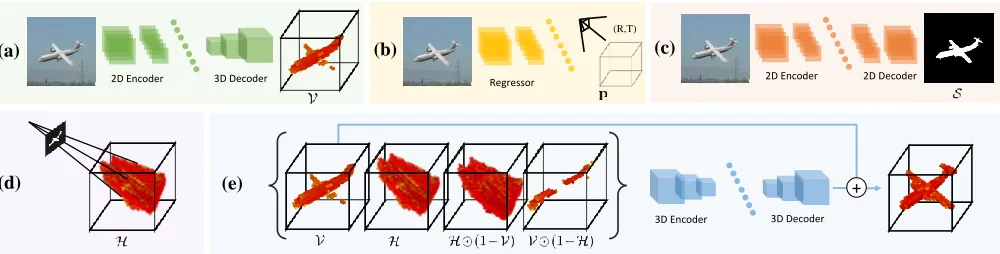
V-Net:The V-Net for voxel occupancy prediction consists of a 2D encoder and a 3D decoder, as depicted in Fig. 3 (a). It is adapted from the network structure of (Choy et al. 2016), and the main difference is we replaced their LSTM layer designed for multi-view reconstruction with a simple fully connected (FC) layer. We denote the 3D voxel occupation
probability map produced by the V-Net asV.
P-Net:The P-Net for pose estimation is a simple
regres-sor outputting 6-dimensional pose vector denoted as p, as
shown in Fig. 3 (b). We construct the P-Net structure sim-ply by appending two FC layers to the encoder structure of V-Net, one with 512 neurons and the other with 6 neu-rons. Since the geometric variation among different object categories is huge and the viewpoint-appearance relation-ships significantly differ, we follow previous works (Su et al. 2015; Massa, Marlet, and Aubry 2016) to use category-specific final FC layers for multiple object categories.
S-Net: The S-Net for object segmentation has a 2D encoder-decoder structure, as shown in Fig. 3 (c). We use the same encoder structure of V-Net for S-Net encoder, and apply a mirrored decoder structure consisting of deconv and uppooling layers. The S-Net generates an object probability
map of 2D pixels, which we denote asS.
PSVH Layer for Probabilistic Visual Hull
Given the estimated posepand the object probability map
Son the image plane, we construct inside of our neural
net-work a Probabilistic Single-view Visual Hull (PSVH) in the 3D voxel grid. To achieve this, we project each voxel
loca-tionXonto the image plane by the perspective
transforma-tion in Eq. 1 to obtain its corresponding pixelx. Then we
assignH(X) =S(x), whereHdenotes the generated
prob-abilistic visual hull. This process is illustrated in Fig. 3 (d). The PSVH layer is differentiable, which means that the
gradients backpropagated toHcan be backpropagated toS
and pose P, hence further to S-Net and P-Net. The
gradi-ent ofHwith respect toS is easy to discern: we have built
correspondences from H toS and simply copied the
val-ues. Propagating gradients topis somewhat tricky.
Accord-ing to the chain rule, we have ∂∂lp = P
X
∂l ∂H(X)
∂H(X) ∂X
∂X
∂p
wherelis the network loss. Obtaining∂∂lpnecessitates
com-puting ∂H∂X(X),i.e., the spatial gradients ofH, which can be numerically computed by three convolution operations with
pre-defined kernels along X-, Y- and Z-axis respectively.∂∂Xp
can be derived analytically.
Refinement Network for Final Shape
With a coarse voxel occupancy probability V from V-Net
and the visual hull Hfrom the PSVH layer, we use a 3D
CNN to refine V and obtain a final prediction, denoted by
V+. We refer to this refinement CNN asR-Net. The basic
(R,T)
2D Encoder Regressor
2D Encoder 3D Decoder 2D Decoder
3D Decoder
+
3D Encoder
(a)
(d)
(b) (c)
(e)
Figure 3: Network structure illustration. Our network consists of (a) a coarse shape estimation subnet V-Net, (b) an object pose estimation subnet P-Net , (c) an object segmentation subnet, (d) a probabilistic single-view visual hull (PSVH) layer, and finally (e) a shape refinement network R-Net.
A straightforward way for R-Net to processV andHis
concatenatingV andHto form a 2-channel 3D voxel grid
as input then generating a newV as output. Nevertheless,
we have some domain knowledge on this specific problem. For example, if a voxel predicted as occupied falls out of the visual hull, it’s likely to be a false alarm; if the prediction does not have any occupied voxel in a viewing ray of the visual hull, some voxels may have been missed. This domain knowledge prompted us to design the R-Net in the following manners.
First, in addition toVandH, we feed into R-Net two more
occupancy probability maps:V (1− H)andH (1− V)
wheredenotes element-wise product. These two
probabil-ity maps characterize voxels inV but not inH, and voxels
inHbut not in V1, respectively. Second, we add a
resid-ual connection between the input voxel predictionVand the
output of the last layer. This way, we guide R-Net to
gen-erate an effectiveshape deformationto refineV rather than
directly predicting a newV, as the predictedVfrom V-Net
is often mostly reasonable (as found in our experiments).
Network Training
We now present our training strategies, including the train-ing pipeline for the sub-networks and their traintrain-ing losses.
Training pipeline. We employ a three-step network train-ing algorithm to train the proposed network. Specifically, we first train V-Net, S-Net and R-Net separately, with in-put training images and their ground-truth shapes, silhou-ettes and poses. After V-Net converges, we train R-Net in-dependently, with the predicted voxel occupancy probability
Vfrom V-Net and the ground-truth visual hull, which is
con-structed by ground-truth silhouettes and poses via the PSVH layer. The goal is to let R-Net learn how to refine coarse shape predictions with ideal, error-free visual hulls. In the last stage, we finetune the whole network, granting the sub-nets more opportunity to cooperate accordingly. Notably, the R-Net will adapt to input visual hulls that are subject to es-timation error from S-Net and P-Net.
1
A better alternative forH (1− V)would be constructing another visual hull usingVandpthen compute its difference from
H. We chooseH (1− V)here for simplicity.
Training loss. We use the binary cross-entropy loss to train
V-Net, S-Net and R-Net. Concretely, letpnbe the estimated
probability at locationnin eitherV,SorV+, then the loss
is defined as
l=−1 N
X
n
p∗nlogpn+ (1−p∗n)log(1−pn)
(2)
wherep∗nis the target probability (0 or 1).ntraverses over
the 3D voxels for V-Net and R-Net, and over 2D pixels
for S-Net. The P-Net produces a 6-D pose estimate p =
[θ1, θ2, θ3, tu, tv, tZ]Tas described before. We use the L1
regression loss to train the network:
l= X
i=1,2,3
α|θi−θ∗i| + X
j=u,v
β|tj−t∗j| +γ|tZ−t∗Z|, (3)
where we setα= 1,γ = 1andβ = 0.01, the Euler angles
are normalized into[0,1]. We found in our experiments the
L1loss produces better results than anL2loss.
Experiments
Implementation details. Our network is implemented in
TensorFlow. The input image size is128×128and the
out-put voxel grid size is32×32×32. Batch size of 24 and the
ADAM solver are used throughout the training. We use a
learning rate of1e−4for S-Net, V-Net and R-Net and divide
it by 10 at the 20K-th and 60K-th iterations. The learning
rate for P-Net is1e−5and is dropped by 10 at the 60K-th
iteration. When finetuning all the subnets together the
learn-ing rate is1e−5and dropped by 10 at the 20K-th iteration.
Training and testing data. In this paper, we test our method
on four common object categories:carandairplaneas the
representative vehicle objects, andchairandcouchas
Input
Image SilhouetteEstimated VisualHull CoarseShape Refined Shape ShapeGT
Input Image
Estimated Silhouette
Visual Hull
Coarse Shape
Refined Shape
GT Shape
IoU 0.955 IoU 0.157 IoU 0.682
IoU 0.951 IoU 0.401 IoU 0.674 IoU 0.964 IoU 0.422 IoU 0.650
IoU 0.979 IoU 0.275 IoU 0.654 IoU 0.959 IoU 0.398 IoU 0.610 IoU 0.978 IoU 0.362 IoU 0.718 IoU 0.975 IoU 0.694 IoU 0.837
IoU 0.906 IoU 0.119 IoU 0.508
Figure 4: Qualitative results on the test set of the rendered ShapeNet objects. The top two rows and bottom two rows show some results on images with a clean background and real-image background, respectively. The color of the voxels indicates the predicted probability (red/yellow for high/low probability). While the coarse shapes may miss some shape details or be inconsistent with the image, our final shapes refined with single-view visual hulls are of high fidelity.
Table 1: The performance (shape IoU) of our method on the
test set of the rendered ShapeNet objects.Hdenotes visual
hull and GT indicates ground truth.
car airplane chair couch Mean Before Refine. 0.819 0.537 0.499 0.667 0.631 After Refine. 0.839 0.631 0.552 0.698 0.680 Refine. w/oH 0.824 0.541 0.505 0.675 0.636 Refine. w. GTH 0.869 0.701 0.592 0.741 0.726 Refine. w/o 2 prob.maps 0.840 0.610 0.549 0.701 0.675 Refine. w/o end-to-end 0.822 0.593 0.542 0.677 0.658
Results on Rendered ShapeNet Objects
The numbers of 3D models for the four categories are 7,496 for car, 4,045 for airplane, 6,778 for chair and 3,173 for ta-ble, respectively. In the rendering process of (Choy et al. 2016), the objects were normalized to fit in a radius-0.5 sphere, rotated with random azimuth and elevation angles, and placed in front of a 50-degree FOV camera. Each object has 24 images rendered with random poses and lighting.
Following (Choy et al. 2016), we use 80% of the 3D mod-els for training and the rest 20% for testing. We train one network for all the four shape categories until the network converge. The rendered images are with clean background (uniform colors). During training, we blend half of the train-ing images with random crops of natural images from the SUN database (Xiao et al. 2010). We binarize the output
voxel probability with threshold0.4and report
Intersection-over-Union (IoU).
Quantitative results. The performance of our method eval-uated by IoU is shown in Table 1. It shows that the results
after refinement (i.e., our final results) are significantly
bet-ter, especially for airplane and chair where the IoUs are
im-Table 2: The performance (shape IoU) of our method and PointOutNet (Fan, Su, and Guibas 2017).
car airplane chair couch Mean (Fan, Su, and Guibas 2017) 0.831 0.601 0.544 0.708 0.671
Ours 0.839 0.631 0.552 0.698 0.680
Table 3: The performance (shape IoU) of our method on the test set of the rendered ShapeNet objects with clean back-ground and backback-ground from natural image crops.
Background car airplane chair couch Mean
Clean 0.839 0.631 0.552 0.698 0.680
Image crop. 0.837 0.617 0.541 0.700 0.674
Table 4: The pose estimation and segmentation quality of our P-Net and S-Net on the rendered ShapeNet objects. Mean values are shown for each category.
car airplane chair couch Mean Rotation error 7.96◦ 4.72◦ 6.59◦ 10.41◦ 7.42◦ Translation error 3.33% 2.60% 3.26% 3.41% 3.15% Silhouette IoU 0.923 0.978 0.954 0.982 0.959
proved by about 16% and 10%, respectively. Note that since our V-Net is adapted from (Choy et al. 2016) as mentioned previously, the results before refinement can be viewed as the 3D-R2N2 method of (Choy et al. 2016) trained by us.
0 100 200 300 400 500 Object ID
0.4 0.6 0.8 1
IoU
car
Before refine. After refine.
0 50 100 150 200 250 Object ID
0 0.2 0.4 0.6 0.8 1
airplane
Before refine. After refine.
0 50 100 150 200 250 Object ID
0.2 0.4 0.6
0.8 chair
Before refine. After refine.
0 100 200 300
Object ID 0.2
0.4 0.6
0.8 couch
Before refine. After refine.
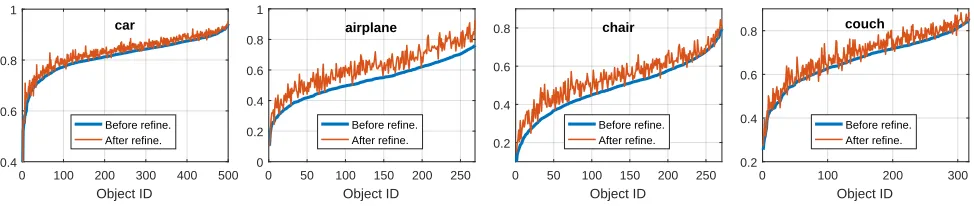
Figure 5: Comparison of the results before and after refinement on rendered ShapeNet objects.
uniformly sampled and sorted by the IoUs of coarse shapes. The efficacy of our refinement scheme can be clearly seen. It consistently benefits the shape reconstruction for most of the objects, despite none of them is seen before.
We further compare the numerical results with PointOut-Net (Fan, Su, and Guibas 2017) which was also evaluated on this rendered dataset and used the same training/testing lists as ours. Table 1 shows that our method outperformed it on the three of the four categories (car, airplane and chair) and obtained a higher mean IoU over the four categories. Note that the results of (Fan, Su, and Guibas 2017) were ob-tained by first generating point clouds using their PointOut-Net, then converting them to volumetric shapes and applying another 3D CNN to refine them.
Table 3 compares the results of our method on test images with clean background and those blended with random real images. It shows that with random real image as background the results are only slightly worse. Table 4 shows the quality of the pose and silhouette estimated by P-Net and S-Net.
Qualitative results. Figure 4 presents some visual results from our method. It can be observed that some object
com-ponents especially thin structures (e.g. the chair legs in the
second and fifth rows) are missed in the coarse shapes. Moreover, we find that although some coarse shapes appear
quite realistic (e.g. the airplanes in the left column), they are
clearly inconsistent with the input images. By leveraging the single-view visual hull for refinement, many shape details can be recovered in our final results, and they appear much more consistent with the input images.
We also compare our results qualitatively with Marr-Net (Wu et al. 2017), another state-of-the-art single-view
3D object reconstruction method2. The authors released a
MarrNet model trained solely on the chair category of the ShapeNet objects. Figure 6 presents the results on four chair images, where the first/last two are relatively good results from MarrNet/our method cherry-picked among 100 objects on our test set. It can be seen that in both cases, our method generated better results than MarrNet. Our predicted shapes are more complete and consistent with the input images.
Input Image
MarrNet 1stview
Ours 1stview
GT 1stview
MarrNet 2ndview
Ours 2ndview
GT 2ndview
Figure 6: Result comparison with the MarrNet method on ShapeNet chairs (our testing split). Top two rows: cherry-picked results of MarrNet, compared against our results. Bottom two rows: cherry-picked results of our method, com-pared against MarrNet results.
Table 5: The performance (shape IoU) of our method on the test set of the PASCAL 3D+ dataset.
car airplane chair couch Mean Before Refine. 0.625 0.647 0.341 0.633 0.552 After Refine. 0.653 0.690 0.341 0.664 0.587
Table 6: The pose estimation and segmentation quality of P-Net and S-Net on PASCAL 3D+. Median values are re-ported. Note that the pseudo ground-truth poses and silhou-ettes used for evaluation are noisy.
car airplane chair couch Rotation error 39.4◦ 25.5◦ 43.6◦ 34.0◦ Translation error 8.6% 4.4% 12.7% 12.5% Silhouette IoU 0.757 0.614 0.457 0.696
Results on the Pascal 3D+ Dataset
We now evaluate our method on real images from the PAS-CAL 3D+ dataset (Xiang, Mottaghi, and Savarese 2014).
Marr-This dataset only have pseudo ground-truth shapes for real images, which makes it very challenging for our visual hull based refinement scheme. Moreover, the provided object poses are noisy due to the lack of accurate 3D shapes, mak-ing it difficult to train our pose network.
To test our method on this dataset, we finetune our net-work trained on ShapeNet objects on images in PASCAL
3D+. We simply set the focal length to be2000for all
im-ages since no focal length is provided. With this fixed focal length, we recomputed the object distances using the image keypoint annotations and the CAD models through reprojec-tion error minimizareprojec-tion.
Quantitative results. The quantitative results of our method are presented in Table 5 and Table 6. As can be seen in Ta-ble 6, the pose and silhouette estimation errors are much higher than the results on the ShapeNet objects. Neverthe-less, Table 5 shows that our visual hull based refinement scheme still largely improved the coarse shape from V-Net for the car, airplane and couch categories. Note again that our V-Net is almost identical to the network in the 3D-R2N2 method (Choy et al. 2016). The refinement only yields marginal IoU increase for the chair category. We observed that the chair category on this dataset contains large intra-class shape variations (yet only 10 CAD shapes as pseudo ground truth) and many instances with occlusion; see the
suppl. materialfor more details.
Qualitative results. Figure 7 shows some visual results of our method on the test data. It can be seen that the coarse shapes are noisy or contain erroneous components. For ex-ample, possibly due to the low input image quality, the coarse shape prediction of the car image in the second row of the left column has a mixed car and chair structure. Never-theless, the final results after the refinement are much better. Figure 1 shows some results from both our method and MarrNet (Wu et al. 2017). Visually inspected, our method produces better reconstruction results again.
More Ablation Study and Performance Analysis
Performance of refinement without visual hull. In this ex-periment, we remove the probabilistic visual hull and train R-Net to directly process the coarse shape. As shown in Ta-ble 1, the results are slightly better than the coarse shapes, but lag far behind the results refined with visual hull.
Performance of refinement with GT visual hull. We also trained R-Net with visual hulls constructed by ground-truth poses and silhouettes. Table 1 shows that the performance is dramatically increased: the shape IoU is increased by up to 30% from the coarse shape for the four object categories. The above two experiments indicate that our R-Net not only leveraged the visual hull to refine shape, but also can work remarkably well if given a quality visual hull.
Effect of two additional occupancy probability mapsV
(1− H)andH (1− V). The results in Table 1 shows
that, if these two additional maps are removed from the input
Net directly predicts the shapes in the current camera view which are not aligned with GT shapes; moreover, the training and testing splits for MarrNet are not disclosed in Wu et al. (2017)
IoU 0.738 IoU 0.710 IoU 0.724 IoU 0417 IoU 0.373 IoU 0.645 IoU 0.808 IoU 0.555 IoU 0.899 IoU 0.533 IoU 0.739 IoU 0.902
Input Image
Estimated Silhouette
Visual Hull
Coarse Shape
Refined Shape
Pseudo GT
Figure 7: Qualitative results on the test set of PASCAL 3D+
of R-Net, the mean IoU drops slightly from 0.680 to 0.675, indicating our explicit knowledge embedding helps.
Effect of end-to-end training. Table 1 also presents the result without end-to-end training. The clear performance drop demonstrates the necessity of our end-to-end finetun-ing which grants the subnets the opportunity to better adapt to each other (notably, R-Net will adapt to input visual hulls that are subject to estimation error from S-Net and P-Net).
Running Time
For a batch of 24 input images, the forward pass of our whole network takes 0.44 seconds on an NVIDIA Tesla M40
GPU, i.e., our network processes one image with 18
mil-liseconds on average.
Conclusions
We have presented a novel framework for single-view 3D object reconstruction, where we embed the perspective ge-ometry into a deep neural network to solve the challenging problem. Our key innovations include an in-network visual hull construction scheme which connects the 2D space and pose space to the 3D space, and a refinement 3D CNN which learns shape refinement with visual hulls. The experiments demonstrate that our method achieves very promising results on both synthetic data and real images.
Limitations and future work. Since our method involves pose estimation, objects with ambiguous pose (symmetric shapes) or even do not have a well-defined pose system (ir-regular shapes) will be challenging. For the former cases, using a classification loss to train the pose network would be a good remedy (Su et al. 2015), although this may render the gradient backpropagation problematic. For the latter, one possible solution is resorting to multi-view inputs and train
Acknowledgement
This research is supported by a Natural Science Foundation of China(NSFC) grant No.61876020 and No.61472038.
References
Chang, A. X.; Funkhouser, T.; Guibas, L.; Hanrahan, P.; Huang, Q.; Li, Z.; Savarese, S.; Savva, M.; Song, S.; Su, H.; Xiao, J.; Yi, L.; and Yu, F. 2015. ShapeNet: An
information-rich 3D model repository. arXiv:1512.03012.
Choy, C. B.; Xu, D.; Gwak, J.; Chen, K.; and Savarese, S. 2016. 3D-R2N2: A unified approach for single and
multi-view 3D object reconstruction. InECCV, 628–644.
Fan, H.; Su, H.; and Guibas, L. 2017. A point set generation network for 3d object reconstruction from a single image. In
CVPR, 605–613.
Girdhar, R.; Fouhey, D. F.; Rodriguez, M.; and Gupta, A. 2016. Learning a predictable and generative vector
repre-sentation for objects. InECCV, 484–499.
Goodfellow, I.; Pouget-Abadie, J.; Mirza, M.; Xu, B.; Warde-Farley, D.; Ozair, S.; Courville, A.; and Bengio, Y.
2014. Generative adversarial nets. InAdvances in Neural
Information Processing Systems (NIPS), 2672–2680. Gwak, J.; Choy, C. B.; Garg, A.; Chandraker, M.; and Savarese, S. 2017. Weakly supervised generative adversarial
networks for 3D reconstruction.arXiv:1705.10904.
H¨ane, C.; Tulsiani, S.; and Malik, J. 2017. Hierarchical
sur-face prediction for 3d object reconstruction. InInternational
Conference on 3D Vision (3DV).
Ji, M.; Gall, J.; Zheng, H.; Liu, Y.; and Fang, L. 2017.
SurfaceNet: an end-to-end 3d neural network for multiview
stereopsis. InICCV, 2307–2315.
Kar, A.; Tulsiani, S.; Carreira, J.; and Malik, J. 2015.
Category-specific object reconstruction from a single image.
InCVPR, 1966–1974.
Kar, A.; H¨ane, C.; and Malik, J. 2017. Learning a multi-view
stereo machine. InNIPS, 364–375.
Kingma, D. P., and Welling, M. 2013. Auto-encoding
vari-ational bayes. arXiv:1312.6114.
Liang, W.; Zhao, Y.; Zhu, Y.; and Zhu, S.-C. 2016. What is where: Inferring containment relations from videos. In
IJCAI.
Massa, F.; Marlet, R.; and Aubry, M. 2016. Crafting a
multi-task cnn for viewpoint estimation. The British Machine
Vi-sion Conference (BMVC).
Qi, C. R.; Su, H.; Mo, K.; and Guibas, L. J. 2017. Pointnet: Deep learning on point sets for 3d classification and
segmen-tation. InCVPR, 652–659.
Richter, S. R., and Roth, S. 2018. Matryoshka networks:
Predicting 3d geometry via nested shape layers. CoRR
abs/1804.10975.
Sharma, A.; Grau, O.; and Fritz, M. 2016. VConv-DAE: Deep volumetric shape learning without object labels. In
European Conference on Computer Vision Workshop on Ge-ometry Meets Deep Learning, 236–250.
Su, H.; Qi, C. R.; Li, Y.; and Guibas, L. J. 2015. Render for CNN: Viewpoint estimation in images using cnns trained
with rendered 3D model views. InICCV, 2686–2694.
Sun, M.; Kumar, S. S.; Bradski, G.; and Savarese, S. 2013. Object detection, shape recovery, and 3d modelling by
depth-encoded hough voting. Computer Vision and Image
Understanding (CVIU)117(9):1190–1202.
Tatarchenko, M.; Dosovitskiy, A.; and Brox, T. 2017. Oc-tree generating networks: Efficient convolutional
architec-tures for high-resolution 3d outputs. InICCV, 2088–2096.
Tulsiani, S.; Kar, A.; Carreira, J.; and Malik, J. 2017a.
Learning category-specific deformable 3d models for object
reconstruction. IEEE Transactions on Pattern Analysis and
Machine Intelligence (TPAMI)39(4):719–731.
Tulsiani, S.; Zhou, T.; Efros, A. A.; and Malik, J. 2017b. Multi-view supervision for single-view reconstruction via
differentiable ray consistency. InCVPR, 2626–2633.
Tulsiani, S.; Efros, A. A.; and Malik, J. 2018.
Multi-view consistency as supervisory signal for learning shape
and pose prediction. InCVPR, 2897–2905.
Vicente, S.; Carreira, J.; Agapito, L.; and Batista, J. 2014.
Reconstructing pascal voc. InCVPR, 41–48.
Wang, H.; Liang, W.; and Yu, L. F. 2017. Transferring
ob-jects: Joint inference of container and human pose. InIEEE
International Conference on Computer Vision, 2952–2960. Wu, Z.; Song, S.; Khosla, A.; Yu, F.; Zhang, L.; Tang, X.; and Xiao, J. 2015. 3D ShapeNets: A deep representation for
volumetric shapes. InCVPR, 1912–1920.
Wu, J.; Zhang, C.; Xue, T.; Freeman, B.; and Tenenbaum, J. 2016. Learning a probabilistic latent space of object shapes
via 3D generative-adversarial modeling. InNIPS, 82–90.
Wu, J.; Wang, Y.; Xue, T.; Sun, X.; Freeman, W. T.; and Tenenbaum, J. B. 2017. MarrNet: 3d shape reconstruction
via 2.5D sketches. InNIPS, 540–550.
Xiang, Y.; Mottaghi, R.; and Savarese, S. 2014. Beyond pascal: A benchmark for 3d object detection in the wild. In
IEEE Winter Conference on Applications of Computer Vi-sion (WACV), 75–82.
Xiao, J.; Hays, J.; Ehinger, K. A.; Oliva, A.; and Torralba, A. 2010. Sun database: Large-scale scene recognition from
abbey to zoo. InCVPR, 3485–3492.
Yan, X.; Yang, J.; Yumer, E.; Guo, Y.; and Lee, H. 2016. Perspective transformer nets: Learning single-view 3D
ob-ject reconstruction without 3D supervision. InNIPS, 1696–
1704.
Zhu, R.; Galoogahi, H. K.; Wang, C.; and Lucey, S. 2017. Rethinking reprojection: Closing the loop for pose-aware
shape reconstruction from a single image. InICCV, 57–64.
Zhu, Y.; Zhao, Y.; and Zhu, S. C. 2015. Understanding tools: Task-oriented object modeling, learning and recognition. In
Computer Vision and Pattern Recognition, 2855–2864. Zou, C.; Yumer, E.; Yang, J.; Ceylan, D.; and Hoiem, D. 2017. 3D-PRNN: generating shape primitives with recurrent