http://dx.doi.org/10.22161/ijeab/2.1.62 ISSN: 2456-1878
Seeds Potentialities of Medicks in Sub-Humid
Area
to be used in Steppe Zone
Alane F
2, R.Chabaca
1, Abdelguerfi-Laouar.M
3,
Abdelguerfi A
11,3National Superior School of Agronomy El Harrach, Algeria
2 National Agronomy Research Institute of Nari Baraki, Algeria
Abstract—New pulse crops varieties more productive as medics should be made available to breeders located in semi-arid region of Algeria. So, and through two years of testing, pods yield and seeds production of twenty populations belonging to species M.intertexta , M.ciliaris, M.polymorpha , M.Truncatula and an introduced population M.muricoleptis is an Australian cultivar (Jemalong) are appreciated.Pods’ yields of year 2013 vary between 78,66g/m² with poly27 and
3637,33g/m² with I107. Values of the second essay (2015)
are different, they vary between 40,89g /m² with Poly236 and 464,36 g/m² with I11.The cultivar Jemalong offers a
yield of 172,4 g/m². The corresponding seed yields also show a low production in year 2015. The ratio leaf / stem varies between 1,03 and 5. The average of yields in dry matter of 27 populations in 2013 was of 457,79g/m2
against 127,41 g/m² in 18 populations in 2015. Jemalong cultivar records a yield of 12,8g/m². For the same dose of seed, number of plants by square meter varies between 44 and 112. Number of stems by square meter varies between 136 in C204 and 420 in I52..The average width of
population’s ramifications varies between 13cm in Tr334
and 44 cm in I52, The Jemalong cultivar offers an average
of 17cm. So, production results of medicks depend of weather conditions in littoral zone of lower altitude than 600-700m. In steppe zones, we recommend to make tests in situ with these same populations.
Keywords— Medicago, medicKs, populations, pods, yield in seed.
I. INTRODUCTION
Husbandry of ruminants is mainly located in arid regions of Algeria, in about 1/5 of the total area. This important availability of agricultural land requires fodder production In fact, fodder grown is one of the solutions considered, pass through intensification of fodder production, per unit of area, not only in quantitative terms (kg of fodder produced by m2) but also in qualitative terms with a net improvement of nutritional quality. New pulse crops varieties more productive and with better nutritional value should be available to the breeders. Much appreciated by livestock, as well in green as in dry, pulse crops are richer in nutrients mainly in digestible nitrogenous matter, in
vitamins and in mineral (2,5 kg of alfalfa hay represents 1 UF) (Bouaboub -Mousab., 2012). M. truncatula is a potential grazing cultivation that products high fodder level of good quality. A study carried out in South-East of Wyoming during 3 years, on three cultivars of M truncatula which are Calife, Mogul et Paraggio,
revealed that average yield in dry matter was respectively of 1.6, 3.1 et 4.0 t /ha (Babita., 2008).
The first researchers’ objectives have been to study kinds of Medicago, Trifolium, Scorpiurus, Hedysarum and Onobrychis (Abdelguerfi., 2000), They showed a positive correlation between bio geographical parameters, particularly altitutde and rainfall, and biological aspects linked to the growth and reproduction – flowering – inflorescences, pods and seeds. The 2/3 of Medicago’s genus species (they are gathered under the term of medicKs). Originating of Mediterranean zone, are particularly adapted to drought conditions: Australia, Chile, California…Piano et Talamucci, 1996). Thanks to accumulation of dry grains, MedicKs’ meadow regenerates between two cereal crops even after several years. This system is applied in various dry cereal areas: Maghreb, Middle East, Spain… (SAREP. 2013).
Diversification of steppe pastures by a combination of medicKs ‘species allows increasing a chance to succeed in their plantation. If one of the cultures dies due to the drought or to the pests, another culture can allow saving the pasture. This allows to put in place pastures more sustainable and increasing soil security. In a well drained soil, sprigs of medicKs can contribute to increase soil organic matter. So, by improving soil health, pulses also help to biodiversity of micro-organisms present into the soil. They can biologically fix more than 350 kg of nitrogen by hectare and by year (FAO., 2015).
http://dx.doi.org/10.22161/ijeab/2.1.62 ISSN: 2456-1878
drought tolerant, roots can enter 5 feet (1.524m) in depth to maintain soil in place and value drops of water (SAREP, 2013). Much constraint prevents annual alfalfa extension, local or introduced in Algeria.
However, we have been interested through two testing years in pods yield and to seeds production of about 20 populations belonging to species of M.intertexta M.ciliaris, M.polymorpha , M.Truncatula and a population introduced belonging to M.muricoleptis and so an Australian cultivar (Jemalong).At the same time, we have tried to approach determining parameters of this production which is: (i) green and dry matter (ii) width of ramifications (iii) weight of 50 pods and their seed (iiii) and number of stems by square meter. These data are thus, very interesting because during dry period, from June to October, pods constitute an available food for animals.
II. MATERIAL AND METHODS
The first trial is set on 13/12/2012 and the second on 24/12/2014 at the experimental farm of National Superior School of Agronomy, located in Algiers City.This station is at 30° 8’ of longitude and latitude of 36°43' north and altitude of 48m.The previous cultural element of the first essay was corn, and for the second one was a fallow. The essay is a full random block with three repetitions. In each block, we have 20 populations for the first essay and 22
populations for the second one, represented each one by four lines of 1 meter with interval of 60cm with 80 grains by population and by line. Every block is spaced from other of 1.50m for the first essay and of 60cm for the second one.
The chemical-physics analysis of the soil was carried out on samples harvested on the plot before seeding, at depths of 20cm and 40cm. At the first essay the texture is silty (soils texture triangle), the soil is rich in calcium and low in nitrogen and organic matters, potassium and sodium. As for the second essay, texture is silty-clayey, low in nitrogen and in organic matter, a pH>7,23 (analysis carried out in Department of Soil Science of ENSA in 2013 and 2015.
Climatic conditions of the experiment period of the first essay 2013 gave a monthly temperature, the highest in May, with an average of 17.8°c with maximal of 23°c. The coldest month was February with an average of 11.5°c. The coldest day recorded 5.9°c. The highest rainfall amount recorded was of 137cm in three days. As for year 2015, the most rainy month was January with 98,9 mm and the hottest month was August with an average of 38.4°c. The maximum and minimum of temperature was also recorded in August with 39°c and 1.2°c (The agro-meteorology of ENSA, 2013 and 2015).The plant material used which comes from collection of the school is shown in table 1.
Table.1: Code and origins of the populations studied and the average weight of 1000 seeds
Softwares used for statistical analysis are: Stat View and Statistica.
III. RESULTS AND DISCUSSION
Yields in dry matter of population vary between 1132,1g/m² in I52 and 38,85 g/m² in Tr221 en 2013 while in 2015 they vary between 453,33g/m² in I31 and 12,56g/m² in S15. The average of 20 populations in 2013 is of 457,79 g/m² against 127,41g/m² in 18 populations in2015. Jemalong cultivar records a yield of 12,8g/m2. In
region of Tunisia yields in gram by square meter of dry matter (DM) of M.polymorpha vary from 84 to 530,
M.truncatula varies from 31 to 450 while Jemalong CV witness varies from 0 to 340. The average of six species of annual alfalfa varies from 102 g/m² to 483g/m² (Seklani et Hassen., 1990 in Seklani et al., 1996.).
Species Populations’ code
Weight of 1000
grains Origins
M.truncatula
M .intertexta
M.ciliaris
M .polymorpha
M.muricoleptis
M.truncatula CV
Jemalong
Tr201,Tr407 Tr238 Tr 334
I756 I107 I4O7 I11 I31 I52
S3 C2 C204 S5 S15 S7 C11 C58
poly 27 Poly 205
Aus106
CV
3,58g
15,77g
13,21g
3,24g
6,26g
3,9 g.
Algeria (2004)
Algeria (2004)
Algeria (2004)
Algeria (2004)
Turkey (2004)
http://dx.doi.org/10.22161/ijeab/2.1.62 ISSN: 2456-1878
En Alaska, yields of 339 to 384 g/m² of DM have been obtained in average on two doses of fertilizer N, 0 and 90 kg /ha, on a neutral ground (Panciera et Sparrow., 1995). The average of ramifications width of populations varies between 13cm in Tr 334 and 44cm in I52 Jemalong cultivar gives an average of 17cm. Number of stems by square meter varies between 136 chez C204 and 420 chez I52. Number of plants by square meter varies between 112 to 44; cultivar Jemalong gives a number of 48 (Tab. 2). Generally, it is well known that leaves-stems ratio is a good indicator of the forage quality and offers a potential for cultivars selection, this last one varies at the beginning of flowering in 2015 between 5 in population of S5 and 1.03 in population of Tr334. In M.truncatula, it varies of 1.03 in Tr334 and 2,81 in Tr238 while in Jemalong cultivar species, it gives a ratio close of the latter (2,8) (Tab.2) while in 2013, it varies between 0,5 in Poly205 and 2,91 in Tr407. Porquiddu (2001) records lower values in
M.polymorpha cv. Cercle Valley that M truncatula. cv. Chypre et M. Tornata cv. Dornafield with respectively 0.97, 0.80 and 0,76. A decrease of this ratio is observed during pods and grains formation probably linked to their high demand for products of photosynthesis with presence
of species interaction x age Derkaoui et al., 1990). The percentage of viable plants at early flowering stage varies in 2013 between 37,08% in Tr334 and 19,16% in Tr55. Average between species varies between 24.06% in
M.polymorpha and between 29.32% in M.intertexta. In 2015 this same parameter (Tab.2) varies between 0% in
M.polymorpha and most of M.truncatula reaches 35% in
M.intertexta, Jemalong cultivar offers a viability of 15%. We can say that both species (M.truncatula , M.intertexta)
are more resistant to abiotic stress than other both species
(M.plymorpha, M.truncatula) probably due to the grains size.
The Fisher’s test offers homogeneous groups for biometrical parameters of forage production (Tab.2). By contrast, for production of pods, no group is formed. The growing cycle parameter of the plan offers seven groups which overlap, except for populations Tr27 and I52 where there is not overlapping. As for matter, green, dry and width of ramifications, population I52 is individualized from other groups. The LS ratio in dry, forms with population S5 the homogeneous group a and population I52 and Tr334 form another group d which did not overlap with other.
Table.2: Average of biometrical parameters studied for production of dry matter in MedicKs populations studied.
Populations Cycle in
days
Number of plants
by m²
Number stems by
m²
Width in cm
MV g/m²
MS
g/m² F/T Sec
Perc of viability
S5 110fg 70,67abc 209,33 abc 18ef 160efg
53,79
def 4,5a 22,08
S15 110g 66bc 154 c 13,5ef 91,2efg
12,56
def 2,43bcd 20,625
C2 114efg 100bc 244 bc 19,5ef 129,613
27,253
def 4,02bcd 31,25
S7 115efg 64bc 260 abc 22,25ef
205,46 efg
37,06
def 3,16bcd 20
S3 116def 44bc 156 bc 20ef 80efg 320def 5b 13,75
C11 116def 64abc 276 bc 18ef 244,4efg
47,68
def 3,21bc 20
C204 116def 56abc 136 bc 23ef 158,04 efg 33def 3,64bcd 17,5
C58 120,33cd 54,67bc 189,33 bc 20,33def
252,87 Defg
91,567
cde 2,33bcd 18,125
CV 118de 48c 116 c 17ef 78,96 12,8
def 2,8cd 15
Tr238 117de 76ac 312 abc 18,5ef
256,54 efg
74,06
def 2,81bcd 23,75
Tr334 128 ,33ab 70,67bc 209,33 bc 13f 80fg 51,72f 1,03d 18,125
Tr27 130a 28bc 172 c 19ef 140efg 36bef 1,28cd 18,500
I253 124bc 112a- 420 a 38,33abc 1072abc 196ab 2,07bcd 35
I756 124,67bc 94,67ab- 353,33 ab 36abcd
749,33 abcd
141,33
abc 1,94bcd 23,88
http://dx.doi.org/10.22161/ijeab/2.1.62 ISSN: 2456-1878
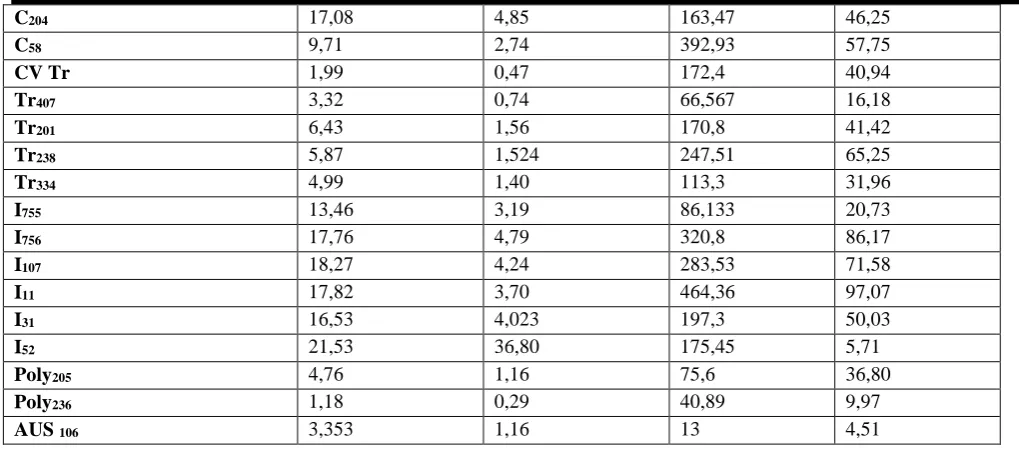
Our yields pods in littoral region in 2013 vary between 79.88g/m2 in poly27 and 3637.33g/m2 in I107 (Alane et al., 2014). Values of the second essay (2015) are different, they vary between 40,89g /m² in Poly236 and 464,36 g/m² in I11. The cultivar Jemalong offers a yield of 172.4g/m2, if we compare it to local species of M.truncatula, population Tr238, it gives a higher yield of 247,51 g/m² (Tableau 3) while yield of pods obtained by l’ITGC in 1977in sub-littoral zone was of 10g/m2. The results comparison of both experiment years show a different yield: for instance year 2013, yield of both quoted populations (Aus106 944g/m², I11 2428, 444g/m²) is superior to that of year 2015 (AUS 10613g/m², I11464, 36 g/m²). Furthermore, some populations as Poly27 have not germinated. This result may be explained by difference of weather conditions between both years of experiments. Soil of the first essay is well fertilized having experienced several essays on medicKs, thus well provided in rhizobium, unlike to soil of the second essay which was a fallow during several years. In addition, climatic data of the first essay record an abundant rainfall compared to that of the second test.
Yields in seeds corresponding to performances in pods produced (g/m²), also show for the same reasons, a low production in 2015 compared to 2013. Since they vary in 2013 between 21,533 g/m² in Poly27 and 900,375g/m² in I107 while introduced population Aus106 gives a yield of 359,077 g/m² (Alane et al., 2014). In 2015 the essay gives in seeds yield which varies between 425, 67g/m² in S7 and of 5,71g/m² in I52 (Table.3). According to Laouar et al
(2000)M .ciliaris is earlier and products more plant/pods but with a low number of pod/grains, contrary to M intertexta.
However, according to results of our essays, we confirm precociousness of M.ciliaris’s populations (Fig.1), but for production of seed, yield of M.intertexta depends of annual weather conditions since in 2013, average yield of M.intertexa exceeds that of M.ciliaris (S :354,602g/m², I :821,997g/m²) while in 2015 the contrary occurred (S: 106,20575g/m², I : 55,215 g/m²).Jemalong cultivar gives a yield of 40,936g/m². This also has been observed in clover by Clark (2014) who noticed that cycle of clover varies from 100 to 126 days after seeding depending of the place, and of timing of sowing, and so of cultivars used. The introduced population in our essay Aus106 gives the lowest yield 4,51g/m² (Table 3).
For information purpose, populations with early flowering have trend to belong to drier habitats and the hottest, and numerous authors found similar results in several other annual pulses (Graziano et al, 2010).
Furthermore, population’s origin influences directly on weight of 1000 grains where itself influences on yield. In effect, populations which come from areas with more annual rainfalls had more small pods and grains at upper sizes than of dry environments (Graziano et al., 2010).
These results are confirmed by Del Pozo et al (2002)
who affirm that sizes of grains and pods have an adaptive value. Nevertheless, the grains performance may be reduced through over-grazing, freeze, and drought. (Muir et al., 2005). Since 70% of feedings have been insured by pods of MedicKs, proportion decreased rapidly to zero when green material becomes available after rain
(Porqueddu., 2001). Much of leguminous fodder species are depending to permanent grassland (Duc et al., 2010).
Weight of grains constitutes a compensation mechanism to support grain yield under impact of the drought (Yousfi et al., 2012).
Table.3: Average of biometrical parameters studied for production of pods and seed in medics’ populations studied.
Populations Weight of 50 pods Weight of seed of
50 pods
Yield in pods g/m²
Yield of seed g/m²
S5 12,1 3 2,98 254,8 63,72
S15 9,64 2,89 142,54 42,27
C2 13,64 3,38 345,8 87,01
S7 15,62 3,84 425,67 425,67
S3 13,28 3,58 245,9 66,29
C11 12,97 3,42 241,2 60,72
bc ab ab Ab
I11 126ab 86,67ab- 332 ab 27cde 41,5cdef 166 2,53bcd 27,083
I58 126,67ab 61,33bc 248 abc
29,67bcd e
530,67
bcde 117,33 1,55cd 19,167
I31
126,67
ab 74abc 290bc
28,33 abc
113,33 abc
453,33
ab 1,32cd 25
http://dx.doi.org/10.22161/ijeab/2.1.62 ISSN: 2456-1878
C204 17,08 4,85 163,47 46,25
C58 9,71 2,74 392,93 57,75
CV Tr 1,99 0,47 172,4 40,94
Tr407 3,32 0,74 66,567 16,18
Tr201 6,43 1,56 170,8 41,42
Tr238 5,87 1,524 247,51 65,25
Tr334 4,99 1,40 113,3 31,96
I755 13,46 3,19 86,133 20,73
I756 17,76 4,79 320,8 86,17
I107 18,27 4,24 283,53 71,58
I11 17,82 3,70 464,36 97,07
I31 16,53 4,023 197,3 50,03
I52 21,53 36,80 175,45 5,71
Poly205 4,76 1,16 75,6 36,80
Poly236 1,18 0,29 40,89 9,97
AUS 106 3,353 1,16 13 4,51
Variance analysis of dry matter production parameters, shows great significance (p<0, 0001) (Table 4). The correlation matrix of these parameters for a ddI of 48 is reported in table (5). Parameters’ variance analysis of pods yield and populations ‘seed studied also show a highly significant difference (p<0,0001) (Table 6). Correlation matrix of these parameters for ddI of 68 is reported in table (7).
Table.4: Univariate analysis of dry matter production parameters
Parameters Variance DDL Chi2 P 95%inf 95%sup Number of plant 47,930 56 2684,097 <0,0001 36,043 67,437 Number of stems 896,770 54 48425,602 <0,0001 671,150 1270,472
Width (cm) 123,931 55 6816,214 <0,0001 92,976 174,963 L/S (green) 49,077 56 2748,304 <0,0001 36,906 69,051
L/S(dry) 13,896 56 778,173 <0,0001 10,450 19,551 GMg/m² 177410,971 56 9935014,349 <0,0001 133412,622 249615,463 DMg/m² 6283,627 55 345599,462 <0,0001 4714,124 8871,072
Table.5: Correlation matix of dry matter production parameters
Number of plant
Number of stems
Width of ramifications
Rapport L/S(dry)
GM g/m²
DM g /m²
Number of plant 1
Number of stems 0,685*** 1
Width of ramifications
0,188 0,481*** 1
Rapport L/S(vert) 0,256 -0,139 -0, 314*
Rapport L/S(sec) 0,127 -0,167 -0,291* 1
GM g/m² 0,447*** 0,772*** 0,862*** -0,218 1
DM g /m² 0,401*** 0,687*** 0,788*** -0,177 0,934*** 1
Table.6: Univariate analysis of pods yield parameters
Parameters Variance DDL Chi2 p 95%inf 95%sup
Weight of 50 pods 680,096 69 46926,641 <0,0001 524,958 922,214
Seed of 50 pods 7,303 69 503,884 <0,0001 5,637 9,904
Weight of collected
http://dx.doi.org/10.22161/ijeab/2.1.62 ISSN: 2456-1878
Seed of collected pods 3778,920 69 260745,462 <0,0001 2916,903 5124,790
Yield of pods in g/m² 27789,048 69 191744,294 <0,0001 21450,032 37686,179
Yield of seed in g/m² 1754,650 69 121070,833 <0,0001 1354,393 2379,572
Table.7: Correlation matrix of dry matter production parameters
Weight of 50 pods
Seed of 50 pods Weight of collected pods Seed of collected pods
Yield of pods g/m²
Yield of seed g/m²
Weight of 50 pods 1
Seed of 50 pods 0,925*** 1
Weight of collected pods -0,091 0,085 1
Seed of collected pods 0,043 0,187 0,584*** 1
Yield of pods g/m²
0,203 0, 346** 0,749*** 0,535*** 1
Yield of seed g/m²
0,203 0,368*** 0,690*** 0,534*** 0,973*** 1
Number of homogeneous groups given by Fisher’s test for green matter production parameters at early flowering is shown in table (2). No homogeneous group is given for pods production parameters.
Projec tion des v ariables s ur le plan fac toriel ( 1 x 2)
Ac tiv e Nom de jours
Nombre de plants Nombre de tiges /m² largeur des ramific ations c m
MVg/m² MS g/m²
pds du rap en g
rap F/T en v ert rap F/T en s ec
-1,0 -0,5 0,0 0,5 1,0
Fac t. 1 : 47,87% -1,0 -0,5 0,0 0,5 1,0 F a c t. 2 : 2 1 ,2 6 %
Projec tion des ind. s ur le plan fac toriel ( 1 x 2) Obs erv ations av ec la s omme des c os inus c arrés >= 0,00
Ac tiv e S5 S15 C2 S7 S3 C11 C204 C58 CV Tr238 Tr334 Tr27 I253 I756 I107 I11 I58 I31 I52
-6 -5 -4 -3 -2 -1 0 1 2 3 4 5 6 7 Fac t. 1 : 47,87%
-6 -5 -4 -3 -2 -1 0 1 2 3 4 5 F a c t. 2 : 2 1 ,2 6 %
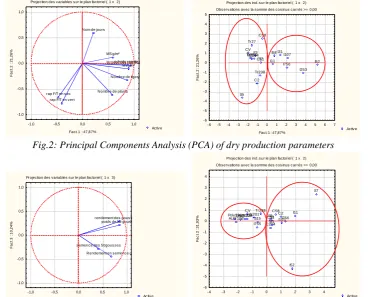
Fig.2: Principal Components Analysis (PCA) of dry production parameters
Projec tion des v ariables s ur le plan fac toriel ( 1 x 3)
Ac tiv e poids de 50 gous s es
s emenc e des 50gous s es rendement des gous s es g/m²
Rendement en s emenc e g/m²
-1,0 -0,5 0,0 0,5 1,0
Fac t. 1 : 52,49% -1,0 -0,5 0,0 0,5 1,0 F a c t. 3 : 1 0 ,2 4 %
Projec tion des ind. s ur le plan fac toriel ( 1 x 2) Obs erv ations av ec la s omme des c os inus c arrés >= 0,00
Ac tiv e S5 S15 C2 S7 S3 C11 C204 C58 CV Tr407 Tr201 Tr238 Tr334 I755 I756 I107 I11 I31 I52 Poly 205 Poly 236 AUS 106
-4 -3 -2 -1 0 1 2 3 4
Fac t. 1 : 52,49% -6 -5 -4 -3 -2 -1 0 1 2 3 4 F a c t. 2 : 3 1 ,9 3 %
Fig.3: Principal Components Analysis (PCA) of pods production parameters.
Principal Components Analysis (PCA) led us to the study of Kaiser Criterion, this one offers us for dry matter production parameters, three designs (1,2), (1,3), 2,3) and in elbow criterion, we observe an important fall from the first axis (of 47 ,87% to 8,96% of inertia). We retained the
http://dx.doi.org/10.22161/ijeab/2.1.62 ISSN: 2456-1878
ratio in green and dry, thus they are effectively well correlated with the two factors used for this design (F1 and F2), by contrast, dry matter (DM/m2) and cycle of the plant in day number are less near to the circle.
The first information axis, whereby is preserved by projection of maximum initial dispersion of points of the cloud. All variables occupy a fairly narrow zone inside of the correlations circle. Maximum angle between two variables is below 90°. This suggests that all variables are positively correlated between them. So, two large populations groups are formed, the first one based on parameters : GM, DM, width of ramifications, weight served to ratio determination, number of stems containing
M.intertexta (I31,I11,I107,I58,I756,I253,I52) the second group containing M.ciliaris and M.truncatula (S3,S5,cv,C204,
C11,Tr27, Tr 334, Tr238, C2,C58 ) are determined by
parameters ratio leaves/stems in green and in
For pods production, the Kaiser Criterion, led us to retain two axes and in elbow criterion, we observe an important fall from the first axis (de 52,49% to 10,24% of inertia). In the first design, all parameters are close of the circle, thus, they are effectively well correlated with both factors constituting this design (F1 and F2). The first factorial axis gives (52,49%+ 31,93%=84,42%), axis that is preserved , by projection of maximum initial dispersion of cloud points. All variables occupy a rather limited area inside of the correlations circle Maximum angle between two variables is below 90°. This suggests that all variables are positively correlated between. And so, two populations groups are formed. The first group determined by all parameters studied includes only both species : M.ciliaris and M.intertexta (S7,S5,I52, C58,S3,I756,C11,C2,C204,I107,I11) while the second group is a mixture of species examined M.ciliaris , M.intertexta, M.truncatula ,M.polymorpha, M.granadensis ( poly236, Aus106, Tr106, Tr407, CV ,poly205, Tr334, Tr201, Tr238,S15,I755).
IV. CONCLUSION
Evaluation of genetic material of medics based on agronomic aspects should take into account of appropriate variability for some characteristics linked to fodder and to production of pods. The results of comparison of both years of experimentation show a different yield: that of 2013 is higher than of 2015. Some populations had not germinated in the last essay. Weather conditions strongly influence on quantity of dry matter produced and also on yield of pods and seed. Both species (M.ciliaris, M.intertexta) are more resistant to abiotic stress than other both species M.plymorpha, M.truncatula) probably due to the grain’s size. M.ciliaris are earlier than other local species but for seed production, yield of M.intertexta
depends of annual weather conditions since in 2013 average yield of M.intertexta exceeds that of M.ciliaris
(S :354,602g/m², I :821,997g/m²) while in 2015 the opposite happened (S: 106,20575g/m², I : 55,215 g/m²). Moreover, this is the last ones which lose their leaves and their greenery until half of June and have a broader land use than other species.
Jemalong cultivar is earlier than all populations studied, but it records a low yield in dry matter and in pods. Variance analysis of dry matter production parameters shows a very high significance (p<0, 0001). Principal components analysis (PCA) of dry matter production parameters forms two large populations groups: the first based on parameters: green matter (GM), dry matter (DM), width of ramifications, weight served to the ratio determination, number of stems containing only in
M.intertexta (I31,I11,I107,I58,I756,I253,I52), the second group containing M.ciliaris and M.truncatula (S3,S5,cv,C204, C11,Tr27, Tr 334, Tr238, C2,C58) are determined by ratio parameters leaves/stems in green and in dry. Therefore, parameters of pods production form two other populations groups. The first group determined by all parameters examined comprises only both species M.ciliaris and
M.intertexta (S7,S5,I52, C58, S3,I756, C11,C2, C204, I107,I11) while the second group is a mixture of species examined
M.ciliaris , M.intertexta, M.truncatula ,M.polymorpha, M.granadensis ( poly236, Aus106, Tr106, Tr407, CV ,poly205, Tr334, Tr201, Tr238,S15,I755).
Results of medics seed production depend on weather conditions in littoral area, of altitude lower than 600/700m. In steppe regions, it is necessary to make trials in situ with these known populations. Mixture of population seeding with small and large grains: will give a better ecological balance and in the same time a high nutritional value. Finally, to control seed population of annual alfalfa (Medics) some number of significant barriers must be overcome: seed bed, maintenance, operation, cultivation through grazing, are determinant on results of pods harvesting. This is particularly delicate and requires an appropriate material.
REFERENCES
[1] Abdeguerfi.A . (2002). ressources génétiques d’interêt pastoral et /ou fourrager : Distribution et variabilité chez le légumineuses spontanées (Medicago, Trifolum, Scorpiurus, Hedysarum et Onobrychis) en Algérie :thése doctorat INA .433p. [2] Alane.F., Chabaca.R., Abdelgherfi-Laouar and
http://dx.doi.org/10.22161/ijeab/2.1.62 ISSN: 2456-1878
[3] Babita Thapa .(2008).Understanding cold acclimation in Medicago truncatula". Graduate Theses and Dissertations. Paper 119 40.
http://lib.dr.iastate.edu/cgi/viewcontent.cgi?article=2 970&context=etd
[4] Bouaboub- Moussab .K.(2001). Comportement des variétés et des populations de la luzerne pérenne
Medicago sativa L. dans la région de d’Adrar. thèse
de magister INA El Harrach. 152p.
[5] Clark, Shawnna. (2014). Plant guide for bur clover (Medicago polymorpha L.) USDA-Natural Resources Conservation Service, Big Flats Plant Materials Center, corning New York..
[6] Del Pozo
.A., Ovalle.C., Aronson.J., Avendaño.J. (2002) . Ecotypic differentiation in MEDICAGO POLYMORPHA L. along an environmental gradient in central Chile. II. Winter growth as related to phenology and temperature regime .Volume 160, Issue 1, pp 53-59
[7] Derkaoui.M ., Caddel .J.L. and Stroup, W.W.(1990). Biomass partitioning and root development in annual Medicago spp. Agr. Med., 120: 407-416. [8] Duc. G., Mignolet . C., Carrouée .B., Huyghe.C.
(2010) . Importance économique passée et présente des légumineuses : Rôle historique dans les assolements et facteurs d’évolution. Innovations Agronomiques 11 (2010), 1-24
[9] FAO. (2015). 2016 Année internationale des légumineuses: des graines pour nourrir l'avenir. Brochure
[10] Graziano. D., G. DiGiorgio, P. Ruisi ., G. Amato and D. Gianbalvo (2010). Variation in pheno-morphological and agronomic traits among burr medic (Medicago polymorpha L.) populations collected in Sicily, Italy. Crop and Pasture Science. 61:59-69.
[11] ITGC (Institut de développement des grandes cultures). (1976). Résultats et perspectives d’extension de la luzerne annuelle(Medicago).Revue céréaliculture n °1 .28-31
[12] James .P. Muir , William.R., Ocumpaugh and Twain J. Butler .(2005). Trade-Offs in Forage and Seed
Parameters of
Annual Medicago and Trifolium Species in North-Central Texas as Affected by Harvest Intensity . American Society of Agronomy. American Society of Agronomy https://www.agronomy.org/
[13] Laouar . M..,Abdelguerfi .A. and Kouchi K. (2000) . Etude du complexe d'espèce Medicago clliaris-M.inlertexta variabilité morphologie et phénologique. Annales de f1nstitut National
Agronomique - EI-HamJch - Vol .21, N" 1 et 2, 2000 5 1
[14] Nasreddine.Yousfi.,Ines.
Slama.,Chedly.,Abdelly.( 2012) . Phenology, leaf gas exchange, growth, and seed yield in contrasting Medicago truncatula and Medicago laciniata populations during prolonged water deficit and recovery . Botanique, 90(2): 79-91, 10.1139/b11-093
[15] Panciera . Sparrow., Panciera. MT., Sparrow .SD. (1995) . Effects of nitrogen fertilizer on dry matter and nitrogen yields of herbaceous legumes in interior. Alaska. Can J Plant Sci 1995
[16] Piano . E. and Talamucci,. P. (l996). Annual self-regenerating legumes in Mediterranean areas. Grassland Science in Europe, I, 895-909. ERSA.
[17] Porqueddu .C. (2001) .Screening germplasm and varieties for forage quality: Cons traints and potentials in annual medics in Delgado I. ( ed.) , Lloveras J. ( ed.) Quality in lucerne and medics for animal production .Zaragoza : CIHEAM Options Méditerranéennes : Série A. Séminaires Méditerranéens; n. 45 pages 89- 98
[18] SAREP. ( 2013). SAREP Cover Crops. 2013. Burr Médic.
http://www.sarep.ucdavis.edu/database/covercrops (accessed 3 Feb 2013)
[19] Seklani.H ., Hassen .H (1990). Contribution à l’étude des espèces spontanées du genre Medicago en Tunisie. Ann. INRAT 63: 3-15 . In Seklani H., Zoghlami A., Mezni