157
Copyright © 2016. Vandana Publications. All Rights Reserved.
Volume-7, Issue-1, January-February 2017
International Journal of Engineering and Management Research
Page Number: 157-162
Design and Fabrication of Pick and Place Robotic Arm Controlled by
Android Device
Arumalla Johnson1, M Venkatesh2
1Senior Assistant Professor, Mechanical Engineering Department, Kamala Institute Of Technology & Science, Huzurabad,
Singapuram, Telangana, INDIA
2Assistant Professor, Mechanical Engineering Department, Kamala Institute Of Technology & Science, Huzurabad,
Singapuram, Telangana, INDIA
ABSTRACT
This work is designed to develop a pick and place robotic arm with a soft catching gripper, which is meant to be constructed on hardware and software. A robotic arm is a type of mechanical arm, usually programmable, with similar functions to human arm. This proposed project is to build a robotic arm that is capable to pick an object with the help of an wireless device (Android device ). Since the system that will be built will be divided into two circuits. Micro controller circuit and Driver Circuit.This system will be powered by 12v Battery.To create a systematic, faster and efficient operation,micro controller is used .
At the transmitting end using android application device, commands are sent to the receiver to control the movement of the robot either to move forward, backward and left or right etc. At the receiving end four motors are interfaced to the microcontroller where two of them are used for arm and gripper movement of the robot while the other two are for the body movement. The android application device transmitter acts as a remote control that has the advantage of adequate range, while the receiver end Bluetooth device is fed to the microcontroller to drive DC motors via motor driver IC for necessary work. Remote operation is achieved by any smart-phone/Tablet etc., with Android OS; upon a GUI (Graphical User Interface) based touch screen operation. The main advantage of this robot is its soft catching arm that is designed to avoid extra pressure on the suspected object for safety reasons.
Further the work can be enhanced by interfacing it with a wireless camera so that the person controlling it can view operation of the arm and gripper remotely.
Keywords— Android Device, Mechanical Arm. Micro
Controller, Pick and Palce Robot
I.
INTRODUCTION
1.1 ROBOTICS:
158
Copyright © 2016. Vandana Publications. All Rights Reserved.
finding many applications in different areas. With growing developments in the field of mechatronics and mathematic modeling, Robotics has come a long way. From an iron piece that could move only a few inches, there are now machines capable of jumping from high rise buildings, detecting landmines, performing complicated operations, and troubleshooting.
1.2 Robotic arm:
A robotic arm is a type of mechanical arm, usually programmable, with similar functions to a human arm; the arm may be the sum total of the mechanism or may be part of a more complex robot. The links of such a manipulator are connected by joints allowing either rotational motion (such as in an articulated robot) or translational (linear) displacement. The links of the manipulator can be considered to form a kinematic chain. The terminus of the kinematic chain of the manipulator is called the end effecter and it is analogous to the human hand.
1.3 Robotic hand:
The end effecter, or robotic hand, can be designed to perform any desired task such as welding, gripping, spinning etc., depending on the application. For example robot arms in automotive assembly perform a variety of tasks such as welding and parts rotation and placement during assembly. In some circumstances, close emulation of the human hand is desired, as in robots designed to conduct bomb disarmament and disposal.
Fig1.1 Basic pick and place robot model
1.4 Types of robotic arms:
There are many different types of robotic arms, but most can be characterized into one of six major categories by their mechanical structure. Cartesian (also known as Gantry) robots have three joints that are coincident with the standard X-Y-Z Cartesian axes. Cylindrical arms have any number of joints that operate on a cylindrical axis, normally rotating about one fixed rod. Spherical (polar) arms are those with joints that allow it full rotation throughout a spherical range. SCARA robots have two parallel rotary joints to allow full movement
throughout a plane, typically for pick-and-place work. Articulated robots are used for complex assembly operations, and consist of three or more rotary joints. Parallel robots have three concurrent prismatic or rotary joints, and allow for tilting of heavy or sensitive platforms.
Fig 1.2 Types of robotic arms Gantry Robot, Articulated Robot, SCARA Robot
1. Cartesian robot / Gantry robot: Used for pick and place work, application of sealant, assembly operations, handling machine tools and arc welding. It's a robot whose arm has three prismatic joints, whose axes are coincident with a Cartesian coordinator.
2. Cylindrical robot: Used for assembly operations, handling at machine tools, spot welding, and handling at die casting machines. It's a robot whose axes form a cylindrical coordinate system.
159
Copyright © 2016. Vandana Publications. All Rights Reserved.
4. SCARA robot: Used for pick and place work,application of sealant, assembly operations and handling machine tools. This robot features two parallel rotary joints to provide compliance in a plane.
5. Articulated robot: Used for assembly operations, die casting, fettling machines, gas welding, arc welding and spray painting. It's a robot whose arm has at least three rotary joints.
6. Parallel robot: One use is a mobile platform handling cockpit flight simulators. It's a robot whose arms have concurrent prismatic or rotary joints.
7. Anthropomorphic robot: Similar to the robotic hand Luke Skywalker receives at the end of The Empire Strikes Back. It is shaped in a way that resembles a human hand, i.e. with independent fingers and thumbs.
II.
BASIC FUNCTION OF PICK AND
PLACE ROBOT
2.1 The basic function of a pick and place robot is done by its joints. Joints are analogous to human joints and are used to join the two consecutive rigid bodies in the robot. They can be rotary joint or linear joint. To add a joint to any link of a robot, we need to know about the degrees of freedom and degrees of movement for that body part. Degrees of freedom implement the linear and rotational movement of the body and Degrees of movement imply the number of axis the body can move.
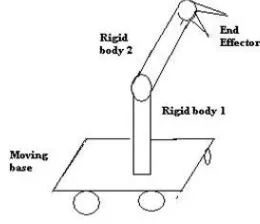
Fig 2.1 Simple pick and place robot
The end effector should accommodate all 6 degrees of freedom, in order to reach all sides of the component, to take up position to any height.
On a whole, the basic pick and place robot works as follows: The wheels under neath the base help to move the robot to the desired location. The rigid body supporting the end effector bends or straightens up to reach the position where the object is placed. The end effector picks up the object with a strong grip and places it at the desired position. Now that we have got a brief idea of the pick and place robot, the basic question is how it is actually controlled.
A simple pick and place robot can be controlled by controlling the movement of its end effector. The motion can be using hydraulic motion, i.e. using hydraulic fluid under pressure to the drive the robot, or using
pneumatic motion, i.e. using pressurized air to cause mechanical motion. However the most effective way is using motors to provide the required motion. The motors have to be controlled in order to provide required motion to the robot and the end effector
III.
BLOCK DIAGRAM AND WORKING
PRINCIPLE OF THE MODEL
160
Copyright © 2016. Vandana Publications. All Rights Reserved.
Fig 3.1 Block Diagram of Pick and Place Robot
3.2 WORKING OF THE MODEL
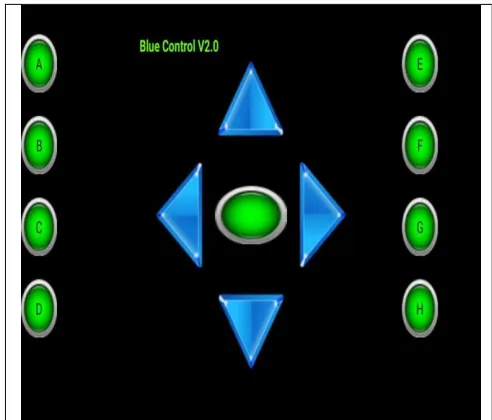
1) First of all search for Blue Control V2.0 (Figure 2.3) at Google Play and install the application in the android device
2) After installing, go to the applications and open the application.
3) Turn on the Bluetooth and scan for the device called “HC-05”and connected to the device by enter pin 1234. 4) Go to the Blue Control app and press the options button and click the connect option. Then it will give a list of devices available. See for“HC-05” and again enter the pin 1234 and then click “OK”.
5) Wait for a while until it gives the confirmation “Connected to HC-05” then the application now ready for communication with the Bluetooth module in the pick and place robotic vehicle.
Below are the operation procedure
Click up button for Robot Forward Movement
Click down button for Robot Backward Movement
Click left button for Robot Left Movement
Click right button for Robot Right Movement
Click A button for Robot Gripper Open
Click B button for Robot Gripper Close
Click C button for Robot Arm Up
Click D button for Robot Arm Down
Click centre button for Stop operation
Now consider the operation of soft catching arm. It sense pressure in the arm by measuring current. The motors used for an operation up and down and gripper operation open and closed pass through series resistor of 10 ohms/ 2 watt from the output of the motor driver IC L293D.While motor is operating the returning current from Driver IC is grounded through this resistance and the voltage across it is proportional to the current owing through it and this current is proportional to the load at the motor or pressure in the arm jaws. Thus by measuring the voltage we can measure the amount of pressure. Thus while motor operates in normal condition the running current results normal voltage drop across the 10R/2W ohm resistor as the motor can run in clockwise (or)anti-clockwise. When load increases the voltage across resistor get increased and is continuously monitored by micro controller. When it increases above a certain value, interrupt is produced thus stopping the motor. The program is so written that once interrupt zero occurs low, no such command would generate any input to the motor driver IC for any direction for that motor movement. Only the other direction rotation is possible from the command. This helps in soft catching arrangement of the arm gripper.
3.3BLUE CONTROL ANDROID APPLICATION
Blue control is a basic universal remote control for blue-tooth enabled serial devices such as Blue Tooth modules connected to a micro-controller. For each button pressed the corresponding ASCII code for the label will be sent. The blue control android application works on based of touch screen operation it consists of eight alphabetical keys and four arrow keys which controls the robot movement and gripper.
161
Copyright © 2016. Vandana Publications. All Rights Reserved.
IV.
FABRICATED MODEL
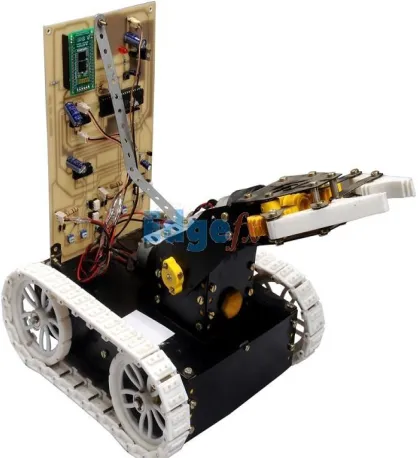
The complete Pick and Place robot is combination of three sub sections
1. Robotic mechanism 2. Hardware driver circuit 3. Controlling software in VC++
Obviously, the main part will be the mechanism that actually forms the body of robot means moving robotic arm that picks or places any object.
Function of hardware driver circuit is to drive all three motors and actuates all the motions of robot.
Controlling software is also an important part of this robot because it will take care of all controlling actions. The main functions of this section are
Rotate the hand to one specific angle from where the object should be picked or to be placed
Move the hand up or down to pick or place the object.
Open or close the grip of hand depending upon size of object.
Fig 4.1 Fabricated model of Pick and Place Robot
V.
RESULTS AND DISCUSSION
5.1 RESULT
In this work a Pick and place robot controlled by an Android application was made. We know that the whole digital devices in the world are transformed in to Android OS based systems , as it is more versatile ,flexible and easy to control and it is an open source software. Here The Pick and place robot is controlled wirelessly by an Android application called Blue control through a blue tooth module. The main feature of this pick and place robot is
the soft catching arm or soft catching Gripper. We know that when handling the explosive items like bomb it should be handled carefully, excessive pressure will cause explosion, so it is very essential to have a soft catching arm .This robotic arm has microcontroller based electrical pressure sensor which has higher sensitivity than mechanical pressure sensors. This robotic arm is designed to handle a maximum weight of 2kg.The weight handling capacity of Pick and Place Robot is determined by the capacity of DC motors used.
After successful fabrication, the robot arm was tested for a fixed distance of 5 meters for picking up of an object and placing with different loads and the results are
TABLE 1
Time taken to travel with different loads
.5.1 Graphical representation of time taken to travel the robot with different loads
Various Weights are made to be griped by the robotic arm and move the links in constant path in bi directional way (i.e. clockwise and anti clockwise rotation) with a constant power source. The lifting force component variation can bring considerable changes in the motor power consumption at various joints. The experimental data so obtained was tabulated as follows:
Slno. Weight of the object in grms
Time taken in seconds
Distance travelled in
mts
1 50 36 5
2 100 39 5
3 200 42 5
162
Copyright © 2016. Vandana Publications. All Rights Reserved.
TABLE 2
Power consumption of each motor in volts
S.No Position of arm
Base rotation
motor
Shoulder elbow motor
Gripper
50gms
Arm is
straight 8.6 8.7 7.2
Arm is at
90degrees 8.1 7.7 8.2
100grm
Arm is
straight 8.6 8.7 8.6
Arm is at
90degrees 8.1 7.5 7.9
200grm
Arm is
straight 8.5 8.6 8.2
Arm is at
90degrees 7.8 7.1 7.9
300grm
Arm is
straight 8.2 8.5 8.2
Arm is at 90
degrees 7.8 6.7 7.8
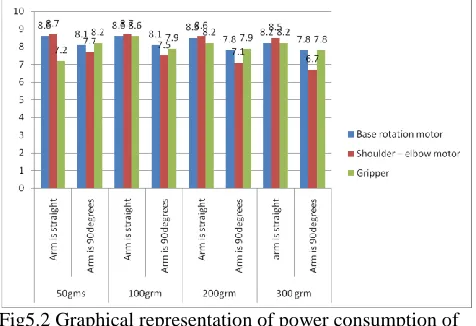
From the above results the gripper motor consumed less power than other motors at different joints. The gripper is used to hold the objects straightly. The base motor consumed more power because it will carry the load of the object and also and the other joints of the arms. The shoulder arm consumed less power than the base motor.
Fig5.2 Graphical representation of power consumption of motors
VI.
CONCLUSION
In this work, Pick and place robot controlled by an Android application was made. We know that the whole the digital devices in the world are transformed in to Android OS based systems ,as it is more versatile ,flexible and easy to control and it is an open source software. Here The Pick and place robot is controlled wirelessly by an Android application called Blue control through a blue tooth module. The main feature of this pick and place
robot is the soft catching arm or soft catching Gripper. We know that when handling the explosive items like bomb it should be handled carefully. Excessive pressure will cause explosion. So it is very essential to have a soft catching arm .This robot has microcontroller based electrical pressure sensor which has higher sensitivity than mechanical pressure sensors. The hardware model functioned as desired and is shown in Figure .This is designed to handle a maximum weight of 2kg.The weight handling capacity of Pick and Place Robot is determined by the capacity of DC motors used. Very useful and interesting can be made by interfacing the “Pick and Place Robot‟ with explosive detectors, metal detectors, wireless cameras, night vision cameras...Etc. for finding the bombs and proper visual assistance.
REFERENCES
[1] John Iovine.,“Robots, Androids, and Animations 12 Incredible Projects You Can Build”, Second Edition,McGraw-Hill.2002
[2] Mohamed Naufal bin Omar,“Pick and place robotic arm controlled by Computer”, UniversititeknikalMalaysia, Melaka April 2007.
[3] Yanjianghuang, ryosukechiba, tamioarai, tsuyoshiueyama and junota. ,“Integrateddesign of multi-robot system for pick-and-place tasks”,
[4]Proceeding of theIEEE International conference on robotics and biomimetic (ROBIO) Shenzhen, china, December 2013.
[5] Sungwookmoon ,youngjinkim, ho junmyeong , changsookim, namjucha, and dong hwankim . ,“Implementation of smart phone environment remote control and monitoring System for android operating system-based robot platform” ,The 8thinternational conference on ubiquitous robots and ambient intelligence (URAI 2011) Tc1-1 Nov. 23-26, 2011 in songdoconventia, incheon, korea 978-1-4577-0723-0 / 11 /$26.00 2011 IEEE [6] Range-based navigation system for a mobile Robot-Neil MacMillan, River Allen, DimitriMarinakis, Sue Whitesides, IEEE 2010
[7] Smartphone-based Mobile Robot Navigation -Nolan Hergert, William Keyes, and Chao Wang, spring 2012 [8]. Development Of A Wireless Device Control Based Mobile Robot Navigation System PheySiaKwek,Zhan Wei Siew, Chen How Wong,, BihLiiChua, Kenneth Tze Kin Teo.IEEE 2012
[9]. A Bluetooth-based Architecture for Android Communication with an Articulated Robot-Sebastian van Delden and Andrew Whigham, IEEE2013
[10]
http://en.wikipedia.org/wiki/Android_(operating_system). April 2015.