The Thirty-Third AAAI Conference on Artificial Intelligence (AAAI-19)
Bidirectional Transition-Based Dependency Parsing
Yunzhe Yuan, Yong Jiang, Kewei Tu
School of Information Science and TechnologyShanghaiTech University
{yuanyzh,jiangyong,tukw}@shanghaitech.edu.cn
Abstract
Transition-based dependency parsing is a fast and effective approach for dependency parsing. Traditionally, a transition-based dependency parser processes an input sentence and pre-dicts a sequence of parsing actions in a left-to-right manner. During this process, an early prediction error may negatively impact the prediction of subsequent actions. In this paper, we propose a simple framework for bidirectional transition-based parsing. During training, we learn a left-to-right parser and a right-to-left parser separately. To parse a sentence, we perform joint decoding with the two parsers. We propose three joint decoding algorithms that are based on joint scor-ing, dual decomposition, and dynamic oracle respectively. Empirical results show that our methods lead to competitive parsing accuracy and our method based on dynamic oracle consistently achieves the best performance.
Introduction
Dependency parsing is a task with a long history in natu-ral language processing. The goal of dependency parsing is to discover syntactic relations among words in a sentence. Dependency trees have been shown to provide effective syn-tactic information in many semantic tasks, such as semantic role labeling (Lei et al. 2015), machine translation (Chen et al. 2017) and sentence classification (Ma et al. 2015). Generally speaking, there are two types of models for de-pendency parsing, graph-based models (McDonald 2006) and transition-based models (Yamada and Matsumoto 2003; Nivre 2003). Known for its efficiency in training and decod-ing, transition-based parsing has been very popular for many languages. A transition-based parser processes the input sen-tence in a sequential manner and outputs a series of ac-tions to incrementally construct a parse tree. During this pro-cess, each action is typically predicted using a discriminative classifier, such as a SVM (Yamada and Matsumoto 2003; Nivre, Hall, and Nilsson 2006), a stack LSTM (Dyer et al. 2015) or a BiLSTM (Kiperwasser and Goldberg 2016).
Traditionally, transition-based dependency parsing cesses the sentence in a left-to-right manner. During this pro-cess, a prediction mistake, especially one in the early stage, may negatively impact many subsequent predictions. Mo-tivated by bidirectional neural machine translation (Liu et Copyright c2019, Association for the Advancement of Artificial Intelligence (www.aaai.org). All rights reserved.
al. 2016), we propose to alleviate this problem and improve parsing accuracy with a simple framework of bidirectional transition-based parsing. During training, in addition to the traditional left-to-right parser, we also learn a right-to-left parser by reversing the word order of all the training sen-tences. For parsing, we propose three joint decoding algo-rithms that can be used to parse a new sentence based on both of the learned parsers. The first algorithm runs the two parsers and then selects one of the two parse trees that has a higher summed score given by the two parsers. The sec-ond algorithm is based on the dual decomposition technique (Rush and Collins 2012) which is an iterative algorithm that encourages the two parsers to gradually reach consensus. The last algorithm follows the same idea, but during each iteration it guides the two parsers with dynamical oracles (Goldberg and Nivre 2012). To the best of our knowledge, we are the first to employ the dynamical oracle mechanism in the decoding period rather than the training period.
Our framework is quite general and can be applied to any transition-based dependency parsing model with well-defined dynamic oracles. In our experiments, we apply our framework to the transition-based parser of Kiperwasser and Goldberg (2016). We evaluate our model on two popular treebanks (PTB and CTB) as well as eight additional tree-banks from the Universal Dependency dataset. Experimental results show that our proposed algorithms significantly out-perform the unidirectional baselines and our third algorithm based on dynamic oracles has the highest accuracy.
Related Work
Transition-based Dependency Parsing
A transition-based dependency parser incrementally builds a dependency tree by a sequence of actions. Some of the early transition-based parsers are list-based (Covington 2001), but more recently stack-based parsers (Nivre 2003), also known as shift-reduced parsers, are more widely used. There are two basic transition systems: the arc-standard system (Nivre 2004) and the arc-eager system (Nivre 2003), which can be combined to form the arc-hybrid system (Kuhlmann, G´omez-Rodr´ıguez, and Satta 2011; Kiperwasser and Gold-berg 2016).
and Matsumoto 2003), maximum entropy classification (At-tardi 2006), memory based learning (At(At-tardi 2006), multi-class averaged perceptron (Attardi et al. 2007) and so on. With the rise of deep learning, neural networks have recently been used to train dependency parsers (Stenetorp 2013; Chen and Manning 2014; Dyer et al. 2015; Kiperwasser and Goldberg 2016), which leads to state-of-the-art depen-dency parsing accuracies. For decoding, the simplest way is Athe greedy algorithm that always performs the action with the highest local score given each parsing configura-tion, but there also exist other methods such as beam search (Zhang and Clark 2008) and dynamic programming (Huang and Sagae 2010).
Parser Ensemble
Our work is related to parser ensemble, which aims at com-bining multiple different parses of the same sentence. Sagae and Tsujii (2007) combine the parse trees produced by a left-to-right parser and a right-to-left parser with a maxi-mum spanning tree voting scheme in the CoNLL Shared Task 2007 (Nivre et al. 2007). Zhang and Clark (2008) trained a graph-based parser and a transition-based parser, combined the scoring of the two parsers, and then used the transition-based parser for decoding. Surdeanu and Manning (2010) systematically studied different ensemble methods based on seven different parsers from MSTParser (McDon-ald et al. 2005) and Malt Parser (Nivre, Hall, and Nilsson 2006). While our framework can be seen as combining two unidirectional parsers, most of the ensemble methods cannot be directly applied to our setting.
Oracles in Dependency Parsing
To effectively train a dependency parser, one key compo-nent is an oracle, which is employed to generate optimal ac-tion sequences from gold trees. The oracle is used to gener-ate training targets to learn a classifier or used to determine whether to perform updates in training a beam search clas-sifier.
There are two kinds of oracles: static oracles and dynamic oracles. Static oracles refer to producing a single static se-quence of transitions that is supposed to be followed in its entirety. However, at test time, the parser’s classifier may be faced with configurations which were not observed in training. This phenomenon may lead to error propagation and significantly decrease the parsing accuracy. Rather than defining a deterministic transition sequence, dynamic ora-cles permit configurations which are not a part of a gold derivation. While dynamic oracles have been widely em-ployed for training transition-based models (Goldberg and Nivre 2012; 2013; Goldberg, Sartorio, and Satta 2014), they have never been used in the decoding period.
Transition-Based Dependency Parsing
Given a sentence x that consists of a word sequence, a transition-based parser produces a sequence of actions that gradually construct an output parse treey. We choose the parser of Kiperwasser and Goldberg (2016) as our baseline.Algorithm 1Greedy Transition-Based Parsing Input:a sentencex
Output:a dependency parse treey 1: c←Initial(x)
2: while notTerminal(c)do
3: ˆa←arg maxa∈Legal(c)f(c, a)
4: c←ˆa(c) 5: y←c.T
6: returny
Model
The transition system uses an abstract machine that gener-ates an action given a parsing configuration. Each config-urationcconsists of a stackσ, a bufferβ and an arc setT. The initial configurationc0contains an empty stack, a buffer
containing a special indexROOTfollowed by all the words of the sentence, and an empty arc set.
We use the arc-hybrid transition system (Kuhlmann, G´omez-Rodr´ıguez, and Satta 2011), which defines three types of actions namedSHIFT,LEFTandRIGHT. The SHIFT action pushes the first itemb0 of the buffer to the
stack. TheLEFTlaction (lis a dependency label) pops the stack, let the modifier of the poped items0be the first item of
the bufferb0, and add the arc with labellto the arc set. The
RIGHTlaction pops the stack, let the modifier of the poped items0be the new top item of the stacks1, and add the arc
with labellto the arc set. We useσ|s1|s0to denote the stack σwith top itemss0ands1,b0|βto denote the bufferβwith
the first itemb0.
SHIFT[(σ, b0|β, T)] = (σ|b0, β, T)
LEFTl[(σ|s1|s0, b0|β, T)] = (σ|s1, b0|β, T∪ {(b0, s0, l)})
RIGHTl[(σ|s1|s0, β, T)] = (σ|s1, β, T ∪ {(s1, s0, l)})
We use the greedy algorithm to parse sentences. Algo-rithm 1 shows the procedure. The abstract machine starts with the initial configurationc0. For each configurationc,
one needs to choose an actionato transfer to the next con-figuration. We define a score functionf for actions and
se-lect the actionaˆthat leads to the largest scoref(c,ˆa). The
transition ends when the buffer ofcbecomes empty. The arc setT then contains all the dependency arcs that constitute
the output parse treey.
The action score for each configuration f(c, a) is com-puted as follows. We run a BiLSTM on the input sentence and produce a vectorvifor each wordxiin the sentence.
vi= BiLSTM(x1:n, i)
The vector representation of a configurationc= (σ, β, T) is the concatenation of the vectors of the top three items of
σand the first item ofβ.
φ(c) =vs2◦vs1◦vs0◦vb0
The score functionf(c, a)is computed by a multi-layer perceptron. The input to the multi-layer perceptron is the vector representation of configuration c, and the output is
the scores of all the valid actions under configurationc.
C SHIFT;c= (σ|s1|s0, b|β, T), Tg
=
{(k, b, l)∈Tg|k∈s1∪σ} ∪ {(b, k, l)∈Tg|k∈s0∪s1∪σ}
C LEFTl;c= (σ|s1|s0, b|β, T), Tg =
{(k, s0, l)∈Tg|k∈s1∪β} ∪ {(s0, k, l)∈Tg|k∈b∪β}
C RIGHTl;c= (σ|s1|s0, b|β, T), Tg =
{(k, s0, l)∈Tg|k∈b∪β} ∪ {(s0, k, l)∈Tg|k∈b∪β}
Table 1: Transition costs for the arc-hybrid system
Training
Our training algorithm follows Kiperwasser and Goldberg (2016). Given a training sentence, we convert its gold de-pendency tree into a set1of sequences of transition actions. For each action, we use the following hinge loss.
max(0,1−max
a∈GM LP(φ(c))[a] + maxa∈A\GM LP(φ(c))[a])
whereAis the set of all possible actions andGis the set of
gold (correct) actions. The total loss is the summation of the loss for each action.
Bidirectional Transition-Based Parsing
A traditional transition-based parser processes a sentence from left to right. During this process, prediction mistakes in the early stage can negatively impact future predictions, leading to a series of subsequent mistakes. We get inspira-tion from bidirecinspira-tional neural machine translainspira-tion (Liu et al. 2016) and propose bidirectional transition-based parsing. Specifically, we train a left-to-right parser as well as a right-to-left parser. The right-right-to-left parser is trained by reversing the word order of all the training sentences. During pars-ing, we perform joint decoding using both parsers. Below we discuss three algorithms for joint decoding.Vanilla Joint Scoring
The simplest method is to design a joint scoring function of parse treess(t), based on which we select from the parse trees{y,z}produced by the two unidirectional parsers, i.e., we outputarg maxt∈{y,z}s(t). Here we simply use a
scor-ing function that is the summation of the scores computed by the two unidirectional parsers:
s(t) =F(t) +G(t)
wheretis a parse tree,F andGare the parse tree scoring
functions of the two parsers.
Joint Decoding with Dual Decomposition
The joint scoring method is rather limited in that it cannot produce any new parse trees. A better method would be to encourage each unidirectional parser to gradually modify its parse tree in order to satisfy the other parser, in hope that the two parsers would eventually reach agreement on a single new parse tree. Here we use the dual decomposition tech-nique (Dantzig and Wolfe 1960; Rush and Collins 2012) for this purpose.
1The gold action at a configuration may not be unique in some transition systems.
We useY,Zto denote the sets of all possible parse trees produced by the two unidirectional parsers. Typically we haveY=Z. We represent a parse treeyby a matrix: if the modifier of thei-th word of the sentence is thej-th word,
theny(i, j) = 1; otherwisey(i, j) = 0. Our goal is to maxi-mizeF(y) +G(z)under the constraint thaty=z. By using Lagrangian relaxation, we can optimize the two parsers y andzrespectively by adding and subtracting the same term toF(y)andG(z). The summation of the two parts is called the Lagrangian dualL(u).
L(u) = max
y∈Y(F(y) + X
i,j
u(i, j)y(i, j))+
max
z∈Z(G(z)− X
i,j
u(i, j)z(i, j))
It can be proved thatL(u)is an upper bound of our goal, and we can iteratively updateutrying to reach the tightest bound. In the case where the two parsers cannot reach agree-ment after the maximal iterations, we simply return one of them. Note that the greedy decoding algorithm (Algorithm 1) cannot solve thearg max exactly and therefore we can only approximately optimize the dual decomposition objec-tive using Algorithm 2.
Joint Decoding Guided by Dynamic Oracle
Dynamic oracles (DO) (Goldberg and Nivre 2012) are a use-ful technique in training a transition-based parser. When the current configuration of the parser deviates from a given gold parse, the dynamic oracle suggests one or more actions that help the parser return to the gold parse in the fastest possible way.
Goldberg and Nivre (2012) derived the dynamic oracle function for the arc-eager transition system. Here we briefly describe the dynamic oracle function proposed by Kiper-wasser and Goldberg (2016) for the arc-hybrid system.
o(a;c, T) =
true, ifC(a;c, T) = 0 false, otherwise
The oracle functionois a Boolean function, whose value
is true if and only if the cost functionCis equal to 0.Cis a function of the input configurationc, actionaand gold tree Tgas shown in Table 1.
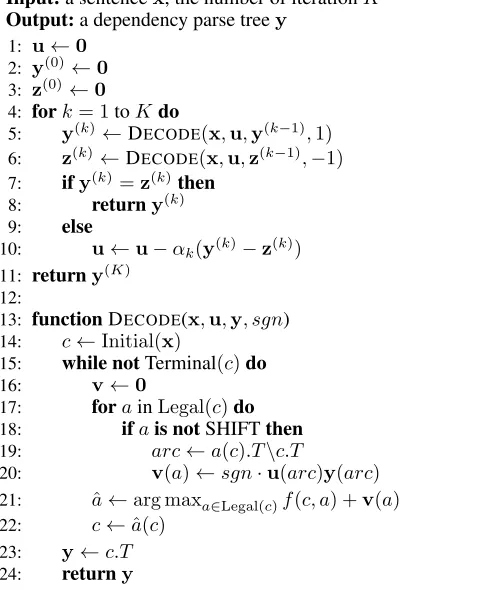
Algorithm 2Decoding with Dual Decomposition Input:a sentencex, the number of iterationK
Output:a dependency parse treey 1: u←0
2: y(0)
←0 3: z(0)
←0
4: fork= 1toKdo
5: y(k)←DECODE(x,u,y(k−1),1) 6: z(k)
←DECODE(x,u,z(k−1),
−1) 7: ify(k)=z(k)then
8: returny(k)
9: else
10: u←u−αk(y(k)−z(k)) 11: returny(K)
12:
13: functionDECODE(x,u,y, sgn) 14: c←Initial(x)
15: while notTerminal(c)do
16: v←0
17: forainLegal(c)do 18: ifais notSHIFTthen 19: arc←a(c).T\c.T
20: v(a)←sgn·u(arc)y(arc) 21: ˆa←arg maxa∈Legal(c)f(c, a) +v(a)
22: c←ˆa(c) 23: y←c.T
24: returny
tree produced by one parser as the gold parse and use a dy-namic oracle to bias the other parser so that it produces a parse tree closer to the gold parse than it would without the dynamic oracle. More concretely, at each step of pars-ing with the second parser, we add a reward to the scores of the actions suggested by the dynamic oracle so as to bias the action choice.
The algorithm is shown in Algorithm 3. First, we obtain two parse trees y(0) andz(0) from the two unidirectional
parsers. Then, at thek-th iteration, we regardz(k−1)as the
gold tree to guide the first parser to producey(k), and
like-wise we regardy(k−1)as the gold tree to guide the second
parser to producez(k). With a proper reward value (c do), the parse trees produced by the two parsers would become in-creasingly similar.
While Algorithms 2 and 3 have very similar forms, they differ in the set of actions whose scores are modified in the decoding subroutine. In the dual decomposition algorithm, only theLEFTandRIGHTactions that produce arcs upon which the two parsers disagree may have their scores modi-fied. In the algorithm guided by dynamic oracles, at least one action in each valid configuration would have its score mod-ified. Therefore, dynamic oracles lead to significantly more change to the scoring function, which potentially leads to much faster convergence of the parses produced by the two parsers.
Finally, because Algorithms 2 and 3 have similar forms,
Algorithm 3Decoding Guided by Dynamic Oracle Input:a sentencex, a constant rewardcdo, the number of iterationK
Output:a dependency parse treey 1: y(0)=None
2: z(0)=None
3: fork= 1toKdo
4: y(k)
←DECODE(x, z(k−1), c do) 5: z(k)←DECODE(x, y(k−1), c
do) 6: ify(k)=z(k)then
7: returny(k) 8: returny(K)
9:
10: functionDECODE(x,yg, cdo) 11: c←Initial(x)
12: while notTerminal(c)do
13: v←0
14: ifygisnotNonethen
15: fora∈Legal(c)ando(a, c,yg)do
16: v(a) =cdo
17: aˆ←arg maxa∈Legal(c)f(c, a) +v(a)
18: c←ˆa(c) 19: y←c.T
20: returny
Dataset #Train #Dev #Test
PTB 39832 1700 2416
CTB 16091 803 1910
UD-de 13814 799 977
UD-en 12543 2002 2077 UD-es 14187 1400 426 UD-fr 14554 1478 416
UD-it 13121 564 482
UD-nl 12269 718 596
UD-pl 13774 1745 1727
UD-zh 3997 500 500
Table 2: Statistics of the ten treebank datasets
we can combine these two methods by adding up their mod-ifications to the scoring functions.
Experiments
Data
We evaluate our framework on the Wall Street Journal cor-pus of Penn Treebank (PTB), Chinese Treebank 5 (CTB), and eight additional treebanks of different languages from Universal Dependencies 2.2 (UD)2.
For PTB, we use Stanford Dependencies (Silveira et al. 2014) to convert the original treebank to the dependency version and use the standard 2-21/22/23 split for training, development and testing.
For CTB, we use Penn2Malt3to convert the original tree-2http://universaldependencies.org/
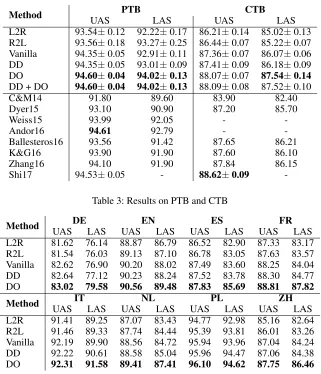
Method UAS PTB LAS UAS CTB LAS L2R 93.54±0.12 92.22±0.17 86.21±0.14 85.02±0.13 R2L 93.56±0.18 93.27±0.25 86.44±0.07 85.22±0.07 Vanilla 94.35±0.05 92.91±0.11 87.36±0.07 86.07±0.06 DD 94.35±0.05 93.01±0.09 87.41±0.09 86.18±0.09 DO 94.60±0.04 94.02±0.13 88.07±0.07 87.54±0.14 DD + DO 94.60±0.04 94.02±0.13 88.09±0.08 87.52±0.10
C&M14 91.80 89.60 83.90 82.40
Dyer15 93.10 90.90 87.20 85.70
Weiss15 93.99 92.05 -
-Andor16 94.61 92.79 -
-Ballesteros16 93.56 91.42 87.65 86.21
K&G16 93.90 91.90 87.60 86.10
Zhang16 94.10 91.90 87.84 86.15
Shi17 94.53±0.05 - 88.62±0.09
-Table 3: Results on PTB and CTB
Method UASDELAS UASENLAS UASESLAS UASFRLAS L2R 81.62 76.14 88.87 86.79 86.52 82.90 87.33 83.17 R2L 81.54 76.03 89.13 87.10 86.78 83.05 87.63 83.57 Vanilla 82.62 76.90 90.20 88.02 87.49 83.60 88.25 84.04 DD 82.64 77.12 90.23 88.24 87.52 83.78 88.30 84.77 DO 83.02 79.58 90.56 89.48 87.83 85.69 88.81 87.82 Method UASITLAS UASNLLAS UASPLLAS UASZHLAS L2R 91.41 89.25 87.07 83.43 94.77 92.98 85.16 82.64 R2L 91.46 89.33 87.74 84.44 95.39 93.81 86.01 83.26 Vanilla 92.19 89.90 88.56 84.72 95.94 93.96 87.04 84.24 DD 92.22 90.61 88.58 85.04 95.96 94.47 87.06 84.38 DO 92.31 91.58 89.41 87.41 96.10 94.62 87.75 86.46
Table 4: Results on UD
Hyperparameter Value
Word embedding dimension 100
POS tag dimension 25
BiLSTM layers 2
LSTM dimensions 200/200
MLP units 100
Table 5: Hyperparameters used in the experiments
bank to the dependency version with the heading rules of (Zhang and Clark 2008). We use the training, development and testing split of the dataset following (Zhang and Clark 2008).
We choose eight additional treebanks from UD, including Chinese (zh-GSD), Dutch (nl-Alpino), English (en-EWT), French (fr-GSD), German (de-GSD), Italian (it-ISDT), Pol-ish (pl-LFG) and SpanPol-ish (es-GSD). See Table 2 for statis-tics of the datasets.
For PTB, we use predicted POS tags generated by Stand-ford Tagger (Toutanova et al. 2003) with an accuracy of
98.0%. For CTB and UD, we use the gold POS tags. We use pretrained word embeddings from GloVe4 (Pen-nington, Socher, and Manning 2014) in our experiments on PTB and pretrained word embeddings from fastText5 (Bo-janowski et al. 2017) in our experiments on UD. We use word2vec (Mikolov et al. 2013) to train Chinese word em-beddings on Wikipedia for our experiments on CTB.
Setup
For dual decomposition, we decrease the update rateαkover time as recommended by (Rush and Collins 2012). Specifi-cally, we setαk = tc+1dd wheretis the number of times the dual value increases and cdd is a hyperparameter. For our method based on dynamic oracle, we also decrease the re-wardcdo over time in a similar way to make the decoding process stabler.
Since convergence is not guaranteed for both dual decom-position and our method based on dynamic oracle, we set a maximum iterationK = 100. If no agreement is reached
0.0 0.2 0.4 0.6 0.8 1.0
Position (Normalized)
0 50 100 150 200 250 300#Error
l2r r2lFigure 1: Comparisons between re-sults from the two bidirectional mod-els
0.0 0.2 0.4 0.6 0.8 1.0
Position (Normalized)
0 50 100 150 200 250 300#Error
l2r doFigure 2: Comparisons between re-sults from the left-to-right model and the DO method
0.0 0.2 0.4 0.6 0.8 1.0
Position (Normalized)
0 50 100 150 200 250 300#Error
r2l doFigure 3: Comparisons between re-sults from the right-to-left model and the DO method
after K iterations, we collect all the 2K parse trees pro-duced during decoding and select the best parse following joint scoring.
We compare six methods: the left-to-right parser (L2R), the right-to-left parser (R2L), vanilla joint scoring (Vanilla), joint decoding with dual decomposition (DD), joint decod-ing guided by dynamic oracles (DO), and the combination of DD and DO (DD+DO).
For each dataset, we train each unidirectional parser for 20 epochs, collect all the models after each of the 20 epochs, and choose the best model based on the UAS metric on the development set. We then fix the unidirectional parsers and tune the hyperparameters of our joint decoding algorithms (cdd ∈ {0,0.005,0.01}andcdo ∈ {0,1,2,3,4}) based on
the UAS on the development set. We repeat the process for five times with different random seeds and report the average accuracy and the standard deviation on the test set.
Table 5 shows all the other hyperparameters used in our experiments.
Figure 4: Accuracy vs. iteration for DD (corresponding to do=0), DO (corresponding to dd=0), and DD+DO
Results
We compare our methods with the following neural transition-based parsers on PTB and CTB: C&M14 (Chen and Manning 2014), Dyer15 (Dyer et al. 2015), Weiss15 (Weiss et al. 2015), Ballesteros16 (Ballesteros et al. 2016), Andor16 (Andor et al. 2016), K&G16(Kiperwasser and Goldberg 2016), Zhang16 (Zhang, Cheng, and Lapata 2017), and Shi17 (Shi, Huang, and Lee 2017). As can be seen from Table 3, our methods are very competitive com-pared with previous methods and our DO-based algorithm produces the highest accuracies on PTB.
It can also be seen that DD only slightly outperforms Vanilla, while DO achieves significant improvement over both Vanilla and DD. Combining DD with DO does not lead to any improvement over DO.
We also run our methods without hyperparameter tuning on the eight UD datasets. As can be seen from Table 4, our three joint decoding algorithms consistently outperform the unidirectional baselines and the DO-based algorithm consis-tently achieves the highest accuracy.
Figure 4 plots the change of accuracy during our itera-tive joint decoding algorithms (DD, DO and DD+DO) on the WSJ development set. It can be seen that the DO-based method not only leads to higher accuracy, but also converges very fast (within 4 iterations). In comparison, DD does not converge within 100 iterations. It can also be seen that when
cdo is small, combining DD into the DO-based method is
helpful; but whencdois large, adding DD to the DO-based
method has little impact on the accuracy.
Analysis
For the two unidirectional parsers, we also analyze the dis-tribution of erroneous actions with respect to the relative po-sition (normalized to the range between 0 and 1) of the ac-tion in the complete acac-tion sequence produced by the parser (Figure 1). For the right-to-left parser, we reverse the di-rection of the x-axis to align the histogram with that of the left-to-right parser. It can be seen that both parsers are more likely to make mistakes at the later stage of parsing: the left-to-right parser makes significantly more mistakes in the range of[0.6,0.9], while the right-to-left parser makes sig-Figure 1: Left: Comparisons between results from the two bidirectional models;Middle: Comparisons between results from the left-to-right model and the DO method;Right: Comparisons between results from the right-to-left model and the DO method
after K iterations, we collect all the 2K parse trees pro-duced during decoding and select the best parse following joint scoring.
We compare six methods: the left-to-right parser (L2R), the right-to-left parser (R2L), vanilla joint scoring (Vanilla), joint decoding with dual decomposition (DD), joint decod-ing guided by dynamic oracles (DO), and the combination of DD and DO (DD+DO).
For each dataset, we train each unidirectional parser for 20 epochs, collect all the models after each of the 20 epochs, and choose the best model based on the UAS metric on the development set. We then fix the unidirectional parsers and tune the hyperparameters of our joint decoding algorithms (cdd ∈ {0,0.005,0.01} andcdo ∈ {0,1,2,3,4}) based on the UAS on the development set. We repeat the process for five times with different random seeds and report the average accuracy and the standard deviation on the test set.
Table 5 shows all the other hyperparameters used in our experiments.
Figure 2: Accuracy vs. iteration for DD (corresponding to do=0), DO (corresponding to dd=0), and DD+DO
Results
We compare our methods with the following neural transition-based parsers on PTB and CTB: C&M14 (Chen
and Manning 2014), Dyer15 (Dyer et al. 2015), Weiss15 (Weiss et al. 2015), Ballesteros16 (Ballesteros et al. 2016), Andor16 (Andor et al. 2016), K&G16(Kiperwasser and Goldberg 2016), Zhang16 (Zhang, Cheng, and Lapata 2017), and Shi17 (Shi, Huang, and Lee 2017). As can be seen from Table 3, our methods are very competitive com-pared with previous methods and our DO-based algorithm produces the highest accuracies on PTB.
It can also be seen that DD only slightly outperforms Vanilla, while DO achieves significant improvement over both Vanilla and DD. Combining DD with DO does not lead to any improvement over DO.
We also run our methods without hyperparameter tuning on the eight UD datasets. As can be seen from Table 4, our three joint decoding algorithms consistently outperform the unidirectional baselines and the DO-based algorithm consis-tently achieves the highest accuracy.
Figure 2 plots the change of accuracy during our itera-tive joint decoding algorithms (DD, DO and DD+DO) on the WSJ development set. It can be seen that the DO-based method not only leads to higher accuracy, but also converges very fast (within 4 iterations). In comparison, DD does not converge within 100 iterations. It can also be seen that when
cdo is small, combining DD into the DO-based method is helpful; but whencdois large, adding DD to the DO-based method has little impact on the accuracy.
Analysis
For the two unidirectional parsers, we also analyze the dis-tribution of erroneous actions with respect to the relative po-sition (normalized to the range between 0 and 1) of the ac-tion in the complete acac-tion sequence produced by the parser (Figure Left). For the right-to-left parser, we reverse the direction of the x-axis to align the histogram with that of the left-to-right parser. It can be seen that both parsers are more likely to make mistakes at the later stage of parsing: the left-to-right parser makes significantly more mistakes in the range of [0.6,0.9], while the right-to-left parser makes
significantly more mistakes in the range of roughly[0.1,0.4] (i.e.,[0.6,0.9]in the right-to-left order). This phenomenon suggests that error propagation exists in transition-based de-pendency parsers.
Gold ROOT Ah , yes , something called a Star Chamber .
# Left-to-right Parser Right-to-left Parser
0 ROOT Ah , yes , something called a Star Chamber . ROOT Ah , yes , something called a Star Chamber .
1 ROOT Ah , yes , something called a Star Chamber . ROOT Ah , yes , something called a Star Chamber .
2 ROOT Ah , yes , something called a Star Chamber . ROOT Ah , yes , something called a Star Chamber .
Figure 3: Example of joint decoding guided by dynamic oracles. The red arcs denote correct dependency arcs.
method. The comparisons of the error distributions of the two unidirectional parsers and the DO-based method are shown in the middle and right of Figure . We can see that overall the DO-based method makes less errors than the two unidirectional parsers and its errors are also more evenly dis-tributed.
Case Study
Figure 3 shows the the intermediate parsing results during the iterative process of the DO-based method on the input sentenceAh, yes, something called a Star Chamber.
At the beginning of the algorithm, we use the left-to-right parser and the right-to-left parser to produce two parse trees, which have 5 and 6 correct arcs respectively. After the first iteration, we get two new parse trees using the left-to-right parser and the right-to-left parser, which have 7 and 9 correct arcs respectively. After the second iteration, the two parse trees have 10 and 9 correct arcs respectively. From this ex-ample we can see that with more iterations, the parse trees produced by the two parsers become increasingly similar as well as increasingly close to the gold tree.
Conclusion
In this paper, we propose a framework for bidirectional tran-sition based dependency parsing. During training, we learn two unidirectional parsers separately. During parsing, we perform joint decoding using the two parsers with three al-gorithms based on joint scoring, dual decomposition, and dynamic oracles respectively. We evaluate our methods on ten datasets and observe that our methods lead to competi-tive parsing accuracy and our method based on dynamic ora-cles consistently achieves the best performance. Our code is based on Kiperwasser and Goldberg (2016) and is available at https://github.com/yuanyunzhe/bi-trans-parser.
Acknowledgment
This work was supported by the National Natural Science Foundation of China (61503248) and Major Program of Science and Technology Commission Shanghai Municipal (17JC1404102).
References
Attardi, G.; Dell’Orletta, F.; Simi, M.; Chanev, A.; and Cia-ramita, M. 2007. Multilingual dependency parsing and do-main adaptation using desr. InProceedings of EMNLP. Attardi, G. 2006. Experiments with a multilanguage non-projective dependency parser. InProceedings of the Tenth Conference on Computational Natural Language Learning. Ballesteros, M.; Goldberg, Y.; Dyer, C.; and Smith, N. A. 2016. Training with exploration improves a greedy stack lstm parser. InProceedings of EMNLP.
Bojanowski, P.; Grave, E.; Joulin, A.; and Mikolov, T. 2017. Enriching word vectors with subword information. TACL. Chen, D., and Manning, C. 2014. A fast and accurate de-pendency parser using neural networks. InProceedings of EMNLP.
Chen, K.; Wang, R.; Utiyama, M.; Liu, L.; Tamura, A.; Sumita, E.; and Zhao, T. 2017. Neural machine transla-tion with source dependency representatransla-tion. InProceedings of EMNLP.
Covington, M. A. 2001. A fundamental algorithm for de-pendency parsing. InProceedings of the 39th annual ACM southeast conference, 95–102.
Dantzig, G. B., and Wolfe, P. 1960. Decomposition principle for linear programs.Operations research.
Dyer, C.; Ballesteros, M.; Ling, W.; Matthews, A.; and Smith, N. A. 2015. Transition-based dependency parsing with stack long short-term memory. InProceedings of ACL. Goldberg, Y., and Nivre, J. 2012. A dynamic oracle for arc-eager dependency parsing.Proceedings of COLING. Goldberg, Y., and Nivre, J. 2013. Training deterministic parsers with non-deterministic oracles.TACL.
Goldberg, Y.; Sartorio, F.; and Satta, G. 2014. A tabu-lar method for dynamic oracles in transition-based parsing. TACL.
Huang, L., and Sagae, K. 2010. Dynamic programming for linear-time incremental parsing. InProceedings of ACL. Kiperwasser, E., and Goldberg, Y. 2016. Simple and ac-curate dependency parsing using bidirectional lstm feature representations. TACL.
Kuhlmann, M.; G´omez-Rodr´ıguez, C.; and Satta, G. 2011. Dynamic programming algorithms for transition-based de-pendency parsers. InProceedings of ACL.
Lei, T.; Zhang, Y.; M`arquez, L.; Moschitti, A.; and Barzilay, R. 2015. High-order low-rank tensors for semantic role labeling. InProceedings of NAACL.
Liu, L.; Utiyama, M.; Finch, A.; and Sumita, E. 2016. Agreement on target-bidirectional neural machine transla-tion. InProceedings of NAACL.
Ma, M.; Huang, L.; Xiang, B.; and Zhou, B. 2015. Dependency-based convolutional neural networks for sen-tence embedding. arXiv preprint arXiv:1507.01839. McDonald, R.; Pereira, F.; Ribarov, K.; and Hajiˇc, J. 2005. Non-projective dependency parsing using spanning tree al-gorithms. InProceedings of EMNLP.
McDonald, R. 2006. Discriminative training and spanning tree algorithms for dependency parsing. University of Penn-sylvania, PhD Thesis.
Mikolov, T.; Sutskever, I.; Chen, K.; Corrado, G. S.; and Dean, J. 2013. Distributed representations of words and phrases and their compositionality. InProceedings of NIPS. Nivre, J.; Hall, J.; K¨ubler, S.; McDonald, R.; Nilsson, J.; Riedel, S.; and Yuret, D. 2007. The conll 2007 shared task on dependency parsing. InProceedings of EMNLP. Nivre, J.; Hall, J.; and Nilsson, J. 2006. Maltparser: A data-driven parser-generator for dependency parsing. In Proceed-ings of LREC.
Nivre, J. 2003. An efficient algorithm for projective depen-dency parsing. InProceedings of IWPT.
Nivre, J. 2004. Incrementality in deterministic dependency parsing. In Proceedings of the Workshop on Incremental Parsing: Bringing Engineering and Cognition Together. Pennington, J.; Socher, R.; and Manning, C. 2014. Glove: Global vectors for word representation. InProceedings of EMNLP.
Rush, A. M., and Collins, M. 2012. A tutorial on dual de-composition and lagrangian relaxation for inference in natu-ral language processing.JAIR45:305–362.
Sagae, K., and Tsujii, J. 2007. Dependency parsing and domain adaptation with lr models and parser ensembles. In Proceedings of EMNLP.
Shi, T.; Huang, L.; and Lee, L. 2017. Fast (er) exact de-coding and global training for transition-based dependency parsing via a minimal feature set. InProceedings of EMNLP. Silveira, N.; Dozat, T.; De Marneffe, M.-C.; Bowman, S. R.; Connor, M.; Bauer, J.; and Manning, C. D. 2014. A gold standard dependency corpus for english. InLREC.
Stenetorp, P. 2013. Transition-based dependency parsing using recursive neural networks. InNIPS Workshop on Deep Learning. Citeseer.
Surdeanu, M., and Manning, C. D. 2010. Ensemble models for dependency parsing: cheap and good? InProceedings of NAACL.
Toutanova, K.; Klein, D.; Manning, C. D.; and Singer, Y. 2003. Feature-rich part-of-speech tagging with a cyclic de-pendency network. InProceedings of NAACL.
Weiss, D.; Alberti, C.; Collins, M.; and Petrov, S. 2015. Structured training for neural network transition-based pars-ing. InProceedings of ACL.
Yamada, H., and Matsumoto, Y. 2003. Statistical depen-dency analysis with support vector machines. In Proceed-ings of IWPT, volume 3, 195–206. Nancy, France.
Zhang, Y., and Clark, S. 2008. A tale of two parsers: in-vestigating and combining graph-based and transition-based dependency parsing using beam-search. In Proceedings of EMNLP.