Volume 2, Issue 4, April 2013
Page 359
Abstract
Noise can be unavoidable in communication networks, and its presence can have disastrous effects upon the data being sent. The main approach is to detect different type of noise in corrupted images. There are two steps in this process that has the ability to handle the real time applications due to its computational simplicity. The algorithm detects the type of noise in the first stage and handles error correction efficiently in the second stage. This algorithm can accurately detect and compensate for various noise sources common in multimedia applications, such as impulse, Gaussian, and uniform noise, with minimal loss to the integrity of the original digital image.
Keywords: Image Restoration, Corrupted Images, Denoising Noise Detection , Salt and pepper Noise, Gaussian Noise
1. INTRODUCTION
An image is two dimensional function f(x,y),where x and y are plane coordinates, and the amplitude of f at any pair of coordinates (x,y) is called the gray level or intensity of the image at that point. Digital images consist of a finite number of elements where each element has particular location and value. These elements are called picture elements, image elements and pixels. There are two types of image gray scale image and RGB image, where RGB image have three channels i.e. Red, Green, Blue and gray scale image have one channel [6].
Image Processing is a technique that improves the quality of raw Images capture in normal day-to-day life for many applications. Images captured by digital cameras could be affected by noise due to random variations of pixel elements in the camera sensors. Noise represents unwanted information which harms image quality. Noise can be unavoidable in communication networks, and its presence can have terrible effects upon the data being sent. There are various types of image noise present in the image such as Gaussian noise, salt and pepper noise, random valued impulse noise, speckle noise, Uniform noise [6].
Salt And Pepper Noise
Salt and Pepper noise is also known as Impulse Noise. This noise can be caused by sharp & sudden disturbances in the image signal. It represents itself is randomly occurring white or black (or both) dots over image.
Gaussian Noise
Gaussian Noise is caused by random fluctuations in the signal. Its modeled by random values added to an image/
Speckle Noise
Speckle noise can be modeled by random values multiplied by pixel values of an image.
Uniform Noise
Uniform noise is also known as quantization noise. It is caused by quantizing the pixels of a sensed image to a number of discrete levels. It has an approximately uniform distribution.
The algorithm which is used to detect the presence of noise and to remove it, should be theoretically, and computationally as simple as possible. A well-defined process of detecting certain types of noise in transmitted images would have to be a somewhat crude for speed. Here, we have discussed a new efficient noise detection algorithm that will be able to allow the receiver to know what type of filtering method should be applied for the type of noise detected in given image.
2. RELATED WORK
Detection of noise in degraded Images by
efficient noise detection algorithm: A Survey
Ms. Gayatri P. Bhelke1, Prof. M. V. Sarode2 and Prof. H. B. Nadiyana3
1
Student, M.E. 1,2,3
Volume 2, Issue 4, April 2013
Page 360
Many of the current papers dealing with noise in communication networks which propose a two-stage method of impulse noise reduction where in the first stage noise is detected and in the second it compensated for a filtering technique.As per Ming Yan’s paper [1] when the noise level is not high, adaptive center-weighted median filter (ACWMF) is appropriate method for removing random-valued impulse noise. Paper presents a general algorithm for blind image inpainting and removing impulse noise by iteratively restoring the image and identifying the damaged pixels.
H. Hosseini and F. Marvasti’s [2] introduced GFN (General Fixed-Valued Impulse Noise) model. For the GFN model, An Impulse Value Detector (IVD) is required to determine the noise values. In this, received image is denoted as I and Image entropy is defined as,
entropy
where, pi is the probability of the grey-value i and can be interpreted as the normalized histogram of the image. While the Gaussian noise does not affect the image entropy, the impulse noise significantly decreases it. The impulse value detector, iteratively, detects and removes the impulse grey-values. If the corresponding pixels have the lowest correlation with their neighbors then the grey value is detected as an impulse. After each iteration, when the impulse value is removed, the image entropy increases. The process continues until the entropy becomes larger than the entropy threshold, thus it ensures that there are no more impulse values in the image and image restoration is done by using AIM filter. In this filter, the noisy pixels which are farther than their nearest uncorrupted pixel, will be modified in more iterations
Qin Zhiyuan a et.al [3] describe A Robust Adaptive Image Smoothing Algorithm in which analysis of some smoothing algorithms are given which include Edge Preserved filtering ,Adaptive medium filter, Robust smoothing filter and Gradient weighting filter. Robust adaptive algorithm combines multi-window templates, gradient weighting, constant gray output on non-pulse pixel and the improved adaptive smoothing algorithm. In Addition to adaptive smoothing algorithm, here we discussed the methods of enlarging windows and selecting sub template windows to remove salt and pepper noise with large space intensity. Because it uses a new algorithm by combining nonlinear filtering and linear filtering according to their respective adaptation to different noises.
Shyam Lal et. al. [4] introduced a methodology “Noise Removal Algorithm for Images Corrupted by Additive Gaussian Noise”, in which, two fundamental mathematical morphological operations such as dilation and erosion are used. Dilation adds pixels to the boundaries of objects in an image, where as erosion removes pixels on object boundaries. Mathematical morphological operations are also useful in smoothing and sharpening.
Deborah D. et al [5] introduced analgorithm for Corrupted Images, in which first stage detect the type of noise and in second stage which type of filter is suitable for detected noise is given to eliminate the noise.
Gurmeet kaur and Rupinder Kaur’s [6] describe Image De-noising using Wavelet Transform and various filters, in which the preprocessing of image is done before image can be used in application by De-noising of image. De-noising is done by using filtering and wavelet based approach.
3. SYSTEM ARCHITECTURE
The discussed algorithm uses a two-stage process of determining three things which are given below, 1.Presence of noise
2.Type of noise such as impulse noise or Gaussian 3.The effective filtering method for removing noise
Similar to the methodology described in [5], architecture includes Adaptive Noise Detector and Adaptive pixel Restorer Following fig shows system architecture,
Volume 2, Issue 4, April 2013
Page 361
Following subsection describe Adaptive Noise Detector and Adaptive pixel Restorer.
a) Adaptive Noise Detector:
The Adaptive Noise Detector is used to detect the type of noise such as Gaussian noise, salt and paper and so on, if exists in the current image. Similar to [5] it calculates the Distance vector D from image histogram array.Histogram of image describes the intensity value of pixels that occur in an image. Various boundary thresholds are set, according to the maxima values found in D. Depending on location of maxima values nature of the noise is detected, whether it is impulse, uniform, or Gaussian. Once the noise has been find out, the NT Indicator is set as an input to the second stage of the system. The corrupted pixels are then mapped to a binary matrix with the same dimensions as the image. An example shown in following fig. gives the difference between edges and salt and paper noise in image [5].
Fig (2). Plot of distance vector D[5]
b)Adaptive pixel Restorer:
In second stage NT indicator is used as input which increases the processing speed. If the NT Indicator has not been set, the “corrupted image”, x(n), is allowed to pass and if the NT Indicator is set, then this sets one of the various noise flags. Again, similar to the second stage of [5], the Adaptive Pixel Restorer searches through the Binary Map for pixels whose value is “1”. If the neighborhood vector of values is not set as null and instance is found , it searches noise flags that are set to determine what type of adaptive filtering is best for that instance which is courrpted. If the neighborhood vector of values in the vicinity of that particular pixel is null, the algorithm goes on to the next pixel value. This process is done repeatedly until the Binary Map is cleared of 1’s.
Following fig(3) shows the image corrupted by the salt and pepper noise with histogram [5]
Volume 2, Issue 4, April 2013
Page 362
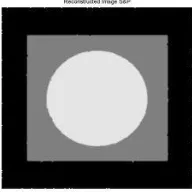
By taking the distance of neighboring histogram values the nature of noise can easily be determined.Figure (4) below, shows the reconstructed images from the second stage of the Adaptive Pixel Restorer.
Fig(4). Reconstructed Image (salt and paper noise)
Following fig shows the image corrupted by the Gaussian with histogram [5]
Fig (5). Histogram of gaussian noise in Image
Figure 6, below, shows the reconstructed images from the second stage of the Adaptive Pixel Restorer.
Fig(6). Reconstructed image (Gaussian)
4. CONCLUSION
Volume 2, Issue 4, April 2013
Page 363
REFERENCES
[1] Ming yan “Restoration of Images Corrupted by Impulse Noise using Blind Inpainting and l0 Norm”, November 7, 2011.
[2] H. Hosseini, F. Marvasti, Senior Member, IEEE “Fast Impulse Noise Removal from highly corrupted image”, Advance Communication Research Institute(ACRI).
[3] Qin Zhiyuan a, Zhang Weiqiang a, Zhang Zhanmu a, Wu Bing b, Rui Jie a,Zhu Baoshan “A R0bust Adaptive Image Smoothing Algorithm”
[4] Shyam Lal1, Mahesh Chandra2 and Gopal Krishna Upadhyay “Noise Removal Algorithm for Images
Corrupted by Additive Gaussian Noise”, International Journal of Recent Trends in Engineering, Vol 2, No. 1, November 2009, pp. 199-206.
[5] Deborah D. Duran-Herrmann, Qilin Qi, and Yaoqing (Lamar) Yang “An Adaptive Algorithm for Corrupted Images”, 2012 International Conference on Systems and Informatics (ICSAI 2012), pp. 2064-2068. [6] Gurmeet kaur Rupinder Kaur “Image De-noising using Wavelet Transform and various filters”, International journal of researcher in computer science Eissn 2249-8265 volume 2(2012) pp.15-21
AUTHOR
![Fig. System Architecture [5]](https://thumb-us.123doks.com/thumbv2/123dok_us/9734801.1957392/2.612.126.494.632.706/fig-system-architecture.webp)