DEMOGRAPHIC RESEARCH
VOLUME 33, ARTICLE 2, PAGES 31
−
64
PUBLISHED 3 JULY 2015
http://www.demographic-research.org/Volumes/Vol33/2/ DOI: 10.4054/DemRes.2015.33.2
Research Article
Marriage and divorce of immigrants and
descendants of immigrants in Sweden
Gunnar Andersson
Ognjen Obućina
Kirk Scott
This publication is part of the Special Collection on “Partnership dynamics among immigrants and their descendants in Europe,” organized by Guest Editors Hill Kulu and Tina Hannemann.
©2015 Gunnar Andersson, Ognjen Obućina & Kirk Scott.
This open-access work is published under the terms of the Creative Commons Attribution NonCommercial License 2.0 Germany, which permits use, reproduction & distribution in any medium for non-commercial purposes, provided the original author(s) and source are given credit.
2 Marriage formation and divorce in Sweden 32
3 Immigrants in Sweden 33
4 Theoretical considerations and previous research on marriage and divorce of immigrants
35
4.1 Marriage formation among immigrants 36
4.2 Previous research on divorce among immigrants 38
4.3 Re-marriage among immigrants 39
4.4 Hypotheses 40
5 Data and methods 40
6 Results I: First marriage formation of immigrants in Sweden 42
7 Results II: Divorce risks of immigrants in Sweden 46
8 Results III: Re-marriage propensities of immigrants in Sweden 49
9 Discussion 52
10 Acknowledgements 56
Marriage and divorce of immigrants and
descendants of immigrants in Sweden
Gunnar Andersson1
Ognjen Obućina2
Kirk Scott3
Abstract
BACKGROUND
Immigrants and their second-generation descendants make up more than a quarter of the current Swedish population. Their nuptiality patterns can be viewed as crucial indicators of their integration into Swedish society.
OBJECTIVES
This study provides data on levels of and patterns in marriage formation, divorce, and re-marriage of people in Sweden, by country of origin.
METHODS
The study is based on analyses of longitudinal register data that cover all residents born in 1951 and later who ever lived in Sweden during 1983−2007. Kaplan-Meier survivor functions demonstrate levels in nuptiality; multivariate event-history analyses demonstrate relative risks of marriage formation and divorce, by country group of origin.
RESULTS
We find evidence of variation among immigrant groups and between migrants and Swedish-born people in marriage and divorce patterns. A few groups of migrants have relatively high churning rates in family dynamics, with high levels of marriage formation, divorce, and re-marriage.
CONCLUSIONS
Many factors relate to the nuptiality behavior of immigrants in Sweden. Differences in family systems seem to have some influence on behavior in the contemporary Swedish context. Other factors relate to the migration process itself and to the selectivity of migrants to Sweden.
1 Stockholm University Demography Unit, Stockholm, Sweden. E-Mail: [email protected]. 2 Stockholm University Demography Unit, Stockholm, Sweden.
1. Introduction
Sweden is often seen as situated at an advanced stage of the so-called Second Demographic Transition of family change (van de Kaa 1987). It also has relatively high levels of immigration. Further, it possesses high-quality demographic data, which makes it possible to study some of these developments. In the present study we take advantage of these opportunities to study patterns in marriage formation and marriage dissolution of immigrants and descendants of immigrants in Sweden. Our study is based on analyses of longitudinal register data that cover the resident population in Sweden during 1983−2007. In contrast to census data, which lack longitudinal information on civil status histories, and survey data, which most often contain too few immigrants to allow for group-specific analyses, our data allow for very detailed and accurate analyses of the nuptiality patterns of key categories of immigrants. Our study focuses on women: it covers their patterns of marriage formation and divorce (the registers provide less useful information on non-marital cohabitation). We study female immigrants who arrived in Sweden as unmarried persons, and follow their subsequent civil-status careers while living in Sweden. We also cover the nuptiality patterns of the daughters of immigrants in Sweden. By means of longitudinal analyses of the marriage formation and divorce behavior of immigrant and non-migrant women, we demonstrate how patterns in nuptiality differ by migration status and country of origin and how they are modified by women’s socio-demographic characteristics. Our study adds insight into patterns of family demographic integration of migrants to Sweden. We address issues related to the disruption and adaptation of the family-demographic behavior of migrants and how the selectivity of migrants may contribute to differences in behavior in the Swedish context. We aim at contributing to a better understanding of the role of factors related to differences in family systems and the institutional setting of Sweden in shaping the family-demographic behavior of immigrants.
2. Marriage formation and divorce in Sweden
marriage formation propensities. Ever since the end of the 1990s, marriage rates in Sweden have increased (Ohlsson-Wijk 2011). Re-marriage propensities have increased as well (Andersson and Kolk 2011), emphasizing the recent development of the increasing popularity of marriage. Practically all marriages are preceded by periods of pre-marital cohabitation and the majority of marriages are preceded by premarital childbearing as well. In a European comparison, Swedish women and men form a union at relatively early ages but are relatively late in getting married (Andersson and Philipov 2002).
In terms of marital dissolution, Sweden is a country where divorce is easy to achieve; legislation that included no-fault grounds for divorce was introduced in 1915 (Sandström 2011). In 1974 the divorce legislation was liberalized further, which resulted in a pronounced increase in divorce risk levels (Andersson 1995, 1997). The trend of increasing divorce risk became visible earlier in Sweden than in other countries in Europe. Swedish divorce risks continued to increase at a moderate pace during the 1980s and 1990s. During this period, divorce was more common than in most other European countries, but less frequent than in the U.S. (Andersson 2002; Andersson and Philipov 2002). However, since the turn of the century Swedish divorce risks have leveled off (Andersson and Kolk 2011).
In Sweden, a person’s marital status brings relatively few benefits in terms of social rights. For example, since 1971 taxation is based on spouses’ own individual earnings and most social benefits are based on a person’s own economic status, regardless of his or her marital or family status. After divorce, joint custody of children is common, but otherwise spouses no longer have to interact with each other. The relatively weak instrumental role of marriage may mean that there is more scope for various ideational and symbolic factors related to marriage in creating differentials between population sub-groups in their nuptial behaviors (Ohlsson-Wijk 2011, 2014, 2015). In the case of international migrants, factors related to family systems in the migrants’ countries of origin may come into play.
3. Immigrants in Sweden
Immigrants from Finland still constitute the largest single foreign-born group in Sweden. Due to a shared national history up to the early 19th century and visible economic differentials between Finland and Sweden until the 1980s, labor migration from Finland to Sweden has been substantial. Other Nordic immigrants mainly comprise Danes and Norwegians but also a few Icelanders. As with the Finns, geographic proximity, shared culture, and the existence of a free Nordic labor market have helped ease migration as well as integration into Swedish society.
Immigrants from the Baltic countries mainly comprise pre- and post-Soviet migrants from Estonia. Polish immigrants in Sweden arrived for a variety of reasons. Some came as refugees from the previous communist regime; others arrived as spouses to Swedish men. Migrants from the rest of Eastern Europe include migrants who left the region during communism, mainly from Hungary, as well as post-communist migrants from, for example, Bulgaria and Romania. We include the post-Soviet states to cover migrants from post-communist Russia and other non-Baltic post-Soviet countries; migrants from Western Europe and from Southern Europe stem from a wide variety of countries in these regions. Immigrants from the former Yugoslavia come from all parts of the former Yugoslav state. They are split mainly between labor migrants arriving during the 1960s (mostly Serbs and Croats) and refugee migrants arriving in conjunction with the Balkan wars of the 1990s, most of them from Bosnia.
Turkey has a varied history of migration to Sweden. During the 1960s, Turks arrived as labor migrants, but later there was a shift in character towards refugee immigration, largely dominated by ethnic Kurds. Many migrants from Turkey belong to its Syriac minority. Most Iranian immigrants to Sweden came as refugees during the 1980s. Iranians then proceeded to become one of Sweden’s largest immigrant nationalities. Immigrants from Middle East Arab countries include a large number of Iraqi immigrants. Most of them arrived in the aftermath of the 2003 US invasion of Iraq. In more recent years, Syria has become the prime source of refugee migration from this region.
4. Theoretical considerations and previous research on marriage and
divorce of immigrants
Our research is motivated by the possibility of observing similarities and differences in partnership dynamics between natives and immigrants as well as across immigrant groups. Similarities in patterns may be taken as evidence of adaptation of behaviors to those prevailing in the Swedish context. Differences in patterns between migrant and Swedish-born women, which may remain even after controlling for observable socio-demographic characteristics, may reflect the impact of circumstances related to the migration process. Differences in patterns across migrant groups may reflect the impact on nuptiality of differences in family systems prevailing in the migrants’ countries of origin.
Sweden´s immigrant population is fairly heterogeneous with respect to norms and value systems in their countries of origin: immigrants come from countries and regions of the world with widely different family systems (Goode 1963, 1993). In line with the socialization hypothesis (Kulu and González-Ferrer 2014), this variety constitutes one of the key mechanisms creating differences in behavior in Sweden. Moreover, factors related to culture are portable from one country to another and can be transmitted to younger generations even outside the original geographical context (Furtado, Marcén, and Sevilla 2013). This makes it relevant for us to also consider Swedish-born individuals of foreign parental origin as separate categories in our analyses. In the context of Sweden, where few legal obligations and benefits are attached to marriage, cultural factors may manifest more strongly in partnership dynamics than in a context where a person’s civil status is a much stronger determinant of his or her social and legal rights. Nevertheless, interpreting all differences in behavior as merely the reflection of factors related to culture and differences in family systems would be simplistic. For instance, it is likely that the very act of migration constitutes an own source of differentiation in partnership dynamics. Migration to another country often involves elements of stress: it may create the seeds for marital instability and may also initially hamper marriage formation because the marriage market is new and unfamiliar. On the other hand, if it is perceived to offer a more secure status in a new and sometimes insecure context, marriage may be found to be more attractive. Marriage and family reunification is a common motive for migration (Statistics Sweden 2008).
how selection into migration affects marriage formation and divorce. We are unable to estimate the impact of selection with the data available to us, but it is always necessary to consider the possible role of selection when interpreting the results of analyses like ours. For instance, Iranian immigrants in Sweden largely stem from urban areas and are often considered more secular than the population in general in their country of origin (Graham and Khosravi 1997; Kelly 2013). These characteristics may be related to marriage propensities and divorce risks. By contrast, the mechanisms of migration from neighboring Turkey to Sweden have been very different and produced an overrepresentation of individuals originating from rural areas.
While factors related to characteristics of family systems in migrants’ countries of origin and different aspects of selection into migration are likely to produce inter-group differences in partnership dynamics, the processes of adaptation and integration into the social fabric of migrants’ countries of destination may work in the opposite direction (Andersson 2004a; Kulu 2006; Kulu and González-Ferrer 2014). Marriage formation and marriage dissolution among immigrants may increasingly resemble that of natives due to exposure to the norms and values prevailing in the destination country. Moreover, in Sweden the institutional context may encourage the equalization of family-demographic behaviors. Swedish social policies are explicitly geared towards promoting social equality and immigrants are granted the same social rights as natives. The equal access of immigrants to formal social rights in the universalistic welfare state of Sweden may contribute to producing similarities in demographic behavior. Previous research on fertility and parity progressions of immigrants in Sweden has revealed striking similarities rather than differences in childbearing behavior between foreign- and Swedish-born people and between different groups of immigrants (Andersson 2004a, Andersson and Scott 2005, 2007).
4.1 Marriage formation among immigrants
and Philipov 2002; Andersson 2004b). This is primarily dictated by a very high acceptance of cohabitation among Swedish-born natives. According to Dribe and Lundh (2012), around one half of natives in endogamous unions have their first child in non-marital cohabitation, while the corresponding share among endogamous immigrant unions is only 8%. Bernhardt et al. (2007) study the transition to adulthood among children of Turkish and Polish immigrants in Sweden and find that these groups, the former in particular, differ from natives in terms of the propensity for non-marital cohabitation. Given these findings and considering that many immigrants originate from countries where marriage has a more dominant role in partnership dynamics than in Sweden, it should be expected that the foreign-born on average are relatively more likely to enter formal marriage. The findings by Ohlsson-Wijk (2011) indicate that this indeed is the case. Her study shows that non-Nordic European and non-European women, particularly those younger than 30, have a higher risk of marriage formation than Swedish-born women. However, her classification of immigrant groups was far less detailed than ours as the native-immigrant differentials in family behavior were not the primary focus of her study. Nekby (2012) studied broad country groups of descendants of immigrants in Sweden and found that, with the exception of those of Nordic origin, they are often more likely than natives to be married at young ages. The propensity to be married at young age is especially pronounced among the descendants of immigrants from Asia.
4.2 Previous research on divorce among immigrants
Based on Swedish register data for 2005, Nekby (2012) studies seven broad categories of immigrants in Sweden and finds that the probability of being divorced is generally higher among the foreign-born than among native Swedes. The propensity to be divorced was highest among Asian and South American immigrants and lowest among Western European immigrants. Statistics Sweden (2012) report higher divorce risks on average among immigrants than among native Swedes. Nekby (2012) further finds that the descendants of immigrants are more likely to be divorced than are natives, but this difference was less pronounced. Previous literature has dealt with the possible link between culture and divorce (e.g., Furtado, Marcén, and Sevilla 2013) and cultural factors remain a strong candidate for explaining group-specific differentials in divorce in our study as well. For instance, one of the findings that emerge from the study by Dribe and Lundh (2012) on intermarriage in Sweden is that endogamous immigrant couples that originate from different value contexts also differ in their divorce risk.
However, there are good reasons to also consider other mechanisms when interpreting the results of our analyses. For example, homogamy theory predicts that a higher degree of dissimilarity in marital unions in terms of values and lifestyle is related to a higher divorce risk (Kalmijn, de Graaf, and Janssen 2005). This argument matters because some immigrant groups may be characterized by a substantial degree of intra-ethnic cultural heterogeneity, partly due to differences in length of exposure to the host society. Homogamy theory thus predicts elevated divorce risks for socio-demographically more heterogeneous immigrant couples and populations, even after controlling for partner´s country of birth. For example, Lesthaeghe and Surkyn (1995) identify a considerable degree of heterogeneity and heteropraxis among Turkish and Moroccan immigrants in Belgium and argue that marriage migration is an important source of such intra-community cultural variation. Eeckhaut et al. (2011) study the same immigrant groups and find that marriage migration, as hypothesized, is associated with increased divorce risk. They also argue that, due to a higher degree of social support, divorce risks should be lower in more closely knit immigrant communities. A study by Milewski and Kulu (2014) on immigrants in Germany provides further support for this argument. For Sweden, Obućina (2014) finds that, within some immigrant groups, endogamous marriages in which one partner is a marriage migrant have higher divorce risks than immigrant endogamous marriages in which both partners were established in Sweden at the start of marriage.
downward social mobility and transition into unemployment, the increased opportunities for women may strengthen their resources in the family. According to Darvishpour (2002), post-migration change in power relations within the family is one of the principal sources of family instability for Iranian couples in Sweden. Although in our study we consider only the divorce risks of couples who have married in Sweden, we cannot discard the possibility that divergent attitudes of immigrant women and men towards prevalent gender norms in the host society can create family conflict for these couples (Lewin 2001).
4.3 Re-marriage among immigrants
4.4 Hypotheses
Based on previous research and our theoretical considerations we may summarize our expectations by posing a few hypotheses on the nuptial behavior of immigrants in Sweden. As the previous section highlights, many factors are at play, but we could expect the following:
♦ Migration is a stressful life event, which causes disruption in marital life: this is likely to produce depressed marriage risks for unmarried migrants and elevated divorce risks for immigrants.
♦ The institutional context of Sweden encourages adaptation of immigrants’ family-demographic behaviors towards the patterns of marriage and divorce that prevail in the native population. This leads to very small differences between groups in their nuptial behavior.
♦ Socialization to values related to family life continues to produce differences in behavior that can be linked to the working of the different family systems in migrants’ countries of origin.
♦ Patterns of selective migration produce several expected and unexpected differences in immigrants’ nuptial behavior.
In real life all factors are at play and it may be difficult to differentiate between the relative importance of each hypothesis.
5. Data and methods
As in all Swedish data, the definition of being an immigrant refers to a person’s own country of birth: an individual born in a country other than Sweden and currently residing in Sweden is an immigrant. In addition, by means of recorded linkages between children and parents we are able to single out the descendants of migrants to Sweden: these are the resident offspring to one or two persons that were born in another country and that migrated to Sweden. Following the practice of much previous family-demographic research, we base our study on the nuptial behavior of women4. As a reference category we use Swedish-born women with two Swedish-born parents (‘Swedish-born parents’). We further distinguish between Swedish-born women with two foreign-born parents (‘Descendant of immigrants’; these are sometimes referred to in the literature as the “second generation” of immigrants), and Swedish-born women
4 This may not be very good practice; in our case it serves the purpose of reducing an output of tabulations
with one foreign-born and one Swedish-born parent (‘One parent Swedish-born’). The immigrants themselves are divided between women born abroad who arrived in Sweden during childhood (‘Immigrated as child’ while aged 15 years or less; these migrants are sometimes referred to in the literature as the “Generation 1.5”), and women born abroad who migrated to Sweden at adult ages (‘Immigrated as adult’). The immigrants are also classified by their country groups of origin, as specified in our previous section.
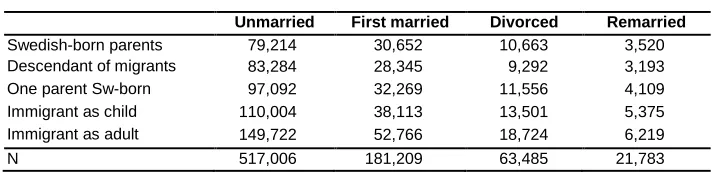
Table 1: Study populations of first marriage formation, divorce, and remarriage in Sweden
Unmarried First married Divorced Remarried
Swedish-born parents 79,214 30,652 10,663 3,520
Descendant of migrants 83,284 28,345 9,292 3,193
One parent Sw-born 97,092 32,269 11,556 4,109
Immigrant as child 110,004 38,113 13,501 5,375
Immigrant as adult 149,722 52,766 18,724 6,219
N 517,006 181,209 63,485 21,783
Note: Swedish register data, authors’ own calculations.
6. Results I: First marriage formation of immigrants in Sweden
Estimates of the cumulative fractions ever married at different ages (Table 2) show that about two thirds of Swedish-born women had been married at least once by age 55. These statistics cover a synthetic cohort (1983−2007) with decreasing as well as increasing period trends in marriage formation (see Ohlsson-Wijk 2011); the relatively low levels of estimated ultimate marriage formation reflect the fact that the study period was marked by strong postponement in marriage formation5. The statistics on ultimate levels of marriage formation do not differ tremendously between native- and foreign-born women, but immigrants who arrived in Sweden during childhood marry somewhat earlier than others. Our estimates for specific country groups of immigrant women in the lower section of Table 2 cover all immigrants regardless of age at migration to Sweden. Differences between country groups are not extremely large: immigrants from Turkey, North Africa, and the Middle East have higher levels of ultimate marriage formation than women from other countries; a few country groups, including Turkey, the Arab Middle East, and the former Yugoslavia stand out with patterns of very early marriage formation. By contrast, immigrants from Western and Southern Europe display relatively low levels of marriage formation in Sweden.
5 For women born during the 1950s, the ultimate level of ever-marriage reached about 80%. For women born
Table 2: Cumulative percentage married at ages 25, 35, 45, and 55, by country group of origin. Unmarried women in Sweden, 1983−2007
25 35 45 55
Swedish-born parents 13 52 63 67
Descendant of migrants 19 53 63 67
One parent Sw-born 13 49 61 65
Immigrant as child 26 56 66 70
Immigrant as adult 12 45 59 64
Finland 15 48 58 62
Other Nordic 10 43 58 64
Former Yugoslavia 32 59 68 71
Poland 14 48 60 65
Western Europe 7 39 53 60
Southern Europe 11 42 54 62
Baltic 9 40 54 65
Eastern Europe 16 49 62 66
US/Aus/NZ/Can 9 45 59 67
Central/South America 14 45 60 66
Horn of Africa 21 47 60 64
Sub-Saharan Africa 16 47 61 70
North Africa 23 57 73 80
Arab Middle East 41 69 80 84
Iran 16 53 69 75
Turkey 49 75 82 83
East Asia 8 47 66 73
South-East Asia 12 44 64 73
South Asia 17 51 64 67
Post-Soviet States 12 44 61 70
Note: Swedish register data, authors’ own calculations.
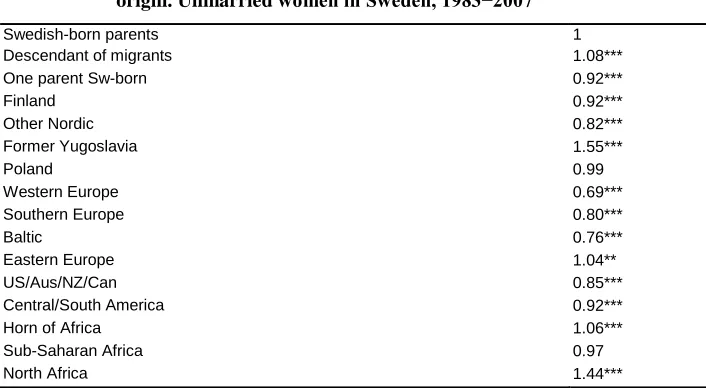
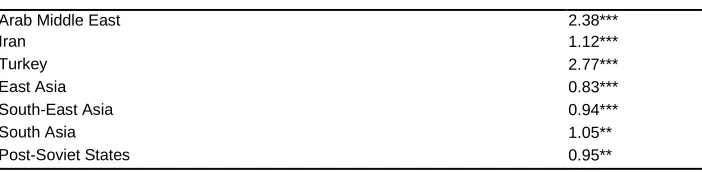
risks of marriage formation for foreign-born women from the former Yugoslavia, North Africa, the Arab Middle East, and Turkey and the depressed relative risks for women from Western Europe. We can also see that many immigrant groups differ very little from the natives with respect to their marriage formation risk.
Table 3a: Relative risk of first marriage formation, by broad country group of origin and other socio-demographic variables. Unmarried women in Sweden, 1983−2007
Swedish-born parents 1
Descendant of migrants 1.08***
One parent Sw-born 0.92***
Immigrant as child 1.31***
Immigrant as adult 0.91***
Primary School 1.04***
Secondary Education 1
University 1.01
Metropolitan 0.95***
Non-metropolitan 1
Note: Swedish register data, authors’ own calculations. Model includes control for age. *** = significant at the 1% level.
Table 3b: Relative risk of first marriage formation, by finer country groups of origin. Unmarried women in Sweden, 1983−2007
Swedish-born parents 1
Descendant of migrants 1.08***
One parent Sw-born 0.92***
Finland 0.92***
Other Nordic 0.82***
Former Yugoslavia 1.55***
Poland 0.99
Western Europe 0.69***
Southern Europe 0.80***
Baltic 0.76***
Eastern Europe 1.04**
US/Aus/NZ/Can 0.85***
Central/South America 0.92***
Horn of Africa 1.06***
Sub-Saharan Africa 0.97
Table 3b: (Continued)
Arab Middle East 2.38***
Iran 1.12***
Turkey 2.77***
East Asia 0.83***
South-East Asia 0.94***
South Asia 1.05**
Post-Soviet States 0.95**
Note: Swedish register data, authors’ own calculations. Model also includes controls for age, educational attainment and metropolitan/non-metropolitan residence. *** = significant at the 1% level, ** = 5% level, * = 10% level.
Table 4: Relative risk of first marriage formation for women born in Sweden, by their parents’ country group of origin. Never-married women in Sweden, 1983−2007
Sweden 1
Finland 0.93***
Other Nordic 1.04***
Former Yugoslavia 1.19***
Poland 0.86***
Western Europe 0.97**
Southern Europe 0.90***
Baltic 0.99
Eastern Europe 0.96**
US/Aus/NZ/Can 0.96
Central/South America 0.80***
Horn of Africa 0.71***
Sub-Saharan Africa 0.77***
North Africa 1.07*
Arab Middle East 1.98***
Iran 0.80***
Turkey 2.71***
East Asia 0.85***
South-East Asia 0.76***
South Asia 1.19***
Post-Soviet States 1.02
Note: Swedish register data, authors’ own calculations. Model also includes controls for age, educational attainment, and metropolitan/non-metropolitan residence. *** = significant at the 1% level, ** = 5% level, * = 10% level.
7. Results II: Divorce risks of immigrants in Sweden
Table 5: Cumulative percentage divorced at durations 5, 10, and 15 years since marriage formation, by country group of origin. First-married women in Sweden, 1983−2007
5 10 15
Swedish-born parents 10 20 28
Descendant of migrants 15 27 37
One parent Sw-born 14 27 36
Immigrant as child 19 33 42
Immigrant as adult 15 28 36
Finland 15 28 37
Other Nordic 14 28 38
Former Yugoslavia 16 27 34
Poland 22 36 46
Western Europe 12 23 32
Southern Europe 12 22 30
Baltic 14 25 36
Eastern Europe 21 35 44
US/Aus/NZ/Can 10 22 31
Central/South America 25 43 52
Horn of Africa 31 49 58
Sub-Saharan Africa 25 44 53
North Africa 23 38 45
Arab Middle East 17 28 34
Iran 25 41 48
Turkey 13 22 28
East Asia 14 26 34
South-East Asia 18 33 41
South Asia 17 31 37
Post-Soviet States 26 44 55
Note: Swedish register data, authors’ own calculations.
Foreign-born women from Poland and other Eastern European countries, Central & South America, Iran, and the three regions of Africa all have strikingly high divorce risks. By contrast, women from Southern Europe and Turkey have very low divorce risks, substantially lower than that of the Swedish-born population.
Table 6a: Relative risk of divorce, by broad country group of origin and other socio-demographic variables. First-married women in Sweden, 1983−2007
Swedish-born parents 1
Descendant of migrants 1.04**
One parent Swedish-born 1.05***
Immigrant as child 1.26***
Immigrant as adult 1.09***
Primary School 1.22***
Secondary Education 1
University 0.66***
Metropolitan 1.23***
Non-metropolitan 1
Age (Years) 0.91***
Partner same nationality 0.76***
Note: Swedish register data, authors’ own calculations. Model includes control for duration of marriage. *** = significant at the 1% level, ** = 5% level, * = 10% level.
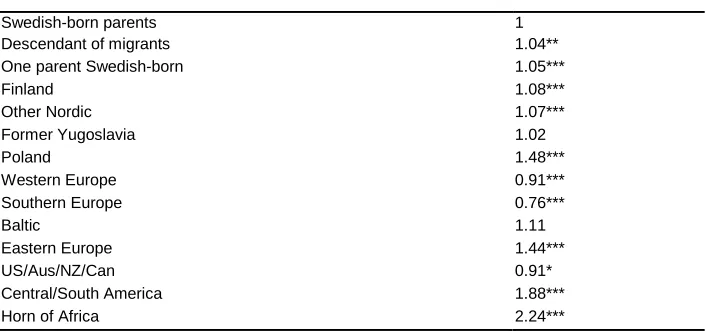
Table 6b: Relative risk of divorce, by finer country groups of origin. First-married women in Sweden, 1983−2007
Swedish-born parents 1
Descendant of migrants 1.04**
One parent Swedish-born 1.05***
Finland 1.08***
Other Nordic 1.07***
Former Yugoslavia 1.02
Poland 1.48***
Western Europe 0.91***
Southern Europe 0.76***
Baltic 1.11
Eastern Europe 1.44***
US/Aus/NZ/Can 0.91*
Central/South America 1.88***
Table 6b: (Continued)
Sub-Saharan Africa 1.82***
North Africa 1.72***
Arab Middle East 1.12***
Iran 2.15***
Turkey 0.69***
East Asia 1.09*
South-East Asia 1.16***
South Asia 1.19***
Post-Soviet States 2.41***
Note: Swedish register data, authors’ own calculations. Model also includes controls for duration of marriage, age, educational attainment, partner’s country background, and metropolitan/non-metropolitan residence. *** = significant at the 1% level, ** = 5% level, * = 10% level.
8. Results III: Re-marriage propensities of immigrants in Sweden
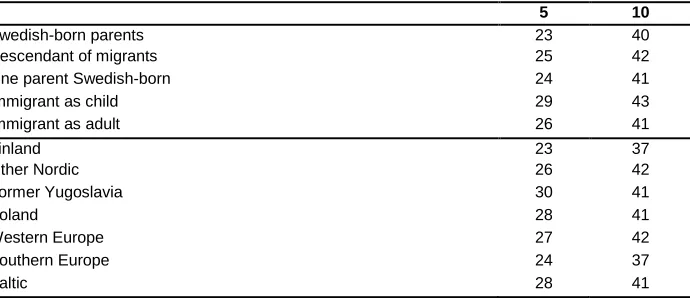
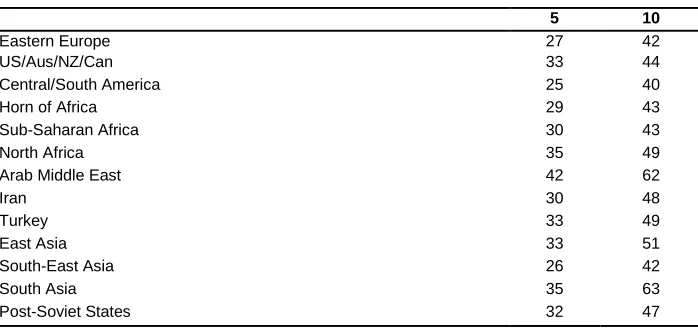
Four in ten first-divorced Swedish native women had re-married at the duration of ten years since marital dissolution (Table 7). Immigrants and their descendants re-marry to a somewhat larger extent than the Swedish-born majority population. Immigrants from the Arab Middle East, Turkey, Iran, North Africa, South Asia, and East Asia have higher re-marriage rates than others.
Table 7: Cumulative percentage re-married at the durations of 5 and 10 years since divorce, by country group of origin. First-divorced women in Sweden, 1983−2007
5 10
Swedish-born parents 23 40
Descendant of migrants 25 42
One parent Swedish-born 24 41
Immigrant as child 29 43
Immigrant as adult 26 41
Finland 23 37
Other Nordic 26 42
Former Yugoslavia 30 41
Poland 28 41
Western Europe 27 42
Southern Europe 24 37
Table 7: (Continued)
5 10
Eastern Europe 27 42
US/Aus/NZ/Can 33 44
Central/South America 25 40
Horn of Africa 29 43
Sub-Saharan Africa 30 43
North Africa 35 49
Arab Middle East 42 62
Iran 30 48
Turkey 33 49
East Asia 33 51
South-East Asia 26 42
South Asia 35 63
Post-Soviet States 32 47
Note: Swedish register data, authors’ own calculations.
Table 8a: Relative risk of re-marriage, by broad country group of origin and other socio-demographic variables. First-divorced women in Sweden, 1983−2007
Swedish-born parents 1
Descendant of migrants 1.00
One parent Swedish-born 1.01
Immigrant as child 1.07***
Immigrant as adult 1.05**
Primary School 0.98
Secondary Education 1
University 1.00
Metropolitan 0.97***
Non-metropolitan 1
Age (Years) 0.79***
Note: Swedish register data, authors’ own calculations. Model includes control for duration since divorce. *** = significant at the 1% level.
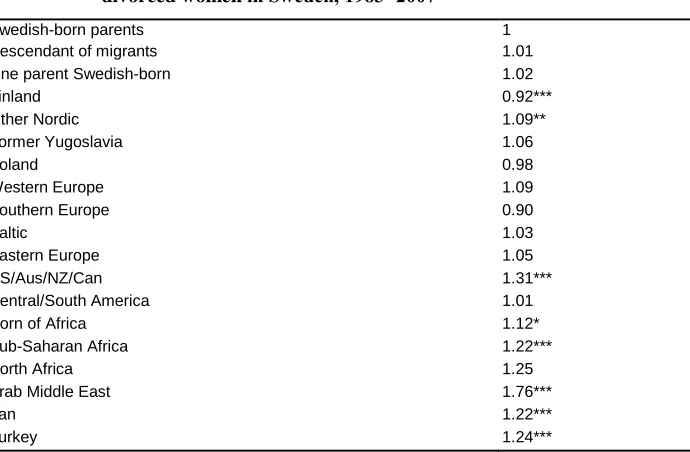
Table 8b: Relative risk of re-marriage, by finer country groups of origin. First-divorced women in Sweden, 1983−2007
Swedish-born parents 1
Descendant of migrants 1.01
One parent Swedish-born 1.02
Finland 0.92***
Other Nordic 1.09**
Former Yugoslavia 1.06
Poland 0.98
Western Europe 1.09
Southern Europe 0.90
Baltic 1.03
Eastern Europe 1.05
US/Aus/NZ/Can 1.31***
Central/South America 1.01
Horn of Africa 1.12*
Sub-Saharan Africa 1.22***
North Africa 1.25
Arab Middle East 1.76***
Iran 1.22***
Table 8b: (Continued)
East Asia 1.39***
South-East Asia 1.09*
South Asia 1.48***
Post-Soviet States 1.20*
Note: Swedish register data, authors’ own calculations. Model also includes controls for duration since divorce, age, educational attainment, and metropolitan/non-metropolitan residence. *** = significant at the 1% level, ** = 5% level, * = 10% level.
9. Discussion
In this study we produced a detailed overview of patterns in marriage formation and divorce of immigrant women in Sweden. A key contribution of our study is that we were able to break down the immigrant population into a fairly large number of country categories, representing a wide variety of migrant backgrounds in terms of the societies and family systems they come from. By means of access to large-scale longitudinal register data, we were able to distinguish between and provide statistics for some twenty country groups of immigrant women. In addition, we produced comparable data for the daughters of immigrants in Sweden. A further contribution of our study is that we are able to distinguish between descendant daughters with two foreign-born parents and those with one foreign-born and one Swedish-born parent. We were also able to distinguish between immigrants who arrived in Sweden at adult ages and those who arrived with their parents during childhood.
Our results suggest that the heterogeneity in partnership dynamics across immigrant groups in Sweden is a result of a complex interplay of factors. In our introduction we formulated a few hypotheses regarding mechanisms that will produce different patterns of difference and similarity in the nuptial behavior of migrants. We find at least some evidence of support for each of our four hypotheses. For example, the relatively high levels of divorce for the majority of immigrant groups can likely be ascribed to the disruption of family life that stems from the situation of being a migrant. The stress associated with the migration act and the exposure to new gender and social norms may be responsible for the elevated divorce risks in some groups. The relatively low rates of marriage formation in many country groups of immigrants may also be ascribed to the disruptive effects of migration on partnership formation. However, the act of migration may also affect marriage formation rates in the opposite direction: The elevated risks of first marriage formation for immigrants from Turkey, the Arab Middle East, former Yugoslavia, and North Africa may be related to the common practice of marriage migration in these populations.
In many cases we found patterns in marriage formation and marriage dissolution that were very similar to those observed for the reference group of Swedish-born women with two Swedish-born parents. With some imagination, we could interpret these similarities as evidence of adaptation of behaviors to those prevailing in the Swedish context. However, we also find many differences in behavior that could, also with some imagination, be linked to differences in family systems and patterns in family dynamics in immigrants’ countries of origin. The persistence of such differences in behaviors in the Swedish context provides support for the importance of childhood socialization into different modes of family-related behaviors. Family systems differ considerably across countries and regions of the world (cf. Hajnal 1965; Goody 1983; Goode 1963, 1993; Therborn 2004); the cultural and ideational factors linked to these family systems are among the strongest candidates for explaining many group-specific differences in family dynamics. There is very little international comparative data on marriage and divorce that we can rely on in our assessment,6 but the demographic and ethnographic literature provides helpful guidance. For example, the literature on Latin America tells of relatively weak families and low levels of formal marriage formation (e.g., López-Gay et al. 2014), while that on Africa tells of often complex and dynamic patterns of marriage formation and marital turnover (e.g., Lesthaeghe, Kaufmann, and Meekers 1989; Tabutin and Schoumaker 2004). The Arab world has historically been characterized by high levels of marital turnover, with high rates of marriage formation,
6 The United Nations provide crude statistics on the estimated fractions of the population in member countries
divorce, and remarriage (cf. Goode 1993; Cuno 2008), and the same holds for parts of South East Asia (Jones 1997) but not for Iran (Abbasi-Shavazi and McDonald 2008) or Turkey (Nauck and Klaus 2008; Yüksel-Kaptanoğlu, Eryurt, and Koç 2012), where divorce levels traditionally have been low. Our finding on low levels of marriage and divorce for immigrants from Southern Europe aligns very well with family-demographic data from that region (cf. Andersson and Philipov 2002), and that on the elevated remarriage risks of immigrants from overseas Anglo-Saxon countries with US patterns of high marital turnover (Cherlin 2009). In our study the diversity of partnership dynamics is manifested not only in the signs of the coefficients but also in their magnitude. In general, we note that differences in partnership dynamics tend to be more pronounced when natives and non-Western immigrants to Sweden are compared than when the comparison is made with immigrants from more similar countries of origin. In our introduction we argued that the Swedish context provides many elements conducive to reproducing differences in behaviors related to marriage and divorce. In a context where an individual’s civil status brings few or no consequences in terms of his or her social rights we may find that cultural and symbolic factors related to marriage play a larger role instead.
Further, the emergence and perpetuation of migration flows to Sweden differ considerably across countries of origin and it is likely that the process of selection into migration shapes our results. To illustrate, Iran and Turkey are neighboring countries which share the same religion and which are placed fairly close to each other on the Inglehart-Weizel cultural map (Inglehart 2006). The two countries do not differ too much with respect to divorce rates at the national level either. If migration from these two countries to Sweden were random one would expect family dynamics to be similar for the two immigrant groups. Yet our results indicate that the risk of first marriage formation is substantially higher among the Turkish-born immigrants in Sweden. Moreover, when looking at divorce risks, these two groups differ from each other more than they differ from Swedish natives. Although we are unable to measure its relative importance, selection into migration is most likely responsible for producing many of the patterns we observe for other groups as well.
migrants as well7. Likewise, we experimented with the inclusion of all divorced people in our re-marriage models rather than only studying the initial cohorts of unmarried migrants to Sweden. The approach we chose to present produced somewhat lower remarriage rates, which could be interpreted as more evidence of adaptation in the remarriage careers of the more demographically established immigrants in Sweden.
Our main hypotheses are first of all relevant for the study of actual migrants; some of them may matter for the descendants of immigrants as well. On average, differences are less pronounced between natives and Swedish-born children of immigrants, as far as the first marriage formation is concerned. This is even more pronounced in the case of divorce and re-marriage where the descendants of immigrants only display slightly elevated divorce risks and the same re-marriage risks as those of women with two Swedish-born parents. In the case of first marriage formation we presented a more in-depth analysis, by the descendants’ parental background. For most European as well as for non-European Anglo-Saxon second generation groups the differences to natives are negligible. This finding is most likely associated with the processes of assimilation and adaptation, at least in the majority of cases in which the relative risk of first marriage formation is depressed in the parental generation but not in the descendant generation. On the other hand, Swedish-born women of Turkish and Arab Middle East parental origin have much higher risk of marriage formation, and they do not differ much from their parents’ generation in this sense. This finding suggests that the socialization into group-specific modes of early marriage formation matter for these groups. Interestingly, for many groups, such as children of immigrants from Poland, Central/South America, the Horn of Africa, Sub-Saharan Africa, Iran, and South-East Asia, the differences relative to natives are somewhat more pronounced in the descendant generation. More precisely, while first generation immigrant women from these regions do not differ much from native women, the risk of first marriage formation is substantially lower among the descendants of these immigrants. The finding aligns with findings of depressed fertility in many groups of descendants to immigrants in Sweden (Andersson and Persson 2014). It may indicate different degrees of difficulty for various minority populations in the marriage market and in the process of getting established as a young adult in Sweden.
Our study provided valuable insight into patterns of marriage formation and marriage dissolution of immigrants in Sweden. It addressed many of the research questions we posed but left other issues unaddressed. For example, we leave it for future research to study whether differential levels of first marriage formation and divorce can be ascribed to differences in immigrants’ success or lack of success in the
7 It is evident that we cannot study the marriage formation in Sweden of immigrants who were already
Swedish labor market. In addition, future research on marriage and divorce in general and on immigrant nuptiality in particular would benefit from paying more attention to the role of men in such dynamics. In the case of marriage formation, it is, for example, sometimes the case that a male migrant moves to a new country while being un-married, in order to be joined later by his newly wed wife (Statistics Sweden 2015). Such instances of marriage migration go undetected in our study on migrant women.
10. Acknowledgements
References
Abbasi-Shavazi, M.J. and McDonald, P. (2008). Family change in Iran: Religion, revolution, and the state. In: Jayakody, R. et al. (eds.). International Family Change. New York: Taylor & Francis: 177−198.
Adsera, A. and Ferrer, A. (2014). Immigrants and demography: Marriage, divorce, and fertility. IZA Discussion Paper, No. 7982.
Andersson, G. (1995). Divorce-risk trends in Sweden 1971-1993. European Journal of Population 11(4): 293−311. doi:10.1007/BF01267721.
Andersson, G. (1997). The impact of children on divorce risks of Swedish women. European Journal of Population 13(2): 109−145. doi:10.1023/A:1005803001 129.
Andersson, G. (1998). Trends in marriage formation in Sweden 1971-1993. European Journal of Population 14(2): 157−178. doi:10.1023/A:1006003520829.
Andersson, G. (2002). Dissolution of unions in Europe: A comparative overview. Zeitschrift für Bevölkerungswissenschaft 27: 493−504.
Andersson, G. (2004a). Childbearing after migration: Fertility patterns of foreign-born women in Sweden. International Migration Review 38(2): 747−775.
doi:10.1111/j.1747-7379.2004.tb00216.x.
Andersson, G. (2004b). Children's experience of family disruption and family formation: Evidence from 16 FFS countries. Vienna Yearbook of Population Research 2004: 313−332.
Andersson, G. and Kolk, M. (2011). Trends in childbearing and nuptiality in Sweden: An update with data up to 2007. Finnish Yearbook of Population Research 2011: 21−29.
Andersson, G. and Persson, L. (2014). Childbearing among the descendants of immigrants in Sweden. Stockholm Research Reports in Demography 2014: 17. Andersson, G. and Philipov, D. (2002). Life-table representations of family dynamics in
Sweden, Hungary, and 14 other FFS countries: A project of descriptions of demographic behavior. Demographic Research 7(4): 67−270. doi:10.4054 /DemRes.2002.7.4.
Andersson, G. and Scott, K. (2007). Childbearing dynamics of couples in a universalistic welfare state: The role of labor-market status, country of origin, and gender. Demographic Research 17(30): 897−938. doi:10.4054/DemRes. 2007.17.30.
Bernhardt, E. and Hoem, B. (1985). Cohabitation and social background: Trends observed for Swedish women born between 1936 and 1960. European Journal of Population 1(4): 375−395. doi:10.1007/BF01797149.
Bernhardt, E., Goldscheider, C., Goldscheider, F., and Bjerén, G. (2007). Immigration, Gender and Family Transition to Adulthood in Sweden. Lanham, Md: University Press of America.
Blanc, A. (1987). The formation and dissolution of second unions: Marriage and cohabitation in Sweden and Norway. Journal of Marriage and the Family 49(2): 391−400. doi:10.2307/352308.
Charsley, K. (2005). Unhappy husbands: Masculinity and migration in transnational Pakistani marriages. Journal of the Royal Anthropological Institute 11(1): 85−105. doi:10.1111/j.1467-9655.2005.00227.x.
Cherlin, A. (2009). The Marriage-Go-Round: The State of Marriage and the Family in America Today. New York: Alfred Knopf.
Chiswick, B. (1978). The effect of Americanization on the earnings of foreign-born men. The Journal of Political Economy 86(5): 897−921. doi:10.1086/260717. Cuno, K. (2008). Divorce and the fate of the family in modern century Egypt. In:
Yount, K. and Rashad, H. (eds.). Family in the Middle East. London: Routledge: 196−216.
Darvishpour, M. (2002). Immigrant women challenge the role of men: How the changing power relationship within Iranian families in Sweden intensifies family conflicts after immigration. Journal of Comparative Family Studies 33(2): 271−296.
de Graaf, P. and Kalmijn, M. (2003). Alternative routes in the remarriage market: Competing-risk analyses of union formation after divorce. Social Forces 81(4): 1459−1498. doi:10.1353/sof.2003.0052.
Dribe, M. and Lundh, C. (2011). Cultural dissimilarity and intermarriage: A longitudinal study of immigrants in Sweden 1990-2005. International Migration Review 45(2): 297−324. doi:10.1111/j.1747-7379.2011.00849.x.
Dribe, M. and Lundh, C. (2012). Intermarriage, value context and union dissolution: Sweden 1990–2005. European Journal of Population 28(2): 139−158.
doi:10.1007/s10680-011-9253-y.
Duvander, A.-Z. (1999). The transition from cohabitation to marriage: A longitudinal study of the propensity to marry in Sweden in the early 1990s. Journal of Family Issues 20(5): 698−717. doi:10.1177/019251399020005007.
Eeckhaut, M., Lievens, J., Van de Putte, B., and Lusyne, P. (2011). Partner selection and divorce in ethnic minorities: Distinguishing between two types of ethnic homogamous marriages. International Migration Review 45(2): 269−296.
doi:10.1111/j.1747-7379.2011.00848.x.
Furtado, D., Marcén, M., and Sevilla, A. (2013). Does culture affect divorce? Evidence from European immigrants in the United States. Demography 50(3): 1013−1038.
doi:10.1007/s13524-012-0180-2.
Goode, W. (1963). World Revolution and Family Patterns. New York: Free Press. Goode, W. (1993). World Changes in Divorce Patterns. New Haven: Yale University
Press.
Goody, J. (1983). The Development of the Family and Marriage in Europe. Cambridge: Cambridge University Press. doi:10.1017/CBO9780511607752.
Graham, M. and Khosravi, S. (1997). Home is where you make it: Repatriation and diaspora culture among Iranians in Sweden. Journal of Refugee Studies 10(2): 115−133. doi:10.1093/jrs/10.2.115.
Haandrikman, K. (2014). Binational marriages in Sweden: Is there an EU effect? Population, Space and Place 20(2): 177−199. doi:10.1002/psp.1770.
Hajnal, J. (1965). European marriage pattern in historical perspective. In: Glass, D.V. and Eversley, D.E.C. (eds.). Population in History. London: Arnold: 101−143. Hoem, J.M. (1991). To marry, just in case ...: the Swedish widow’s-pension reform and
the peak in marriages in December 1989. Acta Sociologica 34: 127−135.
Huschek, D., Liefbroer, A., and de Valk, H. (2010). Timing of first union among second-generation Turks in Europe: The role of parents, peers and institutional context. Demographic Research 22(16): 473−504. doi:10.4054/DemRes. 2010.22.16.
Inglehart, R. (2006). Mapping global values. Comparative Sociology 5: 114−136.
doi:10.1163/156913306778667401.
Jones, G. (1997). Modernization and divorce: Contrasting trends in Islamic Southeast Asia and the West. Population and Development Review 23(1): 95−114.
doi:10.2307/2137462.
Kalmijn, M., de Graaf, P., and Janssen, J. (2005). Intermarriage and the risk of divorce in the Netherlands: The effects of differences in religion and in nationality, 1974–94. Population Studies 59(1): 71−85. doi:10.1080/0032472052000332719. Kelly, M. (2013). Onward Migration: The Transnational Trajectories of Iranians Leaving Sweden [Doctoral Dissertation]. Uppsala: Department of Social and Economic Geography, Uppsala University.
Kulu, H. (2006). Fertility of internal migrants: Comparison between Austria and Poland. Population, Space and Place 12(3): 147−170. doi:10.1002/psp.406. Kulu, H. and González-Ferrer, A. (2014). Family dynamics among immigrants and their
descendants in Europe: Current research and opportunities. European Journal of Population 30: 411−435. doi:10.1007/s10680-014-9322-0.
Lesthaeghe, R., Kaufmann, G., and Meekers, D. (1989). The nuptiality regimes in sub-Saharan Africa. In: Lesthaeghe, R. (ed.). Reproduction and Social Organization in sub-Saharan Africa. Berkeley: University of California Press: 238−337. Lesthaeghe, R. and Surkyn, J. (1995). Heterogeneity in social change: Turkish and
Moroccan women in Belgium. European Journal of Population 11(1): 1−29.
doi:10.1007/BF01264103.
Lewin, F.A. (2001). Identity crisis and integration: The divergent attitudes of Iranian immigrant men and women towards integration into Swedish society. International Migration 39(3): 121−135. doi:10.1111/1468-2435.00159.
McDonald, J.T. and Kennedy, S. (2004). Insights into the ‘healthy immigrant effect’: Health status and health service use of immigrants to Canada. Social Science & Medicine 59(8): 1613−1627. doi:10.1016/j.socscimed.2004.02.004.
Milewski, N. and Kulu, H. (2014). Mixed marriages in Germany: A high risk of divorce for immigrant-native couples. European Journal of Population 30(1): 89−113.
doi:10.1007/s10680-013-9298-1.
Nauck, B. and Klaus, D. (2008). Family change in Turkey: Peasant society, Islam, and the revolution “from above”. In: Jayakody, R. et al. (eds.). International Family Change. New York: Taylor & Francis: 281−312.
Nekby, L. (2012). Cultural integration in Sweden. In: Algan, Y., Bisin, A., Manning, A., and Verdier, T. (eds.). Cultural Integration of Immigrants in Europe. Oxford: Oxford University Press, Studies of Policy Reform: 172−209.
doi:10.1093/acprof:oso/9780199660094.003.0006.
Niedomysl, T., Östh, J., and Van Ham, M. (2010). The globalisation of marriage fields: The Swedish case. Journal of Ethnic and Migration Studies 36(7): 1119−1138.
doi:10.1080/13691830903488184.
Obućina, O. (2014). Marriage migration and divorce risk in Sweden. Paper presented at the British Society for Population Studies Conference, Winchester, UK. September 2014.
Ohlsson-Wijk, S. (2011). Sweden’s marriage revival: An analysis of the new-millennium switch from long-term decline to increasing popularity. Population Studies 65(2): 183−200. doi:10.1080/00324728.2011.574724.
Ohlsson-Wijk, S. (2014). Digit preferences in marriage formation in Sweden: Millennium marriages and birthday peaks. Demographic Research 30(25): 421−432. doi:10.4054/demres.2014.30.25.
Ohlsson-Wijk, S. (2015). Family Formation in Sweden at the Turn of the New Millenium. Stockholm: Stockholm University Demography Unit – Dissertation Series 13.
Parusel, B. (2009). Focus migration: Country profile Sweden. Hamburg: Hamburg Institute of International Economics (HWWI).
Sardon, J.P. (1986). Evolution de la nuptialité et de la divortialité en Europe depuis la fin des années 1960. Population 41(3): 463−482. doi:10.2307/1532803.
Sobotka, T. (2008). The rising importance of migrants for childbearing in Europe. Demographic Research 19(9): 225−248. doi:10.4054/DemRes.2008.19.9. Statistics Sweden (2004). Efterkrigstidens invandring och utvandring [Immigration and
emigration during the postwar period]. Demografiska rapporter 2004:5.
Statistics Sweden (2008). Anhöriginvandrare och deras familjer [Family-reunification immigrants and their families]. Demografiska rapporter 2008:3.
Statistics Sweden (2010). Födda i Sverige – ändå olika? [Born in Sweden – yet different?]. Demografiska rapporter 2010:2.
Statistics Sweden (2012). Sambo, barn, gift, isär? [Cohabiting, kids, married, apart?]. Demografiska rapporter 2012:1.
Statistics Sweden (2014). Generationer genom livet [Generations across life]. Demografiska rapporter 2014:2.
Statistics Sweden (2015). Kärlek över gränserna – migration och familjebildning [Love across the borders – Migration and family formation]. Demografiska rapporter 2015:1.
Tabutin, D. and Schoumaker, B. (2004). The demography of sub-Saharan Africa from the 1950s to the 2000s: A survey of changes and a statistical assessment. Population-E 59(3-4): 457−556. doi:10.2307/3654914.
Therborn, G. (2004). Between Sex and Power. London: Routledge. Trost, J. (1979). Unmarried Cohabitation. Västerås: International Library.
United Nations Statistics Division (2012). Demographic Yearbook. New York: United Nations.
van de Kaa, D. (1987). Europe’s second demographic transition. Population Bulletin 42.
van Kerckem, K., van der Bracht, K., Stevens, P. and van de Putte, B. (2013). Transnational marriages on the decline: Explaining changing trends in partner choice among Turkish Belgians. International Migration Review 47(4): 1006−1038. doi:10.1111/imre.12053.