Summary
ObjectiveParental alienation is very common in conflictual separations and is a serious problem in most parts of the world. In 50% of separations and in one-third of divorces a child under 18 is involved. One of the major problems in these cases is when chil-dren reject a parent after divorce. In conflictual separations a real psychopathology, defined as parental alienation syndrome (PAS) in 1985, can develop. In recent years, a growing interest in this syndrome has been seen in the international scientific commu-nity: several studies have been carried out and the necessity for a more accurate definition of PAS has been considered beneficial because courts, scientific and clinical practice are interested in this syndrome. In order to understand parental alienation bet-ter, our investigation aims to identify which findings in published studies may be useful to clinical practice involving both parents and children.
Methods
Our study systematically reviewed all publications in the MED-LINE/PubMed database searching for the terms “parental aliena-tion”, “parental alienation syndrome”, or “parental alienation disease” as keywords. We included studies and books that were published online between 1985 and 2015, included original data or reviews and involved assessment and/or diagnosis and/ or treatment of PAS. This assessment will reveal strengths and weaknesses in the current PAS literature; moreover, we present suggestions for improving the refinement of the literature.
Results
A total of 28 articles and books were appropriate for this review. The studies included raised many fundamental questions such as the scientific validity of PAS, the proposal of specific diagnos-tic criteria and the importance of an accurate diagnosis. Find-ings from studies that met inclusion criteria in our review are presented, suggesting new clinical perspectives and raising new questions concerning assessment and treatment.
Conclusion
The theme of parental alienation is currently the subject of im-portant research and debate. Based on the research carried out, we could state that parent alienation does not correspond to a “syndrome” or a specific individual psychic “disorder”. It can better defined as a dysfunctional family relation model deter-mined by the excluding or “alienating” parent, the excluded or “alienated” parent and the child, each member of this triad with his/her own responsibilities and contribution. The explanation of this disorder has its own validity, but thorough research to clarify its features, (e.g. duration and intensity of symptoms) should be conducted, otherwise it could be instrumentally used in litiga-tions. Further systematic and large-scale studies of parental al-ienation are needed that take into account the issues discussed and proper objective diagnostic criteria should be defined for scrupulous diagnosis and valid treatment.
Key words
Alienation • parental alienation • denigration • parent-child relational problems
Parental alienation syndrome or alienating parental relational behaviour
disorder: a critical overview
Sindrome da alienazione parentale o disturbo del comportamento relazionale genitoriale di tipo
alienante: un’overview critica
A. Siracusano, Y. Barone, G. Lisi, C. Niolu
Dipartimento di Medicina dei Sistemi, Università di Roma Tor Vergata, UOC di Psichiatria e psicologia clinica, Policlinico Tor Vergata, Roma, Italia
Correspondence
Ylenia Barone, UOC di Psichiatria, via Nomentana 1362, 00137 Roma, Italia • E-mail: ylenia.barone@ hotmail.it
Introduction
Parental Alienation is very common in conflictual separa-tions and is a serious problem in most parts of the world. Nearly half (48.7%) of separations and one-third (33.1%) of divorces concern marriages with at least one child un-der 18. The number of minor children who were placed in foster care in 2012 amounted to 65,064 in separations and 22,653 in divorces. In separations, 54.5% of children in foster care were under 11 years of age; 20% of cases
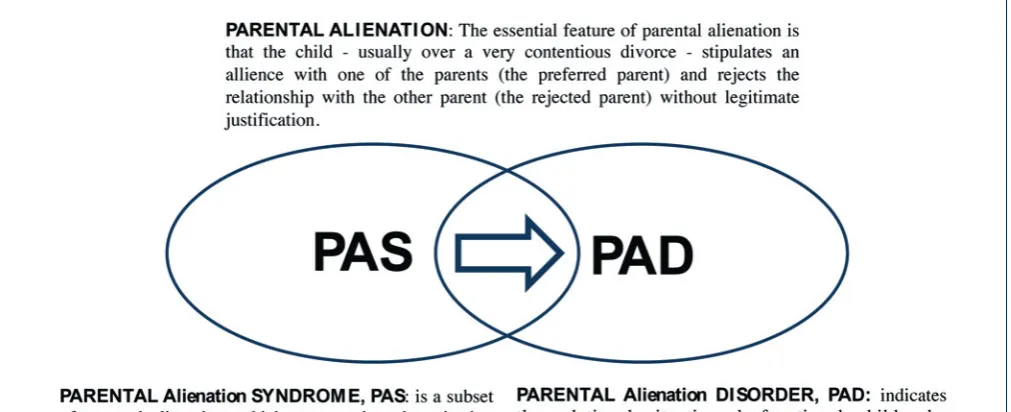
ienation is that the child – usually over a very contentious divorce – stipulates an alliance with one of the parents (the preferred parent) and rejects the relationship with the other parent (the rejected parent) without legitimate jus-tification” (Fig. 1) 5 6.
This definition was later clarified by Cavedon and Magro in 2010, who defined the following criteria:
1. the child is allied with one of the parents and rejects the relationship with the other parent without any legiti-mate justification, usually in the context of a conflictual separation that can involve a child custody dispute; 2. the child shows the following behaviour: a) constant
rejection of a parent that can become a real campaign of denigration; b) use of futile, weak or absurd ration-alisations, in order to criticise the rejected parent per-sistently;
3. the child shows at least two of the following behav-iours and attitudes: a) lack of ambivalence; b) phe-nomenon of the independent thinker; c) automatic support of the alienating parent; d) no guilty feelings for not respecting and not accepting the feelings of the alienated parent; e) presence of borrowed scenarios; f) spread of animosity towards the alienated parent’s extended family 7.
PAS: Features
Gardner described PAS as a preoccupation by the child with criticism and deprecation of a parent, and stated that PAS occurs when, in the context of child custody dis-putes, one parent deliberately or unconsciously attempts to alienate a child from the other parent 4 8 9.
The author described eight symptoms:
Campaign of denigration: It involves the active partici-pation of the child to the disparaging campaign against the target spouse, without scolding or punishment by the alienated parent.
Weak, frivolous, and absurd rationalisations for the child’s criticism of the targeted parent: When they are asked to report specific incidences or explicit examples which support their accusations, they are unable to document credible, significant, or factual examples.
Lack of ambivalence: very likely, PAS children will report a long list of deficits about their targeted parent while minimising or refuting any positive attribute or redeeming quality of that parent.
The independent thinker phenomena: the child claims to be independent in making decisions and judgments about the alienated parent, rejecting accusations of being a weak and passive person.
Reflexive support of the alienating parent: the phenom-enon of the ‘’identification with the aggressor” can be connected to this. The child being weak supports the al-ienating parent because of his/her power.
courts, scientific and clinical practice are interested in this syndrome. PAS is the subject of a heated debate in both the scientific and legal fields. In particular, while attention is paid to the reliability and scientific validity of the syndrome, there is also the risk of the disorder being exploited in legal disputes or in the media.
In order to understand parental alienation better, our in-vestigation aims to identify which findings in published studies may be useful to clinical practice with both par-ents and children.
Method
This article provides an up-to-date critical review of sci-entific articles on parental alienation. We will begin by reviewing the criteria for its definition, postulated patho-genesis and subtypes in order to lay the foundation for understanding PAS; next, we will delineate how PAS is placed in the psychiatric classification, including its re-lationship with official diagnostic categories of psycho-pathology.
Our study systematically reviewed all publications in the MEDLINE/PubMed database searching for the terms “parental alienation”, “parental alienation syndrome”, or “parental alienation disease” as keywords. We included studies and books that: (i) were published online between 1985 and 2015, (ii) included original data or reviews and (iii) were concerned with assessment and/or diagnosis and/or treatment of PAS. Consequently, we excluded publications that concerned child maltreatment or abuse not acknowledged as PAS. In the end, we selected rel-evant studies according to the inclusion criteria specified above. A total of 28 articles and books were appropriate for this review. This assessment will reveal strengths and weaknesses in the current PAS literature; moreover, we present suggestions for improving the refinement of the literature.
PAS: definition
PAS was defined for the first time in 1985 by Richard Gard-ner as a disorder that primarily arises in the context of court divorces that involve a dispute over the custody of the chil-dren. Its primary manifestation is the unjustified campaign of denigration by the child of one parent. In the words of the author, PAS can be described as “a childhood disor-der, which arises almost exclusively in the context of child custody disputes. Its primary manifestation is the child’s campaign of denigration against a parent that results from the combination of a parent’s programming (brain wash-ing) indoctrinations and the child’s own contributions to the vilification of the target parent” 34.
al-transitional difficulties at the time of visitation; in severe PAS, all of the eight characteristic symptoms are present with severe intensity, and the children refuse to have con-tact with the alienated parents 8-10.
In clinical cases of mild PAS psychological intervention is not usually needed. However, it is important to raise awareness among relevant experts to avoid incorrect as-sessment and incorrect handling of situations, and it is essential to reassure the alienating parent about the pos-sibility of keeping custody of child.
In cases of moderate PAS, which are the most common, the court should establish a system of effective sanctions to be inflicted on the alienating parent, if he/she tries to sabotage the therapeutic program agreed on with the psy-chotherapist.
In cases of severe PAS, it is necessary, according to Gard-ner, to enact stringent measures that provide for the trans-fer of primary custody to the alienated parent, and simul-taneously placing the child’s residence in his/her house. If this is the case, it is possible to gradually transfer the child to the alienated parent’s house by arranging some “transitional accommodation” (e.g. the home of a friend, of a relative, community housing, or hospitalisation) 10 11.
DSM-5 and parental alienation
In the DSM-5 the expression “parental alienation” is not present, and the phenomenon is called differently. Paren-Absence of guilt over cruelty to or exploitation of the
al-ienated parent: Child victims of the alienating parent’s campaign of denigration do not feel guilt or empathy to-wards the victim parent and do not feel a decrease in their self-esteem, which is part of the guilt.
Presence of borrowed scenarios: Children use phrases and expressions learned from the adults’ vocabulary and relate events they have never lived or cannot know about, but that are part of the smear campaign.
Spread of the child’s animosity to the extended family of the alienated parent: PAS children also inexplicably reject those relatives they had previously had a loving relationship with and turn hostile to them.
Later, Gardner 4 added four more diagnostic criteria: • difficulties of transition when visiting the
non-custo-dial parent;
• behaviour of the child during visits or periods of stay at the alienated parent’s;
• bond with the alienating parent;
• bond with the alienated parent (before the start of the process of alienation).
Depending on the intensity of the symptoms, Gardner established three levels of PAS severity: mild, moderate, and severe. In mild PAS, alienation is relatively superfi-cial, and children mostly cooperate with visitation but are intermittently critical and disgruntled with the victimised parent; in moderate PAS, alienation is more intense, and children are more disruptive and disrespectful. There are FIgure 1.
A. The child – whose parents are usually involved in a highly contentious divorce – is strongly allied with one of the parents and persistently refuses the rela-tionship with the other alienated parent without any reasonable justification. The child refuses to visit the alienated parent and his/her custodial relationship. B. The child experiences the following behaviours:
1. persistent rejection or denigration of a parent that reaches the level of a campaign of denigration; 2. weak, superficial and absurd rationalisations for
persistent criticism towards the rejected parent; C. The child shows two of the six following attitudes and
behaviours:
1. lack of ambivalence;
2. phenomenon of the independent thinker;
3. automatic support of one parent against the other; 4. absence of guilt towards the rejected parent; 5. presence of borrowed scenarios;
6. extension of hostility to the extended family of the rejected parent.
D. The duration of the disturbance is at least 2 months. E. The disturbance causes clinically significant distress
or impairment in social, academic, occupational, or other important areas.
F. The child refuses to visit the rejected parent without a reasonable justification. The parental alienation disor-der is not diagnosed if the rejected parent abuses the child.
Current debate on parental alienation
and its diagnosis
Despite a growing literature, the term parental alienation syndrome (PAS) continues to raise controversy in child custody matters. Controversy exists, however, in concep-tualising the problem of alienated children and in us-ing the term PAS 14-17. Those favouring the term believe it helps in understanding and treating a well-recognised phenomenon. Those opposing the term believe that it lacks an adequate scientific foundation to be considered a syndrome and that courts should not admit testimony on PAS. Critics argue that PAS is either an unnecessary or potentially damaging label for normal divorce-relat-ed behaviour, that it oversimplifies the aetiology of the symptoms it subsumes, and that it may result in custody decisions which fail to promote children’s welfare.
Is there scientific evidence?
Many authors criticise the existence of PAS, claiming that clinical and empirical evidence is rather limited and therefore there is not adequate scientific evidence. Actu-ally, careful research in the literature on the subject of parental alienation has shown that there are more than tal alienation can, in fact, be framed within the category
of Relational Problems. The DSM-5 defines Relational Problems as “persistent and dysfunctional patterns of feel-ings, behaviours, and perceptions involving two or more partners in an important personal relationship”, laying stress on the individual in the relationship. In order to be diagnosed, the relational disorder requires a pathological interaction between the actors involved in the relation-ship. DSM-5 classifies the parent-child relational prob-lems among Relational Disorders. This category should be used when the main object of clinical attention is the quality of the relationship existing between parent and child, or when the quality of the parent-child relationship dramatically influences the course, prognosis or treat-ment of a treat-mental or a medical disorder. Parent-child rela-tional problems are associated with impairment in social, behavioural, cognitive and emotional functioning. Cognitive problems, in particular, may include “negative attributions of the other’s intentions, hostility toward or scapegoating of the other, and unwarranted feelings of estrangement”. The word alienation appears instead of estrangement in the Italian translation of DSM-5. Howev-er, in English the two words are considered synonyms 13. Bernet 5 6 was one of the leading promoters of the inclu-sion of parental disorder in the DSM-5. He argued 20 rea-sons for including it, stating that parental alienation is a valid concept, has been present in the literature for a long time, may be conceptualised as an attachment disorder and defined by dimensional characteristics in line with the entire structure of the new Diagnostic Manual for Mental Disorders. Despite controversies on the terminol-ogy and aetiolterminol-ogy, the phenomenon is almost universally recognised by mental health professionals from different countries who assess and treat children involved in highly conflictual divorces. The diagnostic criteria proposed for PAS are reliable. Systematic research indicates that the diagnostic criteria can be considered reliable both on the basis of test-retest reliability and internal consistency and it is possible to estimate the spread of parental alienation. Systematic research indicates that in the United States 1% of children and adolescents suffer from parental al-ienation, which is a serious mental condition. Its course often continues in adulthood and can cause serious prob-lems over time. Bernet also stressed the urgent need to establish adequate diagnostic criteria that can be helpful to clinicians working with divorced families and sepa-rated parents who are trying to do what is best for their children, in order to reduce the possibility for molesting parents and unethical lawyers to misuse the concept of parental alienation in disputes over children.
Clinical and epidemiological research has shown that a high incidence of traumatic experiences during infancy and childhood has an impact on the subsequent devel-opment of the person 26. The psychopathological circuit generated by trauma begins when a highly stressful event interacts maladaptively with the individual’s coping strat-egies: if these are inefficient, the traumatic event and its memory cannot be integrated and become dystonic. Among the factors that reduce coping ability there can be an excessive malleability of the subject, as happens in children: they are not resilient, but malleable. Risk factors concern all the existential conditions of the child and his/ her environment that involve a higher risk of developing a psychopathology than what is observed in the general population; “minor” traumatic events or life stress events, and all their variables, interacting with each other, may they be biological, temperamental, family and/or social variables that can be reinforced through cumulative ef-fects. They consequently determine a higher psychopath-ological risk if compared to what can be observed in the general population. Clearly, vulnerability to life events is extremely variable, so it is reasonable to assume that the different circumstances which affect individual lives can determine a mental disorder only if they act on a par-ticular organisation of the person 27 28. A multiplicity of clinical expressions connected to a history of childhood trauma have been described including major depressive disorder 29 34, dissociative disorders 30, or borderline per-sonality disorder 31. Given the same type of trauma at dif-ferent ages, in childhood it causes alterations in differ-ent areas of the brain and differdiffer-ent neuroendocrine sys-tems 32 33. Considering the short- and long-term negative effects of trauma on individuals, the identification of the risk factors such as parental alienation is important for both prevention and treatment of related disorders. Bernet et al., 2015, retrospectively analysed the alienat-ing behaviour present in an sample of Italian children and described the psychosocial symptoms associated with them. An anonymous and confidential survey about their childhood exposure to parental alienating behaviour and measures of current symptomatology was completed by s739 adults in Chieti, Italy. About 75% of the sample re-ported some exposure to parental alienating behaviour; 15% of the sample endorsed the item, “tried to turn me against the other parent.” The results showed strong and statistically significant associations between reported ex-posure to parental alienating behaviour and reports of current symptomatology 34.
The alienating parental relational behaviour
disorder (APrBD): our new concept
Based on the research carried out, we can state that parent alienation does not correspond to a “syndrome” 500 studies on parental alienation 5, including several in
Italy 18-22.
Is there gender imbalance?
Many PAS critics stressed that gender imbalance was pre-sent and that this was used by abusive fathers to discredit women who requested protection for traumatised chil-dren. Recent studies have shown that the alienating par-ents may be equally mothers or fathers. Initially, Gardner indicated the mother as the alienating parent in 75-95% of the cases; this statement has later been revised and researchers have recently confirmed the fact that there is no gender prevalence 16 17.
Baker and Darnall found that there were no differences between the gender of the targeted parent and gender of the child, meaning that both mothers and fathers were alienating parents and both sons and daughters were tar-gets of alienation. However, the gender and the age of the targeted child were associated with the severity of alienation.
Is it possible to talk about syndrome?
The various criticisms addressed to the concept of PAS agree in considering scientifically unfounded the refer-ence to a “syndrome” as a constellation of symptoms that characterise the discomfort of a contended child 23. The problem whether or not there is a “syndrome” related to the alienation of a parental figure is posed in an inade-quate way. PAS seems to be better defined as a “Disorder of Relational Behaviour”, not as a syndrome. Phenom-ena such as bullying, stalking and cruelty exist and have legal significance regardless of recognition of disorders that can be identified as symptomatic. For example, sex-ual abuse exists even if there is not a “syndrome of the abused child” 22-24.
Is PAS a risk factor?
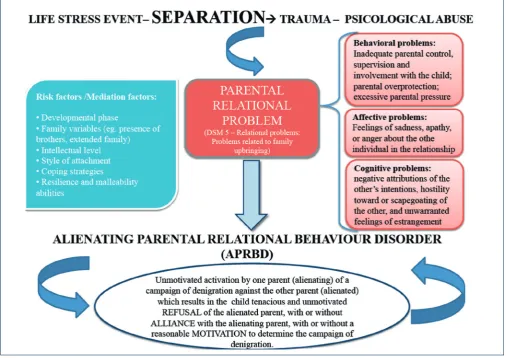
or a specific individual psychic “disorder”. It can bet-ter be defined as a dysfunctional family relation model determined by the excluding or “alienating” parent, the excluded or “alienated” parent and the child, each member of this triad with his/her own responsibilities and contribution. It would, therefore, be more correct to define the old concepts of PAS and PAD as an “Alienat-ing Parental Relational Behaviour Disorder” (APRBD). Different clinical features can then be defined, depend-ing on the presence or absence of an effective alliance with the alienating parent (Alienating Relational Behav-iour Disorder with parental alliance; Alienating Paren-tal Behaviour Disorder without parenParen-tal alliance) or the presence or absence of a motivation that underlies such dysfunctional behaviour (Alienating Parental Relational Behaviour Disorder with motivation; Alienating Parental Relational Behaviour without motivation) (Fig. 2). The DSM-5 defines relational problems as “persistent and dysfunctional patterns of feelings, behaviour and percep-tions involving two or more partners in an important per-sonal relationship”. To be diagnosed as such, a relational disorder requires the existence of a pathological interac-tion between the individuals involved in the relainterac-tionship.
It is not caused only by a pathological frame of one of the subjects. A more correct definition of this disorder would be as follows: unmotivated activation by one parent (al-ienating) of a campaign of denigration against the other parent (alienated) which results in the child tenacious and unmotivated refusal of the alienated parent, with or without alliance with the alienating parent, with or with-out a reasonable motivation to determine the campaign of denigration.
The psychopathological frame can be determined by var-ious risk factors and varvar-ious mediation factors:
• developmental phase;
• family variables (e.g. presence of brothers, extended family);
• intellectual level; • style of attachment; • coping strategies;
• resilience and malleability abilities.
A child that presents with these risk factors might then experience the separation of their parents as a psycho-logical trauma (life stress event) that results in the on-set of the “Alienating Relational Behaviour Disorder” (Fig. 3).
FIgure 2.
A nationwide systematic research is necessary to avoid the misuse of this term and to consent to proper use of the concept in clinical and forensic areas.
Conflict of interests
None.
references
1 ISTAT. Separazioni e divorzi in Italia - 23 giugno 2014. 2 Lavadera AL, Ferracuti S, Togliatti MM. Parental Alienation
Syndrome in Italian legal judgments: an exploratory study.
Int J Law Psychiatry 2012;35:334-42.
3 Gardner, RA. Recent trends in divorce and custody litiga-tion. In: The Academy Forum, 29,2, 3–7. New York: The
American Academy of Psychoanalysis 1985.
4 Gardner R. The parental alienation syndrome: a guide for mental health and legal professionals. Cresskill, NJ: Creative
Therapeutics, Inc 1998.
5 Bernet W, Baker AJ. Parental alienation, DSM-5, and ICD-11: In adulthood, the same child might develop narcissistic
personality disorders, manipulative and egocentric be-haviour, sexual dysfunctions, or eating disorders.
Conclusions and future perspectives
The explanation of this disorder has its own validity, but thorough research to clarify its features (e.g. duration and intensity of symptoms) needs to be carried out, otherwise it could be instrumentally used in litigations. Further sys-tematic and large-scale studies of parental alienation are needed that take into account the issues discussed, and proper objective diagnostic criteria should be defined for scrupulous diagnosis and valid treatment.
With adequate scientific evidence about diagnosis, ther-apy and prognosis, and the possibility of using appropri-ate assessment tools, the alienating parents and unethi-cal lawyers would have fewer possibilities to misuse the concept of parental alienation in disputes over children. FIgure 3.
21 Pignotti MS. Parental alienation syndrome (PAS): unknown in medical settings,endemic in courts. Recenti ProgMed
2013;104:54-8.
22 Camerini GB, Magro T, Sabatello U, et al. Parental alienation: clinical, nosographic, psychological and legal considerations after DSM-5. Gior Neuropsich Età Evol 2014;34:39-48. 23 Mazzeo A. Sindrome di alienazione genitoriale (PAS): il
grande imbroglio (Ebook).
24 Di Blasio P. Dibattito sulla validità e affidabilità scientifica della Sindrome da Alienazione Parentale (PAS). Psicologia
clinica dello sviluppo 2013;2:315-6.
25 Ariatti R, Cabras C, Camerini GB et al. Documentazione psicoforense sull’alienazione genitoriale - 15 ottobre 2012. 26 Widom CS, DuMont K, Czaja SJ. A prospective
investiga-tion of major depressive disorder and comorbidity in abused and neglected children grown up. Arch Gen Psychiatry
2007;64:49-56.
27 Niolu C, Barone Y, Bianciardi E et al. Resilienza e pathways di sviluppo psicopatologico: diverse tipologie di trauma.
Nóos 2015;21:25-34.
28 Di Lorenzo G, Lisi G, Niolu C. Update sul trattamento dei disturbi trauma correlati. Nóos 2015;21:51-69.
29 Niolu C, Lisi G, Siracusano A. I disturbi dissociativi. In: Ma-nuale di Psichiatria. Roma: Il Pensiero Scientifico Editore
2014, pp. 463-85.
30 Siracusano A, Barone Y, Niolu C. La depressione. In: Manua-le di Psichiatria. Roma: Il Pensiero Scientifico Editore 2014,
pp. 305-49.
31 Teicher MH, Samson JA, Polcari A et al. Length of time be-tween onset of childhood sexual abuse and emergence of depression in a young adult sample: a retrospective clinical report. J Clin Psychiatry 2009;70:684-91.
32 Wingenfeld K, Spitzer C, Rullkötter N et al. Borderline per-sonality disorder: hypothalamus pituitary adrenal axis and findings from neuroimaging studies.
Psychoneuroendocri-nology 2010;35:154-70.
33 Andersen SL, Teicher MH. Stress, sensitive periods and mat-urational events in adolescent depression. Trends Neurosci
2008;31:183-91.
34 Bernet W, Baker AJ, Verrocchio MC. Symptom Checklist-90-Revised scores in adult children exposed to alienating be-haviours: an Italian sample. J Forensic Sci 2015;60:357-62. response to critics. J Am Acad Psychiatry Law 2013;41:98-104
6 Bernet W. Parental alienation disorder and DSM-5. Am J
Fam Ther 2008;36:349-66.
7 Cavedon A, Magro T. Dalla separazione all’alienazione pa-rentale. Come giungere ad una valutazione peritale. Milano:
Franco Angeli 2010.
8 Gardner RA. The parental alienation syndrome and the dif-ferentiation between fabricated and genuine child sexual abuse. Cresskill, NJ: Creative Therapeutics 1987.
9 Gardner RA. The parental alienation syndrome: a guide for mental health and legal professionals. Cresskill, NJ: Creative
Therapeutics 1992.
10 Gardner RA. Should courts order PAS children to visit/reside with the alienationparent? A follow-up study. Am J Forensic
Psychol 2001;19:61-106.
11 Gardner, R. A. The judiciary’s role in the aetiology, symptom development, andtreatment of the parental alienation syn-drome (PAS). Am J Forensic Psychol 2003; 21: 39–64. 12 Fidler B, Bala, N. Children resisting postseparation contact
with a parent: concepts, controversies, and conundrums.
Family Court Review 2010;48:10-47.
13 American Psychiatric Association. Manuale diagnostico e statistico dei disturbi mentali, DSM-5. Milano: Cortina
Raf-faello 2014.
14 Gardner RA. Parental alienation syndrome vs parental al-ienation: which diagnosis should evaluators use in child-custody disputes? Am J Fam Ther 2002;30:93-115.
15 Gardner RA. Commentary on Kelly and Johnston’s “The alienated child: a reformulation of parental alienation syn-drome”. Family Court Review 2004;42:61-106.
16 Baker AJL. Parental alienation: a special case of parental re-jection. Parental Acceptance 2010;4:4-5.
17 Baker AJL. Adult recall of parental alienation in a com-munity sample: prevalence and associations with psycho-logical maltreatment. Journal of Divorce & Remarriage
2010;51:16-35.
18 Buzzi I. La sindrome di alienazione genitoriale. In: Cigoli V,
Gulotta G, Santi G, a cura di. Separazione, divorzio e
affida-mento dei figli. II ed. Milano: Giuffré 1997, pp. 177-88. 19 Gullotta G, Buzzi I. La sindrome di alienazione genitoriale:
definizione e descrizione. Pianeta infanzia, Questioni e
do-cumenti, n. 4. Istituto degli Innocenti di Firenze, 1998.