DESERT 14 (2009) 209-215
Evaluation of the Efficiency of CROPWAT Model for Determining
Plant Water Requirement in Arid Regions
A. Malekian
a*, H. Ghasemi
b, A. Ahmadian
ca
Assistant Professor, University of Tehran, Tehran, Iran
b
MSc. Graduate of Combating Desertification, Zabol University, Zabol, Iran
c
Ph.D. Student , Zabol University, Zabol, Iran
Received: 15 March 2009; Received in revised form: 10 September 2009; Accepted: 10 November 2009
Abstract
Shortage of water resources and increasing demand to consumption of this scarce resource, leads to some noticeable limitations. On the other hand, population growth and consequently, increasing demand for water in arid and semi arid regions , needs production in exchange of little amount of water consumption. To approach this objective, an experiment in the complete randomized blocks carried out in four replications for cumin plant growing in Zabol, southeastern Iran. Experimental treatments included irrigation periods at three levels. Then using CROPWAT model, the water requirement of the plant is met. Analyzing the data resulted from production gathered in different times of irrigation and consumption of water in the three times irrigation case with sound efficiency (1750 m3/ha), is more little than the water amount which is simulated by the CROPWAT model in 2003 (6070 m3/ha) and (5363 m3/ha) in 2004. It then showed that this model is not effective in determining the water requirement of cumin at this region.
Keywords: Water requirement; Cumin; CROPWAT model; Efficiency; Zabol; Simulation
1. Introduction
Reaching to higher irrigation efficiencies proportional to best yield, is one of the major challenges at near future which is impossible without using the techniques and approaches in which the consumption of water is reduced. In this respect, minimum irrigation plays an important role in increasing of water use efficiency (WUE). The most important aim of minimum irrigation is reduction of water consumption by plant, so that the water deficiency stress can have the minimum effect on its yield.
Nowadays, there are different types of models to simulate plant growth and water flow at the rooting region. These models are useful and in some cases powerful tools for generalizing the research results to the actual
Corresponding author. Tel.: +98 21 88963295, Fax: +98 21 88971717.
E-mail address:[email protected]
the plant and irrigation and cultivation pattern. Using the daily water balance, user can simulate different conditions of the way of supplying water and consequently evaluate the reduction of yield and efficiency of irrigation and rainfall. Computation of evapotranspiration is based on Penman- Monteith method (9). The input data are minimum and maximum temperature degrees in the form of ten days or monthly, relative humidity, sunshine hours and wind speed.
The plant parameters used in the model include plant coefficient (Kc), duration of
growth season, the amount of critical evacuation and index of yield reaction (Ky). The cumin
(Cuminum cyminum) is an annual plant from
Umbelliferae family and one of the most
important and economic pharmaceutical plants which can be very important in arid and semi arid regions of Iran in the case of water shortage and less fertility of soil. Form of leaves, length of bushes, which is short, and color covering of surface of plant’s organ, all are indicators of compatibility of the plant to dry conditions (1). Moreover, it is resistant to salinity and needs to not fertile soil (1, 3). The conducted investigation on water requirement and fertilizing of cumin to achieve maximum production yield, suggests that mainly the irrigation and fertilizing demand of this plant is very limited and is less than other agricultural plant(1). Anac et al. (1999) made efforts to design a minimum irrigation conditions program for cotton plant. They used CROPWAT model and calibrated it with conditions of the Netherlands and concluded some positive results for cotton cultivation in this country (3). Meanwhile, Tavoosi (2000), by studying the effect of different methods of irrigation on cumin yield , reported that water potential of this plant at the end of growth period reached to
- 30 Bar but any effect of wilting in the plant was not reported . It means that the plant was able to absorb the required water from the soil. At the mentioned study, there was no difference in yield of seed, number of umbel in bush and number of seed in umbel in irrigation treatments, but by complete irrigation treatment, maximum amount of biomass and minimum weight of 1000 grain and harvest index is obtained (12).
Tatary (2004) has reported that increasing of times of irrigation, causes increasing of biologic yield but will cause little decrease in seed yield, weight of 1000 grain and harvest index. The best treatment was then two times irrigation with fresh water and two times in the form of fresh and brackish water mixture (11). Balandary (2003) has reported that the heat and dryness, causes increasing while moderate and wet weather causes decreasing of the amount of extract of the cumin (4). Because of the importance of the recognizing the stages of irrigation in cumin, and also enormous effects of environmental conditions, specially dryness stress, the quality and yield of the mentioned plant, the effect of irrigation timing was investigated.
2. Materials and methods
The experiment was conducted during 2003-2004 cultivation year in Zabol located at southeast of Iran. The climate of this area is hot and dry with a dry summer season. Elevation is about 485 m a.s.l. and the range of annual evapotranspiration is 4500 to 5000 mm. The soil texture of the given field was silty loam and after irrigation, its EC reduced from 9.82 ms/cm to 4.15 ms/cm and the field had been cultivated with wheat in the previous year.
Table 1. The results of soil chemical properties in the study area Parameter pH -EC
(meq/lit)
Ca + Mg (meq/lit) Na (meq/lit) HCO3 (meq/lit) Cl (meq/lit) SO4 (meq/lit) Sum of Anions (meq/lit) Saturated extract (%) Value 7.82 9.28 43.75 56.58 6.42 48.80 84.13 74.1 29.13 Parameter
Sum of Cations (meq/lit)
SAR ESP% %Lime OC% OM% N% P% K%
Value 32.1 12.12 20.14 19 84 1.43 7 30.03 18.78
The experimental design was developed as complete randomized blocks with four replications. Experimental treatments including times of irrigation at three levels (two times irrigation synchronous with sowing and after complete establishment (I1), three times
irrigation: synchronous with sowing, after complete establishment and the early flowering
phase (I2), four times irrigation: synchronous
with sowing, after complete establishment and start of the flowering phase and the relatively ripen seeds (I3).
The irrigation is done in such a way that at least up to 15 cm depth, soil reaches to the limits of field capacity. Amount of the consumed water by two times irrigation and its effect on the yield of cumin evaluated for unit area (ha) is equal to 1200 m3, which does not
result suitable yield. The consumed water by three times irrigation is estimated about 1750 m3/ha , which was a suitable yield when the times of irrigation is added to four times and consumption water reached to 2350 m3/ha, no meaningful differences in the yield was recorded.
Before the final harvest, in order to determine and compute the yield including number of umbel in a bush, number of seed in a umbel, height of stem and weight of seeds, ten bushes from each plot were selected and picked up .For computing seed and biologic yield as well as harvest index, two square meters of each plot was selected and in the field conditions, during 72 hours was dried. The results were compared .interpreted using analysis of variance by the Duncan’s test with 5% confidence limit using MSTATC.
Then by using CROPWAT model, plant water requirement, which contributes in designing and management of irrigation schedule, was estimated. The outlines of the method are as follow: input data such as monthly "ETo", plant's data, pattern of cultivation as well as monthly rainfall data were entered into the model. In addition to the
mentioned data at the next stage for computing irrigation schedule, soil data were entered and indices of irrigation program arranged. Meteorological data of Zabol station for two continued years of 2003 on which the cultivation was done, added to the model. Because the water requirement of plant generally is evaluated during the growth season by crop coefficients of the same plant , then the plant coefficient (Kc)and index of yield coefficient (Ky)for cumin in Zabol, was calibrated. By having (Kc) and evapotranspiration of the reference plant (ETo) in each period, we can compute the evapotranspiration of the mentioned plant (ETc) by the following equation (12).
ETc=Kc*ETo
In order to take the ETc values for each growth period, we must compute the changes of plant coefficients during the growth period from the time of budding until harvest. Since the plant coefficients is not a fixed value, and is changed in the growth period of plant, then according to the FAO guidelines we divided the growth period into four stages including: initial stage, development stage, mid-season and end-season. For cumin it is as shown in Table 2. It's necessary to note that, because of the differentiation of humidity conditions and wind speed, the values of plant coefficient in the mid-season and end-mid-season by using the following equations, were calibrated:
Kc-mid=Kc-mid-table+[0.04(U2-2)-0.004(RHmin-45)][h/3] 0.3
Kc-end=Kc-end-table+[0.04(U2-2)-0.004(RHmin-45)][h/3] 0.3
Where:
Kc –mid, is the improved coefficient of plant in the mid season growth.
Kc-mid-table is the plant coefficient inserted in the table of FAO's irrigation manual 56.
U2, is the wind speed above the land (m/s)
RH, is the least relative humidity in the given period (%)
H, is the height of plant .In this case it is assumed as 0.3.
Kc-end is the plant coefficient according to the FAO manual.
Table 2. Duration of growth and plant coefficient in cumin Kc Growth duration(day) Growth stage
0.34 75 Initial
0.52 30 Development
0.74 30 Mid-season
0.43 25 End-season
Fig. 1. Crop evapotranspiration rate under soil moisture stress
The effect water stress on plant yield is defined by a experimental index (Ky), in the below form:
ETm ETa Ky Y
Ya
1 max 1
Where:
Ya and Ymax are the actual and potential yields
respectively; 1-Ya/Ymax is the relative decrease
of yield proportion to relative decrease in evapotranspiration rate (1-ETa/ETm). Ky values,
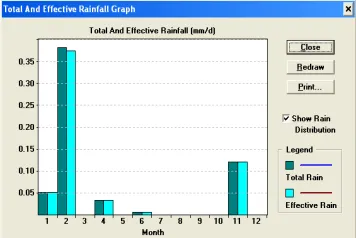
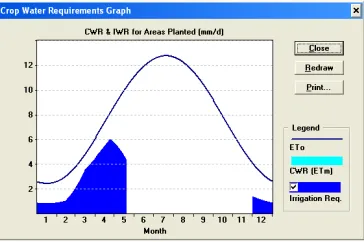
by using the above equation and putting mentioned parameters for different stages of plant life, is obtained and used in the model. Finally the model was developed and the results are presented in Figures 2-10.
Fig. 2. Climatic data graph for sunshine hours
Fig. 3. Climatic data graph for wind speed
Fig. 4. Climatic data graph for relative humidity percentage
Fig. 5. Climatic data graph for maximum and minimum temperature
Fig. 6. Input data graph for rainfall and effective rainfall
Fig. 7. Input data graph for evapotranspiration of reference plant
Fig. 8. Irrigation schedule output
Fig. 9. Irrigation water requirement outputs
3. Results and Discussion:
Table 3 shows the results of analysis of variance which indicates that the effect of irrigation treatment on economical yield, the number of umbel and the weight of seeds in the %1 probability, is meaningful while the effect of irrigation treatment on height of plant, number of seed in the umbrella, straw yield and index of harvest is statistically non significant.
Fig. 10. Plant coefficient
data of cumin in the study area
Comparison of the average of data (Table 4) showed that increasing the consumption water from 2 to 3 times, led to the significant increase of the average of the number of the umbel in a plant, economical and biologic yield, number of
seed in plant in the average of the weight of the grain (p<0.05), while it had no effect on number of seed in umbel, height of plant, straw yield and index of harvest.
Table 3. The results of ANOVA for yield of cumin under different irrigation treatments Harven
st index
StraW yield
Biologic yield
Seed yield
No. of seeds in
each plant
No. of umbel in each plant
Plant height
Seed weight
Seed number in umbel
df Source of variation
ns
145 ns
8043 ns
1513 12753** 29348** 88.7** ns
29.8 ns
0.222 ns
3.24 3 Replication
ns
12.2 ns
19546 60520* 11436** 11349* 78.82** 15.45 0.986** ns
0.385 2 Irrigation level 29.1 8251 11413 1407 4456 9.74 9.97 0.108 1.39 15 Error
10 14 13 9 14.5 9 11.5 12 6.5 0 Coefficient of
Non significant in: ns Significamt in 5%: * Significant 1%: **
The results also showed that there is no significant differences between treatments of I2
and I3; which shows that irrigation in final phase
of growth(filling of plant seeds), not only had no effect on increasing of the yield but also caused decreasing it somehow. Short time between duration of two final irrigation stages and sensitivity of the plant at this phase to irrigation, excessive heat of the region as well as physiological disorder between growth and production phases, could be among the causes of being ineffective in final phase of irrigation as well as decreasing of yield. The effect of water shortage in decreasing yield of cumin seed and being ineffective at the final phase, is
also reported in the works of Aminpour and Mousavi (1995) and Tatary (2004).
Index of harvest in all treatments was the same and there was no meaningful difference in the treatments. This shows that, irrigation has no effect on harvest index and by increasing and decreasing of biologic yield; the seed follows the same response. According to inherited properties of plant, which allocates more than half of its whole aerial weight to the seed, the causes increasing harvest index restricted and then cumin in the different environmental conditions shows a fixed and relatively clear index harvest (1).
Table 4. The comparison of the irrigation treatment of the yield of cumin Harvest index Weigh of 1000 grains(gr) Plant height (cm)
No. of seeds in each
plant
Seed yield
Biologic
yield Straw yield Treat ment Seed number in umbel Seed weight (gr) a 55 a 3.16 a 25.38 b 287 b 374 b 686 a 312 I1 21.18b a13.56 a 53 b 2.51 a 28.58 a 357 a 448 a 850 a 403 I2 27.28a 13.13a a 53 b 2.61 a 27.55 a 347 a 427 a 817 a 391 I3 25.53a 13.38a
I1: Two time irrigation, I2: Three times irrigation, I3: Four times irrigation, significance level: 5% 4. Conclusion
As shown in Table 5, water consumption in the form of three times irrigation, with the suitable efficiency (1756 m3/ha), is less than the amount which is computed by the CROPWAT model in 2003(6070 m3/ha), and 2004 (5363 m3/ha). One of the reasons for difference
between the results of model output and treatments is the climatic condition of the region which includes hot winds, high temperature and lack of sufficient precipitation which affects on the outputs of CROPWAT model and then makes it in effective for prediction process for the studied plant in the region.
Table 5.Comparison of the water requirement of the model in different irrigation treatments
Irrigation treatments/Model output Result of CRW Model I1 I2 I3 Water volume( m3
/ha) 6070 1200 1750 2350
Then it is concluded that the model for planning of irrigation water requirements of cumin, has not the needed efficiency and by focusing to the climatic condition as well as other related conditions in Zabol, it gives incorrect evaluation from water consumption of this plant.
References
Allen, R., Pereira L. A., Raes D., Smith M., 1998. Crop evapotranspiration, FAO Irrigation and Drainage Paper No.56. Rome, Italy.
Aminpour R., Mousavi S.F., 1995. The effect of irrigation timing on the development and yield of cumin, Journal of Agricultural sciences and Natural Resources (in Persian), Vol. 1: 1-7.
Anac, M.S., Ali U., Tuzal, I. H., Anac D., Okur B., Halkerlerler, H., 1999. Optimum irrigation schedules for cotton under deficit irrigation condition. In: C. Kirda, P. Moutonne, C. Hera, D.R Nielsen, eds. Crop Yield Response to deficit irrigation. P., The Netherlands, Kluwer Academic Publishers, 196-212.
Balandary A., 2004. Study of germination, growth and development of Persian cumin, The First National conference on Cumin, 48-52.
Bazza, M., 1999. Improving irrigation management practices with water-deficit irrigation. In: C. Kirda, P. Moutonne, C. Hera, D.R Nielsen, eds. Crop yield response to deficit irrigation, The Netherlands, Kluwer Academic Publishers, 49-71.
Doorenbos J., Kassam A., 1979. Yield response to water, FAO Irrigation and Drainage Paper No 33, Rome, Italy.
Doorenbos J., Pruitt W.O.,1977. Guidelines for predicting CROPWAT water requirements, FAO Irrigation and Drainage Paper No. 24, Rome, Italy. Iacobellis, N. S., T. Takayanagi, and J. Kitajmi, 2005. Antibacterial activity of Cuminum cyminum L. and Carum carvi L. essential oils. J. Agric Food Chem. 53(1):57-61.
Jirovets, L., and G. Buchbouer. 2005. Composition, quality control and antimicrobial activity of the essential oil of Cuminum cyminum L., J. of Food Sci & Techn. 40(24):15-33.
management, FAO Irrigation and Drainage paper No.26, Rome, Italy.
Tatary M., 2004. The effect of different levels of salinity and irrigation timing on growth and development of cumin in Mashad (In Persian), MSc. Thesis, Ferdowsi University, 131pp.