The effects of three types of attention drawing techniques
on the acquisition of English collocations
Rassaei, Ehsan
Department of Foreign languages, Islamic Azad University, Shiraz Branch, Shiraz, Iran ([email protected])
Karbor, Tahereh
Shiraz University, Iran ([email protected])
Received: 8 June 2012 Revised: 17 June 2012 Accepted: 19 June 2012 Available Online: 20 June 2012 DOI: 10.5861/ijrsll.2012.117
ISSN: 2243-7754 Online ISSN: 2243-7762
OPEN ACCESS
Abstract
The current study examined the effectiveness of three types of awareness raising techniques
on learning of a number of English collocations by Persian EFL learners. These techniques
viz. textual enhancement, input enrichment, and form comparison required learners to pay
different levels of attention to collocations in the input. The results indicated that while form
comparison and textual enhancement led to the acquisition of collocations, input enrichment
didn’t. The findings also revealed that paying attention to collocations in the input have some
unfavorable effects on processing content. The findings and their implications for teaching
collocations are discussed in the study.
The effects of three types of attention drawing techniques on the acquisition of English
collocations
1. Introduction
In the past three decades, researchers have been seeking to design activities which encourage learners to pay attention to formal aspects of language during meaning-focused activities. Such an interest in form-focused instruction was initiated by research findings that exposure to input alone may not guarantee learners’ success in second language L2 acquisition specially with regards to the accuracy of certain grammatical features in learners’ speech. According to Spada (1997), form-focused instruction refers to “any pedagogical effort which is used to draw learners’ attention to language form either implicitly or explicitly” (p. 73). Long (1988, 1991) proposed focus on form instruction in which linguistic features are integrated into meaningful activities that require learners to communicate, while eliciting their attention to some linguistic features in input. According to Long and Robinson (1998) focus on form ''often consists of an occasional shift of attention to linguistic code features—by the teachers and/or one or more students—triggered by perceived problems with comprehension or production'' ( p.23). There are different ways of implementing a focus on form instruction. This can range from providing learners with implicit and explicit corrective feedback for their errors during communication (reactive focus on form) to manipulating preselected linguistic features in input to make them more salient and noticeable to learners (proactive or preplanned focus on form).
In the current study, we are concerned with the latter definition of focus on form. Input enhancement is a term which was first used by Sharwood Smith (1993) to refer to any attempt to make certain features in the input more noticeable and salient to learners with the assumption that more noticeable input is more easily acquired. According to Schmidt’s noticing hypothesis (Schmidt, 1990), in order for input to be further processed for acquisition, it should first be noticed. The most wildly investigated type of input enhancement is textual enhancement (TE, also known as visual enhancement) whereby target linguistic features in input are bolded, underlined, CAPITALIZED, or italicized. Input enrichment (IE) (also known as input flood) has also been used by some researchers in several studies as another awareness raising technique whereby the input is seeded by extra tokens of target features with the idea that densely incorporated tokens of target forms draw learners’ attentions to such target forms in the input (e.g., Trahey & White, 1993; Ellis et al., 2009). Several empirical studies which investigated the effects of TE and IE on L2 acquisition provided mixed results. While some of these studies provided evidence for the efficacy of TE and also IE (Jourdandenais et al., 1995; Izumi, 2002; Lee, 2007; Shook, 1999; Simard, 2009; Ellis et al., 2009), other studies provided no convincing evidence (e.g., Allanen, 1995; Leow et al., 2003; Overstreet, 1998; Radwan, 2005; Wong, 2003). All of these studies however were concerned with the acquisition of morphosyntax. To our best knowledge, few if no TE and IE study has yet been conducted on the area of vocabulary acquisition. The current study aims at contributing to the input enhancement literature, by investigating their effects on the acquisition of English collocations.
2. The importance of collocations: Some theoretical views
considered as the hallmark of advanced level proficiency in L2 acquisition which can help L2 learners become accurate and fluent L2 speakers. According to Morgan Lewis (2000), the reason why many learners’ can’t progress beyond certain levels is because they are not familiar with how words go with each other. In his words,
They may know quite a lot of individual words which they struggle to use along their grammatical knowledge, but they lack the ability to use those words in a range of collocations which pack more meaning into what they say or write (p.14).
Although some suggestions have been made regarding the incorporation of collocations in ELT materials (e.g., Michael Lewis, 1997; Morgan Lewis, 2000; Nesselhauf, 2003), research in this area is meager and needs further investigation in to the more effective ways of teaching collocations to L2 learners. One factor which has contributed to the paucity of research in this area is the wide range of collocations of different types and the lack of a clear and comprehensive definition for collocations. Another factor which may have contributed to such a paucity of research is that the absence of collocations in learners’ speech may not be quite transparent and salient to L2 instructors and researchers “because learners can often paraphrase their way around collocations” (Bahns & Eldaw, 1993, p. 101).
3. The definition of collocations
Collocations belong to the broad family of formulaic speech which is defined by Wrey (2002) as:
A sequence, continuous or discontinuous, of words or other elements which are, or appear to be, prefabricated: that is, stored and retrieved whole from memory at the time of use, rather than being subject to generation or analysis by the language grammar (p. 9).
There are a variety of structures which can be regarded as formulaic speech. According to Boer et al. (2006):
Formulaic sequences can be very diverse, in terms of lexical composition as well as function: they range from simple fillers (e.g. Sort of) and functions (e.g. Excuse me) over collocations (e.g. Tell a story) and idioms (e.g. Back to square one) to proverbs (e.g. Let’s make hay while the sun shines) and lengthy standardized phrases (e.g. There is a growing body of evidence that) (p. 246).
Collocations are especial kind of formulaic speech in which “certain words co-occur in natural text with greater than random frequency” (Michael Lewis, 1997, p.8). The concept of collocation can better be understood when compared with idioms. While idioms are relatively frozen expressions (i.e., their components can’t be replaced by other linguistic elements) collocations consist of “loosely fixed” component parts (Bahns & Elda, 1993, p. 103). Furthermore, as opposed to idioms, collocations abide by the principle of semantic compositionality that is the meaning of the whole unit can be derived from the meaning of the component parts. Hill (1999, p.4) identified eight common types of collocations:
(1) verb + noun: make a mistake (2) adjective + noun: heavy traffic (3) adverb + verb: fully understand (4) adverb + adjective: extremely generous (5) adjective + preposition: guilty of (6) noun + noun: a ceasefire agreement
Other types of collocations can also be identified such as verb + preposition (rely on); verb + adverb (destroy completely), etc. Collocations can be classified into grammatical and lexical collocations (Benson, Benson, & Ilson, 1986). Grammatical collocations consist of a lexical item such as a noun, adjective, or a verb plus a preposition (e.g., guilty of, rely on). The focus of the current study is grammatical collocations.
lack of awareness of collocations in input (e.g., Beshop, 2004; Howart, 1996; Michael Lewis, 1993; Powly & Syder, 1993). Michael Lewis (1993) suggested that collocations are not noticed by learners because they are not fixed expressions and consist of words which are put together with high levels of frequency and as such they allow certain degree of creativity. Powly and Syder (1993) argue that learners’ problems with acquiring formulaic sequences may stem from learners’ failure to identify them in input. Similarly, Bishop (2004) suggest that formulaic sequences such as collocations have no clearly delineated boundaries and thus may not be correctly identified by learners. Finally, Wray (2001) suggests that learners’ failure to express their ideas idiomatically is due to “a lack of awareness of the phenomenon” (p. 206).
Another potential source of difficulty for learners to acquire certain collocations which consist of a lexical unit and a grammatical unit (e.g., adjective + prepositions, verb + prepositions) can be explained with regard to VanPatten’s Primacy of Content Words Principle (PCWP) (VanPatten, 1996). According to this principle, learners tend to pay attention to content words at the expense of grammatical words in input for obtaining semantic information which is important for processing input. Content words are first processed by learners because they carry most semantic or communicative information that learners need to decode the language. Based on PCWP, we can predict that the acquisition of verb + prepositions and adjective + prepositions will be difficult for L2 learners because they tend to focus on the lexical part of the structures that is the verb or the adjective and ignore the grammatical part that is the prepositions. Such a difficulty is again attributable to learners’ lack of awareness or noticing of collocations either as a whole or in part. A question which can be asked is whether raising the textual saliency of collocations and as a result learners’ awareness of collocations can enhance their acquisition.
According to Schmidt’s (1990, 2000) noticing hypothesis, in order for input to be further processed for intake, it should be first noticed by learners. In other words, learners must consciously pay attention to the material to be learned. Nation (2001) also notes that three psychological processes are needed for successful vocabulary learning: noticing, generating, and retrieving. A number of suggestions have been made to increase learners’ awareness and noticing of collocations in input. Hill, Morgan Lewis, and Michael Lewis (2000) presented a list of useful task-based activities which can be used by teachers in classrooms to enhance learners’ awareness and thereof facilitate the acquisition of collocations. Few experimental studies have been designed to explore the effects of awareness and noticing on the acquisition of collocations. Bishop (2004) for example explored if the use of textual highlighting (highlighting and red font) affects learners’ selection of vocabulary and formulaic expressions for glossing. The results indicated that in unenhanced condition learners select more unknown words than formulaic sequences for glossing. But in the enhanced condition (i.e., highlighted and red font) the result was reversed.
While previous studies that investigated the link between noticing and acquisition of collocations provided evidence for the facilitative role of raising learners’ awareness of collocations for their subsequent use in their production, further research is needed to better understand how the acquisition of collocations can be eased for learners in L2 classrooms. While a number studies investigated the effects of TE and IE as awareness raising techniques on the acquisition of some grammatical features, their effects on the acquisition of collocations is not yet well examined. The current study aims at contributing to TE literature and also collocation literature by investigating the effects of TE and IE and also another awareness raising technique known as form-comparison (FC) on the development of collocations knowledge by Persian EFL learners. FC (Takahashi, 2001) is an activity in which the learner is asked to compare a pair of linguistic items which differ from each other with respect to a linguistic feature and determine which one is grammatical (or ungrammatical).
3.1 Research questions
The following research questions will be answered in the current study:
A. What are the effects of TE, IE, and FC on the development of the knowledge of English collocations by Persian EFL learners?
B. Is there any difference among the effects of TE, IE, and FC on the development of knowledge of English collocations by Persian EFL learners? If yes, which one is more effective?
4. Method
4.1 Design
The study was a controlled experimental study with pretest, treatment, posttest and delayed post-test design. The participants completed the pretest and were randomly assigned to the treatment and control groups (including three experimental groups and one control group). The treatment groups were (1) the TE group, (2) the IE group, and (3) the FC group. The participants in the treatment groups completed a treatment task according to their group designation. The post-tests were administered one day after the last treatment session and the delayed post-test was assigned 10 days later.
4.2 Target collocations
The collocations which were chosen as target forms for the current study were set of English verb + preposition (VP) and adjective + preposition (AP) collocations. Table 1 provides the list of these target collocations. Such structures are made up of a verb or an adjective plus a preposition. Thus, each VP or AP consists of a lexical unit (i.e., verb or adjective) and a grammatical unit (i.e., preposition).
Table 1
Target collocations
Capable of Ashamed of Equal to Comply with Jealous of
Afraid of
Insist on Adhere to Angry at
Incapable of Apply for
Adapt to
Interested in Similar to Conscious of Composed of Instead of Emphasize on
Attempt at Cope with Inferior to Glance at Acquainted with Tired of
4.3 Participants
The participants for this study were recruited from among learners enrolled in a major English language teaching institute in an Iranian urbane area. The participants were selected for the current study based on their scores in a screening test targeting their knowledge of the 30 collocations mentioned above. Initially, 139 participants filled consent forms and participated in the pretest (the screening test). Out of 139 participants who took the pre-test, 89 who displayed equal knowledge of the collocations in the pre-test (around 30 % of total score) were selected to participate in the study and completed all treatments and post-tests. Of these, 23 were assigned to the TE group, 21 were assigned to the IE group, 24 were assigned to the FC group, and finally, 21 were assigned to the control group. All participants were chosen from the same higher intermediate level. They had been assigned to their level based on their scores in a simulated TOEFL exam and also an interview. The participants ranged in age 22 to 38 and all either held graduate degrees or were university students. All participants were assigned to their groups randomly. All participants’ mother tongue was Persian. The mean length of formal English instruction for participants was 5.2 (SD: 2.2).
4.4 Treatment materials and procedures
The participants received treatment materials in one session according to their group designation as follows: For the TE group, 30 belief statements about a range of general interest topics each incorporating one target form from the list above were devised and presented to learners in the treatment session. The participants were asked to simply choose whether they agree or disagree with the statements. The lexical part of each target form in each statement was only boldfaced while the prepositional part was both boldfaced and underlined. The following example reveals how TE was operationalized:
Those who are capable of accomplishing difficult tasks are well motivated. (agree / disagree)
For IE group, there were also 30 belief statements. However, each statement was made up of two sentences connecting with each other with a conjunction each containing the same target forms. Therefore, each target form occurred twice in each statement prepared for the IE group. The prepositional structures were not boldfaces nor underlined for the enrichment group. The participants were asked to state whether they agree or disagree with the statement by check marking their answer sheet. The following example indicates how input enrichment was operationalized in the study:
Only those who are well motivated are capable of accomplishing difficult tasks and others with low motivation are not capable of performing such tasks. (agree / disagree)
Treatment materials for FC group consisted of 30 pairs of statements. Each pair consisted of one sentence which contained the correct use of one prepositional structure and the other sentence with an incorrect use of the same prepositional structure in terms of the correct combination lexical and prepositional parts. The participants were first asked to decide on which statement is grammatically correct by checking a box in front of the statement and then choose whether they agree or disagree by marking agree or disagree boxes below the statements. Each pair was written on a separate page of booklets which were presented to participants. On the back of each page the correct prepositional structure devoid of the statement was provided. The participants were asked to turn the page and compare the correct answer with their own after performing on each pair. The target forms were underlined to ease participants' comparison. The following example represents how form/comparison was operationalized:
Those who are capable at accomplishing difficult tasks are well motivated.
Those who are capable of accomplishing difficult tasks are well motivated.
The researcher also fully briefed the participants that their answers are solely used for research purposes and
The material for the control group was similar to that of the TE group except that no textual modifications were made to the target forms. All three treatment tasks were performed in paper and pencil and no strict time limit was set for participants to perform the tasks. The statements for the three groups were chosen after carefully scrutinizing the difficulty level of the statements to ease participants’ comprehension. However, the participants were told that they could ask the meaning of any unknown word in the statements.
The treatment conditions explained above differed from one another in terms of the degree to which they elicited the participants’ attentions to target forms by manipulating two important characteristics of the input: (a) the textual saliency of target forms in the input, (b) the enrichment of the input with extra tokens of target forms. The linguistic targets for the FC group were made most salient by asking participant learners explicitly to pay attention to target forms and choose the correct form. The saliency of the target features in the TE condition was also enhanced by boldfacing the lexical part of the target forms and boldfacing and underlining the prepositional part. The saliency of the target forms for the IE was not enhanced; however, each statement was enriched with an extra token of target forms. The control group, on the other hand, received neither textually enhanced nor enriched input.
4.5 Testing instruments and procedure
Two testing instruments were used to investigate learning gains as a result of treatments in this study. They were a multiple choice recognition test (MCRT) and a preposition suppletion test (PST). The MCRT was used as pre-test, post-test, and delayed post-test, while the PST was only used as post-test and delayed post-test. It should be mentioned that the MCRT was the screening test which was used to admit the participants into the study and therefore participants’ scores in the screening test were used as their MCRT’s pre-test scores. Pretesting (MCRT) was performed a week before the treatment sessions began. Post-tests were held the day after the treatment session and the delayed post-tests were administered a week later. Both testing instruments were paper and pencil tests. A description of these follows.
4.5.1 The MCRT
This test consisted of 45 statements including 30 statement targeting the target collocations and 15 distracters. The distracters targeted some grammatical points including articles, question forms, and relative clause forms. Each item targeting the collocations consisted of a statement including one collocation in which the prepositional part was deleted. The participants were provided with four prepositions as options. The participants were asked to choose the correct preposition. They received one point for the correct recognition of the prepositions.
4.5.2 The PST
The PST consisted of 30 statements each targeting one collocation. The prepositional parts of the collocations were deleted from the statements and the participants were asked to supply the correct preposition for each statement. The participants received one point for each correct provision of the prepositions.
4.5.3 Post belief statements questionnaire (PBSQ)
For the FC group, only those statements which contained the correct form of collocations with no underlining were presented to the learners. The participants were asked to provide their beliefs regarding the statements by checking a box provided in front of each statement. In this way, it was possible to see if learners’ beliefs regarding the statements were influenced by treatment conditions which is in effect reminiscent of the effects of treatment conditions on participants’ noticing of target features.
4.6 Issue of reliability
In order to assess the reliability of the instruments, test retest reliabilities (Pearson r) of MCRT and PST were estimated only for the control group. For the MCRT, pre-test/post-test consistency was 0.67, while for the PST the post-test/ delayed post-test consistency was 0.68.
4.7 Analysis
For the pre-test, participants’ raw scores in MCRT were obtained. A one way analysis of variance was performed on pre-test scores to examine any difference among the groups before treatment sessions. Raw scores were also calculated for the MCRT, and PST used as post-tests and delayed post-tests. Descriptive statistics for post-tests and delayed post-tests were calculated for learners in the four groups. Mixed between-within groups ANOVA was performed on MCRT scores in pre-, post-, and delayed post-tests to investigate learning gains as a result of treatments over time with total scores as dependent variable and with time and treatment conditions as independent variables. One-was ANOVAs were also performed on PST scores in post- and delayed post-tests to investigate the effects of treatment conditions on the acquisition of target forms. Tukey’s post hoc analyses were performed whenever ANOVA was significant to locate the difference between groups. Furthermore, in order to investigate the effect of treatment conditions on participants’ noticing of target features, their beliefs (agree vs. disagree) regarding the belief statements during treatment sessions and their beliefs of the same statements in the post belief statement questionnaire were submitted to a chi-square test for independence. To further specify the effects of treatment conditions on noticing of target features, Phi correlation was also estimated for learners’ beliefs during the treatment sessions and in the post belief statement questionnaire. As it was mentioned, this analysis was performed only for 5 participants from each group. In this way, 150 belief statements (5 × 30) were submitted to analysis for each group. An alpha level of .05 was set. SPSS 16 was used to perform the analysis.
5. Results
After obtaining descriptive statistics for the MCRT scores used as pre-test, they were submitted to a one-way analysis of variance (ANOVA) to see if there was any significant difference among groups in the study before treatments took place. Table 2 displays descriptive statistics for pre-test sores.
Table 2
Descriptive statistics for pre-test scores
Technique n Mean SD
TE 23 10.60 0.58
IE 21 10.90 0.70
FC 24 11.00 0.72
Control 21 10.77 0.67
Table 3 displays the results of one-way ANOVA on pre-test scores. No significant difference was observed among the treatment groups enrolled in the study F (3, 85) = 2.26, p <.05.
Table 3
One-way ANOVA for pre-test scores
Sum of squares df Mean square F Significance
Between group 3.07 3 1.02 2.26 0.87
Within group 38.43 85 0.45
Total 41.50 88
Table 4
Mixed between-within ANOVA across four treatments and three testing occasions
Source df F Significance Partial Eta Square
Group (between participants) 3 136 0.000 0.74
Time (within participants) 2 2.93 0.000 0.87
Group*time 6 126.3 0.000 0.81
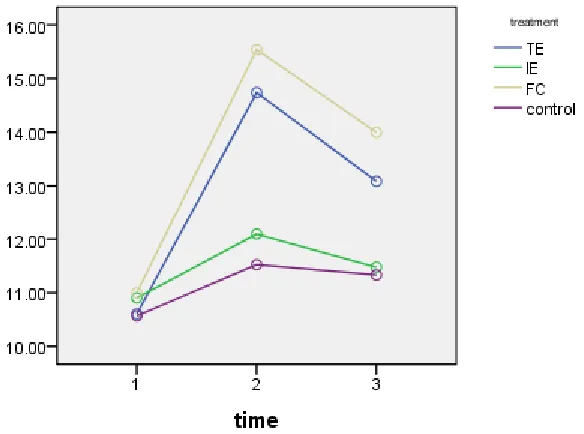
As the table indicates, there are significant effects for time, treatment conditions and also interaction between time and treatment conditions meaning that participants exposed to different treatment conditions improved significantly over time but with different rates. Figure 1 provides the visual representation of participants’ performance across different treatment conditions over time.
Figure 1. Mean test scores for groups versus time
The figure provides the impression that FC and TE groups significantly outperformed other groups in both post-test and delayed post-test. One-way ANOVAs on participants’ scores in MCRT in post- and delayed post-tests confirmed that there is statistically significant between- group differences in both post- test, F (3, 85) = 136. 96, p < 001, and delayed post-test, F (3, 85) = 72.81, P < 001. Tukeys’ HSD multiple comparisons were used to locate the differences among the groups in post- and delayed post-tests. The post-test analysis revealed that while the FC group outperformed other groups including the TE group, the TE group also outperformed the IE and control groups. No statistically significant difference was found between the IE and control groups. In the delayed post-test, the post hoc analysis revealed the same patterns.
statistics for PST scores in post- and delayed post-tests.
Table 5
Descriptive statistics for post- and delayed post-PST scores
Technique n Post-test Delayed post-test
Mean SD n Mean SD
FC 24 14.75 0.58 24 13.00 0.58
TE 23 13.30 0.82 23 11.73 0.68
IE 21 11.14 0.57 21 9.80 0.40
Control 21 10.76 0.62 21 9.52 0.67
One-way ANOVAs on PST scores in both post- and delayed post-tests were performed to investigate the differences between the experimental and control groups. Tables 6 and 7 represent the results of one-way ANOVAs on PST scores in two testing occasions.
Table 6
One-way ANOVA for post-PST scores
Sum of squares df Mean square F Significance
Between group 242.22 3 80.74 184 0.000
Within group 37.20 85 0.43
Total 279.43 88
As table 6 indicates, a significant difference was found between the groups in the PST scores in the post-test. F (3, 85) = 184, p < 001. Tukey’s HSD multiple comparison revealed that while the FC group outperformed all other groups, TE also outperformed IE and control groups. No significant difference was observed between the IE and control groups.
Table 7
One-way ANOVA for delayed post-PST scores
Sum of squares df Mean square F Significance
Between group 183.17. 3 61.06 167 0.000
Within group 30.91 85 0.36
Total 214.09 88
Table 7 also indicates a statistically significant difference between the groups in the delayed post-test F (3, 85) = 167.90, p < 001. Tukey’s HSD post hoc analysis indicated the same trends that observed for the post-test.
In order to examine the effects of treatment conditions on learners’ beliefs during the treatments, the association between learners’ beliefs during the treatments and in the post belief statement questionnaire were submitted to Pearson’s chi-square analysis. The chi-square analysis indicated a significant association between participants’ beliefs under the treatment conditions and when the treatment conditions were removed for TE, IE, and control groups (χ2TE (1, 150) = 27.57, p < 001, χ2 IE (1, 150) = 59.18, p < 001, χ2 control (1, 150) = 96.46, p < 001. No significant relationship, on the other hand, was found for the FC group’s beliefs in the presence and absence of treatment conditions, χ2 FC (1, 150) = 2.1, p < 05. This means that FC participants’ beliefs during the treatment were significantly different from their beliefs for the same statements in the post belief statement questionnaire (in the absence of treatment conditions). In other words, the chi-square analysis revealed that the participants’ beliefs in the FC group were affected statistically significantly by the treatment condition. In order to further examine the association between participants’ beliefs in the presence and absence of treatment conditions, their beliefs for the two occasions were submitted to a phi correlation analysis. Table 8 displays the results.
belong to the control and IE groups while the lowest correlation belong to the FC and TE groups. It can be argued that the less obtrusive the input conditions, the higher the correlation between participants’ beliefs during and after treatment sessions.
Table 8
Phi-correlation estimates for participants’ performance during and after different treatment conditions
Treatment Number of valid cases phi Significance
FC 150 0.12 0.140
TE 150 0.42 0.000
IE 150 0.63 0.000
Control 150 0.80 0.000
6. Discussion
Three major findings are evident in this study. First, those engaged in FC technique outperformed those engaged in TE and IE techniques. Second, among the three types of techniques investigated in this study, IE was the least effective technique for teaching the target forms in this study. Third, in the light of the first and second findings, it can be concluded that enhancing the saliency of input was more effective than exposing learners to more tokens of collocations. What the results of this study indicates is that more focused and obtrusive input is more beneficial than less obtrusive input for the acquisition of collocations. Thus, the findings highlight the role of attention and noticing in the acquisition of collocations.
The importance of attention in L2 acquisition has been widely acknowledged in SLA research. According to Gass & Macky (2000), attention mediates between input and intake. Similarly, Schmidt (2001) claims that attention ‘‘is necessary in order to understand virtually every aspect of second language acquisition’’ (p. 1).The positive effects of FC on collocation learning demonstrated in this study is consistent with the importance of attention and noticing in SLA research. In particular, it was found that FC group outperformed both TE and IE groups in addition to the control group. It can be argued that participants in FC group were pushed to pay more attention to the correct form of collocations since they were explicitly asked to pay attention to the correct use of collocations. The participants’ in the TE group also outperformed the IE and control groups. In this regard, it can be concluded that the more salient and noticeable the collocations to learners, the more likely they will be acquired. IE technique, on the other hand, proved to be least effective as no significant difference was observed between IE and control groups in the MCRT and PST. The results of the current study thus lend support to the argument that the learners’ problems with the acquisition of collocations in part stem from learners’ lack of awareness and their failure to detect them in input (e.g., Beshop, 2004; Howart, 1996; Michael Lewis, 1993; Powly & Syder, 1993).
The ineffectiveness of IE compared with TE and FC demonstrated in this study lends support to the claim that mere exposure to input, though necessary, does not suffice the acquisition of certain aspects of an L2 (e.g., Spada & Lightbown, 1993; Long, 1996; Long & Robinson, 1998). An important feature of the current study was the over-occurrence of target forms in the input for IE group. In other words, the number of collocation tokens to which participants in EI group were exposed was twice those of other groups for each statement. But such an increase in tokens couldn’t compensate for the saliency of input in other groups. The findings, thus, concur with other researchers’ findings that explicit and instructed condition is more superior to implicit and incidental conditions especially with regards to the acquisition of lexicon (e. g., Dutro & Moran; 2003; Fillmore & Snow, 2000; Marzano, 2004; Paribakht & Wesche, 1997). It can be predicted that more focused and structured learning conditions like those provided in the current study, can help learners drive intake from input more easily.
In the light of the discussion above, the answers to research questions posed in the study are now provided. Regarding the first research question, FC and TE techniques proved to be effective for the learning of collocations as both groups significantly outperformed the control group in the post- and delayed post-tests whereas participants in the IE group didn’t perform any better than the control group. Regarding the second research question, the findings of the current study demonstrated that among the three types of techniques, FC technique led participants to perform above all groups and was the most effective for developing the knowledge of collocations. TE, though less effective than FC, proved to be effective in enhancing knowledge of collocations as participants in TE group outperformed the IE and control groups in post- and delayed post-tests. IE, on the other hand, was the least effective technique as no statistically significant difference was observed between the IE and control groups in the PST.
7. Conclusion
This study set out to investigate the effects of three types of awareness raising techniques with varying levels of explicitness on the learning of a specific type of English collocations, namely verb + prepositions and adjective + prepositions, by Persian EFL learners. The results of this study demonstrated that more obtrusive and focused instruction where learners’ attention is explicitly directed to collocations within a meaning-based task is more effective than unobtrusive and implicit presentation of collocations, though in larger quantity, in the input. The results of this study, then is counterevidence to the argument that mere exposure to input suffices acquisition. Furthermore, the statistically significant difference and low correlation between learners’ beliefs during and after the treatment conditions for TE group (phi correlation = 0.43) and no statistically significant difference and very high correlation between learners’ beliefs during and after the treatment conditions for the control group (phi correlation = 0.80) point to the unfavorable effects of textual manipulation of input such as TE on processing content. One implication of such finding is that there is a tradeoff between paying attention to content and linguistic targets in meaning-focused activities. Thus, EFL teachers should beware of learners’ limited processing capacity to pay attention to both form and meaning and should provide them with opportunities to focus on linguistic targets, especially those which are less salient and noticeable in input.
8. References:
Alanen, R. (1995). Input enhancement and rule presentation in second language acquisition. In R. Schmidt (Ed.), Attention and awareness in foreign language learning (pp. 259–302). Honolulu: University of Hawai‘i Press.
Bahns, J., & Eldaw, M. (1993). Should we teach EFL students collocations? System, 21, 101-114. <http://dx.doi.org/10.1016/0346-251X(93)90010-E>
Benson, M., Benson, E. & Ilson, R. (1986). The BBI combinatory dictionary of English: A guide to word combinations. Amsterdam/Philadelphia: Benjamins.
Bishop, H. (2004). The effects of typographic salience on the look up and comprehension of unknown formulaic sequences. In N. Schmitt, & R. Carter, (Eds.), Formulaic sequences, acquisition, processing, and use (pp. 227-248). Amsterdam: John Benjamins.
Boers, F., Eyckmans, J., Kappel, J., Stengers, H., & Demecheleer, M. (2006). Formulaic sequences and perceived oral proficiency: Putting a lexical approach to the test. Language Teaching Research, 10, 245–261. <http://dx.doi.org/10.1191/1362168806lr195oa>
Dutro, S., & Moran, C. (2003). Rethinking English language instruction: An architectural approach. In G. Garcia (Ed.), English learners: Reaching the highest level of English literacy (pp. 227-258). Newark, DE: International Reading Association.
Ellis, R., Shawn, L., Elder, C. Erlam, R., Philp, J., & Reinders, H. (2009). Implicit and explicit learning, knowledge and instruction. Bristol: Short Run Press Ltd.
Fillmore, L. W, & Snow, C. E. (2000).What teachers need to know about language. Special report from ERIC Clearinghouse on language and linguistics (Online).Available at
http://www.cal.org/ericcll/teachers/teachers.pdf
Gass, S., & Mackey, A. (2000). Stimulated recall methodology in second language research. Mahwah, NJ: Lawrence Erlbaum Associates.
Hill, J. (1999). Collocational competence. English Teaching Professional, 11, 3-6.
Hill, J., Lewis, M. & Lewis, M. (2000). Classroom strategies, activities and exercises. In M. Lewis (Ed.), Teaching collocation: Further development in the lexical approach (pp.87-117). Oxford: Oxford University Press.
Howart, P. (1996). Phraseology in English academic writing: Some implications for language learning and dictionary making. Tubingen: Niemeyer.
Izumi,S. (2002). Output, input enhancement, and the noticing hypothesis: An experimental study on ESL relativization. Studies in Second Language Acquisition, 24,541- 577.
<http://dx.doi.org/10.1017/S0272263102004023>
Jourdenais, R., Ota, M., Stauffer, S., Boyson, B., & Doughty, C. (1995). Does textual enhancement promote noticing? A think aloud protocol analysis. In R. Schmidt (Ed.), Attention and awareness inforeign language learning (pp. 183–216). Honolulu: University of Hawai‘i Press.
Lee, S-K. (2007). Effects of textual enhancement and topic familiarity on Korean EFL students’ reading comprehension and learning of passive for, Language Learning, 57, 87-118.
<http://dx.doi.org/10.1111/j.1467-9922.2007.00400.x>
Leow, R., Egi, T., Nuevo, A., & Tsai, Y. (2003). The roles of textual enhancement and type of linguistic item in adult L2 learners' comprehension and intake. Applied Language Learning, 13, 1-16.
Lewis, M. (1997). Implementing the lexical approach: Putting theory into practice. Hove, UK: Language Teaching Publications.
Lewis, M. (2000). Learning in the lexical approach. In M. Lewis (Ed.), Teaching collocation: Further developments in the lexical approach (pp. 155-185). Hove: Language Teaching Publications.
Long, M. & Robinson, P. (1998). Focus on form: Theory, research, and practice. In C. Doughty, & L. Williams (Eds.), Focus on form in classroom second language acquisition. (pp. 15-41). Cambridge: Cambridge University Press.
& C. Kramsch (Eds.), Foreign language research in cross-cultural perspective (pp. 39– 52). Amsterdam: Benjamins.
Long, M. (1996). The role of the linguistic environment in second language acquisition. In W. C. Ritchie & T. K. Bhatia (Eds.), Handbook of second language acquisition (pp. 413–468). San Diego, CA: Academic Press.
Marzano, R. J. (2004). The developing vision of vocabulary instruction. In J. F. Baumann & E. J. Kame’enui (Eds.), Vocabulary instruction: From research to practice. New York: Guilford Press.
Nation, P. (2001). Learning vocabulary in another language. Cambridge: Cambridge University Press. Nesselhauf, N. (2003). The use of collocations by advanced learners of English and some implications for
teaching, Applied Linguistics, 24, 223-242. <http://dx.doi.org/10.1093/applin/24.2.223>
Overstreet, M. (1998). Text enhancement and content familiarity: The focus of learner attention. Spanish Applied Linguistics, 2, 229-258.
Pawley, A., & Syder, F.H. (1983). Two puzzles for linguistic theory: native-like selection and native-like fluency. In J. C. Richards, & R. W. Schmidt, (Eds), Language and communication (pp191-225). Longman, New York: Longman.
Peters, E. (2012). Learning German formulaic sequences: the effects of two attention drawing techniques. Language Learning Journal, 40, 65-79. <http://dx.doi.org/10.1080/09571736.2012.658224> Radwan, A. (2005). The effectiveness of explicit attention to forms in language learning. System, 33, 69-87.
<http://dx.doi.org/10.1016/j.system.2004.06.007>
Schmidt, R. (1990). The role of consciousness in second language learning. Applied Linguistics, 11, 206–226. <http://dx.doi.org/10.1093/applin/11.2.129>
Schmidt, R. (2001). Attention. In P. Robinson (Ed.), Cognition and second language instruction (pp. 3–32). New York: Cambridge University Press.
Sharwood Smith, M. (1993) input enhancement and instructed second language acquisition. Studies in Second Language Acquisition, 15, 65-85.
Shook, D. J. (1999). What foreign language reading recalls reveal about the input-to-intake phenomenon. Applied Language Learning, 10, 39–76.
Simard, D. (2009). Differential effects of textual enhancement formats on intake, System, 37, 124-135. <http://dx.doi.org/10.1016/j.system.2008.06.005>
Spada, N., & Lightbown, P. (1993). Instruction and the development of questions in L2 classrooms. Studies in Second Language Acquisition. 15, 205-224. <http://dx.doi.org/10.1017/S0272263100011967> Spada, N. (1997). Form-focused instruction and second language acquisition: A review of classroom and
laboratory research. Language Teaching, 29, 1–15.
Takahashi, S. (2001). The role of input enhancement in developing pragmatic competence. In R. Rose & G. Kasper (Eds.), Pragmatics in language teaching (pp. 171-199). Cambridge: Cambridge University Press.
Trahey, M., & White, L. (1993). Positive evidence and pre-emption in the second language classroom. Studies in Second Language Acquisition, 15, 181–204. <http://dx.doi.org/10.1017/S0272263100011955>
VanPatten, B. (1996). Input processing and grammar instruction in second language acquisition. Norwood, NJ: Ablex.
Wong, W. (2003). The effects of textual enhancement and simplified input on L2 comprehension and acquisition of non-meaningful grammatical form. Applied Language Learning, 14, 109-132.
Wood, D. (2009). Effects of focused instruction of formulaic sequences on fluent expression in second language narratives: A case study. Canadian Journal of Applied Linguistics, 12, 39-57.
Wray, A. (2002). Formulaic language and the lexicon. Cambridge University Press. <http://dx.doi.org/10.1017/CBO9780511519772>