RESEARCH PAPER
Lactic-based Novel Amine Ionic Liquid: Synthesis and
Characterization of [DEA][Lac]
Mohsen Samimi*, Ali Hojatnia
Department of Chemical Engineering, Faculty of Energy, Kermanshah University of Technology, Kermanshah, Iran
Received: 21 August 2018, Revised: 16 August 2019, Accepted: 15 September 2019 © University of Tehran 2019
Abstract
In this study, a novel amine ionic liquid “Diethanolamine Lactic” [DEA][Lac] was synthesized. The replacement of halogenated ion fluid was used as a modified methodology for the preparation of diethanolamine based on lactic acid. The ionic liquid was characterized using the Fourier transform infrared (FTIR) spectra and the nuclear magnetic resonance (NMR) spectroscopy. The changes in bands' wavelengths and the peaks of the participating elements and process materials have been confirmed before and after synthesis based on the results of FTIR analysis which demonstrate the successful synthesis of diethanolamine lactic. The NMR analysis also clearly confirms the synthesis of diethanolamine lactic acid. Analysis results were shown in the successful synthesis of the [diethanolamine] [lactic].
Keywords:
Diethanolamine, HCl,
Ionic Liquids, Lactic Acid, Synthesis
Introduction
In the past two decades, the term ionic liquids have been limited to liquids with a melting point or glass transition temperature below 100 °C. These compositions are made from organic salts or an early blend of organic and inorganic salt. Characteristics, such as low vapor pressure and dissolving non-polar material, make them special attention. Nowadays, researches on the synthesis and evaluation of ionic liquid compounds significantly have progressed [1-4]. Recently the synthesis of new ionic liquids and the determination of their properties and applications are expanding in industrial fields [2-8]. In addition the use of these components in electrochemical fields [9,10], materials science [11-13], catalysts [14,15], biotechnology [16,17] and separation [18,19] have been reported.
Despite significant advances, the knowledge of the physical, chemical and biological properties of many ionic liquids is still less than the current information on organic solvents. It is important to determine the properties of the ionic liquids and investigate the changes in these properties to synthesize the ionic liquids with required applications. The ionic liquids follow thermodynamic rules and for properties such as vapor pressure, general rules can be generalized to all kinds of ionic liquids; but each group of them have a significant deviation than others, therefore it is not possible to determine such rules that can be extended to all types or even a specific group of ionic liquids. One of the remarkable characteristics of ionic liquids is its span properties. Most of these materials cation were based on imidazolium [20,21], pyridinium [22,23], pyrrolidinium [24,25], phosphonium [26,27], tetraalkylammonium [28,29] and triethanolamine [30]. However, it is possible to use these materials in the structure of lithium batteries, solar cells and other electrochemical equipment [31]. In the present study, a novel and
* Corresponding author
cheap ionic liquid with the name of diethanolamine Lactic has been synthesized in two steps. The ionic liquid also was characterized using FTIR spectra and the NMR spectroscopy.
Materials and Method
Materials
Lactic acid (𝑝𝑢𝑟𝑖𝑡𝑦 ≥ 95.0%), diethanolamine (𝑝𝑢𝑟𝑖𝑡𝑦 ≥ 99.0%), and hydrochloric acid
(𝑝𝑢𝑟𝑖𝑡𝑦 ≅ 37.0%) were purchased from Merck (Germany). Ethanol was purchased from Sigma-Aldrich (USA) and used without further purification. After the synthesis, all the ionic liquids were allowed to stay several days in a high vacuum (𝑃 ≅ 10 𝑚𝑏𝑎𝑟) to remove any excess organic solvents.
Synthesis of Ionic Liquids
General Procedure
There are various methods for synthesizing ionic liquids, such as alkylation, anion exchange, microwave synthesis, sonication, halide-free synthesis, protonation synthesis, ionic exchange haloaluminate synthesis, ionic fluid synthesis with the special performance. In this article, another unique method was used. The appropriate diethanolamine (0.1 moles) was dissolved in ethanol (100 mL), solution combined with HCl (0.1 moles) in 100 mL water, to which a solution of the cation halide. The reaction mixture was stirred at room temperature for hours. Then the organic phase was separated, washed with water, dried and the organic solvent was removed under reduced pressure.
Method I: Synthesis of ionic liquid was carried out in two steps. The reaction gives the intermediate solution [DEA] [Cl] in a moderate yield. The first step of the reaction is the halogenation of diethanolamine. The direct reaction occurs between the diethanolamine and hydrochloric acid. Halogenation is a chemical reaction that involves the addition of one or more halogens to a compound or material. Generally, halogenation is the reaction of a halogen with an alkane in which the introduction of halogen atoms occurs into the organic molecule by an addition reaction or by a substitution reaction. In organic synthesis this may involve the addition of molecular halogens: chlorine, bromine, iodine, or fluorine (Cl2, Br2, I2, or F2) or
for ionic liquid synthesis is based on chloroethane. Even though this is a fast reaction, the main drawback of this preparation procedure is more expensive. In this study, the use of another hydrogenation method is described.
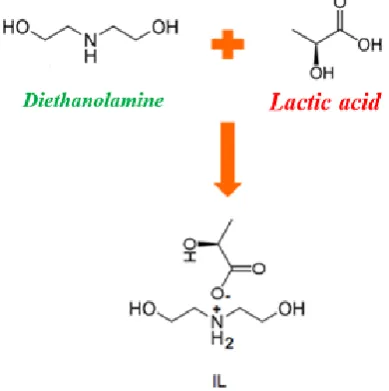
Fig 1. Structure and reaction of the synthesized ionic liquid
Method II: A certain amount of diethanolamine was dissolved in ethanol to obtain the ultimate concentration of 1 M diethanolamine. Lactic acid (1 M in distilled water) also prepared and the system was mixed at 60 °C for 12 hours and then incubated at room temperature for 48 hours. The obtained solution was initially distilled off and then placed in a conventional oven at 95 °C for 12 hours. In the next step, the concentrated solution was placed in a rotary evaporator (attached to the vacuum pump, 100 rpm) at a temperature of 80 °C for 3 hours. The solution was washed 3 times with distilled water (50 ml) and repeated each time in a conventional oven and rotary oven at the same residence time. In the final step, for further purification, the solution was placed in a vacuum oven for 5 hours at 80 °C. The resulting material will be [DEA] [Lac].
Analyses
Nuclear Magnetic Resonance Spectroscopy
The 1H and 13C were recorded using a Bruker Avance 400 spectrometer, operating at 400 MHz for 1H. 13C NMR spectra were recorded on a Bruker AMX 400 spectrometer. The chemical shifts are noted in parts per million (ppm) the coupling constants are given in Hz.
Fourier Transform Infrared Spectrometer
Results and discussion
In order to characterize and identification of ionic liquid FTIR analysis and NMR analysis have been used [35,36].
FTIR Analysis (Fourier-Transform Infrared Spectroscopy)
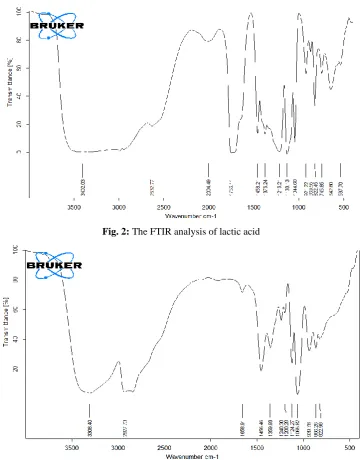
The identification of the synthesized sample was performed using FTIR spectrophotometry technique. The results of the FTIR analysis of lactic acid, diethanolamine and [DEA] [Lac] are shown in Figs. 2-4 respectively. According to the spectra obtained from the analysis of samples, lactic acid shows characteristic peaks at 3402 cm-1 (OH), 1756 cm-1 (C=O), and 1216 cm-1 (C-O). These peaks are demonstrated at 3369 cm-1 (OH), 1728 cm-1 (C=O), and 1231 cm-1 (C-O)
in the synthesized ionic liquid. Also, diethanolamine shows characteristic peaks at 866 cm-1 (bending NH) and 1456 cm-1 (stretching C-N) that are exhibited at 855 cm-1 and 1455 cm-1 at the synthesized compound. The successful synthesis of the ionic liquid is evidenced using these characterization bands in the ionic liquid.
Fig. 2: The FTIR analysis of lactic acid
Fig. 4. The FTIR analysis results for the synthesized diethanolamine lactic [DEA] [Lac]
NMR Analysis (Nuclear magnetic resonance spectroscopy)
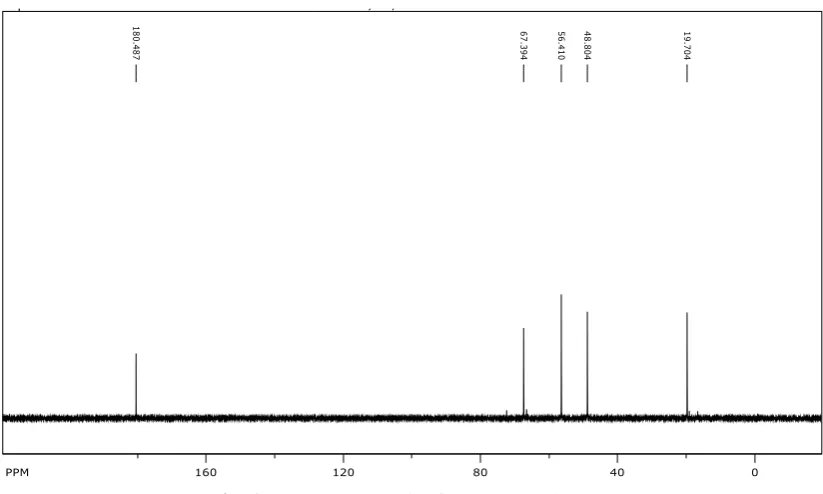
The produced ionic liquid was characterized using 1HNMR and 13CNMR (400 MHz, D2O).
Data of characterization were in compliance with the expected structure. The details of spectra are:
Diethanolamine lactate. IR 3369.33, 2981.63, 1949.22, 1728.23, 1587.88, 1455.65, 1414.63, 1231.35, 1128.26, 1039.92, 945.87, 855.87, 832.96, 776.71, 664.45, 541.69 cm-1 HNMR (400MHz,D2O) δ 1.2 (3H,d), 3.00 (4H,t), 3.63 (4H,t), 4.0 (1H,q), 4.69 (2H,s). 13CNMR (400
MHz, D2O) δ 19.71, 48.81, 56.41, 67.40, 180.49. According to the spectrum, the total carbon numbers obtained equaled 5. The results of HNMR and 13CNMR analysis are shown in Figs. 5 and 6 respectively.
Fig. 6. 13C NMR analysis of diethanolamine lactate
Physicochemical Properties
The [DEA] [Cl] has a high viscous and in yellow color and on the other side, the ionic liquid called [DEA] [Lac] is colorless and high viscous liquid .
Conclusions
With regard to the applications and specific properties of ionic liquids, in this work, a novel amine ionic liquid “diethanolamine Lactic” has been synthesized in two simple steps. The procedure makes use of inexpensive starting compounds, as well as a cheap halogenation agent (HCl). The changes in bands' wavelengths and the peaks of the participating elements and process materials have been confirmed before and after synthesis based on the results of FTIR analysis and demonstrate the successful synthesis of diethanolamine lactic. The NMR analysis also clearly confirms the synthesis of diethanolamine lactic acid. Amine bases property in the ionic liquid can be obtained in good yields with several different anions.
Abbreviations
℃ Celsius degree
𝐶𝑙 Chlorine
𝑐𝑚−1 inverse centimeter
𝐷𝐸𝐴 Diethanolamine
𝐹𝑇𝐼𝑅 Fourier transform infrared
𝐻𝐶𝑙 Hydrogen chloride
𝐻𝑧 Hertz
𝐿 Liter
𝑀 mole
𝑁𝑀𝑅 Nuclear Magnetic Resonance
𝑝𝑝𝑚 Part per million
Acknowledgments
The present work was financially supported by the Kermanshah University of Technology. The authors are also grateful to Professor Philip G. Jessop from Queen’s University for its scientific advisory.
References
[1] Luo QX, An BW, Ji M, Zhang J. Hybridization of metal–organic frameworks and task-specific ionic liquids: fundamentals and challenges. Materials Chemistry Frontiers. 2018;2(2):219-34. [2] Wang LY, Xu YL, Li ZD, Wei YN, Wei JP. CO2/CH4 and H2S/CO2 selectivity by ionic liquids in
natural gas sweetening. Energy & fuels. 2017 Dec 22;32(1):10-23.
[3] Wei Z, Zhang ZH, Wang MM, Xu L, Liu B, Jiao H. Combination effect of ligands and ionic liquid components on the structure and properties of manganese metal–organic frameworks. CrystEngComm. 2017;19(36):5402-11.
[4] Kinik FP, Uzun A, Keskin S. Ionic liquid/metal–organic framework composites: from synthesis to applications. ChemSusChem. 2017 Jul 21;10(14):2842-63.
[5] Wang B, Qin L, Mu T, Xue Z, Gao G. Are ionic liquids chemically stable?. Chemical reviews. 2017 Feb 27;117(10):7113-31.
[6] Cui G, Wang J, Zhang S. Active chemisorption sites in functionalized ionic liquids for carbon capture. Chemical Society Reviews. 2016;45(15):4307-39.
[7] Basile A, Bhatt AI, O’Mullane AP. Stabilizing lithium metal using ionic liquids for long-lived batteries. Nature communications. 2016 Jun 13;7:ncomms11794.
[8] Forsyth M, Girard GM, Basile A, Hilder M, MacFarlane DR, Chen F, Howlett PC. Inorganic-organic ionic liquid electrolytes enabling high energy-density metal electrodes for energy storage. Electrochimica Acta. 2016 Dec 1;220:609-17.
[9] Ohno H, editor. Electrochemical aspects of ionic liquids. John Wiley & Sons; 2005 Aug 8. [10] O'regan B, Grätzel M. A low-cost, high-efficiency solar cell based on dye-sensitized colloidal TiO2
films. nature. 1991 Oct;353(6346):737.
[11] Ye C, Liu W, Chen Y, Yu L. Room-temperature ionic liquids: a novel versatile lubricant. Chemical Communications. 2001(21):2244-5.
[12] Wang Y, Yang H. Synthesis of CoPt nanorods in ionic liquids. Journal of the American Chemical Society. 2005 Apr 20;127(15):5316-7.
[13] Ding K, Miao Z, Liu Z, Zhang Z, Han B, An G, Miao S, Xie Y. Facile synthesis of high quality TiO2 nanocrystals in ionic liquid via a microwave-assisted process. Journal of the American Chemical Society. 2007 May 23;129(20):6362-3.
[14] Zhao D, Wu M, Kou Y, Min E. Ionic liquids: applications in catalysis. Catalysis today. 2002 May 15;74(1-2):157-89.
[15] Geldbach TJ, Dyson PJ. A versatile ruthenium precursor for biphasic catalysis and its application in ionic liquid biphasic transfer hydrogenation: conventional vs task-specific catalysts. Journal of the American Chemical Society. 2004 Jul 7;126(26):8114-5.
[16] Mora‐Pale M, Meli L, Doherty TV, Linhardt RJ, Dordick JS. Room temperature ionic liquids as emerging solvents for the pretreatment of lignocellulosic biomass. Biotechnology and bioengineering. 2011 Jun;108(6):1229-45.
[17] Ouellet M, Datta S, Dibble DC, Tamrakar PR, Benke PI, Li C, Singh S, Sale KL, Adams PD, Keasling JD, Simmons BA. Impact of ionic liquid pretreated plant biomass on Saccharomyces cerevisiae growth and biofuel production. Green Chemistry. 2011;13(10):2743-9.
[18] Azizi D, Larachi F. Immiscible dual ionic liquid-ionic liquid mineral separation of rare-earth minerals. Separation and Purification Technology. 2018 Jan 31;191:340-53.
[20] Mashuga M, Olasunkanmi L, Adekunle A, Yesudass S, Kabanda M, Ebenso E. Adsorption, thermodynamic and quantum chemical studies of 1-hexyl-3-methylimidazolium based ionic liquids as corrosion inhibitors for mild steel in HCl. Materials. 2015 Jun 17;8(6):3607-32.
[21] Hanza AP, Naderi R, Kowsari E, Sayebani M. Corrosion behavior of mild steel in H2SO4 solution with 1, 4-di [1′-methylene-3′-methyl imidazolium bromide]-benzene as an ionic liquid. Corrosion Science. 2016 Jun 1;107:96-106.
[22] Likhanova NV, Domínguez-Aguilar MA, Olivares-Xometl O, Nava-Entzana N, Arce E, Dorantes H. The effect of ionic liquids with imidazolium and pyridinium cations on the corrosion inhibition of mild steel in acidic environment. Corrosion Science. 2010 Jun 1;52(6):2088-97.
[23] Kodama K, Tsuda R, Niitsuma K, Tamura T, Ueki T, Kokubo H, Watanabe M. Structural effects of polyethers and ionic liquids in their binary mixtures on lower critical solution temperature liquid-liquid phase separation. Polymer journal. 2011 Mar;43(3):242.
[24] Sun J, Macfarlane DR, Forsyth M. A new family of ionic liquids based on the 1-alkyl-2-methyl pyrrolinium cation. Electrochimica acta. 2003 May 30;48(12):1707-11.
[25] Golding J, Hamid N, Macfarlane DR, Forsyth M, Forsyth C, Collins C, Huang J. N-methyl-N-alkylpyrrolidinium hexafluorophosphate salts: novel molten salts and plastic crystal phases. Chemistry of materials. 2001 Feb 19;13(2):558-64.
[26] Zhang C, Xin B, Xi Z, Zhang B, Li Z, Zhang H, Li Z, Hao J. Phosphonium-based ionic liquid: a new phosphorus source toward microwave-driven synthesis of nickel phosphide for efficient hydrogen evolution reaction. ACS Sustainable Chemistry & Engineering. 2017 Dec 20;6(1):1468-77.
[27] Yu L, Garcia D, Ren R, Zeng X. Ionic liquid high temperature gas sensors. Chemical Communications. 2005(17):2277-9.
[28] Zhou ZB, Matsumoto H, Tatsumi K. Low‐melting, low‐viscous, hydrophobic ionic liquids: aliphatic quaternary ammonium salts with perfluoroalkyltrifluoroborates. Chemistry–A European Journal. 2005 Jan 7;11(2):752-66.
[29] Pernak J, Syguda A, Mirska I, Pernak A, Nawrot J, Pra̧dzyńska A, Griffin ST, Rogers RD. Choline‐ derivative‐based ionic liquids. Chemistry–A European Journal. 2007 Aug 17;13(24):6817-27. [30] Zhang Z, Zhang Q, Zhang Q, Zhang T, Li W. Isobaric vapor–liquid equilibrium of tert-butyl alcohol
+ water + triethanolamine-based ionic liquid ternary systems at 101.3 kPa. Journal of Chemical & Engineering Data. 2015 Jun 9;60(7):2018-27.
[31] Heintz A. Recent developments in thermodynamics and thermophysics of non-aqueous mixtures containing ionic liquids. A review. The Journal of Chemical Thermodynamics. 2005 Jun 1;37(6):525-35.
[32] Speight JG. Chemical Transformations in the Environment. Environmental Organic Chemistry for Engineers; Butterworth-Heinemann: Oxford, UK. 2017:305-53.
[33] Giernoth R. In situ ir spectroscopy. In: Rogers RD, Seddon KR, editors. ionic liquids: Toward the detection of reactive intermediates in transition metal catalysis. American Chemical Society; 2005. [34] Lin-Vien D, Colthup NB, Fateley WG, Grasselli JG. The handbook of infrared and Raman
characteristic frequencies of organic molecules. Elsevier; 1991 Dec 2.
[35] Lv B, Xia Y, Shi Y, Liu N, Li W, Li S. A novel hydrophilic amino acid ionic liquid [C2OHmim][Gly] as aqueous sorbent for CO2 capture. International Journal of Greenhouse Gas Control. 2016 Mar 1;46:1-6.
[36]de Castro CA, Langa E, Morais AL, Lopes ML, Lourenço MJ, Santos FJ, Santos MS, Lopes JN, Veiga HI, Macatrão M, Esperança JM. Studies on the density, heat capacity, surface tension and infinite dilution diffusion with the ionic liquids [C4mim][NTf2],[C4mim][dca],[C2mim][EtOSO3] and [Aliquat][dca]. Fluid Phase Equilibria. 2010 Jul 15;294(1-2):157-79.
![Fig. 4. The FTIR analysis results for the synthesized diethanolamine lactic [DEA] [Lac]](https://thumb-us.123doks.com/thumbv2/123dok_us/8948500.1857868/5.595.86.516.510.730/fig-ftir-analysis-results-synthesized-diethanolamine-lactic-dea.webp)