in the population sciences published by the Max Planck Institute for Demographic Research Konrad-Zuse Str. 1, D-18057 Rostock · GERMANY www.demographic-research.org
DEMOGRAPHIC RESEARCH
VOLUME 20, ARTICLE 18, PAGES 435-466
PUBLISHED 24 APRIL 2009
http://www.demographic-research.org/Volumes/Vol20/18/ DOI: 10.4054/DemRes.2009.20.18
Research Article
Geographical mortality patterns in Italy:
A Bayesian analysis
Fabio Divino
Viviana Egidi
Michele Antonio Salvatore
© 2009 Fabio Divino, Viviana Egidi & Michele Antonio Salvatore.
This open-access work is published under the terms of the Creative Commons Attribution NonCommercial License 2.0 Germany, which permits use, reproduction & distribution in any medium for non-commercial purposes, provided the original author(s) and source are given credit.
1 Introduction 436
2 Data and indicators 437
3 The hierarchical Bayesian model 441
4 Results 446
4.1 The smoothing effect 446
4.2 The clustering effect and the heterogeneity effect 449 4.3 The regression effect of the past mortality pattern 452
5 Conclusions 460
Geographical mortality patterns in Italy:
A Bayesian analysis
Fabio Divino 1
Viviana Egidi 2
Michele Antonio Salvatore 3
Abstract
In this paper, we present a hierarchical spatial model for the analysis of geographical variation in mortality between the Italian provinces in the year 2001, according to gender, age class, and cause of death. When analysing counts data specific to geographical locations, classical empirical rates or standardised mortality ratios may produce estimates that show a very high level of overdispersion due to the effect of spatial autocorrelation among the observations, and due to the presence of heterogeneity among the population sizes. We adopt a Bayesian approach and a Markov chain Monte Carlo computation with the goal of making more consistent inferences about the quantities of interest. While considering information for the year 1991, we also take into account a temporal effect from the previous geographical pattern. Results have demonstrated the flexibility of our proposal in evaluating specific aspects of a counts spatial process, such as the clustering effect and the heterogeneity effect.
1 Dipartimento di Scienze e Tecnologie per Ambiente e Territorio, Università degli Studi del Molise,
Contrada Fonte Lappone, 86090 - Pesche (Isernia), Italy.Tel.: +39.0874.404170; Fax: +399.0874.404123; E-mail: [email protected].
2 Dipartimento di Scienze Demografiche. Università di Roma “La Sapienza”.
E-mail: [email protected].
3 Dipartimento di Scienze Demografiche. Università di Roma “La Sapienza”
1. Introduction
In the field of public health, the analysis of spatial distribution of mortality and disease rates plays an important role in the formulation of valid aetiological hypotheses that help us to better understand the relationships between events of interest and factors contributing to their occurrence. Moreover, the mapping of the geographical variation in risk may help to identify areas with lower or higher rates of incidence with respect to a reference average. This can be useful in enabling us to better plan and manage the resources of a public health system (for an in-depth review on disease mapping methods and applications see Marshall 1991a and Lawson et al. 1999, 2000).
In recent years, there has also been considerable interest in these kinds of studies from a demographic perspective, and a great deal of effort has been put into developing and applying statistical methods which take into account mortality information about small geographical areas (see for example Benach et al. 2003, 2004; Caselli and Lipsi 2006).
Within this framework, statistical results become more or less pertinent depending on the degree to which the areas display homogenous environmental, demographic, social, and economic characteristics, as these characteristics may influence the phenomenon of interest. In this way, the average value of the mortality incidence observed with respect to any area effectively represents the risk that the majority of the corresponding population is exposed to. Moreover, the phenomenon of interest may be more correctly connected to possible determinants.
In geographical studies of mortality, such a fine specification of the territorial domain, alongside the need to consider data that is also distributed over several factors (e.g., sex and age), clashes with the challenge of dealing with events that are becoming increasingly rare. As a consequence, the territorial distribution of the mortality risks appears strongly influenced by the random variation enclosed in the observable data.
The most common solutions adopted to deal with these problems involve two main approaches. The first consists of stabilising the statistical estimates through the introduction of multiple-years averages (Caselli and Egidi 1980, Pickle et al. 1996, Frova et al. 1999, Jougla et al. 2002, Dupré et al. 2004, De Simoni and Lipsi 2005, Egidi et al. 2005). Underlying this approach is the strong assumption that the territorial units are independent of each other. Moreover, this approach also neglects the possibility of considering the temporal dynamic of the phenomenon within the period considered.
the linear mixed models approach, Ferrandiz et al. 1995 for the use of the auto-Poisson model, Langford et al. 1999 for a multilevel modelling), then as part of the full Bayesian (Bernardinelli and Montomoli 1992; Mollie 1994; Clayton, Bernardinelli, and Montomoli 1994; Bernardinelli, Clayton, and Montomoli 1995) and empirical Bayesian approaches (Clayton and Kaldor 1987, Marshall 1991b, Mollie and Richardson 1991, Bernardinelli and Montomoli 1992).
The purpose of this work is to analyse territorial differences in mortality between the Italian provinces by adopting a Bayesian approach, and to consider the spatial proximity of the geographical areas and their demographic dimensions. Our proposal represents an application of the model introduced by Besag, York, and Mollie for image analysis and disease mapping (Besag, York, and Mollie 1991), which was subsequently developed by other authors in several fields of applications (see for example Heikkinen and Högmander 1994 and Penttinen, Divino, and Riiali 2003 for ecological studies).
The proposed approach allows us to take into account the influence of the geographical structure of the phenomenon, and to evaluate the interaction of the adjacent neighbourhood on the mortality level of each specific area. At the same time, we can also measure the effect of the proper peculiarity of each area with respect to specific features, and the effect of the small-scale randomness present in empirical observations from small domains.
The introduction to the model of an additional regressive term that provides information from the previous geographical pattern allows us also to evaluate the influence of the spatial structure of the past history.
This paper is structured as follows. In Section 2 we describe the nature of the data used for applications. Section 3 concerns the definition of the statistical model and the specification of some computational details. In Section 4 we report and illustrate the results obtained, while Section 5 provides conclusive remarks.
2. Data and indicators
For each province, and for each of the years 1991 and 2001, we consider data by gender and cause of death for four broad age groups ( ‘1-29’, ‘30-54’, ‘55-74’, ‘75 and over’) and constructed on the basis of specific quinquennial rates, referring to 1-4 years of age for the first group, and ages 84 and above for the last one. The quality of the Italian cause of death statistics was evaluated as “medium-high” in a comparative study based on a method developed by the Health Metrics Network (Mahapatra et al. 2007). The rates for the broad age groups have been calculated through a direct standardisation of the specific rates with respect to the population residing in Italy in 1991. For those provinces not yet established in 1991, data have been calculated by totalling the mortality counts of all municipalities making up the new province. In addition, the causes of death have been grouped into four main categories according to the International Classification of Diseases (ICD), Revision IX (see ISTAT 1997). They are, respectively:
1. diseases of the circulatory system (ICD IX from 390 to 459); 2. malignant neoplasms (ICD IX from 140 to 239);
3. external causes of death (ICD IX from 800 to 999); and
4. other causes (all remaining ICD codes not considered in the above groups).
Table 1 shows the corresponding standardised death rates.
Table 1: Standardised death rates by gender, age class, and cause of death, Italy 2001*. Value by 10,000.
Men Women
1-29 30-54 55-74 75 and
over 1-29 30-54 55-74 75 and
over
Diseases of the circulatory
system 0.4 5.0 48.2 402.8 0.2 1.8 21.1 315.0
Malignant neoplasms 0.6 7.0 74.0 242.4 0.4 6.2 36.0 119.8
External causes of death 3.2 4.1 5.8 27.1 0.7 1.0 2.1 20.1
Other causes 1.0 4.9 29.1 220.7 0.5 2.1 16.1 149.1
* Standard population: Italy, 1991 Source: ISTAT, 2005
In the formulas used in this paper, we have indexed the province, the age class, and the cause of death respectively by i=1,...,103; a=1,..., 4, and d =1,..., 4.
Based on the assumption that the mortality counts are independently Poisson or Binomial distributed, an empirical estimate of the relative risk is represented by the standardised mortality ratio (denoted by SMR). This is generally defined with respect to any specific territorial unit as the ratio between the observed and the expected death counts, which are derived from the underlying population average rate.
In particular, for each of the two years taken into account, and with respect to each province i, age group a, and cause of death d, the SMR index has been calculated separately for the two genders through the following ratio:
iad iad ia
iad
iad ad ia
O m P
SMR
E m P
= = (1)
where and are the corresponding observed and expected death counts, computed respectively through the mortality rate (related to the specific province
i) and the average mortality rate iad
O Eiad
iad
m
ad
m (for the whole of Italy), both standardised with respect to the structure of the Italian population in 1991, and multiplied by the population Pia (province i and age class a).
It is important to emphasise that the SMR indexes are constructed using standardised death rates. This means that the numerator of the ratio does not show the number of deaths actually observed (as normally happens), but the number of deaths that would be expected to occur if the population structure were that of the Italian population in 1991. This allows us to eliminate the influence of the age structure within the broad age groups considered, making the SMR comparable among the provinces.
For the youngest age group (1-29), among whom mortality is low and the number of deaths at a provincial level is very small regardless of gender and cause of death, the
SMRs show a very high variability, mainly due to random variations. By contrast, for the oldest age class (75 and over), mortality is high and the SMRs are based on a number of deaths that is sufficiently large. As a consequence, the influence of the random fluctuations is less strong, and the variability is more contained.
Figures 1 and 2 use as an example mortality related to diseases of the circulatory system and malignant neoplasms in men aged 1-29 and 75 and over. They show the diverse territorial variability within the young and the elderly age groups.
Figure 1: Maps of the SMRs, diseases of the circulatory system in men aged 1-29 and 75 and over. Italy, 2001
SMR 75 years and over
SMR 1-29 years
Figure 2: Maps of the SMRs, malignant neoplasms in men aged 1-29 and 75 and over. Italy, 2001
SMR 75 years and over
It is immediately apparent that the map illustrating death rates for the youngestage group (1-29) has a leopard spot structure. Extreme values dominate the picture, and the provinces are mainly grouped at the lowest and highest ends of the classification. Therefore, very high and very low mortality ratios prevail, and larger areas with homogenous mortality levels are difficult to discern.
On the other hand, the maps illustrating rates for the oldest age group (75 and over) are characterised by areas of homogenous mortality, and by the predominance of provinces included in the central intensity class, with mortality rates very similar to the national average.
3. The hierarchical Bayesian model
The use of spatial models in analysing the geographical distribution of mortality data allows us to derive more consistent estimates of the incidence of death through the joint use of observable information and prior knowledge about the phenomenon of interest.
When a rare event, such as the mortality risk over different factors (i.e., sex, age, cause of death), is considered with respect to small geographical locations, statistical inference on the parameters of interest may be affected by two important problems.
First, if the empirical SMR is considered as an estimate of the relative risk, the variation of the population size over the geographical domains is not taken into account. Thus, the SMRs that are based on only a few cases may be the extremes of the distribution, and may therefore dominate the spatial pattern (Clayton and Kaldor 1987).
Second, extra-variation among the observations may be present (Breslow 1984). This means that the variability in the observed death counts, since individual risks are heterogeneous within each area, exceeds the level of variability expected from the likelihood model. In this way, a sort of overdispersion can act on the distribution of the mortality risks, thus compromising the consistency and efficiency of the statistical estimates.
geographical domains, the population size is a source of heterogeneity due to its high level of variability.
Our proposal represents an application of the model introduced by Besag, York, and Mollie (Besag, York, and Mollie 1991); it is a hierarchical Bayesian model and consists of four levels (it will be denoted as BYM model). With respect to a set of n
geographical locations A1,...,An, the first level describes the conditional likelihood model for the observable death counts ,Y =( ,...,Yi Yn) given the mortality relative risks
1
( ,..., n)
θ = θ θ . At the second level, the relative risk θi is defined in terms of a log-linear regression over the previous geographical pattern, local homogeneity, and specific heterogeneity of each area Ai. The third level concerns the definition of the prior probability distributions with respect to the quantities enclosed in the previous levels, such as the regression coefficient and the parameters of both the spatial structured and the spatial non-structured random effects. Finally, at the fourth level, the hyperparameters governing the prior distributions are defined.
In detail, concerning the conditional likelihood, we assume that each observation , given the relative risk
i
Y θi, is independently Poisson distributed with means
i iEi
λ θ= , where Ei represents the expected number of death counts in the area Ai under the general mortality rate underlying all the geographical domains considered. At the second level, we define the mathematical relationship between the relative risk θi and all the elements which can explain the geographical distribution of the observations. We assume that information from the previous history, represented by the empirical SMR on the logarithmic scale delayed by 10 years, can be useful in describing a temporal effect of the underlying geographical trend. In addition, we consider the variation of the relative risks θi as spatially smooth. This means that we allow the mortality risks that refer to nearby areas to show similar intensities. Moreover, we must allow for the possibility that a spatial non-structured random effect, representing the presence of some heterogeneity due to differences in population size between the areas, or due to particular specificities in each location Ai, can be present. We denote the components representing the geographical trend, the spatial homogeneity, and the specific heterogeneity of each area Ai, respectively, by the terms Ti, Si, and Hi. Moreover, following the classical log-linear formulation, we assume that these components act additively on the logarithm scale of the parameter θi, that is:
In particular, the trend effect is specified by a linear regression with respect to the logarithm of the previous standardised mortality ratio, denoted by SMRi t,−10, that is:
, 10 log
i
T =β SMRi t− (3)
At the third level, we specify the prior distribution for the parameter of each component Ti, Si, and Hi. In particular, to account for a spatial homogeneity, we assume that the joint distribution of the component S=( ,...,S1 Sn) is a pairwise Markov random field with a Gaussian specification (GMRF):
2
~
( | ) exp ( )
2
S S
i j
p S γ γ Si Sj
⎧ ⎫
⎪ ⎪
∝ ⎨− − ⎬
⎪ ⎪
⎩
∑
⎭ (4)(see Banerjee, Carlin, and Gelfand 2004:79 and Mollie 1994:365) where γS is a precision parameter (the inverse of the variance) and the sum in the exponential form is extended over all the pairs Ai and Aj; which are geographically adjacent; we denote this pairwise symmetrical neighbourhood relationship by i . It should be noted that, although each location
j ∼
i
A can get a different number of neighbours, the model is able to modulate the spatial interactions just by making relative the effect of the parameter
S
γ with respect to that number of neighbours. This becomes clear if we look at the conditional distributions of each term given the values in its neighbourhood set
denoted by
i
S
{
j j: ∼i}
∂i, that can be derived as:1
( | , ) , S
i j i i
i
p S S j N S
n
γ−
⎛ ⎞
∈ ∂ ⎜
⎝ ⎠
∼ ⎟ (5)
where
n
i is the number of neighbours adjacent to the area Ai, i.e. ni = ∂i , and Si is the local conditional mean, i.e. 1i i j j i S S n ∈∂ =
∑
.Although improper, since it specifies only differences in log-relative risk and not in levels, the GMRF prior does not lead to an improper posterior (Congdon 2003:280), and it represents a quite standard choice (for further details on the theory of Markov random fields see Rue and Held 2005).
denoted by γH. Thus the joint probability density for H =(H1,...,Hn) can be expressed as a multinormal:
2
1 ( | ) exp
2 n H H
i
p H γ γ H
= i
⎧ ⎫
∝ ⎨− ⎬
⎩
∑
⎭ (6)In the regression term, we introduced the linear parameter β , as we expect that the precedent mortality pattern will have no effect on the log-relative risk, and we assume that β is distributed as a Gaussian random variable with mean equal to zero and precision parameter denoted by γβ:
2 ( | ) exp
2
p β β
γ β γ ∝ ⎧⎨− β ⎫⎬
⎩ ⎭ (7)
Then we need to specify the prior distribution of the precision parameters γS, γH, and
β
γ . In line with other authors (Mollie 1994; Bernardinelli, Clayton, and Montomoli 1995), we assume that they are independent Gamma distributed, that is:
{
}
{
}
( h; h, h) exp ( h 1) log h h h , with , ,
p γ ν α ∝ ν − γ −α γ h∈ S H β (8)
At the last level of our model, we fix the values of all the hyper parameters governing the prior distributions enclosed in the previous steps.
After the counts vector Y =( ,...,Y1 Yn) is observed, and in order to make inference on the quantities of interest, we can use the Bayes rule to derive the full posterior distribution of all the parameters involved in the model:
(
)
2 2 21
1
, , , , , | exp ( )
2 2 2
[ log( ) ( )] 1 log
2
1
1 log log .
2 2
n
S H
S H i j i
i j i
n
i i i i i S S S S
i
H H H H
p S H Y S S H
n
Y E E
n β β β β β γ γ γ β γ γ γ β θ θ ν γ α γ ν γ α γ ν γ α = = ⎧⎪ ∝ ⎨− − − − + ⎪⎩ ⎛ ⎞ β γ + − +⎜ + − ⎟ − ⎝ ⎠ ⎫ ⎛ ⎞ ⎛ ⎞ +⎜ + − ⎟ − +⎜ − ⎟ − ⎬ ⎝ ⎠ ⎝ ⎠ ⎭
∑
∑
∑
∼+ (9)
Following a standard approach, we can consider the set of the conditional posteriors with respect to all the parameters involved in the model and generate Monte Carlo simulations through the Gibbs sampler and Metropolis-Hasting algorithms (for a general review on MCMC strategies, see Robert and Casella 2004 and Liu 2001). As a final step, numerical estimates can be produced by considering the posterior ergodic means of those simulations. Thus, the relative risk of each area can be estimated by the
BYM value:
{
ˆ exp [ | ] [ | ] [ | ] i M T Yi M S Yi M H Yi
}
θ = + + (10)
where M[. | ]Y is the arithmetic mean operator over the Monte Carlo simulations from the corresponding marginal posteriors. With respect to the term Ti we have that:
, 10 [ i| ] [ | ]log
M T Y =M β Y SMRi t− . (11)
For the computational aspects, we implemented Fortran routines of a Gibbs-Metropolis algorithm, and to compute the posterior estimates of the mortality relative risk from the BYM model, we used the last 200,000 iterations of one million in total. We could use this large number of iterations due to the high-speed performance of the Fortran codes. The statistical convergence of the Markov chain has been also monitored using the Gelman-Rubin device (see Robert and Casella 2004: 497), and it was assessed at around 10,000 of iterations.
For the values of the hyperparameters enclosed in the Gamma priors, we had to search for a feasible choice for all the datasets, given the fact that our applications referred to a set of very different situations. After some tuning runs of the MCMC algorithm, we fixed those hyperparameters as follows:
(νS =0.01;αS=0.01), (νH =0.01;αH =0.01) and (νβ =1.0;αβ =1.0).
Concerning γS and γH, this represents a quite diffuse assumption. Instead, for the precision γβ, we assume an informative prior. It reflects the fact that, due to the large temporal lag (10 years) and the possible noise enclosed in the regression variable (the
SMRs when considered with respect to small reference populations), we needed to be wary in recording a regressive effect from the previous geographical pattern. In this way, as we already indicated, we supposed the regression parameter to be normal distributed with null mean (we expect no effect), and the corresponding precision parameter to be Gamma distributed with a small prior variance.
which could compromise any interpretation of the results (this kind of problem was also found by Penttinen, Divino, and Riiali 2003 in bio-geographical applications of the BYM model).
4. Results
In this section, we present the main results obtained from the application of the BYM model on the data introduced in Section 2. As we have already mentioned, our applications have been realized with respect to the 103 Italian provinces, and have been numbered following the ISTAT classification, distinctively by cause of death (d=1,..., 4), age class (a=1,..., 4), and gender.
4.1 The smoothing effect
In general, the results show the efficiency of such a model in the elimination of variations due to random occurrences from the territorial mortality distribution, the so-called smoothing effect. The results are obviously much stronger in the youngest age class, in which, for all causes of death and for both genders, mortality is low and the small demographical dimension of many provinces produces an overdispersion in the distribution of the observed counts. Yet for the oldest age group, for whom the large numbers of death counts produce more consistent empirical values, the smoothing effect is almost imperceptible.
Taking the diseases of the circulatory system and the malignant neoplasms in the male population aged 1-29 and 75 and over as an example, Figures 3 and 4 compare the empirical SMRs in 2001 and the relative risks estimated by the BYM model (denoted by BYMs) on the basis of the information related to the geographical proximity of the Italian provinces. As for the youngest age group, the SMRs show a very high variability with peaks of extremely high and extremely low mortality. The BYMs instead show instead a lesser degree of variability and values closer to the national average. For the oldest group, however, the smoothing effect is almost imperceptible.
The smoothing effect as seen in the model is also evident when comparing SMRs
Figure 3: Plots of the SMRs and BYMs, diseases of the circulatory system in men aged 1-29 and 75 and over. Italy, 2001
1-29 years 75 years and over
Figure 4: Plots of the SMRs and BYMs, malignant neoplasms in men aged 1-29 and 75 and over. Italy, 2001
Figure 5: Maps of the SMRs and BYMs, diseases of the circulatory system in men aged 1-29. Italy, 2001
BYM SMR
Figure 6: Maps of the SMRs and BYMs, diseases of the circulatory system in men aged 75 and over. Italy, 2001
In the 1-29 age group, the SMRs map is dominated by extreme values, while the
BYMs map is characterised by more intermediate values and by mortality risks closer to the national average (Figure 5). The changes observed when comparing SMRs and
BYMs maps for the oldest age group are completely marginal (Figure 6).
4.2 The clustering effect and the heterogeneity effect
The BYM model offers an interesting opportunity to break down the territorial variability into two effects. The first, the clustering effect (represented in the model by the component S), is produced by the geographical structure; while the second, the heterogeneity effect (represented in the model by the component H), is produced by the random occurrences and peculiarities of each individual area. The variability of these two components allows us to evaluate, respectively, the structured territorial variability (expressing geographical patterns where homogeneous territorial clusters made up of several adjacent provinces are evident), and the variability without geographical structure (coming out of provinces which have observed values significantly different from the other nearby areas).
Table 2: Posterior estimates of clustering effects ( ) and heterogeneity effects (
ˆv( | )S Y
ˆv(H Y| )) according to gender, age class, and cause of death. Italy, 2001
1-29 30-54 55-74 75 and over
ˆv( | )S Y ˆv(H Y| ) ˆv( | )S Y ˆv(H Y| ) ˆv( | )S Y ˆv(H Y| ) ˆv( | )S Y ˆv(H Y| )
Men
Diseases of the
circulatory system 0.040 0.088 0.027 0.018 0.021 0.010 0.011 0.007
Malignant neoplasms 0.043 0.033 0.018 0.013 0.020 0.010 0.015 0.007
External causes of death 0.034 0.053 0.040 0.047 0.037 0.034 0.036 0.0027
Other causes 0.047 0.070 0.029 0.027 0.033 0.015 0.016 0.009
Women
Diseases of the
circulatory system 0.052 0.050 0.034 0.032 0.024 0.012 0.012 0.008
Malignant neoplasms 0.055 0.044 0.018 0.015 0.016 0.010 0.013 0.008
External causes of death 0.085 0.061 0.037 0.039 0.023 0.029 0.037 0.028
Table 2 shows the estimates of the posterior variance of the two components S and
H, given respectively by ˆv( | )S Y =n−1⋅γˆS−1 (where n=4.5 is the average of neighbours among the 103 Italian provinces considered, see Mollie 1995:366) and
1
ˆ
ˆv(H Y| )=γH− , for all the causes of death considered, within the four age groups and specific for gender. Apart from the first age group, in which, at least for men, the territorial variability is frequently dominated by the heterogeneity effect, the clustering effect almost always prevails. In such cases, the geographical representation of the
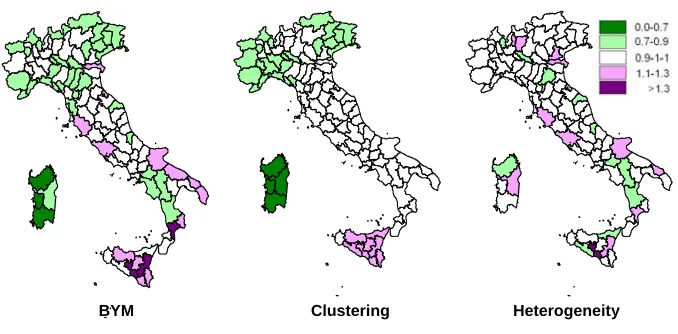
BYMs is mainly influenced by the territorial distribution of the S component, which is the one that shows the structured territorial variation: the geography is characterised by territorial clusters that are wider (low variability) or narrower (high variability), with relatively similar mortality risks. In comparing the different effects, we can also produce distinct maps for each component (S and H). In Figures 7 and 8, we present the three maps corresponding to the BYMs. These maps featurethe component S and the component H, which, respectively, refer to the cases of malignant neoplasms for men aged 75 and over and 1-29. These represent two cases in which the ratio between
and
ˆv( | )S Y ˆv(H Y| ) is greater than one, relative to low total variability (age class 1-29) and to high total variability (age class 75 and over).
As for the mortality rates due to neoplasms in the oldest people (Figure 7), the geography of the S component is clearly known already through the geographical representation of the BYMs. Two large clusters of homogeneous mortality appear: one of medium to high mortality in the North, and another of medium to low mortality for the Centre-South. The specification of the H component in a general framework of absolute homogeneity around the middle levels allows us to highlight some specific situations which concern the provinces of Roma (Centre), Napoli (Centre-South) and Lodi (North). The first two provinces are part of an area where mortality is lower than the average, and the third is part of an area where it is higher than average. They are all characterised by mortality levels that are slightly higher than in the other provinces in the area.
For the youngest age group (Figure 8), the ratio between the ˆv( | )S Y and
Figure 7: Maps of the BYMs, clustering (S) and heterogeneity (H) estimates, malignant neoplasms in men aged 75 and over. Italy, 2001
BYM Clustering Heterogeneity
Figure 8: Maps of the BYMs, clustering (S) and heterogeneity (H) estimates, malignant neoplasms in men aged 1-29. Italy, 2001
BYM Clustering Heterogeneity
When comparing the three maps of Figure 8, which illustrate cancer mortality among men in the youngest age group, it is important to note the specific roles of S and
three low mortality areas: two in the North (North-East and North-West), and one that basically encompasses the entirety of Sardegna island (Centre-West). One high-rate mortality cluster in Sicilia is also defined.
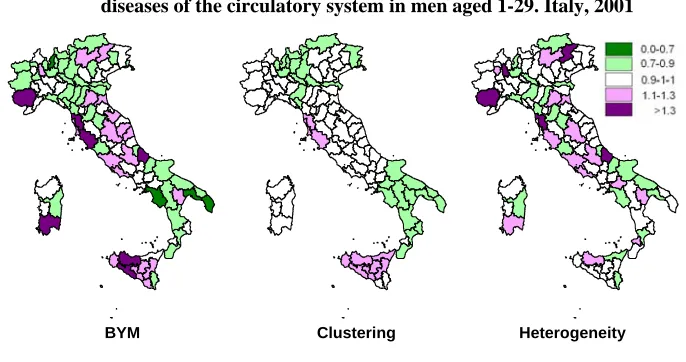
When the ratio between ˆv( | )S Y and ˆv(H Y| ) is less than one, the BYMs are mainly influenced by the heterogeneity factor, and any evaluation of the geographical structure cannot avoid considering the decomposition of both components. The territorial distribution of mortality for diseases of the circulatory system in men aged 1-29 is an example of such a case, and it is reported in Figure 9. The very fragmented image of the BYMs completely obscures the borders of some large, advantaged areas, such as a significant part of the Northern provinces (mainly the North East) and all of the South, and of some disadvantaged areas, like the provinces of Sicily and the central Tirrenic provinces of Toscana (Livorno, Pisa, and Grosseto).
A similar example can be seen in the territorial distribution of mortality by violent causes in men aged 30-54, which is illustrated in Figure 10. In this case, as well, the importance of the variation of the component H blurs the borders of large geographical areas which characterise mortality by violent causes: two disadvantaged areas, one in the North and one which includes the whole of Sardegna; and an advantaged area in the South which includes the provinces of Sicilia, Basilicata, and some provinces of Calabria, Puglia, and Campania.
4.3 The regression effect of the past mortality pattern
We also present results related to the estimation of the relative risks when we add a temporal effect of the previous geographical pattern represented by the mortality SMRs (on the logarithmic scale) of each province in 1991. In this case, the model (denoted by
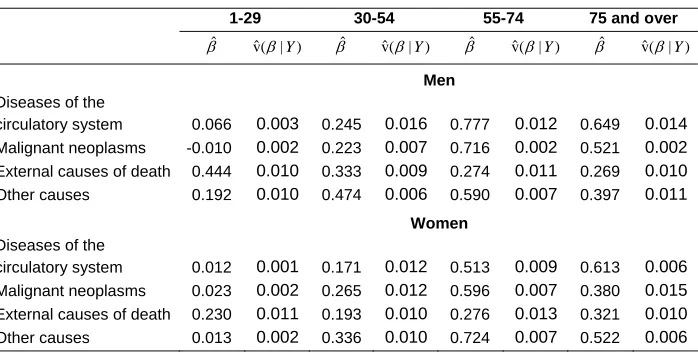
STBYM) for both genders, with the same age classes and causes of death, also allows us to estimate the posterior mean of the log-linear regression parameterβ and its variance,
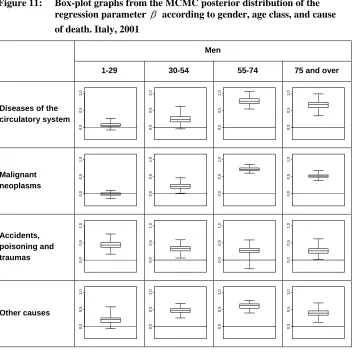
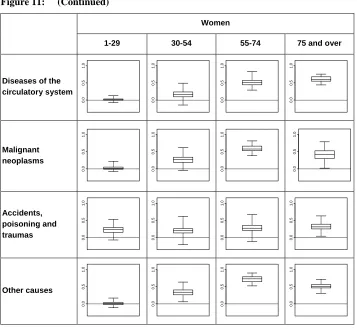
denoted respectively by βˆ and ˆv( | )β Y . Details are provided in Tables 3 and 4, while in Figure 11 the box-plot graphs concerning the posterior distributions of the parameter
ˆ
Figure 9: Maps of the BYMs, clustering (S) and heterogeneity (H) estimates, diseases of the circulatory system in men aged 1-29. Italy, 2001
BYM Clustering Heterogeneity
Figure 10: Maps of the BYMs, clustering (S) and heterogeneity (H) estimates, external causes of death in men aged 30-54. Italy, 2001
Table 3: Posterior estimates of clustering effects ( ) and heterogeneity effects (
ˆv( | )S Y
ˆv(H Y| )) according to gender, age class, and cause of death, STBYM model. Italy, 2001
1-29 30-54 55-74 75 and over
ˆv( | )S Y ˆv(H Y| ) ˆv( | )S Y ˆv(H Y| ) ˆv( | )S Y ˆv(H Y| ) ˆv( | )S Y ˆv(H Y| )
Men
Diseases of the
circulatory system 0.036 0.078 0.019 0.015 0.021 0.009 0.010 0.007
Malignant neoplasms 0.037 0.052 0.015 0.012 0.020 0.007 0.010 0.006
External causes of death 0.041 0.033 0.037 0.037 0.037 0.028 0.031 0.025
Other causes 0.045 0.055 0.027 0.020 0.033 0.010 0.013 0.008
Women
Diseases of the
circulatory system 0.034 0.061 0.036 0.026 0.015 0.010 0.009 0.007
Malignant neoplasms 0.051 0.053 0.020 0.014 0.011 0.008 0.013 0.007
External causes of death 0.093 0.068 0.028 0.040 0.032 0.024 0.038 0.026
Other causes 0.049 0.061 0.041 0.031 0.020 0.013 0.013 0.009
Table 4: Posterior estimates of the regression parameter (βˆ) and its variance (ˆv( | )β Y ) according to gender, age class, and cause of death. Italy, 2001
1-29 30-54 55-74 75 and over
ˆ
β ˆv( | )β Y βˆ ˆv( | )β Y βˆ ˆv( | )β Y βˆ ˆv( | )β Y
Men
Diseases of the
circulatory system 0.066 0.003 0.245 0.016 0.777 0.012 0.649 0.014
Malignant neoplasms -0.010 0.002 0.223 0.007 0.716 0.002 0.521 0.002
External causes of death 0.444 0.010 0.333 0.009 0.274 0.011 0.269 0.010
Other causes 0.192 0.010 0.474 0.006 0.590 0.007 0.397 0.011
Women
Diseases of the
circulatory system 0.012 0.001 0.171 0.012 0.513 0.009 0.613 0.006
Malignant neoplasms 0.023 0.002 0.265 0.012 0.596 0.007 0.380 0.015
External causes of death 0.230 0.011 0.193 0.010 0.276 0.013 0.321 0.010
In order to interpret the effect of the regression parameter over the relative risk, we have to distinguish different cases. When βˆ in absolute value is greater than 1, we find that the differences between the mortality risk in each area, and the average risk underlying all the provinces, are stressed with respect to the previous mortality geographical pattern. Otherwise, when βˆ is smaller than 1 in absolute value, we obtain a sort of homogenisation effect on the general average mortality. This means that the differences between the risk in each area and the general average risk become smaller with respect to the SMR observed in the past.
The results we have obtained demonstrate, for most of the causes of death and for both genders, the importance of information that refers to the past history in identifying geographical patterns in mortality. The posterior estimates of the regression parameter are generally positive (but smaller than 1), indicating the persistence of the essential characteristics within the geography of the phenomenon in the two time frames considered. The only exceptions, which may be justified by very low mortality rates, are detected in the diseases of the circulatory system and malignant neoplasms in the age group 1-29 for both genders; in these cases, the Bayesian estimates are very close to zero.
The levels of the estimates βˆ are very different depending on whether the temporal distribution is more or less stable in time. As far as men are concerned, the maximum values are found for all causes in the age group 55-74; and, of the causes of death, the diseases of the circulatory system are the most stable, with ,
immediately followed by malignant neoplasms, with . For the age group 75
and over, the territorial stability of these two causes is very high ( for
diseases of the circulatory system, and for malignant neoplasms). For women, the levels of the estimate are clearly lower, but the age class and cause of death in which extreme values occur are the same (i.e., only for diseases of the circulatory system; but unlike among men, stability is higher for elderly women than for the younger age groups).
ˆ 0.777
β =
ˆ 0.716
β =
ˆ 0.649
β =
ˆ 0.521
β =
In general, the introduction of the information related to mortality levels in each province delayed by 10 years produces a lowering of ˆv( | )S Y and ˆv(H Y| ). This is because a portion of such variability can be explained by the temporal effect of the past mortality pattern. Only for women are some increases seen, both in the ˆv( | )S Y and the
Figure 11: Box-plot graphs from the MCMC posterior distribution of the regression parameter β according to gender, age class, and cause of death. Italy, 2001
Men
1-29 30-54 55-74 75 and over
Diseases of the circulatory system 0.0 0 .5 1.0 0.0 0 .5 1.0 0.0 0 .5 1.0 0.0 0 .5 1.0 Malignant neoplasms 0.0 0 .5 1.0 0.0 0 .5 1.0 0.0 0 .5 1.0 0.0 0 .5 1.0 Accidents, poisoning and traumas 0.0
Figure 11: (Continued)
Women
1-29 30-54 55-74 75 and over
Diseases of the circulatory system 0.0 0 .5 1.0 0.0 0 .5 1.0 0.0 0 .5 1.0 0.0 0 .5 1.0 Malignant neoplasms 0.0 0 .5 1. 0 0.0 0 .5 1.0 0.0 0 .5 1.0 0.0 0 .5 1.0 Accidents, poisoning and traumas 0.0
0 .5 1.0 0.0 0 .5 1.0 0.0 0 .5 1.0 0.0 0 .5 1.0 Other causes 0.0 0 .5 1.0 0.0 0 .5 1.0 0.0 0 .5 1.0 0.0 0 .5 1.0
Figures 12 and 13 synthesise the work done thus far. Taking as examples the territorial distribution of malignant neoplasms in elderly men aged 75 and over and mortality due to external causes in men aged 30-54 , the figures allow us to compare the map of the BYMs in 2001 with the map of SMRs in 1991, and, finally, with the map of
STBYMs in 2001.
men as reported in Figure 12, we have , and taking into account the information from 1991, we see a reduction of (from 0.015 to 0.010) and a further decrease of
ˆ 0.521
β =
ˆv( | )S Y
ˆv(H Y| ), which is already very low (from 0.007 to 0.006). Meanwhile, the ratio between the two components remains higher than 1. In addition, the consideration of the time effect allows for the introduction within the advantaged areas of the province of Aosta (North-West). This province, when its past history was not considered, was classified as having general average risk. The time effect also strengthens the position of the Enna (Sicilia) province, which subsequently occupies a place among the most advantaged provinces.
In the case of external causes of death, which were reported in Figure 13, the estimate of the regression coefficient is lower (βˆ=0.333), but both ˆv( | )S Y and
ˆv(H Y| ) decrease with the introduction of the time effect and their relative rate balances. Consequently, the geographical areas are better defined: the relative disadvantages of Venezia (North-East) and Oristano (Sardegna) are diminished, while the relative disadvantages of Treviso (North-East), Padova (North-East), Campobasso (South), Isernia (South), and Crotone (South) worsen. The first two are pushed up by the high levels of mortality observed in 1991, leaving the middle area and entering the disadvantaged one. The others slightly decrease their position of advantage and enter the area of average mortality.
With respect to gender, we wish to make a general comment. Italian men and women are traditionally characterised by different geographic patterns: there is a general disadvantage seen among men in the northern provinces (only some provinces of the South have higher mortality risks), while two areas of relatively higher mortality among women have been identified in the North-West and in the South. The difference is explained by the very different mortality structure by cause of death with respect to gender.
Figure 12: Maps of the BYMs 2001, SMRs 1991 and STBYMs 2001, malignant neoplasms in men aged 75 and over, Italy
BYM 2001 SMR 1991 STBYM 2001
Figure 13: Maps of the BYMs 2001, SMRs 1991 and STBYMs 2001, violent causes in men aged 30-54, Italy
5. Conclusions
When working with small territorial areas and a low intensity phenomenon, it is important to control for the overdispersion caused by fluctuations due to random occurrences. The demographic methods traditionally used, like multiple year averages and filters, have certain disadvantages, including the problem that they consider the observed counts as if they only depend on random effects that are not geographically structured. Yet we are aware that some phenomena, including mortality, tend to present levels of intensity and characteristics in adjacent geographical areas which are very similar, and that they show geographical patterns characterised by clusters of different vastness, with risks of mortality having an intensity and a structure by cause of death that are relatively homogeneous.
The Bayesian model that we adopted allows for the use of covariates (time dependent) and two types of random effects (spatially structured and spatially non- structured) in order to describe important features of a geographical death counts process, such as the territorial trend, the local homogeneity, and the particular heterogeneity of each geographical unit. The use of this model thus enables us to overcome the serious problem of the overdispersion present in the classical SMRs.
Clearly it is also important to emphasise that a Bayesian approach can be quite sensitive to the choice of the hyperpriors (see Bernardinelli, Clayton, and Montomoli 1995). And, even if an empirical Bayes strategy can be used to avoid this problem in part, the results are often not satisfactory for evaluating the uncertainty of the parameters estimate (see Bernardinelli and Montomoli 1992).
In the BYM model in particular, one important point is the choice of the Gamma priors referred to the precision parameters γS and γH. In fact, they modulate the strength of the different components interacting into the model, particularly the smoothing effect and the heterogeneity effect. As has already been pointed out by other authors (see Penttinen, Divino, and Riiali 2003), those components are quite sensitive to the choice of the priors, but the effect is not on the estimation of the relative risk, but mainly on the variances of its components. Thus, the risk maps based on the Bayesian posterior estimates result weakly affected by the prior choices concerning the smoothing and heterogeneity parameters.
The BYM model also provides an opportunity to consider a more general smoothing effect, making it dependent not only on the geographical proximity between territorial locations, but also on other relevant features. This is done by introducing a sort of distance function defined over a larger set of covariates (see for example Divino, Frigessi, and Green 2000).
some provinces. On this point, it is also important to emphasise the fact that the smoothing effect is present only when the poor quality of the data is evident, as may for example be the case when very low risks act on small populations (which may occur among the youngest age groups). Instead, when empirical information is very consistent, such as when high death rates act on large populations, the smoothing effect is completely imperceptible.
A further positive aspect of the model is that it allows for the evaluation of the clustering effect (the component S, representing the geographically structured variation), and for the heterogeneity effect (the component H, representing the variation due to small demographic dimension or due to isolated areas of higher or lower risk). This estimation has proven to be very useful for the understanding of the mechanisms that determine the geographical patterns of the phenomenon, particularly when the component H has shown a high variability, as may occur for mortality in younger age groups. This aspect can be very helpful in practical applications and in ecological studies with the goal of exploring spatial relations between the mortality risk and economic, social, or environmental factors.
Furthermore, the introduction of a time effect of the previous geographical pattern has allowed us to solve one of the most crucial problems in the classical territorial analyses: that is, giving meaning to the level of risk for a territorial unit where the small demographic dimension maintains in a cross-sectional evaluation a mortality differential that is consistently below the level of significance. Even at the provincial level, it often happens that the empirical differential is constantly higher or lower than the average. But an evaluation of its significance, not taking into account the time, could create the impression that such a differential is systematically random. When the territorial studies become more specific through the adoption of smaller territorial units, the information related to the behaviour in time may represent an important element on which to base a more consistent evaluation of the significance.
and the relevant etiological factors. Some possible alternative applications of the proposed method should be mentioned due to their utility, both from a scientific and operative point of view. In the version adopted for this study, the proximity among territorial units is expressed in terms of pure geographical distance. The proximity might, however, also be expressed in terms of functional distance (by considering the accessibility to health structures, route times, etc), allowing, for example, for the evaluation of the vastness and the shape of the influence area concerning the health services available. Furthermore, such a model also allows us to deal with other information, such as the hierarchical multilevel structure of the geographical locations (municipalities, provinces, regions, etc.) that can be relevant for areas such as the evaluation of the differential effectiveness of the health policy adopted by several regions.
References
Banerjee, S., Carlin, B. P., and Gelfand, A. E. (2004). Hierarchical Modeling and Analysis for Spatial Data. London: Chapman & Hall.
Benach, J., Yasui, Y., Borrell, C., Rosa, E., Pasarín, M., Benach, N., Español, E., Martínez, J.M., and Daponte, A. (2003). Examining geographic patterns of mortality: the atlas of mortality in small areas in Spain (1987-1995): European Journal of Public Health 13(2): 115-123. doi:10.1093/eurpub/13.2.115.
Benach, J., Yasui, Y., Martinez, J., Borrell, C., Pasarin, M., and Daponte, A. (2004). The geography of the highest mortality areas in Spain: a striking cluster in the southwestern region of the country. Occupational and Environmental Medicine
61: 280-281. doi:10.1136/oem.2002.001933.
Bernardinelli, L., Clayton, D. G., and Montomoli, C. (1995). Bayesian estimates of disease maps: how important are priors? Statistics in Medicine 14: 2411-2431.
doi:10.1002/sim.4780142111.
Bernardinelli, L. and Montomoli, C. (1992). Empirical Bayes versus fully Bayesian analysis of geographical variation in disease risk. Statistics in Medicine 11: 983-1007. doi:10.1002/sim.4780110802
Besag, J., York, J., and Mollie, A. (1991). Bayesian image restoration, with two applications in spatial statistics. Annals of the Institute of Statistical Mathematics
43(1): 1-59. doi:10.1007/BF00116466.
Breslow, N. E. (1984). Extra-Poisson variation in log-linear models. Applied Statistics
33(1): 33-44. doi:10.2307/2347661.
Breslow, N. E. and Clayton, D. G. (1993). Approximate inference in generalized linear mixed models. Journal of the American Statistical Association 88(421): 9–25.
doi:10.2307/2290687.
Breslow, N. E., Leroux, B., and Platt, R. (1998). Approximate hierarchical modelling of discrete data in epidemiology. Statistical Methods in Medical Research 7: 49-62.
doi:10.1191/096228098675989345.
Caselli, G. and Egidi, V. (1980). Le differenze territoriali di mortalità in Italia. Tavole di mortalità provinciali (1971-72). Roma: Istituto di Demografia, No. 32.
Caselli, G. and Lipsi R. M. (2006). Survival differences among the oldest old in Sardinia: Who, what, where, and why. Demographic Research 14(13): 267-294.
Clayton, D. G., Bernardinelli, L., and Montomoli, C. (1994). Spatial autocorrelation in ecological analysis. International Journal of Epidemiology 22: 1193-1202.
doi:10.1093/ije/22.6.1193.
Clayton, D. G. and Kaldor, J. (1987). Empirical Bayes estimates of age-standardized relative risks for use in disease mapping. Biometrics 43: 671-681.
doi:10.2307/2532003.
Congdon, P. (2003). Applied Bayesian Modelling. New York: John Wiley & Sons.
doi:10.1002/0470867159.
De Simoni, A. and Lipsi, R.M. (2005). La mortalità per causa in Italia nell’ultimo trentennio. Tavole di mortalità 1971, 1976, 1981, 1986, 1991, 1996 e 2000.
Roma: Università degli Studi di Roma “La Sapienza”, Dipartimento di Scienze Demografiche, Fonti e Strumenti n. 6.
Divino F., Frigessi, A., and Green, P. (2000). Penalized pseudolikelihood inference in spatial interaction models with covariates. Scandinavian Journal of Statistics 27: 445-458. doi:10.1111/1467-9469.00200.
Dupré, D., Niederlander, E., Jougla, E., and Salem, G. (2004). Mortality in the EU 1997-1999 - Statistics in focus. Eurostat, Theme 3, 2A/2004: 1-7.
Egidi, V., Spizzichino, D., Frova, L., Pappagallo, M., and Di Fraia, G. (2005). Sopravvivenza e mortalità nelle province italiane. In: Rapporto Osservasalute 2005. Stato di salute e qualità dell’assistenza nelle regioni italiane. Osservatorio Nazionale sulla salute nelle regioni italiane, Milano: Prex editore.
Ferrandiz, J., Lopez, A., Llopis, A., Morales, M., and Tejerizo, M. L. (1995). Spatial Interaction between neighbouring counties: cancer mortality data in Valencia (Spain). Biometrics 51: 665-678. doi:10.2307/2532953.
Frova, L., Prati, S., Boccuzzo, C., Capocaccia, R., Conti, S., Masocco, M., Toccaceli, V., and Verdecchia, A. (1999). La mortalità in Italia nel periodo 1970-1992: evoluzione e geografia. Roma: ISTAT.
Heikkinen, J. and Högmander, H. (1994). Fully Bayesian approach to image restoration with application in biogeography. Applied Statistics 43(4): 569-582.
doi:10.2307/2986258.
ISTAT [Italy] (2005). Cause di morte. Anno 2001. Roma: Istituto Nazionale di Statistica, Annuari, No. 17.
Jougla, E., Salem, G., Gancel, S., Michel, V., Kurzinger, M.L., Rican, S., and Hamzaoui, N. (2002). Atlas on mortality in the European Union – Health Statistics. Eurostat, Thème 3, Population and Social Conditions.
Langford, I. H., Leyland, A. H., Rasbash, J., and Goldstein, H. (1999). Multilevel modelling of the geographical distributions of diseases. Journal of the Royal Statistical Society Ser. C(48): 253-268. doi:10.1111/1467-9876.00153.
Lawson, A. B., Biggeri, A., Böhning, D., Lesaffre, E., Viel, J-F., and Bertollini, R. (1999). Disease Mapping and Risk Assessment for Public Health. New York: John Wiley & Sons.
Lawson A. B., Biggeri A., Böehning D., Lesaffre, E., Viel, J-F., Clark, A., Schlattmann, P., and Divino, F. (Disease Mapping Collaborative Group) (2000). Disease Mapping Models: An Empirical Evaluation. Statistics in Medicine 19(17/18): 2217-2242. doi:10.1002/1097-0258(20000915/30)19:17/18<2217::AID-SIM565>3.0.CO;2-E .
Liu, J. S. (2001). Monte Carlo Strategies in Scientific Computing. New York: Springer.
Mahapatra, P., Shibuya, K., Lopez, A. D., Coullare, F., Notzon, F. C., Rao, C., and Szreter, S. (2007). Civil registration systems and vital statistics: successes and missed opportunities. The Lancet 370(9599): 1653-1663.
doi:10.1016/S0140-6736(07)61308-7.
Marshall, R. (1991a). A review of methods for the statistical analysis of spatial patterns of disease. Journal of the Royal Statistical Society Ser. A(154): 421-441.
Marshall, R. (1991b). Mapping disease and mortality rates using empirical Bayes estimators. Applied Statistics 40: 283-294. doi:10.2307/2347593.
Mollie, A. (1994). Bayesian Mapping of Disease. In: Gilks, W., Richardson, S., and Spiegelhalter, D. J. (eds.). Markov Chain Monte Carlo in Practice. London: Chapman & Hall: 359-379.
Mollie, A. and Richardson, S. (1991). Empirical Bayes estimates of cancer mortality rates using spatial models. Statistics in Medicine, Vol. 10: 95-112.
doi:10.1002/sim.4780100114.
Highly Structured Stochastic Systems. London: Oxford University Press: 271-288.
Pickle, L.W., Mungiole, M., Jones, G.K., and White, A.A. (1996). Atlas of United States mortality. Proceedings of Statistical Graphics Section, American Statistical Association Meeting, 1996. Hyattsville, MD: National Center for Health Statistics: 40-44.
Robert, C. P. and Casella, G. (2004). Monte Carlo Statistical Methods. New York: Springer.
Rue, H. and Held, L. (2005). Gaussian Markov random fields. Theory and applications.