
BUFFER CAPACITY IN HETEROGENEOUS MULTICOMPONENT
SYSTEMS. REVIEW
Oxana Spinu
*, Igor Povar
Institute of Chemistry of Academy of Sciences of Moldova, 3, Academiei str., Chisinau MD-2028, Republic of Moldova *e-mail: [email protected]; phone (+373 22) 73 97 36
Abstract. The quantitative basis of the theory of buffer properties for two-phase acid-base buffer systems and for multicomponent heterogeneous systems has been derived. The analytical equations for buffer action with respect to all components for diverse multicomponent systems were deduced. It was found a remarkable relation of proportionality between βiquantities. It is shown, that the buffer properties in relation to the solid phase components are amplifi ed with an increase of solubility due to protolytic or complex formation equilibria in saturated solutions. It has been established, that the buffer capacities of components are mutually proportional, whereas for heterogeneous systems these relationships depend on the stoichiometric composition of solid phases. The deduced equations can be applied to the assessment of buffer action of the systems “Natural mineral – soil solution”, containing soluble and insoluble chemical species. A number of the important conclusions concerning the investigated buffer systems has been made. The obtained results can be used in various areas of chemical and biochemical researches, especially in soil science, ecological sciences, analytical chemistry, pharmacology, pharmaceutics, medical industry and synthetic organic chemistry
Keywords: buffer action, complex formation, thermodynamic stability, extraction multicomponent system, heterogeneous equilibria.
Received: April 2015/ Revised fi nal: September 2015/ Accepted: September 2015
Introduction
Buffer capacity is an important concept in many areas of science: analytical and electroanalytical chemistry [1], geochemistry [2], biochemistry [3], medicine and pharmaceutical industry [4], water treatment [5], agriculture [6], environment [7], etc. The capacity of buffer systems to oppose (resist) to the variation of their composition (usually to рН changes) by infl uence of external fl uxes of chemical compounds of natural or anthropogenic character, that shift chemical equilibria, is called buffer property, and its effi ciency – buffer action. Despite of an abundance of the information on buffer systems, the quantitative theory of buffer action has been developed only for mono-phase systems [8,9]. The buffer action of mono-phase buffers is usually based on protolytic equilibria between water, a weak acid or base or ampholytic compound and their conjugate pairs [10,11]. The widespread use of buffers as well as the variety of chemical processes and phenomena associated with a certain acidity of solutions explains the constant interest in designing and studying new buffer systems.
Unlike the classical mono-phase buffer systems in which the buffer components are dissolved in a unique phase, in two-phase (heterogeneous) buffers they are distributed between two phases: in aqueous phase and solid (gaseous or liquid) phase. The aqueous (buffer) phase contains all the charged particles and a restricted quantity of electro-neutral species. The solid phase contains in signifi cant quantities only electro-neutral particles and serves as their reservoir by means of which the equilibrium is adjusted and one of parameters of buffer system is maintained constantly [9-18]. The buffer action of two-phase systems is based on the shift of complex equilibria, both homogeneous and heterogeneous in the aqueous phase and between phases, respectively [19-21]. By increasing the acidity of solution the role of simultaneous proceeding protolytic reactions with participation of salt anions increases; with an increase of alkalinity the contribution of complex formation reactions occurring with participation of salt cations amplifi es. Authors [15] have proved that the buffer capacity is a special case of the sensitivity analysis, as a more general theoretical approach, which studies the answer of system to various external perturbations (as for example, the variation of the certain component concentration). We believe that it is more correct to consider, as a potential reservoir of buffer heterogeneous systems, the complex chemical heterogeneous equilibria with participation of solid phases [16]. Unfortunately, so far there are a small number of studies dedicated to the systematic investigations and the development of theoretical aspects of the buffer action for two-phase systems [8,9,14-21]. Besides, in the majority of these studies only the рН – buffer properties of heterogeneous systems were investigated. The concept of “buffer action” helps to fi nd out which reactions control the composition of natural waters, including soil solutions [22-32]. The parameters of buffer action are integrated functions of all the soil chemical components by virtue of their capacity, by means of chemical reactions and sorption-desorption processes, to extinguish or strengthen the effect of entered pollutants [33].
considered in detail. It is proved that the heterogeneous multicomponent systems possess buffer action with respect to all components “i” of acid-base mixtures. Analytical equations for the buffer capacities of two-phase systems with respect to all the components of heterogeneous systems have been deduced. Moreover, it has been shown that the quantities in these systems are reciprocally proportional. In contrast to classical mono-phase buffers, in two-phase buffer systems the maximum buffer capacity βH occurs when pHmax is equal to pKd + log(1 + P(HA)), where Kd and P(HA) are respectively the dissociation constant and the repartition constant of the acid between two phases.
Theoretical part
Buffer action of the systems “Mineral – saturated solution”
The buffer action of soil is one of its fundamental physicochemical characteristics. The soil buffer action composes of the buffer action of a set of mineral and organic components and presented by solid, liquid and gaseous compounds. The buffer capacity of soils in relation to chemical compounds is defi ned by the content of chemical elements in the soil solution (the parameter of intensity) and on the content of mobile compounds of these elements in solid phases (the parameter of capacity). The buffer capacity of soils can be discovered by the fact that the increase of amounts of toxic metals (ТМ) is not accompanied by an increase of their content in plants; the different buffer action of the soils in relation to one element is manifested in unequal toxic concentrations for plants [33]. The same soil can possess different buffer action in relation to different metals.
The complexity of the soil solution composition containing mineral phases and a large set of involved chemical compounds determine the possibility of simultaneous chemical reactions along with the capacity of solid phases of minerals to maintain relatively constant the aqueous solution composition [19-21,29-32,34-40]. Under real conditions the buffer action of natural heterogeneous aqueous systems is expressed so as the consumption of any element from solution causes the partial dissolution of solid phases and as a result the composition of the solution is restored.
Currently, extensive information on negative (harmful) transformations of soils, as a result of progressing acid and alkaline loads (in the form of mineral fertilizers, chemicals for protection of plants and industrial emissions dropping out with atmospheric precipitation) has been gathered. Thus, the quantitative assessment of the acid - base buffer action, revealing the degree of infl uence of the systematic use of fertilizers and technogenic pollution by substances of the acid and alkaline nature is an actual problem of the agrology. Besides, the buffer action of soils contains important information on the processes of soil formation (their orientation and intensity) which is used for the soil diagnostics and classifi cation [33].
As a criterion for quantitative assessment of the intensity of buffer action of the studied multicomponent heterogeneous systems, one can use the value of the buffer capacity S
i
(the superscript index “S” specifi es the presence of solid phases), which can be defi ned as a partial derivative:
) ( 0
0
] ln[
i j C i S i
j
i C
where 0
i
C and [i] denote the initial (analytical) concentration in mixture and equilibrium concentration of the component “i” of solid phase, correspondingly, the subscript index shows that the initial concentrations of other components of the mixture are maintained constant.
We will examine the process of formation of the sparingly soluble salt of arbitrary stoichiometric composition MmAn(S) (M - metal ion, A - anion of salt):
. ] [ ] [ ,
)
(S S m n
n
mA mM nA K M A
M (1)
The following set of possible simultaneous reactions in the saturated solution is taken into account:
] /[ ] ][ ) ( [ ,
) (
2O M OH iH K M OH H i M
iH
M i i i (2)
jj j
jA K H A A H
H jH
A , [ ]/[ ][ ] (3)
r qq r q q
rA K MH A M H A
MH rH qA
M , [ ]/[ ][ ] [ ] (4) ].
][ [ ,
2O H OH K H OH
H w (5)
¦
¦
¦¦
' '
1 0 1 0
0 [ ( ) ] [ ]
i q r
q r j i j M r M M
M C C C iM OH MH A
C (6)
¦
¦¦
' '
0 1 0
0 [ ] [ ]
l q r
q r l A r A A
A C C C H A qMH A
C (7)
¦¦
¦¦
¦
1 1 1 1 10 [ ] [ ] [ ] [ ( ) ] [ ]
q r q r i j j i l l
H H OH lH A jM OH r MH A
C (8)
The quantity r i
C represents the residual concentration in solution of the ion “i”, e.g. the total concentration of all the species, containing a given ion, while Ci is its molar quantity in the solid phase in 1 L of solution [14-17,41-42].
In the Eq.(8) CH0 denotes the excess of H+ ions in relation to hydroxyl ions in two-phase mixtures ( 0 0 ) OH
H C
C . The
square brackets designate the equilibrium concentrations of species in solution.
From the stoichiometric composition of the solid phase, the following ratio is obtained:
n C m CM A
or A m CM
n C
(9) On the basis of the written equations it is possible to deduce the formulas for calculating the buffer capacity in relation to any component of the mixture. After a series of transformation, one can fi nally get:
¦¦
¦
¦
¦¦
¦
¦¦
¦¦
¦
¦
¦¦
¦
¦
¦
¸ ¸ ¹ · ¨ ¨ © § ¸ ¸ ¹ · ¨ ¨ © § 1 0 20 1 2 1 0
2 2
2 2
1 1 0 1 1
2 2
2
2
1 1 1 1
1 0 1
] ) ( [ ] [ 1 2 ] [ ] [ ] ) ( [ ] [ ] [ ] [ ] [ ] [ ] [ ] ) ( [ i j j i
l q q r
q r l
l i j q r
q r j
i l
q q r
q r r q r i l l j i j S M OH M i A MH n mq n q m A H n m A MH r OH M j A H l OH H A MH rq n m A MH r A H l n m OH M ij E
(10) or 2 2 1 3
S
M ,
(11) where φ1,φ2 and φ3 denote the following concentration functions:
¦
¦
¦¦
¦
¦
¦
1 1 1 1
1 0 1
1 [ ( ) ] [ ] [ ] [ ]
q q r
q r r q r i l l j i j A MH rq n m A MH r A H l n m OH M ij M
¦
¦¦
¦¦
1 1 0 1 1
2 2
2
2 [ ] [ ] [ ] [ ( ) ] [ ]
l i j q r
q r j
i
lA j M OH r MH A
H l OH H
M (12)
¦¦
¦
¦
¸¸¦¦
¹ · ¨ ¨ © § 1 0 20 1 2 1 0
2 2
2 2
3 [ ] 2 1 [ ] [ ( ) ]
i j
j i
l q q r
q r
l mqn MH A i M OH
n q m A H n m M
Similarly, it is possible to prove that, for the buffer capacity towards proton, the following expression is valid: 3 2 1 2 , 0 0 0 ] ln[ M M M E { ¸ ¸ ¹ · ¨ ¨ © § w w S H C C H A M H C (13)
For the buffer capacity towards the anion of the solid phase one can deduce:
On the basis of obtained Eq.(11), Eq.(13) and Eq.(14) the following remarkable conclusion follows: the buffer capacities towards different components are reciprocally proportional, while the buffer capacities in relation to the ions of the solid phase are interconnected through its stoichiometric coeffi cients:
2 2 m
n S M S
A
(15)
It is worthy to mention that the obtained relations are only valid in the presence of the mineral (solid phase) MmAn(S). The thermodynamic stability area of the latter is determined by the value of the Gibbs energy of the overall process (1)-(5) [14,43,44]:
0
ln ln 0
,
A r A
M r M tot
S
C C nRT C C mRT
G
'
(16)
The solid-phase is stable if ΔGS,tot > 0. The condition ΔGS,tot = 0 corresponds to the beginning of its dissolution and (or) sedimentation.
The analysis of the derived equations shows that the buffer capacities grow with the increase of the precipitate solubility, e.g. by rising the residual concentration of the component of minerals.
Buffer properties for liquid two-phase acid-base buffer systems
The concept of buffering is closely related to the problem of controlling the chemical composition of multicomponent systems. For analytical chemists it is essential to preserve as a constant not only the pH value (e.g., the proton concentration), but the concentrations of other components in the system. In the examined extraction systems, the organic phase serves as the buffer reservoir [31,45-47]. At present, for these systems there is no rigorous theoretical base allowing a priori estimation of their buffer effectiveness as well as a systematic search for new heterogeneous mixtures with high buffer action. Janjić et al. [45] have investigated the buffer action with respect to the hydrogen ion (proton) for the multicomponent two-phase systems containing both separate organic acids and bases, and their mixtures. These authors made an attempt to deduce an equation for an assessment of buffer capacity of such systems. However, the obtained expressions are bulky and in some cases neglect a number of side equilibria, occurring in the organic phase.
For two-phase buffers with polyprotic acids, the following process of formation in aqueous solution of the polyprotic acid of stoichiometric composition HnA takes place:
[ ] [ ]/ ] [
, K H A H A A
H A
nH n
n n n
l
(17)
The following set of concomitantly reactions proceeding in two-phase systems “Aqueous solution (aq) – organic solvent (o)” proceeds:
k k o k aqo k aq
kA H A PH A H A H A
H ( )l ( ), [ ] /[ ] (18)
] ][ [ ,
2O H OH K H OH
H l w (19)
Here and below, for sake of convenience, the charges of species are omitted, the subscript (aq) is also neglected in the case of equilibria taking place only in aqueous solution. Near to equations the associated equilibrium constants are specifi ed: Kn is the protonation constant of polyprotic acid HnA and P(HkA) is the constant of distribution of the molecular acid HkA between two non-mixing liquids. For simplicity, it has been assumed that the system obeys ideal behavior of the studied systems where the ionic strength is zero. Consequently, the ion activities are equal to their concentrations, while the activity of pure species is equal to unity (or included in the equilibrium constants) [24,25,48,49]. The conditions of mass balance in the given heterogeneous system can be formulated as follows:
[ ] [ ]] [ 1 ] [ ] [ ] [ ~
1 0
0 a H A H A A K H PH AK H A
C k k k
n
n n o
k n
aq n
A ¸¸
¹ · ¨
¨ © §
{
¦
¦
(20)¦
¦
1 1
1
0 [ ] [ ] [ ] [ ] [ ] [ ] [ ] [ ] [ ] [ ]
n
k k k n n W
o k n
n
H H OH nH A kH A H K H A nK H kPH AK H A
The 0 A
C value in the Eq.(20) represents the analytical concentration of the anion An-1 of acid in considered heterogeneous system. In the Eq.(21) 0
H
C denotes the excess of H+ ions towards to hydroxyl - ions in the two-phase mixture )
( 0 0
OH
H C
C [12]. When deducing Eq.(20) and Eq.(21) it was assumed that the volume of water phase Vaq is equal to the volume of organic phase Vo:
Vaq = Vo (22) We present here only fi nal results, omitting the intermediate deduction of the equations through the equilibrium constants Eqs.(17) - (19) as it has been done in the Eqs.(20) and (21):
0 0
0 ln[ ]
] ln[ ~ ~ ] [ ] [ ] ln[ ] ln[ ] [ ] [ ]
ln[ 0 1
0
H H
H n C
o k n C o k n aq n C A
A CA H A H A HA nH A k H A a n HA ¸¸
¹ · ¨¨ © § w w { ¸ ¸ ¹ · ¨ ¨ © § ¸¸ ¹ · ¨¨ © § w w ¸ ¸ ¹ · ¨ ¨ © § w w
¦
¦
E (23)
where through
n
~
is designated the sum that the third member of the Eq.(23) contains. Considering that CH const0 :
0 0
0 ln[ ]
] ln[ ~ ~ ] ln[ ] ln[ ] [ ] [ ] [ ] [ ~ 0 ] ln[ 1 2 2 0 H H
H n C C
o k n C H A H h n A H A H k A H n OH H n A C ¸¸ ¹ · ¨¨ © § w w { ¸¸ ¹ · ¨¨ © § w w ¸ ¸ ¹ · ¨ ¨ © § ¸ ¸ ¹ · ¨ ¨ © § w w
¦
(24)Whence h n A H H C ~ ~ ] ln[ ] ln[ 0 ¸¸ ¹ · ¨¨ © § w
w (25)
Substituting the obtained expression for the partial derivative Eq.(24) in the Eq.(23), it is fi nally received:
¦
¦
¸ ¸ ¹ · ¨ ¨ © § 1 2 2 2 1 0 2 ] [ ] [ ] [ ] [ ] [ ] [ ~ ~ n o k n n o k n A A A H k A H n OH H A H k A H n C h n aE (26)
In the case of monoprotic acid HA, n = 1, within the range of pH values, where the concentrations of [H+] and [OH-] can be neglected, the Eq.(26) becomes signifi cantly simpler, [A]
A
, e.g. the buffer capacity is equal to the equilibrium concentration of the anion of acid.
In a similar way, for the buffer capacity in relation to proton, it is possible to obtain the following expression:
¦
¦
{ ¸ ¸ ¹ · ¨ ¨ © § ¸ ¸ ¹ · ¨ ¨ © § w w { 1 2 0 2 1 2 2 0 ~ / ~ ~ ] [ ] [ ] [ ] [ ] [ ] [ ]ln[ 0 n A
n k n k o k n C H
H h n a
C A H k A H n A H k H n OH H H C A
E (27)
It is important to notice, that for monoprotic acid the Eq.(27) simplifi es signifi cantly:
0 2
0 [ ] [ ]
] [ ] [ ] [ ] [ ]
ln[ 0 A
o o C H H C HA HA HA HA OH H H C A ¸ ¸ ¹ · ¨ ¨ © § w w {
E (28)
The maximum buffer capacity for a given
C
0A occurs when
ln[ ]
0 0A
C
H H
, i.e. when:
1 ( )log
max pK P HA
pH d , (29) where Kd = 1 / K1 is the dissociation constant of weak acid HA. It is well-known that for the mono-phase buffer system pHmax = pKd. Consequently, in comparison with classical aqueous buffers, the pHmax value in the case of two-phase systems is shifted by log(1 + P(HA)), which depends mainly on the nature of organic solvent. From the Eqs.(26) and (27) a remarkable identity follows:
a
h H
A ~
~
Therefore, the investigated heterogeneous system shows buffer properties with respect to both ions of the polyprotic acid, and the values of buffer capacity βA and βH are reciprocally proportional. For monoprotic acids, since
o
HA HA OH H
h [ ][ ][ ][ ] and a~C0A, the identity Eq.(30) becomes:
o H oA H][OH][HA][HA] E [A][HA][HA]
E .
Similarly, it is possible to obtain the expressions for calculating the buffer capacities in the case of the polyprotic base BHm as well.
Results and discussion
Buffer action of heterogeneous system “Mineral - saturated solutions”
The buffer action of heterogeneous system “Mineral - saturated solutions” depends on the chemical composition of the water solutions, as well as on the composition and properties of the mineral phases. We will examine a concrete real system “Iron (III) minerals - saturated solution”, although the approach developed here can be applied for any other. As iron occurs in many minerals and materials, it is mostly present in all superfi cial waters. The average concentration of iron in river waters is 0.7 mg/L [50]. With an increase of the acidity of waters (up to a critical threshold of water biota survival; for example, for mollusks this threshold is рН 6.0 and for perches it is рН 4.5), the content of iron (III) increases rapidly because of the interaction of iron (III) hydroxide of natural materials with acid:
3 3 1 2 2 3 3 ) ( 3 2 2 1 ] ][ [ , 3
H Fe H O K Fe H
O
Fe S S
3 3 2 2 ) (
3 3H Fe32H O,K [Fe ][H]
FeOOH S S
3 3 3 2 ) (
3 3 3 3 , [ ][ ]
)
(OH HFe H OK Fe H
Fe S S
We fi nd the following important relation of proportionality between the buffer capacities of heterogeneous systems, “Fe(OH)3(S) - saturated aqueous solution ”:
S Fe S H E
E 32 (31) In the case of formation of poorly soluble oxy-hydroxides of the stoichiometric composition M(OH)n(S), MОOH(S) or 1/2M2Оn(S), the relation (31) can be generalized [14,16,51]:
2 1 2 S M n S H
(32)
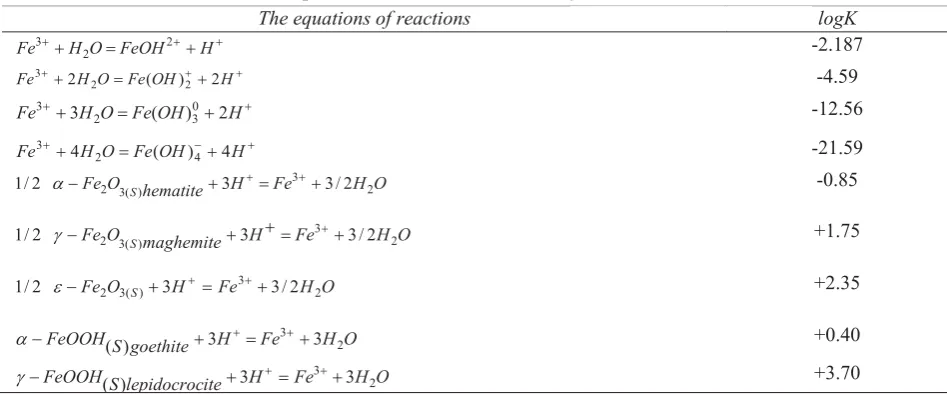
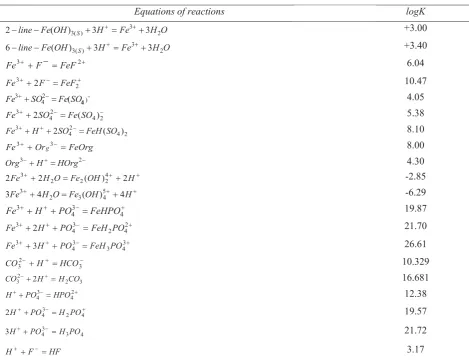
Besides the process of dissolution of the mineral of iron, a set of possible equilibria in the system “Mineral phase – soil solution” (see Table 1) is considered [52]. For the calculations the following composition heterogeneous mixture was used (mol L-1): 0 1106 110 4, 0 510 6, 0 0 0 1104, 0 110 3
3 4 4
y
F Org PO SO CO
Fe C C C C C
C .
Table 1 The equilibrium constants of the analyzed reactions.
The equations of reactions logK
H OFeOH H
Fe 3 2 2
-2.187
H OFe OH H
Fe 3 2 2 ( )2 2
-4.59
HOFe OH H
Fe 3 3 2 ( )30 2 -12.56
H OFe OH H
Fe 3 4 2 ( )4 4
-21.59 O H Fe H hematite O
Fe 2 3(S) 3 3 3/2 2
2 /
1
-0.85 O H F e H maghemite O
Fe 2 3(S) 3 3 3/2 2
2 /
1
+1.75 O H F e H O
Fe 2 3(S) 3 3 3/2 2
2 /
1
+2.35 O H F e H goethite S
FeOOH 3 3 3 2
) ( +0.40 O H F e H ite lepidocroc S
FeOOH( ) 3 3 3 2
+3.70
q y
The equations of reactions logK
HO FeOH H
Fe3 2 2 -2.187
H O FeOH H
Fe3 2 2 ( )2 2 -4.59
H O FeOH H
Fe 3 ( )0 2
3 2 3 -12.56
H O FeOH H
Fe3 4 2 ( )4 4 -21.59
O H Fe H hematite O
Fe2 3(S) 3 3 3/2 2
2 /
1 D -0.85
O H Fe H maghemite O
Fe2 3(S) 3 3 3/2 2
2 /
1 J +1.75
O H Fe
H O
Fe2 3(S) 3 3 3/2 2
2 /
1 H +2.35
O H Fe H goethite S
FeOOH( ) 3 3 3 2
D +0.40 O H Fe H ite lepidocroc S
FeOOH 3 3 3 2
)
(
Continuation of Table 1
Equations of reactions logK
O H F e H OH Fe
line ( )3(S) 3 3 3 2
2 +3.00
O H F e H OH F e
line ( )3(S) 3 3 3 2
6 +3.40
2
3 F FeF
F e 6.04 2 3 2F FeF
F
e 10.47
2 )
4 3 ( 4 SO Fe SO Fe 4.05 2 4 2 4
3 2SO Fe (SO )
F e 5.38 2 4 2 4
3 H 2SO FeH(SO )
Fe 8.10
FeOrg O
r Fe 3 g3
8.00
2
3 H HOrg
Org 4.30
H OFe OH H
Fe 2 ( ) 2
2 4 2 2 2 3 -2.85 H OFe OH H
Fe 4 ( ) 4
3 5 4 3 2 3 -6.29 4 3 4
3 H PO FeHPO
F
e 19.87
2
4 2 3
4
3 2H PO FeH PO
F
e 21.70
3
4 3 3
4
3 3H PO FeH PO
F e 26.61 3 2
3 H HCO
C
O 10.329
3 2 2
3 2H H CO
CO 16.681
2
4 3 4 HPO PO H 12.38 4 2 3 4
2H PO H PO 19.57
4 3 3 4
3HPO H PO 21.72
3.17 Figure 1 shows the calculation results of the buffer capacity S
Fe
E as a function of pH for the various iron (III) minerals. The analysis of the derived equations for the heterogeneous system showed that the increase in the total concentration 0
Fe
C for the pH values above 4.5, as well as the nature of the mineral have an insignifi cant effect on the area of the buffer action of studied system due to the very low solubility of iron oxy - hydroxides minerals. The appearance of maxima on the curves S
H
(рН) and S Fe
E (рН) (Figures 1-3) is due to the dissociation process of carbonic acid with formation of HCO3- ions (pH = 6.36) and CO
32-(pH = 10.34).
2 3 4 5 6 7 8 9 10 11 12
0,0 1,0x10⁻⁴ 2,0x10⁻⁴ 3,0x10⁻⁴ 7 6 5 3,4 2 1
HpH
C0Fe = 1 x 10⁻⁴M Figure 1. The curves of dependence
of the buffer capacity βH on pH for the system “Iron (III) mineral - saturated aqueous solution”. The
used concentrations (mol L-1):
E ( ) 3 0 CO 4 0 SO 0 PO 0 Org 6 0 F 4 0 Fe 10 1 C , 10 1 C C C , 10 5 C , 10 1 C 3 4 4
1 - α-Fe2O3 (hematite), 2 - γ-Fe2O3 (maghemite), 3 – ε-Fe2O3,
4 - α-FeOOH (goethite), 5 - γ-FeOOH (lepidocrocite), 6 – Fe(OH)3 (2-line ferrihydrite), 7 – Fe(OH)3 (6-line ferrihydrite).
Equations of reactions logK
O H Fe H OH Fe
line ( )3(S) 3 3 3 2
2 +3.00
O H Fe H OH Fe
line S 3 2
) (
3 3 3
) (
6 +3.40
2
3 F FeF
Fe 6.04
2
3 2F FeF
Fe 10.47 2 ) 4 3 ( 4 SO Fe SO Fe 4.05 2 4 2 4
3 2SO Fe(SO )
Fe 5.38
2 4 2
4
3 H 2SO FeH(SO )
Fe 8.10
FeOrg Or
Fe3 g3 8.00
2
3 H HOrg
Org 4.30
H O Fe OH H
Fe 2 ( ) 2
2 3 2 2 42 -2.85
H O Fe OH H
Fe 4 ( ) 4
3 3 2 3 54 -6.29
4 3 4
3 H PO FeHPO
Fe 19.87 2 4 2 3 4
3 2H PO FeH PO
Fe 21.70
43 3 43
3 3H PO FeH PO
Fe 26.61 3 2
3 H HCO
CO 10.329
3 2 2
3 2H H CO
CO 16.681
2 4 3 4 HPO PO H 12.38 4 2 3 4
2H PO H PO 19.57
4 3 3 4
3HPO H PO 21.72
HF F
2 4 6 8 10 12 0,0
5,0x10⁻⁶
1,0x10⁻⁵
1,5x10⁻⁵
2,0x10⁻⁵
2,5x10⁻⁵
3,0x10⁻⁵
3,5x10⁻⁵
76 5 3,4 2 1
S Fe
pH
Figure 2. The curves of dependence of the buffer capacity S Fe
E on pH for the system “Iron (III) mineral - saturated aqueous solution”. The used concentrations (mol L-1):
3 0
CO 4 0
SO 0
PO 0
Org 6 0
F 4 0
Fe 1 10 , C 5 10 , C C C 1 10 , C 1 10
C
3 4
4
.
1 - α-Fe2O3 (hematite), 2 - γ-Fe2O3 (maghemite), 3 – ε-Fe2O3, 4 - α-FeOOH (goethite), 5 - γ-FeOOH (lepidocrocite), 6 – Fe(OH)3 (2-line ferrihydrite), 7 - Fe(OH)3 (6-line ferrihydrite).
2 3 4 5 6 7 8 9 10 11 12
0,0 5,0x10⁻⁵
1,0x10⁻⁴ 1,5x10⁻⁴ 2,0x10⁻⁴
2,5x10⁻⁴
3,0x10⁻⁴
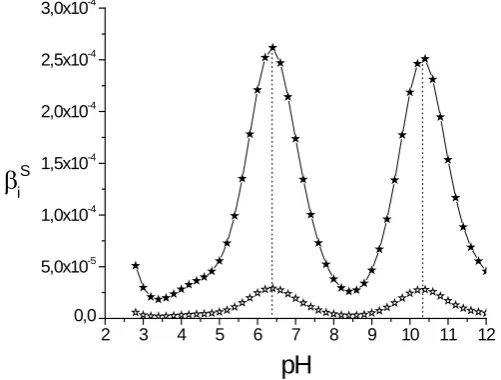
iSpH
Figure 3. Buffer capacities S H
(1) and S Fe
E (2) versus pH for the system “Hematite - saturated aqueous solution”.
The used concentrations (mol L-1): 0 3
CO 4 0
SO 0
PO 0
Org 6 0
F 5 0
Fe 1 10 , C 5 10 , C C C 1 10 , C 1 10
C 4 4 3 .
The iron (III) ions and its complexes have a signifi cant contribution only in very acidic solutions up to pH 4.5. The analysis of the data presented in Figures 2 and 3 allows us to conclude that the studied heterogeneous system has a buffer capacity in relation to ions of hydrogen and iron (III). We will note down that these relations are valid only in the presence of solid phases.
Another example of real natural system that we examined is “Gibbsite – saturated aqueous solution”. By increasing the acidity in aqueous solutions the content of aluminium grows quickly due to the interaction of the gibbsit with an acid:
3 3
2 3 )
(
3 3 3 , [ ][ ]
)
(OH H Al H O K Al H
Al S S
An important interrelation between the buffer capacities of the heterogeneous system “Gibbsite Al(OH)3(s) - saturated aqueous solution” system can be identifi ed [53,54]:
S Al S H E
Besides the process of gibbsite dissolution, a set of possible equilibria in the system “Mineral phase – natural water”, listed in Table 2 has been taken into account [52]. The following composition of the heterogeneous system has been used for the calculations: 0
Al
C = 1∙10-4 mol L-1, 0
F
C = 5∙10-6 mol L-1, 0
Org
C = 1∙10-4 mol L-1, 0
4
PO
C = 1∙10-4 mol L-1,
0
4 SO
C = 1∙10-4 mol L-1 and 0
3 CO
C = 1∙10-3 mol L-1. One can state that the infl uence of H+ in the studied pH interval may be neglected, and the OH– ions exercise infl uence on S
H
only at pH > 8.5. The aluminium ions and their hydroxocomplexes make a signifi cant contribution in acid solutions up to рН 5.5 and at рН > 8 because of the predominance of the stable anionic hydroxocomplex Al(OH)4-. The results of the calculations of the buffer capacities S
H
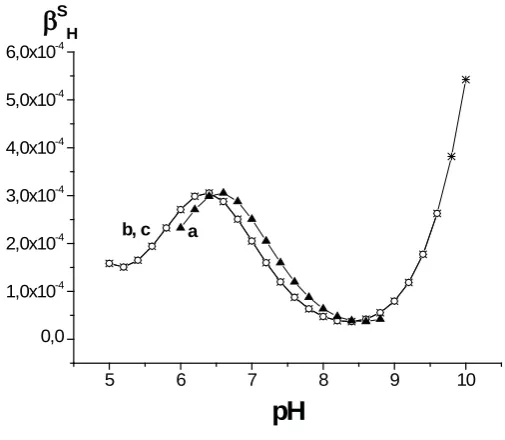
as a function of рН for different compositions of the heterogeneous mixture are shown in Figures 4–5. Obviously, an increase of the total concentration 0
Al
C (Figure 4) augments the area of the buffer action because of the extension of the рН interval of the
thermodynamic stability of the solid phase. At concentrations of fl uoride 0 F
C = 5∙10-4 mol L-1, the S
H
value increases sharply in the range of pH values of the gibbsite dissolution – formation with a simultaneous narrowing of the total pH range of the buffer action (Figure 5).
Table 2 Equilibrium constants and values of enthalpies (ΔH).
Equations of reactions log K ΔH (cаl mоl–1)
H O AlOH H
Al 2
2
3 -4.99 11900
HOAl OH H Al3 2 2 ( )2 2
-10.00 22000
H OAl OH H
Al3 4 2 ( )4 4
-23.00 44060 O H A l H O H
Al( )3(S)3 33 2
9.35 –22800
2
3 F AlF
A l 7.02 1100 2 3 2F AlF
Al 12.76 2000
3 3 3F AlF
Al 17.03 2500
4 3 4F AlF
A
l 19.73 2200
2
5 3 5F AlF
Al 20.92 1800
4 2 4
3 SO AlSO
A
l 3.01 2150
2 4 2 4
3 2SO Al (SO )
A
l 4.90 2840
AlOrg Org
Al3 3 8.39 —
H Org AlHOrg
Al3 3 13.09 —
2
3 H HOrg
Org 6.83 —
H H Org
Org3 2 2 12.73 —
Org H H
Org33 3 14.49 —
HF F
H 3.17 3460
H OH O
H2
-14.00 13340
H OAl OH H
Al 2 ( ) 2
2 4
2 2 2
3 -6.3 —
H OAl OH H
Al 4 ( ) 4
3 3 2 3 54 -12.1 —
2 4 2 4 2
3 H PO AlH PO
A
l 3.1 —
2 4 3
4 H HPO
P
O 12.0 —
4 2 3
4 2 H PO
PO H
19.21 —
4 3 3
4 3H H PO
PO 21.36 —
Note: 1 cal = 4.184 J, Org - organic ligand, the „—” specifi es the absence of experimental data.
Equations of reactions log K ǻH (cɚl mɨl–1
)
H O AlOH H
Al3 2 2 -4.99 11900
HO AlOH H
Al3 2 2 ( )2 2 -10.00 22000
H O Al OH H
Al3 4 2 ( )4 4 -23.00 44060
O H Al H OH
Al( )3(S)3 33 2 9.35 –22800
2 3 AlF F
Al 7.02 1100
2
3 2F AlF
Al 12.76 2000
3 3 3
AlF F
Al 17.03 2500
4
3 4F AlF
Al 19.73 2200
2 5 3 5 AlF F
Al 20.92 1800
4 2 4
3 SO AlSO
Al 3.01 2150
42 4 2
3 2 ( )
SO Al SO
Al 4.90 2840
AlOrg Org
Al3 3 8.39 —
H Org AlHOrg
Al3 3 13.09 —
2 3 HOrg H
Org 6.83 —
H H Org
Org3 2 2 12.73 —
Org H H
Org33 3 14.49 —
HF F
H 3.17 3460
OH
H O
H2 -14.00 13340
HO Al OH H
Al 2 ( ) 2
2 3 2 2 42 -6.3 —
H O Al OH H
Al 4 ( ) 4
3 5
4 3 2
3 -12.1 —
2 4 2 4 2
3 H PO AlH PO
Al 3.1 —
2
4 3
4 H HPO
PO 12.0 —
4 2 3
4 2 H PO
PO H 19.21 —
4 3 3
4 3H H PO
PO 21.36 —
Note: 1 cal = 4.184 J, Org - organic ligand, the „—” specifies the absence of experimental data.
5 6 7 8 9 10 0,0
1,0x10⁻⁴
2,0x10⁻⁴
3,0x10⁻⁴ 4,0x10⁻⁴ 5,0x10⁻⁴ 6,0x10⁻⁴
SH
b, c a
pH
Figure 4. Buffer capacity S H
versus pH for the “Gibbsite - saturated aqueous solution” system. Concentrations (mol L-1):
3 0
C O 4 0
SO 0 PO 0 Org 6 0
F -5 4
3 0
Al :a 1 10 ,b 1 10 ,c-1 10 , C 5 10 , C C C 1 10 , C 1 10
C 4 4 3
.
4 5 6 7 8 9 10
0,0 1,0x10⁻⁴ 2,0x10⁻⁴
3,0x10⁻⁴ 4,0x10⁻⁴
5,0x10⁻⁴
SH
1 3 1, 2 4
pH
Figure 5. Buffer capacity S H
versus pH for the “Gibbsite - saturated aqueous solution” system. Concentrations (mol L-1):
3 0
C O 4 0
SO 0 P O 0 Org 0
A l -4 -5
6 7
0
F:1 5 10 ,2 5 10 ,3-5 10 ,4 -5 10 C C C C 1 10 , C 1 10
C , 4 4 3
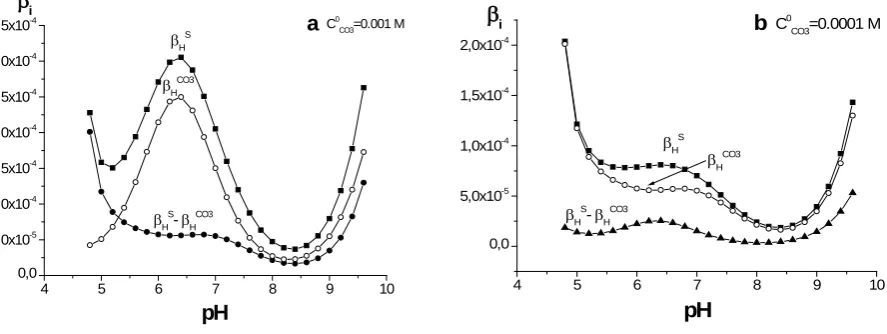
The dependences of HS(рН) for different concentrations of carbonate ion are presented in Figure 6. By taking into account the contribution of equilibria including carbonate ion in the total buffer capacity S
H
, the ECOH3value
was calculated separately. A comparison of the calculated curves shows that equilibria with CO32- participation have a substantial contribution to S
H
at a 0 1104
3 !
CO
C mol L-1 (Figures 7а and 7b). The analysis of the obtained data
. Figure 4. Buffer capacity S
H
E versus pH for the “Gibbsite - saturated aqueous solution” system. Concentrations (mol L-1):
3 0
CO 4 0
SO 0
PO 0
Org 6 0
F -5 4
3 0
Al:a 1 10 , b 1 10 , c-1 10 , C 5 10 , C C C 1 10 , C 1 10
C 4 4 3
Figure 5. Buffer capacity S H
E versus pH for the “Gibbsite - saturated aqueous solution” system. Concentrations (mol L-1):
3 0
CO 4 0
SO 0
PO 0
Org 0 Al -4 -5
6 7
0
F:1 5 10 , 2 5 10 , 3-5 10 , 4-5 10 C C C C 1 10 , C 1 10
C 4 4 3
,
.
presented in Figures 4–7, taking into account Eq.(33) allows us to conclude that the investigated heterogeneous system has a considerable buffer capacity towards to aluminium as well.
5 6 7 8 9 10
0,0 5,0x10⁻⁴ 1,0x10⁻³ 1,5x10⁻³ 2,0x10⁻³ 2,5x10⁻³ 3,0x10⁻³
S H
3 2 1
pH
Figure 6. Buffer capacity S H
versus pH for the “Gibbsite - saturated aqueous solution” system. Concentrations (mol L-1):
6 0
F 4 0
SO 0 P O 0 A l -4 3
2 0
CO :1 1 10 ,2 1 10 ,3-1 10 C C C 1 10 , C 5 10
C
4 4 3
,
4 5 6 7 8 9 10
0,0 5,0x10⁻⁵ 1,0x10⁻⁴ 1,5x10⁻⁴ 2,0x10⁻⁴ 2,5x10⁻⁴ 3,0x10⁻⁴
3,5x10⁻⁴ a
i
C0 CO3=0.001 M
HS
- HCO3
HCO3
HS
pH
4 5 6 7 8 9 10
0,0 5,0x10⁻⁵ 1,0x10⁻⁴ 1,5x10⁻⁴ 2,0x10⁻⁴
i bC0
CO3=0.0001 M
HS
- HCO3
HCO3
HS
pH
Figure 7. Total buffer capacity S H
versus pH, carbonate buffer capacity
COH3 vs. pH and their difference SH
– COH3 for the “Gibbsite - saturated aqueous solution” system.
Concentrations (mol L-1): 0 6
F 4 0
SO 0 PO 0 A l -4 3
0
CO :a 1 10 ,b-1 10 C C C 1 10 , C 5 10
C 3 , 4 4
The infl uence of temperature on the value of the buffer capacity was also studied [55]. The results of the calculations are presented in Figure 8. The equilibrium constants for different temperatures have been estimated by the Van’t Hoff equation.
logK2 = logK1 + (1/T1 – 1/T2) ΔH/2.303R
The necessary values of enthalpies (ΔH) are listed in Table 2. T1 was set to 298 K = 25 °C. It was assumed that the temperature insignifi cantly infl uences the ΔH values inside the investigated temperature range. An analysis of the curves in Figure 8 shows that the buffer capacity increases with a temperature decrease, whereas the рН interval of 5.5 – 7.0 of the maximum values of the buffer capacity displaces slightly.
Figure 6. Buffer capacity S H
E versus pH for the “Gibbsite - saturated aqueous solution” system. Concentrations (mol L-1):
6 0
F 4 0
SO 0
PO 0 Al -4 3
2 0
CO :1 1 10 , 2 1 10 , 3-1 10 C C C 1 10 , C 5 10 C
4 4 3
,
Figure 7. Total buffer capacity S H
E versus pH, carbonate buffer capacity
E
COH3 vs. pH and their differenceS H
E – H
CO3
E for the “Gibbsite - saturated aqueous solution” system.
Concentrations (mol L-1): 0 6
F 4 0
SO 0
PO 0 Al -4 3
0
CO : a 1 10 , b-1 10 C C C 1 10 , C 5 10
C 3 4 4
,
Concentrations (mol L-1): 0 6
F 4 0
SO 0
PO 0 Al -4 3
0
CO : a 1 10 , b-1 10 C C C 1 10 , C 5 10
C 3 4 4
,
.
4 5 6 7 8 9 10 0,0
1,0x10⁻⁴
2,0x10⁻⁴
3,0x10⁻⁴
4,0x10⁻⁴
HS4 3 2
1
pH
Figure 8. Buffer capacity
HS versus pH for the “Gibbsite - saturated aqueous solution” system at different temperatures (t, °С): (1) –5, (2) +10, (3) +25 and (4) +40.Concentrations (mol L-1): 0 6
F 4 0
SO 0
P O 0 A l 3 0
CO 1 10 ,C C C 1 10 , C 5 10
C
4 4
3
0
Org C
Buffer properties for liquid two-phase acid-base buffer systems
Buffer with mono- and diprotic acids
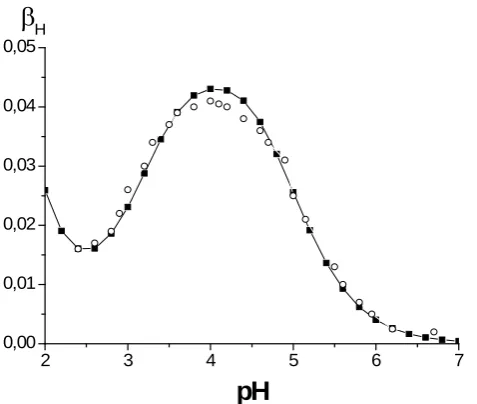
The theoretically calculated and experimentally measured dependences of the buffer capacity on pH in the case of two-phase system 1-octanol – water for monoprotic n-hexanoic acid and diprotic 1,2-benzenedicarboxylic acid are shown in Figure 9 and Figure 10, respectively. Experimental data [45,56] were obtained at 25 0C and constant ionic
strength. For both systems, the experimental data correlate well with the theoretical curves, calculated by Eqs.(27 – 28) that confi rms their correctness. The values in Figures 9 and 10 testify the validity of Eq.(29). (The necessary equilibrium constants were taken from [45,56].)
5,0 5,5 6,0 6,5 7,0 7,5 8,0 8,5 9,0 0,00
0,01 0,02 0,03 0,04 0,05 0,06
H, m
o
l/L
pH
Figure 9. Buffer capacity versusрН for two-phase system containing n-hexanoic acid HA and 1-octanol: (■) the calculated values; (◊) experimental data [56];
1-octanol : water = 1:1; 0
A
C = 0.1 mol L-1, I = 0,t = 25 0C.
Figure 8. Buffer capacity
E
HS versus pH for the “Gibbsite - saturated aqueous solution” system at different temperatures (t, °ɋ): (1) –5, (2) +10, (3) +25 and (4) +40.Concentrations (mol L-1): 0 6
F 4 0
SO 0
PO 0 Al 3 0
CO 1 10 ,C C C 1 10 , C 5 10
C
4 4
3
2 3 4 5 6 7 0,00
0,01 0,02 0,03 0,04 0,05
HpH
Figure 10. Dependence of buffer capacity on рН for two-phase system containing 1,2-benzenedicarboxylic acid and 1-octanol: (■) calculated values; (○) experimental data [45];
1-octanol : water=1:1; 0 A
C = 0.0488 mol L-1, I = 1 (NaCl), t = 25 0C.
Two-phase buffers with monoprotic acids in which dimerization occurs
Mono-component systems: propanoic acid – water – benzene (I) and decanoic acid – water – benzene (II): The numerical values of the equilibrium constants used for calculating the theoretical buffer curves as well as the experimental data were taken from [56]. The theoretical and experimental data are presented in Figure 11 (a,b). It can be seen that the theoretical curves are in good agreement with experimental values.
a
3 4 5 6 7 8 9 10 0,000
0,005 0,010 0,015 0,020 0,025 0,030 0,035
0,040 2
1
pH
b
3 4 5 6 7 8 9 10
0,00 0,01 0,02 0,03 0,04 0,05 0,06 0,07
0,08 2
1
pH
Figure 11. Buffer capacity βH versus pH for mono-component two-phase systems with propanoic (a) and decanoic (b) acids, 0
A
C =0.05 mol L-1 (a) and 0
A
C =0.1 mol L-1 (b) and α = 1;
(■) – experimental values, dotted lines – experimental curves, I = 0.1, t = 25 0C.
3,0 3,5 4,0 4,5 5,0 5,5 6,0 6,5 7,0 0,00
2,50x10⁻³
5,00x10⁻³
7,50x10⁻³
1,00x10⁻² 1,25x10⁻² 1,50x10⁻²
5 4 3 2
1
HpH
Figure 12. Buffer capacity βH versus pH for mono-component two-phase systems with (2.4-dichlorophenoxy) acetic acid, 0
A
C = 0.05 mol L-1, α = 1, t = 25 0C for different organic solvents:
1 – no solvent; 2 – ethylbenzene; 3 – 1-octanol; 4 – chlorbenzene; 5 – nitrobenzene.
pH and pA buffer properties of two-component system in which mixed dimmer occurs
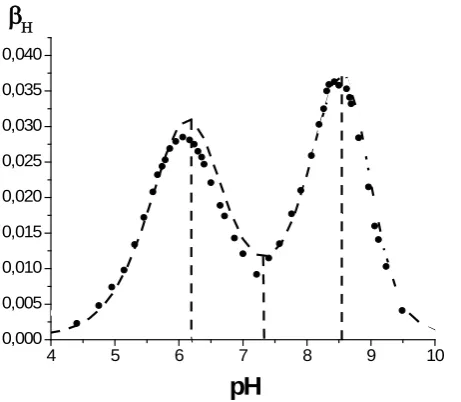
The authors [56] found that the rule of additivity for calculating the total buffer capacity as a sum of separate contributions for this system is not valid. As a result, there are some substantial deviations of the theoretical curves from experimental data within the interval of pH from 4 to 7. The experimental data for this system, along with the calculated theoretical curve are presented in Figure 13. As one can see, the experimental values βH = f(pH) are in good agreement with those calculated, contrasting to the results received by authors [56]. Thus, the experiment confi rms the validity of our developed theoretical approach.
4 5 6 7 8 9 10
0,000 0,005 0,010 0,015 0,020 0,025 0,030 0,035 0,040
pH
Figure 13. Experimental data [56] (
•
) and calculated values (---) for βH(pH) as a sum of the contributions of separate acids for the two-component two-phase buffer system containing hexanoic and decanoic acids.
CH
VHO
1 1V 6 6 2 , C0ACB00.05 mol L-1, I = 0.1, t = 25 0C.
4 5 6 7 8 9 10 0,00
0,02 0,04 0,06 0,08 0,10 0,12
ipH
Figure 14. Curves βH = f(pH),βА = f(pH) and βB = f(pH) for the two-component two-phase buffer system, containing hexanoic and decanoic acids. V
C6H6
V H2O
11, 0 0 B A C
C 0.05 mol L-1, I = 0.1, t = 25 0C.
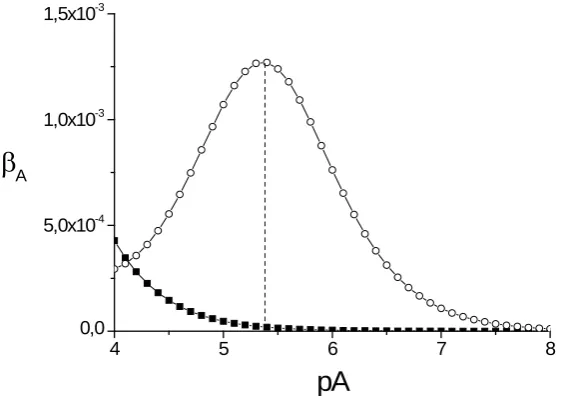
On Figure15 the functional dependence βA = f(pA) for (2.4-dichlorophenoxy)acetic acid for aqueous solution and water-1-octanol mixture is depicted. One can notice that the presence of organic solvent amplifi es signifi cantly (approximately by 70 times) the βA value at pA = 5.4. Therefore, two-phase mixtures can be successfully used for designing new buffers with respect to any component for investigated systems. The developed approach can be expanded to other, more complicated systems, containing metal-ligand complexes.
4 5 6 7 8
0,0 5,0x10⁻⁴
1,0x10⁻³
1,5x10⁻³
ApA
Figure 15. Buffer capacity βA versus pA for the mono-component system with (2.4-dichlorophenoxy) acetic acid in water (curve 1) and water-1-octanol mixture (curve 2), 0
H
C =0.005 mol L-1, α = 1; t = 25 0C.
Conclusions

![Crystal structure and computational study of 2,4 dichloro N [(E) (5 nitrothiophen 2 yl)methylidene]aniline](data:image/gif;base64,R0lGODlhAQABAIAAAP///wAAACH5BAEAAAAALAAAAAABAAEAAAICRAEAOw==)