ACTIVATION OF ACETYLENE BY COORDINATION TO
BIS-TRIPHENYLPHOSPHINE COMPLEX OF Pt(0): DFT STUDY
N. N. Gorinchoy
a*, B. Dobrova
a, M. Yu. Gorbachev
a, G. Munteanu
b, and I. Ya. Ogurtsov
aaInstitute of Chemistry, Academy of Sciences of Moldova, Academiei str. 3, MD 2028 Kishinev, Republic of Moldova b”I.Murgulescu” Institute of Physical Chemistry, Romanian Academy of Sciences, Bucharest, Romania
*E-mail: [email protected]; Phone 373 22 739649
Abstract: The present work is devoted to the theoretical study of the activation of the acetylene molecule coordinated in the [Pt(PPh3)2C2H2] complex. By means of DFT calculations it is shown that the geometrical and electronic characteristics of the C2H2 are essentially changed due to its coordination. The subsequentdetailed analysis of the molecular orbitals (MO) of the active valence zone of this complex allows one to make important conclusion that this activation is being realized mainly due to the orbital back donation of 5d-electronic density from one of the occupied MOs of the complex [Pt(PPh3)2] to the unoccupied antibonding π*-MO of C2H2.
Keywords: chemical activation, quantum-chemical calculations, DFT method.
1. Introduction
Halogen derivatives of acetylene are very important in practical (industrial) use as monomers in plastics manufacturing. They are usually obtained by means of reactions between hydrogen halogenides and various transition metals complexes with coordinated (activated) acetylene molecules. Activation of acetylene by coordination to transition metals is thus the main chemical process in one of the most important chemical industries [1, 2].
Under the chemical activation of molecules by coordination it is implied the modifi cation of their electronic
and nuclear structures which leads to their higher chemical reactivity. Among qualitative models for representation of the metal-unsaturated hydrocarbon bonding the Dewar-Chatt-Duncanson diorbital scheme [3] is more conventional. According to this approach the carbon-metal bond in the transition metals complexes of acetylene is provided by two bonding MOs: the fi rst MO of a σ character is formed through the overlap between one of the empty metal d-orbitals and the bonding π-MO of acetylene, and the second one of a π-type is formed by one of the fi lled dπ orbitals of the metal and the empty antibonding π* orbital of acetylene. The formation of the σ bond leads to the transfer of electronic density from the acetylene to the metal (σ-type donation, Δqσ), while the π bond provides the opposite charge transfer from the metal to the antibonding π*-MO of acetylene (π-type back donation, Δqπ).
A more general defi nition of the ligand bonding, in which mono-orbital, diorbital and multiorbital metal-ligand
bonds are distinguished, was suggested by Bersuker in the monograph [4]. In the MO terminology “the multiplicity of the orbital bonding (mono-, di-, and multiorbital) equals the number of complex-ligand bonding MOs uncompensated by the antibonding orbitals” [4]. It follows from this defi nition that the electronic charge transfers to and from the ligand are
due to formation of such uncompensated bonding MOs of the entire complex. The values of the orbital charge transfers
depend on the nature of the metal and the geometry of ligand coordination. They may have opposite signs (Δqi<0 means
the electron density transfer from i-th MO of the ligand to the metal, and Δqi>0 in the opposite case) compensating each
other and giving a small value of the total charge transfer. However, their effect on ligand activation may be additive. In the particular case of diorbital bonding the scheme of mutually compensating charge transfers [4] is qualitatively the same as the Dewar-Chatt-Duncanson one [3].
Thus, in order to clarify the nature of the metal-ligand bonding, it is necessary to calculate the electronic structure of the whole complex, as well as the values of the orbital charge transfers to and from molecular orbitals of coordinated ligand.
Bis-triphenylphosphine complexes of zero-valence Pt with acetylene and its derivatives of the type [Pt(PPh3)2RCCR΄] have been the subject of several experimental studies [5-8]. In accordance with [5], these complexes are formed mainly as a result of summary model reactions:
[Pt(PPh3)4]+RCCR΄→[Pt(PPh3)2RCCR΄]+2PPh3 (1)
[Pt(PPh3)2]+RCCR΄→[Pt(PPh3)2RCCR΄] (2) It was established also [5, 7] that in above complexes the acetylene molecule is coplanar (or nearly so) with the plane of two phosphorus atoms and the atom of Pt. It is coordinated in the scheme of the πcomplex when the C-C bond
line is perpendicular to the line of bonding to the metal, being cis-distorted. Some explanations of this cis-bent geometry
In the present work, the nature of the Pt(0)-C2H2 binding and the changes in the properties of the C2H2 molecule due to its coordination in the [Pt(PPh3)2HCCH] complex are analyzed on the basis of the Density Functional Theory (DFT) calculations of the electronic structure of the [Pt(PPh3)4] (I), [Pt(PPh3)2] (II), [Pt(PPh3)2HCCH] (III) complexes and free C2H2 and PPh3 molecules.
The energy effects of the [Pt(PPh3)2HCCH] formation due to reactions (1) and (2) were also evaluated. 2. Computational details
The electronic and geometrical structures of free C2H2 and PPh3 molecules and the corresponding platinum(0) complexes (I), (II) and (III) have been investigated by means of the DFT method, including Becke’s three-parameter nonlocal-exchange functional [10] with the correlation functional of Lee, Yang and Parr (B3LYP) [11]. All the calculations were performed with the GAUSSIAN 03 program package [12]. For each compound considered, a full geometry optimization is performed using the LANL2DZ basis set with non-relativistic effective core potential for Pt and the split-valence basis set 6-31G(d) including polarization functions for all other atoms (P, C, and H) in the systems. This method is being widely used for quantum chemical studies of transition metals complexes during a few last years. It has proved its reliability in obtaining quite accurate geometrical parameters (the average B3LYP error is estimated to be ~0.01Å for bond distances and ~0.6° for valence angles) and energy characteristics (2-3 kcal/mol) of studied systems (see, for example [13] and references therein).
To calculate the values of the orbital charge transfers to and from C2H2 the MOs obtained by the DFT calculations are rewritten in the basis of the eigenfunctions of the free C2H2 and atomic orbitals (AO) of other atoms. Then the occupations of the C2H2 eigenfunctions in the complex are calculated as the Mulliken populations of the corresponding orbitals.
The energy gains ΔER of reactions (1) and (2) with R=R΄=H were defi ned as ΔER= E(product) – E(reactant).
3. Results and discussion
3.1 Structure of the Complexes
A general view of the complexes (I), (II) and (III) along with the used coordinate system is shown in Fig.1. Full geometry optimization for all the compounds was carried out assuming the T symmetry group for (I) and C2 symmetry for (II) and (III). Calculations show that in the coordinationally unsaturated [Pt(PPh3)2] compound the P, Pt, P atoms are collinear. The optimized values of the Pt-P distances are equal to 2.29 Å for the above compound and 2.47 Å for the
[Pt(PPh3)4]. These values are in a rather good agreement with the available experimental data [6, 7, 14].
Fig. 1. Structure of the [Pt(PPh3)4] (I), [Pt(PPh3)2] (II) and [Pt(PPh3)2HCCH] (III) complexes (for the sake of simplicity the phenyl-hydrogen atoms are omitted)
analogues. Note fi rst of all, that the acetylene molecule is coordinated in (III) in the plane of P-Pt-P, being cis-distorted.
Moreover, this compound exhibits rather high energy barrier to internal rotation of the C2H2 around the Pt-acetylene axis (~ 60 kcal/mol in our calculations). This value is probably overestimated as the total energies for the rotation up to 90°
(the normal coordination of C2H2) were calculated without the corresponding geometry re-optimization. In any case, the presence of such high energy barrier of rotation is marked in a number of papers [5, 15].
Table 1
Calculated and experimental geometry parameters for the [Pt(PPh3)2RCCR΄]
(distances in Å and angles in degrees)
Geometry parameters Calculated
(R=R′=H)
X-ray data
R(Pt-P) ∠P-Pt-P
2.36 112.9
2.28 [6,7] 103 [6], 102 [7]
R(Pt-C(-C≡C-)) 2.08 2.01 [6,7]
R(C-C(-C≡C-)) 1.28 1.28 [6], 1.32 [7]
∠C(-C≡C-)-Pt- C(-C≡C-) 35.9 37 [6], 39 [7]
Table 2 contains the calculated geometry parameters, the C-C bond force constants (K) and the stretching
frequencies (νС≡С) for both the free and coordinated in (III) acetylene molecules. The values of K were estimated in
the assumption that the total energy E of the C2H2 molecule in the neighbourhood of the equilibrium (RCC0 ) can be written as E('RCC) 1/2K('RCC)2,where 'RCC RCC RCC0 . Then, using the harmonic oscillator equation,
P S
Q 1/2 c K/ , where the reduced mass μ in our case is equal to the half of the mass of the C atom, and c is the velocity
of light, we have evaluated the values of the νС≡С.
Table 2
Geometrical and electronic parameters of the free and coordinated C2H2 molecule
Molecule νС≡С, cm-1 K, mdyn/Å
Distances (Å), angles (deg.)
C-C -C-H ∠С-С-H
HCCH, coordinated
1976 13.80 1.28 1.08 148.2
HC≡CH, free* 2075 15.25 1.21 1.07 180.0
*Experimental values for free C2H2 are [16]: νС≡С=2100 cm-1, K=15.59 mdyn/Å
The results of Table 2 show that the geometrical structure of the acetylene molecule is changed signifi cantly due to its coordination. The coordinated C2H2 moleculeinduces not only an elongation of the C-C distance (1.21Å in free C2H2 versus 1.28Å in coordinated one) but also a bending of the hydrogen atoms away from the metal (the calculated bond angle of the C-C-H group is 148.2° for the complex). The length of the C-C bond in coordinated acetylene is intermediate between this value for gas phase acetylene and ethylene (1.34 Å), while the C-C-H angle is far from that of free C2H2 (180°) and is near to the angle in the ethylene molecule (120°). This means that coordination of acetylene to the Pt(0) in the above complex leads to the essential change of the kind of hybridization of the valence AOs of its carbon atoms from sp (in the gas phase) to approximately sp2. This results to the decrease in the CC bond force constant and the stretching frequency(ΔνС≡С=100cm-1) (Table 2), which means the weakening of the CC bond.
Calculated total energies of the complexes (I), (II) and (III) and free C2H2 and PPh3 molecules in their optimized equilibrium geometries allow one to estimate the energy gains of the model summary reactions (1) and (2). Our calculations show that both the reactions (1) and (2) are exothermic (ΔER(1)=38 kcal/mol and ΔER(2)= 9 kcal/mol), in
agreement with the data of [5].
3.2 Orbital charge transfers and the nature of the Pt(0)-acetylene bonding
In order to analyze the orbital charge transfers in the [Pt(PPh3)2C2H2] complex, consider fi rst of all the changes of the molecular orbitals of C2H2 due to its coordination. As shown in the Section 3.1, the coordinated acetylene molecule possesses a cis-bent structure in the complex. In Fig.2 the highest occupied MO (HOMO) and the lowest unoccupied
MO (LUMO) of the linear and the cis-distorted acetylene molecule are presented (letters a and b denote the irreducible
Fig.2. Splitting of the HOMO and LUMO of free C2H2 molecule (linear, D∞h) due to its coordination (cis-bent, C2)
The cis-distortion causes the splitting of the double-degenerated π and π* MOs of linear C2H2 into the two
occupied b(π|) and a(π||) and two unoccupied a(π|*) and b(π||*) MOs (Fig.2). The maximum of the electronic density of π|| and π||* MOs is in the plane of coordination, while that of π⊥ and π⊥* MOs is in the perpendicular one. This leads to increase of the energy of the HOMO (π||)and to decrease of the energy of the LUMO (π||*) enhancing thereby the donor-acceptor properties of acetylene. When forming the complex [Pt(PPh3)2C2H2], these valence MOs of the acetylene molecule interact with appropriate orbitals of the Pt atom, giving rise to the Pt- C2H2 bonding.
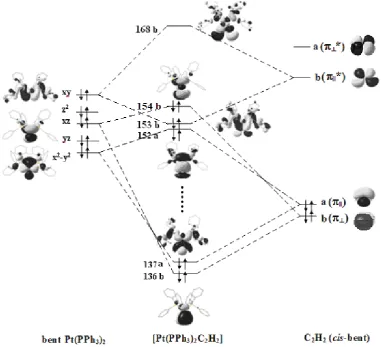
Consider in more detail the MO energy-level scheme of the active valence zone of the whole [Pt(PPh3)2C2H2] and that of its fragments, [Pt(PPh3)2] and C2H2 (Fig.3). Both these fragments were considered in their pre-activated states (nonlinear P-Pt-P fragment and cis-distorted C2H2 molecule). It was done in order to understand the main electronic
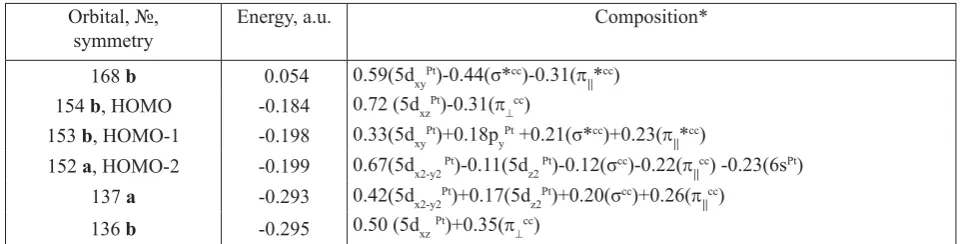
redistribution details accompanying the formation of MOs of the complex [Pt(PPh3)2C2H2]. The orbital energies and the composition of these MOs are presented in Table 3. The nomenclature of MOs in Table 3 is given in accordance with the coordinate system from Fig.1.
Table 3
One-electron states of valence zone of the [Pt(PPh3)2C2H2] Orbital, №,
symmetry
Energy, a.u. Composition*
168 b 0.054 0.59(5dxyPt)-0.44(σ*cc)-0.31(π
||*cc)
154 b, HOMO -0.184 0.72 (5dxzPt)-0.31(π
⊥cc)
153 b, HOMO-1 -0.198 0.33(5dxyPt)+0.18p
yPt +0.21(σ*cc)+0.23(π||*cc)
152 a, HOMO-2 -0.199 0.67(5dx2-y2 Pt)-0.11(5d
z2 Pt)-0.12(σcc)-0.22(π||cc) -0.23(6sPt)
137 a -0.293 0.42(5dx2-y2Pt)+0.17(5d
z2Pt)+0.20(σcc)+0.26(π||cc)
136 b -0.295 0.50 (5dxzPt)+0.35(π⊥cc)
*For simplicity, only those contributions of the AOs of Pt and MOs of C2H2 are presented, whose AO coeffi cients are higher than 0.1 (in absolute value)
It is to be noted that some MOs of the Pt(PPh3)2 fragment on the left side of Fig. 3 are not pure d-AOs of the atom
of Pt. For example, the MO designated as x2-y2, contains, besides the 5d
x2-y2, a fairly signifi cant contribution of 6s-AO and some admixture of 6px-AO of the metal. The MO xy is the linear combination of the 5dxy and 6py AOs of the Pt, and
the 3p-AOs of the atoms of phosphorus.
The occupied a(π||) MO of C2H2 interacts with the occupied MO (x2-y2) of the Pt(PPh
3)2 fragment, giving rise to the two occupied σ-type MOs of the [Pt(PPh3)2C2H2] complex: the bonding MO 137a and the antibonding MO 152a (Fig.3). Because of the fact that both these MOs are occupied by electrons, they compensate each other, and hence their total contribution to the Pt-C2H2 bonding is very small. The results of the DFT calculations yield Δqσ= -0.09 ē. This small
Fig. 3. MO energy-level scheme of the active valence zone of the Pt-C2H2 bonding.
Two other π-type MOs of the [Pt(PPh3)2C2H2], the bonding MO 136b and the antibonding HOMO-154b, are formed also by the occupied MOs of the fragments: b(π⊥) of C2H2 and xz of Pt(PPh3)2, the latter is approximately a pure 5dxz
-AO of Pt. As in the previous case, both these MOs, bonding 136b and antibonding 154b, are double occupied (Fig.3), and hence they do not contribute to the Pt-C2H2 bonding, due to their mutual compensation. The π -type donation is negligible, Δqπ#0.
The main contribution to the Pt-C2H2 bond is provided by forming of the π-type bonding MO 153b from the corresponding MOs of the above fragments, namely, from the fi lled MO xy of the [Pt(PPh3)2]and the empty antibonding
π||*-MO of C2H2. Due to forming of this (153b) MO the electron density from the 5dxy-AO of the Pt atom is transferred
to the π||*-MO of the acetylene molecule (the π-type back donation). The orbital charge transfer is quite signifi cant, Δqπ*
= 0.36 ē. This value coincides with the decrease of the 5dxy-AO population due to formation of the complex (1.50 ē in
the [Pt(PPh3)2C2H2], compared with a value of 1.88 ē in the Pt(PPh3)2).
It is seen from Fig. 3 that only this one bonding MO of the complex, 153b, composed, as discussed above, from the fi lled 5dxy-AO of the Pt and the empty π||*-MO of C2H2, is uncompensated by the antibonding orbital (the empty
MO 168b in our calculations). Therefore the Pt(0)-acetylene bonding in the studied complex can be classifi ed as mainly mono-orbital one [4]. Namely this MO 153b provides the essential charge transfer to the antibonding π*-MO of C2H2 causing the activation of the latter.
Table 4
Atomic charges Q(ē) and bond orders (the Wiberg bond indexes) in the [Pt(PPh3)2], [Pt(PPh3)2C2H2] and free C2H2
Molecule
Q Wiberg bond indexes
Pt P C2H2 Pt-P Pt-Cac C-C C-H
[Pt(PPh3)2] [Pt(PPh3)2HCCH]
-0.48 -0.35 0.38 0.50 --0.24 0. 0.58 0.42 -0.45 -2.31 -0.89
HC≡CH, free - - - - 2.99 0.93
Conclusion
On the base of our DFT calculations the following conclusions can be drawn. The acetylene molecule in the [Pt(PPh3)2C2H2] complex is in its activated state. It is refl ected in the corresponding cis-distortion of the molecule, in
the elongation of the C-C bond distance accompanied by the decrease in the C-C bond force constant and the stretching frequency νС≡С. This activation is being realized mainly owing to the orbital back donation of 5d-electronic density from
one of the occupied molecular orbitals of the precursor complex [Pt(PPh3)2] to the unoccupied antibonding π* MO of the C2H2 molecule.
References
Shteingarts, V.D. Soros’ Educational Journal (Russ.), 1996, Nr. 7, 47-58. [1].
Teomkin, O.N. Soros’ Educational Journal (Russ.), 1998, Nr. 12, 52-58. [2].
Chatt, J.; Duncanson, L.A. J.Chem.Soc., 1953, 2939. [3].
Bersuker, Isaac B. Electronic structure and properties of transition metal compounds. John Wiley: New York, [4].
1995, Ch. 6.3, p. 213.
Greaves, E.O.; Lock, C.J.L.; Maitlis, P.M. Canadian J. of Chemistry, 1968,
[5]. 46, 3879–3891.
Davies, B. W., Payne, N.C., J. Organomet. Chem. 1975,
[6]. 99, 315-328.
Harris, K.J.; Bernard, G.M.; McDonald, C.; McDonald, R.; Ferguson, M.J.; Wasylishen, R.E. Inorg.Chem. 2006
[7]. ,
45, 2461-2473.
Cook, C.D. et.al. J. Amer. Chem. Soc., 1971,
[8]. 93, 1904-1909.
Bizzard, A.C.; Santry, D.P. J. Amer. Chem. Soc., 1968, 5749-5754. [9].
Becke, A.D. J. Phys. Chem., 1993,
[10]. 98, 5648.
Lee, C. et al. Phys. Rev. B, 1988,
[11]. 37, 785.
Gaussian 03, Revision A.1, M. J. Frisch, G. W. Trucks, H. B. Schlegel, G. E. Scuseria, M. A. Robb, J. R. [12].
Cheeseman, J. A. Montgomery, Jr., T. Vreven, K. N. Kudin, J. C. Burant, J. M. Millam, S. S. Iyengar, J. Tomasi, V. Barone, B. Mennucci, M. Cossi, G. Scalmani, N. Rega, G. A. Petersson, H. Nakatsuji, M. Hada, M. Ehara, K. Toyota, R. Fukuda, J. Hasegawa, M. Ishida, T. Nakajima, Y. Honda, O. Kitao, H. Nakai, M. Klene, X. Li, J. E. Knox, H. P. Hratchian, J. B. Cross, C. Adamo, J. Jaramillo, R. Gomperts, R. E. Stratmann, O. Yazyev, A. J. Austin, R. Cammi, C. Pomelli, J. W. Ochterski, P. Y. Ayala, K. Morokuma, G. A. Voth, P. Salvador, J. J. Dannenberg, V. G. Zakrzewski, S. Dapprich, A. D. Daniels, M. C. Strain, O. Farkas, D. K. Malick, A. D. Rabuck, K. Raghavachari, J. B. Foresman, J. V. Ortiz, Q. Cui, A. G. Baboul, S. Clifford, J. Cioslowski, B. B. Stefanov, G. Liu, A. Liashenko, P. Piskorz, I. Komaromi, R. L. Martin, D. J. Fox, T. Keith, M. A. Al-Laham, C. Y. Peng, A. Nanayakkara, M. Challacombe, P. M. W. Gill, B. Johnson, W. Chen, M. W. Wong, C. Gonzalez, and J. A. Pople, Gaussian, Inc., Pittsburgh PA, 2003.
Blomberg, M. R. A.; Siegbahn,
[13]. P. E. M. J. Phys. Chem. B,2001, 105, 9375-9386.
Otsuka, S.; Yoshida, T.; Matsumoto, M.; Nakatsu, K. J.Amer.Chem.Soc., 1976, v.98, 5850-5858. [14].
Albright, T.A.; Hoffmann, R.; Thibeault, J.C.; Thorn, D.L. J. Am. Chem. Soc., 1979,
[15]. 101, 3801-3812
Chemical Encyclopedia, V.I (Russ.), Edited by I.L.Knunjants, Sovetskaja Entciklopedjia: Moscow, 1988, pp. [16].
428-431.
Fantucci, P.; Polezzo, S.; Sironi, M.; Bencini, A. J. Chem. Soc
![Fig. 1. Structure of the [Pt(PPh3)4] (I), [Pt(PPh3)2] (II) and [Pt(PPh3)2HCCH] (III) complexes(for the sake of simplicity the phenyl-hydrogen atoms are omitted)](https://thumb-us.123doks.com/thumbv2/123dok_us/8796433.1769477/2.595.186.426.466.685/structure-hcch-complexes-simplicity-phenyl-hydrogen-atoms-omitted.webp)