A Review on Image Processing using Digital
Image Compression Technique
Isha Shokeen
1, Puneet Sharma
21
M. Tech Scholar CSE Department, Sat Priya Group of Institute, Rohtak, Haryana
2
Asst. Professor CSE Department, Sat Priya group of Institute, Rohtak, Haryana
ABSTRACT
In this paper, we propose a new model for active contours to detect objects in a given image, based on techniques of curve evolution, Mumford–Shah functional for segmentation and level sets. Our model can detect objects whose boundaries are not necessarily defined by gradient. We minimize an energy which can be seen as a particular case of the minimal partition problem. In the level set formulation, the problem becomes a “mean-curvature flow”-like evolving the active contour, which will stop on the desired boundary. However, the stopping term does not depend on the gradient of the image, as in the classical active contour models, but is instead related to a particular segmentation of the image. We will give a numerical algorithm using finite differences. Finally, we will present various experimental results and in particular some examples for which the classical snakes methods based on the gradient are not applicable. Also, the initial curve can be anywhere in the image, and interior contours are automatically detected.
Index Terms: Active contours, curvature, energy minimization, finite differences, level sets, partial differential equations, segmentation.
INTRODUCTION
IMAGE enhancement is used to improve the quality of an image for visual perception of human beings. It is also used for low level vision applications. It is a task in which the set of pixel values of one image is transformed to a new set of pixel values so that the new image formed is visually pleasing and is also more suitable for analysis. The main techniques for image enhancement such as contrast stretching, slicing, histogram equalization, for grey scale images are discussed in many books. The generalization of these techniques to color images is not straight forward. Unlike grey scale images, there are some factors in color images like hue which need to be properly taken care of for enhancement. These are going to be discussed here. Hue, saturation and intensity are the attributes of color [1]. Hue is that attribute of a color which decides what kind of color it is, i.e., a red or an orange. In the spectrum each color is at the maximum purity (or strength or richness) that the eye can appreciate, and the spectrum of colors is described as fully saturated.
If a saturated color is diluted by being mixed with other colors or with white light, its richness or saturation is decreased [2]. For the purpose of enhancing a color image, it is to be seen that hue should not change for any pixel. If hue is changed then the color gets changed, thereby distorting the image. One needs to improve the visual quality of an image without distorting it for image enhancement. Several algorithms are available for contrast enhancement in grey scale images, which change the grey values of pixels depending on the criteria for enhancement. On the other hand, literature on the enhancement of color images is not as rich as grey scale image enhancement. In this regard, a short survey of the literature on color image enhancement is described below.
Strickland et al. [3] proposed an enhancement scheme based on the fact that objects can exhibit variation in color saturation with little or no corresponding luminance variation. Thomas et al. [4] proposed an improvement over this method by considering the correlation between the luminance and saturation components of the image locally. Toet [5] extended Strickland’s method [3] to incorporate all spherical frequency components by representing the original luminance and saturation components of a color image at multiple spatial scales.
(1) Transformation of each color pixel into its maximally saturated version with respect to a certain color gamut and
(2) Desideration of this new color toward a new white point. Pitas et al. proposed a method to jointly equalize the intensity and saturation components in [11].
In [12], Buzulois et al. proposed an adaptive neighborhood histogram equalization algorithm. A 3-D histogram specification algorithm in RGB cube with the output histogram being uniform is proposed by Trahanias et al. [13]. Mlsna et al. [14] proposed a multivariate enhancement technique “histogram explosion”, where the equalization is performed on a 3-D histogram. This principle is later extended to CIE LUV space [15]. The same authors later proposed a recursive algorithm for 3-D histogram enhancement scheme for color images
II. HUE PRESERVING TRANSFORM
Hue preservation is necessary for color image enhancement. Distortion may occur if hue is not preserved. The hue of a pixel in the scene before the transformation and hue of the same pixel after the transformation are to be same for a hue preserving transformation. In this section, the aim is the development of a general hue preserving transformation for contrast enhancement. In general, color images are stored and viewed using RGB color space. To process an image for enhancement in any of the above mentioned spaces (i.e., LHS, HSI, YIQ, etc.), the image needs to be transformed to that space. The transformations involved in changing the color image from RGB space to other mentioned spaces are, generally, computationally costly [19] and again the inverse coordinate transformation has to be implemented for displaying the images. Two operations, scaling and shifting, are introduced in [19], [20] for luminance and saturation processing. Scaling and shifting are hue preserving operations [19], [20]. Using these two operations hue preserving contrast enhancement transformations are developed in this section.
III. DESCRIPTION OF THE MODEL
Because all these classical snakes and active contour models rely on the edge-function , depending on the image gradient , to stop the curve evolution, these models can detect only objects with edges defined by gradient. In practice, the discrete gradients are bounded and then the stopping function is never zero on the edges, and the curve may pass through the boundary, especially for the models in [3], [13]–[15]. If the image is very noisy, then the isotropic smoothing Gaussian has to be strong, which will smooth the edges too. In this paper, we propose a different active contour model, without a stopping edge-function, i.e. a model which is not based on the gradient of the image for the stopping process. The stopping term is based on Mumford–Shah segmentation techniques [18]. In this way, we obtain a model which can detect contours both with or without gradient, for instance objects with very smooth boundaries or even with discontinuous boundaries (for a discussion on different types of contours, we refer the reader to [8]). In addition, our model has a level set formulation, interior contours are automatically detected, and the initial curve can be anywhere in the image.
The outline of the paper is as follows. In the next section we introduce our model as an energy minimization and discuss the relationship with the Mumford–Shah functional for segmentation. Also, we formulate the model in terms of level set functions and compute the associated Euler–Lagrange equations. In Section III we present an iterative algorithm for solving the problem and its discretization. In Section IV we validate our model by various numerical results on synthetic and real images, showing the advantages of our model described before, and we end the paper by a brief concluding section. Other related works are [29], [10], [26], and [24] on active contours and segmentation, [28] and [11] on shape reconstruction from unorganized points, and finally the recent works [20] and [21], where a probability based geodesic active region model combined with classical gradient based active contour techniques is proposed.
In this section we try to generalize the usual grey scale contrast enhancement techniques to color images in such a way that they are hue preserving. The objective is to keep the transformed values within the range of the RGB space, i.e., the transformations are free from gamut problem. Some general and widely used contrast enhancement techniques for grey scale images are S-type enhancement, piecewise linear stretching, clipping etc. The methodologies of these techniques can be found in the literature. Only S-type transformation is listed below for grey scale images.
IV. HISTOGRAM EQUALIZATION
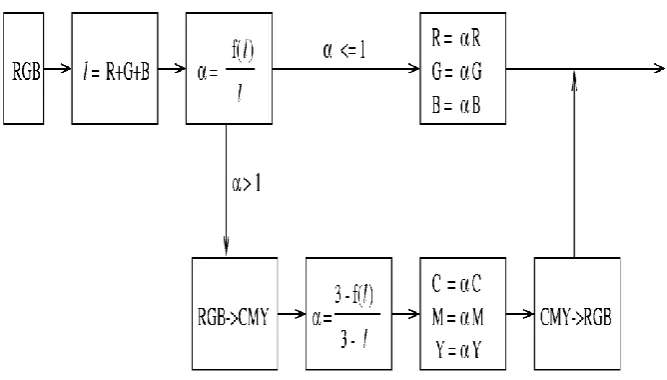
proposed scheme (v) A good hue preserving transformation should not map a pixel having nonzero saturation to a pixel having saturation zero. Otherwise, hue of the pixel becomes undefined. Using the same principle developed in this section, such a case will not arise unless it is a digitization error or the enhancement function ’ ’ maps a or 3 to either 0 or 3. (vi) It should be noted that, whenever any or 3 is mapped to either 0 or 3, the corresponding pixel becomes a black or a white pixel respectively. Individual care should be taken at the time of choosing the constants involved in the transformations while implementing different enhancement functions to make the transformations completely hue preserving. system, periodic training sequences are used to estimate the CFO.
Fig. 1. Block diagram of the proposed enhancement scheme.
Histogram equalization is a very powerful scheme for contrast enhancement in grey scale images. In grey scale histogram equalization, the method rearranges the grey values in such a way that the modified histogram resembles the histogram of uniform distribution. Intuitively, the same technique should work on a color image also, i.e., by equalizing the image in three dimensional space where the three dimensions are the three primary components of the color space. But this causes unequal shift in the three components resulting in change of hue of the pixel [9]. A solution is to equalize only the luminance/saturation or both the components in the color spaces such as LHS, HSI, or YIQ. This sometimes leads to gamut problem when the processed data is again transformed back to RGB space.
Fig. 2. Artificial image of size 128_128.
same principle works for any histogram specification problem. To eliminate the cases of undefined hue, values of and are to be chosen properly
V. RESULTS AND COMPARISONS
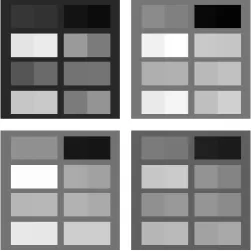
Two real life images namely, Lenna (Fig. 1), Dancer (Fig. 2), and one artificial image (Fig. 3) are considered for showing the results and comparison with other methods. Lenna image has good contrast. Dancer image is a noisy image because of by this method introduces gray patches. On the other hand the proposed enhancement scheme does not distort the image. The output obtained indicates that the proposed scheme provides acceptable enhancement with all the images. It may be noted that the results of Weeks et al.’s method on the artificial image looks better than output of the proposed scheme though the output of the proposed scheme is also an acceptable one.
Fig. 3: Results on Artificial image. (a) S-type enhancement with n = 2 and m =1:5, (b) proposed histogram equalization,
(c) Yang et al.’s method in LHS system, and (d) Weeks et al.’s method.
CONCLUSION AND DISCUSSION
The main contribution here is the scheme to generalize any grey scale image enhancement method to color images without encountering gamut problem. The overall enhancement obtained by the proposed scheme is mainly dependent on the already existing different contrast enhancement functions for grey scale images. These contrast enhancement functions for grey scale images are generalized to enhance the intensity of the color images, keeping the hue intact. A novel scheme is proposed to avoid gamut problem arising during the process of enhancement. This scheme is used to enhance the intensity of color images using a general hue preserving contrast enhancement function. The transformation is general in the sense that the function ’ ’ can be any contrast enhancement function used for grey scale images and is gamut problem free irrespective of the nature of the function ’ ’. While doing the nonlinear enhancement, we have suggested that linear stretching is to be applied prior to the nonlinear transformation. Here, it may be noted that nonlinear enhancement can also be done independently.
REFERENCES
[1]. G. Aubert and L. Vese, “A variational method in image recovery,” SIAM J. Numer. Anal., vol. 34, no. 5, pp. 1948– 1979, 1997.
[2]. S. Byers and A. Raftery, “Nearest-neighbor cluster removal for estimating features in spatial point processes,” J. Amer. Statist. Assoc., vol. 93, no. 442, pp. 577–584, 1998.
[3]. V. Caselles, F. Catté, T. Coll, and F. Dibos, “A geometric model for active
[5]. G. Dal Maso, J. M. Morel, and S. Solimini, “A variational method in image segmentation: existence and approximation results,” Acta Matematica, vol. 168, pp. 89–151, 1992.
[6]. A. Dasgupta and A. Raftery, “Detecting features in spatial point processes with cluster via model-based clustering,” J. Amer. Statist. Assoc., vol. 93, no. 441, pp. 294–302, 1998.
[7]. L. C. Evans and R. F. Gariepy, Measure Theory and Fine Properties of Functions. Boca Raton, FL: CRC, 1992. [8]. G. Kanizsa, La Grammaire du Voir. Essais sur la perception: Diderot Editeur, Arts et Sciences, 1997.
[9]. M. Kass, A. Witkin, and D. Terzopoulos, “Snakes: Active contour models,” Int. J. Comput. Vis., vol. 1, pp. 321–331, 1988.
[10]. S. Kichenassamy, A. Kumar, P. Olver, A. Tannenbaum, and A. Yezzy, “Gradient flows and geometric active contour models,” in Proc. Int. Conf. Computer Vision, Cambridge, MA, 1995, pp. 810–815.
[11]. M.-S. Lee and G. Medioni, “Inferred descriptions in terms of curves, regions and junctions from sparse, noisy binary data,” in Proc. IEEE Int. Symp. Computer Vision, Coral Gables, FL, 1995, pp. 73–78.
[12]. C. Lopez and J. M. Morel, “Axiomatization of shape analysis and application to texture hyper discrimination,” in Proc. Trento Conf. Surface Tension Movement Mean Curvature, Berlin, Germany, 1992.
[13]. R. Malladi, J. A. Sethian, and B. C. Vemuri, “A topology independent shape modeling scheme,” in Proc. SPIE Conf. Geometric Methods Computer Vision II, vol. 2031, San Diego, CA, 1993, pp. 246–258.
[14]. “Evolutionary fronts for topology-independent shape modeling and recovery,” in Proc. 3rd Eur. Conf. Computer Vision Stockholm, Sweden, 1994, vol. 800, pp. 3–13.
[15]. R. Malladi, J. A. Sethian, and B. C. Vemuri, “Shape modeling with front propagation: A level set approach,” IEEE Trans. Pattern Anal. Machine Intell., vol. 17, pp. 158–175, Feb. 1995.
[16]. J. M. Morel and S. Solimini, Segmentation of Images by Variational Methods: A Constructive Approach. Madrid, Spain: Revista Matematica Universidad Complutense de Madrid, 1988, vol. 1, pp. 169–182.