A Novel Secured Data Transmission Model
with Load Balancing for Cloud Computing
N.Madhavi Latha, Y.Pavan Narasimha Rao
M.tech Scholar, Assistant professor RamaChandra college of engineering, India
Abstract
Cloud computing is a distribute network for storing and sharing information over internet with scalability. Information security is one the major issue faced by cloud users and service providers. Data retrieval and security are major issues which block clients to adopt clud computing. Also, cloud servers enables the clients to store information on remote servers thereby preventing third party attacks over this data. The main objective of our research work is to store,transmit and extract data in a secure channel.In this proposed model,secured data transmission model using data integrity approach was implemented. Experimental results proved that the proposed integrity model has high accuracy compared to traditional data transmission models.
Index Terms— cloud server, data integrity, secure transmission.
I. INTRODUCTION
Cloud computing is utilized for the administrations and applications which keep running on an appropriated system utilizing virtualized assets and got to by basic Web conventions and systems administration guidelines.
Amazon Web Services: One of the best cloud-based organizations is Amazon Web Administrations, which is an Infrastructure as a Service offering that gives you a chance to lease virtual PCs all alone foundation. These new capacities empower applications to be composed and conveyed with insignificant cost and to be quickly scaled and made accessible worldwide as business conditions grant. This is genuinely a progressive change in the way venture processing is made and sent [2]. The most recent decades have fortified the thought that data preparing should be possible all the more effectively midway, on extensive homesteads of processing and stockpiling frameworks open through the Internet. Progressions in systems administration and different territories are in charge of the acknowledgement of the two new processing models and prompted the framework registering development in the mid 1990s and, since 2005, to utility figuring and distributed computing. LiteGreen, a method to accumulate desktop power by virtualizing the users desktop computing background being a practical machine (virtual machine) then migrate it connecting the users objective desktop
machine as well as a Virtual machine server, depending upon if the desktop computing environment continues to be actively used or is inactive. Thus, the users desktop back ground is always on, maintaining its net existencel completely no matter if the users physical desktop machine is shifted and thereby cutback power.
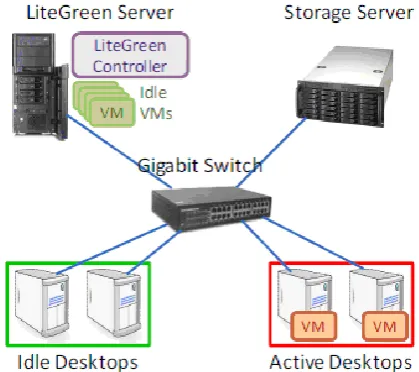
Figure 1 shows an illustration of the front entry design for connection concentrated Internet applications. Users, from side to side dedicated customers, applets, or browser plugins, subject login requests towards the repair cloud. These login needs primary arrive at send off server, which picks appreciable link server and give back its Internet protocol address onto the customer. The customer after that immediately connect with the connection server. The connection server ensures the buyer so if succeeded, a exist TCP link is maintained involving the customer and of course the connection server till the customer logs off.
range of sockets it may host. A latest user login rate L is defined as the quantity of latest connection requirements than a connection server processes inside a second. A restriction on login rate Lmax is about to guard CS as well as additional backend services.
II. RELATED WORK
The Dynamic two-phase commit protocol is a variation of Tree 2PC with no foreordained organizer. Understanding messages are sent by every endless supply of the exchange (getting to be prepared). The organizer is resolved progressively by a hustling assertion of messages at the hub where the messages impact. Messages may impact either at an exchange tree hub, or at an edge. In the recent case one of the two edge's hubs is chosen as a facilitator. D2PC is time ideal (among all the examples of a particular exchange tree, and any particular Tree 2PC protocol execution; all occasions have the same tree; every occasion has an alternate hub as organizer): it submits the facilitator and every associate in least conceivable time, permitting a brief arrival of bolted assets. D2PC is an adjustment of T2PC where the CC is progressively dictated by dashing READY (YES vote) messages, on an each exchange premise, as opposed to being settled, foreordained. For any given exchange D2PC emulates some example of T2PC. We later see that this occasion is ideal (in the arrangement of all cases for a same exchange) in the accompanying sense: It executes the confer choice (i.e., finishes stage 1 of 2PC) in least time. It confers every member in least time.
Fig 1. High level liteGreen Architecture
Fig 1 shows the high-level architecture of LiteGreen. The desktop computing communication is enlarged by using a Virtual machine server as well as a common storage node[8]. Generally, present strength be numerous Virtual machine server and/or common
Proposed Solution:
Step 1: Create instance job name.
Step 2; Create Job size.
Required powerconsumption=(max power of the processor * required workload)/ 100;
If( job_powerconsumption<threshold) Monitor job status or add to queue. Else
Go to Step 3.
Step 3: Job security requirements.
User enters Key pair details of the job.
If(user_key_id==null or
user_key_value==null) Stop creating job. Else
Store job security details in cloud.
Step 4: Execute Load balancing Algorihtm.
Step 4: Execute VIRTUAL MACHINE control method.
Load balancing Algorithm:
Application usage data: AUD
Application request Service :ARS
Available Resource: AR
1. Input: AUD(AR,ARS)
2. availableVIRTUAL MACHINEList //list of available VIRTUAL MACHINEs form each
cloud
3. usedVIRTUAL MACHINEList //list of VIRTUAL MACHINEs,currently provision to
certain job
4. deployableVirtual machine=null
5. if size(usedVIRTUAL
MACHINEList)=size(availbleVIRTUAL MACHINEList) then
6. clear usedVIRTUAL MACHINEList 7. End if
8. for virtual machine in (AUD,AR,ARS) do
9. if virtual machine not in usedVIRTUAL MACHINEList then
10. Add VIRTUAL MACHINE to usedVIRTUAL MACHINEList
11. deployableVirtual machine= virtual machine 12. Break
13. End if 14. End for
15. Save deployableVirtual machine
16. Calculate load balance probable control limit value as:
Upper control
limit(UCL)=AR+
(corr
X
3*
X)*ARS
(
X
3*
X)*ARS
Control Limit(CL)=AR+
Corr*ARS
Lower ControlLimit(LCL)= AR+
(Corr
X
3*
X)*ARS
17 Return Bounded values and deployableVirtual machine.
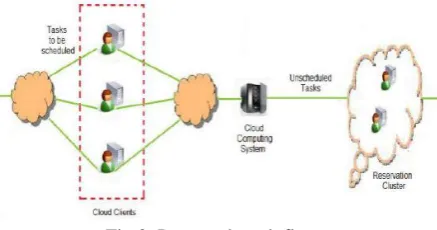
Fig 3: Proposed work flow
Cloud server Control Mechanism admissionControl() {
1. If (there is any initiated virtual machine) 2. For each virtual machinei in each resource
provider rp j 3. {
4. If (! canWait(unew, virtual machinei )) { 5. continue;
6. }
7. Else If (! canInitiateNew(unew, rp j )) 8. Return reject
9. If (PotentialScheduleList is empty) 10. Return reject
11. Else {
12. Get the list of Virtual machine requests 13. Monitor the usage details
14. Get the Load balancing details
15. List Available virtual machine in virtual machine set .
16. If(LCL<=virtual machine.getUsageData and virtual machine.NumberofResources <=UCL)
17. Return accept 18. Else
19. Return reject 20. }
21. }
III. EXPERIMENTAL RESULTS
Experiments are performed by means of the configurations Intel(R) Core(TM)2 CPU 2.13GHz, 2 GB RAM, and the OS platform is Microsoft Windows XP Professional (SP2).
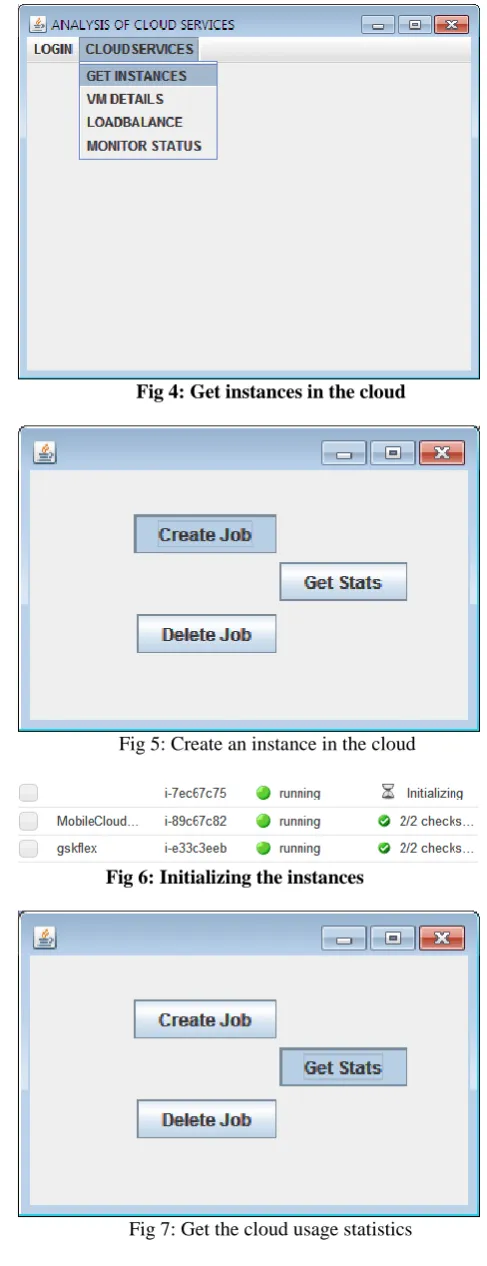
Fig 4: Get instances in the cloud
Fig 5: Create an instance in the cloud
Fig 6: Initializing the instances
Fig 7: Get the cloud usage statistics
80,Name: stopped},PrivateDnsName: ip-172-31-46-33.us-west-2.compute.internal,PublicDnsName: ,StateTransitionReason: User initiated (2015-10-07
02:04:17 GMT),KeyName:
HadoopClusterKey,AmiLaunchIndex:
1,ProductCodes: [],InstanceType:
m4.large,LaunchTime: Tue Oct 06 23:52:46 IST 2015,Placement: {AvailabilityZone: us-west-2b,GroupName: ,Tenancy: default},Monitoring: {State: disabled},SubnetId: subnet-babcaed8,VpcId: vpc-805d4fe2,PrivateIpAddress:
172.31.46.33,StateReason: {Code:
Client.UserInitiatedShutdown,Message:
Client.UserInitiatedShutdown: User initiated shutdown},Architecture: x86_64,RootDeviceType: ebs,RootDeviceName:
/dev/sda1,BlockDeviceMappings:
[],VirtualizationType: hvm,ClientToken:
ParsH1443151317446,Tags: [{Key:
SecurityAlg,Value: ParallelCG}, {Key: Name,Value: ParallelMasterNode}],SecurityGroups:
[{GroupName: SecurityData,GroupId: sg-899e09ed}],SourceDestCheck: true,Hypervisor: xen,NetworkInterfaces: [{NetworkInterfaceId: eni-fb19629d,SubnetId: subnet-babcaed8,VpcId:
vpc-805d4fe2,Description: ,OwnerId:
751633946423,Status: in-use,PrivateIpAddress: 172.31.46.33,PrivateDnsName: ip-172-31-46-33.us-west-2.compute.internal,SourceDestCheck:
true,Groups: [{GroupName: SecurityData,GroupId: sg-899e09ed}],Attachment: {AttachmentId: eni-attach-739c2278,DeviceIndex: 0,Status: attached,AttachTime: Fri Sep 25 08:51:57 IST 2015,DeleteOnTermination:
true},PrivateIpAddresses: [{PrivateIpAddress: 172.31.46.33,PrivateDnsName: ip-172-31-46-33.us-west-2.compute.internal,Primary:
true,}]}],EbsOptimized: true}, {InstanceId: i-d0282a15,ImageId: ami-5189a661,State: {Code: 80,Name: stopped},PrivateDnsName: ip-172-31-46-32.us-west-2.compute.internal,PublicDnsName: ,StateTransitionReason: User initiated (2015-09-25
13:22:13 GMT),KeyName:
HadoopClusterKey,AmiLaunchIndex:
0,ProductCodes: [],InstanceType:
m4.large,LaunchTime: Fri Sep 25 08:51:57 IST 2015,Placement: {AvailabilityZone: us-west-2b,GroupName: ,Tenancy: default},Monitoring: {State: disabled},SubnetId: subnet-babcaed8,VpcId: vpc-805d4fe2,PrivateIpAddress:
172.31.46.32,StateReason: {Code:
Client.UserInitiatedShutdown,Message:
Client.UserInitiatedShutdown: User initiated shutdown},Architecture: x86_64,RootDeviceType: ebs,RootDeviceName:
/dev/sda1,BlockDeviceMappings:
[],VirtualizationType: hvm,ClientToken:
ParsH1443151317446,Tags: [{Key:
SecurityAlg,Value: ParallelCG}, {Key: Name,Value: SlaveNode}],SecurityGroups: [{GroupName:
SecurityData,GroupId:
sg-899e09ed}],SourceDestCheck: true,Hypervisor: xen,NetworkInterfaces: [{NetworkInterfaceId: eni-fa19629c,SubnetId: subnet-babcaed8,VpcId:
vpc-805d4fe2,Description: ,OwnerId:
751633946423,Status: in-use,PrivateIpAddress: 172.31.46.32,PrivateDnsName: ip-172-31-46-32.us-west-2.compute.internal,SourceDestCheck:
true,Groups: [{GroupName: SecurityData,GroupId: sg-899e09ed}],Attachment: {AttachmentId: eni-attach-719c227a,DeviceIndex: 0,Status: attached,AttachTime: Fri Sep 25 08:51:57 IST 2015,DeleteOnTermination:
true},PrivateIpAddresses: [{PrivateIpAddress: 172.31.46.32,PrivateDnsName: ip-172-31-46-32.us-west-2.compute.internal,Primary:
true,}]}],EbsOptimized: true}]}]You have 2 Amazon EC2 instance(s) running.
Datasize TransferTIme Existing(s)
TransferTime Proposed(s)
1M 55 37
2M 124 87
3M 198 167
4M 278 243
5M 326 298
Instances Vs TimeToStart
0 1000 2000 3000 4000 5000 6000
Ins1 Ins2 Ins4
Instances T im e (m s ) EInstanceTime PInstanceTime
Chart 1: Graph displays the comparison between the number of instances Vs instance initialization time.
IV. CONCLUSION AND FUTURE SCOPE
transmission models. In future we may provide security to those properties by allowing access to authenticated users. In future this work can be optimized by using different operating systems.
V. REFERENCES
[1] G. Czajkowski and L. Dayn´es. Multitasking without compromise: a virtual machine evolution. ACM SIGPLAN Notices, 36(11):125.138, Nov. 2001. Proceedings of the 2001
ACM SIGPLAN Conference on Object Oriented
Programming, Systems, Languages and Applications (OOPSLA 2001).
[2] S. Devine, E. Bugnion, and M. Rosenblum. Virtualization system including a virtual machine monitor for a computer with a segmented architecture. US Patent, 6397242, Oct. 1998.
[3] CHEN, Y., DAS, A., QIN, W., SIVASUBRAMANIAM, A., WANG, Q., AND GAUTAM, N. Managing server energy and operational costs in hosting centers. In In Proceedings of the International Conference onMeasurement and Modeling of Computer Systems (2005).
[4] DOYLE, R., CHASE, J., ASAD, O., JIN, W., AND VAHDAT, A. Model- Based Resource Provisioning in aWeb Service Utility. In In Proceedings of the 4th USENIX Symposium on Internet Technologies and Systems (2003). [5] ELNOZAHY, M., KISTLER, M., AND RAJAMONY, R.
Energy conservation policies for web servers. In USITS (2003).
[6] D. Reed, I. Pratt, P. Menage, S. Early, and N. Stratford. Xenoservers: accounted execution of untrusted code. In Proceedings of the 7th Workshop on Hot Topics in Operating
Systems, 1999.
[7] J. S. Robin and C. E. Irvine. Analysis of the Intel Pentium's ability to support a secure virtual machine monitor. In Proceedings of the 9th USENIX Security Symposium, Denver,
CO, USA, pages 129.144, Aug. 2000.