health education program based on stages of change
to prevent osteoporosis
Kambiz Karimzadeh Shirazi1, Shamsaddin Niknami2, Elaheh Rahimi3
Abstract
Intervention mapping provides an explicit theory and data driven guide for intervention development. The intervention program evaluated through a randomized controlled trial design, on 116 women aged 40-65, based on Intervention Map to increase consumption of calcium rich foods to prevent osteoporosis. Osteoporosis knowledge and stages of change of calcium intake were as the effect variables and frequency of calcium rich foods consumption was as the outcome variable of the intervention. The findings revealed that intervention was effective in increasing the participants’ knowledge of osteoporosis and calcium intake in trial group. Perhaps the Intervention mapping can be used as a theoretical framework to design efficient and effective tailored health interventions.
Keywords: Behavior change, Calcium intake, Intervention, Osteoporosis
Journal of Research & Health
Social Development & Health Promotion Research Center
Vol. 4, No.3, Atumun 2014 Pages: 795-802
Original Article
1. Correspondence to: Associate Professor, Social Determinants of Health Research Center, Yasuj University of Medical Sciences; Yasuj, Iran
Tel/Fax: +98 741 2226715
Email: [email protected] 2. Associate Professor of Health Education Department, School of Medical Sciences, Tarbiat Modares University; Tehran, Iran
3. MD, Social Determinants of Health Research Center, Yasuj University of Medical Sciences; Yasuj, Iran
Received: 8 Aug 2013 Accepted: 5 May 2014
How to cite this article: Karimzadeh Shirazi K, Niknami Sh, Rahimi E. Using intervention mapping to develop a tailored health education program based on stages of change to prevent osteoporosis.
J Research Health2014; 4(3): 795-802.
Introduction
Osteoporosis is a major public health problem, primarily due to its relationship with fractures of the vertebrae, wrist, and hip [1]. Results obtained from the national program for prevention, diagnosis and treatment of osteoporosis in Iran, have revealed that more than 70% of women and 50% of women over the age of 50 suffer from osteoporosis or osteopenia [2]. Several modifiable risk factors for osteoporotic fractures have been suggested [3]. One conceivable factor is the diet. The influence and importance of dietary calcium intake, in the initial prevention of osteoporotic fractures have been highly debated [4,5]. Despite the fact that documented evidence addresses the positive effects of calcium on health and that calcium is easily found in milk
and dairy products, calcium intake is still low, particularly among females [6,7].
controlled trial applying intervention mapping in a study of calcium consumption promotion to prevent osteoporosis. Intervention mapping is an additional tool for the planning and development of health education and promotion programs. It has six fundamental steps in the development of the intervention: (a) conducting a needs assessment (b) creating matrices of proximal objectives (c) selecting theory based intervention methods and practical strategies (d) designing and organizing a program (e) specifying adoption and implementation plans and (f) generating program evaluation plans. Each step requires performance of several specific tasks leading to a product that provides the basis for the subsequent steps. The result is an intervention map, which consists of matrices and plans to guide the design, implementation, and evaluation of an intervention [9,10]. IM can contribute to more effective health promotion programs and better explication of these programs The followings are some examples of using IM in different interventions and programs: HIV prevention programs[11,12], diabetes prevention life style[13], and nutrition interventions[14].
Method
The study was a randomized controlled trial with pre-post intervention measurements of stage of change, osteoporosis knowledge, and calcium consumption level. In this study the required sample size, in order to achieve 80% power at a 5% level of significance on the main variable of interest between the case and control groups was calculated to be 52 [15]. Two hundred women were invited to participate in the study considering attribution and non-suitability. This part of the study found a mean (SD) difference of 7.6 (3.9), and retrospective sample size calculation achieved a power of 99%. There were 39 urban District Health Centers (DHC) in Shiraz, Iran. In the first stage of randomization we randomly selected two centers, one as a training center and the other a control center. In each center 100 women whom we expected to meet the study inclusion criteria (40-65 years of age, education ≥ 5th grade) were
randomly selected to take part. Their contact details were obtained from the records in the centers. We excluded women with pregnancy, a previous diagnosis of osteoporosis, or renal stone disease, which would limit calcium consumption. After initial screening, 61 women in the training center and 55 women in the control group were ready for the study. The centers were far enough from each other to minimize the likelihood of contact between women (contamination). The women in the control group were placed on a waiting list for the intervention.
This section provides a brief review of the six steps of the IM process used to produce a nutrition education program to prevent osteoporosis.
Step 1: Needs Assessment
provides considerable support for the stage based models and suggests that these models can be usefully applied in osteoporosis prevention areas [17,18]. Moreover, one of the most prominent models for explaining dietary change which, has received the most empirical investigation and support, is TTM, the Trans-theoretical Model [19,20]. According to these considerations we concluded that the TTM was an appropriate conceptual framework and that osteoporosis prevention program could be subsumed within it. When using intervention mapping, it is necessary to subdivide the priority population in case the behavior or its determinants vary in the population [21]. Hence, we decided to differentiate the participants, implying the stage of change of Trans theoretical model. Five statements were presented (one based on each stage of change) and the participants were asked to mark a statement that best describes their current situation of dietary calcium intake (e.g. “I am not seriously thinking about eating 3 or more daily serving of dairy products in the next 6 months” - precontemplation). This questionnaire was based on a four-question algorithm which was previously validated and used for staging of calcium intake [6]. Women who were in precontemplation showed no tendency to begin calcium intake. On the other hand women in contemplation or preparation showed some tendency to start preventive behavior, and those in action or maintenance were already performing the preventive behavior [22]. Step 2: proximal program objectives
This step in intervention mapping provides the basis for intervention development by defining who and what will change due to the health education program. The product, proximal program objectives, are statements about what the person ought to learn or changed in the environment in order to influence the determinates of behavior that were recognized in the needs assessment [10]. On the basis of the trans-theoretical model (TTM), there is actually one performance objective for each stage of calcium intake. For instance, the performance objective for women in the preparation stage is “move to the action stage for increasing calcium intake”.
The next task was to specify important personal or external determinants influential in helping the individual to carry out the desired behavior based on the core constructs of the TTM, literature review and in-depth interviews. For example, table 1 includes the knowledge, threat, and decisional balance as important determinants for moving from precontemplation to contemplation. After specifying performance objectives of the priority population and the important and changeable determinants, we merged them into a matrix of program objectives. Each matrix had only one performance objective and several determinants were hypothesized to influence the performance objective. Table 1 is a sample matrix.
Step 3: methods and strategies for behavioral
Performance objectives
Determinants
Knowledge Threat Decisional balance skills
Participant will move to the contemplator stage of
calcium intake
Explains the facts about osteoporosis
Identifies that the consequence of osteoporosis can be
serious
Notices negative consequences of
osteoporosis disease
Estimates personal risk factor for osteoporosis
correctly Identifies inactivity
and low calcium consumption as risk factors for
osteoporosis
Identifies herself at risk of getting
osteoporosis
Expresses benefits to knowing about
osteoporosis
Writes calcium rich foods list
Identifies increase calcium intake as
preventive behavior
Expresses greater number of benefits for osteoporosis prevention than
change
One method can lead to several strategies; the trans theoretical model; can be used to describe, explain and predict behaviors. Therefore, it is a model for behavioral determinants and also behavioral change. An important contribution of this model is the specific application of educational effort so that it includes different methods for individuals in different phases of change. The processes of change are mechanisms that people use to move themselves from one stage of change to another. These processes are methods which influence stage shifts. For example, to enable movement from contemplation to action, the experiential processes continue to tip the decisional balance with self re-evaluation focused on crucial benefits and positive outcomes. In order to develop movement between these stages processes to enhance Self-efficacy, such as skill development and testing the new behavior must also be incorporated. Social and / or family support is deemed important at this stage [22,23].
Step4: program plan development:
The intervention program is designed in step 4: the methods and strategies are translated into intervention material. In this phase, the prevention officers play the main role by designing materials in consistence with the target groups [10]. The osteoporosis prevention project used completely mediated intervention components, such as pamphlet, poster and reminder cards. Since participants had to have a minimum education level of 5 years, the information provided in these materials was designed to simplify complex issues. Each pamphlet or reminder card included one process of change. It is suggested that experiential processes are used more in the early stages of change, while behavioral processes are generally higher in the action stages [24]. The participants’ stages in calcium intake were determined every two weeks and each woman received reminder cards and pamphlets based on her recent stages. She was asked to attach the cards in a suitable place at home. The materials were pretested on a group of women (n=12 mean age=57) to make sure they understood all the messages.
Step 5: Implementation
The next step in the intervention mapping process puts intervention in field. Intervention mapping suggests the development of an implementation plan, including adoption and implementation objectives; methods; strategy and training program; and implementation [10]. Health workers were elected to determine women`s stages and deliver the pamphlets and reminder cards to participants every two weeks. A training course was developed for health workers which focused on the content of the protocol, identification of the women`s stage of change for calcium intake, and matching the pamphlets and reminder cards to each stage. Step 6: evaluation plan
The final step in IM is the development of an evaluation plan. The evaluation plan determines whether decisions made about learning and changing objectives, methods, strategies, and implementation are correct at each mapping step through program monitoring and evaluation. This intervention program was evaluated through a randomized controlled trial design, with measurements obtained at the beginning and end of intervention (after 12 wks).
The main effect variables were osteoporosis knowledge, and calcium stage of change, and the main outcome variable was frequency of calcium intake. They were all assessed by self administered questionnaires. Two native Iranian health professionals graduated from British Universities translated the questionnaires to Persian. The questionnaires were backward translated to English by a native English speaker living in Iran. The questionnaires were completed in one session before and after the intervention.
the pamphlets and whether they had attached the reminder cards in a suitable place at home. Health workers determined the stage of change of each woman and modified intervention to fit within each specific stage. Calcium Food Frequency Questionnaire: Iran lacks reliable and valid calcium composition in Iranian food, so collected data concentrated on the frequency of consumption of dairy products and calcium rich food. Sixteen food items were listed and respondents were asked to record how often they ate these food, responding on a 6- point scale of: ‘never’, ‘less than once a week’, ‘1-3 times a week’, ‘4-6 times a week’, once a day’ and ‘more than once a day’. The developed Food Frequency Questionnaire (FFQ) was thus defined as ‘qualitative’ in that it did not investigate portion size, e.g. [25, 26]. Osteoporosis knowledge Questionnaire (OPQ): A 20-item scale, previously designed for Osteoporosis knowledge (OPQ), assessed participant’s knowledge [27,28]. The OPQ is a reliable and validated questionnaire to assess patient’s knowledge in four areas comprising i) General knowledge (5 questions), ii) risk factors (7 questions), iii) treatment (4 questions), and iv) consequences of osteoporosis (4 questions ). There are four responses for each question of which only one is correct. One of these is a ‘don’t know’ option, which has been included to improve patient compliance and scored 0 points. Each correct response scored 1 point and an incorrect response scored -1. The maximum and minimum score on the OPQ is 20 and -20 respectively. Calcium Stage of Change Questionnaire (CSCQ): Five statements were presented (one based on each stage of change) and the participant was asked to mark the statement that best describes their current situation of dietary calcium consumption (e.g. “I am not seriously thinking about eating 3 or more daily serving of dairy products in the next 6 months” - precontemplation). This questionnaire was based on a four-question algorithm previously validated for college female students [6]. To examine differences in demographic variables (age, years of education), independent t-tests were used. A χ2 analysis was used to
compare groups’ stages of change and to assess movement through the stages at baseline and 12 weeks. Comparisons of the variable means of the study (knowledge, and calcium intake), at baseline between the training and control groups were performed using a two-tailed, independent student t-test.
Results
The majority (78%) of the participants were between the ages of 40 and 60 years. The results indicated that at base line the two groups were homogeneous with respect to age, educational level (Table2), frequency of diary and calcium rich foods consumption, and knowledge of osteoporosis (Table4).
At baseline, there was no significant difference between the experimental and control group in the proportion of participants in each of the five stages. After instruction (12 weeks), the experimental group had a smaller proportion of subjects in pre-action stages than the control group (χ2=14.96, P=.0005). Percentages of participants in each stage are summarized in Table 3.
Table3 Participants’ stages of change before and after
the intervention
Stage N (%) Before N (%) After
Precontemplation Trained
Control
15 (24.6) 8 (14.5)
1 (1.6) 3 (5.5) Contemplation
Trained Control
6 (9.8) 12 (21.8)
7 (11.5) 21 (38.2) Preparation
Trained Control
15 (24.6) 15 (27.3)
9 (14.8) 11 (20) Action
Trained Control
15 (24.6) 7 (12.3)
31 (50.8) 8 (14.5) Maintenance
Trained Control
10 (16.4) 13 (23.6)
13 (21.3) 12 (21.8)
The findings revealed that intervention was effective in increasing the participant’s Table2 Baseline characteristics of participants
Training group (n=61)
Mean (SD)
Control group (n=55) Mean (SD)
Age (years) Education (years)
53.5 (7.9) 9.8 (3.6)
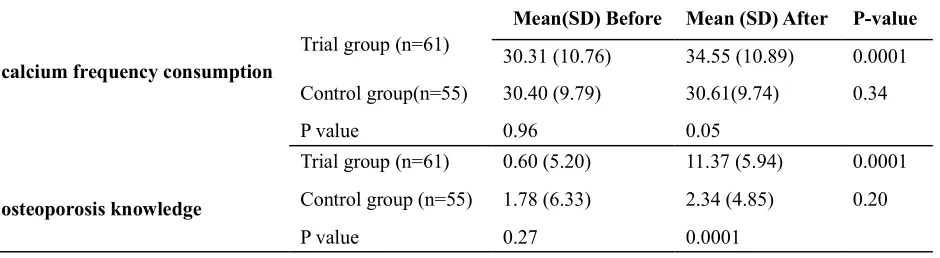
knowledge of osteoporosis and calcium intake in the trial group. As shown in table 4 the mean post-intervention scores were significantly higher than mean pre-intervention scores in the trial group. The results also showed no significant change in the knowledge and
calcium intake scores of the control group (Table4). When compared to the post-intervention control group, the trial group’s knowledge and calcium intake scores differed significantly (Table 4).
Table 4 Change in calcium consumption and osteoporosis knowledge after exposure to intervention
calcium frequency consumption
Trial group (n=61)
Mean(SD) Before Mean (SD) After P-value
30.31 (10.76) 34.55 (10.89) 0.0001
Control group(n=55) 30.40 (9.79) 30.61(9.74) 0.34
P value 0.96 0.05
osteoporosis knowledge
Trial group (n=61) 0.60 (5.20) 11.37 (5.94) 0.0001
Control group (n=55) 1.78 (6.33) 2.34 (4.85) 0.20
P value 0.27 0.0001
Discussion
The present study is a good example of theory application for defining the behavior of interest for osteoporosis education and promotion program and to tailor interventions for effective change in behavior. A systematical incorporation of new and empirical data and TTM was used to guide the intervention design in order to develop osteoporosis education program. In this study the TTM was an appropriate conceptual framework that was used in many steps of intervention mapping, such as differentiation of target group (stage of change), creating matrices of proximal objectives and specifying determinants (self efficacy, decisional balance, …), methods (processes of change), and effect evaluation. Based on the results of the staging algorithm, the experimental group showed a progression in stage compared to the control group. Progression in stages was used as one of the criteria for intervention success, thus providing encouraging results for stage-matched intervention. Individualized, or tailored nutrition education interventions have proven to be effective in inducing dietary change [29, 30]. An interesting aspect of the stages of change is that interventions can be tailored to an individual’s readiness to change. Studies indicate that relative to generic interventions, some tailored interventions are more effective [31] and have been associated with more rapid
behavior change [32,6].
Alongside increasing osteoporosis
This is due to time, budget limitations and using self-reported scales. However, according to the qualitative study that was done in needs assessment, the paramount external determinant of osteoporosis prevention among participants was family support which was considered as one of the determinants. There is the possibility that other studies find more external determinants in this area. Future studies are needed to better understand family support needs and to develop sustainable strategies to deliver such support beyond the life of study. Also, a national review of access to calcium rich foods for women living in different socio economic class may be better conducted before designing any investigation.
This study is a specific example of how intervention mapping can be applied to design and describe a health promotion program. The study also highlights the importance of careful, TTM based intervention planning and individualization and personalization of education programs. This study will provide information about an effective and comprehensive approach that can be used in other health areas. Although details and specific procedures were designed for and with women aged 40-60 years, living in urban areas of Shiraz and may not be generalizable to other settings, our experience and strategies may be helpful for others developing interventions in different communities.
Acknowledgements
This research paper is made possible through the help and support from everyone including: Health system workers and research participant
Contributions Plan organizing: ShN Study design: KKSh, ER
Data collection & instructing: ER Data analysis: KKSh
Manuscript preparation: KKSh, ER
Conflict of interest
"The authors declare that they have no competing interests."
References
1. Wallace LM, Wright S, Parsons A, Wright C, Barlow J. The impact of screening for osteoporosis on bone practicing exercise and dietary calcium intake. Psychol
Health Med2002; 7(4) : 477-88.
2. Larijani B. Osteoporosis in Iran. First international seminar on prevention, diagnosis treatment of osteoporosis. Tehran, Iran. 2004. Available a tURL:http://www.iofbonehealth.org]. Accessed Mar 10, 2008.
3. Cumming RG, Nevitt MC, Cumming SR. Epidemiology of hip fractures. Epidemiol Rev1997, 19(2): 244-57.
4. Kanis JA. The use of calcium in the management of osteoporosis. Bone1999; 24(4): 279-90.
5. Michaelsson K, Melhus H, Bellocco R, Wolk A. Dietary calcium and vitamin D intake in relation to osteoporotic fracture risk. Bone2003;32(6):694-703. 6. Tucker LJ, Snelling AM, Adams TB. Development and validation of a stages of change algorithm for calcium intake for college female students. J Am Coll Nutr2002; 21(6): 530-35.
7. Cullen KW, Bartholomew LK, Parcel GS. Intervention mapping: use of theory and data in the development of a fruit and vegetable nutrition program for Girl Scouts. J Nutr Edu1998; 30(4): 188-95. 8. Backett-Milburn K, Parry O, Mauthner N. ‘I’ll worry about that well it comes alone’: osteoporosis, a meaningful issue for women at mid-life. Health Educ Res2000; 15(2): 153-62.
9. Bartholomew K, Parcel G, Kok GS, & Gottlieb N. Intervention mapping: Designing theory-and
evidence-based health promotion programs. Mountain View,
CA: Mayfield. 2001.
10. Bartholomew LK, Parcel GS, Kok G, Gottlieb NH. Planning health promotion programs. An Intervention Mapping approach. 2nd edition. San Francisco, CA,
Jossey-Bass; 2006.
11. MathewsC, Aarø LE, Grimsrud A, et al. Effects of the SATZ teacher-led school HIV prevention programmers on adolescent sexual behavior: cluster randomized controlled trials in three sub-Saharan African sites. Int Health2012; 4(2): 111-22.
12. Leonard N R, Banfield A , Riedel M, et al. Description of an efficacious behavioral peer-driven intervention to reduce racial/ethnic disparities in AIDS clinical trials. Health Educ Res2013; 28(4): 574-90. 13. Helitzer D, Peterson AB, Thompson J, Fluder S. Development of a planning and evaluation methodology for assessing the Contribution of Theory to a Diabetes Prevention Lifestyle Intervention. Health
Promot Pract2008; 9(4): 404-14.
R. The Program Assessment Guide: An Approach for Structuring Contextual Knowledge and Experience to Improve the Design, Delivery, and Effectiveness of Nutrition Interventions. J Nutr2011; 141(11): 2084-91. 15. Nelson ME, Fiatarone MA, Morganti CM, Trice I, Greenberg RA, Evans WJ. Effects of high-intensity strength training on multiple risk factors for osteoporotic fractures: A randomized controlled trial. JAMA1994; 272(24): 1909-14.
16. Tortolero SR, Markham CM, Parcel GS, et al. Using Intervention Mapping to Adapt an Effective HIV, Sexually Transmitted Disease, and Pregnancy Prevention Program for High-Risk Minority Youth. Health Promot
Pract2005; 6(3): 286-98.
17. Blalock SJ, DeVellis RF, Gold DT, Dooley MA, Anderson JJB, Smith ShL. Osteoporosis prevention in premenopausal women: using a stage model approach to examine the predictors of behavior. Health Psychol1996; 15(2): 84-93.
18. Marsden J, Jones RB. Validation of web-based questionnaires regarding osteoporosis prevention in young women. Health Bull2001; 59(4): 254-62.
19. Campbell MK, Symons M, Demark-Wahnefried W, Polhamus B, Bernhardt JM, McClelland JW & Washington C. Stages of change and psychological correlates of fruit and vegetable consumption among rural African-American church members. Am J Health
Promot1998; 12(3): 185-91.
20. Green GW, Rossi SR, Rossi JS, Velicer WF, Fava JL, & Prochaska JO. Dietary application of the stages of change model. J Am Diet Asso1999; 99(6): 673-78. 21. Van Empelen P, Kok G, Schaalma HP, Bartholomew LK. An AIDS risk reduction program targeting Dutch drug users: An intervention mapping approach to program planning. Health Promot Pract2003; 4(4): 402-12. 22. Prochaska JO, DiClemente CC. Transtheoretical therapy: toward a more integrative model of change.
Psychother Theory Res Pract1982; 20(2): 161-73.
23. Mullen PD, DiClemente CC¸ Bartholomew LK. Theory and Context in ProjectPANDA: A program to help post partum women stay of cigarettes In: Bartholomew K, Parcel G, Kok GS, Gottlieb N, Intervention mapping: Designing theory-and evidence-based health promotion programs. Mountain View, CA: Mayfield 2001; 453 – 77. 24. Prochaska JM, Paiva AL, Padula JA, et al. Assessing emotional readiness for adoption using the Transtheoretical model. Child Youth Serv Rev2005; 27(2): 135-52.
25. Semphos C T. Some limitations of semiquantative food frequency questionnaires. Am J Epidemiol1992; 135(10): 1127-32.
26. Holdsworth M, Raymond NT, & Haslam C. Does the heartbeat award scheme in England result in change in dietary behavior in the workplace? Health Promot
Int2004; 19(2): 197-204.
27. Kim K, Horan M, Gendler P. Osteoporosis Knowledge tests, osteoporosis health belief scale, and osteoporosis self-efficacy scale. Allendale: MI: Grand Valley State University, 1991.
28. Pande KC, de Takats D, Kanis JA, Edwards V, Slade P, McCloskey EV. Development of a questionnaire (OPQ) to assess patient’s knowledge about osteoporosis. Maturitas2000; 37(2): 75-81. 29. Brug J., Steenhuis I., Van Assema P., & De Vries H. The impact of a computer tailored nutrition education.
Preventive Medicine1996; 25(3), 236-242.
30. De Bourdeaudhuij I., & Brug J. Tailoring dietary feedback to reduce fat intake: an intervention at the family level. Health education research2000; 15(4), 449-62.
31. Greene, GW and Rossi, SR. Stages of change for reducing dietary fat intake over 18 months. J Am Diet
Assoc1998; 98(5): 529–34.
32. Campbell M.K., Devellis B.M., Strecher V.J., Ammerman A.S., DeVellis R.F., & Sandler R.S. Improving dietary behavior: The effectiveness of tailored massages in primary care settings. American
journal of public health1994; 84(5), 783-87.
33. Wolfers ME, Hoek CV, Brug J, & Zwart O. Using intervention mapping to develop a program to prevent sexually transmittable infections, including HIV, among heterosexual migrant men. BMC Public
Health2007; 7(6): 141.
34. Belansky ES, Cutforth N, Chavez RA, Waters E, Bartlett-Horch K. An Adapted Version of Intervention Mapping (AIM) Is a Tool for Conducting Community-Based Participatory Research . Health Promot
Pract2011; 12(3): 440-55.