i tif c n
e C
i o
c n
S f
l e
a r
n e
o n
i c
t e
a
2
nr 0
et 1
1
n I
ISC 2011
Proceeding of the International Conference on Advanced Science,
Engineering and Information Technology 2011
Hotel Equatorial Bangi-Putrajaya, Malaysia, 14 - 15 January 2011
ISBN 978-983-42366-4-9
ISC 2011
International Conference on Advanced Science, Engineering and Information Technology
ICASEIT 2011
Cutting Edge Sciences for Future Sustainability Hotel Equatorial Bangi-Putrajaya, Malaysia, 14 - 15 January 2011
SR
IE
AVIUNIT NESIE
DO KB
IN N
R AG
JA A
L S
A A
E N
P M
N A
A L
U A
T Y
A S
SREP A I
N I
NO OD
I TAI COSSA STNEDUTS NA ISEN
Organized by Indonesian Students Association Universiti Kebangsaan Malaysia
Proceeding of the
EDGOM – Game Design Accelerates Students’
Performance
Nur Hazwani Mohamad Roseli
1, Nurulnadwan Aziz
1, Nurul Ulfa Abdul Aziz
1,Hasiah Mohamed @ Omar
21 Faculty of Office Management and Technology, Universiti Teknologi MARA (UiTM)
Dungun Campus, Dungun, 23000, Terengganu, Malaysia
Tel.:+6098400400, E-mail: [email protected], [email protected], [email protected]
2Faculty of Computer and Mathematical Sciences
Dungun Campus, Dungun, 23000, Terengganu, Malaysia Tel.:+6098400400, E-mail: [email protected]
Abstract— Educational computer game is one of the potential applications that is being researched to replace traditional method of teaching and learning. It is believed that with the use of computer games in education, it is able to make learning process easier and student can grasp knowledge efficiently. The way the game is designed is very crucial to ensure it can be adapted in the learning environment. The purpose of this paper is to identify factors regarding game design that can enhance learning process. This paper also highlights problems that lead to the development of EDGOM and the way EDGOM will be developed.
Keywords— educational games, game design, category, element, principle, criteria, game play
I. INTRODUCTION
The advances of technology nowadays give an impact to the educational sector. Traditional method of giving lecture in front of the class without other activities make students feel bored and hard to grasp knowledge. Hence, failures in teaching and learning occur. Many educators and researchers explore new methods to deliver contents to the students such as the usage of multimedia in education or educational multimedia. [1] mentioned that using
educational multimedia in teaching and learning
environment makes learning easier, more convenient, and more effective. He identified three approaches which are the intensive use of digital slide-show presentations, educational applications, and recording a video of the entire lecture [1]. Game portrays educational software to become more motivating and engaging; thus the difficult process of learning could turn more amusing [2]. Hence, game is considered as one of the educational applications. Game is an activity that is based on rules which must be followed, single or multiplayer, and the design should be interesting [3, 4]. Many researchers found that students who learn through game could enhance their performances and lead to positive results in terms of student engagement, encouragement and learning [2, 5, 6, 7, 8]. Students who are believed to be poor
performers had benefited the most from the game environment [2]. Collaborative or cooperative educational games playing promotes significantly more positive impact on learning attitudes and have the potential to transform educational experience than competitive and individualistic groups [7, 8]. Games are not just for youth but also children and adults. Survey conducted in United States as reported in [9, 10], 91 percent of boys and 93 percent of girls aged 8 to 11 years old play online games, and 50 percent of adults play games; 55 percent are male and 43 percent are female. This proves that children and adults love to play games. They play games during their leisure time because games are fun, they can feel the excitement and at the same time increase their intrinsic motivation level due to the challenges and feedback provided [3]. There are many types of games and the most suitable type for educational purpose is educational game.
included. Edutainment depends heavily on various media like television programs, video games, films, music, multimedia, websites and computer software [11]. Game is chosen because the performance of semester 1 students was not good. Figure 1 shows the number of students for each grade based on Office Automation subject. The data was taken for three semesters namely July 2008, January 2009, and July 2009. Most of the students got B-, C+, and C. Only a small number of them managed to score A+, A, and A-. Due to this reason, it is hoped that with the implementation of EDGOM in the learning environment can increase students’ performance. Before any development of games can start, it is crucial to know the design aspects that are suitable for games. The purpose of this paper is to identify factors regarding game design that can enhance the learning process.
Fig. 1 Performance of students for three semesters
This article contains three parts. Section II illustrates five factors of game design which are categories, elements, principles, criteria, and game play. Section III provides discussion about the game design and EDGOM. Finally, the last part will conclude the paper and discuss further research on EDGOM.
II. GAME DESIGN
The way the game is constructed is one of the vital things in designing the game. The game design decides and creates all player choices and the consequences for the rest of the game and it leads to the win or loss condition. It is a form of communication between computer and players, and includes the way player controls the game [4]. This section comprises several factors that must be considered when designing games. The factors are categories, elements, principles, criteria, and gameplay.
A. Categories
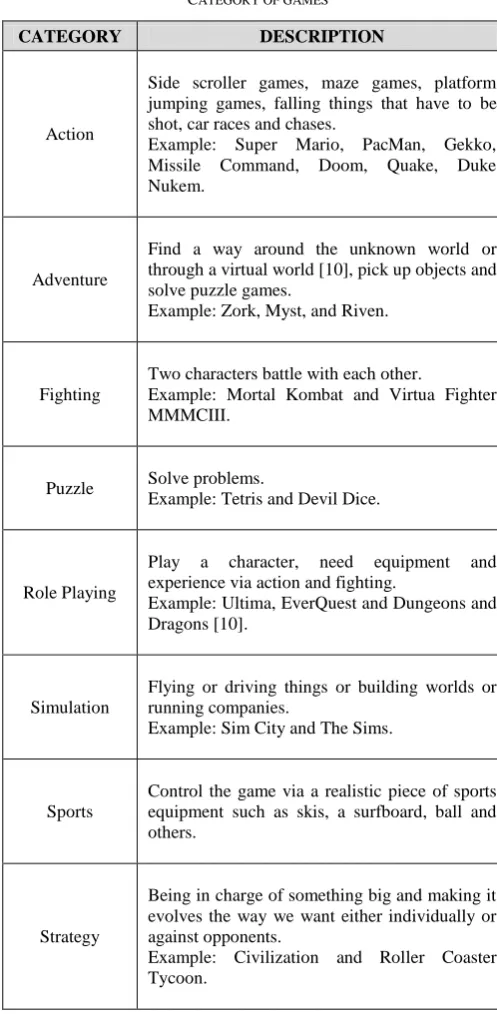
According to research done by Circa (2000) as reported in [12], computer games can be divided into 8 categories namely action, adventure, fighting, puzzle, role playing, simulations, sports, and strategy. Explanation and examples are as follows [12]:
TABLE I CATEGORY OF GAMES
CATEGORY DESCRIPTION
Action
Side scroller games, maze games, platform jumping games, falling things that have to be shot, car races and chases.
Example: Super Mario, PacMan, Gekko, Missile Command, Doom, Quake, Duke Nukem.
Adventure
Find a way around the unknown world or through a virtual world [10], pick up objects and solve puzzle games.
Example: Zork, Myst, and Riven.
Fighting
Two characters battle with each other.
Example: Mortal Kombat and Virtua Fighter MMMCIII.
Puzzle Solve problems.
Example: Tetris and Devil Dice.
Role Playing
Play a character, need equipment and experience via action and fighting.
Example: Ultima, EverQuest and Dungeons and Dragons [10].
Simulation
Flying or driving things or building worlds or running companies.
Example: Sim City and The Sims.
Sports
Control the game via a realistic piece of sports equipment such as skis, a surfboard, ball and others.
Strategy
Being in charge of something big and making it evolves the way we want either individually or against opponents.
Example: Civilization and Roller Coaster Tycoon.
The most preferred games were adventure (example: Zork Nemesis), strategy (example: Red Alert), and role playing games (Massively Multiplayer Online Role-Playing Games - MMORPG) [13, 14]. Meanwhile, the category of game least liked was under Simulation (example: SimIsle) [13].
B. Elements
Fun
It relates to something amusing, enjoyable, and exciting going on. It is the principle source that can makes us return to repeat the action and the performance becomes better, easier, and more goals can be achieved.
Play
It involves intensity and passionate. People who play more will increase their learning, performance, creativity, and productivity. It is a natural way to learn because children or adults choose their own activities and use all their senses to solve problem and understand the environment [11].
Rules
They refer to the structure of the game that must be followed in order to reach specific goals and ensure all players take the same directions.
Goals
Each game has its own goals and it motivates players to achieve the goals and to win.
Interactive
It relates to how players interact with the games in terms of the audio, video, graphics, animation, and navigations.
Adaptive
Players will adapt in the environment and follow the flow or sequence of the games.
Outcome, feedback or reward
It refers to the progress against the goals, and any responses from the games when some actions taken. It consists of three forms which are numerical score, graphic, and oral.
Win states
It gives players ego gratification and moves to the next level.
Conflict
It is also called competition, challenge, and opposition. The excitement of solving the conflicts or problems provides adrenaline to the players. Example as mentioned in [5].
Problem solving
It has connection with conflict. Problem solving approach can foster creativity of the players. Example as mentioned in [5].
Interaction
It involves interaction of the player and the computer, and with other people (multiplayer). Multiplayer promotes the formation of social groupings.
Representation and game story
It includes any narrative or story elements in the game. A good representation and story gives a big impact to the players to keep playing and feel the excitement. Thus, learning can be delivered better.
C. Principles
A good computer game design is one of the critical issues that game designers must take into account. Computer
magazine Next Generation (1997) as reported in [12] has
highlighted six principles of good computer game design. The principles are described in Table 2 below:
TABLE 2
SIX PRINCIPLES OF GOOD COMPUTER GAME DESIGN
PRINCIPLES DESCRIPTION
Balance
Even though the game is challenging, all levels must be fair and moderate; not too difficult and not too easy.
Creative The design is unique.
Focus Make players go through the games without any interruption.
Character
Characters can give a big impact to the players. It can be divided into four components namely character personality, integration, appearance, and rules [16].
Tension Make players mind about the goal but it is hard to reach.
Energy
It comes from movement, momentum and pacing. The game’s energy can cause players to play the games all day long.
D. Criteria
TABLE 3 FIVE CRITERIA
CRITERIA DESCRIPTION
Interface
Consistency, interactivity, navigation, screen design, and pleasant to use.
[18] justified interface design based on three aspects:
Heads-up display (HUD)
- Minimal on-screen information - Icon placement at bottom of screen - Voice communication instead of text
messaging
Keyboard and mouse control
- Configurable keys and mouse buttons - Prefer keyboard and mouse control
over gamepad controllers
- Standard WASD key layout available - Hot keys/key binding instead of menu
selections or multiple keystrokes Menus
- Fast or easy to navigate, configure and access information from within the game
- Voice recognition instead of menu to control
Pedagogy
Clear goal and objective, motivation, learners’ control, learning values, immediate feedback and challenge.
Multimedia
It involves multimedia elements issues: The usage should be suitable according to
its functions
The integration of multimedia elements in each screen
The suitability of multimedia elements.
Content
Reliability of the content, clear and understandable structure, interesting and engaging materials.
Playability
Challenge, strategy, pace in balance, players are able to control and know the progress of the game.
E. Game play
Game play is the interaction between players and the games world, and how the games world responds to the every selection that has been made by the players. Four components of game play [4] are as followed:
People
People are players who run the game. Players choose any games to be played based on their personal opinions and taste. Game designers must understand their target players so that the design is tailored to
they will keep playing until they achieve the goals. Therefore, the learning process can be transferred. It can be single-player or multiplayer games. [18] has identified several positive preferences for the single and multiplayer. For the single player, there are a few advantages compared to multiplayer such as a convenient set up or no scheduling, no human team coordination required, no cheating or anti social behaviour, no connection or hardware issues, and able to save the game midway. Other than that, the bots must be challenging, player skills can be improved, and fun personal activity. Meanwhile, for the multiplayer there are three aspects to consider which are playing with other people (social interaction, competition, share tips or techniques, less need for bots, and advantages of human players over bots – unpredictable behaviour, make mistakes or not perfect, team play with humans than bots, variable skill levels, online internet multiplayer (convenient set up and anonymous), and local area network multiplayer (more fun, social, play with friends in the same room, team play, and no cheating).
Technology
Technology includes stationary console technology (example: playstation, Xbox, NES), mobile consoles (example: playstation portable PSP, Nintendo DS, regular cell phones) and other kind of technology representing the shape of traditional personal computers (example: PCs and Macs). Traditional computer games are concerned about the interface between the player and the game. This involves physical game control (example: keyboard, mouse, game pad) and a virtual, graphical interface on some kind of screen (example: television, computer screen, mobile phone screen) thereby the choices, actions,
navigations, environments, and outcomes of
manipulating the world are presented.
Environment
There are two types of environment; physical and virtual environment. Physical environment is where the player is placed in the real world setting, accesses, and participates in the game. Meanwhile, virtual environment is the computerized representation of the game world. Most of the games are set to be played in the virtual environment. Game developers must design exciting and motivating virtual environment so that the players are highly focused on the games and are not distracted by the real environment surrounding them. Examples of virtual game environment preferred by the players are various topographic features, multiple levels, indoor and outdoor maps, jumping and climbing, high quality graphics, large maps or lots of people, and quick paced storyline or plot [18].
Rules
However, less formal rules are played in a fair manner to respect the rules that are supposedly to be followed. Players cannot violate the rules in order to achieve the goals. Standard and complete rules lead to fair play from each player.
III. EDGOM – GAME DESIGN / DISCUSSION
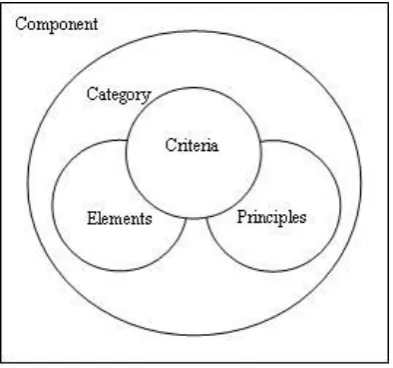
Based on Section II, the authors came out with one model (refer to Fig. 2) that shows the interrelationship between the five factors in designing a game. The inner part of the model shows the relationship between criteria and elements, and criteria and principles. The combination of these three factors makes up the foundation part of game design. Without these three factors, game design will not be complete. The outer part is the category of the game. Designers must choose the best category or the combination of a few categories in order to make the game fun, attractive and amazing. Finally the most outer part is the component. Without people, there will be no player to play the game. Technology is used by the game designer as a medium to communicate with the players. Players also use technology to play games. Environment is like an interface for the game. Players enter the stimulating environment to reach certain goals or objectives. Each game has rules. Rules are the one which provide challenge to the players.
As shown in Fig 2, the inner part comprises of three factors namely criteria, elements, and principles. Table 4 below depicts the combination of the three factors based on the authors’ understanding. Criteria become the major factor and each criterion has its own elements and principles.
Fig. 2 Interrelationship of five factors in game design
TABLE 4
THE COMBINATION OF CRITERIA, ELEMENTS, AND PRINCIPLES
CRITERIA
ELEMENTS PRINCIPLES
Interface Interactive Creative
Pedagogy Goal Feedback Conflict Problem solving
Multimedia Interactive Character
Content
Rules Adaptive Representation or game story
Playability Fun Play Win states Conflict Interaction Problem solving
Balance Focus Tension Energy
EDGOM is an educational game that will combine three categories of game which are adventure, simulation, and puzzle. The first phase of development will only cover a topic in one of the first semester’s Information Technology subjects in the faculty that is Office Automation subject. The model in Fig 2 will be used together with the combination of criteria, elements, and principles in Table 4.
IV. CONCLUSIONS
REFERENCES
[1] G. Friedland, W. Hurst, and L. Knipping, “Educational multimedia
systems: The past, the present, and a glimpse into the future,” in Proc. EMME’07, 2007, ACM, p. 1-4.
[2] M. Virvou, G. Katsionis, and K. Manos, “Combining software games
with education: Evaluation of its educational effectiveness,” in Educational Technology & Society, 2005, ACM, 8 (2), p. 54-65.
[3] T. Phit-Huan, L. Siew-Woei, and T. Choo-Yee, “Adaptive digital
game-based learning framework,” in DIMEA’07, 2007, ACM, p.
142-146.
[4] K. Jegers, “Elaborating eight elements of fun: Supporting design of
pervasive player enjoyment,” ACM Computers in Entertainment,
2009, Vol. 7, No. 2, Article 25, p. 1-22.
[5] V. Srinivasan, K. Butler-Purry, and S. Pedersen, “Using video games
to enhance learning in digital system,” in FuturePlay, 2008, ACM, p. 196-199.
[6] M. Muratet, P. Torguet, J. Jessel, and F. Viallet, “Towards a serious
game to help students learn computer programming,” International
Journal of Computer Games Technology, Hindawi Publishing Corporation, vol. 2009, p. 1-12, February 2009.
[7] K. Fengfeng, “Classroom goal structures for educational math game
application,” in Proc ICLS 2006, p. 314-320.
[8] N. Andrea, and B. Tiffany, “Games for CS education:
Computer-supported collaborative learning and multiplayer games,” in Proc
FDG 2010, ACM, p. 274-276.
[9] B. Maxwell. (2010). [Online]. Available:
http://www.next-gen.biz/news/survey-90-per-cent-of-children-play-games-online
[10] O. Diana. (2006) EDUCAUSE Learning Initiative. [Online].
Available: http://net.educause.edu/ir/library/pdf/ELI3004.pdf
[11] K. Rapeepisarn, K. W. Wong, C. C. Fung, and A. Depickere,
“Similarities and differences between “learn through play” and
“edutainment”,” in Proc 3rd Australasian Conference on Interactive
Entertainment, 2006, ACM, Vol. 207, p. 28-32.
[12] M. Prensky. (2001) From Digital Game-Based Learning. Fun, play
and games: What makes games engaging. [Online]. Available: http://www.marcprensky.com
[13] A. Amory, K. Naicker, J. Vincent, and C. Adams, “The use of
computer games as an educational tool: identification of appropriate
game types and game elements,” British Journal of Educational
Technology, Blackwell Publishers, vol. 30, no. 4, p. 311-321, 2000.
[14] L. Achterbosch, R. Pierce, and G. Simmons, “Massively multiplayer
online role-playing games: The past, present, and future,” 2008, ACM Computers in Entertainment, vol. 5, no. 4, article 9, p. 1-33.
[15] I. Roslina, and J. Azizah, “Using educational games in learning
introductory programming: A pilot study on students’ perceptions,” 2010, IEEE.
[16] A. Tychsen and M. Hitchens, “Character play- The use of game
characters in multi-player role-playing games across platforms,” 2008, ACM Computers in Entertainment, vol. 6, no. 2, article 22, p. 1-24.
[17] M. Hasiah, and J. Azizah, “Challenges in the evaluation of
educational computer games,” in Proc International Symposium on
Information Technology, 2010, IEEE, vol. 1, p. 322-327.
[18] D. Clarke and P. R. Duimering, “How computer gamers experience