VOLUME NO.6(2016),ISSUE NO.10(
O
CTOBER) ISSN2231-5756A Monthly Double-Blind Peer Reviewed (Refereed/Juried) Open Access International e-Journal - Included in the International Serial Directories
Indexed & Listed at:
Ulrich's Periodicals Directory ©, ProQuest, U.S.A., EBSCO Publishing, U.S.A., Cabell’s Directories of Publishing Opportunities, U.S.A., Google Scholar, Open J-Gage, India [link of the same is duly available at Inflibnet of University Grants Commission (U.G.C.)],
Index Copernicus Publishers Panel, Poland with IC Value of 5.09 & number of libraries all around the world.
Circulated all over the world & Google has verified that scholars of more than 5000 Cities in 187 countries/territories are visiting our journal on regular basis.
VOLUME NO.6(2016),ISSUE NO.10(
O
CTOBER) ISSN2231-5756INTERNATIONAL JOURNAL OF RESEARCH IN COMMERCE, IT & MANAGEMENT
CONTENTS
Sr.
No.
TITLE & NAME OF THE AUTHOR (S)
Page
No.
1
.
A STUDY ON THE JOB SATISFACTION OF THE EMPLOYEES OF BPO SECTOR
V. SAVITHA & DR. E. VIJILA
1
2
.
A PRODUCTIVE ANALYSIS OF REGIONAL INEQUALITY IN AGRICULTURAL DEVELOPMENT: STUDY OF
HARYANA INTER-DISTRICT EMPIRIC
DR. INDERJIT
5
3
.
THE STUDY OF KEY SUCCESS FACTORS IN NEW PRODUCT DEVELOPMENT PROCESS IN TEXTILE
INDUSTRY WITH SPECIAL REFERENCE TO SURAT REGION
RASHVIN TAILOR & DR. MANISHA PANWALA
9
4
.
AN EMPIRICAL STUDY ON MARKETING INFORMATION SYSTEM
DEEPAK S & DR. S. J. MANJUNATH
12
5
.
MOMPRENEURSHIP: A NEW TREND OF ENTREPRENEURSHIP
B. N. LALITHCHANDRA & T. LAVANYA KUMARI
16
6
.
RELATIONSHIP BETWEEN JOB SATISFACTION AND OTHER PSYCHOSOCIAL VARIABLES: A
COMPARATIVE STUDY OF MALE AND FEMALE EMPLOYEES OF BUSINESS PROCESSING OUTSOURCING
(BPO) SECTOR
PRIYANKAR SINGHA & DR. SOUVIK RAYCHAUDHURI
20
7
.
YOGA AND MEDICAL SCIENCE
PRADEEP H. TAWADE
24
8
.
A STUDY ON AN ANALYSIS OF SHORT-TERM LIQUIDITY POSITION OF TATA STEEL LIMITED
R. SATHISHKUMAR
26
9
.
RULES AND VALUES OF CO-OPERATIVE BANKS
DR. SAKSHI TEWARI
30
10
.
CUSTOMERS BUYING BEHAVIOUR IN ASHOK LEYLAND, CHENNAI
DR. R. AMUDHA & K. SRILAKSHMI
34
11
.
IMPACT OF ENGLISH INVASION ON INDIAN CULTURE
SANGEETHA. J
39
12
.
BEST PRACTICES FOR ENHANCING USE OF LIBRARY COLLECTION AND OTHER LIBRARY SERVICES
AJIT VASANTRAO JANUGADE
41
13
.
ENTREPRENEURSHIP DEVELOPMENT EFFORTS AND THE CHALLENGE OF QUALITY EDUCATION AND
HUMAN RESOURCE DEVELOPMENT IN NIGERIA
DR. S.O. ONIMOLE
44
14
.
FACTORS INFLUENCING THE DECISION OF ADOPTING COMPUTERIZED ACCOUNTING SYSTEM (CAS)
BY SMALL AND MEDIUM ENTERPRISES (SMEs) IN KURUNEGALA URBAN AREA IN SRI LANKA
PATHMINI MGS & KARUNADASA MKGPSK
49
15
.
ASSESSMENT OF CUSTOMERS’ ATTITUDE AND BANKS’ GROWTH TOWARDS E- BANKING IN NIGERIA
FAITH ERINMA ONYEBUENYI
55
16
.
IMPLEMENTATION MECHANISM OF MGNREGA IN HIMACHAL PRADESH
KHEM RAJ
60
17
.
EFFECTS OF FDI IN RETAIL SECTOR IN INDIA
NAZEEFA BEGUM MAKANDAR
67
18
.
AN ANALYSIS OF SERVQUAL AND SERVPERF IN INDIAN BANKING CONTEXT
SUDESHNA DUTTA
72
19
.
EFFECT OF MOBILE PHONES ON HUMAN BODY
SUNIL KUMAR TRIVEDI
78
20
.
SELF EFFICACY AND OTHER PERSONAL RESOURCES AS ANTECEDENTS OF EMPLOYEE ENGAGEMENT:
A CRITICAL LITERATURE REVIEW
HARSH VARDHAN KOTHARI
82
VOLUME NO.6(2016),ISSUE NO.10(
O
CTOBER) ISSN2231-5756INTERNATIONAL JOURNAL OF RESEARCH IN COMMERCE, IT & MANAGEMENT
CHIEF PATRON
PROF. K. K. AGGARWAL
Chairman, Malaviya National Institute of Technology, Jaipur
(An institute of National Importance & fully funded by Ministry of Human Resource Development, Government of India)
Chancellor, K. R. Mangalam University, Gurgaon
Chancellor, Lingaya’s University, Faridabad
Founder Vice-Chancellor (1998-2008), Guru Gobind Singh Indraprastha University, Delhi
Ex. Pro Vice-Chancellor, Guru Jambheshwar University, Hisar
FOUNDER PATRON
LATE SH. RAM BHAJAN AGGARWAL
Former State Minister for Home & Tourism, Government of Haryana
Former Vice-President, Dadri Education Society, Charkhi Dadri
Former President, Chinar Syntex Ltd. (Textile Mills), Bhiwani
FORMER CO-ORDINATOR
DR. S. GARG
Faculty, Shree Ram Institute of Business & Management, Urjani
ADVISORS
PROF. M. S. SENAM RAJU
Director A. C. D., School of Management Studies, I.G.N.O.U., New Delhi
PROF. M. N. SHARMA
Chairman, M.B.A., Haryana College of Technology & Management, Kaithal
PROF. S. L. MAHANDRU
Principal (Retd.), Maharaja Agrasen College, Jagadhri
EDITOR
PROF. R. K. SHARMA
Professor, Bharti Vidyapeeth University Institute of Management & Research, New Delhi
CO-EDITOR
DR. BHAVET
Faculty, Shree Ram Institute of Engineering & Technology, Urjani
EDITORIAL ADVISORY BOARD
DR. RAJESH MODI
Faculty, Yanbu Industrial College, Kingdom of Saudi Arabia
PROF. SANJIV MITTAL
University School of Management Studies, Guru Gobind Singh I. P. University, Delhi
PROF. ANIL K. SAINI
Chairperson (CRC), Guru Gobind Singh I. P. University, Delhi
DR. SAMBHAVNA
VOLUME NO.6(2016),ISSUE NO.10(
O
CTOBER) ISSN2231-5756INTERNATIONAL JOURNAL OF RESEARCH IN COMMERCE, IT & MANAGEMENT
DR. MOHENDER KUMAR GUPTA
Associate Professor, P. J. L. N. Government College, Faridabad
DR. SHIVAKUMAR DEENE
Asst. Professor, Dept. of Commerce, School of Business Studies, Central University of Karnataka, Gulbarga
ASSOCIATE EDITORS
PROF. NAWAB ALI KHAN
Department of Commerce, Aligarh Muslim University, Aligarh, U.P.
PROF. ABHAY BANSAL
Head, Department of I.T., Amity School of Engineering & Technology, Amity University, Noida
PROF. A. SURYANARAYANA
Department of Business Management, Osmania University, Hyderabad
PROF. V. SELVAM
SSL, VIT University, Vellore
DR. PARDEEP AHLAWAT
Associate Professor, Institute of Management Studies & Research, Maharshi Dayanand University, Rohtak
DR. S. TABASSUM SULTANA
Associate Professor, Department of Business Management, Matrusri Institute of P.G. Studies, Hyderabad
SURJEET SINGH
Asst. Professor, Department of Computer Science, G. M. N. (P.G.) College, Ambala Cantt.
FORMER TECHNICAL ADVISOR
AMITA
Faculty, Government M. S., Mohali
FINANCIAL ADVISORS
DICKIN GOYAL
Advocate & Tax Adviser, Panchkula
NEENA
Investment Consultant, Chambaghat, Solan, Himachal Pradesh
LEGAL ADVISORS
JITENDER S. CHAHAL
Advocate, Punjab & Haryana High Court, Chandigarh U.T.
CHANDER BHUSHAN SHARMA
Advocate & Consultant, District Courts, Yamunanagar at Jagadhri
SUPERINTENDENT
VOLUME NO.6(2016),ISSUE NO.10(
O
CTOBER) ISSN2231-5756INTERNATIONAL JOURNAL OF RESEARCH IN COMMERCE, IT & MANAGEMENT
CALL FOR MANUSCRIPTS
We invite unpublished novel, original, empirical and high quality research work pertaining to the recent developments & practices in the areas of Com-puter Science & Applications; Commerce; Business; Finance; Marketing; Human Resource Management; General Management; Banking; Economics; Tourism Administration & Management; Education; Law; Library & Information Science; Defence & Strategic Studies; Electronic Science; Corporate Gov-ernance; Industrial Relations; and emerging paradigms in allied subjects like Accounting; Accounting Information Systems; Accounting Theory & Practice; Auditing; Behavioral Accounting; Behavioral Economics; Corporate Finance; Cost Accounting; Econometrics; Economic Development; Economic History; Financial Institutions & Markets; Financial Services; Fiscal Policy; Government & Non Profit Accounting; Industrial Organization; International Economics & Trade; International Finance; Macro Economics; Micro Economics; Rural Economics; Co-operation; Demography: Development Planning; Development Studies; Applied Economics; Development Economics; Business Economics; Monetary Policy; Public Policy Economics; Real Estate; Regional Economics; Political Science; Continuing Education; Labour Welfare; Philosophy; Psychology; Sociology; Tax Accounting; Advertising & Promotion Management; Management Information Systems (MIS); Business Law; Public Responsibility & Ethics; Communication; Direct Marketing; E-Commerce; Global Business; Health Care Administration; Labour Relations & Human Resource Management; Marketing Research; Marketing Theory & Applications; Non-Profit Or-ganizations; Office Administration/Management; Operations Research/Statistics; Organizational Behavior & Theory; Organizational Development; Pro-duction/Operations; International Relations; Human Rights & Duties; Public Administration; Population Studies; Purchasing/Materials Management; Re-tailing; Sales/Selling; Services; Small Business Entrepreneurship; Strategic Management Policy; Technology/Innovation; Tourism & Hospitality; Transpor-tation Distribution; Algorithms; Artificial Intelligence; Compilers & Translation; Computer Aided Design (CAD); Computer Aided Manufacturing; Computer Graphics; Computer Organization & Architecture; Database Structures & Systems; Discrete Structures; Internet; Management Information Systems; Mod-eling & Simulation; Neural Systems/Neural Networks; Numerical Analysis/Scientific Computing; Object Oriented Programming; Operating Systems; Pro-gramming Languages; Robotics; Symbolic & Formal Logic; Web Design and emerging paradigms in allied subjects.
Anybody can submit the soft copy of unpublished novel; original; empirical and high quality research work/manuscriptanytime in M.S. Word format after preparing the same as per our GUIDELINES FOR SUBMISSION; at our email address i.e. [email protected] or online by clicking the link online submission as given on our website (FOR ONLINE SUBMISSION, CLICK HERE).
GUIDELINES FOR SUBMISSION OF MANUSCRIPT
1. COVERING LETTER FOR SUBMISSION:
DATED: _____________
THE EDITOR
IJRCM
Subject: SUBMISSION OF MANUSCRIPT IN THE AREA OF .
(e.g. Finance/Mkt./HRM/General Mgt./Engineering/Economics/Computer/IT/ Education/Psychology/Law/Math/other, please specify)
DEAR SIR/MADAM
Please find my submission of manuscript titled ‘___________________________________________’ for likely publication in one of your journals.
I hereby affirm that the contents of this manuscript are original. Furthermore, it has neither been published anywhere in any language fully or partly, nor it is under review for publication elsewhere.
I affirm that all the co-authors of this manuscript have seen the submitted version of the manuscript and have agreed to inclusion of their names as co-authors.
Also, if my/our manuscript is accepted, I agree to comply with the formalities as given on the website of the journal. The Journal has discretion to publish our contribution in any of its journals.
NAME OF CORRESPONDING AUTHOR :
Designation/Post* :
Institution/College/University with full address & Pin Code : Residential address with Pin Code : Mobile Number (s) with country ISD code : Is WhatsApp or Viber active on your above noted Mobile Number (Yes/No) : Landline Number (s) with country ISD code :
E-mail Address :
Alternate E-mail Address :
Nationality :
VOLUME NO.6(2016),ISSUE NO.10(
O
CTOBER) ISSN2231-5756INTERNATIONAL JOURNAL OF RESEARCH IN COMMERCE, IT & MANAGEMENT
NOTES:
a) The whole manuscript has to be in ONE MS WORD FILE only, which will start from the covering letter, inside the manuscript. pdf. version is liable to be rejected without any consideration.
b) The sender is required to mention the following in the SUBJECT COLUMNof the mail:
New Manuscript for Review in the area of (e.g. Finance/Marketing/HRM/General Mgt./Engineering/Economics/Computer/IT/ Education/Psychology/Law/Math/other, please specify)
c) There is no need to give any text in the body of the mail, except the cases where the author wishes to give any specific message w.r.t. to the manuscript.
d) The total size of the file containing the manuscript is expected to be below 1000 KB.
e) Only the Abstract will not be considered for review and the author is required to submit the complete manuscript in the first instance.
f) The journal gives acknowledgement w.r.t. the receipt of every email within twenty-four hours and in case of non-receipt of acknowledgment from the journal, w.r.t. the submission of the manuscript, within two days of its submission, the corresponding author is required to demand for the same by sending a separate mail to the journal.
g) The author (s) name or details should not appear anywhere on the body of the manuscript, except on the covering letter and the cover page of the manuscript, in the manner as mentioned in the guidelines.
2. MANUSCRIPT TITLE: The title of the paper should be typed in bold letters, centeredand fully capitalised.
3. AUTHOR NAME (S) & AFFILIATIONS: Author (s) name, designation, affiliation (s), address, mobile/landline number (s), and email/al-ternate email address should be given underneath the title.
4. ACKNOWLEDGMENTS: Acknowledgements can be given to reviewers, guides, funding institutions, etc., if any.
5. ABSTRACT: Abstract should be in fully Italic printing, ranging between 150 to 300 words. The abstract must be informative and eluci-dating the background, aims, methods, results & conclusion in a SINGLE PARA. Abbreviations must be mentioned in full.
6. KEYWORDS: Abstract must be followed by a list of keywords, subject to the maximum of five. These should be arranged in alphabetic order separated by commas and full stop at the end. All words of the keywords, including the first one should be in small letters, except special words e.g. name of the Countries, abbreviations etc.
7. JEL CODE: Provide the appropriate Journal of Economic Literature Classification System code (s). JEL codes are available at www.aea-web.org/econlit/jelCodes.php. However, mentioning of JEL Code is not mandatory.
8. MANUSCRIPT: Manuscript must be in BRITISH ENGLISH prepared on a standard A4 size PORTRAIT SETTING PAPER. It should be free from any errors i.e. grammatical, spelling or punctuation. It must be thoroughly edited at your end.
9. HEADINGS: All the headings must be bold-faced, aligned left and fully capitalised. Leave a blank line before each heading.
10. SUB-HEADINGS: All the sub-headings must be bold-faced, aligned left and fully capitalised.
11. MAIN TEXT:
THE MAIN TEXT SHOULD FOLLOW THE FOLLOWING SEQUENCE:
INTRODUCTION
REVIEW OF LITERATURE
NEED/IMPORTANCE OF THE STUDY
STATEMENT OF THE PROBLEM
OBJECTIVES
HYPOTHESIS (ES)
RESEARCH METHODOLOGY
RESULTS & DISCUSSION
FINDINGS
RECOMMENDATIONS/SUGGESTIONS
CONCLUSIONS
LIMITATIONS
SCOPE FOR FURTHER RESEARCH
REFERENCES
APPENDIX/ANNEXURE
VOLUME NO.6(2016),ISSUE NO.10(
O
CTOBER) ISSN2231-5756INTERNATIONAL JOURNAL OF RESEARCH IN COMMERCE, IT & MANAGEMENT
12. FIGURES & TABLES: These should be simple, crystal CLEAR, centered, separately numbered & self-explained, and the titles must be above the table/figure. Sources of data should be mentioned below the table/figure. It should be ensured that the tables/figures are referred to from the main text.
13. EQUATIONS/FORMULAE: These should be consecutively numbered in parenthesis, left aligned with equation/formulae number placed at the right. The equation editor provided with standard versions of Microsoft Word may be utilised. If any other equation editor is utilised, author must confirm that these equations may be viewed and edited in versions of Microsoft Office that does not have the editor.
14. ACRONYMS: These should not be used in the abstract. The use of acronyms is elsewhere is acceptable. Acronyms should be defined on its first use in each section e.g. Reserve Bank of India (RBI). Acronyms should be redefined on first use in subsequent sections.
15. REFERENCES: The list of all references should be alphabetically arranged. The author (s) should mention only the actually utilised references in the preparation of manuscript and they may follow Harvard Style of Referencing. Also check to ensure that everything that you are including in the reference section is duly cited in the paper. The author (s) are supposed to follow the references as per the following:
•
All works cited in the text (including sources for tables and figures) should be listed alphabetically.•
Use (ed.) for one editor, and (ed.s) for multiple editors.•
When listing two or more works by one author, use --- (20xx), such as after Kohl (1997), use --- (2001), etc., in chronologically ascending order.•
Indicate (opening and closing) page numbers for articles in journals and for chapters in books.•
The title of books and journals should be in italic printing. Double quotation marks are used for titles of journal articles, book chapters, dissertations, reports, working papers, unpublished material, etc.•
For titles in a language other than English, provide an English translation in parenthesis.•
Headers, footers, endnotes and footnotes should not be used in the document. However, you can mention short notes to elucidate some specific point, which may be placed in number orders before the references.PLEASE USE THE FOLLOWING FOR STYLE AND PUNCTUATION IN REFERENCES:
BOOKS
•
Bowersox, Donald J., Closs, David J., (1996), "Logistical Management." Tata McGraw, Hill, New Delhi.•
Hunker, H.L. and A.J. Wright (1963), "Factors of Industrial Location in Ohio" Ohio State University, Nigeria. CONTRIBUTIONS TO BOOKS•
Sharma T., Kwatra, G. (2008) Effectiveness of Social Advertising: A Study of Selected Campaigns, Corporate Social Responsibility, Edited by David Crowther & Nicholas Capaldi, Ashgate Research Companion to Corporate Social Responsibility, Chapter 15, pp 287-303.JOURNAL AND OTHER ARTICLES
•
Schemenner, R.W., Huber, J.C. and Cook, R.L. (1987), "Geographic Differences and the Location of New Manufacturing Facilities," Jour-nal of Urban Economics, Vol. 21, No. 1, pp. 83-104.CONFERENCE PAPERS
•
Garg, Sambhav (2011): "Business Ethics" Paper presented at the Annual International Conference for the All India Management Asso-ciation, New Delhi, India, 19–23UNPUBLISHED DISSERTATIONS
•
Kumar S. (2011): "Customer Value: A Comparative Study of Rural and Urban Customers," Thesis, Kurukshetra University, Kurukshetra. ONLINE RESOURCES•
Always indicate the date that the source was accessed, as online resources are frequently updated or removed. WEBSITESVOLUME NO.6(2016),ISSUE NO.10(
O
CTOBER) ISSN2231-5756INTERNATIONAL JOURNAL OF RESEARCH IN COMMERCE, IT & MANAGEMENT
ENTREPRENEURSHIP DEVELOPMENT EFFORTS AND THE CHALLENGE OF QUALITY EDUCATION AND
HUMAN RESOURCE DEVELOPMENT IN NIGERIA
DR. S.O. ONIMOLE
SR. LECTURER
DEPARTMENT OF ENTREPRENEURSHIP
COLLEGE OF MANAGEMENT SCIENCES
JOSEPH AYO BABALOLA UNIVERSITY
IKEJI – ARAKEJI
ABSTRACT
There is a substantial consensus in literature on entrepreneurship and its potency to engender a nation’s economic viability, self-employment, and sustained eco-nomic development. The study considered Entrepreneurship as the process of increasing the supply of entrepreneurs who can successfully run, and nurture innova-tive enterprises to growth and sustain them to achieving broad socio-economic developmental goals. The study sees education as one of the preconditions for entrepreneurship development and suggests that the only rational course for the Nigeria Nation is to turn to qualitative Human Resource Development (quality education) and revisit the purpose of education in nation building. This study examines the constraints militating against entrepreneurship education development in Nigeria. The research design adopted for the study was a survey and documentary analysis. The survey involved the collection of data from existing records and findings of the opinion of some people on the subjects, through the use of structured questionnaire. Stratified sampling technique was used to select the respondents for the study. The instrument used was validated and pilot-tested to ascertain the internal consistency using Cronbach Alpha. The reliability coefficient of the questionnaire was 0.71. Data obtained were analyzed using mean, one-way analysis of variance, percentages and frequency count. The results of data analysis indicated that there was no significant difference in the mean responses of the Entrepreneurship Personnel; Education Personnel, and Small Scale Business Person-nel. A large proportion of the respondents in all the groups are of the view that failure to link education with entrepreneurship development and the absence of high level training facilities were some of the major obstacles to entrepreneurship development in Nigeria. The study is of the view that education is the tool to upgrade the quality of human capital for the production of goods and services to satisfy human wants and develop the Nation.
KEYWORDS
entrepreneurship, entrepreneur, quality education, efforts, human resource development, constraints.
INTRODUCTION
BACKGROUND TO THE STUDY
n this study, Entrepreneurship Development is considered as a major key to self-employment, sustained economic development and viability. Entrepreneurial development enhances the quality of small and medium size businesses/enterprises as individuals engage themselves in diverse economic pursuits. Bearing in mind the vital role of Entrepreneurship in economic development it becomes apparent that more careful attention is needed to invest and promote entrepreneurship.
Education is seen, Fajana (2014), as one of the preconditions for entrepreneurship development particularly in a place where its spirit and culture is very minimal. It is also said to be an important determinant of selection into entrepreneurship, formation of new venture and entrepreneurial success-Dickson, Solomon and Wear (2008). Consequently, it could be equally assumed that there is a positive relationship between education and individual’s choice to become an entrepreneur as well as the result and outcome of his or her entrepreneurial activity.
As Nigerians continue to ponder over the state of the nation, the question that logically arises is which way forward? According to Adegeye (2015) the only rational course for the nation is to turn to qualitative Human Resource Development (education) and revisit the purpose of education in nation building. This is why many countries of the world have given it a pride of place as reflected in the way their educational systems are being handled because of their belief that education would ultimately lead to self - reliance, job creation, security, economic growth and development. Thus, the educational systems in these countries were allocated appropriate funding in their budgets to promote compulsory qualitative education and human resource development for their citizens as can be observed in the South East Asian countries - the “Asian Tigers. However, in Nigeria, since independence, education funding has been far from being impressive.
The evidence of the educational experience of Japan; the Soviet Union and of most of the Western World in supporting a robust economy and an impressive technology have perhaps been decisive in persuading people, of the dynamic power of education and Training in stimulating and sustaining economic growth and development.
Education, according to Fajana (2015), is the tool to upgrade the quality of human capital for the production of goods and services to satisfy human wants. Thus, any country that wants to enhance productive capacity of her inhabitants and promote rapid growth socially, economically, politically, etc. must invest maximally in the education of her populace. One of the numerous ways in which education has been described, is that it is a process for the development of the totality of the individual, intellectually, physically, socially, morally, spiritually and psychologically to enable him, according to Essien (1995), live an effective and meaningful life and to be able to contribute towards the development of the society in which he finds himself.
That great hope has existed and still exists for utilizing education as a major lever to move away from life’s backward social order to more satisfactory levels. This is evident from the statements and policies of governments throughout the world. This is so because it is now a universally accepted principle that the attempt to create a new social order based on freedom, equality and justice can succeed only if the traditional education is revolutionized both in content and extent Ozuruma (1987). Perhaps the most dramatic indication about the place of education and its expansion for National Development may be found in a communication ad-dressed to the Soviet leader Lenin, in 1919 by the Soviet Economist, Strumulin on the eve of the launching of the Soviet Union. Strumulin had warned Lenin that the most hydroelectric power grids he was planning, the huge industrial enterprises about to be initiated, the steel drills, the machine - tool factories, and even mechanized farms would not be productive of what was needed unless an equivalent level of investment in education was provided. Lenin took the advice and made a colossal investment in the education of his people.
The result was obvious. It was obvious from the Soviet example that in our quest to produce Entrepreneurs and job creators, the issue of education in Nigeria must be seriously addressed, as an educated and well-trained man is more likely to contribute to the economic growth and development of the country. Consequently, in today’s globalized world, there must be strong emphasis on the importance of quality entrepreneurial education. Entrepreneurship must be seen as the creative application of individual talents, aptitudes and skills to the production of goods and services on a small scale. It is the view of this study that a country that embraces entrepreneurial development, experiences tremendous progress in the creation of wealth, employment and value addition and enhanced economic well being of society. Entrepreneurial development enhances the quality of small and medium size enterprises as individuals engage themselves in diverse economic pursuits.
PURPOSE OF THE STUDY
Two contrasting lines of thought have led to the preparation of this study. The first is the increasing reliance which Nigeria government is placing on entrepreneurial development and the small business sector development and the second is the relatively high rate of failure of small business which is commonly reported.
VOLUME NO.6(2016),ISSUE NO.10(
O
CTOBER) ISSN2231-5756INTERNATIONAL JOURNAL OF RESEARCH IN COMMERCE, IT & MANAGEMENT
One result of the recent upsurge of international political interest in the small business sector of the economy has been a focus on the role of Human Resource management, training and development in the small business and on the wider but related issues of quality education and training for entrepreneurship. The rationale for this emphasis lies firstly in the recognition of the crucial role of the entrepreneur in small business development and secondly in the fact that in the small business, management (that is in most cases, entrepreneur) development is virtually synonymous with organization development.This is what has motivated this study, “Entrepreneurship development efforts and the challenge of quality education and Human resource development in Nigeria”. The study examines the constraints militating against Entrepreneurship Development.
SUMMARY OF LITERATURE REVIEW
Many scholars have written widely on entrepreneurship and its potency to engender a nation’s economic viability. For instance, Binks and Vale (1990) defined entrepreneurship as unrehearsed combination of economic resource instigated by the uncertain prospect of temporary monopoly profit. Agbeze (2012) defined Entrepreneurship as the process of increasing the supply of entrepreneurs or adding to the stock of existing small, medium and big enterprises available to a country by creating and promoting many capable entrepreneurs, who can successfully run innovative enterprises, nurture them to growth and sustain them, with a view to achieving broad socio-economic developmental goals.
According to Schumpeter (1989), capital and output growth in an economy depends significantly on the entrepreneur. The quality of performance of the entre-preneur determines whether capital would grow rapidly or slowly and whether the growth involves innovation where new products and production techniques are developed. The difference in economic growth rates of countries of the world is largely due to the quality of entrepreneurs in those countries. Production factors of land, labour and capital are said to be dormant or indolent without the entrepreneur who organizes them for productive ventures.
In a related sense Kolawole (1989) had earlier stated that the centre piece of the manpower development in the small industrial concern is the entrepreneur, who is often referred to as the ‘captain’ of industry. The entrepreneur is a person who risks time, efforts and money to start, nurture and operate a business. From discussions and real life experience about entrepreneurs, it can be safely inferred that successful ones among them possess distinctive qualities, which can combine successfully all other factors of production for the benefit of the organization. This human element (the entrepreneur) must therefore be continuously educated, trained and retrained in line with dynamics of both technology and management.
Small Scale Enterprises are increasingly being identified as having a crucial place in strategies for economic and social development. They are seen as valuable not only through employment generation and commercial value, but more significantly for the contributions they can make to community development and to im-proving the situation of members of disadvantaged groups in developing countries, particularly youth, women and refugees. The development of entrepreneurs is a feature of many national development plans and the Lagos Plan of Action recommended, for example, the creation of ‘a network of small and medium scale industries’ as well as active promotion and encouragement of the informal sector. Another fact of this is that technical and financial assistance provided by national and multi-lateral agencies as well as private voluntary bodies and chambers of commerce is more and more being focused on small enterprise development, after many large-scale projects and investments have not had the desired developmental results. Their view often is that in this context, small enterprises can be more efficient in the use of capital, labour and materials than large-scale businesses, being less capital-intensive and less dependent on elaborate physical infrastructure. A healthy and expanding small enterprise sector can play an important role in many of the development objectives of governments and aid agencies, including mobilization of domestic savings and investment, use of local labour and other resources, and more production geared to basic consumer needs. The extent to which the basic assumptions are justified and these highly desirable goals are advised through building up the small enterprise sector is a function of many varia-bles, including appropriate policy, effective selection and training of entrepreneurs, and effective choice of materials and technology.
The importance that employment creation via entrepreneurship holds in developing countries cannot be over-emphasized. The basic concept of job creation can be categorized according to Fajana (2015), into three, namely: (a) The creation and development of small and medium sized entrepreneurs; (b) the development of entrepreneurial skills by the provision of free management consulting and (c) economic development and the provision of social security.
A number of countries across the world have found entrepreneurship as a viable solution to the problem of unemployment. India, for instance has grown her economy tremendously over the years through the promotion of cottage industries in Agriculture, Manufacturing and other Sectors. So also is the Asian Tigers which today dominate global entrepreneurship.
The experiences of developed economies in relation to the roles played by entrepreneurship buttress the fact that the importance of entrepreneurship cannot be overemphasized especially among the developing countries. In order to highlight its significance in relation to the growth and development of a given economy, entrepreneurship has been variously referred to as a “source of employment generation”- Adeyemo (2000). This is because entrepreneurial activities have been found to be capable of making positive impacts on the economy of a nation and the quality of life of the people. Studies have also established its positive relation-ship with stimulation of economic growth; employment generation; and empowerment of the disadvantaged segment of the population, which include women and the poor -Fajana (2014).
Nigeria as a country has numerous businesses and investment potentials due to the abundant, vibrant and dynamic human and natural resources it possesses. Tapping these resources require the ability to identify potentially useful and economically viable fields of endeavours. Nigerians have made their marks in diverse fields such as science, technology, academics, business and entertainment.
Entrepreneurship has been recognized as an important aspect and functioning of organization and economies (Dickson et al, 2008). It contributes in an immeas-urable way toward creating new job, wealth, poverty reduction, and income generation for both government and individuals. Schumpeter (1934) argued that entrepreneurship is very critical to the growth and development of economies (Keister, 2005).
Entrepreneurship is an important agent of innovation, growth and technical progress. The development and utilization of technical and commercial skills by indi-viduals create growth potential in micro, small and medium-scale enterprises. The spirit of enterprise makes an entrepreneur. Such a spirit transforms him from a nomad to a cattle rearer, to a settled agriculturalist, to a trader and to an industrialist. Thus, entrepreneurs are persons who initiate, organize, manage and control the affairs of a business unit. He or she combines the factors of production to supply goods and services, whether the business pertains to agriculture, industry, trade or the professions. An Entrepreneur is a central figure of economic activity and a propeller of development under free enterprise. A country’s development or underdevelopment is the reflection of the development or underdevelopment of entrepreneurship in the society (Banerjee, 2012).
The present day global economy is knowledge driven operating on the pragmatic and innovative thoughts of the entrepreneur. Business set ups have become informal and oriented towards survival and self-employment. Technical progress essentially results in increases in production, employment of labour, stimulation of export and overall growth of GDP.
ASSESSMENT OF CURRENT EDUCATIONAL POLICY
A report on a survey by the Federal Ministry of Education on Graduate unemployment reveals that ‘massive unemployment’ consistently has been cited as one of the major concomitants of the foregoing appalling conditions of the Nigerian State. In the recent study by the Federal Ministry of Education, it was found that 53% of graduates in Nigeria are unemployed, 30% are under-employed, only 14% are employed and a meager 3% are running a business.
Prior to 1966, the unemployment phenomenon was a non-issue. During this period, the country registered a labour force of about 18.3 million with an unemploy-ment rate below 2%. However, by 1985 unemployunemploy-ment had risen to disturbing proportions at a figure of 9.8 per cent. A survey by the National Directorate of Employment which was conducted in 1986 identified the following features:
i. Over 70% of the unemployed are relatively unskilled Primary and Secondary School Leavers between the ages of 13 - 25 years; ii. Graduate unemployment, which hitherto was unnoticed, had emerged and was growing rapidly;
iii. The lack of marketable skills among the unemployed youths and the absence of highly skilled manpower in the informal sector of the economy were major factors favouring the perpetuation of unemployment;
VOLUME NO.6(2016),ISSUE NO.10(
O
CTOBER) ISSN2231-5756INTERNATIONAL JOURNAL OF RESEARCH IN COMMERCE, IT & MANAGEMENT
Nigeria has got education, yes but there is a national debate whether this education is adequate to the needs of society or the needs of our young people. Some observers have recently pointed out that Nigerian graduates were unemployable because the received education emphasized only rote learning rather than marketable skills and competence (example, Soludo, Okebukola, to mention but a few). This calls for concern by all stakeholders in the Nigerian project. The need for qualitative education with practical and sound moral content has inevitably arisen. University teachers must therefore aim at not merely imparting theoretical knowledge, but at giving greater emphasis on practical experience in all disciplines, and the development of appropriate skills by their students. In the 21st Century, the sustainability of any University, given the continuous global economic evolution with high level of uncertainties, will depend according to Adeniyi (2006) essentially ona. The quality and character of its programmes and the impact of its scholarly activity on society;
b. Its ability to quickly adapt its programmes to the dynamics of its environment and the changing needs of society.
THE MANPOWER OBJECTIVES OF NIGERIAN INDUSTRIES
The involvement and influence of governments in the economic and other vital activities within their territories are increasingly significant all over the world. Nigeria is no exception and the various governments have consistently assumed to themselves major responsibilities with regard to the provision and ordering of strategic aspects of the country’s economy. According to Longe (1982), the vital role played in the advancement of a Nation by its people is an accepted fact and must be the rationale for the Nigeria Government’s position for many years with regard to its human resources.
The importance of the human resources of a nation is still persistently stressed. It is stressed that the major obstacle of advancement in most developing countries often relates to Human Resource Development issues. According to Awolowo (1975) in ‘The Problems of Africa’ he states that…. “Economic underdevelopment in Africa arises not from any deficiency in natural resources in any African Country, but from the underdevelopment of the subjective mind, typified by ignorance, illiteracy and deficiency in techniques and organization… the solution to underdevelopment in Africa consists in full development and full employment of every African”…
The review showed a dearth of literature on clear areas of need for investigation on the constraints militating against entrepreneurship quality education and development. The situation presents a wider gap when one cannot lay hands on any current and specific study attempting to examine the extent of constraints militating against Entrepreneurship quality education development.
RESEARCH METHODOLOGY
The study is designed to investigate and examine the constraints militating against Entrepreneurship Development in Nigeria.
The research design adopted for this study is survey and documentary analysis. The survey research involves collection of data from existing records and findings of the opinion on the subjects through the use of structured questionnaire. Stratified sampling technique was used to select the respondents for the study. The instrument was validated and pilot-tested to ascertain the internal consistency using Cronbach Alpha. Data obtained were analyzed using mean one-way analysis of variance, percentages and frequency count. The reliability coefficient of the questionnaire was 0.71.
The instrument used was personally developed and administered by the researcher. The instrument was validated by three experts from the field of Human Resource Development, Management Training and Education and Entrepreneurs of various categories.
The questionnaire was personally administered by the researcher, together with some tutors and students of the Department of Entrepreneurship studies of the University.
SUMMARY AND ANALYSIS OF FINDING
RESEARCH QUESTION
WHAT ARE THE CONSTRAINTS MILITATING AGAINST ENTREPRENEURSHIP DEVELOPMENT?
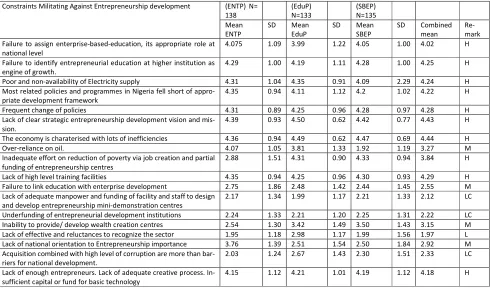
TABLE 1: RESPONDENTS MEAN SCORES ON THE CONSTRAINTS MILITATING AGAINST ENTREPRENEURSHIP DEVELOPMENT
Constraints Militating Against Entrepreneurship development (ENTP) N= 138 (EduP) N=133 (SBEP) N=135 Mean ENTP
SD Mean EduP
SD Mean SBEP
SD Combined mean
Re-mark Failure to assign enterprise-based-education, its appropriate role at
national level
4.075 1.09 3.99 1.22 4.05 1.00 4.02 H
Failure to identify entrepreneurial education at higher institution as engine of growth.
4.29 1.00 4.19 1.11 4.28 1.00 4.25 H
Poor and non-availability of Electricity supply 4.31 1.04 4.35 0.91 4.09 2.29 4.24 H Most related policies and programmes in Nigeria fell short of
appro-priate development framework
4.35 0.94 4.11 1.12 4.2 1.02 4.22 H
Frequent change of policies 4.31 0.89 4.25 0.96 4.28 0.97 4.28 H
Lack of clear strategic entrepreneurship development vision and mis-sion.
4.39 0.93 4.50 0.62 4.42 0.77 4.43 H
The economy is charaterised with lots of inefficiencies 4.36 0.94 4.49 0.62 4.47 0.69 4.44 H
Over-reliance on oil. 4.07 1.05 3.81 1.33 1.92 1.19 3.27 M
Inadequate effort on reduction of poverty via job creation and partial funding of entrepreneurship centres
2.88 1.51 4.31 0.90 4.33 0.94 3.84 H
Lack of high level training facilities 4.35 0.94 4.25 0.96 4.30 0.93 4.29 H
Failure to link education with enterprise development 2.75 1.86 2.48 1.42 2.44 1.45 2.55 M Lack of adequate manpower and funding of facility and staff to design
and develop entrepreneurship mini-demonstration centres
2.17 1.34 1.99 1.17 2.21 1.33 2.12 LC
Underfunding of entrepreneurial development institutions 2.24 1.33 2.21 1.20 2.25 1.31 2.22 LC Inability to provide/ develop wealth creation centres 2.54 1.30 3.42 1.49 3.50 1.43 3.15 M Lack of effective and reluctances to recognize the sector 1.95 1.18 2.98 1.17 1.99 1.56 1.97 L Lack of national orientation to Entrepreneurship importance 3.76 1.39 2.51 1.54 2.50 1.84 2.92 M Acquisition combined with high level of corruption are more than
bar-riers for national development.
2.03 1.24 2.67 1.43 2.30 1.51 2.33 LC
Lack of enough entrepreneurs. Lack of adequate creative process. In-sufficient capital or fund for basic technology
4.15 1.12 4.21 1.01 4.19 1.12 4.18 H
Source: Computed by the Researcher
VOLUME NO.6(2016),ISSUE NO.10(
O
CTOBER) ISSN2231-5756INTERNATIONAL JOURNAL OF RESEARCH IN COMMERCE, IT & MANAGEMENT
Data on table 1 show the overall mean responses for Entrepreneurial Personnel, Education Personnel and Small Business Personnel, on the constraints militating against the Entrepreneurship Development in Nigeria. The data show that the respondents accepted failure to link education with enterprise development with a combined mean score of ̅ 4.44, the absence of high level training facilities ̅ = 4.43, inability to provide, purchase, equip Entrepreneurship development centres̅ = 4.29, lack of equipment for machine tools ̅ = 4.0; inadequate effort on reduction of poverty via job creation ̅ = 4.28. ̅ = 4.24 and ̅ 4.22 respectively were rated by the participants as high constraints militating against entrepreneurship development in their respective areas. However, the respondents also rated lack of effective effort and reluctance to recognize the sector ̅ = 2;55, Lack of national orientation, ̅ = 2.12, poor and non-availability of Electricity supply ̅ = 1.97 as low constraints.
HYPOTHESIS 1
There is no significant difference in the mean responses of the Entrepreneurship Personnel, Education Personnel and Small Business Personnel regarding the constraints militating against entrepreneurship development in the country.
ANALYSIS OF DATA RELATED TO THE TEST OF THE ABOVE HYPOTHESIS ARE PRESENTED IN TABLE 2 BELOW TABLE 2: SUMMARY OF THE ANALYSIS OF VARIANCE OF THE RESPONSES Sources of variance SS Df Ms F Level of significance Remarks
Between groups 0.12 2 0.06 0.06 0.05 NS
Within groups 48.36 51 0.95
Total 48.48 53
SS = Sum of squares, df = degree of freedom, ms = means square, F = F- ration, NS No Significance.
Data in table 2 show the results of analysis of variance NOVA summary on data relating to the constraints. The data show that there is no significant difference between the test score results of the respondents on the constraints, with an F. ratio of 0.06. Since our ratio is less than the table value of 3.18 therefore the null hypothesis is accepted as stated.
DISCUSSION AND INTERPRETATIONS
Findings with regards to the constraints militating against entrepreneurship development. A large proportion of the respondents in all the groups, rated failure to link education with enterprise development, and the absence of high level training facilities, as major obstacles or constraints to entrepreneurship development. Other high constraints identified in this study are inability to provide, purchase and equip entrepreneurship development centres, underfunding of entrepreneurial development institutions, lack of clear strategic entrepreneurial development vision and mission, the economy is characterized with lots of inefficiencies and reliance on oil.
However, reluctance to recognize the sector, lack of national orientation, together with poor and non-availability of electricity supply are not considered as major constraints by respondents from most of the groups.
ANOVA results showed that the respondents from the three different groups agreed in their responses on the items listed under this category, especially on the issue of inadequate efforts on reduction of poverty via job creation and partial funding of entrepreneurship together with the failure to link education with enterprise development.
Considering the responses as indicated above, it may be inferred that the present educational experience of Nigeria as a country, is lacking in essential quality. According to Essien (2002) the curriculum everywhere, as currently conceived, is either too restrictive or not useful enough to awaken the inner resources of our youths for entrepreneurship development. Above is further confirmed by Otokiti (2015) who stated that – Nigeria, though a developing country, is equally one of the richest oil producing countries and with extensive natural resources like crude oil petroleum, forest and quarry resources in the world. However, the lack of sufficient entrepreneurs, creative process, sufficient capital or fund for basic technology acquisition combined with high level of corruption are more than barriers for national development. We can develop our nations if we have entrepreneurship policy that works. It plays vital role in national development. Through entre-preneurship, we can develop new products, enter into new markets, develop new processes, new mechanism, generate employment opportunities for young graduates and create army of creative thinkers, and innovators that can best utilize both tangible and intangible resources of this country. The study observed the lack of positive attitudes and commitment towards enterprise development. Due to this lack of national orientation to its importance, the country has not suffi-ciently involved people oriented enterprise business, rather all forms of imported concept and ideology, that have not really moved the country to substantial indigenous enterprise oriented level are in the environment.
It cannot be too strongly denied that the failure to link education with enterprise development, with repeated emphasis on self employment in all the planning efforts, lack of entrepreneurship-ability or ineffective entrepreneurship-policy, (as expressed by large proportion of respondents), together with lack of clear strategic Entrepreneurship development vision and mission will create major obstacles or constraints to entrepreneurship development efforts.
The absence of serious commitment to entrepreneurship policy implication, evaluation and control, together with the failure to identify entrepreneurial education at higher institution as engine of growth and pivotal agent against shades of unemployment are part of the several challenges and serious indicators of major obstacles and constraints to entrepreneurship education development in the country.
It is a matter of serious concern that in the opinion of most respondents; the expectation is expressed that for a number of reasons, respondents are not calling for more educational institutions or more Universities but for qualitative entrepreneurship education. It is also expressed that some of the greatest investors of the ages were not men trained in the field in which they later made the impacts. John Dunlop for example, the man who developed the pneumatic tyre, was a veterinary surgeon. Goerge Stephenson who became known as the father of the Steam Engine, was a Fitter-Machinist, as we call it today in this country. The study believes that what is required is a general awareness of quality education involving science and technology that the entrepreneur will demand of himself and expect of others, standards that are scientifically based.
Omolayole had earlier argued that there is public and private entrepreneurship. In either case, the common denominator is the profit motive. In adopting this viewpoint, one will want to add that, it is this profit motive, more than anything else that encourages the development of technology. An entrepreneur does not go into business because he loves his country. He goes into business to make profit, and he will do such things that will not only assure him a reasonable return on his capital, but more than that, he will seek to continually improve upon the rate of return on his capital. It is because the profit motive is suppressed that many public entrepreneurship activites failed. So, private entrepreneurs succeed, whilst public entrepreneurs fail within the same business environment.
How then does the profit encourage the development of technology? Government directive on the use of local raw materials illustrates the point. The development of industry was originally predicated upon import substitution. That was Government policy of the sixties. Entrepreneurs were invited to set up plants in Nigeria, to manufacture goods that were hitherto imported. So entrepreneurs sought out joint venture partners who agreed to move their operations, or part of it thereof, from the home base to Nigeria. The only skill required from the Nigerian entrepreneur was what Omolayole described as “Karakata” skill. The entrepreneur needs not have a clue of what the business is all about. He must wield enough influence to obtain all the needed permits and secure a sizeable proportion of the market; usually government patronage. Anyone who possesses these skills was a favoured entrepreneur. The raw materials, equipment, processes and skills (expatriate quotas) were all imported. The country got what it asked for, much growth - in economic indices and statistics, without development. If now we are to develop technologically, we need a new kind of entrepreneur.
VOLUME NO.6(2016),ISSUE NO.10(
O
CTOBER) ISSN2231-5756INTERNATIONAL JOURNAL OF RESEARCH IN COMMERCE, IT & MANAGEMENT
ensure profitable returns on investment. However, an entrepreneur needs more than the profit motive to survive; he needs skills. Skills are needed to identify, select and develop the appropriate technology for any operation. This can be achieved through quality education.CONCLUSION
In today’s globalized world, the importance of entrepreneurial education has become globally critical. Entrepreneurship is being seen as the creative application of individual talents, aptitudes and skills to the production of goods and services on a small scale. A country that embraces entrepreneurial development experi-ences tremendous progress in the creation of wealth, employment and value addition and enhanced economic well being of society. Entrepreneurial development enhances the quality of small and medium size enterprise as individuals engage themselves in diverse economic pursuits. With the potentials of possible endow-ments for higher educational institutions, Universities must continually look for innovative ideas towards resolving the unemployment pandemic.
According to Otokiti (2015) Entrepreneurship provides opportunities for entrepreneurs. It helps in the formation of capital. It is most essential for business success. It facilitates and creates employment opportunities not only for owners and their relatives, but also for other people. It helps to increase productivity. We can produce more output through using least time, effort and at minimum resources. It also helps to balance development of the nations. Through it, national revenue can be distributed equitably to many people.
However, Entrepreneurship also has some negative aspects such as risk of failure, emotion, and stress due to the changes in government policies, lack of profes-sionals, managers, funding and enabling environment. However, positive aspect of entrepreneurship is more than negative aspects. To gain something, we must be able to take some risks, develop capacity and traits, as can be seen in Schumpeter’s concept of creative destruction for development of entrepreneurship. This entrepreneurship traits/potential, when found amongst youth of any nation can have significant implication for her economic development. It has helped countries like, Malaysia. Hong Kong, Brazil, China and even India. In these states, its contribution includes the following (but not limited): development of new sources of materials, new markets, mobilize capital resources, introduction of additional new technologies, and importantly, the provision of employment for employable etc.
On the importance of entrepreneurship in economic development the study states that:
• Entrepreneurship is central to increasingly knowledge based and technologically driven economy.
• The change or passage from less developed status into developing status can only be accelerated with rapid process of individual, social and economic transformation. The study believes that, with quality education, a major engine accelerating previous socioeconomic status to new position can be acceler-ated.
REFERENCES
1. Adegeye A.J. (2015), The Kick-Start on Youth Employment and Empowerment and Youth Enterprise Development – Paper presented at the International Breweries Programme. Ibadan.
2. Adejumo (2000) Indigenous entrepreneurship development in Nigeria: Characteristics, Problems and Prospects. Advances in Management Journal of Depart-ment of Business Administration. Unilorin.
3. Adeniyi P. (2006), Rebuilding FUTA for Sustain Academic Excellence Wura-key Printers Lagos 4. Agbeze (2012): Entrepreneurship: The need to create wealth….. why not now. Olafia Today. 5. Awolowo O. (1975) The problems of Africa. Kware Nkruma Memorial Lecture Series No. 1 6. Benerjee (2012) Art of Entrepreneurship Published by Lotus Press.
7. Binks and Vale (1990) Entrepreneurship and Economic Change; London McGraw Hill 8. Essien (1995) Education and the Challenge of quality: Ethiope Publishing Corporation Benin.
9. Fajana (2015), Entrepreneurship Pathway to Accelerated National Development: The Institute of Entrepreneurs. Lagos. Paper delivered at the Institute of Entrepreneur’s Conference - Lagos
10. Fajana Sola (2014) Entrepreneurship: Road Map to a Nations. Economic Viability. 6th Annual Academy for ENT studies Conference Lagos.
11. Kolawole (1989) Integrating Small Scale Industrial Activities into the Development Process ITF Conference Jos. 12. Longe F. (1982) Training Programme and Facilities in Nigeria. ITF Annual Conference.
13. Omolayole, M (1988) Private Entrepreneurship as a catalyst for economic growth: City Securities Ltd. Seminar Lagos.
14. Otokiti (2015) Entrepreneurship Development and Strategy; Funding and Sustainable Implementation 3rd Annual Memorial Lecture JABU.
VOLUME NO.6(2016),ISSUE NO.10(
O
CTOBER) ISSN2231-5756INTERNATIONAL JOURNAL OF RESEARCH IN COMMERCE, IT & MANAGEMENT
REQUEST FOR FEEDBACK
Dear Readers
At the very outset, International Journal of Research in Commerce, IT & Management (IJRCM) acknowledges
& appreciates your efforts in showing interest in our present issue under your kind perusal.
I would like to request you to supply your critical comments and suggestions about the material published
in this issue, as well as on the journal as a whole, on our e-mail
for further
improve-ments in the interest of research.
If you have any queries, please feel free to contact us on our e-mail
.
I am sure that your feedback and deliberations would make future issues better – a result of our joint effort.
Looking forward to an appropriate consideration.
With sincere regards
Thanking you profoundly
Academically yours
Sd/-
Co-ordinator
DISCLAIMER
VOLUME NO.6(2016),ISSUE NO.10(
O
CTOBER) ISSN2231-5756