Please cite this article as: S. S. Tabatabaee Moradi, N. I. Nikolaev, E. L. Leusheva, Improvement of Cement Properties Using a Single Multi-functional Polymer, International Journal of Engineering (IJE), IJE TRANSACTIONS A: Basics Vol. 31, No. 1, (January 2018) 181-187
International Journal of Engineering
J o u r n a l H o m e p a g e : w w w . i j e . i rImprovement of Cement Properties Using a Single Multi-functional Polymer
S. S. Tabatabaee Moradi*, N. I. Nikolaev, E. L. Leusheva
Department of Well Drilling, Oil and Gas Faculty, Saint-Petersburg Mining University, Saint Petersburg, Russia
P A P E R I N F O
Paper history:
Received 31 August 2017
Received in revised form 28 October 2017 Accepted 30 November 2017
Keywords: Well Construction Cement Polymer Additive Multi-functional Additive
A B S T R A C T
Cementing of the casing pipes inside the wellbore is considered as one of the most expensive and difficult operations during the well construction process. A low quality cementing job leads to further repair operations, which are usually costly and time-consuming to conduct. Polymer cements are being used for decades in the oil and gas industry due to their improved properties such as sedimentation stability, flexural strength and adhesion. Furthermore, these cements are characterized by improved pore structure, decreased slurry density, decreased porosity and controllable rheological parameters. In this research, a single domestic polymer is added as a cement modifying agent. Domestic additive are easier to buy in the market and are usually cheaper than the imported additives. In addition, using a single additive leads to a simplified logistics operation. Results of the experimental investigations on the main properties of the developed cement systems show that using the proposed polymer in the proper concentration leads to an optimum flow-ability and pump-ability of the slurry, reduced cement water loss, increased strength characteristics and improved adhesion properties of the set cement.
doi: 10.5829/ije.2018.31.01a.24
1. INTRODUCTION1
Primary cementing job, defined as the cement placement in the annular space between the casing and the formation rock, is considered as an essential step during the well construction process. The objectives of the primary cementing operation are casing support, casing protection against shock loads and corrosive agents, zonal isolation and preventing the unwanted movement of the wellbore fluids [1]. Quality of the cementing job defines the productive life of the drilled well. The cement sheath should withstand the induced stresses from the temperature or pressure variations and corrosive agents during life of the well, which can last up to fifty years [2].
Low quality cementing job results in a permeable cement rock, through which the fluids migrate from one layer to another or even to the surface. This unwanted migration destroys the well integrity and leads to further repair operations, which are usually costly and time-consuming [3].
*Corresponding Author’s Email: [email protected] (S. S. Tabatabaee Moradi)
As the cements are used in different geological, geographical and technical conditions, various cement compositions are designed to meet the necessary requirements of the available conditions. Polymer cements are being used for many years in the oil and gas industry. Some properties of the polymer cements like sedimentation stability, flexural strength, adhesion and durability are higher than the standard cements [4]. In addition, these cements are characterized by improved pore structure, decreased slurry density, decreased porosity and controllable rheological parameters [5].
Various types of polymers are used in industry to modify the properties of the slurry and set cement. Polymers are added as water loss control agent, like hydroxyethylcelluloses (HEC), as retarder, like carboxymethylhydroxyethyl celluloses (CMHEC) and as free fluid control agent, like hydroxypropylguars (HPG), diutan, guar and xanthan [6].
cement. Based on the research results, they indicated that low viscosity CMC along some other additives are capable of optimizing the slurry and set cement performances. In the work of [8] a synthetic modified cellulose-based polymer is introduced, which acts as a functional additive. By using a single multi-functional additive, a simplified logistics operation is achieved, as the number of additives usually needed to control the cement properties is significantly reduced. Authors of [9] developed a flexible synthetic cement using a thermosetting polymer to control the challenges of thermal well completion like high cement brittleness and low strength characteristics. High degree of flexibility and strength, high temperature resistant and zero shrinkage are achieved properties of the developed cement system. Authors of the [10] introduced a new polymer additive to the cement composition by blending approach, through which the advantageous aspects of different polymers are combined to develop a new material with modified properties. The newly introduced polymer enhanced the mechanical properties of the cement samples.
In this work, a single domestic polymer is added as a cement modifying agent. The main characteristics of the developed cement systems like slurry flow-ability, cement setting time, slurry consistency, free fluid content of the slurry and cement strength properties are studied and compared to a base cement system.
2. MATERIAL AND CEMENT COMPOSITION DESIGN
The cementitious material considered in this work was ordinary Portland cement obtained from local providers inside the Russian Federation with the following composition (wt.%): 61.34 C3S, 14.61 C2S, 5.49 C3A, 16.62 C4AF. C3A and C4AF have little contribution to the cement strength development. C3S is the main component responsible for early strength development, while C2S is responsible for final strength development of the cement system [1]. To modify the slurry and set cement properties a single multi-functional additive is used to reduce the number of additives and the final operation cost and difficulties. A new domestic polymer «Concrepol» has been introduced as the single additive. The polymer is developed inside the Russian Federation and is applicable in the mining, oil and natural gas industry as a reagent for drilling, preliminary exploitations and transportation. Concrepol is a high molecular water-soluble polyvinylpyrrolidone, which appears as a semitransparent colorless fluid and is stable to be used with the metallic salts and up to 120 ℃.
Three cement compositions are considered in this work. A base cement as a reference to compare the performance of the other cement systems. The other
compositions are developed by adding 0.8% and 1.0% Concrepol into the base cement system.
3. EXPERIMENTAL METHODS
3. 1. Sample Preparation The cement samples were prepared in accordance with standard procedures. The fluid polymer is solved in the water and then the dry Portland cement is added to the prepared solution. One part of the prepared mixture is taken for further investigations on the slurry performance. The other part is casted into molds for measurement of compressive and flexural strengths. The samples are left in the room condition for 1, 3, 5, 7 and 28 days before measurements of strength characteristics. All experiments on the cement slurry and set cement are conducted based on the API standards.
3. 2. Water to Cement Mass Ratio Water to cement mass ratio (W/C) significantly influences the properties of the slurry (consistency, flow-ability, free fluid content, water loss etc.) and set cement (strength properties, porosity and permeability). Increasing the W/C ratio leads to the set cement porosity increase and reduction of its strength characteristics.
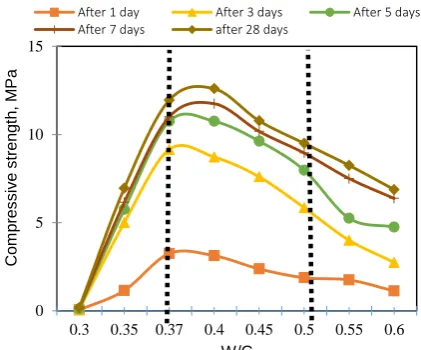
The W/C ratio in the well drilling practice can be changed from 0.5, which is considered as the standard value, to 1 or even more [11-14]. The effect of W/C ratio on the set cement compressive strength is investigated to choose the optimum value of W/C ratio. An automatic destructive compression tester is used to measure the strength characteristics of the samples. The compressive strength values of the base cement composition at different W/C ratios are presented in Figure 1.
Figure 1. Base cement compressive strength as a function of slurry W/C ratio
0 5 10 15
0.3 0.35 0.37 0.4 0.45 0.5 0.55 0.6
W/C
After 1 day After 3 days After 5 days
After 7 days after 28 days
4
C
o
m
p
re
s
s
iv
e
s
tr
e
n
g
th
,
M
P
As it can be seen from Figure 1, the compressive strength of the set cement as a function of W/C ratio can be divided into three sections. First section, in which the W/C ratio is less than 0.37, is characterized by cement strength reduction by decreasing the W/C ratio. Lowering the water volume in the slurry, leads to partial cement hydration process and therefore compressive strength reduction. The third section (W/C ratio from 0.5 to 0.6), on the other hand, is characterized by compressive strength increase by increasing the W/C ratio, which is a result of present excess water in the slurry composition. Therefore, the optimum W/C ratio, which leads to the increase of cement strength properties and successful zonal isolation, should be adjusted in the range of 0.35-0.5.
It is desirable to lower the W/C ratio down to 0.37 to increase the cement strength characteristics, but a natural consequence of W/C ratio reduction is the decrease in the cement slurry flow-ability and pump-ability. However, in field applications, the minimum W/C ratio, which provides the ability of the slurry to flow and pump inside the well, is considered not less than 0.5. However, additives inside the cement composition can affect the flow-ability of the slurry.
3. 3. Slurry Flow-Ability During the flow test, the slurry is poured inside a plastic cone, which is placed on a glass circular plate. Removing the cone, the slurry spreads on the plate. The average diameter of the spread cement (D) is reported and indicates the flow-ability of the cement slurry.
The results of the conducted experiments show that with a 0.8-1% concentration of Concrepol in the polymer cement composition, the flow-ability of the slurry is in the acceptable range, while the W/C ratio is lowered to 0.4-0.45 (Figure 2).
Figure 2. Flow-ability of different cement compositions as a function of W/C ratio
Although by increasing the Concrepol concentration in the cement composition more than 1%, the thinner slurries can be resulted, but it is not reasonable from the economic point of view. Therefore, the 0.8-1% is considered as the optimum Concrepol concentration in the cement composition for further experiments on the slurry and set cement properties.
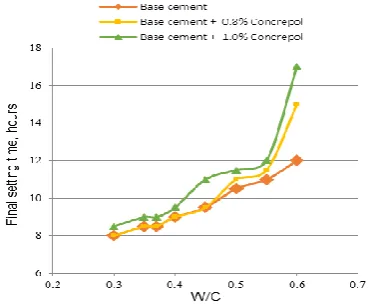
3. 4. Cement Setting Time Before cement application in the field conditions, the cement initial and final setting time should be measured in the laboratory. The initial setting time indicates the time, when cement setting begins, while the final setting time is related to the end of the cement setting process. A correct knowledge of the cement setting time is necessary to choose the wait on cement time in the well completion operation.
The results of the conducted experiments show that adding the Concrepol in the 0.8% concentration to the cement composition does not affect the setting time of the cement significantly, especially in lower W/C ratios. However, by increasing the W/C ratio up to 0.5 and 0.6, the initial and final setting times are changed more significantly (up to 3 hours) (Figures 3 and 4).
Figure 3. Initial setting time of the cement composition
Figure 4. Final setting time of the cement composition
0 5 10 15 20 25 30
0.3 0.35 0.4 0.45 0.5 0.55 0.6
D
,
c
m
W/C
Base cement (W/C =0.5)
Base cement + 1% Concrepol (W/C =0.4) Base cement + 0.8% Concrepol (W/C =0.45)
3 5 7 9 11 13 15
0.2 0.3 0.4 0.5 0.6 0.7
In
it
ial
s
e
tt
ing
t
im
e
,
h
o
u
rs
W/C
Base cement
However, the kinetics of the cement structure formation and effect of Concrepol cannot be revealed just by studying the setting times of the cement. Therefore, further experiments are conducted on the
slurry consistency and set cement strength
characteristics.
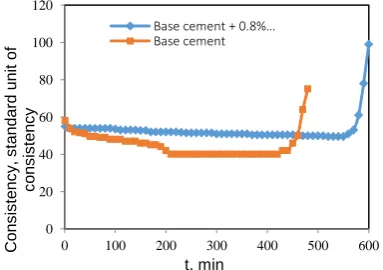
3. 5. Slurry Consistency Measurement Slurry consistency measurements are essential to evaluate the cement thickening time. The sufficient thickening time is required for a successful slurry pumping into the annular space. Higher consistency of the slurry reduces its pump-ability and leads to difficulties during the cementing job. The consistency of the base cement and cement composition with 0.8% Concrepol are measured and presented in Figure 5.
As it is evident from Figure 5, in the first minutes of cement structure formation, the base cement has a larger consistency in comparison with the slurry with Concrepol addition. After one hour, the consistency of the base cement is reduced, while the consistency of the slurry with Concrepol addition remains constant up to 7.5 hours, where its consistency is sharply increased.
3. 6. Free Fluid Content and Water Loss Slurry filtration properties changes during the set cement structure formation. These properties can be expressed via sedimentation in gravitational field or via water loss in the porous medium under the influence of pressure drop, which simulates the cement pumping inside the well and the cement setting process [15].
The sedimentary stable slurries have minimum free fluid content (FFC). Minimizing the FFC of the slurry helps to remove the channels that function as pathways for formation fluids. The FFC of the slurry is measured based on the method, explained in the [16].
Large values of slurry water loss is harmful and can decrease the quality of cementing job significantly [17].
The water loss can be lowered by reducing the water content of the slurry and also by holding the free water in the dispersion system.
Figure 5. Slurry consistency change with respect to time
The FFC and water loss of the cement composition are measured and presented in Table 1.
Adding the Concrepol to the cement composition leads to 10-12% reduction in the slurry free fluid content and 39.2% reduction in the water loss value. However, the water loss of the slurry can be controlled by adding other additives.
3. 6. Set Cement Volume Change In the cement hydration process the adsorbed water molecules on the cement particles are rearranged, which results in the volume change of the final set cement. The specific surface areas of the hydration products are 3-4 times larger than the one for the initial cementing materials. Additionally, the chemically bonded water occupies less volume in comparison to the free water. Because of these reasons, in the process of cementing material hydration and formation of crystal hydrates, volume change occurs. This volume change is called contraction and is approximately equal to the water volume, which is participated in the chemical reactions [18].
The volume deformation of the cement systems are analyzed and represented in Table 2. The minus sign in table shows the set cement volume reduction (contraction), while the plus sign indicates the volume increase of the set cement (expansion). Results show that with the standard W/C ratio (0.5), the contraction is about 1-1.5%, while the W/C ratio reduction results in zero deformation or even the expansion of the cement system.
TABLE 1. Water loss of cement slurries
Cement
composition W/C
Slurry density, kg/m3
FFC , ml
Water loss, cm3/30 min
Base cement 0.4 1920 0 103.6
Base cement +
0.8% Concrepol 0.4 1920 0 72.54
Base cement 0.5 1840 1.3 119.4
Base cement +
0.8% Concrepol 0.5 1840 1.0 80.6
TABLE 2. Water loss of cement slurries
Cement composition W/C Volume change, %
Base cement
0.4 0.28
0.45 0
0.5 -1
Base cement + 0.8% Concrepol
0.4 -1.5
0.45 0
0.5 0.15
0 20 40 60 80 100 120
0 100 200 300 400 500 600
C
o
n
s
is
te
n
c
y
,
s
ta
n
d
a
rd
u
n
it
o
f
c
o
n
s
is
te
n
c
y
t, min
In addition, it can be seen from Table 2 that the Concrepol addition leads to the cement contraction increase (in average for 0.5%). However, this value is not significant and can be neglected.
3. 7. Set Cement Strength Characteristics The set cement in the well is subjected to a wide range of pressures and temperatures. Operations inside the well like perforation and pressure testing, pressure and temperature variations can induce compressional, tensional and bending stresses inside the cement during life of the well. Beside that, the physical and mechanical conditions of the cement setting processes differ from one depth to another and the cement strength characteristics may be changed with the time. If the cement cannot withstand the induced stresses, the annular flow of formation fluids and premature water coning inside the well cannot be avoided. Mechanical strength of the set cement is considered as the main factors, which defines the stability of the system against the induced stresses. Therefore, the strength characteristics of the cement compositions are analyzed at the room temperature (Figure 6).
After 28 days, the compressive strength of the system with the 1% Concrepol addition has been increased approximately for 200% in comparison with the base cement system.
Set cement flexural strength is investigated after 7 days curing in the laboratory condition (Figure 7). Measurements at earlier times showed high degree of scattering, giving the data serious statistical error.
From the presented results in Figure 7, it can be seen that the flexural strength of the cement containing 0.8% Concrepol is 25.4% higher than base cement. Increasing the concentration of Concrepol to 1% leads to further flexural strength increase up to 33.3%. The set cement flexural strength enhancement with addition of the Concrepol indicates the plasticized character of the additive.
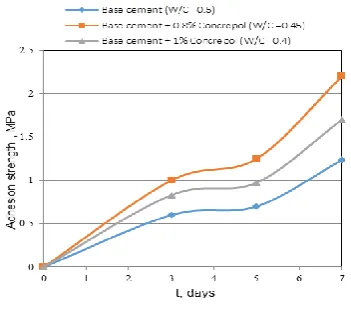
3. 8. Cement Adhesion Strength It has been known [19, 20] that a successful isolation of the productive formations depends not only on the set cement strength characteristics, but also on the adhesion strength of the set cement with the formation rock and casing pipes. In the current drilling practice, there is no standard method to measure the cement adhesion strength.
The cement adhesion strength with the metallic surface of the casing pipes is measured for three developed compositions. The results are presented in Figure 8.
As it is evident from the presented results, the adhesion strength of the cement composition with the Concrepol addition is 37.2% greater than the one for the base cement composition after 3 days of curing.
Figure 6. Compressive strength of the cement compositions
Figure 7. The flexural strength of the cement compositions
Figure 8. Cement adhesion strength
However, after 28 days curing their bond strength value is almost the same.
4. CONCLUSIONS
The following conclusions can be made from the results of the experimental investigations:
Using a multi-functional single additive, instead of several different additives leads to a significant
0 2 4 6 8 10 12 14 16 18 20
0 3 6 9 12 15 18 21 24 27
C
o
m
p
re
s
s
iv
e
s
tr
e
n
g
th
,
M
P
a
t, days
Base cement + 1% Concrepol (W/C =0.4) Base cement + 0.8% Concrepol (W/C =0.45) Base cement (W/C =0.5)
-1 4 9 14
0.3 0.4 0.5 0.6
Flex
u
ra
l
s
tr
e
n
g
th
,
M
P
a
W/C Base cement
reduction in operation time and final cost of the cementing job. Developed cement compositions based on the proposed polymer meets the essential requirements of the cementing operation.
The required flow-ability and pump-ability of the cement slurry for a successful cementing job is achieved by adding the high molecular reagent polyvinylpyrrolidone in a concentration of 0.8-1% by the weight of dry blend to the cement composition.
The reagent addition in an optimum concentration leads to the water loss decrease down to 39.2%, compressive strength increase up to 200% after 28 days curing, flexural strength increase up to 33.3% after 7 days curing and cement adhesion strength increase up to 37.2% after 3 days curing.
5. REFERENCES
1. Moradi, S.T. and Nikolaev, N.I., "Considerations of well cementing materials in high-pressure, high-temperature conditions", International Journal of Engineering, Transactions C: Aspects, Vol. 29, No. 9, (2016), 1214-1218. 2. Brandl, A., Cutler, J., Seholm, A., Sansil, M. and Braun, G.,
"Cementing solutions for corrosive well environments", SPE Drilling & Completion, Vol. 26, No. 02, (2011), 208-219. 3. Ilyas, M., Sadiq, N., Mughal, M.A., Pardawalla, H. and Noor,
S.M., "Improvement of cementing in deep wells", in SPE/PAPG Annual Technical Conference, Society of Petroleum Engineers. (2012).
4. Chougnet, A., Audibert-Hayet, A., Lecolier, E., Moan, M., Guichard, B., Mazard, C. and Valenti, A., "Polymer powder/cement composites for oil and gas wells", in SPE Annual Technical Conference and Exhibition, Society of Petroleum Engineers., (2006).
5. Chung, D., "Use of polymers for cement-based structural materials", Journal of materials science, Vol. 39, No. 9, (2004), 2973-2978.
6. Reddy, B.R., Patil, R. and Patil, S., "Chemical modification of biopolymers to design cement slurries with temperature-activated viscosification--a laboratory study", SPE Drilling & Completion, Vol. 27, No. 01, (2012), 94-102.
7. Roshan, H. and Asef, M., "Characteristics of oilwell cement slurry using cmc", SPE Drilling & Completion, Vol. 25, No. 03, (2010), 328-335.
8. Brandl, A., Bray, W.S. and Magelky, C., "Improving well cementing quality with an environmentally preferred
multifunctional polymer", in SPE Europec/EAGE Annual Conference, Society of Petroleum Engineers., (2012).
9. Shanbhag, R., Melrose, Z., Nutt, S., Cleveland, M. and Keese, R., "Thermosetting polymer based flexible synthetic cement for successful zonal isolation in thermal wells–a new approach", in SPE Thermal Well Integrity and Design Symposium, Society of Petroleum Engineers., (2015).
10. Zhong, S. and Chen, Z., "Properties of latex blends and its modified cement mortars", Cement and Concrete Research, Vol. 32, No. 10, (2002), 1515-1524.
11. Marar, K., "Effect of cement content and water/cement ratio on fresh concrete properties without admixtures", International Journal of Physical Sciences, Vol. 6, No. 24, (2011), 5752-5765.
12. Reddy, V.M., Rao, M., Srilakshmi, P. and Kumar, S., "Effect of w/c ratio on workability and mechanical properties of high strength self compacting concrete (m70 grade)", IOSR Journal of Mechanical and Civil Engineering (IOSR-JMCE), Vol. 11, No. 5, (2014), 15-21.
13. Wong, H. and Buenfeld, N., "Determining the water–cement ratio, cement content, water content and degree of hydration of hardened cement paste: Method development and validation on paste samples", Cement and Concrete Research, Vol. 39, No. 10, (2009), 957-965.
14. Singh, S., Munjal, P. and Thammishetti, N., "Role of water/cement ratio on strength development of cement mortar",
Journal of Building Engineering, Vol. 4, (2015), 94-100. 15. Vorderbruggen, M., Bryant, S. and Bottiglieri, A., "Reducing
cementing blend complexity: A single biopolymer capable of replacing multiple cement additives", in SPE Annual Technical Conference and Exhibition, Society of Petroleum Engineers. (2016).
16. Choolaei, M., Rashidi, A.M., Ardjmand, M., Yadegari, A. and Soltanian, H., "The effect of nanosilica on the physical properties of oil well cement", Materials Science and Engineering: A, Vol. 538, (2012), 288-294.
17. Bach, D. and Vijn, P., "Environmentally acceptable cement fluid loss additive", in SPE International Conference on Health, Safety and Environment in Oil and Gas Exploration and Production, Society of Petroleum Engineers., (2002).
18. Backe, K., Skalle, P., Lile, O., Lyomov, S., Justnes, H. and Sveen, J., "Shrinkage of oil well cement slurries", Journal of Canadian Petroleum Technology, Vol. 37, No. 09, (1998). 19. Lacuve, M., Chougnet, A., Allouche, M. and Mazard, C., "A
method to improve adhesion strength at the cement/steel-casing interface and its effect on cement evaluation log response", in Offshore Mediterranean Conference and Exhibition, Offshore Mediterranean Conference., (2015).
Improvement of Cement Properties Using a Single Multi-functional Polymer
S. S. Tabatabaee Moradi, N. I. Nikolaev, E. L. Leusheva
Department of Well Drilling, Oil and Gas Faculty, Saint-Petersburg Mining University, Saint Petersburg,Russia
P A P E R I N F O
Paper history:
Received 31 August 2017
Received in revised form 28 October 2017 Accepted 30 November 2017
Keywords: Well Construction Cement Polymer Additive Multi-functional Additive
ديكچ ه
تخاس دنیآرف لوط رد اه تایلمع نیرت تخس و نیرت نارگ زا یکی ناونع هب ،هاچ لخاد یرادج یاه هلول یراک نامیس
رب نامز و نارگ لاومعم هک دوش یم یریمعت یاه تایلمع هب رجنم نییاپ تیفیک اب یراک نامیس کی .دور یم رامش هب هاچ
دوبهب صاوخ لیلد هب یرمیلپ یاه نامیس .دنتسه رد اه ههد یارب یگدنبسچ و یشمخ تمواقم ،یبوسر یرادیاپ ریظن هتفای
،هتفای دوبهب للختم یاضف ریظن یتایصوصخ اب اه نامیس نیا ،نیا رب هولاع .دنریگ یم رارق هدافتسا دروم زاگ و تفن تعنص
ش یم زیامتم ،لرتنک لیاق یکیژولوئر یاه یگژیو و رتمک للخت ،رتمک یلاگچ اب نامیس باغود کی زا شهوژپ نیا رد .دنو
یارب رت تحار لاومعم یلخاد یاه یندوزفا .تسا هدش هدافتسا نامیس صاوخ هدنهد دوبهب لماع ناونع هب یلخاد رمیلپ
تایلمع کی هب یندوزفا کی اهنت زا هدافتسا ،نیا رب هولاع .دنشاب یم یتادراو یاه یندوزفا زا رت نازرا و رازاب رد ندیرخ
رت هداس یکیتسجل یم ناشن هتفای هعسوت یاه نامیس یلصا صاوخ یور رب یهاگشیامزآ یاه یسررب جیاتن .ددرگ یم رجنم
یداهنشیپ رمیلپ زا هدافتسا هک دهد دازآ بآ ،باغود هنیهب یریذپ پمپ و یریذپ نایرج تیلباق ثعاب بسانم تظلغ رد
گنس رتهب یگدنبسچ و هتفای شیازفا یتمواقم صاوخ ،نامیس هتفای شهاک .دوش یم نامیس