Research Paper:
The Effectiveness of Educational Package Based on
Visual-Spatial Processing in Reading Performance of Dyslexic Students
Khatereh Vojoudi1 , Mahnaz Akhavan Tafti1* , Moluk Khademi Ashkzari11. Department of Educational Psychology, Faculty of Education and Psychology, Alzahra University, Tehran, Iran.
* Corresponding Author:
Mahnaz Akhavan Tafti, PhD.
Address:Department of Educational Psychology, Faculty of Education and Psychology, Alzahra University, Tehran, Iran. Tel: +98 (912) 2187860
E-mail: [email protected]
Background: Dyslexia refers to a kind of learning difficulty, a combination of strengths and weaknesses which affects the reading and spelling learning process.
Objectives: The aim of current research was to develop an instructional package based on visual spatial abilities and examine its efficacy on the reading performance of students with dyslexia.
Materials and Methods: This is a quasi-experimental study with pre-test, post-test design and control group. The statistical population included dyslexic students in the elementary schools of Hamadan City, Iran in the academic year 2016-2017. The sample size was 60 students that were randomly selected and assigned to the experimental and control groups (n=30 in each group). This study was conducted to investigate the effectiveness of an educational package based on visual-spatial abilities in reading performance of dyslexic students. To achieve this aim, we designed an educational package based on visual-spatial abilities presented in 10 forty-minute sessions. Before training the package, the experimental and control group were taken a pre-test of reading abilities and the same test was repeated after receiving the package training. The data gathering tools were reading and dyslexia tests. The covariance test was used to analyze the research data.
Results: The result indicated that the intervention was significantly effective in the subscales of words reading, word chain, word comprehension, text comprehension, and naming of the images. The results also showed that the educational package was not effective in other areas of reading, including rhyming, reading the non-words, removing the voices, marks of letters, and words.
Conclusion: Based on the results, the visual-spatial package was effective in improving the reading skills of dyslexic students.
A B S T R A C T
Keywords:
Visual spatial processing, Reading performance, Dyslexia
Citation Vojoudi Kh, Akhavan Tafti M, Khademi Ashkzari M. The Effectiveness of Educational Package Based on Visual-Spatial Processing in Reading Performance of Dyslexic Students. Avicenna J of Neuropsychophysiology. 2017; 4(3):79-86. http://dx.doi. org/10.32598/ajnpp.4.3.79
:
http://dx.doi.org/10.32598/ajnpp.4.3.79 Use your device to scan
and read the article online
1. Introduction
ccording to the Diagnostic and Statistical Manual of Mental Disorders (DSM) [1], learning disabilities are defined as the dys-function of one or more psychological pro-cesses that contribute to understanding and using spoken and written language and may pres-ent in disabilities of listening, thinking, reading, writing, spelling, and mathematical calculations. This problem involves conditions such as perceptual dysfunctions, dyspnea, dyslexia, and developmental aphasia. How-ever, it does not involve learning problems resulting from the visual, hearing, motor, and mental disabilities; emotional disturbances; or environmental, cultural, and economic deprivation [2].
Generally, learning disorder is classified into three main categories: dyslexia, dysgraphia, and dyscalculia. Reading is one of the most important ways to acquire knowledge and information. Each person in the com-munity is bound to read a large volume of texts. For this reason, in most societies, reading and writing are the keys to educational achievement, and students who are weak in reading are weak in learning different lessons throughout and after the school years, thus failing in education [2].
Educating-motivated and self-directed readers are among the main goals of reading programs in the el-ementary schools [3]. Reading has two main elements of decoding and comprehension [4]. Decoding is the mechanical aspect in the conversion of printed letters into spoken language or spoken language equivalents
[5], while understanding is defined as the construction of a mental representation of text information and its interpretation [6]. Reading disability is one of the most important areas that usually cause more difficulties for students with learning disabilities [7].
Evidence suggests that reading disorders have a high degree of comorbidity with other disorders that affect learning and simultaneous occurrence of more than one problem may result in severe cases of impairment. It has been reported that dyslexia is commonly comor-bid with attention deficit hyperactivity disorder [8], developmental coordination disorders [9], and math-ematical calculation disorder. Despite the importance of reading skills, Iranian students show low ability in this
skill [10]. Also, the prevalence of reading disorder has
been reported to be 4.58% among Iranian students [11].
In Iran, 10-15% of all the children who enter school have difficulties in reading, and 4% have serious prob-lems [12]. The prevalence of dyslexia in the United States, England, Canada, Australia, and the Scandina-vian countries is estimated to be 10-15% [13].
Reading as a complex activity involves interactions between sensory systems and the brain network. The results obtained from Galaburda (1993) research on teaching and learning reading have brought some achievements [14]. One of the important achievements of these studies for teaching and learning reading pro-vided the main base for Baker proposed model [15]. Baker called this model “reading equilibrium model”. This model has been used by researchers in different countries to classify and treat dyslexic students [16]. Baker identified various types of dyslexic readers, each has different hemisphere dominance and requires dif-ferent training.
Perceptual type of dyslexic children over-process the right hemisphere strategies and therefore, they may have a good level of understanding but their reading speed is slow. On the other hand, the linguistic type of dyslexic children use left hemisphere strategies for early processing and it seems that left hemisphere has an active role in reading. These children are quick to read and suffer from major errors such as deletion, ad-diction, and succession. For a long time, most research on dyslexia has reported shortcomings and disorders of dyslexic students, while in some studies researchers have reported the strengths and abilities of these stu-dents, too [17,18]. One of which is the visual-spatial ability of dyslexic children. Gradually, the investigations on the probability of the visual-spatial abilities’ superi-ority of dyslexic individuals led to controversial results.
In fact, the visual-spatial ability is one of the most im-portant dimensions of cognitive abilities used in school along with the traditional emphasis on verbal and arith-metic abilities [18-20]. In general, the visual-spatial ability is widely referred to as the ability to express and convey symbolic or non-verbal information in the envi-ronment. This ability includes arguing through modes and forms that are directly related to the argumentation of architecture, engineering, physics, and many artistic and visual arts [21,22].
Various studies have reported higher, lower, and equal visual-spatial abilities with dyslexia. Some studies have reported the superiority of sight-spatial ability in dys-lexic individuals but there were studies that did not recognize such processing between dyslexic and
dyslexic individuals [23-27], and even the weakness of this process in dyslexic individuals [28,29]. However, those studies that indicate the potential dysfunctional superiority in the field of visual-spatial ability can be a source of further and a new perspective on research in this field. Therefore, identifying more characteristics of dyslexic students helps professionals provide better and more appropriate educational services based on their needs.
2. Materials and Methods
This is a quasi-experimental study with pre-test-post-test design and control group. The statistical population included dyslexic students in the elementary schools of Hamadan City, Iran in the academic year 2016-2017. The study sample consisted of 60 students who were selected via the cluster sampling method from Hama-dan City educational regions and elementary schools. The selected sample was assigned to the experimental and control groups (30 students in each group).
The inclusion criteria were the students in third, fourth or fifth grade of elementary school, at least been re-ferred once from the school to learning disorder cen-ters, with good improvement in the other educational fields, received appropriate and moderate educational equipment and family support, and without any senso-ry-motor disabilities according to their school records. The exclusion criteria were two sessions or more ab-sences in educational sessions and illness or cancelation by the student or his or her family.
Data gathering tools
Reading and Dyslexia test
This test has been standardized for male and female elementary students studying in the first to fifth grade of the linguistic and bilingual elementary school by Karimi Nuri and Morady and includes 10 subtests: read-ing the words, readread-ing the meanread-ingless words, testread-ing word comprehensions, word chain test, rhythm test, image naming test, voice removal test, letter mark test, and wordmark test. The reliability of the 10 subtests us-ing the Cronbach alpha are 0.91, 0.85, 0.73, 0.65, 0.88, 0.75, 0.78, and 0.66, respectively.
The reliability of the whole test was 0.82 using the Cronbach alpha reliability coefficient. This test was per-formed individually and according to the cut-off point of this test (157), students who scored 157 or less (114 errors or more) were considered as dyslexia. The
valid-ity of the test was measured by Hosseini that demon-strated a good internal consistency of the test. The ex-perimental and control group were taken a pre-test of reading and dyslexia tests and results were collected to compare after administrating the package.
Educational package based on visual-spatial abilities
Another instrument utilized by the present study was a training package developed by the researcher to use the visual-spatial abilities of dyslexic students for boost-ing their readboost-ing skill. In the followboost-ing, we will present a summary of the training session contents. The pack-age has 10 sessions and every training session took 40 minutes on average.
Session 1. A written short story was presented to the students received and they were asked to read the sto-ry individually and loudly, then their reading mistakes were noted. The same story was visualized in pictures by the teacher and asked students to read the story again; Session 2. Some new words were taught in vi-sualized and general methods instead of spitting and analytical methods. Visualizing were done with beans, play dough, and finger dolls; Session 3. Students were asked to create some pictures for the written form of the words. The teacher showed the samples first; Ses-sion 4. Students were taught to ignore some unimport-ant words like prepositions and summarize the main idea of the text; Session 5. Students were taught to use colored talc in reading and put them on the words to bold them in reading; Session 6. Some comic books full of pictures were given to the students and they were trained to comprehend the text via following pictures chains; Session 7. Students were trained to bold spe-cial information with specific colors, for instance, turn data to green or names to red; Session 8. Detecting ap-propriate methods for each student based on previous sessions; Session 9. Teaching an integrated method based on previous methods; and Session 10. Review and summing up of previous sessions in a way that we assure that each student could detect his or her own appropriate learning method/s.
3. Results
Covariance analysis is a comprehensive form of vari-ance analysis, in which, by comparing the means of one or more groups and estimating one or more inde-pendent variables, the effect of one or more control, interceptor, integer or covariate variables are excluded from the equation. In fact, this analysis is a statistical method that allows examining the effect of an indepen-dent variable on the depenindepen-dent variable, while eliminat-ing the effect of another variable(s). However, the use of this test requires some assumptions, i.e. the normal distribution of variables and homogeneity of variance. In Tables 2 and 3, we assessed these two assumptions for our data.
After achieving the conditions of covariance test, you can see the results of multivariable covariance
analy-sis in Table 4. As mentioned in the study tools section,
reading and dyslexia test has 10 subscales and Table 4
presents the results of multivariable covariance analysis on the subscales. According to Table 1, the reading and dyslexia test scores of the experimental group increased in the post-test after the end of the intervention. The results of the Shapiro-Wilk tests in Table 2 show that achieved statistics at a significance level of 0.05 are not significant so the condition of the normality of data dis-tribution is established. The results of the Levene’s tests
in Table 3 show that the condition of homogeneity of
variance of the data is established because the amount of F at significance level 0.05 is not significant.
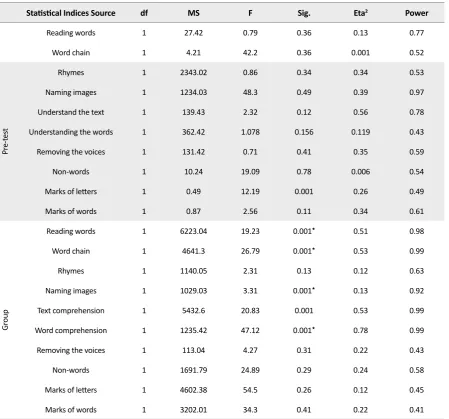
The results of covariance analysis indicated that the educational package was significantly effective in the subscales of words reading, word chain, word compre-hension, text comprecompre-hension, and naming of images at the significance level of 0.001. However, the education-al package was not effective in other areas of reading, including rhyming, reading the non-words, removing the voices, marks of letters and words. Moreover, there was no significant difference between the experimental group and the control group.
4. Discussion
The results of covariance analysis indicated that the educational package was significantly effective in im-proving the subscales of words reading, word chain, word comprehension, text comprehension, and nam-ing of images. Therefore, the research hypothesis was confirmed. This finding is in line with the results of the research by Arjmandnia et al. (2012) and Murphy (2009) [30,31].
According to them, using mentoring and educational intervention strategies in children with learning dis-abilities can improve their educational performance.
Table 1. The Mean±SD values of reading and dyslexia test results for the experimental and control groups
Groups Mean±SD
Experimental Group Index Control Group Index
Pre-test 12.5±8.44 12.4±8.2
Post-test 19.2±7.41 13.41±11.25
Table 2. Normality test of reading performance score distribution
Shapiro-Wilk Test
Variable Group Statistic df Sig.
Reading performance Experimental 0.90 30 0.30
Control 0.78 30 0.21
Table 3. Levene’s test result for testing variance homogeneity of the variables
Variable F df1 df2 Sig.
Also, the results of this research are in agreement with the findings of studies carried out by Von Karolyi et al. (2003) and Chakravarty (2009) [17,32]. It should be not-ed that a significant amount of research has attributnot-ed the reading disorder to dysfunction in phonological pro-cessing, particularly phonological awareness, pronun-ciation impairment, impairment in selective storage, and manipulation of verbal information. However, it has been argued that both phonological processing and per-formance impairment play a role in reading impairment.
Much research on the basic skills required in reading comprehension focuses on phonological awareness. Phonological awareness, such as the teaching of the de-letion, addition, and substitution of syllables and pho-nemes plays an important role in increasing the
aware-ness of the sounds of the language and the association of phonemic characters in dyslexic children [15]. In per-ceptual dyslexia, the child tries deliberately each time to find the connection between the shape, the letters, the sound, and the concept, and since this connection does not become automated, the reading is done slowly and with repeated interruptions.
The child might encounter some problems such as fast reading, interruptions, pause on words, and repetitions that affect the speed and fluidity of reading. In linguistic dyslexia, the natural process of recognizing the form of the word and then converting it into sound and mean-ing is not done naturally. In addition to phonological awareness, mental rotation as one of the spatial abili-ties can be involved in reading learning. Given that
ac-Table 4. The results of multivariable covariance analysis on the subscales of reading performance of the experimental and control group
Statistical Indices Source df MS F Sig. Eta2 Power
Reading words 1 27.42 0.79 0.36 0.13 0.77
Word chain 1 4.21 42.2 0.36 0.001 0.52
Pr
e-t
es
t
Rhymes 1 2343.02 0.86 0.34 0.34 0.53
Naming images 1 1234.03 48.3 0.49 0.39 0.97
Understand the text 1 139.43 2.32 0.12 0.56 0.78
Understanding the words 1 362.42 1.078 0.156 0.119 0.43
Removing the voices 1 131.42 0.71 0.41 0.35 0.59
Non-words 1 10.24 19.09 0.78 0.006 0.54
Marks of letters 1 0.49 12.19 0.001 0.26 0.49
Marks of words 1 0.87 2.56 0.11 0.34 0.61
Gr
oup
Reading words 1 6223.04 19.23 0.001٭ 0.51 0.98
Word chain 1 4641.3 26.79 0.001٭ 0.53 0.99
Rhymes 1 1140.05 2.31 0.13 0.12 0.63
Naming images 1 1029.03 3.31 0.001٭ 0.13 0.92
Text comprehension 1 5432.6 20.83 0.001 0.53 0.99
Word comprehension 1 1235.42 47.12 0.001٭ 0.78 0.99
Removing the voices 1 113.04 4.27 0.31 0.22 0.43
Non-words 1 1691.79 24.89 0.29 0.24 0.58
Marks of letters 1 4602.38 54.5 0.26 0.12 0.45
Marks of words 1 3202.01 34.3 0.41 0.22 0.41
tive memory is the source of information storage in the cognitive process, it can be said that mental rotation with a spatial nature represents the object and stores it in short-term memory.
Active memory is a limited-capacity processing re-source, which involves storing information while pro-cessing other information, but dyslexic people have difficulty remembering this same limited amount. Dyslexia children experience active memory dysfunc-tions and are weaker in active memory assignments. The results of the subtests showed that the educational intervention increased the performance of dyslexic stu-dents in each of the subtests, including reading words, word chains, rhyming, naming images, understanding the text, understanding the words, removing the voic-es (sounds), reading the non-words and pseudo-like words, letter mark, and wordmark. This finding is in line with the results of the studies carried out by Grady et al. (2015) and Mankinen et al. (2015) [33,34].
These researchers found out that the memory-related brain activity increases after the educational interven-tion. To explain these findings, it can be said that children must master a series of skills to be proficient in reading. These skills have neuro-psychological aspects and are acquired by experience, education, and learning. Most children do these skills unconsciously, but children with dyslexia have difficulty in learning these skills and should be trained, so training interventions are the best way in this regard. In other explanations, given the fact that dyslexic children have difficulty in active memory, edu-cational intervention can enhance the memory, which in turn can improve the quality of the child’s academic performance. In other words, verbal training and visu-al-spatial training using shapes and letters for dyslexic students activate a part of the brain that is related to memory. This training enhance verbal and visual-spatial memory and subsequently improve the reading perfor-mance in the student.
5. Conclusion
In this study, appropriate visual and audio training (us-ing forms, letters, and numbers) was used to educate dyslexic students to read. In other words, memory en-hancement as a prerequisite for neuro-psychological process improves reading performance in students. Based on the results of this study, it is suggested that researchers and educational staff find ways to increase students’ memory efficiency and activity.
We also suggest that the results of this study be used in schools and teaching centers to help students learn the reading skills, also appropriate training courses be held to familiarize teachers with phonological aware-ness training. It is also suggested that in future studies, the effectiveness of other spatial abilities such as spatial perception and spatial imagery be investigated on dys-lexia and the results are compared with the findings of the present study. It is also recommended that, in ad-dition to children suffering from dyslexia, children with dysgraphia and dyscalculia are studied and the results be compared with the findings of the present study.
Performing the study only on a sample of elementary schools students and only in 3 grades was one of our research limitations that affect external validity and generalization of the results to other populations. The other limitation relates to our time restraint that pre-vents us to follow up on our results and checking their prolonged effects.
Ethical Considerations
Compliance with ethical guidelinesThere was a written consent from participants' par-ents. The designed package was also implemented for the control group after the follow-ups.
Funding
The present paper was extracted from the PhD. thesis of the first author, in Department of Educational Psy-chology, Faculty of Educational Sciences and Psychol-ogy, Alzahra University.
Authors contributions
All authors contributed in preparing this article.
Conflict of interest
The authors declared no conflict of interest.
Acknowledgements
References
[1] American Psychiatric Association. Diagnostic and Statistical Manual of Mental Disorders (DSM–5). Philadelphia: American Psychiatric Association; 2013.
[2] Hulme C, Snowling MJ. Learning disorders and dyslexia. Encyclope-dia of Mental Health. 2016; 2:5-11.
[3] Pintrich P, R, Blazevski J. Applications of a model of goal orientation and self-regulated learning to individuals with learning problems. International Review of Research in Mental Retardation. 2004; 28:31-83. [DOI:10.1016/S0074-7750(04)28002-8]
[4] Wang Z, Yan X, Liu Y, Spray G, J. Structural and functional abnormal-ity of the putamen in children with developmental dyslexia. Neu-ropsychologia. 2018; pii:S0028-3932(18):30325-7. [DOI:10.1016/j. neuropsychologia.2018.07.014] [PMID]
[5] Colenbrander D, Kohnen S, Lock K, Smith, Nickels L. Individual dif-ferences in the vocabulary skills of children with poor reading com-prehension. Learning and Individual Differences. 2016; 50:210-20.
[DOI:10.1016/j.lindif.2016.07.021]
[6] Vellutino FR, Scanlon DM, Frank R, Vellutino DMS. The interac-tive strategies approach to reading intervention. Contemporary Educational Psychology. 2002; 27(4):573-635. [DOI:10.1016/S0361-476X(02)00002-4]
[7] Nicolson RI, Taroyan NA. Reading words and pseudo words in dys-lexia: ERP and behavioral tests in English-speaking adolescents. Ternational Journal of Psychophysiology. 2009; 74(3):199-208.
[DOI:10.1016/j.ijpsycho.2009.09.001] [PMID]
[8] Danielli L, Berlingeri M, Bottini G, Borghese NA, Paulesu E. How many deficits in the same dyslexic brains? A behavioural and fMRI assessment of comorbidity in adult dyslexics. Cortex. 2017; 97:125-42. [DOI:10.1016/j.cortex.2017.08.038] [PMID] [PMCID]
[9] Lander J, Seeho S, Foster K. Learning practical research skills using an academic paper framework: An innovative, integrated approach. Health Professions Education. 2018. In Press.
[10] Raghebian R, AkhavanTafti M, Hejazi E. [An examination of the effectiveness of a program based oncombining questioning the au-thor and triarchic reading comprehension approches in improving the students’ reading comperehension (Persian)]. Journal of school psychology. 2012; 1(2):39-58.
[11] Sharifi A, Davari R. [Prevalence of reading disorder in Shahr-e-Kord primary school students (Persian)]. Exceptional Children. 2008; 8(4):413-8.
[12] Rahimian Bougar E, Sadeghi A. [Prevalence of reading disorder in elementary school students (Persian)]. Iranian Journal of Psychiatry and Clinical Psychology (Thought and Behavior). 2006; 12(4):396-402.
[13] Tamboer P, Vorst HCM, Ghebraeb S, Scholte HS. Machine learning and dyslexia: Classification of individual structural neuro-imaging scans of students with and without dyslexia. NeuroImage: Clinical. 2016; 11:508-14. [DOI:10.1016/j.nicl.2016.03.014] [PMID] [PMCID]
[14] Galaburda AM. Neurology of developmental dyslexia. Current Opinion in Neurobiology. 1993; 3(2):237-42. [DOI:10.1016/0959-4388(93)90216-L]
[15] Baker DL, Park Y, Baker SK, Basaraba DL, Kame’enui EJ, Beck CT. Ef-fects of a paired bilingual reading program and an English-only pro-gram on the reading performance of English learners in Grades 1-3. Journal of School Psychology. 2012; 50(6):737-58. [DOI:10.1016/j. jsp.2012.09.002] [PMID]
[16] Desroches AS, Joanisse MF, Robertson EK. Specific phonological impairments in dyslexia revealed by eyetracking. Cognition. 2006; 100(3):B32-42. [DOI:10.1016/j.cognition.2005.09.001] [PMID]
[17] Von Karolyi C, Winner E, Gray W, Sherman GF. Dyslexia linked to talent: Global visual-spatial ability. Brain and Language. 2003; 85(3):427-31. [DOI:10.1016/S0093-934X(03)00052-X]
[18] Winner E, Von Karolyi C, Malinsky D, French L, Seliger C, Ross E, et al. Dyslexia and visual-spatial talents: Compensation vs deficit model. Brain and Language. 2001; 76(2):81-110. [DOI:10.1006/ brln.2000.2392] [PMID]
[19] Colangelo A, Stephenson K, Westbury C, Buchanan L. Word asso-ciations in deep dyslexia. Brain and Cognition. 2003; 53(2):166-70.
[DOI:10.1016/S0278-2626(03)00102-7]
[20] Davis G, Rimm S. Education of the gifted and talented. Boston: Allyn & Bacon; 2004.
[21] Gohm CL, Humphreys LG, Yao G. Characteristics of 12th-grade
students seriously deficient in spatial ability. Intelligence. 1997; 25(3):161-78. [DOI:10.1016/S0160-2896(97)90040-4]
[22] Humphreys P, Kaufmann WE, Galaburda AM. Developmental dyslexia in women: Neuropathological findings in three patients. Annals of Neurology: Official Journal of the American Neurological Association and the Child Neurology Society. 1990; 28(6):727-38.
[DOI:10.1002/ana.410280602] [PMID]
[23] Gouleme N, Gerard CL, Bui-Quoc E, Bucci MP. Spatial and temporal analysis of postural control in dyslexic children. Clinical Neurophysiol-ogy. 2015; 126(7):1370-7. [DOI:10.1016/j.clinph.2014.10.016] [PMID]
[24] Hooper S, Mattison E, Glassberg AL. Three-year course of learn-ing disorders in special education students classified as behavioral disorder. American Academy of Child & Adolescent Psychiatry. 2002; 41(12):1454-61. [DOI:10.1097/00004583-200212000-00017] [PMID]
[25] Kubová Z, Kuba M, Kremláček J, Langrová J, Szanyi J, Vít F, et al. Comparison of visual information processing in school-age dys-lexics and normal readers via motion-onset visual evoked poten-tials. Vision Research. 2015; 111(Pt A):97-104. [DOI:10.1016/j.vis-res.2015.03.027] [PMID]
[26] Sinatra R. Styles of thinking and literacy proficiency for males disabled in print acquisition. Reading Psychology: An International Quarterly. 1988; 9(1):33-50. [DOI:10.1080/0270271880090104]
[27] Swanson HL. Semantic and visual memory codes in learning disa-bled readers. Experimental Child Psychology. 1984; 37(1):124-40.
[DOI:10.1016/0022-0965(84)90062-6]
[28] Muehl S, Knott JR, Benton AL. EEG abnormality and psychological test performance in reading disability. Cortex. 1965; 1(4):434-40.
[DOI:10.1016/S0010-9452(65)80004-1]
[29] Weiss AH, Granot RY, Ahissar M. The enigma of dyslexic musi-cians. Neuropsychologia. 2014; 54:28-40. [DOI:10.1016/j.neuropsy-chologia.2013.12.009] [PMID]
[30] Arjmandnia AA, Kakabaraee K, Afrooz GA. The effect of rehearsal strategy on the performance of dyslexic student’s working mem-ory. Procedia-Social and Behavioral Sciences. 2012; 46:2620-4.
[DOI:10.1016/j.sbspro.2012.05.535]
[31] Murphy F. The clinical experiences of dyslexic healthcare students. Radiography. 2009; 15(4):341-4. [DOI:10.1016/j.radi.2008.06.002]
[33] Grady CL, St-Laurent M, Burianová H. Age differences in brain activity related to unsuccessful déclarative memory retrieval. Brain Research. 2015; 1612:30-47. [DOI:10.1016/j.brainres.2014.12.036] [PMID] [PMCID]