Planktonic Foraminiferal Biostratigraphy and Faunal
Turnover across the Cretaceous-Tertiary
Boundary in Southwestern Iran
B. Darvishzad,
1,*E. Ghasemi-Nejad,
2S. Ghourchaei,
2and G. Keller
31
Department of Geology, Faculty of Science, Bu Ali Sina University, Hamedan, Islamic Republic of Iran 2
Department of Geology, Faculty of Science, University of Tehran, Tehran, Islamic Republic of Iran 3 Department of Geosciences, Princeton University, Princeton NJ 08544, USA
Abstract
The Kabirkuh section in the Ilam Province of southwestern Iran contains one of
the most complete Late Maastrichtian to early Danian sequences similar to those
known from the eastern Tethys realm. The Cretaceous-Tertiary boundary is
marked by a 1-2 cm thick kidney-red shale in the uppermost Gurpi Formation. All
Late Maastrichtian planktonic foraminiferal biozones CF1 to CF4 (equivalent to
the
Abathomphalus mayaroensis zone) and Danian zones
P0
(Parvularugo-globigerina extensa), P1a (Parvularugo(Parvularugo-globigerina eugubina) and Parasubbotina
pseudobulloides are present. Faunal studies show that all but six of the Cretaceous
species identified (22 of 29 species) disappeared at or below the K-T boundary in
zone CF1 (P. hantkeninoides). Another 6 species (Heterohelix globulosa, H.
navarroensis, H. dentata, Hedbergella monmouthensis, H. holmdelensis,
Guembelitria cretacea) appear to have survived into the early Danian. Early
disappearances appear to be environmentally controlled. Coarse ornamented
species with small populations disappeared first, whereas small species with little
or no ornamentation and generally large populations tended to survive after the
environment changing. This indicates a pattern of gradual and selective faunal
turnover in planktonic foraminifera during the latest Maastrichtian and into the
earliest Danian that is similar to that observed at the El Kef stratotype of Tunisia,
as well as K-T sequences in Egypt, Italy, Spain and Mexico.
Keywords: Cretaceous-Tertiary Boundary; Biostratigraphy; Plankton foraminifera
*E-mail: [email protected] Introduction
The Gurpi Formation, which spans the Cretaceous-Tertiary transition in southwestern Iran, has been extensively studied before [13,3840,44,45]. A brief
southwestern Iran, Hobbi reported the KTB in the upper part of the Gurpi Formation at the base of a 50 cm thick glauconitic layer based on palynology and foraminiferal stratigraphy [12]. A restudy of this section based on foraminifera and dinoflagellate cysts revealed a hiatus of at least 500 ky spanning the uppermost Maastrichtian to lowermost Danian [11].
Thus previous studies indicate that the KTB is located in the uppermost shale layers of the Gurpi Formation that the KTB is continuous in the southwestern Province of Ilam and in the southern Province of Khuzistan, but that a hiatus spanning about
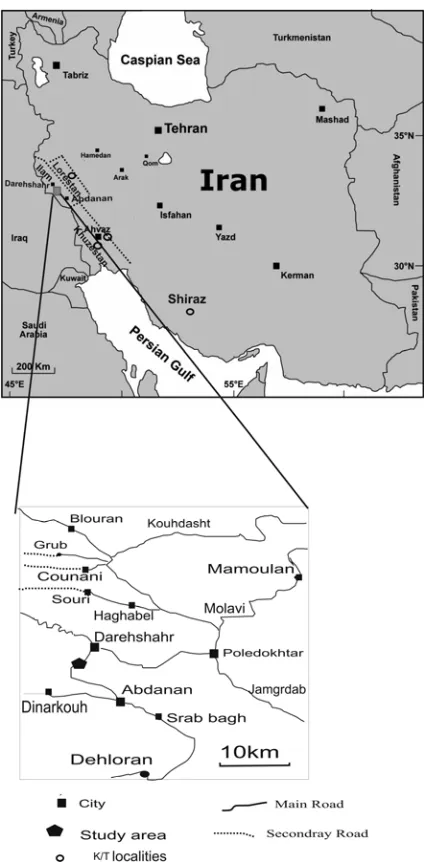
Figure 1. Location map of the K-T sequence studies in the
Lorestan Province of southwestern Iran. Additional K-T localities mentioned in the text are marked by open circles.
500,000 years is present in the southwestern Fars Province.
Outcrops of the Gurpi Formation are widespread in the Kabirkuh region of the Zagros Mountains in southwestern Iran (Fig. 1), which was chosen for this study with the main objectives to detail the planktic foraminiferal record across the Late Maastrichtian through early Danian and compare and contrast the results with the K/T stratotype of Tunisia and other complete low latitude sequences.
Location and Lithology
The Gurpi Formation is exposed along the northeastern flank of the Kabirkuh anticline of the Zagros Mountains in southwestern Iran. The Kabirkuh section of this report (E: 47° 40′ 21″ and N: 33° 20′ 09″) is located between the towns of Dare-Shahr and Abdanan in the Ilam Province, about 2 km south of Dare-Shahr (Fig. 1). At this locality, the Gurpi Formation consists of 234 m and crops out on both sides of the road. The lower part of the formation consists of white (milky) limestone and marly limestone. The upper part consists of soft dark grey shale alternating with marly shales. The K-T boundary occurs 147.19 meters above the lower contact of Gurpi Formation within the soft grey shale and is marked by a 1-2 cm thick kidney-red shale.
Methods
The Gurpi Formation was sampled three times for this study. The first reconnaissance sample collection identified the approximate age and foraminiferal biozones of the region. Based on this information, more detailed sampling at 30-40 cm intervals concentrated on the interval from 10 m below to 8 m above the red layer and K-T boundary (KTB). From this sample set the Upper Maastrichtian to Lower Paleocene biozones were identified and species ranges determined. To further evaluate the faunal turnover across the KTB, a third sample set was collected at 2-3 cm intervals from 30 cm below to 15 cm above the KTB and kidney-red layer.
Plate 1. Figure 1a-b: Globotruncanella havanensis (Voorwijk), 1937 (Scale bar: a-b =50 µm; c = 80 µm) (placed in zone CF4).
Figure 2a-c: Globotruncana esnehensis Nakkady, 1950 (Scale bar = 50 µm) (placed in zone CF3). Figure 3a-b: Gansserina gansseri
(Bolli), 1951 (Scale bar = 50 µm) (placed in zone CF4). Figure 4a-b: Kassabiana pseudocalcarata (Kerdany & Abdelsalam), 1969
(Scale bar: a = 50 µm, b =55 µm) (placed in zone CF1). Figure 5a-b: Rugoglobigerina reicheli (Bronnimman), 1952 (Scale bar: a = 45 µm, b = 50 µm) (placed in zone CF1). Figure 6a-c: Globotruncana aegyptiaca (Nakkady), 1950 (Scale bar = 50 µm) (placed in
zone CF4). Figure 7a-b: Globotrunanita pettersi (Gandolfi), 1955 (Scale bar = 60 µm) (placed in zone CF4). Figure 8a-b: Globotruncanita angulata (Tilev), 1951. (Scale bar; a = 45 µm, b = 50 µm) (placed in zone CF2). Figure 9a-c: Globotruncanella petaloidea (Gandolfi), 1955 (Scale bar: (a, b = 50 µm, c = 60 µm) (placed in zone CF4). Figure 10a-b: Globotruncanita stuartiformis
(Dalbiez), 1955 (Scale bar =50 µm) (placed in zone CF4). Figure 11a-c: Globotruncanita stuarti (De Lapparent), 1918 (Scale bar =
50 µm) (placed in zone CF4). Figure 12a-c: Globotruncana falsostuarti (Sigal), 1952 (Scale bar = 50 µm) (placed in zone CF4).
Figure 13a-b: Abathomphalus intermedius (Bolli), 1951 (Scale bar: a = 50 µm, b = 60 µm) (placed in zone CF2). Figure 14: Pseudotextularia elegans (Rzehak), 1895 (Scale bar = 50 µm) (placed in zone CF2). Figure 15a-c: Globotruncana arca (Cushman),
Plate 2. Figure 1a-1c: Plummerita hantkeninoides (Bronnimann), 1952 (Scale bar: 1a = 50 µm, b, c = 60 µm) (placed in zone CF1). Figure 2: Pseudoguembelina hariaensis (Nederbragt), 1991 (Scale bar =100 µm) (placed in zone CF3). Figure 3: Pseudoguembelina palpebra (Bronniman & Brown), 1953 (Scale bar = 50 µm) (placed in zone CF2). Figure 4: Racemiguembelina fructicosa
(Nederbragt), 1991 (Scale bar =60 µm) (placed in zone CF4). Figure 5a-c: Abathomphalus mayaroensis (Bolli), 1951 (Scale bar: a,b
= 50 µm, c = 30 µm) (placed in zone CF4). Figure 6: Guembelitria cretacea (Cushman), 1933 (Scale bar = 15 µm) (placed in zone
CF1). Figure 7a-b: Heterohelix dentata (Stenestad), 1968 (Scale bar = 60 µm) (placed in zone CF4). Figure 8a-8c: Rugoglobigerina hexacamerata (Plummer), 1926 (Scale bar = 50 µm) (placed in zone CF4). Figure 9a-9c: Hedbergella monmouthensis (Olsson), 1960
(Scale bar: a, b = 25 µm, c = 50 µm) (placed in zone CF4). Figure 10a-b: Rugoglobigerina rugosa (Plummer), 1926 (Scale bar = 50
µm) (placed in zone CF4). Figure 11: Heterohelix navarroensis (Loeblich), 1951 (Scale bar = 50 µm) (placed in zone CF4). Figure
12: Hedbergella holmdelensis (Olsson), 1960 (Scale bar = 25 µm) (placed in zone CF4). Figure 13: Parvularugoglobigerina longiapertura (Lutherbacher & Premoli Silva), 1964 (Scale bar = 10 µm) (placed in P1a). Figure 14: Heterohelix globulosa
(Ehrenberg), 1840 (Scale bar = 25 µm) (zone CF4). Figure 15a-c: Eoglobigerina fringa (Subbotina), 1950 (Scale bar: a = 6 µm, b, c
= 10 µm) (placed in zone P1a). Figure 16a-c: Globoconusa daubjergensis (Bronnimann), 1953 (Scale bar: a, b = 15 µm, c = 22 µm)
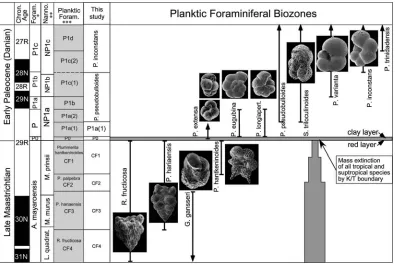
Figure 2. Comparison of biozones of the studied area with * [8]; ** [41]; *** [19,23].
Figure 3. Delineated uppermost Maastrichtian and lower Danian biozones on the studied area.
Biostratigraphy
For the Late Maastrichtian the biozonation of [23] and [24] was used, which subdivides the
Abathomphalus mayaroensis zone into four Cretaceous
Foraminiferal (CF) biozones (CF1 to CF4, Fig. 2). For the earliest Danian zones P0 and P1a ( Parvularu-goglobigerina eugubina zone), the biozonation of [19]
was used. The subsequent Danian zones of [19] were not recognized in the employed sample strategy and therefore were zoned based on the biozonation of [42]. These biozonal schemes are shown in Figure 2 in comparison with other commonly used biozones.
Late Maastrichtian
Abathomphalus ayaroensis Total Rang Zone:
This biozone was defined previously as the interval from the first to the last appearance of A.mayaroensis,
which spans the entire late Maastrichtian interval [10,42].
In the Kabirkuh section the A. mayaroensis zone
Figure 4. Late Maastrichtian to Danian planktonic foraminiferal species ranges from the Kabirkuh section, southwestern Iran. Samples collected at 30-40 cm intervals.
Zone CF4 (Racemiguembelina fructicosa):
Zone CF4 is defined as the interval from the first appearance of R. fructicosa to the first appearance of Pseudoguembelina hariaensis [23]. In the Kabirkuh
section, zone CF4 encompasses 19.40 m of the dark grey shale (Figs. 3 and 4). The CF4 assemblage is characterized by Abathomphalus intermedius, A.
mayaroensis, Gansserina gansseri, Globotruncana aegyptiaca, G. arca, G. esnehensis, G. falsostuarti, Globotruncanella havanensis, G. petaloidea, Globotruncanita conica, G. stuartiformis, G. stuarti, Hedbergella holmdelensis, H. monmouthensis, Heterohelix dentata, H. globulosa, H. navarroensis,
Racemiguembelina fructicosa, Rugoglobigerina
Zone CF3 (Pseudoguembelina hariaensis):
Zone CF3 defines the interval from the first appearance of Pseudoguembelina hariaensis at the base
to the disappearance of Gansserina gansseri at the top
[23,24]. This biozone spans 2.20 m of grey shale (Figs. 3 and 4). Other species identified in CF3 include
Abathomphalus intermedius, A. mayaroensis, Gansserina gansseri, Globotruncana aegyptiaca, G. arca, G. falsostuarti, Globotruncanita conica, G. stuartiformis, G. stuarti G. pettersi, Hedbergella holmdelensis, H. monmouthensis, Heterohelix dentata, H. globulosa, H. navarroensis, Pseudoguembelina hariaensis, P. palpebra, Rugoglobigerina rugosa, R. macrocephala and R. reicheli (Fig. 4).
Zone CF2 (Pseudoguembelina palpebra):
This zone spans the interval from the last appearance of Gansserina gansseri to
the first appearance of Plummerita hantkeninoides
[23,24]. In the Kabirkuh section, this zone spans 3.80 m of grey shale (Fig. 3). The assemblage includes
Abathomphalus intermedius, A. mayaroensis,
Globotruncana aegyptiaca, G. arca, G. falsostuarti, Globotruncanita angulata, G. stuarti, G. stuartiformis, Hedbergella holmdelensis, H. monmouthensis, , Heterohelix dentata, H. globulosa, H. navarroensis Pseudoguembelina hariaensis, Rugoglobigerina macrocephala, R. reicheli and R. rugosa (Fig. 4).
Zone CF1 (Plummerita hantkeninoides):
Zone CF1 is defined by the total range of Plummerita hantkeninoides. Which marks the last 300 ky of the
Maastrichtian [23,24,33]. In the Kabirkuh section zone CF1 spans the uppermost 2.2 m of grey shale below the kidney-red KTB horizon. Other species identified in this interval include Abathomphalus mayaroensis, Globotruncana aegyptiaca, G. arca, G. esnehensis, G. falsostuarti, Globotruncanella citae, G. petaloidea, G. havanensis, Globotruncanita angulata, G. conica, G. pettersi, G. stuarti, G. stuartiformis, Heterohelix globulosa, H. navarroensis, Hedbergella monmou-thensis, Kassabiana falsocalcarata, Plummerita hantkeninoides, Pseudoguembelina hariaensis, P. palpebra, Pseudotextularia elegans, Rugoglobigerina macrocephala, R. riecheli and R. rugosa (Fig. 4).
Early Danian
Zone P0 (Parvularugoglobigerina extensa):
The base of zone P0 coincides with the base of the kidney-red layer and the extinction of all tropical and subtropical species, and within a few cm the first appearance of Danian species including P. extensa
(formerly known as Globoconusa conusa, [32]). The top
of zone P0 is defined by first appearance of Parvularu-goglobigerina eugubina and/or P. longiapertura.
The zone P0 interval is generally only a few cm thick, except at the El Kef stratotype where it spans 50 cm. The zone P0, or K/T layer, commonly consists of clayey shale or red clay enriched with iron and may contain an Ir anomaly and Ni-rich spinels [37]. In the Kabirkuh section zone P0 is only 2.5 cm thick and marked by the presence of P. extensa. Associated
species include Guembelitria cretacea, Hedbergella holmdelensis, H. monmouthensis, Heterohelix dentata, H. globulosa, and H.navarroensis (Fig. 5).
Zone P1a (Parvularugoglobigerina eugubina):
Zone P1a is defined by the total range of
Parvularugoglobigerina eugubina and/or P.
longiapertura [19]. In the Kabirkuh section zone P1a is
80 cm thick and consists of dark grey shale of the Gurpi Formation. The P1a zone assemblage includes
Eoglobigerina fringa, Globoconusa daubjergensis, Parvularugoglobigerina eugubina, P. extensa. P. longiapertura. Parasubbotina pseudobulloides was not
observed in this interval and therefore the subdivision of zone P1a(1)/P1a(2) could not be applied.
Parasubbotina pseudobulloides zone:
In this study, this zone marks the interval from the first appearance of P. pseudobulloides to the first
appearance of Praemurica inconstans. The zone spans
one meter of grey shale and the assemblage includes
Globoconusa daubjergensis and Subbotina trilocul-inoides (Fig. 4).
Comparison with other K/T Sections
K/T Boundary and Mass Extinction
The Kabirkuh KTB is marked by the coincidence of a 1-2.5 cm thick kidney-red layer, the extinction of all ornate large tropical and subtropical species, including all globotruncanids, rugoglobigerinids and racemiguem-belinids at or below the red layer, and the first appearance of early Danian species immediately above it (Figs. 4, 5). Species diversity is relatively low with a total of 29 species identified, but comparable to shallow water faunal assemblages from Egypt [15,18].
Of the 29 Cretaceous species identified, 3 (~10%) disappeared in the CF3-CF2 interval (Fig. 4), 20 species (69%) disappeared in the top 28 cm of CF1 below the KTB and 6 species (~20%) survived into the early Danian zones P0 and P1a (Fig. 4).
Figure 5. Planktonic foraminiferal species ranges across the
K/T boundary at Kabirkuh, southwestern Iran. Samples collected at 2-3 cm intervals.
This gradual extinction pattern may be due, at least in part, to preservation or rarity of species. However, similar patterns observed in shallow water Tethys environment (e.g., Mexico, Texas, Egypt) suggest also environmental effects. The onset of severe biotic stress can be identified in the upper zone CF3 to lower CF2 interval where all globotruncanids including G. arca
and G. havanensis decreased in relative abundances and
G. gansseri disappeared. At the same time,
heterohelicids increased in relative abundance along with hedbergellids and thrived through zone CF1 to the end of Maastrichtian. The surface dwellers rugoglobigerinids and Plummerita hantkeninoides
thrived during zone CF1.
Similar extinction patterns were also observed in Egypt [15,18]. The observed faunal changes can be correlated to global climate and sea level changes.
The late Maastrichtian zones CF3-CF2 interval was characterized by global cooling and a major sea level regression, which culminated about 500 ky before the KTB. Therefore, rapid greenhouse warming with increased temperatures of 3-4°C occurred between 400 and 200 ky prior to the KTB, followed by gradual cooling during the last 100-200 ky of the Maastrichtian [4,25].
The greenhouse warming is widely believed to be related to the concurrent massive Deccan Trap volcanic activity [4,22,32].
Stable isotope ranking of planktic foraminiferal species in the water column indicates that globotruncanids were intermediate to deep dwellers [4]. Their early decline and eventual demise may have been related to the increased biotic stress associated with climatic warming and related changes in the water mass stratification that decreased their habitat. But in the shallow water sequences of Egypt, as well as the Kabirkuh section of Iran, the early disappearance of these species is likely due to the sea level regression and hence shallowing environment.
The decrease and disappearance of globotruncanids is associated with increased aboundance of biserial species (e.g., Heterohelix globulosa, H. dentata and H. navarroensis), which are interpreted as ecological
generalists, characterized by medium or small test sizes, simple morphologies and little surface ornamentation. They appear to have tolerated significant fluctuations in temperature and thrived in nutrient-enriched low oxygen conditions where few other species survived. High abundances of heterohelicids thus indicate high biotic stress related to the expansion of the oxygen minimum zone during climate warming, or isolated basin environments with high terrestrial nutrient influx [15].
H. globulosa) dominate in the >150 µm size fraction of
zone CF3 to CF1. In the upper part of zone CF1, the relative abundance of heterohelicids in the larger size fraction decreased rapidly and smaller sized heterohelicids (63-150 µm) dominate. In the earliest Danian (zone P0), the relative abundance of these species drops to <5% and they disappeared in zone P1a (Fig. 5).
This pattern of abundance and size changes, or dwarfing, is commonly observed throughout the Tethys during the latest Maastrichtian in heterohelicids and other species groups [14,15,29]. Dwarfing has been recognized as a common response to high-stress environmental conditions in foraminifera as well as other marine organisms at other mass extinction events (e.g., [34] and [43]).
Dwarfing can be directly correlated with biotic stress induced by climate warming [3] and the migration of tropical-subtropical species into higher latitudes [4,22,32]. Although the direct cause of species dwarfing is still unknown, preliminary data suggests increased biotic stress induced by enhanced nutrient influx during high terrestrial runoff associated with climate change [18].
The surface dwellers Plummerita hantkeninoides and Rugoglobigerina reicheli thrived during the climate
warming of zone CF1 along with Kassabiana falsocalcarata. However, these species decreased
rapidly during the global cooling of the last 100-200 ky of the Maastrichtian as also observed in Tunisia, Egypt.
The ecological opportunist or disaster species
Guembelitria cretacea (>63 µm) is present in very
lower abundances (<2%) during the late Maastrichtian in the Kabirkuh section. During the early Danian zones P0 and P1a, the relative abundance of Guembelitria
reaches only about 10%. This very low Guembelitria
abundance is in marked-contrasts with the high abundances (60-80%) generally found in the basal Danian throughout the Tethys in shallow near shore or open marine environments [18].
There are several possible explanations for this anomaly in the Kabirkuh section: 1) this section represents an unusual post-K/T environment with less biotic stress than observed throughout the Tethys realm. This is unlikely because the pre-K/T faunal assemblages show similar stress conditions as elsewhere and the post-K/T assemblages show similar biozone assemblages. 2) The earliest Danian zones P0 and P1a are condensed with the maximum Guembelitria
abundance peak missing. This is very likely for the short (2.5 cm thick) zone P0, but not likely for the 80 cm thick zone P1a, which should also have very high
Guembelitria abundances. 3) There is a preservation
effect, which selectively eliminates very small fragile species. This is a possibility either due to diagenesis or mechanical breaking during sample processing. And 4)
Guembelitria species, which are generally found in the
63-100 um size fraction, may be dwarfed in the Kabir-kuh section with most of the specimens in the 38-63 µm size fraction. This is a likely possibility because such dwarfing of Guembelitria is frequently observed in K/T
sequences (e.g., [15] and [19]) and will have to be tested
in future quantitative studies of the Kabirkuh section.
Summary and Conclusions
The Cretaceous-Tertiary boundary in the Kabirkuh section of southwestern Iran reveals an expanded Late Maastrichtian and early Danian sedimentary record similar to the El Kef stratotype in Tunisia, except for a very condensed (3 cm thick) zone P0 as compared with 50 cm at El Kef. In Egypt sections, very condensed (<10 cm) zone P0 intervals tend to be truncated by erosion [15,16]. Species extinction and survivorship patterns are similar to those observed in Tunisia, Egypt, Spain, Italy and Mexico.
The onset of the terminal K/T mass extinction and faunal turnover began during climatic cooling in zone CF3, accelerated during the rapid warming in zone CF1 and culminated at the boundary event. The first phase of this extended faunal turnover affected largely globotruncanids and other large tropical species, which decreased in abundance, whereas heterohelicids and hedbergellids thrived.
The second phase began during the climate warming 200-400 ky before the K/T boundary event and accelerated during the cooling of the last 100-200 ky of the Maastrichtian. Dwarfed species are common during the climate warming. Dwarfing has been interpreted as a sign of early sexual maturation and rapid reproduction to favor survival during high biotic stress. Tropical species abundances are very low with most species dwarfed and/or sporadically present. Some species disappeared well before the K/T boundary, for others, sporadic occurrence prevents accurate assessment of the extinction level (Signor-Lipps effect). Nevertheless, the rarity of tropical species and their apparent disappearances prior to the K/T boundary indicate increasing biotic stress preceding the K/T boundary event. This is also indicated by the high heterohelicid abundance, suggesting an expanded oxygen minimum zone, possibly due to increased nutrients from enhanced terrestrial runoff associated with the climate change.
the disaster opportunist Guembelitria species. The latter
appears to be missing in the Kabirkuh section in the size fraction examined. This phase clearly marks the cataclysmic end of the mass extinction brought about by yet another environmental perturbation (impact, volcanism) that exceeded threshold conditions for the already endangered tropical and subtropical species and led to the terminal decline of the generally robust heterohelicids and hedbergellids, leaving only the disaster opportunist Guembelitria to thrive.
Acknowledgements
We thank Mehdi Norouzi, paleontologist of Geological Survey of Iran for his comments and suggestions.
References
1. Abramovich S., Almogi-Labin A., and Benjamini C. Decline of the Maastrichtian pelagic ecosystem based on planktic foraminfera assemblage change: implications for terminal Cretaceous faunal crisis. Geology, 26: 62-66
(1998).
2. Abramovich S. and Keller G. High stress late Maastrichtian Paleoenvironment in Tunisia: Inference from planktic foraminifera. Palaeogeography, Palaeoclimatology, Palaeoecology, 178: 145-164 (2002).
3. Abramovich S. and Keller G. Planktic foraminiferal response to the latest Maastrichtian abrupt warm event: A case study from mid-latitude Atlantic Site 525A. Marine Micropaleontology,48(3-4): 225-249 (2003).
4. Abramovich S., Keller G., Stueben D., and Berner Z. Characterization of late Campanian and Maastrichtian planktonic foraminiferal depth habitats and vital activities based on stable isotopes. Palaeogeography, Palaeoclimatology, Palaeoecology,202: 1-29 (2003).
5. Alegret L., Arenillas I., Arz J.A., Liesa C., Melendez A., Molina E., Soria A.R., and Thomas E. The Cretaceous/Tertiary boundary: sedimentology and micropaleontology at El Mulato section, NE Mexico.
Terra Nova,14: 330-336 (2002).
6. Apellaniz E., Baceta J.I., Bernaola-Bilbao G., Nunez-Betelu K., Orue-etxebarria X., Payors A., Pujalte V., Robin E., and Rocchia R. Analysis of uppermost Cretaceous-lowermost Tertiary hemipelagic successions in the Basque Country (Western Pyrenees): evidence for a sudden extinction of more than half planktic species at the K/T boundary. Bull. Soc. Geol. France, 168(6): 783-793
(1997).
7. Arenillas I., Arz J.A., Molina E., and Dupuis C. The Cretaceous/ Tertiary boundary at Aïn Settara, Tunisia: sudden catastrophic mass extinction in planktic foraminifera. Journal of Foraminiferal Research, 30(2): 202-218 (2000).
8. Berggren W.A., Kent D.V., Swisher C.C., III and Aubry M.-P. A revised Cenozoic geochronology and chronostratigraphy. In: Berggren W., Kent D.V., Aubry M.-P. and Hardenbol (Eds.), Geochronology, Time Scales
and Global Stratigraphic Correlation: Society for Sedimentary Geology, Special Publication, 54: 129-212 (1995).
9. Canudo J.L., Keller G., and Molina E. Cretaceous/ Tertiary extinction pattern and faunal turnover at Agost and Caravaca: SE Spain. Marine Micropaleontology, 17: 319-341 (1995).
10. Caron M. Cretaceous planktic foraminifera. In: Bolli H. M., Saunders J.B., and Perch-Nielson K. (Eds.), Plankton Stratigraphy. Cambridge University Press, pp. 17-86 (1985).
11. Ghasemi-Nejad E., Hobbi M.H., and Schioler Poul R. Dinofellagellate and foraminifera biostratigraphy of the Gurpi Formation (Upper Santonian - Upper Paleocene) Zagros Mountains, Iran. Cretaceous Research (in press).
12. Hobbi M.H. Palynostratigraphy of Gurpi Formation in Kuh- e- Shah Neshin (Nowdan) Section, West of Shiraz. M.Sc. Thesis, University of Tehran. 137 p. (Unpublished)
(2002).
13. James G.A. and Wynd J.G. Stratigraphic Nomenclature of Iranian Oil Consortium Agreement Area. AAPG Bulletin,
46(12): 2182-2245 (1965).
14. Keller G. Extended Cretaceous/Teriary boundary Extinctions and delayed population change in planktonic foraminifera from Brazos River, Texas.
Paleoceanography, 4: 287-332 (1989).
15. Keller G. Guembelitria-dominated Late Maastrichtian planktic foraminiferal assemblages mimic early Danian in Central Egypt. Marine Micropaleontology, 47: 71-99
(2002).
16. Keller G. Low diversity late Maastrichtian and early Danian planktic foraminiferal assemblages of the eastern Tethys, Journal of Foraminiferal Research,34(1): 49-73
(2004).
17. Keller G. and Benjamini C. Paleoenvironment of the eastern Tethys in the early Paleocene. Palaios, 6: 439-464
(1991).
18. Keller G. and Pardo A. Disaster opportunists Guembelitridae: index for environmental catastrophes.
Marine Micropaleontology, 53: 83-116 (2004).
19. Keller G., Li L., and MacLeod N. The Cretaceous/ Tertiary boundary stratotype section at El kef, Tunisia: How catastrophic was the mass extinction?
Paleogeography Paleoclimatology Paleoecology, 119: 221-254 (1995).
20. Keller G., Stinnesbeck W., and Lopez-Oliva J.G. Age, deposition and biotic effects of Cretaceous-Tertiary boundary event at Mimbral NE Mexico. Palaios, 9: 144-157 (1994).
21. Keller G., Stinnesbeck W., Adatte T., Holland B., Stueben D., Harting M., de Leon C., and de la Cruz J.. Spherule deposits in Cretaceous-Tertiary boundary sediments in Belize and Guatemala. Journal Geological Society London, 160: 1-13 (2003).
22. Kucera M. and Malmgren B.A. Terminal Cretaceous warming event in the mid-latitude South Atlantic Ocean: evidence from poleward migration of Contusotruncana contusa (planktonic foraminifera) morphotypes.
Palaeogeography, Palaeoclimatology, Palaeoecology,
138: 1-15 (1998).
Atlantic. DSDP sites 52 and 21. Marine Micropaleontology,33: 55-86 (1998a).
24. Li L. and Keller G. Diversification and extinction in Campanian- Maastrichtian planktic foraminiferal of the North-west Tunisia. Eclogue Geol. Helv., 91: 75-102
(1998b).
25. Li L., Keller G. Abrupt deep-sea warming at the end of the Cretaceous. Geology, 26: 995-999 (1998c).
26. Lopez-Oliva J.G. and Keller G. Age and stratigraphy of near K/T boundary clastic deposits in northeastern Mexico. In: Ryder G., Fastovsky D., and Gartner S. (Eds). The Cretaceous-Tertiary Event and other Catastrophes in Earth History: Boulder, Colorado.
Geological Society of America,307: 227-242 (1996).
27. Luciani V. Planktonic foraminiferal turnover across the Cretaceous-Tertiary boundary in the Vajont Valley (Southern Alps, northern Italy). Cretaceous Research, 18:
799-821 (1997).
28. Luciani V. High resolution planktonic foraminiferal analysis from the Cretaceous Tertiary boundary at Ainsettara (Tunisia): Evidence of an extended mass extinction. Palegeography, Paleoclimatology, Paleoecology, 178: 299-320 (2002).
29. MacLeod N., Ortiz N., Fefferman N., Clyde W., Schulter, C., and MacLean J. Phenotypic response of foraminifera to episodes of global environmental change. In: Culver S.J. and Rawson P. (Eds.), Biotic Response to Global Environmental Change: the Last 145 Million Years.
Cambridge University Press, pp. 51-78 (2000).
30. Molina E., Arenillas I., and Arz J.A. Mass extinction in planktic foraminifera at the Cretaceous/Tertiary boundary in the subtropical to temperate latitudes. Bull. Soc. Geol. France, 169: 351-372 (1998).
31. Norouzi M. Microbiostratigraphy of Gurpi Formation from Sultan Anticline (Central Lorestan) to Gurpi Anticline (type section of Gurpi Formation, NE Khuzestan). M.Sc. Thesis, University of Tehran, 142 p.
(Unpublished). (2001).
32. Olsson R.K., Hemleben C., Berggren W.A., and Huber B.T. Atlas of Paleocene Planktonic Foraminifera. Smithsonian Contribution to Paleobiology No. 85, Smithsonian Institution Press, Washington, D.C., pp. 252 (1999).
33. Pardo A., Ortiz N., and Keller G. Latest Maastrichtian and K/T boundary foraminiferal turnover and environmental changes at Agost, Spain. In: McLeod N. and Keller G. (Eds.), Biotic and Environmental Events across the Cretaceous/Tertiary Boundary. Norton Press,
New York, pp. 139-171 (1996).
34. Pamolda M.A. and Peryt D. Benthonic foraminifera
response to the Cenomanian-Turonian Boundary event in the Ganuza section, Northern Spain. Revista Espanola de Paleontologia, 52: 101-118 (1995).
35. Peryt D., Lahodynsy R., Rocchia R., and Boclet D. The Cretaceous/Paleocene boundary and planktonic foraminifera in the Flyschgosau (Eastern Alps, Austria).
Palaeogeography, Palaeoclimatology, Palaeoecology,
104: 239-252 (1993).
36. Robaszynski F., Caron M., Gonzalez Donoso J.M., Wonders A.A.H., and the European Working Group on planktonic foraminifera. Atlas of Late Cretaceous Globotruncanids. Revista Micropaleontologia, 26(3-4): 145-305 (1983-1984).
37. Rocchia R., Robin E., Froget L., and Gayraud J. Stratigraphic distribution of extraterrestrial markers at the Cretaceous-Tertiary boundary in the Gulf of Mexico area: Implications for the temporal complexity of the event.
Geological Society of America, Special Paper, 307: 279-286 (1996).
38. Setudehnia A. Lexique stratigraphique International ASEI. Vol III. Fascicule 9b. 2- Iran du Sud Quest (1972).
39. Stinnesbeck W., Keller G., Schulte P., Stüben D., Berner Z., Kramar U., and Lopez-Oliva J.G. The Cretaceous-Tertiary (K/T) Boundary transition at Coxquihui, state of Veracruz, Mexico: evidence for an early Danian impact event? American Journal of South American Research,
15: 497-509 (2002).
40. Stoneley R. Evolution of the continental margin boundary a former Southern Tethys. In: Burk C.A. and Darke C.L. (Eds.), The Geology of Continental Margins.
Springer-Verlog, Berlin, pp. 889-902 (1974).
41. Tantawy A.A.A. Calcareous nannofossil biostratigraphy and Paleoecology of the Cretaceous-Paleogene transition in the central eastern Desert of Egypt. Marine Micropaleontology, 47: 323-356 (2003).
42. Toumarkine M. and Lutherbacher H. Paleocene and Eocene planktonic foraminifera. In: Bolli H.M., Saunders J.B., and Perch Nielson K. (Eds.), Plankton stratigraphy, Cambridge University Press, pp. 87-153 (1985).
43. Twitchett R.J. Incompleteness of the Permian-Triassic fossil record: a consequence of productivity decline?
Geological Journal, 36: 341-353 (2001).
44. Wynd J.G. Biofacies of the Iranian Oil Consortium Agreement Area. IOOC, Internal Report No. 1082, (Unpublished) (1965).
45. Wells A.J. Lithofacies and geological history of post Sarvak (Upper Cretaceous sediments in Southwestern Iran. IOOC, Internal Report No. ll20, (Unpublished) (1968).