*Corresponding author: Mithra R ISSN: 0976-3031
SYSTEMATIC ANALYSIS ON THE CONVENTIONAL AND DIGITAL IMPRESSION
TECHNIQUES FOR SUC
Mithra R, Ramesh A.S.
Department of Prosthodontics
DOI: http://dx.doi.org/10.24327/ijrsr.2019.100
ARTICLE INFO ABSTRACT Abstract:
For this conventional and digital impression techniques are used. Though the digital impression technique is growing in the field of dentistry, there is always a con
conventional impressions as to which method provides a better fixed dental prosthesis with accurate fit, as the fit of the prosthesis is important for the success of a prosthesis.
Objectives:
providing better reproduction of details and hence a better fit of the prosthesis. Materials and Methods:
years previously. Several journals were hand searched and cross references were done. The following data were extracted from the studies included for review. Publication, study design, sample size, pro
perception and ease of use and inference. Result:
criteria. The analysis shows
technique in providing better reproduction of details and hence better fit of the prosthesis. Conclusion:
better than conventional impressions.
INTRODUCTION
Impression making is one of the most important steps in constructing a dental prosthesis. For this conventional and digital impression techniques are used. Conventional impression materials used may be alginate, polyether or polyvinylsiloxane, among which polyether impression material was reported to produce better marginal accuracy
impression technique is either direct or indirect method methods employ intraoral scanner systems
iTero, TRIOS, Lava C.O.S. Most commonly used laboratory scanner is Lava scan ST. Though the digital impression technique is growing in the field of dentistry, there is always a controversy between the digital and conventional impressions as to which method provides a better fixed dental prosthesis with accurate fit, as the fit of the prosthesis is important for the success of a prosthesis. The purpose of this systematic analysis was to compare the conventional and digital impressions in providing better reproduction of details and hence a better fit of the prosthesis.
International
Vol. 10, Issue, 04(A), pp. 31629
Copyright © Mithra R, 2019, this is an open
License, which permits unrestricted use, distribution and reproduction in any cited.
Article History:
Received 06th January, 2019 Received in revised form 14th February, 2019
Accepted 23rd March, 2019 Published online 28th April, 2019
Key Words:
Tooth, Teeth, Mouth, Impression, Digital impression, Conventional impression
Research Article
SYSTEMATIC ANALYSIS ON THE CONVENTIONAL AND DIGITAL IMPRESSION
TECHNIQUES FOR SUCCESS IN FIXED DENTAL PROSTHESIS
Ramesh A.S., Kirubakaran A, and Nithya Priya
Department of Prosthodontics Adhiparasakthi Dental College and Hospital
DOI: http://dx.doi.org/10.24327/ijrsr.2019.1004.3304
ABSTRACT
Abstract: Impression making is one of the most important steps in constructing a dental prosthesis. For this conventional and digital impression techniques are used. Though the digital impression technique is growing in the field of dentistry, there is always a con
conventional impressions as to which method provides a better fixed dental prosthesis with accurate fit, as the fit of the prosthesis is important for the success of a prosthesis.
Objectives: This systematic review was to compare the conventional and digital impressions in providing better reproduction of details and hence a better fit of the prosthesis.
Materials and Methods: The MEDLINE–PubMed database was searched from May 2018 to 10 years previously. Several journals were hand searched and cross references were done. The following data were extracted from the studies included for review. Publication, study design, sample size, prosthesis given, observations including marginal fit, dimensional accuracy, patient perception and ease of use and inference.
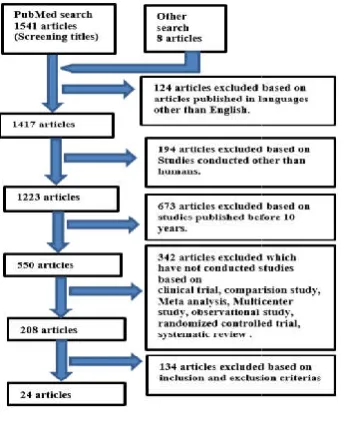
Result: The search yielded 208 articles. Ultimately 24 articles were selected based on the eligibility criteria. The analysis shows that Digital impression method is better than Conventional impression technique in providing better reproduction of details and hence better fit of the prosthesis.
Conclusion: Based on the current existing data, it can be summarized that digital impression better than conventional impressions.
Impression making is one of the most important steps in constructing a dental prosthesis. For this conventional and digital impression techniques are used. Conventional alginate, polyether or polyvinylsiloxane, among which polyether impression material was reported to produce better marginal accuracy1. The digital impression technique is either direct or indirect method2. Direct methods employ intraoral scanner systems3such as CEREC, iTero, TRIOS, Lava C.O.S. Most commonly used laboratory scanner is Lava scan ST. Though the digital impression technique is growing in the field of dentistry, there is always a controversy between the digital and conventional impressions which method provides a better fixed dental prosthesis with accurate fit, as the fit of the prosthesis is important for the success of a prosthesis. The purpose of this systematic analysis was to compare the conventional and digital impressions in ng better reproduction of details and hence a better fit of
MATERIALS AND METHODS
The following analysis was performed according to the guidelines and the principles of the PRISMA statement for a systematic review.
Focused Question (Patients, Intervention, Comparison and Outcomes)
The review is focused on: “Which is the impression technique that leads to a better fit of a fixed dental prosthesis success? The following medical subject heading terms: “tooth”, “mouth”, “impression”, “intra
impression” and their related entry terms were used in different combinations using the Boolean operators “AND” and “OR” for the research. In addition, manual search was made [Figure 1].
Figure 1 Keywords for article
International Journal of Recent Scientific Research
Vol. 10, Issue, 04(A), pp. 31629-31633, April, 2019
, this is an open-access article distributed under the terms of the Creative Commons Attribution License, which permits unrestricted use, distribution and reproduction in any medium, provided the original work is properly
CODEN: IJRSFP (USA)
SYSTEMATIC ANALYSIS ON THE CONVENTIONAL AND DIGITAL IMPRESSION
CESS IN FIXED DENTAL PROSTHESIS
Nithya Priya S
thi Dental College and Hospital
Impression making is one of the most important steps in constructing a dental prosthesis. For this conventional and digital impression techniques are used. Though the digital impression technique is growing in the field of dentistry, there is always a controversy between the digital and conventional impressions as to which method provides a better fixed dental prosthesis with accurate fit, as the fit of the prosthesis is important for the success of a prosthesis.
compare the conventional and digital impressions in providing better reproduction of details and hence a better fit of the prosthesis.
PubMed database was searched from May 2018 to 10 years previously. Several journals were hand searched and cross references were done. The following data were extracted from the studies included for review. Publication, study design, sthesis given, observations including marginal fit, dimensional accuracy, patient
The search yielded 208 articles. Ultimately 24 articles were selected based on the eligibility that Digital impression method is better than Conventional impression technique in providing better reproduction of details and hence better fit of the prosthesis.
Based on the current existing data, it can be summarized that digital impressions are
MATERIALS AND METHODS
The following analysis was performed according to the guidelines and the principles of the PRISMA statement for a
ients, Intervention, Comparison and
The review is focused on: “Which is the impression technique that leads to a better fit of a fixed dental prosthesis success? The following medical subject heading terms: “tooth”, “mouth”, “impression”, “intra-oral”, “extra-oral”, “digital impression” and their related entry terms were used in different combinations using the Boolean operators “AND” and “OR” for the research. In addition, manual search was made [Figure
Keywords for article search
International Journal of
Recent Scientific
Research
Search Strategy
The MEDLINE–PubMed database was searched from May 2018 to 10 years previously [Figure 2].
Study Inclusion Criteria
The studies were analyzed according to the following inclusion criteria:
1. In vivo and In vitro studies.
2. The language of an article should be in English.
3. Article should have compared digital and conventional impressions.
4. Articles published in the last 10 years.
5. Studies should report either of the following features: a. Marginal fit
b. Internal fit
c. Dimensional accuracy d. Patient perception e. Ease of use by dentists.
Study Exclusion Criteria
The studies with following criteria were not included in the review:
1. Studies involving comparison of time consumption on making digital and conventional impressions. 2. Animal study.
3. Articles other than English language. 4. Articles before 10 yrs.
5. Case series 6. Authors opinion
Data Extraction
All studies which met the inclusion and exclusion criteria for review were obtained and screened independently. The following data were extracted from the studies included for review. Publication, study design, sample size, prosthesis given, observations including marginal fit, dimensional accuracy, patient perception and ease of use and inference. Qualities of various studies, regarding comparison of digital and conventional impressions were considered for quality assessment of accurate fit of fixed dental prosthesis.
Figure 2 Search strategy
PubMed database was searched from May
The studies were analyzed according to the following inclusion
ge of an article should be in English.
Article should have compared digital and conventional Articles published in the last 10 years.
Studies should report either of the following features:
The studies with following criteria were not included in the
Studies involving comparison of time consumption on making digital and conventional impressions.
Articles other than English language.
All studies which met the inclusion and exclusion criteria for review were obtained and screened independently. The re extracted from the studies included for review. Publication, study design, sample size, prosthesis given, observations including marginal fit, dimensional accuracy, patient perception and ease of use and inference. g comparison of digital and conventional impressions were considered for quality assessment of accurate fit of fixed dental prosthesis.
DISCUSSION
This systematic review tried to compare the dimensional accuracy, marginal fit, internal fit, patients’ perception and ease of use between conventional and digital impression techniques. Conventional/traditional impressions are made directly from the patient’s mouth using custom trays or stock trays. Though conventional impression materials produced good reproducibility of the oral structures, it also has some disadvantages like short working time, tearing of impression during removal, patient movement, tim
to the patient. The digital impression concept is emerging rapidly and is believed that digital impressions will solve the difficulties of conventional impressions. The digital impression technique can be of direct and indirect meth
uses intra oral scanners. Intraoral scanner systems available are Lava C.O.S , iTero, CEREC, E4D and TRIOS. CEREC system was the first intraoral digital impressions in market. Various generations of CEREC system are CEREC AC Bluecam, CEREC AC Omnicam, CEREC MC, CEREC In
Bluecam captures a single image data collection while the CEREC Omnicam captures continuous images and gives a 3D image on data collection. Lava C.O.S (Lava chairside oral scanner) system works on the principal
sampling. This system needs powdering of the tooth surface. iTero system works on the principle of parallel confocal imaging. This system works under the principle of ultrafast optical sectioning and confocal microscopy. TRIOS system works under the principle of ultrafast optical sectioning and confocal microscopy. Indirect digitalization method uses Lava Scan ST. Advantages of digital impressions are accuracy of impressions, saves time, ease of use by the dentist, no physical impression for patient.
Marginal fit and internal fit are important features in success of a fixed dental prosthesis. Ill
secondary caries; food accumulation which paves a way for bacterial colonization; periodontal diseases and bone los total 24 articles were included, from which data were collected. Among these, the total numbers of in
were 15 and total numbers of in
The following data were collected: Publication, study design, sample size, prosthesis given, observations including marginal fit, internal fit, dimensional accuracy, patient perception and ease of use and inference.
Marginal Fit
Total no of articles: 114-14. In 6 articles researchers found that marginal fit of a fixed dental prosthesis was better in direct digitalization than the conventional impression techniques. In 2 articles researchers found that conventional impression was better than digital impressions in marginal fit. In 3 articles, it was found that Conventional and Digital impression techniques produced similar results.
Internal Fit
Total no of articles: 6(6,9,13,15-17)
that internal fit of digital impressions was better than conventional impressions. In 1 article researc
conventional was better than digital impressions in internal fit.
31630 |
P a g e
This systematic review tried to compare the dimensional accuracy, marginal fit, internal fit, patients’ perception and ease of use between conventional and digital impression techniques. Conventional/traditional impressions are made directly from nt’s mouth using custom trays or stock trays. Though conventional impression materials produced good reproducibility of the oral structures, it also has some disadvantages like short working time, tearing of impression during removal, patient movement, time taking and discomfort to the patient. The digital impression concept is emerging rapidly and is believed that digital impressions will solve the difficulties of conventional impressions. The digital impression technique can be of direct and indirect method. Direct method uses intra oral scanners. Intraoral scanner systems available are Lava C.O.S , iTero, CEREC, E4D and TRIOS. CEREC system was the first intraoral digital impressions in market. Various generations of CEREC system are CEREC AC Bluecam,EC AC Omnicam, CEREC MC, CEREC In-Lab. CEREC Bluecam captures a single image data collection while the CEREC Omnicam captures continuous images and gives a 3D image on data collection. Lava C.O.S (Lava chairside oral scanner) system works on the principal of active wavefront sampling. This system needs powdering of the tooth surface. iTero system works on the principle of parallel confocal imaging. This system works under the principle of ultrafast optical sectioning and confocal microscopy. TRIOS system orks under the principle of ultrafast optical sectioning and confocal microscopy. Indirect digitalization method uses Lava Scan ST. Advantages of digital impressions are accuracy of impressions, saves time, ease of use by the dentist, no physical
Marginal fit and internal fit are important features in success of a fixed dental prosthesis. Ill-fitting margins can cause secondary caries; food accumulation which paves a way for bacterial colonization; periodontal diseases and bone loss. In total 24 articles were included, from which data were collected. Among these, the total numbers of in-vitro studies included were 15 and total numbers of in-vivo studies included were 9. The following data were collected: Publication, study design, ample size, prosthesis given, observations including marginal fit, internal fit, dimensional accuracy, patient perception and
. In 6 articles researchers found that ed dental prosthesis was better in direct digitalization than the conventional impression techniques. In 2 articles researchers found that conventional impression was better than digital impressions in marginal fit. In 3 articles, it ional and Digital impression techniques
17)
Table 1 Characteristics of 24 studies included
Reference design Study
Sample size Impression Technique Prosthesis given Observation
Conv Digi Conventional impression impression Digital
SINGLE CROWN/FIXED
DENTAL PROSTHESIS
Marginal Fit
(µm) Internal fit
Dimensional Accuracy
(µm)
Patient perception
Ease of use
Abdel-Azim et al
Comparision
study 10 10 each PVS
i-Tero
Single crown
Conv-112.3 Lava C.O.S iTero-89.6 Lava- 89.8
Ahrberg et al RCT
25 Lava C.O.S -Direct
FDP
Lava C.O.S-61.08
25 Lava Scan ST-
Indirect
Lava Scan ST- 70.40
Ajioka et al Comparision study 10 10 PVS
Lava C.O.S(optical
impression)
Conv- 64.5 Lava C.O.S- 22.5
Almeida et al Comparision study 12 12 Polyether Lava C.O.S FDP
Conv- 65.33 Conv- 65.94 Lava C.O.S-
63.96 Lava C.O.S- 58.46
An et al Comparision
study 10 10 PVS
iTero with dies(iP) &iTero without dies(iNo)
Single crown
Conv (with dies)- 92.67 iP- 103.05 iNo-103.55
Anadioti et al(2013)
Comparision study
30(15-press; 15-CAD/CAM)
30(15-press; 15-CAD/CAM)
PVS Lava C.O.S Single crown
Conv (press) 3D-0.048 2D-0.040 Conv(CAD/CAM)
3D-0.088 2D-0.076 Digi (press) 3D-0.089 2D-0.075 Digi(CAD/CAM)
3D-0.084 2D-0.074
Anadioti et al(2014)
Comparision study
30(15-press; 15-CAD/CAM)
30(15-press; 15-CAD/CAM)
PVS Lava C.O.S Single crown
Conv(press)-0.111
Conv(CAD/CAM)-0.116 Digi(press)-0.211
Digi(CAD/CAM)-0.145
Benic et al Comparision study 10 10 PVS
Lava C.O.S, iTero, and Cerec
Single crown
Lava C.O.S-71 Lava C.O.S-53 iTero-66
iTero-77 Cerec-48 Cerec-56
Conv-61 Conv-88
Boeddinghaus et al
Comparision
study 24 24 PVS
OCam, TDef,
CTRIOS Single crown
Conv-113 Tdef-88 CTRIOS-112 OCam-149 Boerrendero
et al
Prospective
study 30 30 PVS TRIOS
Conv-119.9 Conv-185.4 Digi-106.9 Digi-170.9
Ender et al Comparision study 8 8
POE; VSE; VSES; ALG;
polyether
CER; ITE; OC; iTero;
LAV
Full arch scan
POE-60.2 VSE- 13.0 VSES- 11.5 VSES-dig- 35.1 ALG- 37.7 CER- 29.4 OC- 37.3 ITE- 32.4 LAV-44.9
Gjelvold et al RCT 42 42 Polyether TRIOS FDP/ Single crown
Conv-44.86 Conv- 24
Digi- 6.50 Digi-48.02
Joda et al RCT 20 20 Polyether iTero Single crown Conv-53.6
Digi- 78.6
Keul et al Comparision study 12 12 ImpregumPenta iTero FDP
C-56.90 DD-Z-127.23 C-90.64
ID-Z-141.08
Kim et al Comparision study 15 15 Exafine Putty iTero Conv-17.6 Digi-23.9
Lee et al Comparision study 30 30 Aquasil Ultra Monophase iTero Single crown
Conv- 43.12 Digi-30.63
Lin et al Comparision study 10 10 PVS Cadent iTero
Conv-0.084 (zero degree angulation) Digi-0.304 (zero degree angulation) Ng et al Comparision
study 15 15 PVS Lava C.O.S Single crown
Conv- 74 Digi- 48
Pradies et al Prospective study 25 25 PVS Lava C.O.S Single crown Conv- 91.46 Digi- 76.33
Seelbech et al Comparative study 10 10 PVS(2 step & single step) iTero; CEREC Lava C.O.S; Single crown
Conv: single step(lava
zirconia)-36 ; single step( cera E alloy)-44;
two step(lava zirconia)-35; two step( cera E
alloy)-56
Conv: single step(lava zirconia)-33
; single step( cera E
alloy)-38; two step(lava zirconia)-60;
two step( cera E alloy)-68 lava- 29 lava-48 iTero- 50 iTero-41 CEREC- 88 CEREC-30 Syrek et al RCT 20 20 PVS Lava C.O.S Single crown Lava C.O.S- 49 Conv-71
Tingshu et al Comparision
study 10 10 PVS TRIOS Single Crown
Conv-76 Conv- 134 TRIOS-63 TRIOS- 110 Yuzbasioglu
et al
Comparision
study 24 24 Polyether
CEREC
Omnicam FDP
Conv- 605.38 Cerecomnicam-
248.48
Zeltner et al RCT 10 10 PVS
Lava C.O.S; iTero; CerecinLab; Cerecinfinident
Single crown
Conv- 90.4 Cerecinfinident-
83.6 Lava C.O.S- 94.3
In 2 articles, researchers found that internal fit of digital and conventional impressions can be comparable.
Dimensional Accuracy
Total no. of articles: 6(17,18-22). In 3 articles researchers found that dimensional accuracy of digital impressions was better than conventional impressions. In 1 article researchers found that conventional was better than digital impressions in dimensional accuracy. In 2 articles, researchers found that dimensional accuracies of digital and conventional impressions can be comparable.
Patient Perception
Total no. of articles- 423-26. In 3 articles researchers found that digital impression was more convenient to patients than conventional impression. In 1 article, it was found that there is no difference in patience convenience between digital and conventional impression.
Ease of Use
Total no. of articles -3(23, 24, 27). In all 3 articles, researchers found that digital impression was more convenient than conventional impressions.Table 1
Chart 1 Summation of evaluation
Summary
From the chart we can Observe that
Marginal fit is better in fixed dental prosthesis made from digital impression techniques
Internal fit is better in fixed dental prosthesis made from digital impression techniques
Dimensional accuracy is better with digital impression techniques
Patients’ perception is in favor of digital impression over conventional impression.
Digital impressions are easy and convenient for the dentist’s use.
On summary, considering all parameters, it can be observed that Digital impression method is better than Conventional technique.
In 2 articles, researchers found that internal fit of digital and conventional impressions can be comparable.
. In 3 articles researchers found that dimensional accuracy of digital impressions was better than conventional impressions. In 1 article researchers found that conventional was better than digital impressions in al accuracy. In 2 articles, researchers found that dimensional accuracies of digital and conventional impressions
. In 3 articles researchers found that ient to patients than conventional impression. In 1 article, it was found that there is no difference in patience convenience between digital and
. In all 3 articles, researchers und that digital impression was more convenient than
Summation of evaluation
Marginal fit is better in fixed dental prosthesis made Internal fit is better in fixed dental prosthesis made Dimensional accuracy is better with digital impression Patients’ perception is in favor of digital impression tal impressions are easy and convenient for the On summary, considering all parameters, it can be observed that Digital impression method is better than
CONCLUSION
Digital impression method is better than the
impression method. Since impression technique is one of the most important steps in providing better fixed dental prosthesis, the knowledge about the impression technique must be known for the clinicians.
Financial Support and Sponsorship Nil.
Conflicts of Interest
There are no conflicts of interest.
Reference
1. Haghi HR, Shiehzadeh M, Nakhaei M, Ahrary F,
Sabzevari S. Effect of technique and impression material on the vertical misfit of a screw
implant bridge: An in vitro study.
Indian Prosthodontic Society
2. Sason GK, Mistry G, Tabassum R, Shetty O. A
comparative evaluation of intraoral and extraoral digital impressions: An in vivo study.
Prosthodontic Society. 2018 Apr 1;18(2):108.
3. YaminiRuthwal, ShivaniParmar,
SurbhiAbrolArchanaNagpal, Rajeev Gupta Impressions: A New Era in Prosthodontics. 2279-0853, p-ISSN: 2279
II (June. 2017), PP 82-8.
4. Abdel-Azim T, Rogers K, Elathamna E, Zandinejad A,
Metz M, Morton D. Comparison of the marginal fit of lithium disilicate crowns fabricated with CAD/CAM technology by using conventional impressions and two intraoral digital scanners.
Dentistry. 2015 Oct 1;114(4):554
5. Ahrberg D, Lauer HC, Ahrberg M, Weigl P. Evaluation
of fit and efficiency of CAD/CAM fabricated all
restorations based on direct and indirect digitalization: a double-blinded, randomized clinical trial. Clinical oral investigations. 2016 Mar 1;20(2):291
6. e Silva JS, Erdelt K, Edelhoff D, Araújo É, Stimmelmayr
M, Vieira LC, Güth JF. Marginal and internal fit of four unit zirconia fixed dental prostheses based on digital and conventional impression techniques. Clinical oral investigations. 2014 Mar 1;18
7. An S, Kim S, Choi H, Lee JH, Moon HS. Evaluating the
marginal fit of zirconia copings with digital impressions with an intraoral digital scanner.
Dentistry. 2014 Nov 1;112
8. Anadioti E, Aquilino SA, Gratton DG, Holloway JA,
Denry I, Thomas GW, Qian F. 3D and 2D marginal fit of pressed and CAD/CAM lithium disilicate crowns made from digital and conventional impressions.
Prosthodontics. 2014 Dec 1;23(8):610
9. Berrendero S, Salido MP, Valverde A, Ferreiroa A,
Pradíes G. Influence of conventional and digital intraoral impressions on the fit of CAD/CAM
ceramic crowns. Clinical oral investigations. 2016 Dec 1;20(9):2403-10.
10.Keul C, Stawarczyk B, Erdelt KJ,
Güth JF. Fit of 4-unit FDPs made of zirconia and CoCr alloy after chairside and labside digitalization
31632 |
P a g e
Digital impression method is better than the conventional impression method. Since impression technique is one of the most important steps in providing better fixed dental prosthesis, the knowledge about the impression technique must be knownFinancial Support and Sponsorship
There are no conflicts of interest.
Haghi HR, Shiehzadeh M, Nakhaei M, Ahrary F, Sabzevari S. Effect of technique and impression material on the vertical misfit of a screw-retained, three-unit
implant bridge: An in vitro study. The Journal of the
Indian Prosthodontic Society. 2017 Jan;17(1):41.
Sason GK, Mistry G, Tabassum R, Shetty O. A comparative evaluation of intraoral and extraoral digital
impressions: An in vivo study. The Journal of Indian
. 2018 Apr 1;18(2):108.
YaminiRuthwal, ShivaniParmar,
SurbhiAbrolArchanaNagpal, Rajeev Gupta Digital Impressions: A New Era in Prosthodontics.e-ISSN: ISSN: 2279-0861.Volume 16, Issue 6 Ver.
8.
Azim T, Rogers K, Elathamna E, Zandinejad A, Metz M, Morton D. Comparison of the marginal fit of lithium disilicate crowns fabricated with CAD/CAM technology by using conventional impressions and two
intraoral digital scanners. Journal of Prosthetic
. 2015 Oct 1;114(4):554-9.
er HC, Ahrberg M, Weigl P. Evaluation of fit and efficiency of CAD/CAM fabricated all-ceramic restorations based on direct and indirect digitalization: a blinded, randomized clinical trial. Clinical oral investigations. 2016 Mar 1;20(2):291-300
lva JS, Erdelt K, Edelhoff D, Araújo É, Stimmelmayr M, Vieira LC, Güth JF. Marginal and internal fit of four-unit zirconia fixed dental prostheses based on digital and conventional impression techniques. Clinical oral investigations. 2014 Mar 1;18 (2):515-23.
An S, Kim S, Choi H, Lee JH, Moon HS. Evaluating the marginal fit of zirconia copings with digital impressions
with an intraoral digital scanner. Journal of Prosthetic
. 2014 Nov 1;112 (5):1171-5.
Anadioti E, Aquilino SA, Gratton DG, Holloway JA, Denry I, Thomas GW, Qian F. 3D and 2D marginal fit of pressed and CAD/CAM lithium disilicate crowns made
from digital and conventional impressions. Journal of
. 2014 Dec 1;23(8):610-7.
ero S, Salido MP, Valverde A, Ferreiroa A, Pradíes G. Influence of conventional and digital intraoral impressions on the fit of CAD/CAM-fabricated all-ceramic crowns. Clinical oral investigations. 2016 Dec
laboratory study. Dental Materials. 2014 Apr 1;30(4):400-7.
11.Ng J, Ruse D, Wyatt C. A comparison of the marginal fit
of crowns fabricated with digital and conventional
methods. Journal of Prosthetic Dentistry. 2014 Sep
1;112(3):555-60.
12.Syrek A, Reich G, Ranftl D, Klein C, Cerny B,
Brodesser J. Clinical evaluation of all-ceramic crowns fabricated from intraoral digital impressions based on the
principle of active wavefront sampling. Journal of
dentistry. 2010 Jul 1;38(7):553-9.
13.Su TS, Sun J. Comparison of marginal and internal fit of
3-unit ceramic fixed dental prostheses made with either a
conventional or digital impression. Journal of Prosthetic
Dentistry. 2016 Sep 1;116(3):362-7.
14.Zeltner M, Sailer I, Mühlemann S, Özcan M, Hämmerle
CH, Benic GI. Randomized controlled within-subject evaluation of digital and conventional workflows for the fabrication of lithium disilicate single crowns. Part III:
marginal and internal fit. Journal of Prosthetic Dentistry.
2017 Mar 1;117(3):354-62.
15.Anadioti E, Aquilino SA, Gratton DG, Holloway JA,
Denry IL, Thomas GW, Qian F. Internal fit of pressed
and computer-aided design/computer-aided
manufacturing ceramic crowns made from digital and
conventional impressions. Journal of Prosthetic
Dentistry. 2015 Apr 1;113(4):304-9.
16.Pradíes G, Zarauz C, Valverde A, Ferreiroa A,
Martínez-Rus F. Clinical evaluation comparing the fit of all-ceramic crowns obtained from silicone and digital intraoral impressions based on wavefront sampling
technology. Journal of dentistry. 2015 Feb
1;43(2):201-8.
17.Seelbach P, Brueckel C, Wöstmann B. Accuracy of
digital and conventional impression techniques and workflow. Clinical oral investigations. 2013 Sep 1;17(7):1759-64.
18.Ajioka H, Kihara H, Odaira C, Kobayashi T, Kondo H.
Examination of the position accuracy of implant abutments reproduced by intra-oral optical impression. PloS one. 2016 Oct 5;11(10):e0164048.
19.Boeddinghaus M, Breloer ES, Rehmann P, Wöstmann B.
Accuracy of single-tooth restorations based on intraoral digital and conventional impressions in patients. Clinical oral investigations. 2015 Nov 1;19(8):2027-34.
20.Ender A, Mehl A. Full arch scans: conventional versus
digital impressions--an in-vitro study. International
journal of computerized dentistry. 2011;14(1):11-21..
21.Kim SY, Kim MJ, Han JS, Yeo IS, Lim YJ, Kwon HB.
Accuracy of dies captured by an intraoral digital impression system using parallel confocal imaging.
International Journal of Prosthodontics. 2013 Mar
1;26(2).
22.Lin WS, Harris BT, Elathamna EN, Abdel-Azim T,
Morton D. Effect of implant divergence on the accuracy of definitive casts created from traditional and digital implant-level impressions: an in vitro comparative study. International Journal of Oral & Maxillofacial Implants. 2015 Jan 1;30(1).
23.Benic GI, Mühlemann S, Fehmer V, Hämmerle CH,
Sailer I. Randomized controlled within-subject
evaluation of digital and conventional workflows for the fabrication of lithium disilicate single crowns. Part I: digital versus conventional unilateral impressions.
Journal of Prosthetic Dentistry. 2016 Nov
1;116(5):777-82.
24.Gjelvold B, Chrcanovic BR, Korduner EK,
Collin‐Bagewitz I, Kisch J. Intraoral digital impression
technique compared to conventional impression
technique. A randomized clinical trial. Journal of
Prosthodontics. 2016 Jun 1;25(4):282-7.
25.Joda T, Brägger U. Digital vs. conventional implant
prosthetic workflows: a cost/time analysis. Clinical oral implants research. 2015 Dec 1;26(12):1430-5.
26.Yuzbasioglu E, Kurt H, Turunc R, Bilir H. Comparison
of digital and conventional impression techniques: evaluation of patients’ perception, treatment comfort, effectiveness and clinical outcomes. BMC oral health. 2014 Dec;14(1):10.
27.Lee SJ, Betensky RA, Gianneschi GE, Gallucci GO.
Accuracy of digital versus conventional implant impressions. Clinical oral implants research. 2015 Jun 1;26(6):715-9.
How to cite this article:
Mithra R., 2019, Systematic Analysis on the Conventional and Digital Impression Techniques for Success in Fixed Dental Prosthesis. Int J Recent Sci Res. 10(04), pp. 31629-31633. DOI: http://dx.doi.org/10.24327/ijrsr.2019.1004.3304