OPTIMIZATION OF GRI-MECH 3.0 MECHANISM USING HCCI
COMBUSTION MODELS AND GENETIC ALGORITHM
A. Yousefzadi Nobakht, R. Khoshbakhi Saray* and G. Soleimani Astiar
Department of Mechanical Engineering, Sahand University of Technology P.O. Box 51335-1996, Tabriz, Iran
[email protected] - [email protected] - [email protected]
*Corresponding Author
(Received: August 22, 2009 – Accepted in Revised Form: April 23, 2011)
Abstract This paper presents a modeling study of a CNG Homogenous Charge Compression Ignition (HCCI) engine using a single-zone and a multi-zone combustion model. Authors’ developed code is able to predict engine combustion and performance parameters in closed part of the engine cycle. As detailed chemical kinetics is necessary to investigate combustion process in HCCI engines, therefore, GRI-mech3.0 mechanism was used which includes 53 chemical species and 325 reactions for natural gas combustion. Although, single-zone model is useful to parametric study on variation of some engine combustion parameters such as start of combustion (SOC); But, it could neither be able to accurately predict other engine combustion related parameters nor engine performance and emission parameters. Hence, a multi- zone combustion model was developed to predict those parameters accurately. GRI-mech 3.0 combustion mechanism was developed for natural gas combustion without considering Exhaust Gas Recirculation (EGR). To consider the effect of EGR on HCCI combustion, the mechanism's rate coefficients should be optimized. These coefficients were optimized using a developed genetic algorithm code. Predicted values show good agreement with corresponding experimental values for whole ranges of engine operating conditions.
Keywords HCCI Combustion, Chemical Kinetics, Single-Zone Model, Multi-Zone Model, Genetic Algorithm
هﺪﯿﮑﭼ
ﻪﺑ ﺮﺿﺎﺣ رﺎﮐ يﺎﻫرﻮﺗﻮﻣ يور ﻪﻌﻟﺎﻄﻣ رﻮﻈﻨﻣ
HCCI
ﻪﻘﻄﻨﻣ ﮏﺗ ﯽﻗاﺮﺘﺣا لﺪﻣ ﮏﯾ ﮏﻤﮐ لﺪﻣ ﮏﯾ و يا
ﻪﻘﻄﻨﻣ ﺪﻨﭼ ﺖﺳا هﺪﺷ مﺎﺠﻧا ،يا
. رد رﻮﺗﻮﻣ يدﺮﮑﻠﻤﻋ و ﯽﻗاﺮﺘﺣا يﺎﻫﺮﺘﻣارﺎﭘ ﯽﻨﯿﺑ ﺶﯿﭘ ﻪﺑ ردﺎﻗ ﻪﺘﻓﺎﯾ ﻪﻌﺳﻮﺗ ﺪﮐ
ﯽﻣ رﻮﺗﻮﻣ ﻪﺘﺴﺑ ﻞﮑﯿﺳ ﺪﺷﺎﺑ
. ﺑ رد ﻞﺼﻔﻣ ﯽﯾﺎﯿﻤﯿﺷ ﮏﯿﺘﻨﯿﺳ ﻪﮐ ﯽﯾﺎﺠﻧآ زا قاﺮﺘﺣا ﯽﺳرﺮ
HCCI
يروﺮﺿ يﺮﻣا
ﯽﯾﺎﯿﻤﯿﺷ مﺰﯿﻧﺎﮑﻣ رﻮﻈﻨﻣ ﻦﯾا ياﺮﺑ ،ﺖﺳا
GRI-mech 3.0
ﻞﻣﺎﺷ 53 و ﯽﯾﺎﯿﻤﯿﺷ ﻪﻧﻮﮔ 325
ﺮﻈﻧ رد ﯽﯾﺎﯿﻤﯿﺷ ﺶﻨﮐاو
ﺖﺳا هﺪﺷ ﻪﺘﻓﺮﮔ .
لﺪﻣ ﻪﭼﺮﮔ ﻪﻘﻄﻨﻣ ﮏﺗ يﺎﻫ
يﺮﺳ ﮏﯾ تاﺮﯿﯿﻐﺗ يور ﮏﯾﺮﺘﻣارﺎﭘ ﯽﺳرﺮﺑ ياﺮﺑ ﯽﺒﺳﺎﻨﻣ راﺰﺑا يا
عوﺮﺷ ي ﻪﻈﺤﻟ ﻞﯿﺒﻗ زا ﯽﻗاﺮﺘﺣا يﺎﻫﺮﺘﻣارﺎﭘ ﯽﻣ قاﺮﺘﺣا
لﺪﻣ ﻦﯾا ﯽﻟو ﺪﺷﺎﺑ ﺮﮕﯾد ﺮﯾدﺎﻘﻣ ﻖﯿﻗد ﯽﻨﯿﺑ ﺶﯿﭘ ﻪﺑ ردﺎﻗ ﺎﻫ
ﺪﻨﺘﺴﯿﻧ رﻮﺗﻮﻣ يدﺮﮑﻠﻤﻋ و ﯽﻗاﺮﺘﺣا يﺎﻫﺮﺘﻣارﺎﭘ .
ﻪﻘﻄﻨﻣ ﺪﻨﭼ لﺪﻣ ﮏﯾ ﻦﯾاﺮﺑﺎﻨﺑ ﺎﻫﺮﺘﻣارﺎﭘ ﻦﯾا ﯽﻨﯿﺑ ﺶﯿﭘ ياﺮﺑ يا
ﺖﺳا ﻪﺘﻓﺎﯾ ﻪﻌﺳﻮﺗ .
ﯽﯾﺎﻤﯿﺷ مﺰﯿﻧﺎﮑﻣ
GRI-mech 3.0
ﻦﺘﻓﺮﮔ ﺮﻈﻧ رد نوﺪﺑ و ﯽﻌﯿﺒﻃ زﺎﮔ ياﺮﺑ
EGR
ﯾ ﻪﻌﺳﻮﺗ ﻪﺘﻓﺎ
ﺖﺳا . ﺮﯿﺛﺎﺗ نداد راﺮﻗ ﺮﻈﻧ ﺪﻣ ياﺮﺑ
EGR
قاﺮﺘﺣا رد
HCCI
ﺶﻨﮐاو مﺎﺠﻧا خﺮﻧ ﻪﺑ طﻮﺑﺮﻣ يﺎﻫﺮﺘﻣارﺎﭘ ﯽﯾﺎﯿﻤﯿﺷ يﺎﻫ
مﺰﯿﻧﺎﮑﻣ رد
GRI-mech 3.0
ﯽﻣ ﻪﻨﯿﻬﺑ ﯽﺘﺴﯾﺎﺑ ﺪﻧﺪﺷ
. ﻪﻨﯿﻬﺑ ﮏﯿﺘﻧژ ﻢﺘﯾرﻮﮕﻟا ﮏﯾ ﮏﻤﮐ ﻪﺑ ﺎﻫﺮﺘﻣارﺎﭘ ﻦﯾا ﺪﻧﺪﺷ يزﺎﺳ
.
ﮔ ﺮﻈﻧ رد يدﺮﮑﻠﻤﻋ ﻂﯾاﺮﺷ مﺎﻤﺗ رد هﺪﺷ ﯽﻨﯿﺑ ﺶﯿﭘ ﺞﯾﺎﺘﻧ ﺪﻧراد ﯽﻫﺎﮕﺸﯾﺎﻣزآ ﺞﯾﺎﺘﻧ ﺎﺑ ﯽﺑﻮﺧ ﻖﺑﺎﻄﺗ هﺪﺷ ﻪﺘﻓﺮ
.
1. INTRODUCTION
Operating an engine using the Homogeneous Charge Compression Ignition (HCCI) technology can significantly reduce NOx and particulate matter emissions while keeping thermal efficiency high [1,2]. However, HCCI generates more unburned hydrocarbons (UHC) than traditional engines and operates with lower Indicated Mean Effective Pressure (IMEP) [3,4]. Inability to control the
initiation and rate of combustion over the required speed and load range of engines [5] and low IMEP are limiting the commercialization of the HCCI engines.
1. single-zone models
2. multi-zone models
3. CFD models
As, it is generally accepted that HCCI combustion characteristics are controlled by chemical kinetics, considering detailed chemical kinetics in HCCI engine modeling can improve the model results. In CFD models, coupling CFD codes with detailed chemical kinetics leads to a long run time. Therefore, single-zone and multi-zone models are more common than CFD models. Additionally, the use of fluid mechanics codes is most important in operating conditions in which the charge is not homogeneous and fuel mixing and evaporation may have a significant effect on the combustion process [6]. Some of recent studies are summarized as follows:
Aceves, et al [6] developed a multi-zone model coupled with CFD code using KIVA and HCT. The authors studied the effect of equivalence ratio and inlet temperature on SOC in HCCI engines. Fiveland, et al [7] introduced a detailed chemical kinetics single-zone combustion model. The authors used CHEMKIN library for chemical kinetics modeling. They modeled HCCI engine for natural gas and hydrogen fuels. They performed a parametric study on HCCI engine.
Easley, et al [8] described engine’s combustion, performance and emission parameters for iso-octane, methane and n-heptane fueled engines using a MZCM and detailed chemical kinetics. To predict NOx emissions accurately some reactions have been added to reaction mechanisms.
Ogink, et al [9] modeled the complete cycle of a HCCI engine using SENKIN and AVL BOOST software packages. The initial conditions at IVC calculated by AVL BOOST and fed to a MZCM which used SENKIN. Again, AVL BOOST was employed at the end of expansion stroke to model gas exchange process. Because of emission calculation at EVO, engine emissions were over predicted.
Babajimopoulos, et al [10] used Variable Valve Timing (VVT) method of controlling HCCI combustion timing as a theoretical study. Authors coupled a MZCM and a CFD model in their study. CFD part was modeled using KIVA-3V and detailed chemical kinetics was modeled using CHEMKIN package. KIVA-3V was used for calculating gas exchange and expansion steps.
Compression and combustion steps were modeled using CHEMKIN. The authors considered both temperature and equivalence ration stratification inside the cylinder to predict engine emissions in a better way. They found that each zone’s ignition is a function of its temperature and the zone which has the highest temperature ignites earlier.
Kongsereeparp, et al [11] introduced a new method of setting initial conditions at IVC for multi-zone HCCI combustion modeling. The authors assumed an "S" shaped in-homogeneity in the engine cylinder. This assumption was raised from the schematic of flow behavior during the intake stroke and developed model based on this assumption has good agreement with experimental results.
Komninos, et al [12] developed a new MZCM in which heat and mass transfer was taken into account simultaneously but they didn't use detailed chemical kinetics for HCCI combustion modeling. They study the effect of compression ratio and temperature at IVC on SOC and peak pressure. Increasing the temperature at IVC leads to earlier SOC and higher peak pressure, increasing compression ratio has the same effect on these two parameters. Later the authors published a parametric study on a hydrogen HCCI engine using the aforesaid model [13].
The present contribution describes a single-zone and a five-zone combustion models were developed to investigate HCCI combustion in natural gas fueled engines. In multi-zone model both heat and mass transfer are considered. At first for a specific operating condition, GRI-mech3.0 mechanism’s rate coefficients were optimized using genetic algorithm. Then, Single-zone and multi-zone model results were compared with experimental data for that case and two other cases for validation of the model. Experimental data was recorded from a Co-operative fuel research (CFR) single-cylinder engine.
2. DESCRIPTION OF THE COMBUSTION MODELS
whole mixture burns at the same time and all of fuel energy release in a short period of time. Single-zone model cannot describe unburned or partially burned regions of the combustion chamber. Therefore, these models usually over predict maximum pressure and temperature and subsequently NOx emission and also under predict CO and UHC emissions.
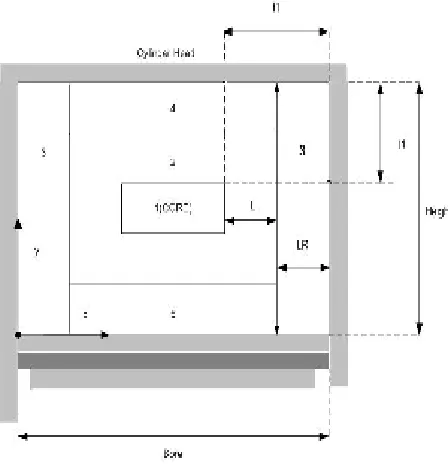
In order to improve single-zone model limitations, a five-zone model was developed. As shown in Figure 1, five-zone model includes two core zones, one zone for cylinder wall, one zone for cylinder head and one zone for piston crown. Core volume (Vcore) is perfectly centered within the charge, forming an inner cylinder of gas that is surrounded by an outer concentric shell of gas with thickness t1.
To model a physical boundary layer, it is assumed that each zone becomes successively thinner as it approaches an in-cylinder surface. This procedure for allocating zones is also consistent with the natural temperature profiles that develop within the charge during the compression stroke and leading up to combustion. Another parameter, which is essential to calculate the remaining zone thicknesses, is the geometric ratio defined by R. The value of R indicates each successive zone is how much thinner than previous
zone’s thickness. Vcore, a fraction of total cylinder volume, and R are adjustable model parameters.
3. GOVERNING EQUATIONS
Due to the mass conservation and modeling of the closed part of combustion, from inlet valve closing (IVC) to exhaust valve opening (EVO), in-cylinder mass remains constant. Therefore:
0 = dt tot dm (1)
Mass is transferred between zones to maintain the pressure uniform inside the combustion chamber as follows: 0 ≠ dt k dm
K =1,...,NZ (2)
tot m Z N K k m = ∑ =1
K=1,...,NZ (3)
The cylinder pressure is calculated at each crank angle (CA) step using the ideal gas relation for all the zones: k T u R k MW k m k
PV = K=1,...,NZ (4)
Cylinder volume changes relative to time as follows:
(
sin2)
)]2 1 2 sin 2 2 1 (sin 1 2 1 [ dt d C R dt d c r c V dt dV θ θ θ θ θ − − − − − = (5)
Energy conservation equation and net rate of production equation for each species are also as follows:
∑
= − +
−
= Ns
i dt k dQ dt k dV P dt k i dY i U k m dt k dT k c k m 1 , υ (6) k i MW k i dt k i dY ρ ω,
, = & (7)
All properties in each zone of a MZCM were considered to be uniform at IVC and calculated based on ideal gas theory.
Convection from in-cylinder mixture to cylinder wall in both multi-zone and single-zone models was described using Woschni correlation [14].
8 . 0 ) ( 73 . 0 ) ( 8 . 0 ) ( 2 . 0 ) ( )
(t Height t P t T t vt
c
h =β − − (8)
The Woschni correlation was developed from a regression of direct injection diesel engine data and is essentially a linearized radiative/convective relation that will greatly over-predict heat transfer in a lean burn, premixed, nonsooting engine [8]. Consequently, to predict heat loss in a better way, coefficients of the Woschni correlation were modified in this model.
Heat is transferred between zones with a mechanism similar to conduction. Therefore, the heat flux is based on the temperature difference of the neighboring zones and on their mean distance as follows:
dy dT tot K q=− •
(9)
The total conductivity in Equation 2 is calculated based on the approach of Komninos [15] and is the sum of a laminar and a turbulent component.
t k l k tot
k = + (10)
The ratio of turbulent to laminar conductivity is calculated using the following formula:
l t t l l k t k µ µ Pr Pr = (11)
Equation 4 presupposes swirl dominated flows and is used in the absence of other data. The viscosity ratio of Equation 4 is calculated from the following relation: − − + +
=kyn 1 exp( 2 kyn )
l t α µ µ (12) and ∫ ∗ = + u n dy w u n y 0ρ µ (13)
Where k=0.41 is the Von Karman Constant,
α=0.06 and yn+ is the normal distance from the wall. The characteristic velocity is considered to be proportional to engine speed.
4. EXPERIMENTAL SET-UP AND ENGINE SPECIFICATIONS
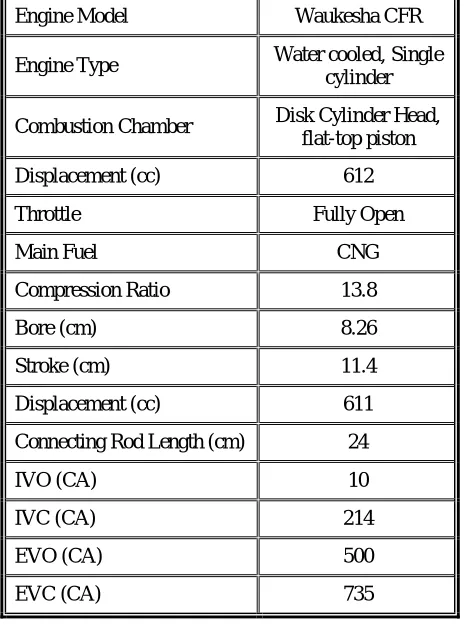
The experiments were conducted using a Waukesha Co-operative fuel research (CFR) single-cylinder engine. CFR engine is a standard engine with Bore × Stroke (mm) of 82.6 × 114.3 and displacement of 612 cc. Throttle was kept wide open. A heater was installed inside the intake manifold in order to control the intake mixture temperature when needed. Intake mixture consisted of air, natural gas and exhaust gas recirculation (EGR). Intake mixture temperature was set at constant value and was monitored just before intake valve. EGR line was taken immediately after exhaust port and returned to intake manifold after the heater and before the fuel injectors. EGR was controlled by a manual butterfly valve. A Kistler 6043A water cooled pressure transducer was used to acquire pressure signal on a 0.1 CAD resolution. Table 1 summarizes the engine specifications for the current experiments.
5. DESCRIPTION OF THE COMPUTATIONAL PROCEDURE OF
MULTI-ZONE MODEL
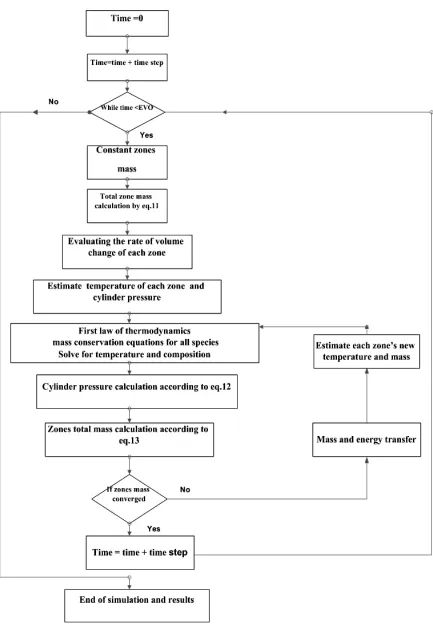
not considered). In order to estimate temperature and composition of the zones, the first law of thermodynamics, simultaneously, with the net rate of production equation for each species was applied.
In the second stage, initially, the cylinder total pressure was calculated. Then, by considering ideal gas law and each zone's defined volume, each zone's new temperature and mass were calculated. If the computed mass in the second stage differs considerably with considered tolerance of the first stage, in order to equalize pressure, mass transfer among the zones takes place. Because of mass transfer, energy transfer among the zones occurs. Thus, the first law of thermodynamics and the mass conservation step should be calculated again. Single-zone model procedure is like multi-zone model. But in single zone-model the number of zones is one, therefore there is no mass transfer phenomenon.
6. GENETIC ALGORITHM
In the current study, genetic algorithm (GA) was applied using a FORTRAN90 code. GA code first, recalls GA input parameters from a file, and then it produces a population randomly, within the range +/-15% around the original values, and by recalling MZCM, it performs an initial estimate of fitness function using this population. After calculating fitness function, GA changes the chemical mechanism parameters and repeats this procedure again and again until it attains maximum generation size.
Applied GA calculates fitness function using a weighting method in which weights (wi) were selected based on functions importance. Fitness function was considered as follows:
∑ = − × 2 1 i , , , i w = Function Fitness test i X test i X code i X (14)
The term
test i X test i X code i X , ,
, − , is the ith
target function in which, Xi,code is the estimated i
th
variable via MZCM and Xi,test is the experimental attained quantity for i
th
variable. In this work the concerned functions were related to maximum pressure and indicated work of each working cycle. The optimized rate coefficients are available in appendix A. Other parameters which have been used in genetic algorithm code are shown in Table 2.
7. RESULTS AND DISCUSSION
This section verifies multi-zone and single-zone models results. As mentioned above GRI-mech 3.0 chemical mechanism’s rate coefficients were optimized for one case (case 1 in Table 3.) and then the optimized mechanism were used to model two other engine operating conditions (cases 2 and 3 in Table 3.) to validate the developed model results.
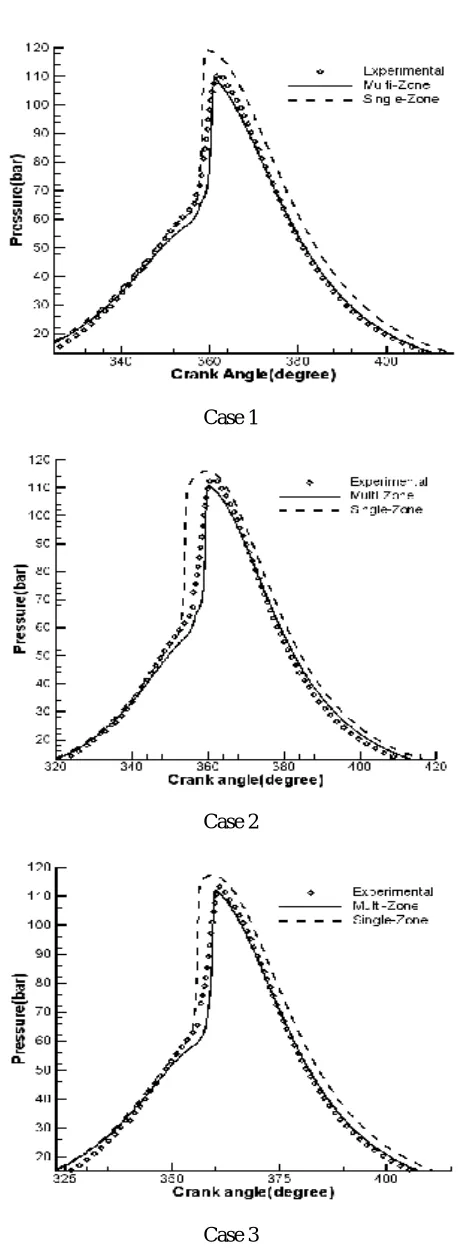
Figure 3 shows a comparison between experimental and predicted pressure traces for the three cases being considered. For each experimental data, two predicted pressure traces are shown. The predicted pressure traces were calculated with TABLE 1. CFR Engine Specifications.
Engine Model Waukesha CFR
Engine Type Water cooled, Single cylinder Combustion Chamber Disk Cylinder Head,
flat-top piston
Displacement (cc) 612
Throttle Fully Open
Main Fuel CNG
Compression Ratio 13.8
Bore (cm) 8.26
Stroke (cm) 11.4
Displacement (cc) 611
Connecting Rod Length (cm) 24
IVO (CA) 10
IVC (CA) 214
EVO (CA) 500
single-zone and multi-zone combustion models. As discussed previously, single-zone model assumes a homogenous mixture inside the cylinder and therefore, predicts a very short burning duration and a high peak pressure [16].
MZCM takes temperature and composition distributions into consideration and has better results in comparison with SZCM. According to Figure 3, MZCM can reasonably capture pressure history.
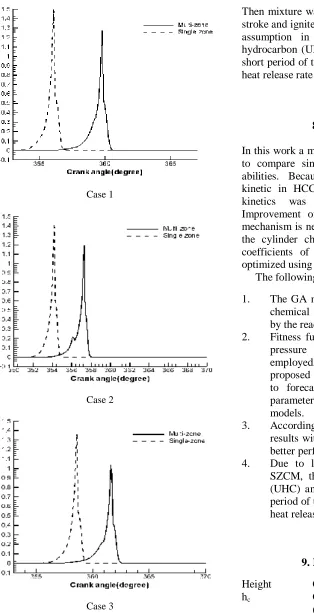
Figure 4 Shows Heat Release Rate (HRR) graphs for three considered operating conditions. According to graphs, it can be realized that in SZCM combustion starts earlier than MZCM, because boundary layer was not included in SZCM and this model predicts less heat loss than MZCM. TABLE 2. Genetic Algorithm Parameters.
Crossover Probability (Pc) 0.5 Mutation Probability (Pm) 0.02 Population Number (n-population) 50
Maximum Produced Population 300
TABLE 3. Operating ConditionsforConsideredthree Cases.
3 2
1 Case
0.29 0.48
0.55 Equivalence Ratio Ф
3.35 3.30
2.94 Air mass rate (g/s)
800 800
800 RPM
413 413
413 TIVC (K)
1.57 1.58
1.56 PIVC (bar)
9.68 21.15
30.52 % EGR
17.25 17.25
17.25 Compression Ratio
Case 1
Case 2
Case 3
Then mixture warms up faster during compression stroke and ignites earlier. Due to lumped properties assumption in SZCM, there is no unburned hydrocarbon (UHC) and all of the fuel burns in a short period of time. It causes a thinner and higher heat release rate diagram for SZCM.
8. CONCLUSION
In this work a modeling study has been carried out to compare single-zone and multi-zone models abilities. Because of importance of chemical kinetic in HCCI combustion, detailed chemical kinetics was considered in both models. Improvement of the existence chemical kinetic mechanism is necessary due to addition of EGR in the cylinder charge. For this purpose, the rate coefficients of GRI-mech 3.0 mechanism were optimized using GA.
The following conclusions have been drawn: 1. The GA might be used in the hydrocarbons
chemical kinetic mechanism development by the reactions rate coefficients adjustment. 2. Fitness function, on the basis of maximum
pressure and indicated work, might be employed, as an effective parameter, in the proposed mechanism improvement in order to forecast combustion and performance parameters by the use of both combustion models.
3. According to comparison of modeling results with experimental data, MZCM have better performance than SZCM.
4. Due to lumped properties assumption in SZCM, there is no unburned hydrocarbon (UHC) and all of the fuel burns in a short period of time. It causes a thinner and higher heat release rate diagram for SZCM.
9. NOMENCLATURE
Height Cylinder height (m)
hc Convection heat transfer coefficient (W/m2 k)
K Thermal conductivity (W/m k)
k
Karman constantCase 1
Case 2
Case 3
L Thickness (m)
m Mass (Kg)
k
m The amount of mass inside the kth zone (Kg)
k
MW Average zone Molecular weight of
the kth zone (Kg/Kmole) S
N Total number of species Z
N Total number of zones P In-cylinder Pressure (Pa)
k
Q Heat transfer into/out of the kth zone (J)
R Geometric ratio
RC Ratio of connecting rod length to crank radius
c
r
Compression ratioZ Number of zones
u
R Universal Gas Constant (8.314 J/mole K)
t Time measured reference to TDC (t @ TDC = 0 sec)
t1 Thickness (m)
T Temperature (K)
k
T Mixture temperature of the kth zone (K)
i
U Internal energy of the ithspecies (J)
V In-cylinder volume (m3) c
V Clearance volume (m3) k
V
Volume inside the kth zone (m3) wi Weighting factor of the ith targetfunction
y Distance (m)
k i
Y, Mass fraction of the i th
species in the kth zone
Greek
β Correcting factor for heat transfer to the wall
ν Velocity (m/sec)
•
ω Molar rate of production
(moles/(cm3 sec))
φ Equivalent ratio
ρ Density (Kg/m3)
k
cν Specific heat constant (at constant volume) of intake mixtures inside the kth zone (J/Kg K)
θ Crank angle (Degree)
Subscripts
l Laminar
n Normal
t Turbulent
tot Total
w Wall
Superscripts
+ Dimensionless value ٭ Characteristic value
Abbreviations
ATDC After top dead center BTDC Before top dead center
CA Crank angle
CFR Co-operative fuel research CNG Compressed natural gas EGR Exhaust gas recirculation EVO Exhaust valve opening GA Genetic Algorithm
HCT Hydrodynamics, Chemistry and Transport
HRR Heat release rate IVC Inlet valve closing
MZCM Multi-zone combustion model RPM Revolutions per minute SZCM Single-zone combustion model SOC Start of combustion
UHC Unburned Hydro Carbon
10. APPENDIX A
Optimized GRI-mech 3 Mechanism
Rate coefficients are expressed in the form:) exp(
RT E b
T A
K= × × −
For concentration units mol/cm 3 and time in s. E is given in cal/mol.
11. REFERENCES
1. Noda, T. and Foster, D.E., “A Numerical Study to Control Combustion Duration of Hydrogen-Fueled HCCI by Using Multi-Zone Chemical Kinetics Simulation”, SAE Paper, No. 01-0250, (2001).
2. Fiveland, S.B. and Assanis, D.N., “A Four-Stroke Homogeneous Charge Compression Ignition Engine Simulation for Combustion and Performance Studies”, SAE Paper, No. 01-0332, (2000).
3. Suzuki,H., Koike,N., Ishii, H. and Odaka, M., “Exhaust Purification of Diesel Engines by Homogeneous Charge with Compression Ignition Part 1: Experimental Investigation of Combustion Behavior under Premixed
Homogeneous Ignition Method”, SAE Paper, No.
970313, (1997).
4. Ishibashi, Y. and Asai, M., “Improving the Exhaust Emission of Two- Stroke Engines by Applying the Activated Radical Combustion”, SAE Paper, No. 960742, (1996).
5. Ryan, T.W. and Callahan, T.J., “Homogeneous Charge Compression Ignition of Diesel Fuel”, SAE Paper, No. 961160, (1996).
6. Aceves, S.M.,Flowers, D.L., Westbrook, C.K., Smith, J.R., Pitz, W., Dibble, R., Christensen, M. and Johansson, B., “A Multi-Zone Model for Prediction of HCCI Combustion and Emissions”, SAE Paper, No. 01-0327, (2000).
7. Fiveland, S.B. and Assanis, D.N., “A Four-Stroke Homogeneous Charge Compression Ignition Engine Simulation for Combustion and Performance Studies”, SAE Paper, No. 01-0332, (2000).
8. Easley, W.L., Agarwal, A. and Lavoie, G.A., “Modeling of HCCI Combustion and Emissions using Detailed Chemistry”, SAE Paper no. 2001-01-1029, (2001). 9. Ogink, R. and Golovitchev, V., “Gasoline HCCI
Modeling: An Engine Cycle Simulation Code with a Multi-Zone Combustion Model”, SAE Paper, No. 01-1745, (2002).
10. Babajimopoulos, A., Lavoie, G.A. and Assanis, D.N., “Modeling HCCI Combustion with High Levels of Residual Gas Fraction-A Comparison of Two VVA Strategies”, SAE Paper, No. 01-3220, (2003).
11. Kongsereeparp, P. and Checkel, M.D., “Novel Method
of Setting Initial Conditions for Multi-zone HCCI Combustion Modeling”, SAE Paper, No. 01-0205, (2007).
12. Komninos, N.P., Hountalas, D.T. and Kouremenos, D.A., “Development of a New Multi-Zone Model for Description of Physical Processes in HCCI Engines”, SAE Paper, No. 01-0562, (2004).
13. Komninos, N.P., Hountalas, D.T. and Rakopoulos, C.D., “A Parametric Investigation of Hydrogen Hcci Combustion using a Multi-Zone Model approach”, Energy Conversion and Management, Vol.48, (2007), 2934–2941.
14. Chang, J., Guralp, O., Filipi, Z. and Assanis, D.N., “New Heat Transfer Correlation for an HCCI Engine Derived from Measurements of Instantaneous Surface Heat Flux”, SAE Paper, No. 01-2996, (2004).
15. Komninos, N.P., “Investigating the Importance of Mass Transfer on The Formation of HCCI Engine Emissions using a Multi-Zone Model”, Applied Energy, Vol. 86, (2009), 1335–1343.