VOLUME NO. 4 (2014), ISSUE NO. 12 (DECEMBER) ISSN 2231-5756
A Monthly Double-Blind Peer Reviewed (Refereed/Juried) Open Access International e-Journal - Included in the International Serial Directories
Indexed & Listed at:
VOLUME NO. 4 (2014), ISSUE NO. 12 (DECEMBER) ISSN 2231-5756
INTERNATIONAL JOURNAL OF RESEARCH IN COMMERCE, IT & MANAGEMENT
CONTENTS
Sr.
No.
TITLE & NAME OF THE AUTHOR (S)
Page
No.
1
.
IMPACT OF INFORMATION SYSTEMS SUCCESS DIMENSIONS ON SYSTEMS EFFECTIVENESS: A CASE OF
SUNPLUS ACCOUNTING PACKAGE WITHIN THE ZIMBABWE UNION CONFERENCE OF THE SEVENTH-DAY
ADVENTIST CHURCH
DR. B. NGWENYA, R. CHISHIRI & F. NCUBE
1
2
.
CAPACITY BUILDING THROUGH INFORMATION TECHNOLOGY INITIATIVE IN ENVIRONMENTAL CONCERN
OF UTTARAKHAND ENVIRONMENT PROTECTION AND POLLUTION CONTROL BOARD (UEPPCB)
AMIT DUMKA & DR. AJAY GAIROLA
5
3
.
STRESS MANAGEMENT IN PRESENT SCENARIO: A CHALLENGING TASK
ABHA SHARMA & DR. AJAY KUMAR TYAGI
12
4
.
CORPORATE SIZE AND CAPITAL STRUCTURE: AN EMPIRICAL ANALYSIS OF INDIAN PAPER INDUSTRY
DR. A. VIJAYAKUMAR & A. KARUNAIATHAL
20
5
.
APPLICATION OF KNOWLEDGE MANAGEMENT PRACTICES IN SMALL ENTERPRISES
T. S. RAVI
25
6
.
A STUDY ON CUSTOMER PREFERENCE AND ATTITUDE TOWARDS DATA CARD SERVICE PROVIDERS WITH
REFERENCE TO COIMBATORE CITY
B. JANANI & T. M. HEMALATHA
28
7
.
THE SIGNIFICANCE OF EMPLOYEES TRAINING IN THE HOTEL INDUSTRY: A CASE STUDY
S. KALIST RAJA CROSS
33
8
.
A STUDY ON CUSTOMER SATISFACTION TOWARDS HEALTH DRINKS PRODUCTS (WITH SPECIAL REFERENCE
TO COIMBATORE CITY)
S. HARIKARAN
37
9
.
DATA MINING PRACTICES: A STUDY PAPER
B.AYSHWARYA
41
10
.
ASSESSING THE ORTHOPEDICALLY HANDICAPPED CUSTOMERS’ (OHC) ACCEPTANCE OF MOBILE BANKING
ADOPTION THROUGH EXTENDED TECHNOLOGY ACCEPTANCE MODEL
UTHARAJA. K & VINOD KUMAR. G
44
11
.
A FINANCIAL ANALYSIS OF INDIAN AND FOREIGN STEEL INDUSTRIES: A COMPARISON
M. BENEDICT & DR. M. SINDHUJA
48
12
.
TRENDS OF FDI IN INDIA
DR. M. K. PANDEY & ANUMEHA PRIYADARSHNI
52
13
.
CURRENT e-CRM PRACTICES IN INDIAN PRIVATE SECTOR BANKS AND THE NEED FOR STRATEGIC
APPROACH
WASEEM JOHN & SUHAIL JAVAID
55
14
.
SECURITY ISSUES IN e-COMMERCE
DR. SARITA MUNDRA, DR. SADHANA ZANZARI & ER. SURABHI MUNDRA
60
15
.
STUDY ON INVESTOR’S PERCEPTIONS TOWARDS ONLINE TRADING WITH REFERENCE TO
MAYILADUTHURAI TOWN
DR. C. BALAJI
64
16
.
IMPACT OF DEBT CAPITAL ON OUTREACH AND EFFICIENCY OF MICROFINANCE INSTITUTIONS: A SURVEY
OF SOME SELECTED MFIs IN TANZANIA
HARUNI MAPESA
69
17
.
RURAL CONSUMER ATTITUDE TOWARDS ONLINE SHOPPING: AN EMPIRICAL STUDY OF RURAL INDIA
MALLIKA A SHETTY
74
18
.
MICRO INSURANCE: A PRODUCT COMPARISON OF LIC & SBI LIFE INSURANCE
LIMNA .M
79
19
.
AN INTERDISCIPLINARY APPROACH TO EMPLOYABILITY IN INDIA
HARI G KRISHNA
82
20
.
AN OPINION-STUDY ABOUT 5-S PRACTICES TOWARDS IMPROVING QUALITY & SAFETY AND MAINTAINING
SIMPLIFIED WORK ENVIRONMENT
K.BHAVANI SELVI
87
VOLUME NO. 4 (2014), ISSUE NO. 12 (DECEMBER) ISSN 2231-5756
CHIEF PATRON
PROF. K. K. AGGARWAL
Chairman, Malaviya National Institute of Technology, Jaipur
(An institute of National Importance & fully funded by Ministry of Human Resource Development, Government of India)
Chancellor, K. R. Mangalam University, Gurgaon
Chancellor, Lingaya’s University, Faridabad
Founder Vice-Chancellor (1998-2008), Guru Gobind Singh Indraprastha University, Delhi
Ex. Pro Vice-Chancellor, Guru Jambheshwar University, Hisar
FOUNDER PATRON
LATE SH. RAM BHAJAN AGGARWAL
Former State Minister for Home & Tourism, Government of Haryana
Former Vice-President, Dadri Education Society, Charkhi Dadri
Former President, Chinar Syntex Ltd. (Textile Mills), Bhiwani
CO-ORDINATOR
AMITA
Faculty, Government M. S., Mohali
ADVISORS
DR. PRIYA RANJAN TRIVEDI
Chancellor, The Global Open University, Nagaland
PROF. M. S. SENAM RAJU
Director A. C. D., School of Management Studies, I.G.N.O.U., New Delhi
PROF. M. N. SHARMA
Chairman, M.B.A., Haryana College of Technology & Management, Kaithal
PROF. S. L. MAHANDRU
Principal (Retd.), Maharaja Agrasen College, Jagadhri
EDITOR
PROF. R. K. SHARMA
Professor, Bharti Vidyapeeth University Institute of Management & Research, New Delhi
CO-EDITOR
DR. BHAVET
Faculty, Shree Ram Institute of Business & Management, Urjani
EDITORIAL ADVISORY BOARD
DR. RAJESH MODI
Faculty, Yanbu Industrial College, Kingdom of Saudi Arabia
PROF. SANJIV MITTAL
University School of Management Studies, Guru Gobind Singh I. P. University, Delhi
PROF. ANIL K. SAINI
VOLUME NO. 4 (2014), ISSUE NO. 12 (DECEMBER) ISSN 2231-5756
INTERNATIONAL JOURNAL OF RESEARCH IN COMMERCE, IT & MANAGEMENT
DR. SAMBHAVNA
Faculty, I.I.T.M., Delhi
DR. MOHENDER KUMAR GUPTA
Associate Professor, P. J. L. N. Government College, Faridabad
DR. SHIVAKUMAR DEENE
Asst. Professor, Dept. of Commerce, School of Business Studies, Central University of Karnataka, Gulbarga
ASSOCIATE EDITORS
PROF. NAWAB ALI KHAN
Department of Commerce, Aligarh Muslim University, Aligarh, U.P.
PROF. ABHAY BANSAL
Head, Department of Information Technology, Amity School of Engineering & Technology, Amity
University, Noida
PROF. A. SURYANARAYANA
Department of Business Management, Osmania University, Hyderabad
DR. SAMBHAV GARG
Faculty, Shree Ram Institute of Business & Management, Urjani
PROF. V. SELVAM
SSL, VIT University, Vellore
DR. PARDEEP AHLAWAT
Associate Professor, Institute of Management Studies & Research, Maharshi Dayanand University, Rohtak
DR. S. TABASSUM SULTANA
Associate Professor, Department of Business Management, Matrusri Institute of P.G. Studies, Hyderabad
SURJEET SINGH
Asst. Professor, Department of Computer Science, G. M. N. (P.G.) College, Ambala Cantt.
TECHNICAL ADVISOR
AMITA
Faculty, Government M. S., Mohali
FINANCIAL ADVISORS
DICKIN GOYAL
Advocate & Tax Adviser, Panchkula
NEENA
Investment Consultant, Chambaghat, Solan, Himachal Pradesh
LEGAL ADVISORS
JITENDER S. CHAHAL
Advocate, Punjab & Haryana High Court, Chandigarh U.T.
CHANDER BHUSHAN SHARMA
Advocate & Consultant, District Courts, Yamunanagar at Jagadhri
SUPERINTENDENT
VOLUME NO. 4 (2014), ISSUE NO. 12 (DECEMBER) ISSN 2231-5756
CALL FOR MANUSCRIPTS
We invite unpublished novel, original, empirical and high quality research work pertaining to recent developments & practices in the areas of Computer Science & Applications; Commerce; Business; Finance; Marketing; Human Resource Management; General Management; Banking; Economics; Tourism Administration & Management; Education; Law; Library & Information Science; Defence & Strategic Studies; Electronic Science; Corporate Governance; Industrial Relations; and emerging paradigms in allied subjects like Accounting; Accounting Information Systems; Accounting Theory & Practice; Auditing; Behavioral Accounting; Behavioral Economics; Corporate Finance; Cost Accounting; Econometrics; Economic Development; Economic History; Financial Institutions & Markets; Financial Services; Fiscal Policy; Government & Non Profit Accounting; Industrial Organization; International Economics & Trade; International Finance; Macro Economics; Micro Economics; Rural Economics; Co-operation; Demography: Development Planning; Development Studies; Applied Economics; Development Economics; Business Economics; Monetary Policy; Public Policy Economics; Real Estate; Regional Economics; Political Science; Continuing Education; Labour Welfare; Philosophy; Psychology; Sociology; Tax Accounting; Advertising & Promotion Management; Management Information Systems (MIS); Business Law; Public Responsibility & Ethics; Communication; Direct Marketing; E-Commerce; Global Business; Health Care Administration; Labour Relations & Human Resource Management; Marketing Research; Marketing Theory & Applications; Non-Profit Organizations; Office Administration/Management; Operations Research/Statistics; Organizational Behavior & Theory; Organizational Development; Production/Operations; International Relations; Human Rights & Duties; Public Administration; Population Studies; Purchasing/Materials Management; Retailing; Sales/Selling; Services; Small Business Entrepreneurship; Strategic Management Policy; Technology/Innovation; Tourism & Hospitality; Transportation Distribution; Algorithms; Artificial Intelligence; Compilers & Translation; Computer Aided Design (CAD); Computer Aided Manufacturing; Computer Graphics; Computer Organization & Architecture; Database Structures & Systems; Discrete Structures; Internet; Management Information Systems; Modeling & Simulation; Neural Systems/Neural Networks; Numerical Analysis/Scientific Computing; Object Oriented Programming; Operating Systems; Programming Languages; Robotics; Symbolic & Formal Logic; Web Design and emerging paradigms in allied subjects.
Anybody can submit the soft copy of unpublished novel; original; empirical and high quality research work/manuscript anytime in M.S. Word format
after preparing the same as per our GUIDELINES FOR SUBMISSION; at our email address i.e. [email protected] or online by clicking the link online
submission as given on our website (FOR ONLINE SUBMISSION, CLICK HERE).
GUIDELINES FOR SUBMISSION OF MANUSCRIPT
1. COVERING LETTER FOR SUBMISSION:DATED: _____________
THE EDITOR
IJRCM
Subject: SUBMISSION OF MANUSCRIPT IN THE AREA OF.
(e.g. Finance/Marketing/HRM/General Management/Economics/Psychology/Law/Computer/IT/Engineering/Mathematics/other, please specify) DEAR SIR/MADAM
Please find my submission of manuscript entitled ‘___________________________________________’ for possible publication in your journals.
I hereby affirm that the contents of this manuscript are original. Furthermore, it has neither been published elsewhere in any language fully or partly, nor is it under review for publication elsewhere.
I affirm that all the author (s) have seen and agreed to the submitted version of the manuscript and their inclusion of name (s) as co-author (s).
Also, if my/our manuscript is accepted, I/We agree to comply with the formalities as given on the website of the journal & you are free to publish our contribution in any of your journals.
NAME OF CORRESPONDING AUTHOR: Designation:
Affiliation with full address, contact numbers & Pin Code: Residential address with Pin Code:
Mobile Number (s): Landline Number (s): E-mail Address: Alternate E-mail Address:
NOTES:
a) The whole manuscript is required to be in ONE MS WORD FILE only (pdf. version is liable to be rejected without any consideration), which will start from the covering letter, inside the manuscript.
b) The sender is required to mentionthe following in the SUBJECT COLUMN of the mail:
New Manuscript for Review in the area of (Finance/Marketing/HRM/General Management/Economics/Psychology/Law/Computer/IT/ Engineering/Mathematics/other, please specify)
c) There is no need to give any text in the body of mail, except the cases where the author wishes to give any specific message w.r.t. to the manuscript. d) The total size of the file containing the manuscript is required to be below 500 KB.
e) Abstract alone will not be considered for review, and the author is required to submit the complete manuscript in the first instance.
f) The journal gives acknowledgement w.r.t. the receipt of every email and in case of non-receipt of acknowledgment from the journal, w.r.t. the submission of manuscript, within two days of submission, the corresponding author is required to demand for the same by sending separate mail to the journal.
2. MANUSCRIPT TITLE: The title of the paper should be in a 12 point Calibri Font. It should be bold typed, centered and fully capitalised.
3. AUTHOR NAME (S) & AFFILIATIONS: The author (s) full name, designation, affiliation (s), address, mobile/landline numbers, and email/alternate email address should be in italic & 11-point Calibri Font. It must be centered underneath the title.
VOLUME NO. 4 (2014), ISSUE NO. 12 (DECEMBER) ISSN 2231-5756
INTERNATIONAL JOURNAL OF RESEARCH IN COMMERCE, IT & MANAGEMENT
5. KEYWORDS: Abstract must be followed by a list of keywords, subject to the maximum of five. These should be arranged in alphabetic order separated bycommas and full stops at the end.
6. MANUSCRIPT: Manuscript must be in BRITISH ENGLISH prepared on a standard A4 size PORTRAIT SETTING PAPER. It must be prepared on a single space and single column with 1” margin set for top, bottom, left and right. It should be typed in 8 point Calibri Font with page numbers at the bottom and centre of every page. It should be free from grammatical, spelling and punctuation errors and must be thoroughly edited.
7. HEADINGS: All the headings should be in a 10 point Calibri Font. These must be bold-faced, aligned left and fully capitalised. Leave a blank line before each heading.
8. SUB-HEADINGS: All the sub-headings should be in a 8 point Calibri Font. These must be bold-faced, aligned left and fully capitalised. 9. MAIN TEXT: The main text should follow the following sequence:
INTRODUCTION
REVIEW OF LITERATURE
NEED/IMPORTANCE OF THE STUDY
STATEMENT OF THE PROBLEM
OBJECTIVES
HYPOTHESES
RESEARCH METHODOLOGY
RESULTS & DISCUSSION
FINDINGS
RECOMMENDATIONS/SUGGESTIONS
CONCLUSIONS
SCOPE FOR FURTHER RESEARCH
ACKNOWLEDGMENTS
REFERENCES
APPENDIX/ANNEXURE
It should be in a 8 point Calibri Font, single spaced and justified. The manuscript should preferably not exceed 5000 WORDS.
10. FIGURES &TABLES: These should be simple, crystal clear, centered, separately numbered & self explained, and titles must be above the table/figure. Sources of data should be mentioned below the table/figure. It should be ensured that the tables/figures are referred to from the main text.
11. EQUATIONS:These should be consecutively numbered in parentheses, horizontally centered with equation number placed at the right.
12. REFERENCES: The list of all references should be alphabetically arranged. The author (s) should mention only the actually utilised references in the preparation of manuscript and they are supposed to follow Harvard Style of Referencing. The author (s) are supposed to follow the references as per the following:
All works cited in the text (including sources for tables and figures) should be listed alphabetically.
Use (ed.) for one editor, and (ed.s) for multiple editors.
When listing two or more works by one author, use --- (20xx), such as after Kohl (1997), use --- (2001), etc, in chronologically ascending order.
Indicate (opening and closing) page numbers for articles in journals and for chapters in books.
The title of books and journals should be in italics. Double quotation marks are used for titles of journal articles, book chapters, dissertations, reports, working papers, unpublished material, etc.
For titles in a language other than English, provide an English translation in parentheses.
The location of endnotes within the text should be indicated by superscript numbers.PLEASE USE THE FOLLOWING FOR STYLE AND PUNCTUATION IN REFERENCES: BOOKS
Bowersox, Donald J., Closs, David J., (1996), "Logistical Management." Tata McGraw, Hill, New Delhi.
Hunker, H.L. and A.J. Wright (1963), "Factors of Industrial Location in Ohio" Ohio State University, Nigeria.CONTRIBUTIONS TO BOOKS
Sharma T., Kwatra, G. (2008) Effectiveness of Social Advertising: A Study of Selected Campaigns, Corporate Social Responsibility, Edited by David Crowther & Nicholas Capaldi, Ashgate Research Companion to Corporate Social Responsibility, Chapter 15, pp 287-303.JOURNAL AND OTHER ARTICLES
Schemenner, R.W., Huber, J.C. and Cook, R.L. (1987), "Geographic Differences and the Location of New Manufacturing Facilities," Journal of Urban Economics, Vol. 21, No. 1, pp. 83-104.CONFERENCE PAPERS
Garg, Sambhav (2011): "Business Ethics" Paper presented at the Annual International Conference for the All India Management Association, New Delhi, India, 19–22 June.UNPUBLISHED DISSERTATIONS AND THESES
Kumar S. (2011): "Customer Value: A Comparative Study of Rural and Urban Customers," Thesis, Kurukshetra University, Kurukshetra.ONLINE RESOURCES
Always indicate the date that the source was accessed, as online resources are frequently updated or removed.WEBSITES
VOLUME NO. 4 (2014), ISSUE NO. 12 (DECEMBER) ISSN 2231-5756
IMPACT OF INFORMATION SYSTEMS SUCCESS DIMENSIONS ON SYSTEMS EFFECTIVENESS: A CASE OF
SUNPLUS ACCOUNTING PACKAGE WITHIN THE ZIMBABWE UNION CONFERENCE OF THE SEVENTH-DAY
ADVENTIST CHURCH
DR. B. NGWENYA
DEAN
FACULTY OF BUSINESS
SOLUSI UNIVERSITY
ZIMBABWE
R. CHISHIRI
INFORMATION SYSTEMS ADMINISTRATOR
ZIMBABWE UNION CONFERENCE
ZIMBABWE
F. NCUBE
INFORMATION & COMMUNICATION TECHNOLOGY MANAGER
SOLUSI UNIVERSITY
ZIMBABWE
ABSTRACT
Information systems’ stock has risen with technological advancement. They do not come cheaply and huge amounts of resources are committed toward successful implementation of a system reckoned to bring value to an organisation. It is worthy taking time out to establish the verity of the returns on this investment. This gives an insight into the areas that may need to be re-considered with regards to the implemented system, while also providing a guide for future implementations. The D&M information systems success model’s dimensions adopted in this study provide a standard with which a systems’ effectiveness can be assessed. The results of this study indicate that the SunPlus Accounting package is delivering satisfactorily across the 5 dimensions of information quality, system usefulness, system usage, overall satisfaction and service quality. However, the implementation process needs to be revised if users are to benefit from it. The users overall satisfaction is affected to a greater extent by information quality usage, usefulness and service quality perception than by the implementation process or usefulness. As such, for the organisation to realise more from the users, it should pay more attention to these key dimensions.
KEYWORDS
information systems, systems success dimensions, systems effectiveness, D&M information systems success model.
INTRODUCTION
n Accounting Information Systems (AIS) is supposed to provide the primary data for decision-making by administrators. It maintains and produces the data used by an organization to plan, evaluate, and diagnose the dynamics of operations and financial circumstances (Anthony et al., 2004). Being a specialized information system, it can be very expensive to purchase and maintain.
STATEMENT OF THE PROBLEM
The General Conference of the Seventh Day Adventist Church (SDA) has invested huge sums in the purchase of the licenses for Sun Plus Accounting Systems, customization and its subsequent implementation to fit the requirements of its entities as well as the requisite hardware in order to achieve the organization’s financial management objectives. Presently, there has not been a post-implementations review audit, in-house or otherwise, that has been conducted to determine whether SunPlus is really meeting its intended objectives within the Zambezi Union Conference (ZUC) constituency. There is an undetermined return to this investment in a seemingly not-so-primary mission, to warrant its continuance. Therefore, this study seeks to evaluate the effectiveness of the SunPlus Accounting System within the Zimbabwe Union Conference.
OBJECTIVES OF THE STUDY
1. To audit the implementation of the Sun Plus Accounting System in terms of sequence deliverance, content coverage and environment.
2. To audit the extent to which the implementation of SunPlus Accounting System has been effective in terms of the dimension of information quality; system
usefulness; system usage characteristics; overall satisfaction, and service quality.
3. To ascertain the extent to which each of the D&M Information Systems success dimensions explain the overall user system satisfaction.
METHODOLOGY
The study made use of stratified sampling technique. Respondents were selected based on the offices and roles they hold and play for the purpose of assessing the system`s effectiveness. All Chief Executive Officers of the ZUC institutions, Executive Secretaries, Chief Financial Officers, Financial Officers were co-opted into the population, while one Audit Financial Officer was picked from each of the entities that have this designation or equivalent. All accountants, accounting clerks and information technology support personnel were selected from each of the entities that have these positions filled. Non-probability purposive sampling technique was adopted, in which the selection of the sample was based on the judgment about some appropriate characteristics required of the sample members. A total of 707 employees from the above mentioned categories were taken as sample size and questionnaires were administered to the sample.
SCOPE OF THE STUDY
The scope of the study is limited to the case study of the Zimbabwe Union Conference (ZUC) of the Seventh Day Adventist Church. The ZUC is constituted by three Regional Conferences, that is, the East Zimbabwe Conference (EZC), the Central Zimbabwe Conference (CZC) and the West Zimbabwe Conference (WZC).
VOLUME NO. 4 (2014), ISSUE NO. 12 (DECEMBER) ISSN 2231-5756
INTERNATIONAL JOURNAL OF RESEARCH IN COMMERCE, IT & MANAGEMENT
BACK DROP
An offshoot of the Millerite movement in the United States during the middle part of the 19th century and formally established in 1863, the Seventh-day Adventist (SDA) church has extensively grown to an estimated worldwide membership of 17.2 million as of June 2011 (General Conference-Secretariat, 2012). It has a missionary presence in over 200 countries and territories and is ethnically and culturally diverse (General Conference-Office of Archives Statistics, 2009). The church operates about 10,000 schools, 168 hospitals and publishing houses worldwide, as well as a humanitarian arm known as ADRA (Adventist Development and Relief Agency). Zimbabwe Union Conference (ZUC) is a 3rd administrative level organization within the SDA church falling within the Southern Africa Indian Ocean Division (SID) of the General Conference (GC). It administers the national territory of Zimbabwe, which consists of three local conferences, a university, two dental practices, orthodontic centre, a book centre, a humanitarian agency and an orphanage. The local conferences, in and of themselves, are responsible for 75primary and 38 secondary schools, 11 clinics, and 3,890 congregations (ZUC, 2012).
Administrative reports are regularly received from lower organizations to keep higher organizations abreast of the actual performances within their territory. One such report is the financial report that ought to provide an accurate picture of the accounting and treasury functions of entities that then serves as a reference resource for decision-making. ZUC operates many different entities, bringing to fore the challenge to balance the uniform application of standards and procedures that apply to every entity to allow for meaningful comparison among similar entities and among different time periods. To this end, the church has drafted and adopted an Accounting Manual, internally referred to as the Seventh-day Adventist Accounting Manual (SDAAM, 2011). Comparability is key to performance assessment of sub organizations across time periods and industry line. Realizing this fact, the General Conference (GC), after the false starts of previous experiments with off the shelf accounting packages and attempts at internally customizing source codes, teamed up with Information Systems for the development of an accounting package especially tailor-made for the church and its entities code-named SunPlus. 403.03. Selection of Software to encourage uniformity and comparability, the denomination has modified a software application (known as SunPlus) to implement this account structure, and has made that software available to all denominational entities. Although organizations can choose to obtain other accounting software, the GC recommends the use of SunPlus (SDAAM, 2011).
Financial Reports are one by-product of an accounting system. A good accounting system, by the church standards: will enable the Chief Financial Officers to produce these reports efficiently, without additional editing and reorganizing of the underlying data, and in a format that will be understandable to the average well-informed reader. In addition, the reports should comply with generally accepted accounting principles (GAAP) and conform to the standards of uniformity required for statistical comparison with the reports of other denominational organizations (SDAAM, 2011). SunSystems 3.6 is one package that the church widely deployed as a standard to its entities. It was DOS-based, with the typical black prompt. It required extensive adaptations and had no maintenance contract from the source code seller. It could not handle large volumes of data and had some compatibility issues. To a non-computer versant user, integration with other office programs was not so seamless, requiring some tinkering and tricks. The ‘not-so-user-friendly’ interface did not help its acceptability too. Thus, in the 4th quarter of 2002, the World Church began the rollout of SunPlus to its entities. It was hoped that this would see an improvement in the quality of financial reports, reduce the workload of treasury staff, enhance comparability and reduce the time needed for report generation. As of November 2012, ZUC officially has 20 entities that use SunPlus as their Accounting package (ZUC – Mid-Year Report, 2012).
ANALYSIS OF THE STUDY
TABLE 1: CORRELATIONS Implementation
Process
Information Quality
System Usefulness
System Usage
Overall Satisfaction
Service Quality
User Capability
Implementation Process Pearson Correlation 1 -.009 .107 -.029 -.084 .136 .116
Sig. (2-tailed) .904 .166 .712 .280 .078 .135
N 168 168 168 168 168 168 168
Information Quality Pearson Correlation -.009 1 .780** .700** .770** .569** .408**
Sig. (2-tailed) .904 .000 .000 .000 .000 .000
N 168 168 168 168 168 168 168
System Usefulness Pearson Correlation .107 .780** 1 .626** .666** .526** .450**
Sig. (2-tailed) .166 .000 .000 .000 .000 .000
N 168 168 168 168 168 168 168
System Usage Pearson Correlation -.029 .700** .626** 1 .766** .666** .501**
Sig. (2-tailed) .712 .000 .000 .000 .000 .000
N 168 168 168 168 168 168 168
Overall Satisfaction Pearson Correlation -.084 .770** .666** .766** 1 .664** .289**
Sig. (2-tailed) .280 .000 .000 .000 .000 .000
N 168 168 168 168 168 168 168
Service Quality Pearson Correlation .136 .569** .526** .666** .664** 1 .453**
Sig. (2-tailed) .078 .000 .000 .000 .000 .000
N 168 168 168 168 168 168 168
User Capability Pearson Correlation .116 .408** .450** .501** .289** .453** 1
Sig. (2-tailed) .135 .000 .000 .000 .000 .000
N 168 168 168 168 168 168 168
**. Correlation is significant at the 0.01 level (2-tailed).
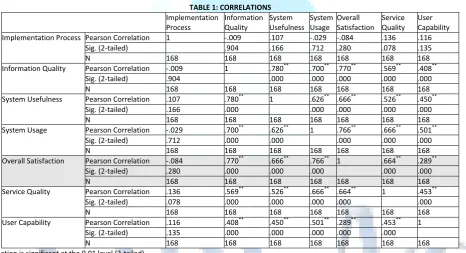
Overall, the matrix in table 1 above reflects the consistency of the relationships among Information Quality, System Usefulness, System Usage, Overall Satisfaction, Service Quality and User Capability, that is, the D&M Information Systems success dimensions adopted for the purposes of this study. There was, however, no consistent relationship between the other Information Systems dimensions with Implementation Process with correlation coefficient values close to 0 and p-values greater than 0.05. A system’s ability to produce clear, accurate, sufficient and timeous information enables a user to do more as they will spend less time hunting for meaning and sense from the output. A correlation coefficient of 0.780 reflects that those with a higher rating for Information Quality tend to rate the system’s usefulness highly too. A user is more concerned with getting a system to accept his input, process it and give an output. All the complexities involved in the processing are not important. The more complicated a system is the more likely it it is difficult to learn, and the harder it is to get it do what one wants done. The quality of information may be affected by the errors committed or omitted during data entry due to a system not being easy to use or learn. The correlation coefficient of 0.700 affirms the relationship between Systems Usage and Information Quality that is reflected from the users’ perception of SunPlus. A system’s ease of use may enhance a users’ efficiency in that less effort will be required to get a desired result. It may also be possible for more work to be done by a user if a system is easy to learn. This in turn may reduce expenses in the form of overtime or perdiem allowances paid as the need for extra time is voided. This may explain the significant correlation coefficient of 0.626, indicative of the relationship between the two dimensions of System Usefulness and System Usage.
VOLUME NO. 4 (2014), ISSUE NO. 12 (DECEMBER) ISSN 2231-5756 no access disruptions. In the case of a systems failure, a user would expect the support team to be able to solve the problem as soon as possible so that tasks may be completed on time. Entities using SunPlus are audited by General Conference Auditing Services once a year. The team normally visits and expects to finish their assignment in set time. A user would expect the support team to understand their circumstance and come to their aid quickly, without system failures derailing their schedules. A correlation coefficient of 0.766 does reflect the consistent relationship between the two dimensions. In the same vein, system support availability, competence and reliability ensures that the system is available for use and is able to do what it should. This relates it to the System Usage dimension (0.626) and System Usefulness (0.666). Moderate relationship is evident between the dimensions of System Usefulness and Service Quality, as well as between Information Quality and Service Quality. The ratings for the two are 0.526 and 0.569 respectively.
TABLE 2: THE MODEL SUMMARY
Model R R Square Cum. Adjusted R Square Std. Error of the Estimate Change Statistics
R Square Change F Change df1 df2 Sig. F Change
Information Quality .770 .593 .591 .48065 .593 242.350 1 166 .000
System Usage .833 .694 .690 .41827 .101 54.212 1 165 .000
Service Quality .846 .715 .710 .40471 .021 12.241 1 164 .001
User Capability .862 .744 .737 .38526 .028 17.972 1 163 .000
Implementation Process .866 .750 .742 .38156 .006 4.179 1 162 .043
System Usefulness .870 .756 .747 .37796 .006 4.097 1 161 .045
As shown in Table 2 above the model summary indicates that all the dimensions’ contributions are significant, (p-value <0.05). The model reflects that the Information Quality dimension singularly explains 59.1% of the variability in Overall Satisfaction. It is the key dimension that predicts the Overall Satisfaction level as it applies to Sun Plus. The addition of the System Usage dimension to the model resulted in an additional 10.1% of the variation in Overall Satisfaction with SunPlus being explained. Addition of the Service Quality dimension increased the account for variance by 2.1% while the addition of User Capability dimension increased the explanation of variation in Overall Satisfaction by 2.8% variation to 74.2%. The other 2 dimensions of implementation and usefulness increased the variance explanation by a 0.6% each, bringing the Model total explanation level to 74.7%.
DEPENDENT VARIABLE: ENHANCED OVERALL SATISFACTION
TABLE 3: REGRESSION ANALYSIS
Model Unstandardized Coefficients Standardized Coefficients t Sig.
B Std. Error Beta
(Constant) .058 .240 0.239 .811
Information Quality .448 .091 .344 4.917 .000
System Usage .388 .067 .369 5.766 .000
Service Quality .221 .047 .257 4.679 .000
User Capability -.191 .044 -.201 -4.312 .000
Implementation Process -.057 .024 -.096 -2.363 .019
System Usefulness .137 .068 .132 2.024 .045
a. Dependent Variable: Overall Satisfaction
From table 3 above, holding all other dimensions constant, for the Model that has all the dimensions included, a positive change by a one unit rating of Information Quality will increase the overall satisfaction by a rating of 0.448 units. This implies that users rate the dimension of Information Quality very highly. Bearing in mind that SunPlus is an Accounting Information System, this is to be expected as the elements of timeliness, accuracy, format and relevance are highly expected of such systems. It also confirms earlier studies that suggest the existence of an association between the Information Quality and Overall Satisfaction Dimensions (Scheepers et al., 2006). The second placed dimension is the System Usage characteristics whose positive unitary change would increase the overall satisfaction rating by 0.388 if all other dimensions are held constant. SunPlus is used for all the Financial and Treasury functions of the church’s entities. As such, its functionality has been built around the “needs” of the entities. The users’ expectations were thought out and built in, such that the user actually has no need for another system beside SunPlus. Variables like interface, ease of use and extensibility ensure the user can do more and achieve more. This is in tandem with other earlier works on the relationship (Coombs et al., 2001; Pietter, 2008). This ranked lower than System Quality probably because an Accounting Information System is primarily information focused, and other factors come second. A unitary positive change in Service Quality would produce a 0.221 shift in the Overall Satisfaction, holding all other dimensions constant. Whilst, studies by Chiu (2007), and Marble (2003) found this relationship insignificant for Accounting Information Systems in Korean firms, Pietter (2008) supports these findings. Another qualitative study found that higher quality training and friendly Information Systems support staff led to more positive attitudes about the system (Coombs et al., 2001). Systems support is closely associated with individual performance, and Service Quality ensures that an individual who strikes at productivity and effectiveness is enabled and enhanced by system availability and dependable support. The User Capability seems to have a negating influence on the variation in Overall Satisfaction, also referred to as suppressor variable. A unit increase in User Capability, with other dimensions held constant, decreases overall satisfaction by 0.191. The more a person knows, the more he expects of and from a system. So with increasing capability come more expectations and demands from the system. In the end, there will be some functionality not built in, but which has now turned into a need. This may explain this inverse effect that exists between these two dimensions. The Implementation Process Dimension, just like the User Capability Dimension also has an inverse effect on the overall system. An increase by 1 rating unit will decrease the Overall Satisfaction by 0.057 with all other dimensions held constant. While there have been very few studies on this relationship, it appears that this finding goes against the grain (Joos D et al., 2006, van der Meijden, 2003). A probable explanation could be that SunPlus orientation programs are usually conducted over a short duration, and users are taken away from their usual surroundings. Trainings are usually done at the Union Offices, rather than at the entities, and in large batches too. Users, who missed the last implementation and training, will have to get their training in-house from “secondary” sources. This could also explain the large deviations that may stem from responses from those who received training from the implementation team and those who received it from secondary in-house users. Their satisfaction with the system therefore stems from other factors like limited expectation or acceptance of the product offer from the system. System Usefulness, with all other dimensions held constant will increase the overall satisfaction by 0.137 for each unitary increase in its rating. Something is useful if it provides future benefits or when it is capable of being used advantageously. The study shows that SunPlus users are not greatly swayed by the perceived usefulness of the system. It suggests that the other dimensions are being highly considered over the elements of increase in productivity, efficiency and resource utility.
FINDINGS AND SUGGESTIONS
The results of this study indicate that the SunPlus Accounting package is delivering satisfactorily across the 5 dimensions of Information Quality, System Usefulness, System Usage, Overall Satisfaction and Service Quality. However, the implementation process needs to be revised if users are to benefit from it. The users overall satisfaction is affected to a greater extent by information quality usage, usefulness and service quality perception than by the implementation process or usefulness.
Suggestion 1: Dependent variable and independent variables are significantly related to each other.
VOLUME NO. 4 (2014), ISSUE NO. 12 (DECEMBER) ISSN 2231-5756
INTERNATIONAL JOURNAL OF RESEARCH IN COMMERCE, IT & MANAGEMENT
Suggestion 3: For Overall System Satisfaction – the system implementation process is very important. If users are to fully benefit from the system, the implementation process for Sun Plus Accounting System will need to be revised, especially the orientation scope and duration. This will prepare the user for the effective application of the system and improve overall satisfaction with the system.REFERENCES
1. Anthony, R. S., Reese, J. S. & Herrenstein, J. H. Accounting Text and Cases, Irwin, 2004.
2. Chiu CM, Chiu CS and Chang HC Examining the Integrated Influence of Fairness and Quality on Learners’ Satisfaction and Web- based Learning Continuance
Intention. Information Systems Journal, 2007, Vol 17, Issue 3, pp 271–287.
3. Coombs C.R., Doherty N.F., Loan-Clarke J. The importance of user ownership and positive user attitudes in the successful adoption of community
information systems. Journal of End User Computing, 2001, Vol 13, Issue 4, pp 5–16.
4. Egwakhe O. George Seventh Day Adventist Accounting Manual January 2011 Edition. General Conference, 2011, p.33.
5. Joos, D, Klein G, Carr C.L, Measuring Information System Service Quality: SERVQUAL from the Other Side. MIS Quarterly, 2006, Vol 26, Issue 2, pp 145–166.
6. Marble K, Post-Implementation Evaluation of Information Systems Technology: A Survey of UK Practice. Working Paper, 2003, Department of Computing,
Manchester Metropolitan University.
7. Pietter, P Effectiveness of Accounting Information System: Effect on Performance of Thai Listed Firms in Thailand. International Academy of Business and
Economics, 2008, Vol 12, Issue 3.
8. Scheepers R, Scheepers H and Ngwenyama OK Contextual Influences On User Satisfaction with Mobile Computing: Findings from Two Healthcare
Organizations. European Journal Of Information Systems, 2004, Vol 15, Issue 3, pp 261–268.
9. Seventh-day Adventist World Church Statistics". Office of Archives and Statistics, General Conference of Seventh-day Adventists. December 2009.
Retrieved 2012-12-17.
10. Seventh-day Adventists—the Heritage Continues Along. General Conference of Seventh-day Adventists. Archived from the original on December 6, 2006.
Retrieved 2012-11-17.
11. Sithole, R Secretariat Report – 4th Constituency Meeting. Bulawayo, Zimbabwe: The Secretariat, Zimbabwe Union Conference of Seventh-day Adventists.
2012. p. 26.
12. Van der Heijden H User Acceptance of Hedonic Information Systems. MIS Quarterly, 2004, Vol 28, Issue 4, pp 695–704.
13. Van Der Meijden MJ, Tange HJ, Troost J, Hasman A, Determinants of Success of Inpatient Clinical Information Systems: A Literature Review. J Am Med
VOLUME NO. 4 (2014), ISSUE NO. 12 (DECEMBER) ISSN 2231-5756
CAPACITY BUILDING THROUGH INFORMATION TECHNOLOGY INITIATIVE IN ENVIRONMENTAL CONCERN
OF UTTARAKHAND ENVIRONMENT PROTECTION AND POLLUTION CONTROL BOARD (UEPPCB)
AMIT DUMKA
DY. MANAGER (EXTENSION & TRAINING)
GOVERNMENT MEDICAL COLLEGE
HALDWANI
DR. AJAY GAIROLA
ASSOCIATE PROFESSOR
DEPARTMENT OF CIVIL ENGINEERING
IIT
ROORKEE
ABSTRACT
Uttarakhand, a newly formed state of Union of India has raised several issues of environmental concern due to rapid increase in population and caused industrial development. The environment includes water, Air, Land and inters relationship which exists among and between water, air and land and human beings, other living creatures, plants, micro-organism and properties. In amendment to the Indian constitution makes provisions for protecting and improving the environment. The state policy in which enjoins the state to make endeavour for protection and improvement of the environment, safe guarding for the forest and wild life of the country. Yet another amendment which stipulates that, it shall be the duty of every citizen of India to protect and improve the natural environment including forest, lakes, rivers and wild life and to have compassion for leaving creative. After the Stockholm conference on human environment in June 1972 it was considered appropriate it have uniform laws all over the country for broad environmental problem endangering the health and safety of people as well as flora and fauna. To ensure the sustained compliance of such laws is a great challenge. The present paper discusses the capacity building of Uttarakhand Environment Protection & Pollution Control Board (UEPPCB) by implementing Online Consent Management System to ensure transparent and efficient and monitoring of environmental laws and waste management rules enforcement.
KEYWORDS
E-Governance in Environment Management, Environmental benefits of e-governance, online consent management, Offline consent Management, eXtended Green Node (XGN).
INTRODUCTION
ttarakhand Environment Protection and Pollution Control Board is an autonomous regulatory body under the EP Act – 1986. It is mandatory to implement specific provision of the acts and the rules made thereof. In exercise of its power the board under the acts has certain roles and functions to perform.
Among the various, the regulatory and monitoring of the industries, is an important role and function of the Board. This involves scrutinizing a large numbers of applications received from the industry desirous for seeking permission from the board for establishing and operating an industrial unit within the geographical boundary of the state. It is mandatory that the decision for consenting or rejecting be taken within a stipulated period of time. This decision making requires time bound coordinated inputs from different levels of officials. Under various constraints the response time in taking the decision would normally spill over the mandatory time schedule. It was felt that primarily this is responsible to refrain the whole system in effectively regulating and monitoring the expected eco-friendly development. This led to explore the possibilities of developing system facilitation for the governance of environmental concerns. This paper illustrates a unique comparison between the traditional mechanism of processing the application of industries and IT-enabled processing. This paper has shown useful conclusion highlighting environment benefits of e-governance.
METHODOLOGY
The mechanism involved in processing the application has been illustrated in this section.
TYPE OF CONSENTS: The industry approached the UEPPCB broadly for three types of consents:-
NoC : To establish the unit.
COP : To operate the unit.
COR : Renewal to continue the operations.
NoC and COP are then sub-categorized for Expansion and Modernization as
NoC-Exp : To establish the Expansion/Modernization.
COP-Exp : To start the operation of expansion/modernization.
FILING OF APPLICATIONS FOR CONSENT: On the basis of consent type form should be obtained from board or downloaded from board’s website and duly filled application from should be submitted to the Board.
SCRUTINY: Scrutiny is done as per the statutory norms laid down in the respective acts/notifications. Criteria are based on:-
Location of industry.
Site suitability
Project Cost.
Manufacturing Process.
Product and Raw material used.
Water and Air pollution control measures and its adequacy.
Air and water quality through various parameters.
DECISION MAKING: It involves the physical inspection of the site, where primary data provided in application form is monitored/inspected and supplemented by secondary data generated through analysis report of the parameters of drawn samples. The final decision on grant/reject is arrived at through a number of steps including the evaluation of project report/compliance of the issued consents etc.
MONITORING PLAN: Monitoring should be done as per the schedule provided based on the colour categorization (Schedule V):
Red Category (17) : every 90 days.
Red Category (54) : every 120 days.
VOLUME NO. 4 (2014), ISSUE NO. 12 (DECEMBER) ISSN 2231-5756
INTERNATIONAL JOURNAL OF RESEARCH IN COMMERCE, IT & MANAGEMENT
Green Category : once in a year.
Monitoring enables the Board to review the quality of pollutants (emissions and effluent) generated by the unit.
DEVELOPMENT OF ALGORITHM
CONSENT MANAGEMENT TRADITIONAL (OFFLINE) SYSTEM Industry has to collect the consent application form from Board’s office or download from Board’s website. There are three types of form for seeking consent:-
NOC Form: For those units who want’s to establish a new unit or expansion/modernization/change of product mix in the existing unit.
Form I (Air) and Form I (Water) form: For those units who wants to start operations for newly established unit or for expansion/
modernization/change of product mix in unit and also for continuing the operations of the unit.
Along with the duly filled application form, the supporting documents as annexed and demand draft of the prescribed fee be submitted to the Board’s
office in three sets. The bunch of documents may vary from 300-1800 pages depends on type of project/unit. Requires 5-10 days to file the application at Regional Office and the process is completely physical/human interaction based.
Then in an indexed file as per the type of consent, the submitted documents are put up to the Regional officer (RO). The case is then referred to the technical staff at RO for scrutiny and Inspection. The process is time taking as depends on number of application in current movement and number of tables/desks for movement. Completely human interaction based and some errors results in dumping of file, which may be due to scarcity of time, multitasking nature of job profile of the staff.
Technical staff then scrutinizes application, in case if some additional information is required then query is raised to the applicant, else inspection of the
unit is planned to verify the information provided by the applicant and to check whether unit/applicant has implemented proper measures for emission and effluents.
For NoC/CTE, during inspection the site suitability; adequacy of water pollution control measures and air pollution control measures are verified. Whereas,
for CCA’s (COP/COR) along with above samples are drawn as per requirement. Along with samples, the compliance of earlier issued consent is also inspected.
Inspection Report along with analysis report is put up to the decision making authority through Regional Officer (as per the delegation of power). If all the
parameters of analysis report are under the permissible limits and all parameters of inspection report are complying with the norms laid in the acts, consent with conditions is issued to the applicant.
IT ENABLED (ONLINE) SYSTEM
Uttarakhand - the Adobe of the gods, the home of Himalayas and truly a paradise on earth, allures everyone from everywhere. The fresh air, the pure
water, the chilling snow, the adverting mountains, the scenic beauty, the small villages, the simpler people and a tougher life-style is what that distinguishes Uttarakhand from rest of the world.
In this context Board had an important role in facilitating and nurturing the eco-friendly industrial development to harmonize the natural ethnicity and
economic growth of the state. A key initiative has been taken up by the board to bring SMART governance (i.e. Self-Monitoring, Analysis, and Reporting Technology) by implementing IT enabled consent management system through the Ganga-XGN (Developed by the NIC, Gujarat).
Virtual office on the web has been introduced through the Online Consent Management System named Ganga-XGN.
Industry/Applicant has to register on the website to get username and password.
Applicant has to update the Industry master data viz. Industry profile, Product and Raw material, Air/Water/Hazardous waste related information.
Duly filled up application form’s (which can be collected from Regional Office or download application form from Board’s website) scanned copy and
supporting documents in PDF format are then uploaded and by clicking a button online application is submitted to the Board.
Application will be accepted only when all the required documents are uploaded. Once the application is accepted, a SMS will be sent to the applicant to
for entering the fee details.
Time for processing the application will be calculated after the physical acceptance of the demand draft along with system generated Forwarding Letter
and FORM-D/I/1.
Online processing sheets will be generated based on the logics provided for the consent and indicates type of consent and its status along with date wise
chronology of the steps taken.
When final consent will be granted applicant be informed through a SMS and after appropriate formalities consent order will be sent to industry/applicant.
The system was adopted in UEPPCB on July 06, 20009. It was made mandatory to submit the application through this system from the date.
VOLUME NO. 4 (2014), ISSUE NO. 12 (DECEMBER) ISSN 2231-5756
VOLUME NO. 4 (2014), ISSUE NO. 12 (DECEMBER) ISSN 2231-5756
VOLUME NO. 4 (2014), ISSUE NO. 12 (DECEMBER) ISSN 2231-5756
COMPARISON BETWEEN OFFLINE AND ONLINE SYSTEM
Sr.No Particulars Off-Line System On-Line system
1 Total Applications for submission 3000 3000
2 No. pages per application for submission 300 – 1800 (in triplet) 70% are 0f 300 and 30% 1800 pages. 0
3 Average Number of pages with Application 450 0
4 Average Number of pages for Office use 30 15
5 Total consumed pages* 1440000 30000
6 Total Trees fell down Per Annum# 173 4
7 Released CO2 in Air (in Pounds per year) 2544 59
* Total consumed pages = (3+4) X 1
# 1 tree = 8333 Nos of Sheets (A4 Sheets) 8333
CONCLUSION
Standardization for transparent and efficient disposal of consents.
Applicants along with the Board officials are the custodian of the file. Human interaction has been reduced.
A Transparent e-Movement from all levels. Loss of information/documents, miss-managed file management will be reduced to zero.
Strengthening the Monitoring role of the Board.
Monitoring of Technical Parameters related to Air/Water/Hazardous Pollution.
Reviews of previous inspection and Samples.
Timely Alerts for Renewals/Expiry of Consents / NoC & Payment Dues.
It is in alignment with RTI act..
Future scope: Since Online Consent Management System’s database at Board contains primary data related to the Industry viz. location, products, quantityand quality of effluents and emissions etc. which needs to be integrated with GIS based remote sensing database so as to provide dynamic and time related properties/parameters. It will help in analysing the environmental parameters and its local as well as neighbour impacts on environment.
ACKNOWLEDGEMENTS
The Leadership and advice from time to time to develop the customized on-line software by Dr.R.Mahajan, SIO, Gujarat; Mr. Harish M. Advani, TD, NIC-Gujarat; Mr.O.P.Gupta, NIC-NIC-Gujarat; Dr. D. R. Shukla, SIO, NIC-Dehradun, Mr. Sanjay Gupta TD,NIC-Dehradun, has played a very instrumental role. This has helped greatly in capacity building of UEPPCB. The support by NIC, Dehradun and BSNL Dehradun in creative the required infrastructure in highly acknowledged.
REFERENCES
1. The Air (Prevention and Control of Pollution) Act 1981, amended 1987 - No.14 of 1981, [29/3/1981]
2. The Environment (Protection) Act, 1986, amended 1991 - No.29 of 1986, [23/5/1986]
3. The Water (Prevention and Control of Pollution) Act, 1974, amended 1988 - No.6 of 1974, [23/3/1974]
WEBSITES
4. http://www.conservatree.com/learn/EnviroIssues/TreeStats.shtml
5. http://www.recycling-revolution.com/recycling-facts.html
VOLUME NO. 4 (2014), ISSUE NO. 12 (DECEMBER) ISSN 2231-5756
INTERNATIONAL JOURNAL OF RESEARCH IN COMMERCE, IT & MANAGEMENT
STRESS MANAGEMENT IN PRESENT SCENARIO: A CHALLENGING TASK
ABHA SHARMA
RESEARCH SCHOLAR
TEERTHANKER MAHAVEER UNIVERSITY
MORADABAD
DR. AJAY KUMAR TYAGI
FORMER PROFESSOR
ACCURATE INSTITUTE OF ADVANCED MANAGEMENT
GREATER NOIDA
ABSTRACT
The national institute of occupational safety and health (NIOSH-USA) defines stress as “the harmful physical and emotional responses that occur when the requirements of the job does not match with the capabilities, resources of the workers”. In industrialized countries, there have been quite dramatic changes in the conditions at work, during the last decade, caused by economic, social and technical development. As organizations contend with tougher business environments around the world, these demands trickle down to employees in the form of longer hours, tighter deadlines, and so on, making stress a universal issue. Stress was identified as the number one health risk factor in nearly all surveyed countries so that stress management is becoming a major issue in both corporate and social agenda . Employers are not understating this risk, as stress materially affects employee attitudes towards their work and the organization in general. As a consequence, the people today at work are exposed to high quantitative and qualitative demands as well as hard competition caused by global economy. Stress Management is a challenging task in Present scenario because different cultures have different values and motivators. This is why, as an employer, have to spend too much time on learning about new team members, their culture, and what will motivate them to perform effectively. A successful strategy for preventing stress within the workplace will ensure that the job fits the person, rather than trying to make people fit jobs that they are not well suited to. The focus of the paper is to study the work stress their causes and effects and also find out the coping strategies that employers are focusing for preventing work stress.
KEYWORDS
stress management, HRM.
INTRODUCTION
odern life is full of hassles, deadlines, frustrations, and demands. For many people, stress is so commonplace that it has become a way of life. According to stoner and wankel “Stress is the tension and pressure that result when an individual views a situation as presenting a demand that threatens to exceed his capabilities and resources.” Job stress is mainly a product of the working condition or situation therefore this is to be considered as a big issue. So it is a growing organizational problem that deserves attention of the top management. Although today occupational stress and stress management have assumed enormous importance in organizations, stress-like phenomena have long been of concern in the world of work. The very first academic research into what could nowadays be considered stress-like symptoms can be traced back to the early 1900s and studies into the effects of fatigue. ‘Stress’ first started to appear as a subject of psychological research after the Second World War. Since then, research in the area has burgeoned, and stress has moved from being the focus of academic research to assume a vast importance in our understanding and interpretation of everyday life. Inevitably, this has included the part of our lives that we spend in work. In fact, use of the term stress goes much further than merely expressing an emotion or feeling.
When an individual talks about stress, we hear them not only expressing a feeling or experience, but often describing a cause and effect relationship, or attributing cause for the way they feel. For workers everywhere, the troubled economy may feel like an emotional roller coaster. "Layoffs" and "budget cuts" have become bywords in the workplace, and the result is increased fear, uncertainty, and higher levels of stress. Increasing competition in the global market has compelled Indian organizations to deal with stress management issues on a priority basis.
SOURCES OF STRESS
Work-related stress is a growing problem around the world that affects not only the health and well-being of employees, but also the productivity of organizations. Work-related stress arises where work demands of various types and combinations exceed the person’s capacity and capability to cope. Research findings show that the most stressful type of work is that which values excessive demands and pressures that are not matched to workers’ knowledge and abilities, where there is little opportunity to exercise any choice or control, and where there is little support from others. Causes of stress - known as stressors - are in two categories: external stressors and internal stressors.
VOLUME NO. 4 (2014), ISSUE NO. 12 (DECEMBER) ISSN 2231-5756
TOP CAUSES OF WORK-RELATED STRESS IN U.S. - TOWERS WATSON SURVEY
Towers Watson Global Benefits Attitudes Survey highlights that the main sources of stress for employees in U.S. are tied to the work experience — specifically, inadequate staffing, low pay increases and conflicting job expectations.
Unclear or conflicting 30%
Lack of work/life balance 24%
Inadequate staffing (lack of support, uneven workload or performance in group) 52%
Technologies that expand availability during nonworking hours (e.g., mobiles, notebooks) 8%
Organisational culture, including lack of teamwork, tendency to avoid accountability and assign blame to others 33%
Lack of supervisor support, feedback and not living up to their word 23%
Lack of technology, equipment and tools to do the job 13%
Low pay (or low increases in pay) 38%
Fears about benefit reduction/loss (e.g. lower value or loss of health care coverage, reduction in retirement benefits) 11%
Fears about job loss, too much change 20%
Source : 2013 Global Benefit Attitudes Survey, completed by 22,347 workers globally (7,094 in Asia Pacific) at companies with 1,000 or more employees.
0%
10%
20%
30%
40%
50%
60%
MAJOR LIFE CHANGES
Marriage, death, birth, any disease.
THOUGHTS
mind, opinion, pessimism FINANCIAL PROBLEM
Inadequate pay or benefits, family crisis
ATTITUDE
Rigid, aggressive, Lower tolerance WORK ENVIRONMENT
Noise, light, equipment ,recourses
CHRONIC WORRY
Heart disease, sugar, Accident, memory loss RELATIONSHIP DIFFICULTIES
Change management, coworkers, staff, customer
COGNITIVE DIFFICULTIES
reduced ability to concentrate or make decisions JOB CHALLENGES AND EXPECTATIONS
Competition, deadline, demands, recognition, reward, long work hours
AMOUNT OF REST AND SLEEP Insomnia, leisure time, lunch breaks etc BALANCING CARRIER AND FAMILY
work interfering with home/personal life, unsocial hours, excessive travel time
PERFECTIONISM
Fear of failure, presentation, public speaking INTERPERSONAL CONFLICT
lack of support from others, poor relationships with colleagues
NUTRITIONAL STATUS
Gastrointestinal upsets, such as diarrhea or constipation TECHNOLOGY
demands of learning new skills, software, new ways of working.
PRESENCE OF ILLNESS Any injury, infection CONTROL
Lack of control over assignment, job, performance.
DISINTEREST
Job profile, boring work, lack of resources, repetitive work ORGANIZATIONAL DECISION
Introduction strategies, implementation, training, promotion, transfer, bonus.
VOLUME NO. 4 (2014), ISSUE NO. 12 (DECEMBER) ISSN 2231-5756
INTERNATIONAL JOURNAL OF RESEARCH IN COMMERCE, IT & MANAGEMENT
TOP CAUSES OF STRESS IN THE U.S.-AMERICAN PSYCHOLOGICAL ASSOCIATION
Source:- American Psychological Association, American Institute of Stress, NY Dated: 7.8.14
Since stress is the leading lifestyle risk factor across most countries in Asia likes India, U.S., Canada, and Europe. Majority of India's young IT workforce, are suffering from lifestyle disorders due to unhealthy eating habits and hectic work schedules, nearly 85% of employees in private sectors survey reveals that 42% identified themselves are afflicted to lifestyle disease, followed by 38% suffering from chronic disease and remaining 15% have an acute ailment in the private sector than the government employees ranging below 8%, according to a recent survey conducted by ASSOCHAM on the occasion of 'World Health day'. About 52 per cent of corporate employees are afflicted by lifestyle diseases linked to bad eating habits. "Unless there is a change in lifestyle and diet style, young corporate executives will be sitting ducks for a range of diseases," says Dr N. Salgunan, (cardiovascular and thoracic surgeon in Chennai) who does surgery on at least one young victim of corporate life style a day. The study further pointed out that Mumbai ranked first, while Delhi ranked second and Ahmadabad ranks third -afflicted to high levels of stress in private sector.
The Economic Times “85% of employees in private sectors afflicted to life-style, chronic diseases: ASSOCHAM Survey” Vishal Dutta, ET Bureau Apr 5, 2013. The lifestyle risk issues identified as top concerns in around the world. The top lifestyle risk factors as listed by employers in all developing countries like India U.S. Singapore Asia Pacific and china, stress led this list, followed by a lack of physical activity, obesity, tobacco use and other common issues that are exacerbated by long working hours and an increasingly sedentary working lifestyle.
stress
25%
obesity
24%
lack of physical activity
23%
poor nutrition
18%
tabacco use
10%
What affects our emloyees
Causes FactorsJob Pressure Co-Worker tension, Bosses Work Overload
Money Loss of Job, Reduced Retirement, Medical Expenses
Health Health Crises, Terminal or Chronic Illness
Relationship Divorce, Death of spouses, Arguments with friends, Loneliness
Poor Nutrition Inadequate Nutrition, Caffeine, Processed Foods, Refined Sugars
Media Overload Television, Radio, Internet, E-Mail, Social Networking
Sleep Deprivation Inability to release adrenaline and other stress hormones
U.S. Stress Statistics Data
Percent who say stress has a negative impact of their personal and professional life 77%
Regularly experience psychological symptoms caused by stress 73%
Feel they are living with extreme stress 3%
Feel their stress has increased over the past five years 48%
Cited money and work as the leading cause of their stress 76%
VOLUME NO. 4 (2014), ISSUE NO. 12 (DECEMBER) ISSN 2231-5756
TOP LIFESTYLE RISK FACTORS
Stress Lack of Physical Activity Obesity Tobacco Use Presenteeism Poor Nutrition Substance Abuse
India 1 2 3 4 5 6 7
United States 1 3 2 5 6 4 7
Singapore 1 2 4 6 3 5 7
Asia Pacific 1 2 3 4 5 6 7
China 2 1 4 3 6 7 5
Source: - 2013/2014 Staying@Work Survey Report
EFFECTS OF STRESS
The effects of stress differ from individual to individual. Stress can affect how you feel, think, behave and how your body works. Many factors influence the individual and his/ her interpretation of ‘threat’, response to threat and recuperation after a threatening experience. Usually, the effects of stress can be categorized as follows:
● Mental (how the mind works) ● Behavioral (the things we do) ● Physical (how the body works)
● Cognitive (the way we think and concentrate).
Different personality styles, gender difference, age, context, family history, emotional state, understanding of self and general social awareness will all influence each person’s stress levels. Stress which is constant and does not abate, but gets worse over time can lead to mental and physical health problems and illnesses. This is why it is in everyone’s interest to prevent stress occurring and reduce its effects when it does occur.
IMPACT OF STRESS IN VARIOUS DIMENSIONS
Affective Cognitive physical Behavioral Motivational
Anxiety Helpless/powerless Aches and pains Eating more or less Indifference
Tension Hostility Nausea, dizziness Isolating yourself from others Low morale
Apathy Projection Diarrhea or constipation Sleeping too much or too little Resistance to go to work
Irritability Distrust in peers/(emanagers Loss of sex drive Using alcohol, cigarettes, or drugs to relax Loss of interest in others
Depression Difficulties in decision making Frequent colds Nervous habits (e.g nail biting, pacing) Dampening of work
initiative
Anger Suspicion Chest pain, rapid heartbeat Procrastinating or neglecting responsibilities Loss of work motivation
Over sensitive Not feeling appreciated Impairment of immune system Hyperactivity Loss of enthusiasm, zeal,
encouragement
Dissatisfaction Memory problems Changes in hormone levels Declined productivity Disappointment, Boredom
Memory loss Cynicism about the work role Accidents Increased sick leave Disillusionment
Negativity Cognitive impairments Suicide Poor time management Demoralization
Source: Adapted from ‘‘Introduction to Work and Organizational Psychology: A European Perspective’’ by Nik Chmiel, 2000 (p 156).
STRESS MANAGEMENT TECHNIQUES
Since job and workplace stress increase in times of economic crisis, it’s important to learn new and better ways of coping with the pressure. Globalization and the successful application of sophisticated process technologies will make the human element even more important to operations competitiveness than before. Policies and practices which benefit employee health can improve productivity. The perception that levels of stress are low is associated with low staff turnover, low levels of absenteeism and low rates of illness and injury. Organizations that are perceived to be healthy tend to have clear policies and active methods of dealing with people which includes:
Physical consideration in job design
Clear goals for employees in line with organizational goals;
Respect for the dignity of each employee;
Employee input into decision making and career progression
Regular feedback and recognition of performance
Consistent and fair management action
Many practical stress management techniques like life style programme, spiritual programme and counseling are available, some for use by health professionals, self-help and others, which may help an individual reduce their levels of stress, provide positive feelings of control over one's life and promote general well-being. Evaluating the effectiveness of various stress management techniques can be difficult, as limited research currently exists. Consequently, the amount and quality of evidence for the various techniques varies widely.