A b s t r a c t. Runoff and soil erosion are serious and widespread land degradation problems throughout the world. Steep slopes are highly vulnerable to water erosion. Transport of eroded material from steep slopes has received significant attention, as sediment is both a pollutant and an effective vector for contaminant transport. Soil loss on hill slopes can be prevented by stabilizing aggregates at the soil surface with soil conditioners. In this study the effects of soil binders were investigated using the rainfall simulator and small flume facilities of IRFRI erosion laboratory. Series of experiments were conducted on soil of clay texture. Experimental treatments included different slopes (15, 20, 25 and 30 %), soil amendments and rain intensities (25, 50 and 75 mm h-1). The treatments consisted of: soil without cover (control), spraying the soil surface with three polyacrylamide solution concentrations of 25, 50 and 75 kg ha-1, mixing 10, 20 and 30 Mg ha-1gypsum with upper 5 mm of the soil surface, and applying polyacrylamide and gypsum simultaneously at the rates of 25 kg ha-1PAM + 10 Mg ha-1gypsum, 50 kg ha-1PAM + 20 Mg ha-1 gypsum and 75 kg ha-1PAM + 30 Mg ha-1gypsum. Amending the soil surface with soil binders in steep slopes did not reduce runoff significantly compared with the control. Application of soil binders alone had low efficiency as well. Application of 75 kg ha-1PAM along with 30 Mg ha-1gypsum reduced soil loss to non-detectable levels as compared with control (~ 99 %). Therefore, with the role of soil binders in flocculation of clay particles and improvement of soil physical properties, reduction in sediment concentration to a small level is not impossible. Because of the economic advantages of gypsum, application of polyacrylamide along with gypsum can be recommended for increasing their efficiency.
K e y w o r d s: polyacrylamide, gypsum, simulated rainfall, runoff and sediment yield
INTRODUCTION
Infiltration rate (IR) is one of the most important processes in the soil phase of the hydrologic cycle, since it determines the amount of runoff as well as the supply of
water to soil profile. Moreover, IR affects water-driven soil erosion, and soil degradation. In arid and semi-arid regions the main factor that controls the IR of soil under water-drop impact, especially in steep slopes, is the formation of a stru-ctural seal at the soil surface (Morinet al., 1981). This seal is relatively thin and characterized by higher density and strength, finer pores, and lower saturated hydraulic conductivity than underlying soil (Alcordo and Rechcigl, 1995). Agassiet al., (1981), Morinet al., (1981), and Ladoet al., (2004) noted that formation of a structural seal is a result of 3 comple-mentary mechanisms: (1) physical disintegration of surface soil aggregates, caused by the impact energy of raindrops; (2) aggregate slaking as a result of fast wetting of the soil; and (3) physicochemical dispersion of soil clays which migrate into the soil with water and clog the pores imme-diately beneath the surface to form the washed-in zone. The relative importance of the last mechanism depends on the electrical conductivity (EC) of the soil solution and the exchangeable sodium percentage (ESP) of the surface soil. As the EC decreases and the ESP increases, the clay dispersion is enhanced and the reduction in IR caused by seal formation becomes more pronounced (Agassiet al., 1981). Moreover, an increase of ESP decreases the stability of the soil structure and this, in turn, could enhance soil detach-ment and loss. All these hydraulic parameters are strongly affected by soil structure; therefore, it is important to main-tain the stability of soil structure during its wetting (Ben-Hur, 2006). One way of increasing the stability is the use of ground cover. But in some cases establishment of vegetation cover is difficult due to special conditions and also, in steep slopes, in spite of vegetation cover, intensive rainfall can cause remarkable soil erosion and sediment production.
Using soil binders to control runoff and soil loss in steep slopes
under simulated rainfall
A. Akbarzadeh
1, R. Taghizadeh Mehrjardi
1*, H.G. Refahi
1, H. Rouhipour
2, and M. Gorji
1 1Department of Soil Science, College of Agriculture and Natural Resources, University of Tehran, Karaj, P.O. Box 31587-77871, Iran 2
Research Institute of Forests and Rangelands, Tehran, P.O. Box 13185-116, Iran
Received October 18, 2008; accepted January 14, 2009
© 2009 Institute of Agrophysics, Polish Academy of Sciences
*Corresponding author’s e-mail: [email protected]
A
A
Agggrrroooppphhyhyysssiiicccsss
Another traditional method used to control erosion and promote vegetation establishment on steep slopes is mulching. However, mulch may not be the best alternative in many cases due to high application cost, its unavailability and large bulk mass (Wallace and Wallace, 1986). Another method for erosion control in steep land is application of different materials which are used in engineering projects related to road construction, tunnel establishment and mine engineering. An efficacious, relatively cheap, and low cost application method is the use of soil conditioners which are substances that improve physical properties of soils. Additional benefits include a decrease of rilling, an increase of vegetation establishment, smaller reshaping of slopes, and reduction of on- and off-site water pollution.
Soil binders are often called soil amendments or soil conditioners. There are various types of soil conditioners (natural, synthetic, physical, chemical and others) with different usage. Polymers are one of the best soil condi-tioners to improve soil physical properties (Wilson and Crisp, 1975). Polymers consist of repeated small identical units (monomers) coupled together to form extended chains. The polymer chain lengths in solution may range from a few thousand to some millions of Daltons and the chains are flexible, multisegmented and polyfunctional. Polyacryla-mide (PAM) is a water-soluble polymer with the ability to enhance soil stabilisation. This polymer is able to reduce soil detachment, maintain soil structure, increase infiltration rate and reduce erosion (Ladoet al., 2004). Many studies related to various aspects of effectiveness of PAM on reducing runoff and erosion, especially on sloping lands, have been reported recently (Sepaskhah and Bazrafshan-Jahromi, 2006; Santos et al., 2003; and Bjorneberg et al., 2003). Whether used alone or in conjunction with other erosion control practices, PAM is both economical and effective in controlling erosion. Therefore, it was found to be a cost-effective and safe technology (Roa-Espinosaet al., 2000). Another group of soil conditioners are the cement-based binders such as gypsum. Calcium ions are effective at im-proving soil structure and increasing water infiltration. In addition, calcium and sulphur are important micronutrients for plants. Gypsum (CaSO42H2O) is commonly used as soil amendment to provide calcium (an electrolyte source) and sulphur (Alcordo and Rechcigl, 1995). Norton and Mamedov (2006) demonstrated that surface application of gypsum reduced runoff and erosion. Roa-Espinosa et al. (2000) showed that PAM is able to reduce runoff and erosion by 60 to 97 % with 3 years studies in construction sites. Levy
et al. (1995) used silt loam loess and a clay grumusol from Israel, with ESP levels ranging from 3 to 25%. They noted that PAM was effective in controlling erosion at all the ESP levels they studied, but it was ineffective in significantly reducing runoff in soils with ESP > 20%. Norton (2007) studied the surface application of 1 Mg ha-1 synthetic gypsum (~70% CaSO42H2O) on a loamy soil with 5% slope
under 64 mm h-1 rainfall. He reported that addition of gypsum not only reduced runoff volume and sediment loss but also reduced the concentrations of phosphorous and atrazine. Borselliet al. (1996) showed that application of gypsum improved hydrological and physical properties and porosity of a kaolinitic crusting soil. The effects of 70 kg ha-1of cationic polysaccharide + 10 Mg ha-1of phospho-gypsum, 20 kg ha-1of anionic PAM + 10 Mg ha-1of phospho-gypsum and of 200 kg ha-1of polysaccharide on erosion were investigated by Agassi and Ben-Hur (1992). Their study was conducted on steep embankments with slopes ranging from 33 to 60% under natural rainfall conditions. They reported that soil losses in the treatments of polymer + phosphogypsum were 6-10 times smaller than those in the control (untreated
soil). Whilst many rills were observed in the control
treatment, plots with polysaccharide + phosphogypsum were characterized by stable aggregates with no seal or rills.
The objectives of this study were to determine the most efficient method of application of soil binders and effective-ness of the PAM, gypsum, and PAM + gypsum under diffe-rent rain intensities on steep slopes, and to evaluate the stability of different aggregate size classes after treatment with soil binders.
MATERIALS AND METHODS
application the polymer was dissolved in water and then sprayed on the soil surface in three solution concentrations of 25, 50 and 75 kg ha-1. Dry powder of natural inorganic gypsum was applied also in three rates of 10, 20 and 30 Mg ha-1. The gypsum doses were mixed with upper 5 mm of the soil. As a third treatment a combination of 25 kg ha-1PAM + 10 Mg ha-1gypsum, 50 kg ha-1PAM + 20 Mg ha-1gypsum and 75 kg ha-1PAM + 30 Mg ha-1gypsum was used.
For each experiment approximately 100 kg of soil was packed in the 1×1 m tilting flume tray (adjustable between 0 and 50% slope) and levelled manually. A rainfall simulator with oscillating nose was used in the studies. The rainfall simulator was positioned 3 m above the soil surface. Uniformity of rainfall and determination of different rain intensities with necessary variation in angle of nozzle rota-tion was accomplished. Mean drop size of produced rainfall was 1.5 mm diameter with a kinetic energy of 15.1 J mm-1m-2. Soil surface was levelled and saturated with a plastic pipe and water applied at the bottom of flume. After removal of gravity water, rainfall simulation tests at different rain intensities (25, 50 and 75 mm h-1) and under different slopes (15, 20, 25 and 30%) were done with the electronic control system for all treatments. Runoff and percolated water, sediment yield, shear strength of soil surface and splash of soil particles were measured for each run. Runoff was collected in different times for 60 min after its initiation. Weight and volume of runoff samples were recorded. Sediment concentrations were determined gravimetrically using the evaporation method from collected runoff samples in different times (Brakensieket al., 1979),ieafter drying the samples in the oven with temperature of 105°C for 24 h. Mean values of sediment concentration as well as runoff volume were measured finally with evaporation of all of the runoff samples that were collected after 60 min. Splash of soil particles was collected and measured for each run after drying the samples in the oven. We collected the splashed soil particles using a tray that was installed in front of the flume. This tray was able to collect soil particles that were splashed to the bottom of slope direction. Shear strength of soil surface before and after each run was measured with torvane apparatus. Water stable aggregate (WSA) and mean weight diameter of soil particles (MWD) before and after treatment with soil binders were determined using wet sieving method. Though for achievement of most accurate results some experiments were repeated, because of carrying a large amount of soil (about 100 kg) for each run, replication of experiments in prevalent models of statistical plots was not conceivable. Performance of experiments without replication is common in rainfall simulation studies. So any error in results may be possible. For example, if some results that were related to runoff volume or sediment concentration had essential differences with other results due to inappropriate levelling of soil surface and the occurrence of sudden depletion of a large volume of soil into the runoff, wrong collection and missing of some parts of
runoff and therefore missing the sediments, and any other unpredicted errors, we deleted such results and did not enter them into the final results. Therefore, we did not use any statistical patterns in this study and these replications are not statistical replications because of deletion of inconse-quential results. Indeed, each of the values of different para-meters is related to one individual experiment and was not repeated statistically. Also, for prediction of various para-meters derived from rainfall simulation experiments in soils treated by soil amendments, the SPSS software was used. Analysis of various parameters was done by linear regres-sion and stepwise method.
RESULTS
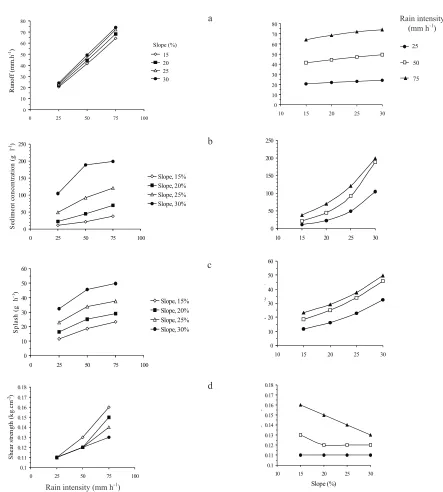
Sediment yield, runoff and percolated water, splash, and shear strength of soil (after the end of each run) for control treatments at different slopes and rain are presented in Fig. 1. As shown in Fig. 1a, with increasing rainfall intensity, runoff increased to high values, whereas addition in slope inclination had no large effect on runoff rate. Moreover, due to large amount of clay particles at the soil surface on relati-vely steep slopes, by reason of raindrop impact, a structural seal at the soil surface was observed. So, infiltration rate in this soil due to this structural seal was limited and main-tained on low level, and increase in rain intensity enhanced runoff volume rapidly. Therefore, increase in slope degree from 15 to 30% had not too much influence on runoff inten-sity. More explanation is that in low slopes partial change in slope had a perceptible influence on enhancement of runoff volume. For example, increase in slope degree from 0 to 3% had a large influence on runoff rate, whereas in steep slopes change in slope inclination had no such effect. Increase in sediment concentration with addition of slope and rain in-tensity is presented in Fig. 1b as well. As shown in this figure, rainfall intensity and slope degree had large influen-ce on sediment coninfluen-centration. An increase in sediment con-centration with addition of slope and rain intensity was similar to the splash of soil particles in the direction of the front section of the flume (Fig. 1c). Thus, it can be concluded that splash of soil particles and runoff had high effect on sediment concentration. Fig. 1d shows the relation between shear strength of soil surface with rain intensity and slope after rainfall simulation experiments. As shown in this figure, an increase in slope inclination resulted in decline of shear strength. This phenomenon, presumably, is due to decreasing of surface area which receives rainfall with increasing slope degree. Moreover, probably when slope inclination increases, raindrop impact on soil surface will reduce, which leads to formation of less surface sealing and smaller value of shear strength.
25% slopes. Application of 25 kg ha-1PAM on steep slopes (30 %) and under rain intensity of 75 mm h-1had no effect on sediment reduction compared with the control. But spraying the soil surface with this same amount of PAM reduced sediment concentration by approximately from 27 to 40% at 15 to 20% slopes in comparison to the control. Application of 50 kg ha-1PAM reduced sediment concentration by from about 7 to 58% in comparison to the control in different slopes and rains. Application of 75 kg ha-1 PAM at 30% slope and under 75 mm h-1rain intensity reduced sediment
concentration by up to about 58% compared with the control. Thus, with regard to obtained results, it seems that application of 50 kg ha-1 PAM has low efficiency in reducing sediment concentration at 30% slope and under intense rain intensities (50 and 75 mm h-1). Whereas, the effect of spraying the soil surface with the same amount of PAM is relatively high at 15, 20 and 25% slopes and under different rain intensities. Application of 30 Mg ha-1gypsum, by formation of a thin protective layer on the soil surface and improvement of soil physical properties, reduced soil loss to
0 10 20 30 40 50 60 70 80
10 15 20 25 30
25
50
75
Fig. 1.Slope inclination and rain intensity effects on: a – runoff intensity, b – sediment concentration, c – splash of soil particles in the
direction of front section of the flume, and d – shear strength of soil surface in control treatments. b 0 50 100 150 200 250
10 15 20 25 30
Slope (%) S ed im e n t co n ce n tr at io n (g r. l -1) Rain intensity, 25mm/h Rain intensity, 50mm/h Rain intensity, 75mm/h c 0 10 20 30 40 50 60
10 15 20 25 30
Slope (%) S p la sh (g r. h
-1) Rain intensity,
25mm/h Rain intensity, 50mm/h Rain intensity, 75mm/h 0.1 0.11 0.12 0.13 0.14 0.15 0.16 0.17 0.18
10 15 20 25 30
Slope (%) S h e ar st re n g th (k g .c m -2) Rain intensity, 25mm/h Rain intensity, 50mm/h Rain intensity, 75mm/h 0 10 20 30 40 50 60 70 80
0 25 50 75 100
Rain intensity (mm.h-1)
R unof f (m m .h
-1) 15
20 25 30 Slope (%) a 0.1 0.11 0.12 0.13 0.14 0.15 0.16 0.17 0.18
0 25 50 75 100
Rain intensity (mm.h-1)
S h e ar st re n g th (k g .c m -2) Slope, 15% Slope, 20% Slope, 25% Slope, 30% d Rain intensity (mm h-1)
Rain intensity (mm h-1) 0 50 100 150 200 250
0 25 50 75 100
Rain intensity (mm.h-1
) S ed im e n t co n ce n tr at io n (g r. l -1) Slope, 15% Slope, 20% Slope, 25% Slope, 30% 0 10 20 30 40 50 60
0 25 50 75 100
Rain intensity (mm.h-1)
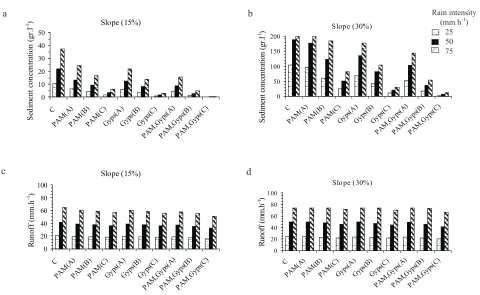
low levels at steep slopes and under intense rain intensities. And thus, application of 30 Mg ha-1gypsum at 30% slope and 75 mm h-1rain intensity reduced considerably sediment concentration by approximately up to 85% compared with the control. Consequently, reduction of soil loss to low levels is possible by use of large amounts of gypsum on steep slopes and under intense rains. Application of 75 kg ha-1 PAM along with 30 Mg ha-1gypsum reduced soil loss to non-detectable levels as compared with the control (Fig. 3). Also, application of these amounts of soil conditioners together caused a reduction in sediment concentration by approximately up to 99% compared with the control at steeper slopes and higher rain intensities. Application of 50 kg ha-1PAM along with 20 Mg ha-1gypsum at 30% slope and under 75 mm h-1rain intensity reduced sediment concen-tration by approximately 73% compared with the control.
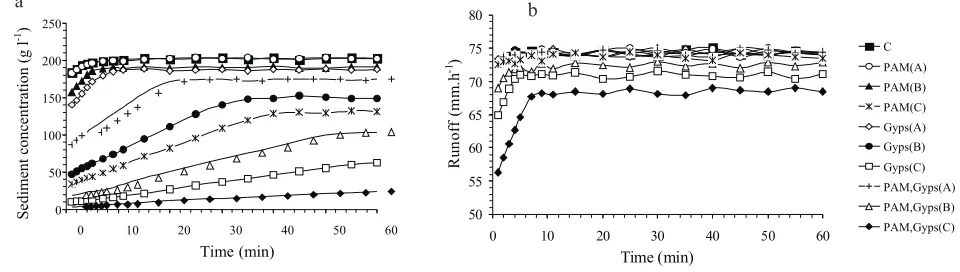
The effect of different levels of soil amendments on re-duction of sediment concentration during 60 min after initiation of runoff on 30 % slope and under 75 mm h-1rain intensity compared with the control is presented in Fig. 4. The effectiveness of 25 kg ha-1PAM decreased at the initial moments of runoff generation rapidly. It means that varia-tion of sediment concentravaria-tion with time for this treatment reached steady state conditions quickly. Whereas, for the
same slope and rain intensity, the effectiveness of 75 kg ha-1 PAM decreased about 40 min after initiation of runoff ie steady state was reached at 40th min. Hence, spraying of soil surface with large amounts of PAM had considerable efficien-cy in soil loss reduction. Also, as it is shown in Fig. 5, the effectiveness of 30 Mg ha-1gypsum on sediment reduction did not decrease even 1 hour after initiation of runoff. Chan-ges of sediment concentration with time for treatment of 50 kg ha-1 PAM + 20 Mg ha-1 gypsum reached steady-state approximately in 60 min after initiation of runoff. This figure also illustrates the efficiency of 75 kg ha-1PAM along with 30 Mg ha-1gypsum on soil loss reduction compared with the control on steep slopes and under intense rains. Sediment concentration is negligible for this treatment (~ 99% lower than control treatment) even at 60 min after initiation of runoff. Application of gypsum and PAM reduced soil loss to non-detectable levels.
Soil amendments effect on reducing runoff (mean runoff intensity at 15 and 30% slopes and different rain intensities of 25, 50 and 75 mm h-1) is presented in Fig. 2. Course of changes of runoff reduction at other slopes (20 and 25%) is similar to those at 15 and 30% slope. The treatment of soil surface by soil amendments had no such influence on runoff reduction. The effect of different amounts of soil
Slope (15%) 0 10 20 30 40 50 C PAM (A) PAM (B) PAM (C) Gyp s(A ) Gyp s(B) Gyp s(C ) PAM ,Gyp s(A ) PAM ,Gyp s(B ) PAM ,Gyp s(C) S ed im e n t co n ce n tr at io n (g r. l
-1) Slope (30%)
0 50 100 150 200 C PAM (A) PAM (B) PAM (C) Gyp s(A ) Gyp s(B) Gyp
s(C)
PAM
,Gyp
s(A)
PAM
,Gyp
s(B)
PAM ,Gyp s(C) S ed im en t co n ce n tr at io n (g r. l -1) Slope (15%) 0 20 40 60 80 100 C PAM (A) PAM (B) PAM (C) Gyp s(A ) Gyp s(B) Gyp s(C ) PAM ,Gyp s(A ) PAM ,Gyp
s(B)
PAM ,Gyp s(C) R u n o ff (m m .h -1 )
Slo pe (30% )
0 20 40 60 80 100 C PAM (A) PAM (B) PAM (C) Gyp
s(A)
Gyp
s(B)
Gyp
s(C)
PAM
,Gyp
s(A)
PAM
,Gyp
s(B)
PAM ,Gyp s(C) R un of f (m m .h -1)
Fig. 2.Soil amendments effect on reducing sediment concentration (a, b) and runoff intensity (c, d) at 15 and 30 % slopes and different
rain intensities compared with the control. In these diagrams and subsequent diagrams C is control treatment, PAM (A), (B) and (C) are application of 25, 50 and 75 kg ha-1PAM, respectively, Gyps (A), (B) and (C) are application of 10, 20 and 30 Mg ha-1gypsum, respectively, and PAM,Gyps (A), (B) and (C) are application of 25 kg ha-1PAM + 10 Mg ha-1gypsum, 50 kg ha-1PAM + 20 Mg ha-1 gypsum and 75 kg ha-1PAM + 30 Mg ha-1gypsum.
a b
d c
Rain intensity (mm h-1)
Fig. 3.Soil amendments effect on splash of soil particles in the direction of front section of the flume at 15 and 30% slopes and different rain intensities compared with the control. Explanation as in Fig. 2.
Slope (30%) 0 10 20 30 40 50 C PAM (A) PAM (B) PAM (C) Gyp s(A ) Gyp
s(B)
Gyp
s(C)
PAM ,Gyp s(A ) PAM ,Gyp s(B ) PAM ,Gyp s(C ) S p la sh (g r. h -1 ) b Slope (15%) 0 10 20 30 40 50 C PAM (A) PAM (B) PAM (C) Gyp s(A ) Gyp s(B) Gyp
s(C)
PAM ,Gyp s(A ) PAM ,Gyp
s(B)
PAM ,Gyp s(C) S p la sh (g r. h -1 ) a
Fig. 4.Soil amendments effect on shear strength of the soil surface: a – before rainfall simulation experiments and b – after rainfall
simulation experiments at 30% slope and different rain intensities compared with the control
.
Explanations as in Fig. 2.(a) 0 0.2 0.4 0.6 0.8 1 C PAM (A) PAM (B) PAM (C) Gyp sum (A) Gyp sum (B) Gyp sum (C) PAM +Gyp
s(A)
PAM
+Gyp
s(B)
PAM +Gyp s(C) S h ea r st re n g th (k g .c m -2 ) a (b ) 0 0.2 0.4 0.6 0.8 1 C PAM (A) PAM (B) PAM (C) Gyp sum (A) Gyp sum (B) Gyp sum (C) PAM +Gyp s(A ) PAM +Gyp s(B ) PAM +Gyp s(C) S he ar st re n gt h (k g. cm -2 ) b
Fig. 5.Soil amendments effect on reducing of sediment concentration (a) and runoff intensity (b) at 30% slope and under 75 mm h-1rain
intensity in different times during 60 min afterinitiation of runoff compared with the control. 0 50 100 150 200 250
0 10 20 30 40 50 60
Time (min) S ed im en t co n ce n tr at io n (g l -1 ) a 50 55 60 65 70 75 80
0 10 20 30 40 50 60
Time (min) R u n o ff (m m .h -1) 0 50 100 150 200 250
051015202530354045505560
amendments in reducing runoff intensity in different times during 60 min after initiation of runoff on 30% slope and under 75 mm h-1rain intensity compared with the control is shown in Fig. 3. The effectiveness of various amounts of soil conditioners in runoff reduction decreases rapidly on steep slopes at the initial moments of runoff generation. So, with due attention to this figure, PAM and gypsum are not able to delay runoff production and will lose their effectiveness very fast.
Soil amendments effect on splash of soil particles at 15 and 30% slopes and different rain intensities (25, 50 and 75 mm h-1) is presented in Fig. 3. Splash manner for these slopes was proportional to those obtained for 20 and 25% slopes. Results of the studies showed that all of the amounts of soil conditioners were not effective in decreasing soil splash detachment. so that even the application of 75 kg ha-1 PAM + 30 Mg ha-1gypsum on 30% slope and under 75 mm h-1 rain intensity decreased soil splash detachment by just 7% compared with the control. So soil binders do not play much of a role in decreasing splash of soil particles.
As illustrated in Fig. 4a, measurement of shear strength of the soil surface before rainfall simulation experiments had shown that with addition of soil amendments to soil surface, due to improvement of soil physical properties and production of more stable aggregates, its value increased. Fig. 5b shows increase of shear strength of the soil surface after rainfall simulation experiments. Measurement of aggrega-te stability index (WSA) and mean weight diameaggrega-ter of soil parti-cles (MWD) revealed that increasing shear strength of the soil surface after rainfall simulation experiments in all treat-ments was not a result of the formation of surface sealing.
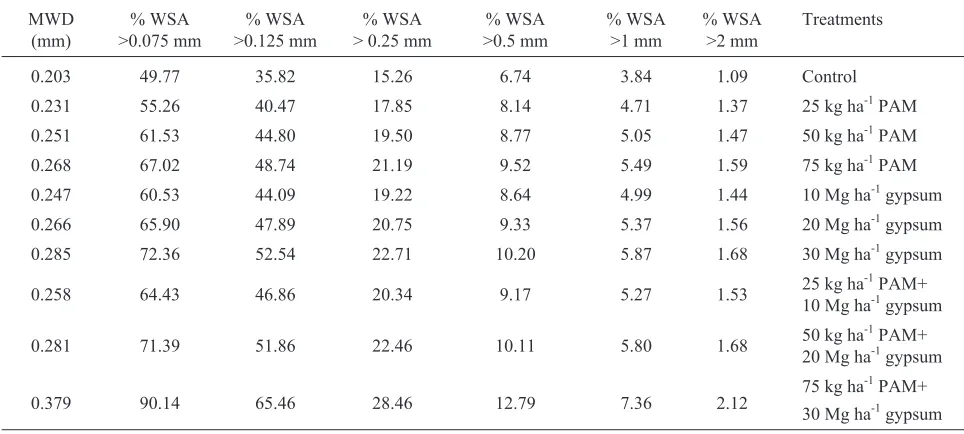
For better demonstration of the effectiveness of soil amendments on stability of soil structure, aggregate stability index (WSA) and mean weight diameter of soil particles (MWD) were determined for all treatments using the wet sieving method (Table 1). Comparison of mean weight dia-meter and stability index of soil aggregates after treatment with soil binders shows that with increasing amounts of soil conditioners, larger and more stable aggregates appear. Thus, with increasing aggregate stability, less surface sealing can be expected with application of soil amendments.
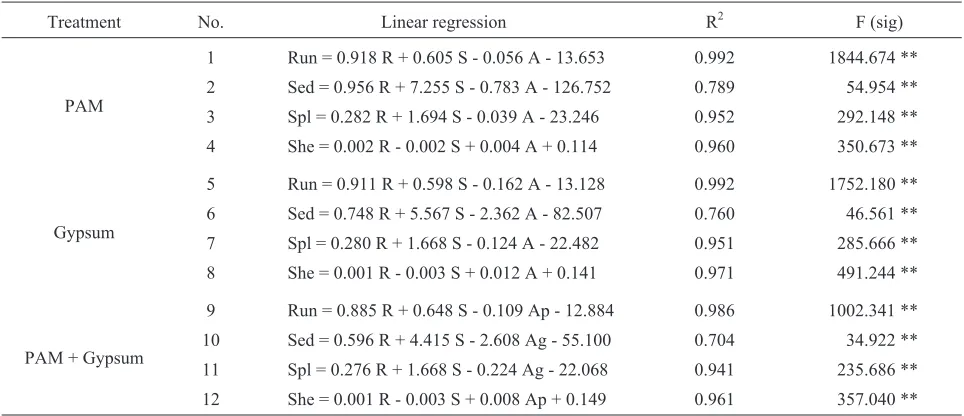
In these models the independent variables and their levels were:
– slope (15, 20, 25 and 30%);
– intensity of simulated rainfalls (25, 50 and 75 mm h-1; – application rate of: PAM (0, 25, 50 and 75 kg ha-1);
gypsum (0, 10, 20 and 30 Mg ha-1); PAM (0, 25, 50 and 75 kg ha-1) + gypsum (0, 10, 20 and 30 Mg ha-1).
The zero served as the control experiment. The depen-dent variables in the models were all measured amounts of: runoff intensity (mm h-1), sediment concentration (g l-1), splash (g h-1), and shear strength (kg cm-2).
General equation for PAM is (y = aR + bS + cA + d). In this equation (y) is each dependent variable and (R, S and A) are three independent variables consisting of: rain intensity, slope, and application rate of PAM, respectively with their coefficients (a, b, and c), d is the constant coefficient.
General equation for gypsum is (y = aR + bS + cA + d). In this equation (y) is each dependent variable, and (R, S and A) are three independent variables consisting of: rain inten-sity, slope, and application rate of gypsum respectively, with their coefficients (a, b, and c), d is the constant coefficient.
MWD (mm)
% WSA >0.075 mm
% WSA >0.125 mm
% WSA > 0.25 mm
% WSA >0.5 mm
% WSA >1 mm
% WSA >2 mm
Treatments
0.203 49.77 35.82 15.26 6.74 3.84 1.09 Control
0.231 55.26 40.47 17.85 8.14 4.71 1.37 25 kg ha-1PAM
0.251 61.53 44.80 19.50 8.77 5.05 1.47 50 kg ha-1PAM
0.268 67.02 48.74 21.19 9.52 5.49 1.59 75 kg ha-1PAM
0.247 60.53 44.09 19.22 8.64 4.99 1.44 10 Mg ha-1gypsum
0.266 65.90 47.89 20.75 9.33 5.37 1.56 20 Mg ha-1gypsum
0.285 72.36 52.54 22.71 10.20 5.87 1.68 30 Mg ha-1gypsum
0.258 64.43 46.86 20.34 9.17 5.27 1.53 25 kg ha
-1PAM+ 10 Mg ha-1gypsum
0.281 71.39 51.86 22.46 10.11 5.80 1.68 50 kg ha
-1 PAM+ 20 Mg ha-1gypsum
0.379 90.14 65.46 28.46 12.79 7.36 2.12 75 kg ha
-1PAM+
General equation for PAM + gypsum is (y = aR + bS + cA + d). In this equation (y) is each dependent variable and (R, S and A) are three independent variables consisting of: rain intensity, slope, and application rate of PAM or gyp-sum, respectively, with their coefficients (a, b, and c). Also in this equation d is the constant coefficient. For estimating of runoff intensity and shear strength none of the inde-pendent variables related to different levels of gypsum were used (the model deleted this insignificant factor). So, in these models (Ap) is application of different levels of PAM. Also for estimating sediment concentration and splash the different levels of PAM were not considered. So in these models (Ag) is application of different levels of gypsum.
Table 2 shows multivariable linear regression results at stepwise method in rainfall simulation experiments.
DISCUSSION
Zejun et al. (2002) believe that PAM increases soil structure stability and hydraulic conductivity and therefore reduces runoff and soil loss due to flocculation of particles and formation of new aggregates and prevention from surface sealing and crusting. Percentage of reduction of runoff at different slopes and rain intensities for application of 25, 50 and 75 kg ha-1PAM was 0-6, 0-9, and 3-12%, respectively, compared with the control. With regard to these results, application of low levels of PAM on steep slopes (30%) and under intense rain intensities (75 mm h-1) has a insignificant effect on runoff reduction compared with the control. Also application of low levels of PAM lost its effectiveness in reducing runoff rapidly (Fig. 3). This may be mainly due to soil saturation, surface sealing, and soil consolidation. Our results support the findings of other studies. Blanco-Canquiet al. (2004) showed that 9 kg ha-1
PAM applied on silty loam soils at 4.5 and 5% slopes under intense rains (69 and 93 mm h-1) reduced runoff by 13% compared with the control. They reported that PAM is effe-ctive for reducing runoff only during the early stages of rain-fall as well. The effectiveness of PAM diminished rapidly in time. Similarly, Aaseet al. (1998) found that 2 kg ha-1of PAM reduced runoff by 70%. However, runoff from PAM-treated and unPAM-treated soil at 80 mm h-1was the same after 30 min of irrigation. They suggested that runoff from the PAM treatment would quickly approach that of the control treatment under intense rains.
Percentage of reduction of sediment concentration in different slopes and rain intensities for application rates of 25, 50 and 75 kg ha-1PAM was 0-40, 7-58, and 58-85%, respectively, compared with the control. The high efficiency of 75 kg ha-1of PAM in reducing sediment concentration is presumably due to improving the soil structure stability. Also with respect to Fig. 3 variations of sediment concentra-tion reached steady state rapidly for the low applicaconcentra-tion levels of PAM. Therefore, rainfall decreased PAM effecti-veness, leaving soil surface increasingly unprotected from raindrop impact in the soils treated with low levels of PAM. We suggest that because of PAM penetration into the soil being limited it quickly loses its effectiveness as the soil gets eroded. Lu and Wu (2003) reported that PAM has very low penetration into the soil profile. The effectiveness of PAM for reducing erosion decreased from 94 to 82% between the first 30 min and the end of 1 hour dry run (without soil saturation they conducted their experiments and produced runoff). Similarly, Blanco-Canquiet al. (2004) showed that effectiveness of 9 kg ha-1PAM decreased within 30 min after initiation of rainfall (approximately 20 minutes after beginning of runoff) on a silty loam soil with 4.5% slope under 69 mm h-1rain intensity. They indicated that 9 kg ha-1
Treatment No. Linear regression R2 F (sig)
PAM
1 Run = 0.918 R + 0.605 S - 0.056 A - 13.653 0.992 1844.674 **
2 Sed = 0.956 R + 7.255 S - 0.783 A - 126.752 0.789 54.954 **
3 Spl = 0.282 R + 1.694 S - 0.039 A - 23.246 0.952 292.148 **
4 She = 0.002 R - 0.002 S + 0.004 A + 0.114 0.960 350.673 **
Gypsum
5 Run = 0.911 R + 0.598 S - 0.162 A - 13.128 0.992 1752.180 **
6 Sed = 0.748 R + 5.567 S - 2.362 A - 82.507 0.760 46.561 **
7 Spl = 0.280 R + 1.668 S - 0.124 A - 22.482 0.951 285.666 **
8 She = 0.001 R - 0.003 S + 0.012 A + 0.141 0.971 491.244 **
PAM + Gypsum
9 Run = 0.885 R + 0.648 S - 0.109 Ap - 12.884 0.986 1002.341 **
10 Sed = 0.596 R + 4.415 S - 2.608 Ag - 55.100 0.704 34.922 **
11 Spl = 0.276 R + 1.668 S - 0.224 Ag - 22.068 0.941 235.686 **
12 She = 0.001 R - 0.003 S + 0.008 Ap + 0.149 0.961 357.040 **
Run – runoff intensity, Sed – sediment concentration, Spl – splash, She – shear strength. **significant at 1%.
of PAM is insufficient to control erosion to low levels for rainfall events longer than 30 min. A decrease in PAM effecti-veness for application of 75 kg ha-1PAM after initiation of runoff in this study is approximately similar to the findings by Petersonet al. (2002). They reported that soil loss from recently tilled soils treated with 60 kg.ha-1 PAM did not increase within 1 h of rainfall simulation at 75 mm h-1. Similarly, Flanaganet al. (2002) showed that application of 80 kg ha-1PAM on disturbed 32% sloping soils was effec-tive in reducing soil loss by 54% after nine rainfall events, and by 40% from 19 events over a 6 month period. Because durability of erosion control by low application levels of PAM is short, we suggest that split application of PAM after major rainfall events may be a successful treatment.
Percentage of reduction of runoff at different slopes and rain intensities for application of 10, 20 and 30 Mg ha-1 gypsum was 0-7, 0-9, and 5-13%, respectively, compared with the control. Our results showed that application of low levels of gypsum on steep slopes and under intense rain intensities had insignificant effect on runoff reduction compared with the control. Also application of low levels of gypsum lost its effectiveness in reducing runoff rapidly. This may be due to washing of gypsum by runoff, surface sealing, and soil consolidation. Our results are similar to findings of other studies just in some aspects. For example, Tishmacket al. (2001) showed that application of 5 Mg ha-1inorganic gypsum on a silty clay soil at 9.5% slope under 70 mm h-1simulated rainfall reduced runoff by 12% compared with the control. They reported that changes of runoff in time for this treatment reached steady state in approximately 35 min after initiation of runoff (~ 45 min after initiation of rainfall). Whereas, for treatment of 30 Mg ha-1gypsum, just about 5 min time was needed to reach steady state after initiation of runoff at 30% slope and under 70 mm h-1rainfall. Our lower effectiveness may be explained by steeper slope and different behaviour of various soils treated with gypsum.
Percentage of reduction of sediment concentration at different slopes and rain intensities for application rates of 10, 20 and 30 Mg ha-1 gypsum was 11-44, 48-64, and 85-92%, respectively, compared with the control. The high efficiency of 30 Mg ha-1 gypsum in reducing sediment concentration is presumably due to improvement in the soil structure stability. Also rainfall decreased gypsum effectiveness in the soils treated with low levels of gypsum. Similarly, Tishmacket al. (2001) showed that application of 5 Mg ha-1inorganic gypsum on a silty clay 9.5% sloping soil under 70 mm h-1simulated rain- fall reduced sediment loss by 28% compared with the control. They reported that changes of sediment concentration with time for this treatment reached steady state in approximately 35 min after initiation of runoff (~ 45 min after initiation of rainfall). With due attention to these findings it seems that durability of erosion control by gypsum is long and even at intense rains this material does not lose its efficiency in reducing erosion. So we suggest that, taking into account the economic
advantages of gypsum, high application levels of gypsum in one stage can reduce soil erosion to low levels. This issue draws too much concern when the use of gypsum at great volumes has no economic disadvantages. Summarising, cheap value and low cost of surface application of gypsum make this material a suitable option for erosion control by improving infiltration and reducing surface sealing (Wallace-Cochraneet al., 2005).
Percentage reduction of runoff at different slopes and rain intensities for application of 25 kg ha-1PAM + 10 Mg ha-1gypsum, 50 kg ha-1PAM + 20 Mg ha-1gypsum and 75 kg ha-1PAM + 30 Mg ha-1 gypsum was 0-11, 1-15, and 11-22%, respectively, compared with the control. Our results showed that application of low levels of PAM + gypsum on steep slopes and under high rain intensities had insignificant effect on runoff reduction compared with the control. Also application of low levels of PAM + gypsum lost its effectiveness in reducing runoff rapidly. Petersonet al. (2002) reported that 40 kg ha-1PAM + 5 Mg ha-1gypsum applied on silty clay loam packed in erosion boxes was highly significant in reducing runoff, but that runoff amount increased progressively beyond 30 min of rainfall. They suggested that runoff from the PAM + gypsum treatment would quickly approach that of the control treatment under intense rains. Yuet al. (2003) found that higher amount of PAM application needs a higher amount of gypsum to achieve the best effect on infiltration. They showed that spreading dry PAM mixed with gypsum on the soil surface increased the final infiltration rate of the silty loam by up to four times compared with the control. Whereas, using PAM or gypsum alone did not prevent seal formation, reduced the soil hydraulic conductivity and its infiltration rate. Taking into account our results and findings of other studies we suggest that on sloping areas under intense rains high levels of PAM + gypsum should be applied to improve soil physical properties, prevent seal formation, and therefore reduce runoff.
solu-tion. These cations increase the adsorption of the aggregates, thus enhancing their stabilizing effect (Ben-Huret al., 1989). Therefore, short polymer chains are apparently ineffective in clogging pores, and effective in stabilising the surface ag-gregates and preventing seal formation. Baueret al. (2005) demonstrated the usefulness of low cost gypsum as soil amendment in reducing runoff and erosion. Hence, because of economic advantages of gypsum, application of PAM along with gypsum can be recommended for increasing their efficiency in increasing aggregate stability and reducing runoff and sediment yield (Tanget al., 2006).
Purchase price of 1 kg PAM in the market, depending on its type, molecular weight, charge density and manufacturer, is about 7.5-15 $. Gypsum is so cheap and can be provided from manufactures producing raw gypsum with low costs (less than 0.02 $ for each kg gypsum). So, with due attention to the cost of PAM and gypsum, their purchase price in the market can be estimated for a hectare. The California Department of Transportation (Caltrans) has reported the cost of installation of different types of soil binders as well (Caltrans, 2002). The purchase price and cost of installation of PAM and gypsum is presented in Table 3. Dates presented in this table indicate that the use of gypsum for stabilizing of soils is lower than PAM.
CONCLUSIONS
1. It was found that at steep slopes higher soil binder application rates are required to enhance soil structure stability, to reduce runoff and soil erosion. It is indicated that application of gypsum alone reduced soil erosion by approximately 92% as compared with the control.
2. Gypsum is a suitable option for erosion control due to cheap value and low cost of surface application.
3. It is indicated that for steeper slopes (up to 30%) and under intense rains the use of PAM alone is not cheap for erosion control.
4. The application of gypsum and PAM together can be recommended for temporary soil stabilization.
5. This study emphasizes that when testing soil condi-tioners performance, temporal responses should be monito-red and studies should be conducted for an appropriate period of time in order to fully characterize the response. Such attention to time ensures identification of critical thresholds where soil binders become less effective. Short-duration experiments may fail to reach threshold points, and thus provide a poor indication of system effectiveness.
6. It was indicated the low durability of soil binders on steep slopes and under intense rains. Therefore, soil binders should not be used in areas containing swift-moving con-centrated flow or high-volume sheet flow because it has a tendency to be washed away.
REFERENCES
Aase J.K., Bjorneberg D.L., and Sojka R.E., 1998.Sprinkler
irrigation runoff and erosion control with polyacrylamide-laboratory tests. Soil Sci. Soc. Am. J., 62, 1681-1687.
Agassi M. and Ben-Hur M., 1992.Stabilizing steep slopes with
soil conditioners and plants. Soil Technol., 5, 249-256.
Agassi M. and Ben-Hur M., 1991.Effect of slope length, aspect
and phosphogypsum on runoff and erosion from steep slopes. Aust. J. Soil. Res., 29, 197-207.
Agassi M., Shainberg I., and Morin J., 1981.Effect of electrolyte
concentration and soil sodicity on the infiltration rates and crust formation. Soil Sci. Soc. Am. J., 45, 848-851.
Alcordo I.S. and Rechcigl J.E., 1995. Soil Amendments and
Environmental Quality. (Ed. J.E. Rechcigl). CRC Press, Boca Raton, FL, USA.
Barvenik F.W., 1994.Polyacrylamidecharacteristics related to soil application. Soil Sci., 158, 235-243.
Ben-Hur M., 2006.Using synthetic polymers as soil conditioners
to control runoff and soil loss in arid and semi-arid regions – a review. Austr. J. Soil Res., 44, 191-204.
Ben-Hur M., Faris M.J., Malik M., and Letter J., 1989.
Polymers as soil conditioners under consecutive irrigations and rainfall. Soil Sci. Soc. Am. J., 53, 1173-1177.
Bjorneberg D.L., Santos F.L., Castanheira N.S., Martins O.C.,
Reis J.L., Aase J.K., and Sojka R.E., 2003.Using
poly-acrylamide with sprinkler irrigation to improve infiltration. J. Soil Water Cons., 58(5), 283-289.
Blaco-Canqui H., Gantzer C.J., Anderson S.H., and Thompson
A.L., 2004.Soil berms as an alternative to steel plate borders
for runoff plots. Soil Sci. Soc. Am. J., 68, 1689-1694.
Borselli L., Biancalani R., Giordani C., Carnicelli S., and Ferrari
G.A., 1996.Effect of gypsum on seedling emergence in
a kaolinitic crusting soil. Soil Technol., 9(1-2), 71-81. Brakensiek D.L., Osborn H.B., and Rawls W.J., 1979. Field
Manual for Research in Agricultural Hydrology. USDA Press, Washington, DC, USA.
Brauer D., Aiken G.E., Pote D.H., Livingston S.J., Norton L.D.,
Way T.R., and Edwards J.H., 2005.Amendment effects of
soil test P. J. Environ. Quality., 34, 1682-1686.
Caltrans,2002.State of California Department of Transportation, Caltrans Statewide Erosion Control Review, CTSW-RT-01-067.
Cost of installation*
Cost
of purchasing Types of soil binders ($ ha-1)
1 700-3 700
187.5-375 25
kg ha-1 PAM
375-750 50
562.5-1125 75
2 000-3 000
100-200 10
Mg ha-1 gypsum
200-400 20
300-600 30
*Presented by Caltrans (2002).
T a b l e 3.Cost of purchasing and installation of different types of
Flanagan D.C., Chudhari K., and Norton L.D., 2002. Poly-acrylamide soil amendment effects on runoff and sediment yield on steep slopes: natural rainfall conditions. Trans. ASAE, 45, 1339-1351.
Lado M., Paz A., and Ben-Hur M., 2004.Organic matter and
aggregate size interactions in infiltration, seal formation and soil loss. Soil Sci. Soc. Am. J., 68, 935-942.
Levy G.J., Levin J., and Shainberg I., 1995.Polymer effects on
runoff and soil erosion from sodic soils. Irrig. Sci., 16, 9-14. Lu J.H. and Wu L., 2003.Polyacrylamide distribution in columns
of organic matter-removed soils following surface applica-tion. J. Environ. Qual., 32, 674-680.
Mohamed A.M.O., 2000.The role of clay mineral in marly soils on its stability. Eng. Geology, 57, 193-203.
Morin J., Benyamini Y., and Michaeli A., 1981.The effect of
raindrop impact on the dynamics of soil surface crusting and water movement in the profile. J. Hydrol., 52, 321-335.
Norton L.D., 2007.Reducing runoff volume and concentrations of
phosphorous and atrazine with gypsum amendment. Purdue Univ. Press, West Lafayette, IN, USA.
Norton L.D. and Mamedov A.I., 2006. Reducing runoff
phosphorous loss using byproduct gypsum and waste paper. Proc. Int. Symp. Agricultural Constraints in the Soil-Plant-Atmosphere Continuum.September 2-7, Ghent, Belgium.
Peterson J.R., Flanagan D.C., and Tishmack J.K., 2002.PAM
application method and electrolyte source effects on plot-scale runoff and erosion. Trans. ASAE, 45, 1859-1867.
Roa-Espinosa A., Bubenzer G.D., and Miyashita E.S., 2000.
Sediment and runoff control on construction sites usuig four application methods of polyacrylamide mix. Proc. Conf. Tools for Urban Water Resources Management and Pro-tection, February 7-10, Chicago, IL, USA.
Santos F.L., Reis J.L., Martins O.C., Castanheira N.L., and
Serrlheiro R.P., 2003.Comparative assessment of
infiltra-tion, runoff and erosion of sprinkler irrigated soils. Bio-systems Eng., 86(3), 355-364.
Sepaskhah A.R. and Bazrafshan-Jahromi A.R., 2006.
Control-ling runoff and erosion in sloping land with polyacry-lamide under a rainfall simulator. Biosystems Eng., 93(4), 469-474.
Tang Z., Lei T., Yu J., Shainberg I., Mamedov A.I., Ben-Hur M.,
and Levy G.J., 2006.Runoff and interrill erosion in sodic
soils treated with dry PAM and phosphogypsum. Soil Sci. Soc. Am. J., 70, 679-690.
Tishmack J.K., Peterson J.R., and Flanagan D.C., 2001.Use of
coal combustion by-products to reduce soil erosion. Proc. Int. Symp. Ash Utilization, University of Kentucky, October 22-24, Lexington, KN, USA.
Wallace G.A. and Wallace A., 1986.Control of soil erosion by polyacrylamide soil conditioner. Soil Sci., 141, 363-367.
Wallace-Cochrane B., Eltz F., Reichert M., and Norton L.D.,
2005. Controlling soil erosion and runoff with
poly-acrylamide and phosphogypsum on subtropical soil. Trans. ASAE, 48(1), 149-154.
Wilson A.D. and Crisp S., 1975.Rigid highly carboxylated ionic
polymers In: Ionic Polymers (Ed. L. Holiday). Chapman and Hall Press, New York, USA.
Yu J., Lei T., Shainberg I., Mamedov A.I., and Levy G.J., 2003.
Infiltration and erosion in soils treated with dry PAM and gypsum. Soil Sci. Soc. Am. J., 67, 630-636.
Zejun T., Tingwu L., Qingwen Z., and Jun Z., 2002.The sealing