Solid Solution in the As2S3-Sb2S3 Series at
Zarshuran Gold Deposit, Iran
B. Mehrabi
*Department of Geology, Tarbiat Moalem University, 15614-Tehran, Islamic Republic of Iran
Abstract
Orpiment, getchellite and stibnite from Zarshuran deposit, NW Iran, exhibit
extensive As-Sb substitution. There are four known minerals along As
2S
3-Sb
2S
3join, i.e. orpiment (As2S3), Wakabayashilite [(As,Sb)20S30], getchellite (AsSbS3)
and stibnite (Sb2S3). Extensive mineralogical studies by scanning electron
microscope (SEM) and electron probe micro-analyzer (EPMA) indicate that
getchellite from Zarshuran exhibits large As/Sb substitution, compared to the
synthetic mineral and occurrences in other deposits, which justifies further
experimental studies. Natural orpiment with the highest Sb content was recorded
in Zarshuran samples. Considering the possible explanation for the incomplete
record of solid solution, it appears that rapid variation in fluid chemistry and
variability of As and Sb concentration in the hydrothermal solution may have
caused extensive solid solution in the As
2S
3-Sb
2S
3system. The recorded solid
solution may indicate that temperatures of gold mineralization were less than
250°C which is supported by fluid inclusion data.
Keywords: Getchellite; Orpiment; Stibnite; Solid solution; As2S3-Sb2S3 system; Zarshuran gold
deposit
*
Corresponding author, Tel.: +98(021)88309293, Fax: +98(021)88309293, E-mail: [email protected]
Introduction and Previous Work
Orpiment and stibnite have been recognized in several disseminated replacement type gold deposits in the western United States [1,2], China [3,4] and Iran [5-8]. There are four known minerals along the As2S3
-Sb2S3 join, i.e. orpiment (As2S3), Wakabayashilite
[(As,Sb)20S30] [9] and [(As,Sb)6S9] [(As4S5] [10],
getchellite (AsSbS3) and stibnite (Sb2S3). In contrast to
the common occurrences of the end members, the occurrences of getchellite and wakabayashilite are rare.
Although arsenic and antimony have different crystallochemical behaviour and structures in their
sulphides, they are chemically analogous elements. The chemical analysis of most minerals in As-Sb-S systems indicates the presence of an incomplete solid solution between orpiment and stibnite. Synthetic [11] and natural stibnite, from Nevada and Utah, exhibit 7wt% As in stibnite coexisting with orpiment [12]. The crystal chemistry of the As-Sb-S system was studied under hydrothermal condition by Nakaiet al. [11].
et al. [11]. Natural orpiment with the highest antimony content is recorded in the recent study.
Asadi et al. [13] reported high concentrations of antimony in orpiment (based on 16 EPMA point analysis) with an average of 4.71 wt%, and arsenic concentrations in coexisting stibnite (based on 4 EPMA point analysis) with an average of 3.79 wt%. They considered this as evidence for solid solution or the presence of fine grained inclusions. They reported getchellite as a uniform phase with an As:Sb ratio of 1:1 (based on 4 EPMA point analysis).
Phase relations in the As-Sb-S and As2S3-Sb2S3
systems were studied by Craiget al. [14], Dicksonet al.
[12], Sobott [15], Nakai et al. [11], Bernardini et al.
[16] and Tomkinset al. [17]. The phase diagram of the As2S3-Sb2S3 (Fig. 1) systems shows the main phases and
areas of solid solutions in these systems. Orpiment, realgar and stibnite melt at 310, 321 and 556 respectively.
Hydrothermal synthesis of the As2S3-Sb2S3 system
by Nakaiet al. [11] at 250, 300, 350 and 400°C, 1000 kg/cm2 pressure in the presence of Na2S, show that
crystals of stibnite were formed at all temperatures, whereas those of getchellite and orpiment were formed only at 250 and 300°C. Stibnite crystals formed at higher temperatures of 350 and 400°C, have a rather narrow As substitution range. Synthetic orpiment formed at 250°C shows more Sb substitution than that formed at 300°C with the same raw material.
In view of the discrepancy between the Zarshuran occurrence and other example of solid solution, the condition of mineralization at Zarshuran will first be introduced.
The Zarshuran Deposit
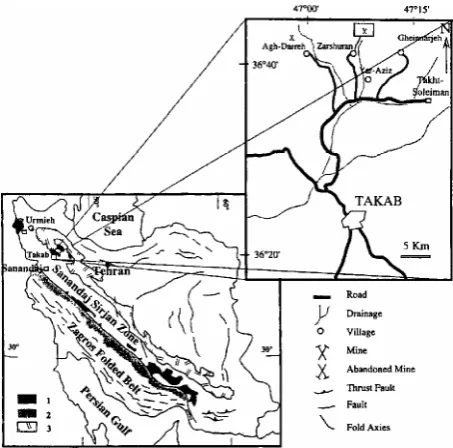
The Zarshuran deposit is located at 36° 43.390' N, 47° 08.219' E, 42 km north of Takab in the West Azarbijan province (Fig. 2). It is well known for arsenic mining, orpiment and realgar having been mined for hundreds of years, and now is a gold prospect with a reserve of 88t Au at a grade of 7.9 g/t [18].
The geology and genesis of the Zarshuran deposits and the nature of mineralization have been described by Mehrabi [5], Mehrabiet al. [6], Asadiet al. [7], Asadiet al. [13] and Mehrabiet al. [8]. The Zarshuran deposit is closely comparable with sedimentary rock-hosted disseminated gold deposits (SRHDGD) also known as Carlin-type gold deposits. Gold-bearing arsenic mineralization is semi-conformable within the presumed late Precambrian Zarshuran Black Shale Unit. The mineral assemblage includes orpiment, realgar, stibnite, getchellite, cinnabar, As-Au-bearing pyrite, base metals
sulphides and sulphosalts, thallium minerals and micron to angstrom-sized gold.
The characteristic features of gold mineralization at Zarshuran are: 1) invisible disseminated gold, 2) calcareous and carbonaceous shale and limestone host, 3) presence of a low temperature hydrothermal suite of elements including As, Sb, Hg, and Tl associated with gold, 4) a complex paragenesis and lack of zoning in alteration patterns and mineralization, 5) the presence of different types of fluid inclusions and fluctuation in fluid density and chemistry, and 6) fluid PT conditions of 216±32°C at 865±375 bar, 264±38°C at 1150±150 bar and 185±40°C at 865±375 bar at early, main and late stage of mineralization, respectively [6].
An exploration program has indicated the presence of four styles of mineralization. Steeply dipping
Figure 1. Phase diagram of the As2S3 and Sb2S3 system.
Table 1. Bulk chemical analysis of Au, As and Sb in black gouge (BG), jasperoid (JS), massive orpiment (MO) and jasperoid containing orpiment veinlets (JSOV) ore
Ore type
No. of analysis
Au (ppm)
As (%)
Sb (%)
As/Sb (Ratio)
Au-As Cc
Au-Sb Cc
As-Sb Cc
BG 81 13.52 3.89 0.19 20.47 0.23 0.01 0.04
JS 61 7.81 2.18 0.59 3.69 0.512 -0.01 -0.01
MO 17 18.04 40.50 0.27 150 0.08 -0. 04 0.32
JSOV 44 9.21 6.26 0.52 12.04 0.08 -0.02 0.24
Cc: Correlation Coefficient
Au measured by fire assay and As and Sb by AAS.
mineralization (70 degree dip or greater) include two ore types; a) black gouge with orpiment and jasperoid clasts and b) jasperoid and massive orpiment. Flat lying mineralization (45 degree or flatter) include two ore types; a) mineralized breccias and tectonites and b) sandy or powdery Chaldagh marble. The bulk of mineralization, approximately 60% of the volume, occurs in flat lying carbonaceous decalcified marble. The highest gold grade mineralization, approximately 40% of the volume, appears to occur in steeply dipping black gouge zone.
Black gouge ore formed along steep dipping faults and has the highest gold grade and As concentration. It is composed of orpiment, pyrite, stibnite, arsenian-pyrite, sphalerite and lolingite in association with organic carbon, (locally up to 11%), fluorite and barite. Jasperoid ore is composed of silicified limestone and jasperoid with erratic gold grades, microcrystalline arsenian pyrite formed along micro fractures with minor stibnite, locally cut by massive orpiment veins and veinlets. Getchellite is mainly associated with late stage orpiment and quartz veins and in silicified rocks.
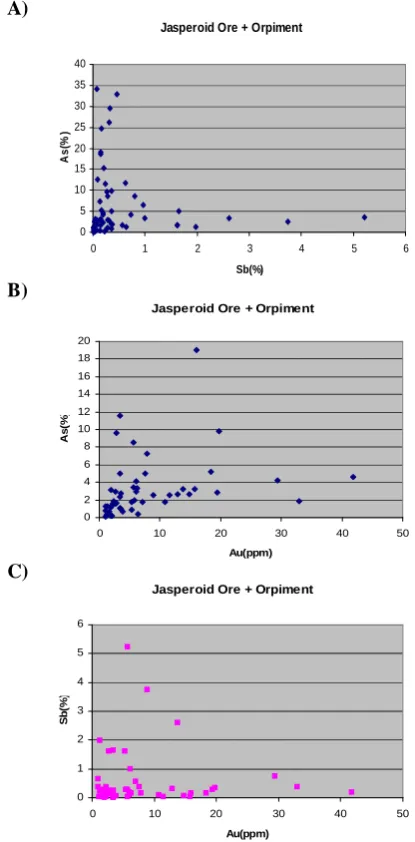
Chemical analyses of Au, As and Sb in black gouge (BG), jasperoid (JS), massive orpiment (MO) and jasperoid containing orpiment veinlets (JSOV) are presented in Table 1. Au only shows a significant correlation with As. Figure 3 presents the whole rock analysis scatter diagrams of As-Sb, Au-As and Au-Sb for the jasperoid containing orpiment veinlets (JSOV) ore types. Selected orpiment, getchellite and stibnite were analysed by EPMA from this ore type.
Mineral Compositions at Zarshuran
Ores and separated pure orpiment, getchellite and stibnite were examined by XRD after conventional petrographic studies. Semiquantitative analyses were carried out by Cambridge Stereo Scan 2000 (at the University of Leeds) and LEO 1450VP (at IMPRC) SEM-EDXA, preliminary quantitative EDX analysis by
Jeol JXA 8800 EPMA (at Imperial College) and quantitative analysis by Cameca SX50 fully automated EPMA (at the University of Leeds). The EPMA measurements were carried out based on following X-ray lines and standard; As Kα (pure arsenic), Sb Kα (pure antimony) and S Kα (ZnS) with 60 seconds counting time, at 15 kV and 20 nA.
Backscattered Electron mode (BSE) images show that orpiment, getchellite and stibnite crystals exhibit complex and variable chemical zonations due to variations in the As/Sb ratio (Fig. 4), though grains with uniform composition are common in arsenical ore. The chemical compositions of orpiment (selected from 189 point analyses), getchellite and stibnite from Zarshuran are listed in Table 2. The mole numbers in the formula were calculated based on As+Sb+S=5 (Table 2).
Orpiment occurs as massive coarse crystalline to microcrystalline masses in the form of veins, veinlets and lenses. One of the drill holes intersected up to 20m massive orpiment at depth of 200m and the assay results show up to 60g/t Au. Orpiment normally contains Sb, Te and Tl and shows substantial As/Sb substitution. Galkhahite and simonite were identified in orpiment as rare phases.
Stibnite occurs as needles, as needles aggregates and as subhedral crystals in jasperoid ore and massive orpiment ore. It is normally associated with quartz and occurs in clusters of acicular crystals. Stibnite shows massive substitution by As.
Getchellite is a rare mineral at Zarshuran and was recognized by Bariandet al. [19]. It is mainly associated with late phase quartz, orpiment and realgar in jasperoids and shows a flaky texture.
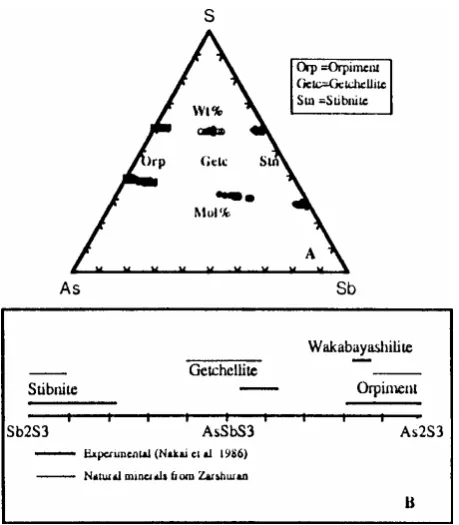
Figure 5 summarizes the solid solution range of hydrothermally synthesized [11] and natural minerals from the Zarshuran deposit. Synthetic stibnite shows As substitution up to 24 mol%. It causes elongation of thea
A)
Jasperoid Ore + Orpiment
0 5 10 15 20 25 30 35 40
0 1 2 3 4 5 6
Sb(%)
A
s
(%)
B)
Jasperoid Ore + Orpiment
0 2 4 6 8 10 12 14 16 18 20
0 10 20 30 40 50
Au(ppm)
A
s
(%)
C)
Jasperoid Ore + Orpiment
0 1 2 3 4 5 6
0 10 20 30 40 50
Au(ppm)
Sb(
%)
Figure 3. Whole rock analysis scattered diagram showing A) As-Sb, B) As-Au and C) Sb-Au content of Jasperoid containing orpiment mineralization at Zarshuran gold deposit. Orpiment, getchellite and stibnite phase were selected for EPMA analysis from this ore type. (Au measured by fire assay and As and Sb by AAS).
substitution. The chemical composition of getchellite was reported to be As0.98Sb1.01S3 which is idealized as
AsSbS3 [20]. The chemical composition of synthetic
getchellite deviates from the ideal AsSbS3 component
only toward As rich side [11]. Getchellite from the Zarshuran deposit shows extensive substitution of As-Sb, which is spread symmetrically around a As/Sb ratio of 1 (Fig. 3). The upper limit of the substitution of Sb for As in synthetic orpiment is 17 mol%. Natural orpiment from the Getchell mine, Nevada (associated
with getchellite samples of the US National museum) contains 11 mol% Sb2S3, which is the highest antimony
content recorded previously in natural orpiment [11]. Zoned orpiment from the Zarshuran deposit shows brighter zones with up to 12 mol% Sb2S3.
Discussion
The lower level of solid solution recorded in natural orpiment and stibnite, relative to those in synthetic minerals, raises the question of the existence of such a difference. The possible explanations are: 1) natural minerals may have formed originally with an extensive solid solution that subsequently readjusted by exsolution, 2) synthetic minerals grew metastably and incorporated more foreign elements in their structure [13], 3) the properties of arsenic and antimony such as, covalent radii and coordination geometry are different, thus the As-Sb substitution causes distortion and deformation of the unit cell, therefore the limit of such a deformation may be responsible for the limited solid solution [11], and 4) different condition of formation.
Natural getchellite from the Zarshuran deposit shows a wider range of solid solution than in the synthetic system. This observation challenges some of the results obtained from synthesizing getchellite, and justifies further experimental studies. Considering the condition of mineralization at the Zarshuran deposit may help to find a realistic explanation for the paradox recorded in the As2S3-Sb2S3 solid solution. Notably the temperature
of formation at the Zarshuran was below 250°C, which is supported by fluid inclusion data [6].
The presence of a wide range of As/Sb ratio (150-3.69), different fluid inclusion types, locally even in a single sample, and variation in composition, salinity, temperature and pressure of the mineralizing fluid during the main stage of orpiment, getchellite and stibnite formation have been recorded at the Zarshuran deposit [6]. Possibly rapid variations in the fluid chemistry, availability of enough As and Sb in solution and variation in PT condition are responsible for extensive solid solution among the As2S3-Sb2S3 join
A)
C)
E)
G)
B)
D)
F)
H)
Figure 4. Photograph, BSE and SE images from sulphosalt minerals in Zarshuran showing As-Sb substitution. A) getchellite and orpiment in jasperoid; B) subhedral to euhedral getchellite formed in open spaces in association with quartz showing negligible substitution; C) heterogeneous getchellite with patchy zonation; D) stibnite and orpiment in association with quartz with negligible substitution; E&F) oscillatory zonining in orpiment (bright area contains more Sb); G) complex zoning in orpiment and H) As-Sb substitution in unknown minerals of twinnite-guettardite series.
Getchellite
Orpiment
Getchellite Quartz
Orpiment Sb-rich zone
Orpiment
Getchellite
Quartz
Stibnite Orpiment
Quartz
Orpiment
Table 2. Chemical analysis of orpiment (O), getchellite (G) and stibnite (S) by EPMA, from Zarshuran deposit. Empirical formula calculated on the basis of As+Sb+S=5
Composition (element wt%) Composition (element wt%)
No. S As Sb Total Empirical Formula No. S As Sb Total Empirical Formula
O01 39.05 60.31 0.39 99.75 As1.99Sb0.01S3.01 G08 30.57 19.81 50.13 100.51 As0.81Sb1.26S2.93
O02 38.54 58.99 2.23 99.76 As1.96Sb0.05S2.99 G09 31.73 26.99 41.73 100.44 As1.06Sb1.01S2.92
O03 37.95 55.96 6.21 100.12 As1.88Sb0.13S2.99 G10 31.64 24.49 44.38 100.51 As0.97Sb1.09S2.94
O04 37.59 54.08 9.10 100.77 As1.83Sb0.19S2.98 G11 31.00 23.93 45.22 100.15 As0.97Sb1.12S2.92
O05 37.36 54.78 8.85 100.99 As1.86Sb0.18S2.96 G12 31.57 25.54 43.72 100.83 As1.18Sb1.07S2.92
O06 38.62 59.30 2.24 100.16 As1.96Sb0.01S2.99 G13 31.36 24.87 44.76 100.99 As0.99Sb1.10S2.92
O07 38.32 58.49 3.18 99.99 As1.95Sb0.07S2.98 G14 31.64 25.52 43.42 100.31 As1.00Sb1.06S2.94
O08 37.45 54.04 8.76 100.25 As1.84Sb0.18S2.98 G15 31.52 25.43 43.90 100.85 As0.99Sb1.10S2.92
O09 37.46 56.06 6.18 99.70 As1.90Sb0.13S2.97 G16 31.70 25.51 43.39 100.60 As1.01Sb1.06S2.93
O10 37.94 56.75 5.18 99.87 As1.91Sb0.11S2.98 G17 31.24 24.55 44.24 100.03 As0.98Sb1.09S2.93
O11 38.22 56.78 5.20 100.20 As1.90Sb0.11S2.99 G18 31.63 26.59 42.00 100.22 As1.05Sb1.02S2.92
O12 38.01 54.67 7.69 100.37 As1.84Sb0.16S3.00 G19 31.89 26.10 42.49 100.84 As1.03Sb1.03S2.94
O13 37.55 56.18 6.13 99.66 As1.91Sb0.13S2.96 G20 31.76 26.08 42.98 100.82 As1.03Sb1.04S2.93
O14 38.40 59.60 2.18 100.18 As1.98Sb0.04S2.98 G21 31.88 26.47 42.08 100.43 As1.04Sb1.02S2.94
O15 37.52 53.85 8.70 100.07 As1.83Sb0.18S2.98 G22 31.60 25.00 44.08 100.68 As0.99Sb1.08S2.93
O16 37.85 55.34 7.07 100.26 As1.87Sb0.15S2.99 G23 31.46 24.83 44.12 100.41 As0.99Sb1.08S2.93
O17 38.31 57.83 3.64 99.78 As1.93Sb0.07S2.99 S01 27.77 1.43 72.63 101.72 Sb2.01As0.06S2.93
O18 38.23 58.49 2.92 99.64 As1.95Sb0.06S2.99 S02 28.03 2.57 71.26 101.86 Sb1.96As0.11S2.93
O19 38.54 60.25 1.18 99.97 As1.99Sb0.02S2.98 S03 28.22 3.52 70.39 102.67 Sb1.93As0.16S2.92
O20 37.78 54.28 8.15 100.21 As1.84Sb0.17S2.99 S04 27.53 1.20 72.59 101.32 Sb2.03As0.03S2.92
O21 38.17 57.19 4.25 99.61 As1.92Sb0.09S2.99 S05 28.50 4.01 70.02 102.53 Sb1.89As0.18S2.93
O22 38.62 59.15 2.16 99.93 As1.96Sb0.04S2.99 S06 27.58 0.99 72.46 101.03 Sb2.03As0.04S2.93
O23 37.09 53.56 8.89 99.54 As1.84Sb0.19S2.97 S07 27.30 1.12 71.26 100.34 Sb2.03As0.05S2.92
O24 37.28 53.52 8.95 99.75 As1.83Sb0.19S2.98 S08 27.69 1.05 70.39 101.22 Sb2.02As0.05S2.93
O25 38.38 59.72 1.24 99.34 As1.99Sb0.03S2.99 S09 27.75 0.98 72.59 100.02 Sb2.00As0.04S2.96
O26 37.10 52.40 11.07 100.57 As1.80Sb0.23S2.97 S10 28.34 2.26 71.20 101.80 Sb1.95As0.10S2.95
O27 38.72 57.91 3.63 100.26 As1.92Sb0.07S3.00 S11 28.37 3.77 68.22 100.36 Sb1.97As0.17S2.96
O28 38.66 58.70 1.21 98.57 As1.96Sb0.02S3.02 S12 28.37 2.73 70.70 101.80 Sb1.93As0.12S2.95
O29 38.78 59.70 0.76 99.24 As1.98Sb0.02S3.00 S13 28.42 4.20 98.60 101.22 Sb1.87As0.19S2.94
O30 38.57 59.76 0.65 98.98 As1.99Sb0.01S3.00 S14 28.05 1.11 71.33 100.49 Sb1.99As0.05S2.96
O31 38.97 60.11 0.75 99.83 As1.98Sb0.02S3.00 S15 28.05 1.54 71.89 101.48 Sb1.99As0.07S2.94
O32 38.88 57.76 2.12 99.76 As1.95Sb0.04S3.01 S16 28.75 4.02 69.15 101.71 Sb1.88As0.18S2.95
O33 37.28 51.78 10.98 100.04 As1.78Sb0.23S2.99 S17 28.32 2.68 70.10 101.20 Sb1.93As0.12S2.95
O34 38.01 52.95 9.00 99.96 As1.80Sb0.19S3.01 S18 28.18 1.18 71.35 100.71 Sb1.98As0.05S2.97
O35 37.81 51.37 11.46 101.00 As1.76Sb0.24S3.00 S19 28.14 1.17 71.71 101.20 Sb1.99As0.05S2.96
O36 37.41 51.63 10.31 99.37 As1.78Sb0.22S3.01 S20 28.14 2.98 69.27 100.39 Sb1.91As0.13S2.95
O37 37.57 51.98 10.97 100.52 As1.77Sb0.23S3.00 S21 28.05 1.59 70.76 100.40 Sb1.97As0.07S2.96
O38 37.28 51.32 10.96 99.56 As1.77Sb0.23S3.00 S22 27.49 1.21 71.23 99.93 Sb2.01As0.06S2.94
O39 37.21 51.92 10.39 99.52 As1.79Sb0.22S2.99 S23 28.44 2.87 70.06 101.37 Sb1.92As0.13S2.96
G01 32.02 23.99 44.73 100.74 As1.79Sb1.09S2.96 S24 27.97 1.07 71.22 100.26 Sb1.99As0.05S2.96
G02 32.01 25.92 42.81 100.74 As1.02Sb1.04S2.94 S25 28.97 4.18 68.57 101.72 Sb1.85As0.18S2.97
G03 31.45 24.15 45.72 101.32 As0.96Sb1.12S2.92 S26 27.65 1.17 70.68 99.50 Sb1.99As0.05S2.96
G04 31.11 24.87 44.67 100.65 As0.99Sb1.10S2.95 S27 28.05 1.39 71.18 100.62 Sb1.98As0.06S2.96
G05 31.44 24.09 43.79 99.32 As0.97Sb1.08S2.95 S28 28.94 4.02 68.93 101.89 Sb1.86As0.18S2.96
G06 32.36 30.56 37.38 100.30 As1.18Sb0.98S2.95 S29 28.69 5.12 67.79 101.60 Sb1.83As0.22S2.94
Figure 5. Ternary (A) and binary (B) diagrams showing the variation in chemical composition of orpiment, getchellite and stibnite, indicating the extensive As-Sb solid solution compared to experimental data.
Acknowledgements
I am grateful to Prof. Bruce Yardley, Leeds University, Prof. R. Mortiz, University of Geneva, and Prof. I. Nakai, Tokyo University, for their constructive and critical reviews and improvement of manuscript. I would like to thank Dr. Eric Condliff, Leeds University and Ms. Shahabifar, IMPRC for their assistance in EPMA and SEM analysis.
References
1. Berger B.R. and Bagby W.C. The geology and origin of Carlin-type deposit. In: Foster R.P. (Ed.), Gold Metallogeny and Exploration. Blackie, Glasgow, 210-248 pp. (1991).
2. Arehart G. Characteristics and origin of sediment-hosted disseminated gold deposits: A review. Ore Geology Reviews,11: 383-403 (1996).
3. Ashley R.P., Cunningham J.S., Bostick N.H., Dean W.E., and Chou I.M. Geology and Geochemistry of three sedimentary-rock-hosted disseminated gold deposits in Guizhou Province, People's Republic of China.Geology Reviews,6: 133-151 (1991).
4. Li Z. and Peters S.G. Comparative geology and
geochemistry of sedimentary-rock hosted (Carlin type) gold deposits in the People’s Republic of China and Nevada, USA. USGS, Open-File Report, 98-466 pp. (1998).
5. Mehrabi B. Genesis of the Zarshuran gold deposit, NW Iran. Unpublished Ph.D. Thesis, University of Leeds (1997).
6. Mehrabi B., Yardley BW.D., and Cann J.R. Sediment-hosted disseminated gold mineralization at Zarshuran, NW Iran.Mineralum Deposita,34: 673-969 (1999). 7. Asadi H.H., Voncken J.H.L., Kuhnel R.A., and Hale M.
Petrology, mineralogy and geochemistry of the Zarshuran Carlin-like gold deposit.Ibid.,35: 656-671 (2000). 8. Mehrabi B., Yardley BW.D., and Komninue A.
Modelling the As-Au association in hydrothermal gold mineralization: Example of Zarshuran deposit, NW Iran.
IRI Journal of Sciences,14(1): 37-52 (2003).
9. Scott J.D. and Nowacki W. The substructure of wakabayashilite (As,Sb)(sub20)S(sub30). American Crystallography Association, Program. with Abstract Series 2,4: 60-61 (1976).
10. Bonazzi P., Lampronti G.I., Bindi L., and Zanardi S. Wakabayashilite, [(As,Sb)6S9] [(As4S5]: Crystal structure,
pseudosymmetry, twinning and revised chemical formula.
American Mineralogist,90: 1108-1114 (2005).
11. Nakai I., Yokoi H., and Nagashima K. Crystal chemistry of the system As-Sb-S (I): Synthesis of wakabayashilite and synthetic study on the solid solution in the As2S3
-Sb2S3 system. Mineralogical Journal, 13(4): 212-222
(1986).
12. Dickson F.W., Radtke A.S., Wiessberg B.G., and Heropoulos C. Solid solution of antimony, arsenic, and gold in stibnite (Sb2S3), orpiment (As2S3) and realgar
(As2S2).Economic Geology,70: 591-594 (1975).
13. Asadi H.H., Voncken J.H.L., and Hale M. Invisible gold at Zarshuran, Iran.Ibid.,94: 1367-1374 (1999).
14. Craig J.R., Skinner R., Francis C.A., Luce E.D., and Makovicky M. Phase relations in the As-Sb-S system.
Eos,55: 483 (1974).
15. Sobott R.J.C. Sulfosalts and Tl2S-As2S3-Sb2S3-S phase
relation. Neues Jahrbouch fuer Mineralogie, Abhandlungen,150: 54-59 (1984).
16. Bernardini G.P., Corsini F., Mazzetti G., and Parrini P. The As-Sb-S system: a synthetic study at 400° and 250°C and a postulated phase diagram at 25°C.Ibid.,H.6: 265-275 (1992).
17. Tomkins A.G., Pattison D.R.M., and Zaleski E. The Hemlo gold deposit, Ontario: An example of melting and mobilization of a precious metal-sulfosalts assemblage during amphibolite facies metamorphism and deformation.Economic Geology,99: 1063-1084 (2004). 18. Anglo exploration, Zarshuran gold deposit, final report,
Ministry of Industry and Mine (2001).
19. Bariand P., Cesborn F., Agrinier H., Geffroy J., and Issakhanian V. La Getchellite, AsSbS3, de Zarshuran, Afshar, Iran.Bulletin of Mineralogy and Crystallography, France,95: 403-406 (1968).
20. Weissberg B.G. Getchellite, AsSbS3, a new mineral from