Please cite this article as: F. Yaghmaee, Robust Fuzzy Content Based Regularization Technique in Super Resolution Imaging, International Journal of Engineering (IJE), TRANSACTIONS C: Aspects Vol. 29, No. 6, (June 2016)
International Journal of Engineering
J o u r n a l H o m e p a g e : w w w . i j e . i rRobust Fuzzy Content Based Regularization Technique in Super Resolution Imaging
F. Yaghmaee
Electrical and Computer Engineering Department Semnan University,Semnan, Iran
P A P E R I N F O
Paper history:
Received 15 December 2015
Received in revised form 13 February 2016 Accepted 02 June 2016
Keywords:
Image Super Resolution Fuzzy Regularization SIFT-BP-RANSAC Registration
A B S T R A C T
Super-resolution(SR) aims to overcome the ill-posed conditions of image acquisition. SR facilitates scene recognition from low-resolution image(s). Various approaches have tried to aggregate the informative details of multiple low-resolution images into a high-resolution one. In this paper, we present a new robust fuzzy super resolution approach. Our approach, firstly registers two input image using SIFT-BP-RANSAC registration. Secondly, due to the importance of information gain ratio in the SR outcomes, the fuzzy regularization scheme uses the prior knowledge about the low-resolution image to add the amount of lost details of the input images to the registered one using the common linear observation model. Due to this fact, our approach iteratively tries to make a prediction of the high-resolution image based on the predefined regularization rules. Afterwards the low-resolution image have made out of the new high-resolution image. Minimizing the difference between the resulted low-resolution image and the input low-resolution image will justify our regularization rules. Flexible characteristics of fuzzy regularization adaptively behave on edges, detailed segments, and flat regions of local segments within the image. General information gain ratio also should grow during the regularization. Our fuzzy regularization indicates independence from the acquisition model. Consequently, robustness of our method on different ill-posed capturing conditions and against registration error noise compensates the shortcomings of same regularization approaches in the literature. Our final results show reduced aliasing achievements in comparison with similar recent state of the art works.
doi: 10.5829/idosi.ije.2016.29.06c.00
1. INTRODUCTION1
Preserving the natural characteristics of images in order to have a better quality picture to the common viewer is an indisputable requirement of present imaging systems. With respect to the importance of transferring more information through common imaging systems, Super-resolution (SR) has developed. SR aims to overcome the limitations of device/system ill-posed conditions, during image acquisition. The goal of SR is to produce a higher–resolution image based on a set of images that were acquired from the same scene [1].
Much of works also have done to increase the details of only one image [1]. Hardware limitation, ill-posed acquisition condition and compression algorithms of image retrieval systems are the main obstacles in complete information attainment from a scene. Higher
1*Corresponding Author’s Email:[email protected] (F.
Yaghmaee)
resolution image does not mean a higher physical sized image necessarily. The classical way of obtaining super-resolved images is by using one single kernel for every type of imaging system [2]. These kernels try to represent an inverse observation model. Some common problems of single kernel SR algorithms are blurring, blocking artifacts, noise propagation and inability to generate high frequency according to different observation models [3].
new information to use to reconstruct an HR image. Decision making on the appropriate way to fuse the LR images into a robust result is directly related to the observation and acquisition model. We have developed a new adaptive fuzzy regularization model to fuse the LR images according to their observation model assessment.
In this paper we worked on one of the pervasively general acquisition models however, according to the literature, various models can be presumed [4]. The model consists of the following four operations. Geometric transformation, blurring, down sampling by a factor of q1 × q2, and noise addition (usually additive
white Gaussian noise). Here, the geometric
transformation includes translation, rotation, and scaling. Blurring also, is usually divides into motion blur or out-of-focus blur.
The remainder of the paper is organized as follows. Section 2 outlines the main concepts of SR and briefly reviews important SR approaches. The main concepts discussed in Section 3 clarify technical details that have explained in Section 4. Section 5 and 6 explain the method implementation and empirical results. The paper conclusion have mentioned in Section 7.
2. BACKGROUND
2. 1. The Observation Model Most of the super-resolution images reconstruction methods consist of four basic components: motion estimation, interpolation, deblurring and noise removal.
In Ref. [21], motion estimation is used to map the motion from all available low-resolution frames to a common reference frame. The motion field can model in terms of motion vectors or as affine transformations. The second component refers to mapping the motion-corrected pixels onto a super-resolution grid. The last two components needed to remove the sensor and optical blurring and noise effects. The given high-resolution ground truth should be compared with the high-resolution image reconstructed from a set of low-resolution images [1]. This can be summarizing mathematically [1] in (1).
(1)
where Y(k) is the Kth low resolution image and X is the ground truth image. Accordingly Matrixes of D(k), P(k), W(k) and V(k) in (1) respectively represents decimation (D), blurring (P), warping (W) and noise (V). As far as the difference between ground truth and the resulted super resolution image decreases the quality of SR method improves.
2. 2. Literature Super Resolution (SR) have been investigated by many researchers and their suggested
techniques include wide different approaches including frequency domain-based [5], non-uniform interpolation [6], deterministic and stochastic regularization [7], projection onto convex sets (POCS) [8], hybrid techniques, optical flow[9] and other approaches [2]. Super resolution was first addressed by Tsai and Huang [5] in frequency domain. They combined Discrete Fourier Transform (DFT) coefficients according to the relationship between the aliased observed low-resolution images and unknown high-low-resolution image. Their results were a very drastic start in the SR domain. Frequency domain methods can be computationally efficient, but they are often limited to global rigid motion as the translations and rotation are estimated from the aliased spectra [10]. Robinson et al. [11] presented a novel extension of the combined Fourier-wavelet deconvolution and applied a space-variant nonlinear wavelet for resolution enhancement of fused SR images. Working with spectrum domain has shown reasonable outcomes. However, the blurred results are a prevalent occasion in these methods.
To enhance the computing performance, Xie Qinlan et al. in [12] had proposed a classifying method to divide the high-frequency patches of low-resolution image into different classes. Singh et al. [12] determined sample sets for super resolution to maximize reconstruction accuracy while minimizing the number of sample sets.
Vrigkas et al. [13] applied a maximum a posteriori
(MAP) scheme for image super-resolution in
conjunction with the maximization of mutual information. They actually improved image registration for super-resolution imaging. Their MAP based registration shows high correlations between the ground truth and resulted images. In their approach, the pitfall is within the mismatching registration.
Haidawati et al. [14] developed three step method consisting of image registration, singular value
decomposition (SVD)-based image fusion and
interpolation. The results of their approach have cited and because our registration phase is the same as theirs, the results of their approach compared with our proposed method. Their proposed algorithm is actually based on the registration phase and the fusion would not add more details to the registered image necessarily. The unknown high-resolution image can be estimated via some statistics of a probability distribution of the unknown high-resolution image. HR images establish by applying inference to exploit the information provided by both the observed low-resolution images and the prior knowledge of the unknown high-resolution image. This is the main concept in regularization base methods. In [15] as a good instance of regularization method a Bayesian inference formulation is exploited. Its base is on the observed low-resolution images and
mathematically derived. Their results have a slight problem of blocky effects in their outcomes.
Various mathematical techniques are used to create a single composite image. Fuzzy theory is one of these mathematical models that has been used in SR methodologies [16]. The combination of the contents within multiple images is related to relational fuzzy calculations to obtain highest information gain ratio. Associations of fuzzy relation between the image contents gives more obviously reasonable results in visual fidelity and consequently more subjective metrics in comparison with the crisp methods. Accordingly, we introduce a new adaptive fuzzy regularization SR method, which is robust for predefined classes of acquisition model in multi-view SR approaches.
3. MAIN CONCEPTS
In this section, we give an overview of main concepts and describe in detail the novelties of our technique. To simplify exposition, all proposed methods will be explained assuming two low-resolution input images with only two-observation class. Generalization to more than two images and various classes is straightforward.
3. 1. SIFT-BP-RANSAC Registration There are wide varieties of registration techniques in different domains. Earliest methods involved using the cross-correlation between images as its value can show that two images are correctly overlaid. Many variations of these methods have been proposed in the literature. Generally, these methods have two main classes: intensity-based methods and feature-based methods. Intensity-based methods compare the intensity patterns in images via correlation metrics, while feature-based methods find correspondence between image features.
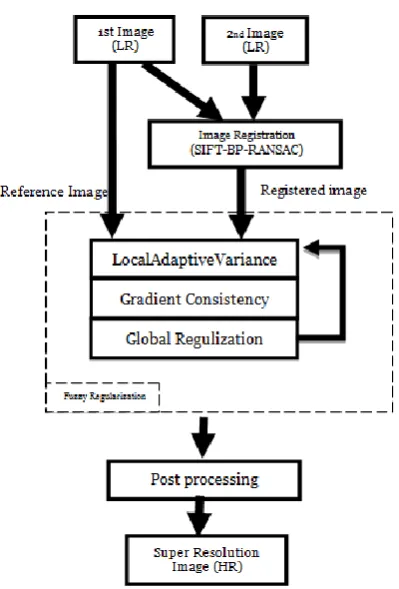
Image features consists variety of models proposed in literature. When the SIFT features are extracted, Random Sampling Consensus (RANSAC) [17] is usually used to omit the mismatching points between two images’ featured ey points. Common ey points of two images of a same scene makes accurate registered image from them. Input images are registered using the well-known SIFT-BP-RANSAC method [17]. One of the images will be regarded as a reference image. The reference will be registered with the other image. As depicted in Figure 1 the result of this step is called the registered image. In the first phase, SIFT [18] algorithm extracts local features that is tolerant to changes in scale, illuminations and rotation. The resulted key points would have a description and orientation assignment. In the next step, Belief propagation (BP) [19] is used to match the common features. BP attempts to evaluate the probability (belief) of each possible solution and matches the best correlated ones. As it is obvious, some of the key points might be matched
incorrectly. To overcome this problem, RANSAC [17] is used after the BP feature matching step, to remove the remaining outliers. RANSAC estimates a homographic matrix H. When matrix H is multiplied to the spatial coordinates of one pixel in the first image, its corresponding pixel in the other image is generated too. This is demonstrated in (2).
( ) ( ) (2)
where (x’,y’) and (x,y) are coordinates of respective matching points in first and second image. Finally, the registered image is built.
3. 2. Fuzzy Regularization Concepts The observation model defined in Equation (1) tries to describe how the direct LR image is acquired from grand truth. Based on Equation (1), we can estimate the corresponding HR image from observed LR images. A common approach is estimating a primitive HR image in the first step. Afterwards the aforementioned ill-posed acquisition operation is applied to this new HR images to make new LR images. The distance between this new LR image with the original LR image can be a practical guide to show how much the resulted HR image has reached to the grand truth image.
As indicated in the Equation (3) L norm is one of frequent distance measures [20]. This Estimation needs to be iteratively justified by minimizing the estimation error using a feedback from the results of previous steps.
∑ ∑ - (3)
Here, ρ calculates the distance between the observation and estimation. X is the unknown high-resolution image to be estimated, Yk is the k
th
observed LR image. Fk, Hk, and Dk are respectively motion matrix, blur matrix, and down-sampling matrix. One of the best approaches to increase the stability and robustness of SR algorithm is imposing specific regularization on the estimation model. Hence, regularization enforcement can keep the valuable known information during SR algorithm. Accordingly, SR process can be reconfigured into a generalized minimization cost function [20] shown in Equation (4) to give well-behaved HR solutions.
( ) ∑ (4)
while removing artifacts in the estimated HR image. On this basis the regularization term can be expressed as Equation (5) The first and second terms were introduced by [21]. However, to outperform the previous methods we have added the global regularization term to the total equation.
( ) ∑
∑
(5)
where the data error term ρ, measures the reconstruction error to figure out how much the reconstructed HR image resembles to real values, the distance function ρ' measures the distance between the gradient of LR images and the estimated HR image. The regularization term
γ
, controls the qualitative characteristics such as smoothness of the HR image. The third term or the gradient error term, guarantees the consistency between the gradient of estimated HR image and that of original LR images. The global regularization functionΨ
, eeps the global integrity of the image. λ1, λ2 and λ3 are coefficients, used to balance the preference between the second ,third and fourth terms. According to the fuzzy contents of the images, the values of coefficients varies adaptivly. If the image has more soft areas within its content the value for λ1 increases but if the details of the images and edges are high the λ2 value becomes more impressive to keep the fidelity of outcomes in its highest value. However, according to the global charactersitics of a natural images, λ3 value variates slightly.4. PROPOSED METHOD
In the following sub sections we describe the base of our proposed methods in some steps.
4. 1. Locally Adaptive Bilateral Total Variation
The fuzzy regularization term controls the adaptation and robustness of the solution. It also guarantees a stable HR estimation. Farsiu et al. [20] proposed the bilateral total variation model for regularization by combining the total variation and the bilateral filter.
( ) ∑ ∑
-
- (6)
where l+m>=0, l
x
S and
S
my are shift matrices to present l and m pixels shift in horizontal and vertical directions, respectively, and α 0<α<1 is the weighting coefficient. Small values of α sharpens edges while magnifying noises also in the estimated HR image. On the other hand large values of α helps to abolish noise effects while softening the constructed HR. Accordingly, it is a suitable tool to justify the contents [21]. Imposing small values of α onedges and large α to smooth regions in the HR image estimation, leads to edge preservation and noise suppression simultaneously. The fuzzy regularization termed can be presented as follows:
Suppose a vector of a Q×Q image patch with pixels in the form of
Q Q ij]
[X
X is given by
Q Q Q 2 1,X,....,X ] [X
X 2 accordingly the locally adaptive
bilateral total variation is given by
( ) ∑ ∑ -
- (7)
where Similar to Ref. [21], Pxk is the Kth entry of Px(l,m) and instead of a crisp value for Pxk a variable value in the distance of 1Pxk2 is assumed upon the variations in the pixels values. The adaptive weight coefficient matrix Φ m, l is a diagonal Q2×Q2 matrix containing the proportional adaptive weights. Diagonal entries of Φ(m, l) are obtained from image local features, which responses to local smoothness. The fuzzy entropy-based neighborhood homogeneity (R) measures the local smoothness for the neighbored pixel patch of size (2n+1) ×(2n+1)centered at (i, j),
∑ - ∑ - ( ) (8)
| - | (9)
Here Ht(ut) stands for the fuzzy entropy of ut and u(t) presents the membership function of pixel x. The range of Ri,j is [0, 1]. The smaller the value of R smoother the patch centered at (i, j) will be. Moreover, R is robust to noise and sensitive to weak edges. Therefore, R is a suitable choice to determine Φ m, l . With regard to the definition of R the diagonal values of matrix is defined in the following format:
{
} - (10)
0<Φk,k(m, l)<1 . If one of the diagonal entries in the matrix Φ reaches to the value it shows the pixel and its neighbors are in a flat and smooth area and vice versa. So the Φ value shows the smoothness of the patches and achieves our objective for designing weighing coefficient regarding to the texture of patches.
4. 2. Using Lp Norm To overcome the shortcomings of L1 and L2 norms, Lp norm is presented (where 1<p<2). The Value of P is determined by the difference between a specific pixel and its neighbor. To reduce noise for smooth regions, p should be set with large values, i.e., p reaches the values near 2, while to preserve edges for non-smooth regions, p should be set to the values near 1.
- (11)
4. 3. Analysis of the Proposed Adaptive Regularization The weighting coefficient matrix Φ m, l and the norm pi,j(m,l) parameter can be estimated by the initially reconstructed HR image. After that the adaptive regularization term can be calculated. This regularization term has different effects on pixels with different degrees of smoothness. Its smooth effect on a non-border pixel xi,j in an image X can be presented by the variation of the operator.
4. 4. The Consistency of Gradients The consistency of gradients is defined as the difference between the gradient of them:
( ) ∑ ∑ ( )- (12)
The gradient is calculated in four direction without considering the blurring effect, the L1 norm is used to measure the difference between the gradient maps, Fk is the motion matrix, Dk is the down-sampling matrix and
4 , 3 , 2 ,
1
, are respectively gradient vectors in
horizontal, vertical, and two diagonal directions, respectively
- -
- -
- - -
- - -
(13)
4. 5. The Global Regularization Term A global regularization term with respect to the whole image properties evaluates the difference of the resulted LR image with the original input LR image. The coefficient of Global regularization term plays role as a tradeoff between the reconstruction error and the regularization term. We use general fuzzy entropy difference of the estimated pixels with real ones. The imposed prior knowledge about the global structur of the desired HR image, aims to give more stable results which are indicated in the following equation.
( )- (14)
Here Ht indicates the global fuzzy entropy and mainly measures the global texture and smoothness of the image. As much as the global distance between the real LR image and resulted LR image decreases the approach has reached to a better solution.
No regular mathematical relations are easily
available between two images. Hence, fuzzy
regularization has powerful potentialities to fuse input images using local and global fuzzy knowledge about the image contents.
The iterative regularization algorithm merges their information into a fused result with highest information
gain. The Fuzzy rules are modified according to the learning from the iterative modifications of input and output images. As it was mentioned, there exists a plenty of observation models in multi-image super resolution approaches. According to the decimations happened to input image set, the information pretermission can be classified. However, this classification is indirectly happening through the regularization routine.
5. METHOD IMPLEMENTATION
In this section, our method will be discussed. The main concepts were overviewed in the previous sections. The flowchart depicted in Figure 1 gives a brief overview of proposed method. The technical details of each step are explained in the rest of this section.
5. 1. Preprocessings It should be pointed out that all the input images should have same size. Images can have different observation model. Robustness of our approach to the predefined ill-posed observation model also can be generalized for whole of known acquisition model. In our approach, images are in gray scale. The acquisition models are translation, scaling, blurring, and decimation. Algorithm performs a bi-cubic interpolation to double size input images before registration phase to avoid any possible data loss on diagonal edges during registration. In the post-processing step as shown in Figure 1 the final images are resized back to their original resolutions.
smooth areas and edge areas. These two local features with the global regularization rules are enforced in the reconstruction routine of the HR image. The difference function in equation should be minimized to find the best matching with the observation model.
̂ ∑ ‖ - ‖
∑ ∑ -
- ‖ - ‖
∑ - ‖ ( )- ‖
(15)
Here ρ is the distance function, Yk is the Kth LR image,
Dk, Hk and Fk are orderly, Decimation operator, Blur Matrix and the geometric motion operator matrix. Here X is the ground truth image. This equation has an implicit equation, which can be assumed as robustness of method. It is represented in (16)
∑ ( ) (16)
where
( )
Here (/X) shows the different values for optimum X that our approach is ma ing while ρ is the distance function. There is no closed form solution and the steepest descent is adopted in this paper to find a solution for that.
Figure 1. The proposed method chart
According to the predefined observation classes, fuzzy regularization are tuned using output images mapping to the input images regarding the cost of minimization function. Iterative fuzzy regularization engine fits the best solution to the mentioned equations. To have more robustness the system should be adapted to more various ill-posed acquisition models. The fusion can result in better outcomes in comparison with the approaches, which blindly try to fuse two images. The fuzzy rules have a flexibility that gives priority to more informative details of a scene (usually the registered image) so we have a better guidance in the fusion of the realities within the image.
Ultimately, the more important feature of this approach is that the image content plays an essential role on the information aggregation. Edge parts or soft texture areas are not regarded in a same way. Global and natural integrity of the image also is noted. Hence, the stability of the results is obvious in comparison with the other SR algorithms. This trend guaranties to keep the highest information gain from the results. Our approach tries to keep the most informative details of one image through the registration. To have more robust and stable results our approach tries to utilize the information existing in the LR images to guess the HR image in a more realistic and adaptive manner.
In post processing the histogram will be slightly equalized to enrich a better contrast and thoroughly higher fidelity of picture. Also some of possibly unallocated pixel values of the HR picture might remain unassigned. This phase will copy the median value of neighbors to the rarely unallocated pixel value. Eventually, the size of HR image is resized back to appropriate value. The results in the next section show our positive achievements in comparison with other similar approaches.
6. EXPRIMENTAL RESULTS
shortcomings occurring during the image acquisition are limited in our approach, the model can respectively be generalized to cover more models. The method in [14] has used the same registration phase but their approach is not concerning the relative local properties of the images to reconstruct the SR image. This method is not adaptive with the content of the image and only regards the global information gain ratio. This might lead to loss of some local features. On the other hand the method in [21] has used the same regularization method as our one, but did not note the global information gain. Although registration phase plays a key role in the global information aggregation of a scene that other methods did not use of it. Using a global term in regularization and a robust registration phase as a main step to integrate the image local features is our superiority in comparison with this approach. Our approach has improved the shortcomings in both of the aforementioned methods and has aggregated the positive features into one method. The results depicted in Figure 2 shows our improvements. The robustness and fidelity of our proposed method as it is obvious in Figure 2 shows reasonably better results than the other approaches.
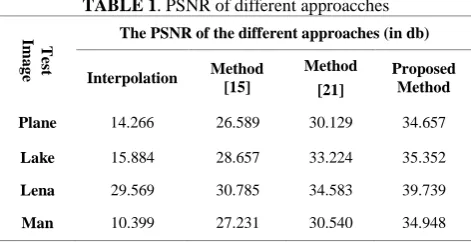
To better understand the difference of our results we have used some famous objective metrics [13],[17]. These are Peak signal-to-noise ratio (PSNR) plotted in Table 1, structural similarity (SSIM) depicted in Table 2, Blind Image Quality Index (BIQI) [22] projected in Table 3 and sharpness index [23] in Table 4. PSNR and SSIM are full-reference measures while BIQI is a no-reference metric. BIQI generates a quality score between 0 and 100. High values of PSNR and SSIM shows more similarity of our results with the ground truth. Low value of the BIQI represents the best quality and high values shows worse quality. Sharpness index also indicates how much the sharpness of image is preserved and the blurring effect has decreased. Higher sharpness indexes show better edge preserving algorithm.
Because SSIM and PSNR are comparing the results with a ground truth, our method shows considerable improvements.
TABLE 1. PSNR of different approacches
T
est
Ima
g
e
The PSNR of the different approaches (in db)
Interpolation Method [15] Method [21]
Proposed Method Plane 14.266 26.589 30.129 34.657
Lake 15.884 28.657 33.224 35.352
Lena 29.569 30.785 34.583 39.739
Man 10.399 27.231 30.540 34.948
TABLE 2. SSIM of different approacches
T
est
Ima
g
e
The SSIM of the different approaches Interpolation Method
[15]
Method [21]
Proposed Method
Plane 0.52 0.78 0.79 0.79
Lake 0.64 0.80 0.81 0.84
Lena 0.79 0.83 0.84 0.87
Man 0.45 0.79 0.8 0.83
TABLE 3. BIQI of different approacches
T
est
Ima
g
e
The BIQI of the different approaches Interpolation Method
[15]
Method [21]
Proposed Method
Plane 39 27 25 22
Lake 36 27 21 18
Lena 20 31 22 16
Man 42 47 41 39
TABLE 4. Sharpness index of different approacches
T
est
Ima
g
e
The Sharpness Index of the different approaches Interpolation Method
[15]
Method [21]
Proposed Method
Plane 90,354 103,478 115,121 117,231 Lake 89,772 101,833 111,696 114,287 Lena 103,841 114,392 127,790 127,906 Man 96,409 110,784 123,007 126,508
However, in BIQI because of blindness, our improvement is not showing drastic improvement for in some instances. Sharpness Index is a special metric for blurring effect. Local edge preserving term of our regularization method administers the advantages of our approach in the sharpness index. It should be noticed that, final results could not exactly restore the ground truth, because of the natural data loss occurring during the conducted decimations on input images.
7. CONCLUSION AND FUTURE WORK
Enhancement of information gain from LR images and fusing whole of information into an HR image is the main goal of super resolution (SR). Robustness to the different ill-posed image acquisition conditions is a bottleneck in SR methods.
This registration is robust and gives a good map to combine the details of the images. Afterwards, iteratively fuzzy regularization rules are imposed to maintain the prior knowledge about the image. Edge and soft homogenous areas of image are essential to be preserved during the image reconstruction. During our approach these fundamental parts of image remain with the least drastic changes. Our approach robustly overcomes the predefined decimations occurred in LR images.
Our outcomes outperforms in comparison with approaches, which blindly try to fuse the contents of two images. Handling registration between the input images and after that recombination of them together into a single, high quality image actually supports ghost removal caused by motion between the consecutive images. The fuzzy regularization rules have a flexibility that gives a priority to more informative details of the scene and adaptively makes the SR method robust to different decimation models.
The final results substantiate our improvements. Misleading registered points are not impressive during our approach and this is another constructive aspect of our approach. For future work, robustness to different noise distributions is of high concern. There are also other ill-posed acquisition/decimation models (i.e. colored images), where this approach can be investigated on.
8. References
1. Tian, J. and Ma, K.-K., "A survey on super-resolution imaging", Signal, Image and Video Processing, Vol. 5, No. 3, (2011), 329-342.
2. Srinivasan, K. and Kanakaraj, J., "A study on super-resolution image reconstruction techniques", Computer Engineering and Intelligent Systems, Vol. 2, No. 4, (2011), 222-227.
3. van Ouwerkerk, J.D., "Image super-resolution survey", Image and Vision Computing, Vol. 24, No. 10, (2006), 1039-1052. 4. Zhaozhong, W. and Feihu, Q., "On ambiguities in
super-resolution modeling", Signal Processing Letters, IEEE, Vol. 11, No. 8, (2004), 678-681.
5. Tsai R.Y. , H., T.S., Multiframe image restoration and registration, in Advances in computer vision and image processing., T.S. Huang, Editor. 1984, JAI Press Inc.: London. 6. Sung Cheol, P., Min Kyu, P. and Moon Gi, K.,
"Super-resolution image reconstruction: A technical overview", Signal Processing Magazine, IEEE, Vol. 20, No. 3, (2003), 21-36. 7. Purkait, P. and Chanda, B., "Super resolution image
reconstruction through bregman iteration using morphologic regularization", Image Processing, IEEE Transactions on,
Vol. 21, No. 9, (2012), 4029-4039.
8. Huiqin, X., Chuangbai, X. and Chunxiao, B., "Edge halo reduction for projections onto convex sets super resolution image reconstruction", in Digital Image Computing Techniques and Applications (DICTA), (2012), 1-7.
9. Mochizuki, Y., Kameda, Y., Imiya, A., Sakai, T. and Imaizumi, T., "Variational method for super-resolution optical flow", Signal Processing, Vol. 91, No. 7, (2011), 1535-1567. 10. Foroosh, H., Zerubia, J.B. and Berthod, M., "Extension of phase
correlation to subpixel registration", Image Processing, IEEE Transactions on, Vol. 11, No. 3, (2002), 188-200.
11. Robinson, M.D., Toth, C.A., Lo, J.Y. and Farsiu, S., "Efficient fourier-wavelet super-resolution", Image Processing, IEEE Transactions on, Vol. 19, No. 10, (2010), 2669-2681. 12. Singh, M., Lu, C., Basu, A. and Mandal, M., "Choice of low
resolution sample sets for efficient super-resolution signal reconstruction", Journal of Visual Communication and Image Representation, Vol. 23, No. 1, (2012), 194-207.
13. Vrigkas, M., Nikou, C. and Kondi, L.P., "Accurate image registration for map image super-resolution", Signal Processing: Image Communication, Vol. 28, No. 5, (2013), 494-508.
14. Nasir, H., Stan ović, . and Marshall, S., "Singular value decomposition based fusion for super-resolution image reconstruction", Signal Processing: Image Communication, Vol. 27, No. 2, (2012), 180-191.
15. Tian, J. and Ma, K.-K., "Stochastic super-resolution image reconstruction", Journal of Visual Communication and Image Representation, Vol. 21, No. 3, (2010), 232-244.
16. Seng, C.H., Bouzerdoum, A., Tivive, F.H.C. and Amin, M.G., "Fuzzy logic-based image fusion for multi-view through-the-wall radar", in Digital Image Computing: Techniques and Applications (DICTA), (2010), 423-428.
17. Fischler, M.A. and Bolles, R.C., "Random sample consensus: A paradigm for model fitting with applications to image analysis and automated cartography", Commun. ACM, Vol. 24, No. 6, (1981), 381-395.
18. Lowe, D.G., "Distinctive image features from scale-invariant keypoints", International Journal of Computer Vision, Vol. 60, No. 2, (2004), 91-110.
19. Cheng, S., Stankovic, V. and Stankovic, L., "Improved sift-based image registration using belief propagation", in Acoustics, Speech and Signal Processing. ICASSP (2009), 2909-2912. 20. Farsiu, S., Robinson, M.D., Elad, M. and Milanfar, P., "Fast and
robust multiframe super resolution", Image Processing, IEEE Transactions on, Vol. 13, No. 10, (2004), 1327-1344. 21. Li, X., Hu, Y., Gao, X., Tao, D. and Ning, B., "A multi-frame
image super-resolution method", Signal Processing, Vol. 90, No. 2, (2010), 405-414.
22. Moorthy, A.K. and Bovik, A.C., "A two-step framework for constructing blind image quality indices", Signal Processing Letters, IEEE, Vol. 17, No. 5, (2010), 513-516.
Robust Fuzzy Content Based Regularization Technique in Super Resolution Imaging
F. Yaghmaee
Electrical and Computer Engineering Department Semnan University,Semnan, Iran
P A P E R I N F O
Paper history:
Received 15 December 2015
Received in revised form 13 February 2016 Accepted 02 June 2016
Keywords:
Image Super Resolution Fuzzy Regularization SIFT-BP-RANSAC Registration
ديكچ ه
ِتضاد ریَصت شزادرپ رد یوْه صقً ُزٍرها ،يییاپ تیفیک اب ریٍاصت زا یدادعت کوک ِب لااب حَضٍ اب یریَصت داجیا کیٌکت
ُدافتسا تیفیک اب ریَصت داجیا تْج یزاف نتسیس کی زا اه ِلاقه يیا رد .تسا ُدض ماجًا ٌِیهز يیا رد یددعته یاّراک ٍ
شٍر کوک ِب ریَصت ٍد ادتبا یداٌْطیپ شٍر رد .نیا ُدرک
SIFT-BP-RANSAC
دًَطیه تیبثت مَْفه کوک ِب سپس .
ترَص ِب ُدض فیرعت صیپ زا دعاَق زا ُدافتسا ٍ تیفیک نک ریٍاصت یلبق تاعلاطا کوک ِب یزاف نتسیس کی ،یتاعلاطا ُرْب
لااب تیفیک اب ریٍاصت یٌیب صیپ رد یعس ُدًَض رارکت رد ظَصخ ِب شٍر يیا رد یزاف فاطعًا لباق تاویظٌت .دٌک یه
یرادربریَصت شٍر زا لاهاک یداٌْطیپ شٍر .دّدیه ىاطً یرتطیب ییآراک ،اْلای ریظً ریَصت تایئسج یٍاح ٍ ُدیچیپ یحاًَ
بثت ِلحره رد یرتوک یاطخ خرً ،ٌِیهز يیا رد حرطه یاْضٍر ریاس اب ِسیاقه رد يیٌچوّ ٍ ُدَب لقتسه یرتطیب یرادیاپ ٍ تی
.دّد یه ىاطً دَخ زا تیفیک ىٍدب ِیلٍا ریٍاصت زا ُدافتسا رد