by Bill Slavicsek and Richard Baker
F o rew o rd by K im M o han
Editorial Manager for DU N G EO N S
& DR A G O N S
Dungeons &
Dr a gons
®
FOR
by Bill Slavicsek and Richard Baker
Foreword by Kim Mohan
Editorial Manager for DUNGEONS
& DRAGONS
Dungeons &
Dragons
®
FOR
Bill Slavicsek: Bill Slavicsek began playing the DUNG EONS& DRAG ONS roleplay-ing game with his friends durroleplay-ing his formative teenage years in New Y ork City. This was in 1977, the same year that Star Warsand Terry Brooks’s T h e Sw o rd o f Sh an n aradebuted. This trilogy of epic fantasy combined with comic books and horror novels to forever influence Bill’s outlook on life and entertainment. In 1986, Bill’s hobby became his career when he joined the staff of West End G ames. There, as an editor and game designer, Bill worked on a number of board games and roleplaying games, including G h o stb u ste rs, P aran o ia, Star Wars: T h e R o le p lay in g G am e, andT o rg : R o le p lay in g th e P o ssib ility Wars. Later, Bill went on to use his vast knowledge of the Star Warsfilms and associated extensions to write two editions of A G u id e to th e Star Wars U n iv e rse for Lucasfilm, Ltd. (published by Del Rey Books).
1n 1993, Bill joined the staff of TSR, Inc., then publishers of the DUNG EONS& DRAG ONSgame lines, as a game designer and editor. His design credits for the company include the A lte rn ity Sc ie n c e F ic tio n G am e (which he co-designed with Richard Baker), the d 2 0 M o d e rn R o le p lay in g G am e, the d 2 0 Star Wars R o le p lay in g G am e, the Star Wars M in iatu re s G am e, U rb an A rc an a, C o u n c il o f Wy rm s, and the E b e rro n C am p aig n Se ttin g.
Since 1997, Bill has been the Director of Roleplaying G ames Research and Development for Wizards of the Coast, Inc., the company that now publishes all DUNG EONS& DRAG ONSnovels and game products. He oversaw the creation of the d20 Roleplaying G ame System and the newest edition of the DUNG EONS& DRAG ONSgame. Bill leads a talented staff of game designers, developers, and editors who produce award-winning game products for DUNG EONS& DRAG ONS and other d20 System game lines, including roleplaying game supplements and accessories, adventures and campaign books, and prepainted plastic miniatures. He lives with his wife Michele, two cats, and more comics, toys, and books than he knows what to do with — and that’s okay by him.
newest edition of the DUNGEONS& DRAGONSgame. He has also served as cre-ative director for the Alternity and FORGOTTENREALMSgame lines. As an author, Rich has published seven fantasy and science fiction novels, including City of Ravens, Forsak en H ouse, and the New York Times bestseller Condemnation. Rich is currently employed as a senior game designer at Wizards of the Coast, Inc. and works every day on new products for the DUNGEONS& DRAGONSgame. He married his college sweetheart K im in 1991; they have two daughters, Alex and Hannah. When he’s not writing (a rare occurrence), Rich likes to hike in the Cascades, play wargames, and root for the Philadelphia Phillies — because somebody has to.
Dedication
Bill Slavicsek:To everyone who ever imagined an amazing adventure, I offer this key to D&D. When I first found the game, it helped focus and expand my imagination and creativity. And it was a lot of fun. Today, I still have fun play-ing the game, and my gamplay-ing group meets every Thursday evenplay-ing to brave whatever new challenges I dream up for them. I hope you’ll find the same outlet for imagination and fun as I’ve enjoyed for almost thirty years. Richard Baker:To K im, Alex, and Hannah for being patient with me through nigh-constant work in evenings and on weekends for many months now. I promise that I’m going to take my computer for a drive deep into the woods sometime soon and leave it there so it can’t ever find its way home again.
Author’s Acknow ledgm ents
Valterra, Chris Toepker, Liz Schuh, Mary Elizabeth Allen, and Charles Ryan. I have to acknowledge the efforts of my current staff. This amazing collection of designers, developers, and editors work everyday to push the envelope and expand the horizons of our products, and as much as I lead them, they influence the way I think about and approach game design and D&D. Every part of this For Dummiesbook owes at least a little to the ideas and work of Richard Baker, Michele Carter, Andy Collins, Bruce Cordell, Jesse Decker, Michael Donais, Rob Heinsoo, Gwendolyn F.M. Kestrel, Stacy Longstreet, Michelle Lyons, Kim Mohan, David Noonan, Christopher Perkins, John Rateliff, Stephen Schubert, Matthew Sernett, Ed Stark, Chris Thomasson, Rob Watkins, Jennifer Clarke Wilkes, and James Wyatt.
Finally, thanks to everyone at Wiley Publishing who worked with us on this book, including Melody Layne, Christopher Morris, and Jean Rogers, and to everyone at Wizards of the Coast, Inc., who help us make great games on a regular basis.
Richard Baker:Many people of exceptional creativity have worked on the D&D game over the years. Without the work of game designers, editors, and artists such as Gary Gygax, Dave Arneson, Jim Ward, Kim Mohan, Z eb Cook, Jeff Grubb, Steve Winter, Bruce Nesmith, Tim Brown, Troy Denning, Roger Moore, Ed Greenwood, Mike Carr, Harold Johnson, Andrea Hayday, Jon Pickens, Lawrence Schick, Skip Williams, Dave Sutherland, Jeff Easley, Larry Elmore, and countless others, D&D would not have grown into the beloved hobby of millions of fans across the world. Countless other authors, artists, develop-ers, and editors have contributed over the years; we’re sorry that we can’t thank them all.
Some of the people who helped bring this book to market include the following: Acquisitions, Editorial, and
M e dia D e v e lop m e nt
Project Editor:Christopher Morris Acq uisitions Editor:Melody Layne Cop y Editor:Jean Rogers
Technical Editor:Wizards of the Coast, Inc. Editorial Manager:Kevin Kirschner Media Develop ment Sup ervisor:
Richard Graves
Editorial Assistant:Amanda Foxworth
Cartoons:Rich Tennant (www.the5thwave.com)
C om p osition S e rv ice s
Project Coordinator:Adrienne Martinez Layout and Grap hics:Joyce Haughey,
LeAndra Hosier, Lysney Osborn, Melanee Prendergast, Heather Ryan, Mary Gillot Virgin
Proofreaders:Joe Niesen, Tammy Todd Index er:Rebecca R. Plunkett
Art Credits: Des Hanley, Hugh Jamieson, Rob Lazzaretti, Todd Lockwood, Steve Prescott. Wayne Reynolds, Arnie Swekel, Steve Tappin, Lars Grant West, Sam Wood
Publishing and Editorial for Technology Dummies
Richard Swadley,Vice President and Executive Group Publisher Andy Cummings,Vice President and Publisher
Mary Bednarek,Executive Acquisitions Director Mary C. Corder,Editorial Director
Publishing for Consumer Dummies
Diane Graves Steele,Vice President and Publisher J oyce Pep p le,Acquisitions Director
Comp osition Services
Foreword ...xix
Introduction ...1
Part I: D & D Crash Course ...7
Chapter 1: Preparing for Adventure...9
Chapter 2: Your First Character...21
Chapter 3: Starting Out as a Fighter...31
Chapter 4: Starting Out as a Rogue ...43
Chapter 5: Starting Out as a Sorcerer ...53
Chapter 6: Starting Out as a Cleric...63
Chapter 7: Playing the Game...73
Chapter 8: Practice Session ...85
Chapter 9: Finding a D&D Game to Join ...95
Part II: B uilding a D & D Character ...105
Chapter 10: Defining Your Character ...107
Chapter 11: Choosing a Class ...119
Chapter 12: Figuring Out Your Character’s Ability Scores ...135
Chapter 13: Picking a Race ...143
Chapter 14: Selecting Feats ...151
Chapter 15: Picking Skills ...169
Chapter 16: Choosing Armor, Weapons, and Gear ...183
Chapter 17: Choosing Spells ...195
Chapter 18: Advancing Your Character ...211
Part III: Playing Your B est G am e...217
Chapter 19: Handling Yourself in a Fight ...219
Chapter 20: Making the Most of Magic ...237
Chapter 21: Roleplaying and Working Together...263
Chapter 22: Character Building for Experts...279
Part IV: The A rt of D ungeon M astering ...291
Chapter 23: Running the Game ...293
Chapter 24: Building a Dungeon ...313
Chapter 27: The Ten Best Cleric Spells...347
Chapter 28: The Ten Best Low-Level Monsters ...353
Chapter 29: The Ten Best Mid-Level Monsters...359
Chapter 30: The Ten Best Dungeon Master Resources ...363
Chapter 31: The Ten Best Player Resources ...369
Chapter 32: The Ten Best D&D Novels ...373
Glossary...377
Foreword...xix
Introduction...1
About This Book...1
Why You Need This Book...2
How to Use This Book ...2
D&D Terminology ...3
How This Book Is Organized...4
Part I: D&D Crash Course ...4
Part II: Building a D&D Character...5
Part III: Playing Your Best Game ...5
Part IV: The Art of Dungeon Mastering...5
Part V: The Part of Tens...5
Icons Used in This Book...6
Where Do I Go From Here? ...6
Part I: D&D Crash Course...7
Ch ap ter 1 : P r ep ar ing for A d v entu r e . . . .9
What Is D&D? ...9
Objectives of the D&D Game ...11
Storytelling ...11
Adventure goals...12
Character victories ...12
Looking at the Components of the Game...12
Players and characters ...13
The Dungeon Master...13
The adventure...14
Supplies you need ...14
One Game Rule to Rule Them All ...17
Joining a D&D Game...19
Ch ap ter 2 : Y ou r F ir st Ch ar acter . . . .2 1
Defining Your Character ...21Name ...22
Race...22
Class ...23
Level and X P...24
Special abilities ...24
Key statistics...25
Feats ...25
Skills ...25
Gear ...26
Spells ...26
Playing Your Character...27
Taking turns ...27
Roleplaying...27
Your imagination is the limit...28
Choosing Your Character ...28
Chapter 3: Starting Out as a Fighter . . . .31
Who Should Play a Fighter? ...32
How to Play a Fighter...32
Selecting a Fighter...33
Regdar, Human Fighter ...34
Brenna, Human Fighter...36
Tordek, Dwarf Fighter ...38
Quarion, Elf Fighter...40
Chapter 4 : Starting Out as a R ogue . . . .4 3
Who Should Play a Rogue?...44How to Play a Rogue ...44
Selecting a Rogue ...45
Kerwyn, Human Rogue ...46
Shadow, Human Rogue ...48
Lidda, Halfling Rogue...50
Chapter 5 : Starting Out as a Sorcerer . . . .5 3
Who Should Play a Sorcerer?...54How to Play a Sorcerer ...54
Selecting a Sorcerer ...55
Wellyn, Human Sorcerer...56
Eronni, Human Sorcerer ...58
Valanthe, Elf Sorcerer ...60
Chapter 6 : Starting Out as a Cleric . . . .6 3
Who Should Play a Cleric? ...64How to Play a Cleric...64
Selecting a Cleric ...65
Jorune, Human Cleric ...66
Tiann, Human Cleric ...68
Chapter 7: Playing the Game . . . .73
Understanding the D&D Game ...73
Rolling Dice ...74
Combat Basics ...75
Determining who goes first ...75
Moving in combat...76
Attacking with a weapon ...77
Damage and dying ...78
Healing a dying character ...78
What Else Can You Do During Combat? ...79
Casting spells ...79
Saving throws...80
Switching weapons...80
Reloading a crossbow ...81
Special Combat Rules ...81
Shooting into a fight ...81
Flanking...81
Exploring the Dungeon ...82
What can you do while exploring? ...83
Ability checks ...83
Chapter 8 : Practice Session . . . .8 5
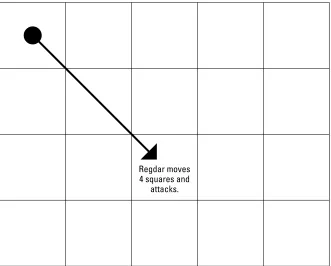
The Battle Grid and Markers ...85Markers...86
Moving on the battle grid ...86
Practice: a Sparring Match...88
Placing characters on the battle grid ...88
What to do on a turn ...89
Example of a Sparring Match ...89
Player Characters versus Monsters...90
Placing characters on the battle grid ...90
What to do on a turn ...91
The Dungeon Master...91
Example of player versus monster combat ...92
Adding Story Elements ...93
Chapter 9: Finding a D&D Game to J oin . . . .95
A Typical Game Session ...95
Finding Someone to Play With...96
Joining someone else’s game ...97
Organizing your own game...98
Starting Off with a High-Level Character ...99
Regdar, 4th-Level Human Fighter ...100
Part II: Building a D&D Character...105
Chapter 10: Defining Your Character . . . .107
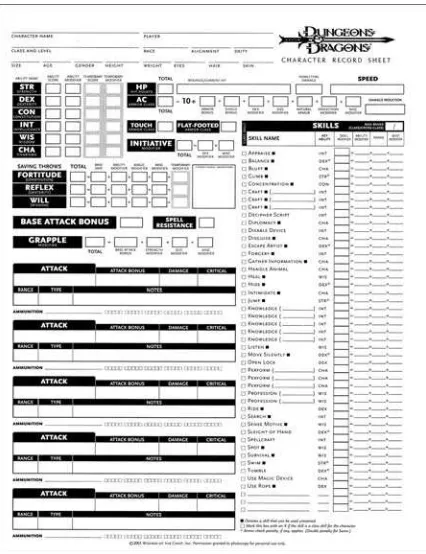
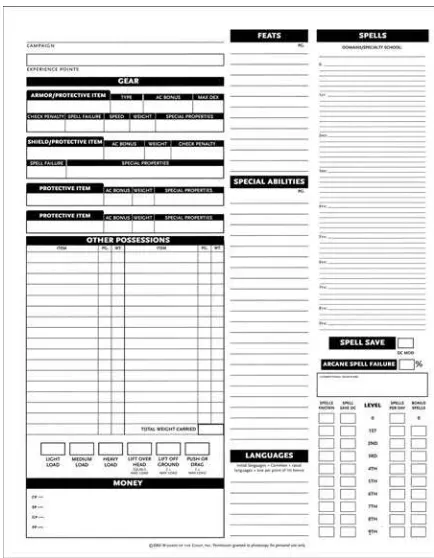
Your Character Sheet...107
Filling Out the Character Sheet ...109
Names ...109
Class and level ...110
Race...110
Alignment and deity ...110
Character description...111
Ability scores ...112
Hit points ...112
Armor Class...113
Speed...114
Initiative...114
Saving throws...114
Base attack bonus ...115
Attacks ...115
Skills ...116
Feats ...117
Special abilities ...118
Spells ...118
Gear ...118
Making Informed Choices ...118
Chapter 11: Choosing a Class . . . .119
Class and Level Benefits...120
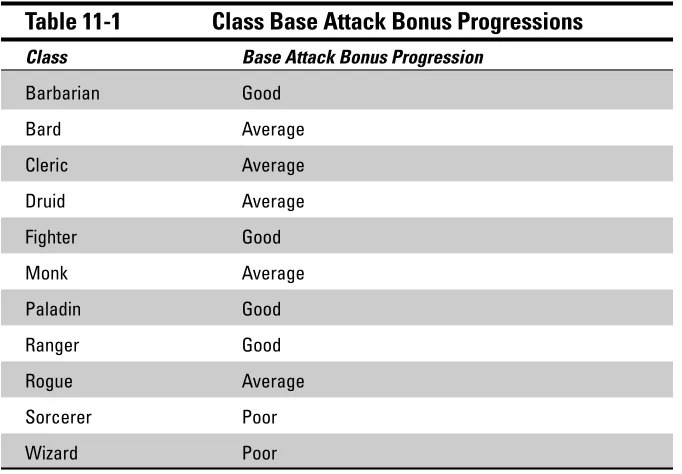
Base attack bonus ...120
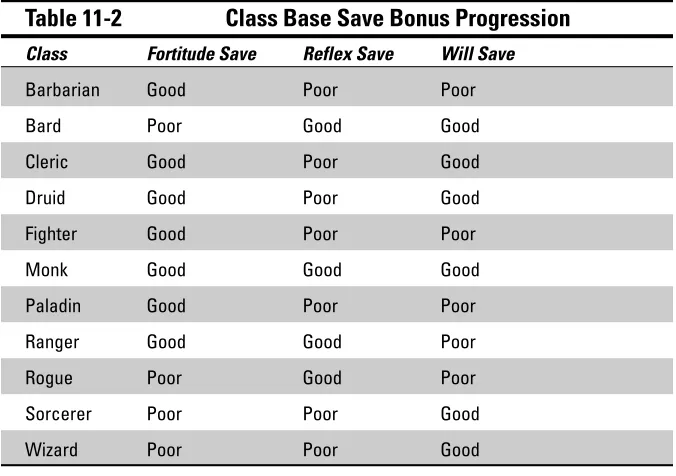
Base save bonus ...122
Level benefits ...123
Class Descriptions ...124
The fighter is the best class ...124
The rogue is the best class...126
The sorcerer is the best class...129
The cleric is the best class...131
Other classes ...134
Chapter 12: Figuring Out Your Character’s Ability Scores . . . .135
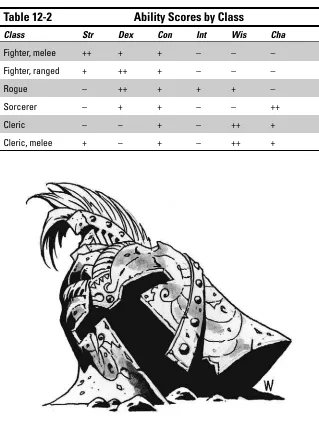
How the Ability Scores Work ...136
Generating Ability Scores...139
The random method ...139
The elite array...141
Chapter 13: Picking a Race . . . .143
Humans...144
Ability adjustments ...144
Special traits ...144
Best class...144
Dwarves...145
Ability adjustments ...145
Special traits ...145
Best class...146
Elves...146
Ability adjustments ...147
Special traits ...147
Best class...147
Halflings...148
Ability adjustments ...148
Special traits ...149
Best class...149
More Races to Choose From...149
Chapter 14: Selecting Feats . . . .151
What’s a Feat? ...151
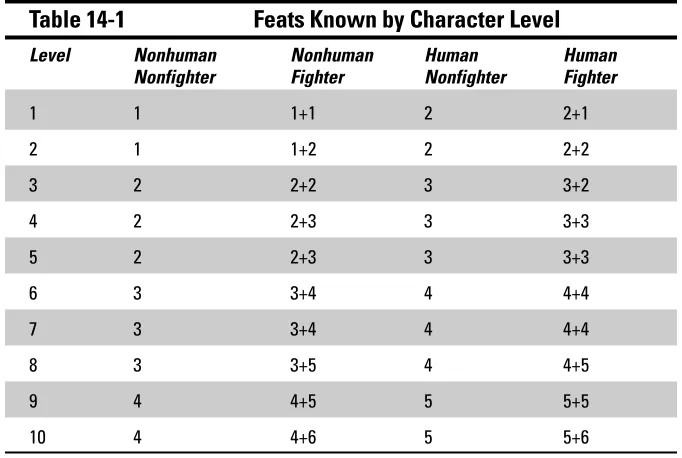
The Basics of Acquiring Feats ...152
Meeting feat requirements ...153
Understanding feat types ...154
Climbing up feat trees...155
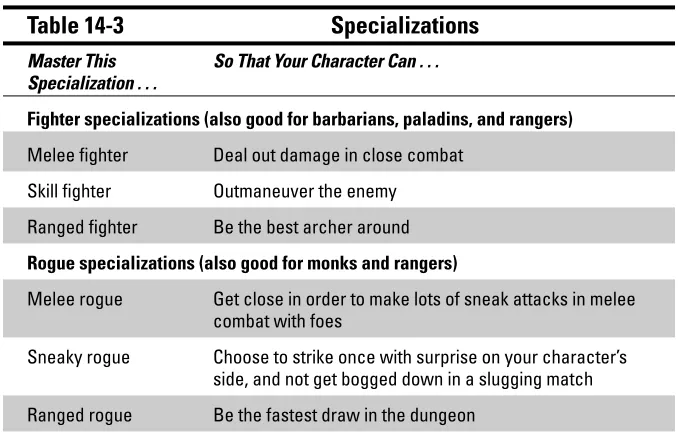
Making Your Choices Simpler with Feat Ladders ...156
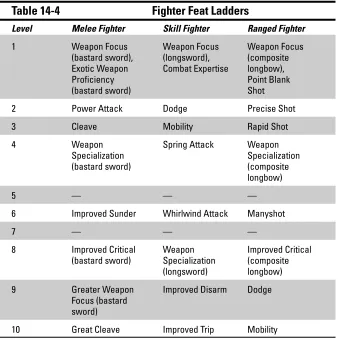
Fighter feat ladders ...157
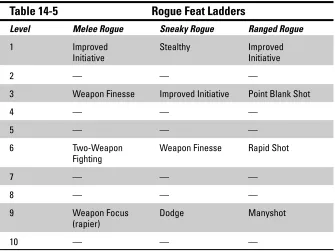
Rogue feat ladders...160
Sorcerer feat ladders...162
Cleric feat ladders ...164
Chapter 15: Picking Skills . . . .169
All about Skills ...169
Using skills ...171
Choosing your character’s skills ...172
Quick Picks: Using Skill Packages ...176
Fighter skill package ...176
Rogue skill package ...177
Sorcerer skill package ...179
Chapter 16: Choosing Armor, Weapons, and Gear . . . .183
Going Shopping ...183
Choosing the Right Weapon...185
Fighter weapons ...187
Rogue weapons...187
Cleric weapons ...188
Sorcerer weapons...188
Choosing Armor ...189
Shield or no shield?...189
Speed versus protection...190
Everything Else Your Character Is Carrying ...191
Useful gear...192
Write it down and forget it ...192
Improving Weapons and Armor ...193
Better armor...193
Masterwork ...193
Magical arms and armor...194
Chapter 17: Choosing Spells . . . .195
Casting Spells as a Sorcerer...195
Learning spells...196
Building your sorcerer’s spell selection ...197
Casting Spells as a Cleric...202
2+ 1 isn’t 3? ...202
Choosing domains...203
Preparing cleric spells ...204
Cleric spell loadouts ...205
Chapter 18: Advancing Your Character . . . .211
Gaining Experience Points ...211
Where does XP come from? ...212
For the Dungeon Master ...213
Advancing a Level ...213
Multiclassing...216
Prestige Classes...216
Part III: Playing Your Best Game ...217
Chapter 19: H andling Yourself in a Fight . . . .219
Choosing the Right Weapon for the Job...219
Killing ’em slowly: Attacking hit points ...220
Swinging for the fences: Save-or-die spells ...220
Beating ’em with footwork: Maneuver...221
Winning with a smile: Negotiation...221
Putting It All Together: Developing Your Combat Strategy ...222
Using Advanced Tactics ...225
Flanking...225
Beating the initiative order ...225
Charging and full attacks ...226
Avoiding attacks of opportunity...227
Fighting defensively ...229
Maximizing Your Character’s Attacks...230
Setting up attacks of opportunity ...230
Hitting hard: Power Attack 101...231
Adapting Your Tactics to Your Foes ...233
Beating spellcasters ...233
Handling numerous foes...234
Fighting monsters your character can’t hurt ...234
Chapter 20: Making the Most of Magic . . . .237
Selecting Spells for the Adventure...237
Casting Effectively in Combat...240
Powering Up with Magic Items ...241
Types of magic items ...242
Acquiring magic items ...244
Defining the magic item baseline ...246
Fighter magic items...247
Rogue magic items ...251
Cleric magic items ...254
Sorcerer magic items ...258
Chapter 21: Roleplaying and Working Together . . . .263
Roleplaying with Style ...263
Choosing your character’s alignment...264
Building a persona ...265
Creating mannerisms ...266
Knowing when to stop ...267
Working Together...268
Cooperating in a fight ...269
Buffing: Making your character and the team better...270
Saving downed characters ...272
Minding Your Table Manners...273
Five dos...274
Five don’ts ...276
Chapter 22: Character B uilding for E x perts . . . .279
Min-Maxing Your Character ...279
Min-maxing strategies...281
Exploiting good interactions...281
Multiclassing: Maxing Out Your Choices...283
Part IV: The Art of Dungeon Mastering...291
Chapter 23: Running the Game . . . .293
DMing: The Best Job in the Game ...294
Preparing an adventure ...294
Building the world ...294
Playing NPCs ...295
Running monsters ...296
Adjudicating results ...296
Keeping up with the characters ...296
Choosing an Adventure to Run ...297
Task-Oriented DMing ...298
The exploration task ...300
The conversation task ...302
The combat task ...303
The free time task...305
Getting the Most out of Your Monsters...306
Figuring out monster stats ...306
Deciding what the bad guys do ...310
Fighting smart, fighting dumb ...311
Chapter 24: Building a Dungeon . . . .313
Creating a D&D Adventure ...313
Parts of an adventure...314
Adventure-builder checklist...317
Sample Dungeon: Hall of the Spider God ...318
Adventure premise...318
Using the battle grid...318
Using the character and monster markers ...319
Adventure key...319
Starting the adventure ...320
Wrapping up the adventure ...330
Chapter 25: K eeping Your Players Happy . . . .331
Figuring Out Your Players ...331
Narrating the Adventure ...334
Getting ready, getting organized...334
Creating evocative scenes...335
Using the cut-scene ...335
Running a Fun Game ...336
Using props ...336
Table rules...337
Part V: The Part of Tens ...341
Chapter 26: The Ten Best Sorcerer Spells . . . .343
10. Mirror Image ...343
9. Hold Monster ...344
8. Fly...344
7. Stoneskin ...344
6. Sleep...344
5. Teleport ...345
4. Fireball...345
3. Polymorph ...345
2. Invisibility...346
1. Magic Missile ...346
Chapter 27: The Ten Best Cleric Spells . . . .347
10. Air Walk ...347
9. Bull’s Strength...348
8. Summon Monster III...348
7. Death Ward...348
6. Flame Strike ...349
5. Dispel Magic...349
4. Divine Favor ...349
3. Protection from Evil...350
2. Raise Dead...350
1. Hold Person ...351
Chapter 28: The Ten Best L ow - L evel Monsters . . . .353
10. Stirge (CR 1/2)...353
9. Hell Hound (CR 3) ...354
8. Young White Dragon (CR 4) ...354
7. Large Monstrous Spider (CR 2) ...354
6. Werewolf (CR 3)...355
5. Ghoul (CR 1) ...355
4. Dire Rat (CR 1/3) ...355
3. Ogre (CR 3)...356
2. Skeleton (CR 1/2)...356
1. Orc (CR 1/2) ...356
Chapter 29: The Ten Best Mid- L evel Monsters . . . .359
10. Hydra (CR 6) ...359
9. Flesh Golem (CR 7) ...359
8. Ghost (CR 7)...360
7. Umber Hulk (CR 7) ...360
5. Mummy (CR 5)...361
4. Mind Flayer (CR 8) ...361
3. Demon (Vrock) (CR 9) ...361
2. Troll (CR 5)...362
1. Young Adult Black Dragon (CR 9) ...362
Chapter 30: The Ten Best Dungeon Master Resources . . . .363
Dungeon Master’s Guide ...363
Monster Manuals...364
Player’s Handbook ...364
Forgotten Realms Campaign Setting...364
Eberron Campaign Setting ...365
Deities and Demigods ...365
Manual of the Planes...366
Draconomicon ...366
Deluxe Dungeon Master’s Screen...366
Adventures...367
D&D Miniatures ...368
Chapter 31: The Ten Best Player Resources . . . .369
Player’s Handbook ...369
Races Series Books ...369
Deluxe Player Character Sheets ...370
Hero Series Books ...370
Expanded Psionics Handbook ...370
Forgotten Realms Campaign Setting...371
Eberron Campaign Setting ...371
Arms and Equipment Guide...372
Weapons of Legacy ...372
Epic Level Handbook ...372
Chapter 32: The Ten Best D&D N ovels . . . .373
Dragonlance Chronicles ...373
Dragonlance Legends ...373
Icewind Dale Trilogy ...374
R.A. Salvatore’s War of the Spider Queen ...374
Knights of the Silver Dragon ...374
The City of Towers ...374
The Temple of Elemental Evil ...375
The Hunter’s Blades Trilogy ...375
The Year of Rogue Dragons...375
The Savage Caves...375
Glossary ...377
T
wenty-five years ago, I was looking for employment as an editor. What I found, in addition to a great job with Dragon Magazine, was this game called DUNGEONS& DRAGONS.I could tell just by looking through those early rulebooks that the game was in a world all its own. The ideas excited me, and the atmosphere they created was exhilarating. However, those rules didn’t do a good job of explaining how to actually p lay the game, and how to get the most out of the experience. As D&D has evolved over the years, the rules have devoted more and more space to that sort of advice — but DUNGEONS& DRAGONSis, and always will be, a complex, multifaceted game with countless choices and options. Those of us at Wizards of the Coast who create the books that keep the game vibrant and growing will be the first to admit that for a new player, absorbing the P lay er’s H and b ook can be a daunting task.
That’s where Du ngeons & Dragons F or Du m m iescomes in. With this book, Bill Slavicsek and Richard Baker break down the DUNGEONS& DRAGONSexperience into its component parts, making each piece of the whole easy to understand and appreciate.
If their names aren’t familiar to you, I’ll tell you that Bill and Rich are experts at what they do. As professional writers, they have each created or contributed to dozens of D&D rulebooks and adventures over the last decade and then some. As accomplished Dungeon Masters and players of the game, they bring their love of D&D and their knowledge of the rules to the table every time they get a group together.
D&D is a game about rules. It’s also a game about teamwork and social inter-action. It’s also about many other things, if you want it to be. But at the most fundamental level, it’s a game that’s meant to be fun to play.
Bill and Rich know how to have fun playing the game and how to make it enjoyable for everyone else. Read on, and let them show you what I mean.
— Kim Mohan
Y
ou crave action and adventure. You revel in the fantastic. You want to play DUNGEONS& DRAGONS. The DUNGEONS& DRAGONSgame has been around for more than 30 years, and it stands as the pinnacle of fantasy-adventure games (also known as roleplaying games). The concepts and play patterns of D&D (as it is affectionately called) harken back to the games of make-believe that almost everyone played as a little kid. However, D&D provides form and structure, making game play more satisfying and robust for kids and adults alike.This book makes the mysterious and often arcane world of fantasy roleplay-ing, specifically the DUNGEON& DRAGONSgame, easier to understand and faster to get into. Get ready to open your imagination, roll some dice, and battle dragons and other magical monsters.
A bout This B ook
We wrote this book to make our favorite hobby game more accessible to every fantasy and gaming fan, from the novice who enjoys fantasy novels such as The Lord of the Ringstrilogy and has a passing curiosity about DUNGEONS& DRAGONS, to the seasoned D&D player who goes to every convention and has been playing since Gary Gygax and Dave Arneson published the original White Box version of the game. Whether you have yet to play your first game or have been in a regular gaming group for years, our mission is to measurably increase the fun you have playing D&D and your proficiency with the game.
As a new player, this book shows you the basics of the game. You end up with a character to play and enough understanding to confidently take your place at any gaming table. Read this book today, grab a copy of the D&D Player’s Handbook, and you can play tomorrow without worry or confusion. D&D is a game. Games are fun. We hope to make learning to play fun, too.
Why You Need This Book
Novices need Dungeons & Dragons For Dummiesbecause it’s written by D&D experts to serve as the most comprehensive introduction to the D&D game. You’re going to learn things about D&D and fantasy roleplaying that many sea-soned gamers still haven’t discovered. Do you know the ins and outs of attacks of opportunity? What the best class and race combos are? How to make the most of your character’s key abilities? Which monsters can be brought down by what spells and weapons? You can find the answers to all kinds of D&D questions within these pages. And what if you already know a lot about the game? Get ready to learn a good deal more. We’ve filled this book with inside tips and behind-the-curtain details that you rarely encounter outside the hallowed walls of Wizards of the Coast’s fabled RPG R&D department. We believe that DUNGEONS& DRAGONSspeaks to and feeds the human condi-tion. D&D is a game of the imagination, building on the myths and fantasies that have shaped our culture. D&D is a game of endless possibilities, where the only limit on what can happen is what you can imagine. D&D is a social experience, a fun and exciting activity that combines group storytelling and fantasy iconology with strategic challenges and dice rolling. Nothing else — no computer game, no board game, no movie — comes close to delivering the interactive and unlimited adventure of the D&D experience.
From the days of telling stories about trolls and dragons and knights in shining armor around a campfire to the high-tech equivalent that involves computers and high-speed Internet connections, make-believe has advanced along with society. Today, one of the purest expressions of the game is DUNGEONS& DRAGONS. No other outlet for the adventures of armored warriors and powerful wizards is as versatile, creative, or fun as D&D. Get ready to go explore some dungeons and bash some monsters!
H ow to U se This Book
Much of this book is written with the assumption that you have a D&D Player’s Handbook. We don’t replace the D&D game rules; instead, we try to make them clearer and help you navigate your way through them with inside tips and advice. In addition, you’ll need a set of dice (see Chapter 1 for details) to use the practice sessions presented in later chapters, as well as the battle grid dungeonand character and monster markersincluded in this book. The battle grid, covered with one-inch squares, when used with the markers, helps show where your character is in relation to other characters and monsters in any particular encounter. We discuss how to use the battle grid in greater depth in Chapter 8.
D&D Terminology
DUNGEONS& DRAGONShas its own lexicon, just like a lot of other intensive activ-ities. Throughout this book, we work to explain things in plain language and to demystify some of the arcane terms and jargon used in the game and rule-books. Whenever you need some help, flip to the glossary. The glossary is your friend. Still, you should become familiar with the following key terms right off the bat:
DU N G E O N S & DR A G O N S:The original roleplaying game of medieval fantasy and adventu re. In the game, you tak e on the role of an imaginary c harac -ter defined b y a series of statistic s, c ool pow ers, and magic al ab ilities. The game is played arou nd a tab le or other c omfortab le loc ation w here b ook s and papers c an b e spread ou t and dic e c an b e rolled. D & D ( the short form of the name) is a game of you r imagination, part grou p storytelling and part w argame. There are no w inners or losers in this game; the point is to b u ild an ex c iting fantasy story throu gh the ac tions of you r c harac ter and the c hallenges set b y the D u ngeon M aster.
Du n g e o n M a s te r :O ne player is the D u ngeon M aster ( or the D M ) . W hile other players c ontrol a single c harac ter, the D M c ontrols all the monsters and enemies, narrates the ac tion, referees the game, sets u p adventu res, and develops the c ampaign. E very D & D game needs a D M .
P la y e r c h a r a c te r : The c harac ter c ontrolled b y a player is c alled a player c harac ter. A player c harac ter might b e a pow erfu l fighter, a sneak y rogu e, a c rafty sorc erer, or a c harismatic c leric .
Campaign:The D&D game doesn’t end with a single adventure. When the same characters continue from one adventure to another, the overall story is called a campaign.
Dice:D&D is a game that uses dice to resolve actions and determine other factors where the outcome isn’t certain. The twenty-sided die is the most important, as all major actions in the game are resolved using it. The game also uses a four-sided die, a six-sided die, an eight-sided die, a ten-sided die, and a twelve-sided die. We refer to these dice as d2 0 , d4 , d6 , d8 , d1 0 , and d1 2 . S ometimes, you need to roll multiple dice of a specific shape, such as four six-sided dice. In that case, we use this notation: 4 d6 . This allows you to generate a result between 4 and 2 4 . S ometimes you need to roll multiple dice and add a modifier, such as two four-sided dice plus two. In that case, we use this notation: 2 d4 + 2 . This allows you to generate a result between 4 and 1 0 . (S ee C hapter 1 for more about D&D dice.) Player’s Handbook:One of the three books that make up the rules of
the D&D game. This volume contains the basic rules of play and charac-ter creation. N o D&D player should be caught without one.
D u ng eon M aster’s G u ide:The second of the three books that make up the rules of the D&D game. This volume contains information that every Dungeon Master needs to run the game, set up adventures, and build campaigns.
M onster M anu al:The third of the three books that make up the rules of the D&D game. This volume is packed with monsters to challenge even the toughest D&D heroes, and contains information that every player and DM needs to know.
How This Book Is Organized
Dungeons & Dragons For Dummiesconsists of five parts. The chapters within each part cover specific topics in detail. In each chapter, we start with the basics and build from there. Whenever a point needs further clarification, we cross-reference the appropriate chapter so you can immediately find any additional information you need. In addition, whenever it comes up, we refer you to the appropriate chapter in the D&D P lay er’s H and b ook or, if necessary, one of the other two books that make up the core rules of the game: the Dungeon M aster’s G uid eor the M onster M anual.
Part I: D& D Crash Course
characters (called pregenerated characters) so you can join a game right now. We finish off this section with a discussion on starting your own game, just in case you don’t currently know anyone who plays.
Part II: Building a D&D Character
U sing a pregenerated character is fine, but eventually you’ll want to build a character of your very own. In this part, we explain the fine points of character creation and go behind the scenes to discuss character advancement. After all, where your character ends up might be more important than where he or she started. This part of the book is for the player who wants to become more invested in the D&D game. We help you navigate the Player’s Handbookso that you can make solid, informed decisions about what kind of character you want to build and play.
Part III: Playing Your Best Gam e
Even expert players should find something new and informative in this part of the book. F rom effective combat tactics to powerful character combina-tions, the basics of adventuring party teamwork to advice on good roleplay-ing, we offer insights into the mechanics of the game and how to be the best D&D player you can be.
Part IV: The Art of Dungeon M astering
The rest of the book spends a lot of time offering advice and tactics to players. H ere’s where we provide tips and tricks for that select and important individ-ual who makes every D&D game come alive — the Dungeon Master. It’s good to be the DM, and this section of the book starts with the basics of DMing and builds to provide insights that should give even experienced DMs something to think about when running their own games.
Part V: The Part of Tens
No For Dummiesbook is complete without this section of top-ten lists. H elpful and interesting collections of the best spells, monsters, and resources abound throughout these short chapters.
Icons Used in This Book
To guide you along the way and to point out information you really need to know, this book uses the following icons.
This icon points to tips and tricks that make some aspect of the D&D game easier or faster.
R emember these important nuggets, and you’ll be a better player or DM.
If you see this icon, read and follow the accompanying directions. This infor-mation can prevent you (or your character) from having a very bad day.
Whenever you see this icon, you know we’re directing you to more detailed information in one of the D&D core rulebooks — the Player’s Handbook, Dungeon Master’s Guide, or Monster Manual.
W here Do I Go from Here?
If you’re a new player, get a copy of the D&D Player’s Handbook. If you aspire to be a Dungeon Master, you’ll also need the Dungeon Master’s Guideand the Monster Manual. B ut don’t read them yet! The core rulebooks aren’t written for novices. Start by digging into the chapters in Part I of this book. We wrote that part specifically to help new players enter the D&D game.
If you’ve played a time or two (or a hundred!), check out Parts II, III, and IV for D&D gaming advice that anyone interested in the game can use. Part IV is especially relevant if you want to be the Dungeon Master or if you want to improve your already formidable DMing skills.
P reparin g fo r A d v en tu re
In This Chapter
Exploring the origins and objectives of DUNGEONS& DRAGONS
L ooking at the components of the game
Explaining role of the Dungeon Master
Examining the things you need to play
Understanding the different expressions of the game
J oining a 1st-level game
E
veryone played make-believe during childhood. Whether you played cops and robbers, cowboys and Indians, superheroes, or firefighters, you opened up your imagination and pretended to be something other than your-self. DUNGEONS& DRAGONSis a game of the imagination, a roleplaying game where players take on the roles of amazing heroes in a medieval fantasy set-ting. It’s just like make-believe, only more sophisticated, grown up, and fun. D&D gives form and structure to your imagination, creating a leisure activity that’s more interactive and open-ended than any movie, novel, or computer game.The backdrop for D&D is a mythological world of fairy tales, epic adventures, and monsters, where heroes gain power and magic to win against all kinds of challenges and villains. This backdrop owes much to fantasy novels, including The Lord of the Ringstrilogy by J .R.R. Tolkien, but also to a sort of collective consciousness consisting of material from comic books, TV shows, movies, and other fantasy-related influences. Over the course of 3 0 years, D&D has, in turn, influenced such media and helped set the stage for the computer game industry. This chapter provides an overview of the game and explores some of the topics that we discuss in greater detail throughout the book.
W hat Is D& D?
For a number of reasons, D&D is different from other games you may have played:
The play keeps on going:Like an ongoing television series, your game continues from play session to play session.
Y our character grow s as the game goes on:You play a character that grows and develops with every adventure he or she participates in. The only limit is your imagination: The game offers endless possibilities
and a multitude of choices because your character can do whatever you can imagine.
Everyone w ins: Because the game is really a series of stories told collec-tively by the players and the Dungeon Master, D&D is a game where everyone wins. If your character survives and wins the day (or dies spectacularly and memorably), and everyone has a good time, then the adventure ends in a win for the group.
Objectives of the D&D Game
D&D is a cooperative game, not a competitive one. In other words, you don’t compete against the other players and you don’t win by beating them. Instead, there are a lot of different ways to “ win” the game. The common denominator in every victory condition is “ fun.” If you and the other players have fun, every-one wins a game of D&D.
Storytelling
One way to “ win” a D&D game is to help the group tell a fun and exciting story. Whether you successfully complete your adventure or fail miserably, if everyone has a good time and you contribute to creating a story that every-one is going to remember, the group wins.
D&D: It’s good for y ou
A few times over the long history of the DUNGEONS& DRAGONS game, some people have tried to knock it as something silly or even harmful. Nothing could be further from the truth. D&D pro-motes teamwork and socialization. It teaches math and reading skills. It encourages creativity and imaginative problem solving. It’s uplifting,
Adventure goals
Every adventure contains its own set of victory conditions. Sometimes it’s as simple as surviving the dungeon and escaping, or defeating the boss villain at the heart of the fortress of evil. Other times, you might have a specific goal to accomplish (take the evil ring and toss it in the volcano) or a specific monster to beat (stop the werewolf before it rampages through the town again). If you achieve the objective of the adventure, the group wins.
Character victories
When you begin playing D&D, your character starts out at 1st level — the lowest experience level. Your character wins each time he or she defeats monsters and gains experience points and treasure. With each new level your character gains, he or she increases in power and reputation. Each increase in wealth, power, and equipment is a win for your character.
Looking at the Components of the Game
You need three distinct components to play a DUNGEONS& DRAGONSgame:Players:You need players, usually two to six of them, to take on the roles of adventurers in the fantasy world. The adventurers controlled by the players are also called heroesor p layer c harac ters(PC s,for short).
A Dungeon Master:The Dungeon Master ( DM) controls all of the non-p layer c harac ters ( N PC s) — the monsters, villains, and other incidental characters that inhabit the fantasy world. The DM sets the pace of the story and referees the action as the adventure unfolds.
A c ontinuing saga . . .
Unlike other games, each D&D adventure thatyou play is just one tale in the continuing saga of your player character and the other characters in your group. Of course, you can play a single game session and have a great time, but the real excitement and power of the D&D game comes from watching your character improve and develop from one adventure to the next.
An adventure:An adventure is the activity that the player characters par-ticipate in. An adventure usually consists of a basic plot and a number of encounters. As the players (through their characters) interact with the plot and resolve the encounters, they help the DM tell a story. The cool thing is that every action the player characters perform affects the twists and turns of the plot, so that the outcome of the adventure winds up surprising everyone.
The following sections give more details about all the various parts of the D&D experience.
Players and characters
Like the protagonists of a novel or the heroes of a movie, the action revolves around the characters in a D&D game. Each player creates a character (or selects a ready-to-play character, such as the ones presented in Chapters 3, 4, 5 , and 6), a heroic adventurer who is part of a team that regularly delves into dungeons and battles monsters. These characters include mighty fighters, brave clerics, cunning rogues, and powerful sorcerers. You, as a player, play the game while your character takes all the risks.
Playing a D&D character is kind of like acting, except everything happens around the gaming table. You don’t have to deliver lines or perform stunts. Just find a comfortable seat, explain what your character is doing, and roll some dice. The scene plays out in your imagination and in the imaginations of the other players.
The Dungeon M aster
One player has a special role in a D&D game. This player, the Dungeon Master (or DM), controls the pace of the story and referees the action along the way. Every D&D game needs a Dungeon Master — you can’t play the game without one.
The cool thing about Dungeon Masters is that they allow the game to be totally interactive and open-ended. Players can have their characters attempt anything they can imagine because there’s a real, live person sitting in the DM’s chair, coordinating the action and determining how every event adds to the story. The game rules and the dice help, but the DM must use his or her imagination to make the world unfold.
Some groups use multiple DMs, so that everyone gets to run a player charac-ter at some point, and everyone who wants to try their hands at DMing gets the opportunity. Other groups go for years with the same player serving as DM for every game session. It all depends on the desires of the group and the personalities involved.
The adventure
The player characters are the stars of your D&D game, just like the heroes in books or movies. They are adventurers, and adventurers need adventures. A D&D adventure features action, combat, mystery, challenges, and lots and lots of monsters. Adventures come in three forms: full-length adventures published specifically for D&D, adventure hooks in published products that DMs can turn into full-length adventures, and adventures that DMs create for themselves.
Adventures can be as simple as a basic dungeon crawl or as complex as a murder mystery. An adventure can last for a single game session or stretch out over a number of sessions of play. One adventure might take place in a haunted castle, another in a crime-ridden village, a third in the catacombs beneath an ancient graveyard. What makes D&D different from your typical board game is that each adventure is just a single tale in the continuing saga of your player characters. Adventures provide the stage upon which your player characters perform heroic deeds and resolve legendary quests. Anything is possible in a D&D game, and it is through adventures that the possibilities come alive.
Supplies you need
Players and characters, a Dungeon Master, and an adventure — these are the basic components of any DUNGEONS& DRAGONSgame. However, you need a few supplies to get the most out of the experience. These things include:
The D&D game itself Special dice
Character sheets
The D&D game
This For Dummiesbook is a great place to start, but eventually you’ll need other products and books to get the most from the DUNGEONS& DRAGONS role-playing game. Beginners should pick up the DU NGE O NS & DRA GO NS B asic Game, which includes the basic rules, dice, and many of the other components dis-cussed in this section, all in one convenient box.
If you want to progress beyond the basics, you’ll need the three core books, all published by Wizards of the Coast, that comprise the full D&D game:
Player’s Handbook:Presents the rules of the game from the player’s point of view and provides details on creating characters, outfitting adventurers, and playing the game.
Dungeon Master’s Guide: Presents the rules of the game from the Dungeon Master’s point of view and provides detailed advice on running games, creating adventures, sustaining campaigns, and awarding experi-ence to player characters. It also contains a selection of magic items and a fold-out battle grid to enhance play.
Monster Manual:Presents hundreds of creatures to use in any D&D game. From low-level to high-level, friendly to hostile, each creature has an illustration, game tactics, and statistics for ease of use.
The DM needs all three books, but players can usually get by with just a copy of the Player’s Handbook.
Dice
Dice are used to determine the outcome of actions in the game. If you want your character to try something — such as attack the ogre, disarm the trap, or search for clues — the dice are used whenever the result isn’t a sure thing. The D&D game uses dice of different shapes. Each player should have his or her own set of dice with which to play the game. Players get possessive and protective of their dice, and having your own set means you can customize it (dice come in all kinds of styles and colors). Game play also proceeds more smoothly when you don’t have to pass the dice around when sharing among players.
A set of dice for the D&D game includes at least the following (see Figure 1-1): One four-sided die (referred to as a d4)
One eight-sided die (d8) Two ten-sided dice (d10)
When these two dice are rolled together, they can produce any digit between 01 and 100. For this reason, these two dice are often called percentile dice (d% ). Some dice sets include a d9 0 (a die that has sides expressed in tens — 10, 20, 30, and so on) to make rolling percentile dice easier.
One twelve-sided die (d12) One twenty-sided die (d20)
Figure 1-1: The basic dice for D&D.
The d20 determines character success at any given action, while the other dice determine what happens if an action succeeds.
Character sheets
Your D&D character is defined by a series of key statistics, as well as by the background story you create for the character. These statistics and other key information are contained on a character sheet. As your character participates in adventures, these statistics change.
This book contains a series of basic character sheets that provide ready-to-play characters. These can be found in Chapters 3, 4, 5, and 6.
Miniatures and a battle grid
While most of the action of D&D occurs in the imaginations of the partici-pants, it is often very helpful to display certain information where everyone can see it. Combat situations, for example, work better when the players and DM know where all the participants are (characters and monsters) in relation to one another. D&D uses a one-inch grid, called the battle grid, to represent where the action takes place. To represent the characters and monsters, the players and DM place miniatures or other markers on the battle grid.
This book contains a sample battle grid and markers to use in your first few D&D experiences. We discuss the use of these items in Chapter 8.
Other play surfaces can be found in the Dungeon Master’s Guideand the D&D Basic Game. Official prepainted plastic D&D miniatures can be found in the D&D Basic Game, as well as in D&D Miniaturesbooster packs, available wher-ever fine hobby games are sold.
Pencils, paper, and graph paper
You’ll want a means for keeping notes and recording important information during game play, so have a lot of pencils, scrap paper, and graph paper available. Use the scrap paper for notes about the adventure (write down the names of NPCs and places, any treasure your character acquires, and any other details that you might forget or think may be important later). One player might take the role of note keeper, or each player may want to take his or her own notes. Use the graph paper to sketch a map of the area the PCs are explor-ing — players want to map the dungeon as they explore it, while the DM uses graph paper to design the whole dungeon before the adventurers enter it.
One Game Rule to Rule Them All
The DUNGEONS& DRAGONSgame is built around a core mechanic. This core mechanic is used to resolve all actions in the game, keeping play fast and intuitive.
The Core Game Mechanic:Whenever your character attempts an action that has a chance of failure associated with it, roll a twenty-sided die (d20). The higher the roll, the better the character’s chances of succeeding in that action. Character actions boil down to three basic types:
Attack rolls:A roll to determine if your character succeeds at attacking a monster or other opponent. Using a longsword against a monster, for example, requires an attack roll.
Skill checks:A roll to determine if your character uses a skill successfully. Using the Climb skill to scale a wall, for example, requires a skill check. Ab ility checks:A roll to determine if your character succeeds at
attempt-ing to do somethattempt-ing to which no specific skill really applies. Attemptattempt-ing to bash open a dungeon door, for example, requires a Strength ability check. To determine if any of these actions are successful, follow these steps:
1 . Roll a d2 0 .
2 . Add any relevant modifiers.
Y our First Character
In This Chapter
Examining the D&D player character Playing a character
Selecting the type of character you want to play
Y
our interface with the fantastic adventures of DUNGEONS& DRAGONSis your player character(also called a PC). Like the hero of a novel, the star of a movie, or the character in a computer game, your player character (along with the other player characters in your adventuring party, run by other play-ers) is at the center of all the action. Unlike the heroes of novels, movies, or even computer games, however, a D&D player character has no script to follow. Y oudetermine the course of every adventure through the actions you have your character take — and the only limit is your own imagination. In this chapter, we examine the basics of what makes a D&D player character tick. From game statistics to race and class abilities, this chapter provides an overview so that you can get a handle on the character you’re going to play. This is all in preparation for selecting one of the ready-to-play characters pre-sented in Chapters 3 through 6. In those chapters, we’ve done all the work of creating characters so that you can spend time getting familiar with all of the game concepts. Later in the book, we walk you through the process of char-acter creation so that you can use this book and the core D&D rulebooks to make your very own player character from scratch.Defining Your Character
D&D is a game, and so you need some way to express and describe your character in the context of the game world. Your fighter, for example, might be “extremely strong but not too bright,” and those characteristics need to be translated into game terms. The following sections provide an overview of the things you’ll find on your character sheet,a record of your character’s game statistics.
Name
Every great character has a great name. You may have a name all picked out from the moment you conceive your character, or you may figure it out after you’ve determined all of your character’s game statistics. Great names are evoca-tive. They fit the mood of the story and world in which the character adventures. John Savage is a great name for a character in a spy thriller set in the modern world, but it doesn’t work so well for a character in a D&D fantasy world. The characters presented for your use in Chapters 3, 4, 5, and 6 have names already assigned to them. Chapter 2 of the Player’s Handbookalso lists sample names based on race. Those are good places to start when you decide to create your own character from scratch (which we discuss in Part II).
Race
In the fantasy world of DUNGEONS& DRAGONS, humans aren’t the only intelligent race walking around. Other intelligent races share their adventures, and your character can belong to any of these. To start, we present only a few of the possible races you could choose from. The D&D Player’s Handbookhas addi-tional races that make great player characters.
These races are drawn from myth and legend, and they are similar to the imaginary races that populate many popular fantasy worlds. For D&D, the races we begin with are humans, dw arv es, elv es, and halflings. More detailed information on the character races can be found in Chapter 13. Here’s a quick rundown on the benefits of each:
Humans: These are people just like you and us. They are adaptable, flex-ible, and extremely ambitious. Compared to the other races, humans are relatively short-lived. In game terms, humans get an extra feat and four extra skill points to reflect their natural tendencies.
Dwarves: The members of this race are hearty and steadfast, standing about 41⁄
magical effects. Dwarves also have darkvision, the ability to see up to 60 feet in the dark.
Elves: Elves have a strong connection to the natural world, especially woodlands. They can live to be more than 700 years old. K nown for being artists of both song and magic, elves have an affinity for spellcast-ing and lore. They stand about 51⁄
2feet tall, appearing graceful and frail. Elves receive a +2 to Dexterity and a –2 to Constitution (see the “Ability scores” section). They are immune to sleep effects and receive a bonus against enchantment spells. Elves have low-light vision and a racial bonus on Listen, Search, and Spot checks (see the “Skills” section, later in this chapter).
Halflings: The members of this race are clever and capable — much more so than their small size might indicate. Standing about 3 feet tall, with slim, muscular builds, halflings are athletic and outgoing. Curious to a fault and usually with a daring to match, halflings love to explore. They tend to live well past 100. Halflings receive a +2 Dexterity and a –2 Strength to reflect their small statures. They also receive bonuses to Climb, Jump, Listen, and Move Silently checks (see the “Skills” section), as well as a bonus to all saving throws due to their fearlessness and ability to avoid damage.
Class
In addition to your character’s name (Regdar, perhaps) and race (human, for example), your character is most easily identified by his or her class. A class is kind of like a profession or vocation. It determines what role the character plays in the adventuring party. In this book, we present four of the most popu-lar D&D classes for your use. More can be found in the D&D Player’s Handbook. The four basic classes are fighter, rogue, sorcerer,and cleric. More detailed information on the character classes can be found in Chapter 11. Here’s a quick overview of each class:
F ighters:These characters are warriors with exceptional combat capa-bilities and weapon skills. Nobody kills monsters and stands at the front of an adventuring party as well as the fighter.
Rogues: Members of this class rely on tricks, cunning, and stealth to get through a dungeon and save the day. Rogues are great at getting past locked doors, scouting, spying, and attacking from the shadows. Sorcerers: These are spellcasters, calling on powerful magic spells to
fight monsters and protect their teammates. Sorcerers need to stay out of direct combat, but the power they bring to the adventure makes them worthy members of any party.
So, your character might be Regdar the human fighter, for example.
Level and XP
Levelis a description of your character’s relative degree of power. A
10th-level character, for example, is more powerful and able to take on tougher challenges than a 5th-level character. With each new level your character attains, he or she becomes more powerful and capable. Your character begins play at 1st level.
Ex perience points (X P)are the numerical measure of your character’s
per-sonal achievements. Your character earns experience points by defeating opponents and overcoming challenges. When your character’s X P total reaches various milestones, he or she gains new levels. At 0 X P, for example, your character is 1st level. At 1,000 X P, your character attains 2nd level. More information on X P and levels can be found in Chapter 18.
Ability scores
The primary expression of your character in game terms starts with his or her ability scores. Every D&D character is defined by six abilities — Strength, Dexterity, Constitution, Intelligence, Wisdom, and Charisma. (See Chapter 12 for more information about ability scores.) Each ability gets a score, a number that determines how good your character will be at different tasks in the game. The average score for everyday people in a D&D world is 10 or 11. Player characters are heroes, and so they are better than everyday folk. The average ability score for a player character is 12 or 13.
During character creation, you can generate numbers between 3 (a terrible score) and 18 (an excellent score). The characters presented for your use in Chapters 3 through 6 already have their ability scores and other statistics figured out, so you can start playing immediately.
Special abilities
If it hasn’t been made clear yet, your player character is special. He or she stands above the normal people and becomes a hero in the world. As such, your character has special abilities. These might be based on your character’s class or race, or tied to certain feats you have selected.
Key statistics
Your character has a number of key statistics that you’ll refer to over and over through the course of play. These appear right at the top of the ready-to-play character sheets presented in Chapters 3 through 6. More details on how to use these statistics can be found in Chapter 7. Here’s a quick rundown on these statistics:
Initiative modifier:This modifier is used to determine who goes first in a combat round.
Speed: This value shows how far your character can move (measured in feet) in a round.
Attack and damage modifiers:These numbers are associated with your character’s weapons of choice, show what you must roll to attack oppo-nents, and how much damage your character does if the attack succeeds.
Armor Class (or AC):This value is what opponents need to roll to hit your character during combat.
Hit points (or hp):This number defines how much damage your charac-ter can withstand before being defeated in combat. When your characcharac-ter runs out of hit points, he or she is defeated.
Feats
Featsprovide special bonuses or capabilities for your character. Sometimes a feat provides a totally new pow er for your character. O ther feats improve pow ers your character already has. T he ready-to-play characters in C hapters 3 throug h 6 have already had feats selected for them. F or more information about selecting your ow n feats, see C hapter 1 4 .
Skills
Skillsrepresent the training and education your character has beyond the combat and spellcasting inherent to his or her class. D epending on your char-acter’s class, your character w ill have a g reater or lesser amount of sk ills to call upon. R og ues, for ex ample, receive a larg e number of points w ith w hich to buy and improve sk ills. F ig hters, on the other hand, just don’t g o in much for studying , and therefore receive a much smaller number of sk ill points to use.
Gear
Every D&D player character must be well prepared for adventuring life. This is reflected not only in the class, skills, and feats the character has, but in the gear the character carries. From weapons and armor to rations, sleeping rolls and rope, torches, flint and steel, and the backpack to carry it all in, no adventurer goes naked into a dungeon.
Eq uipment has already been selected for the ready-to-play characters pre-sented in Chapters 3 through 6. Additional information on adventuring gear can be found in Chapter 16.
Spells
Characters with a spellcasting class possess spells. In this book, the spellcast-ing classes we cover are the sorcerer ( an arcane spellcaster) and the cleric ( a divine spellcaster) . The D&D Player’s Handbookpresents other spellcasting class options.
The sorcerer (one of the spellcasting character classes presented in this book) casts arcane spells. Arcane spells tend to be offensive in nature. The cleric (another spellcasting character class in this book) casts divine spells. Divine spells tend to be helpful and defensive in nature, providing healing or effects that improve or otherwise benefit the party.
Spells have already been selected for the ready-to-play spellcasters pre-sented in Chapters 5 and 6. Additional information on spells can be found in Chapter 17 .
Playing Your Character
As stated earlier in this chapter, the way you interface with the D&D world is through your player character. Y our character is your eyes and ears in the fantasy world, as well as your hands and feet. Y ou can interact with the world your Dungeon M aster presents in any way you want through your character. The only limit is your imagination — and sometimes how well you roll the dice. The following sections tell you how to get the most out of your player characters.
Taking turns
W hen you’re caught up in a game, it’s easy to care only about whose turn it is during combat and other dramatic situations (such as when dealing with a trap or obstacle). Try not to forget that there are other people playing the game with you. W hen you really get into your character and the fantasy, you might have a tendency to hog all of the DM ’s attention. Resist that urge! L et every player have a turn talking to the DM , asking questions, or describing what his or her character wants to do. It’s only fair, and it makes the game work much better. B esides, much of the fun is in seeing what the other play-ers are thinking and how they’re reacting to their charactplay-ers’ actions.
During combat situations, everyone makes an initiative roll to determine the order of play. W e cover initiative and game play in greater detail in Chapter 7 .
Roleplaying
D&D is a game. Have fun with it. You don’t have to use funny voices or accents or anything like that. J ust determine how your character would act in any given situation and remain true to the character as the adventure unfolds. Soon, your character will develop a personality all of his or her own, and the game, in turn, will take on a fantastic life that makes each session fun to play.
Your imagination is the limit
In addition to attacking, casting spells, and using skills, characters can do all sorts of things. The only limit to what a character can do is the player’s imag-ination and the rulings of the Dungeon Master. Depending on the situation, your character might bash apart a cabinet to find a secret compartment, make a rope out of bed sheets, or try to build a trap out of spare parts in an evil wiz ard’s workshop. The DM decides if an idea works or not, sometimes calling for die rolls to help determine the outcome.
Choosing Your Character
The earlier sections in this chapter cover the basics. After you have a handle on the basic stuff, select your own character from those presented over the
Play ers are n ot characters
Always keep in mind that you and your characterare two different people. Y ou hav e knowledg e as a player that your character doesn’t hav e. Y our character shouldn’t know what die rolls hav e b een made or other thing s that don’t make up his or her “ character knowledg e.” C haracters nev er talk ab out Armor C lass or hit points or ab ility scores. T hey can discuss the q uality of their armor, their g eneral health, and their comparativ e streng ths and weaknesses, b ut nev er the g ame mechanics b ehind those thing s.
B e sure to let the D M and the other players know when you’re speaking as your character or as yourself, if there is any confusion. W hen
you rememb er the difference b etween you the player and your character, ev eryone can hav e more fun roleplaying .
A g ood D ung eon M aster may say during the g ame “ Y ou don’t know that” or “ Y ou wouldn’t think of that,” meaning that you’re confusing player knowledg e with character knowledg e. G ood players learn to av oid this type of prob lem b y keeping the two separate.
next four chapters. There’s no right or wrong way to choose a character. You might like the picture of the character and decide to play that character because he or she looks cool and heroic. You might really want to play a spe-cific class and/ or race. Of course, you should read through all the material, but in the end, go with your gut and choose the character that most appeals to you. Here are some recommendations:
Fighters: You want to play a fighter if being in the thick of combat appeals to you. Fighters always have something to do, no matter what challenge appears before them. Fighters are also among the easiest characters to play because they do one thing and they do it well — they fight. If you want to play a fighter, turn to Chapter 3 and select one of the ready-to-play fighters presented therein.
R o gu es: You want to play a rogue if being sneaky and cunning appeals to you. Rogues have plenty of skills to call upon, and they excel at making sneak attacks on their enemies. Rogues have a few more options than fighters, making them slightly more complex to play, but they’re still a good choice for those new to the game and the concepts of D&D. If you want to play a rogue, turn to Chapter 4 and select one of the ready-to-play rogues presented therein.
S o rc erers: You want to play a sorcerer if casting flashy spells appeals to you. Sorcerers cast arcane spells that deal damage or protect the party. Sorcerers are harder to play than fighters or rogues due to the slight complexity of spellcasting, but the rewards for playing a sorcerer well can be very satisfying. If you want to play a sorcerer, turn to Chapter 5 and select one of the ready-to-play sorcerers presented therein.
C leric s: You want to play a cleric if spellcasting, up close combat, and helping others appeals to you. Clerics cast defensive and helpful divine spells that give the entire party a boost. In addition, they have the ability to fight alongside fighters when the monsters charge in fast and furiously. If you want to play a cleric, turn to Chapter 6 and select one of the ready-to-play clerics presented therein.
Creating your ow n character
We recommend starting out by using one of theready- to- play characters. This allows you to get right into the game and get a feel for it without a lot of upfront preparation. H owever, one of the great joys of the D& D game is creating your own character and watching him or her develop and
S tarting O ut as a Fighter
In This Chapter
Understanding the fighter class Exploring who should play a fighter Discovering how to play a fighter Meeting four ready-to-play fighters
T
he fighter is the quintessential DUN G EON S& DRAG ON Splayer character. As the name of the class implies, the fighter has the best all-around fighting capabilities. A fighter usually has a good Strength score to better use melee weapons, such as swords and axes. A good Dexterity score helps bolster a fighter’s use of ranged weapons, such as bows, as well as his or her Armor Class.Fighters can use any kind of armor, shield, or most weapons without penalty. They are trained in all types of combat.
Your character can take any approach to the fighter class. He might be a questing knight, a king’s champion, or an elite foot soldier. She might be a mercenary, a raider, or a thug. Some fighters use their expertise for the greater good, while others are only interested in personal gain.
Some fighters take up the sword to escape life on the farm. Whether a fighter receives formal training in an army or local militia, or is self-taught but battle tested, he or she stands at the front of any adventuring party. A fighter pro-vides combat prowess, high hit points, and good defense to the party. In return, the fighter seeks magical support, healing, and scouting skills from comrades. As part of a team, the fighter protects the other party members and wades in to defeat the tough opponents. In other words, the fighter’s job is to fight.