“The book does a terrific job of explaining the tax code. The tax advice . . . is on target and has depth. Smart chapters — not just thumbnail sketches — for filling out forms.”
— Gannett News Service
“Among tax advice books is far and away the best. Taxes For Dummiesis fun to read and teaches about the tax system itself. The book also provides excellent advice about dealing with mistakes — created by you or the Internal Revenue Service. And it talks about fitting taxes into your daily financial planning. In other words, it’s a book you can use after April 15, as well as before.”
— Kathy M. Kristof, Los Angeles Times
“The best of these books for tax novices. Substitutes simple English for tax-code complexities.”
—Worthmagazine
“User-friendly income-tax preparation and sound financial advice you can use through-out the year.”
—The Seattle Times
“This book is the most accessible and creative. It’s also the best organized of the lot, presenting information in the order you need it to complete your tax forms.”
—USA Today
“Taxes For Dummieswill make tax preparation less traumatic . . . It is a book that answers — in plain English, and sometimes with humor — many puzzling questions that arise on the most commonly used tax forms.”
— Stanley Angrist, The Wall Street Journal
“This is a lot of book for the money, filled with good examples . . . and level-headed advice. It follows the line-by-line format but also has year-round reference value for taxpayers who plan ahead . . . A human heart beats in this highly intelligent tax tome.”
— Michael Pellecchia, syndicated columnist
“$$$$ — Highest rated among the annual tax guides . . . superb writing and friendly organization.”
More Bestselling For Dummies
Titles by Eric Tyson
Investing For Dummies
®The complete guide to building wealth in stocks, real estate, mutual funds, and small business. With updated coverage on everything from Internet brokerages to informa-tion sources, this friendly guide shows you how to assess your situainforma-tion, gauge risks and returns, and make sound investments. Also check out the latest edition of Eric’s Mutual Funds For Dummies!
Personal Finance For Dummies
®Discover the best ways to establish and achieve your financial goals, reduce your spending and taxes, and make wise personal finance decisions. Wall Street Journal bestseller with more than 1 million copies sold in all editions and winner of the Benjamin Franklin best business book award.
Home Buying For Dummies
®America’s #1 real estate book includes coverage of online resources in addition to sound financial advice from Eric Tyson and frontline real estate insights from industry veteran Ray Brown. Also available from America’s best-selling real estate team of Tyson and Brown — House Selling For Dummiesand Mortgages For Dummies.
Real Estate Investing For Dummies
®Real estate is a proven wealth building investment but many people don’t know how to go about making and managing rental property investments. Real estate and prop-erty management expert Robert Griswold and Eric Tyson cover the gamut of propprop-erty investment options, strategies, and techniques.
Small Business For Dummies
®Taxes 2007
FOR
by Eric Tyson, MBA
Financial consultant and bestselling author
Margaret Atkins Munro, EA
Tax advisor
David J. Silverman, EA
Tax advisor
Taxes 2007
FOR
Taxes 2007 For Dummies®
Published by
Wiley Publishing, Inc.
111 River St.
Hoboken, NJ 07030-5774
www.wiley.com
Copyright © 2007 by Eric Tyson, David J. Silverman, and Margaret Atkins Munro Published by Wiley Publishing, Inc., Indianapolis, Indiana
Published simultaneously in Canada
No part of this publication may be reproduced, stored in a retrieval system, or transmitted in any form or by any means, electronic, mechanical, photocopying, recording, scanning, or otherwise, except as permitted under Sections 107 or 108 of the 1976 United States Copyright Act, without either the prior written permission of the Publisher, or authorization through payment of the appropriate per-copy fee to the Copyright Clearance Center, 222 Rosewood Drive, Danvers, MA 01923, 978-750-8400, fax 978-646-8600. Requests to the Publisher for permission should be addressed to the Legal Department, Wiley Publishing, Inc., 10475 Crosspoint Blvd., Indianapolis, IN 46256, 317-572-3447, fax 317-572-4355, or online at
http://www.wiley.com/go/permissions.
Trademarks:Wiley, the Wiley Publishing logo, For Dummies, the Dummies Man logo, A Reference for the Rest of Us!, The Dummies Way, Dummies Daily, The Fun and Easy Way, Dummies.com and related trade dress are trademarks or registered trademarks of John Wiley & Sons, Inc. and/or its affiliates in the United States and other countries, and may not be used without written permission. All other trademarks are the property of their respective owners. Wiley Publishing, Inc., is not associated with any product or vendor mentioned in this book.
LIMIT OF LIABILITY/DISCLAIMER OF WARRANTY: THE PUBLISHER AND THE AUTHOR MAKE NO REPRESENTATIONS OR WARRANTIES WITH RESPECT TO THE ACCURACY OR COMPLETENESS OF THE CONTENTS OF THIS WORK AND SPECIFICALLY DISCLAIM ALL WARRANTIES, INCLUDING WITHOUT LIMITATION WARRANTIES OF FITNESS FOR A PAR-TICULAR PURPOSE. NO WARRANTY MAY BE CREATED OR EXTENDED BY SALES OR PROMOTIONAL MATERIALS. THE ADVICE AND STRATEGIES CONTAINED HEREIN MAY NOT BE SUITABLE FOR EVERY SITUATION. THIS WORK IS SOLD WITH THE UNDERSTANDING THAT THE PUBLISHER IS NOT ENGAGED IN RENDERING LEGAL, ACCOUNTING, OR OTHER PROFESSIONAL SERVICES. IF PROFESSIONAL ASSISTANCE IS REQUIRED, THE SERVICES OF A COMPETENT PROFESSIONAL PERSON SHOULD BE SOUGHT. NEITHER THE PUBLISHER NOR THE AUTHOR SHALL BE LIABLE FOR DAMAGES ARISING HEREFROM. THE FACT THAT AN ORGANIZATION OR WEBSITE IS REFERRED TO IN THIS WORK AS A CITATION AND/OR A POTENTIAL SOURCE OF FURTHER INFORMATION DOES NOT MEAN THAT THE AUTHOR OR THE PUBLISHER ENDORSES THE INFORMATION THE ORGANIZATION OR WEBSITE MAY PROVIDE OR RECOMMEN-DATIONS IT MAY MAKE. FURTHER, READERS SHOULD BE AWARE THAT INTERNET WEBSITES LISTED IN THIS WORK MAY HAVE CHANGED OR DISAPPEARED BETWEEN WHEN THIS WORK WAS WRITTEN AND WHEN IT IS READ.
For general information on our other products and services, please contact our Customer Care Department within the U.S. at 800-762-2974, outside the U.S. at 317-572-3993, or fax 317-572-4002.
For technical support, please visit www.wiley.com/techsupport.
Wiley also publishes its books in a variety of electronic formats. Some content that appears in print may not be available in electronic books.
Library of Congress Control Number: 2006934809 ISBN: 978-0-470-07901-0
Manufactured in the United States of America 10 9 8 7 6 5 4 3 2 1
About the Authors
Eric Tyson, MBA,is a bestselling author, syndicated columnist, and lecturer. He works with
and teaches people from myriad income levels and backgrounds, so he knows the financial and tax questions and concerns of real folks.
After toiling away for too many years as a management consultant to behemoth financial-service firms, Eric decided to take his knowledge of the industry and commit himself to making personal financial management accessible to all of us. Despite being handicapped by a joint B.S. in Economics and Biology from Yale and an MBA from Stanford, Eric remains a master at “keeping it simple.”
An accomplished freelance personal-finance writer, Eric is the author of other For Dummies national bestsellers on Personal Finance, Investing, Real Estate Investing, and Home Buying. His work has been critically acclaimed in hundreds of publications and programs including Newsweek, The Los Angeles Times, Chicago Tribune, Kiplinger’s Personal Finance Magazine, The Wall Street Journal,and NBC’s Today Show,ABC, CNBC, PBS’s Nightly Business Report, CNN, FOX-TV, CBS national radio, Bloomberg Business Radio, and Business Radio Network.
Margaret Atkins Munro, EA,(who answers to Peggy) is a tax advisor, writer, and lecturer
with more than 30 years’ experience in various areas of taxation and finance with a mission in life to make taxes understandable to anyone willing to learn. Her practice is concentrated in the areas of family tax, small business, trusts, estates, and charitable foundations. She is a graduate of The Johns Hopkins University and has also attended University College Cork (Ireland) and the Pontifical Institute of Mediaeval Studies in Toronto, and she feels that her ability to decipher the language in the Internal Revenue Code derives completely from her familiarity with a variety of obscure medieval languages.
Peggy is the author of 529 & Other College Savings Plans For Dummies. She lectures for the IRS annually for its volunteer tax preparer programs and speaks on a variety of tax-related topics.
David J. Silverman, EA,has served on the Advisory Group to the Commissioner of Internal
Revenue. David has a Certificate in Taxation from New York University and has been in pri-vate practice in Manhattan for more than 25 years.
Dedication
My deepest and sincerest thanks to my family, friends, clients, and students for their enthusi-astic support and encouragement. My wife, Judy, as always, gets special mention for
inspiring my love of books and writing.
—Eric Tyson None of this is worthwhile without the love of my immediate family — my husband Colin, my son Jacob, my parents-in-law MIL and FIL, and especially my parents, Cynthia and Harvey, who are proud of, but never surprised at, my achievements. To all of you, this book is a testa-ment to your belief in me.
—Margaret Atkins Munro To my wife, Betsy, who provided the inspiration; my late father, Louis, whose writing skills I hope I inherited; and my daughters, Joanna and Lisa, who assisted with the essential research and editing.
—David J. Silverman
Authors’ Acknowledgments
Special thanks to the people at CCH, a Wolters Kluwer business — especially Glenn Borst, JD, LLM; Geralyn Jover-Ledesma, LLB, CPA; and Kenneth L. Swanson, JD, LLM, who provided the technical review. Every chapter in this book was improved by their knowledge, insights, and experience.
Publisher’s Acknowledgments
We’re proud of this book; please send us your comments through our Dummies online registration form located at
www.dummies.com/register/.
Some of the people who helped bring this book to market include the following:
Acquisitions, Editorial, and Media Development
Project Editor: Chad R. Sievers
(Previous Edition: Chrissy Guthrie)
Acquisitions Editor: Mike Baker
Technical Editor: CCH, a Wolters Kluwer business: Glenn Borst, JD, LLM; Geralyn Jover-Ledesma, LLB, CPA; and Kenneth L. Swanson, JD, LLM
Editorial Manager: Michelle Hacker
Editorial Assistants:Erin Calligan, Joe Niesen, David Lutton
Cartoons: Rich Tennant (www.the5thwave.com)
Composition Services
Project Coordinator: Kristie Rees
Layout and Graphics: Denny Hager, Stephanie D. Jumper, Barry Offringa, Ronald Terry, Erin Zeltner
Anniversary Logo Design:Richard Pacifico
Proofreaders: Betty Kish, Jessica Kramer, Dwight Ramsey
Indexer: Anne Leach
Special Help
Vicki Adang
Publishing and Editorial for Consumer Dummies
Diane Graves Steele, Vice President and Publisher, Consumer Dummies
Joyce Pepple, Acquisitions Director, Consumer Dummies
Kristin A. Cocks, Product Development Director, Consumer Dummies
Michael Spring, Vice President and Publisher, Travel
Kelly Regan,Editorial Director, Travel
Publishing for Technology Dummies
Andy Cummings,Vice President and Publisher, Dummies Technology/General User
Composition Services
Gerry Fahey,Vice President of Production Services
Contents at a Glance
Introduction...1
Part I: Getting Ready to File ...5
Chapter 1: Understanding the U.S. Tax System ...7
Chapter 2: Tax Return Preparation Options and Tools ...19
Chapter 3: Getting and Staying Organized ...29
Chapter 4: No Form Fits All (Or, What Kind of Taxpayer Are You?) ...41
Part II: Tackling the Various Forms...63
Chapter 5: Easy Filing: 1040EZ and 1040A...65
Chapter 6: Form 1040: Income Stuff ...85
Chapter 7: Form 1040, Part II: Adjustments to Income Stuff...117
Chapter 8: The Rest of the 1040 ...137
Part III: Filling Out Schedules and Other Forms...161
Chapter 9: Itemized Deductions: Schedule A...163
Chapter 10: Interest and Dividend Income: Schedule B (1040), Schedule 1 (1040A) ...203
Chapter 11: Business Tax Schedules: C, C-EZ, and F...217
Chapter 12: Capital Gains and Losses: Schedule D ...249
Chapter 13: Supplemental Income and Loss: Schedule E ...273
Chapter 14: Giving Credits Where Credits Are Due ...285
Chapter 15: Other Schedules and Forms to File...299
Part IV: Audits and Errors: Dealing with the IRS...315
Chapter 16: The Dreaded Envelope: IRS Notices, Assessments, and Audits ...317
Chapter 17: Fixing Mistakes the IRS Makes...337
Chapter 18: Fixing Your Own Mistakes ...353
Part V: Year-Round Tax Planning...375
Chapter 19: Tax-Wise Personal Finance Decisions...377
Chapter 20: Reducing Taxes with Retirement Accounts ...385
Chapter 21: Small Businesses and Tax Planning ...405
Chapter 22: Your Investments and Taxes...419
Chapter 23: Real Estate and Taxes ...435
Chapter 24: Children and Taxes ...451
Chapter 25: Estate Planning ...463
Part VI: The Part of Tens...473
Chapter 26: Ten Tips for Reducing Your Chances of Being Audited...475
Chapter 27: Ten (or So) Often-Overlooked Tax-Reduction Opportunities...479
Chapter 28: Ten (Plus One) Tax Tips for Military Members (and Their Families)...483
Chapter 29: Ten Interview Questions for Tax Advisors...487
Glossary ...491
Contents
Introduction ...1
What’s New in This Edition...1
Why Buy This Tax Book?...2
Your Tax Road Map ...2
Part I: Getting Ready to File ...2
Part II: Tackling the Various Forms ...3
Part III: Filling Out Schedules and Other Forms ...3
Part IV: Audits and Errors: Dealing with the IRS ...3
Part V: Year-Round Tax Planning...3
Part VI: The Part of Tens ...3
Glossary...4
Icons Used in This Book...4
Part I: Getting Ready to File...5
Chapter 1: Understanding the U.S. Tax System ...7
Figuring Out the U.S. Tax System ...8
You can reduce your taxes...9
Beyond April 15: What you don’t know can cost you...9
Understanding Your Income Tax Rates ...11
Total taxes ...11
Your marginal income tax rate ...12
Chapter 2: Tax Return Preparation Options and Tools ...19
Preparing Your Own Return...19
Using IRS Publications...20
Perusing Tax-Preparation and Advice Guides ...21
Buying Software...21
Accessing Internet Tax Resources ...22
Internal Revenue Service...22
Directories...23
Research ...23
Tax preparation sites ...23
Hiring Help ...24
Deciding whether you really need a preparer ...24
Preparers ...25
Enrolled agents (EAs) ...25
Certified public accountants (CPAs)...26
Tax attorneys ...27
Finding Tax Preparers and Advisors...27
Chapter 3: Getting and Staying Organized ...29
Keeping Good Records ...30
Ensuring a complete and accurate tax return ...30
Setting up a recordkeeping system...31
Tracking tax information on your computer ...32
Reconstructing Missing Tax Records ...33
Property received by inheritance or gift...34
Securities received by inheritance or gift ...36
Improvements to a residence ...37
Casualty losses ...37
Business records ...38
Requesting Copies of Lost Tax Returns ...38
Understanding the Cohan Rule ...39
Chapter 4: No Form Fits All (Or, What Kind of Taxpayer Are You?) ...41
What Rendition of 1040 Shall We Play? ...41
Form 1040EZ...42
Form 1040A (the short form) ...42
Form 1040 (the long form) ...43
Choosing a Filing Status ...43
Single...43
Married filing jointly ...44
Married filing separately ...45
Head of household ...48
Qualifying widow(er) with dependent child ...50
Figuring Personal and Dependent Exemptions ...51
Personal exemptions ...51
Dependent exemptions...52
Securing Social Security Numbers for Dependents ...55
Filing for children and other dependents ...55
Defining Who Is a Qualifying Child ...56
Age test ...56
Relationship test...57
Residency test...57
Support test ...57
Filing a Return for a Deceased Taxpayer...57
Must I File? ...58
When to file ...59
If you don’t file ...60
Where to file...60
How to file ...60
A Final Bit of Advice...61
Part II: Tackling the Various Forms ...63
Chapter 5: Easy Filing: 1040EZ and 1040A...65
Who Can File a 1040EZ?...65
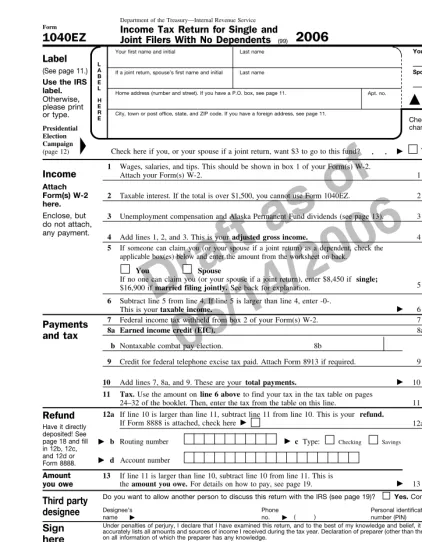
Filling Out a 1040EZ ...66
Line 1: Total wages, salaries, and tips ...67
Line 2: Taxable interest income of $1,500 or less...67
Line 3: Unemployment compensation and Alaska Permanent Fund dividends ...67
Line 4: Adjusted gross income...67
Line 5: Deductions and exemptions...67
Line 6: Taxable income ...68
Line 7: Federal income tax withheld ...68
Line 8a: Earned income credit (EIC) ...68
Line 8b: Nontaxable combat pay election...69
Line 9: Credit for federal telephone excise tax paid ...69
Line 10: Total payments...69
Line 12a: Refund time!...70
Line 13: Amount you owe ...70
Finishing up...71
Who Can File a 1040A?...72
Completing Form 1040A ...72
Line 6: Exemptions through line 9b: Qualified dividends ...72
Line 10: Capital gain distributions ...73
Lines 11a and 11b: Total IRA distributions ...74
Lines 12a and 12b: Total pensions and annuities...74
Line 13: Unemployment compensation, Alaska Permanent Fund dividends, and jury duty fees...74
Lines 14a and 14b: Social Security benefits ...75
Line 15: Total income ...76
Line 16: Penalty on early withdrawal of savings ...76
Line 17: Your (and your spouse’s) IRA deduction...76
Line 18: Student loan interest deduction ...76
Line 19: Jury duty pay you gave your employer ...77
Line 20: Total adjustments ...77
Line 21: Adjusted gross income...77
Line 22: Successful transcription of adjusted gross income to back of Form 1040A ...77
Lines 23a and 23b: Standard deduction questions ...77
Line 24: Standard deduction ...78
Line 25: IRS subtraction quiz ...78
Line 26: Total number of exemptions times $3,300...78
Line 27: Taxable income ...78
Line 28: Find your tax...79
Line 29: Credit for child and dependent care expenses ...79
Line 30: Credit for the elderly or the disabled...79
Line 31: Education credits...79
Line 32: Retirement contributions credit ...80
Line 33: Child tax credit...80
Line 34: Total credits...80
Line 35: Another IRS subtraction problem...80
Line 36: Advance earned income payments ...80
Line 37: Total tax ...81
Line 38: Total federal income tax withheld ...81
Line 39: 2006 estimated tax payments and amount applied from 2005 return...81
Line 40a and 40b: Earned income credit and nontaxable combat pay election ...81
Line 41: Additional child tax credit ...82
Line 42: Credit for federal telephone excise tax paid ...82
Line 43: Total payments...82
Line 44: We smell refund!...82
Lines 45a and 46: What to do with your refund...83
Lines 45b–d: Direct deposit of your refund...83
Line 47: Amount you owe ...83
Line 48: Estimated tax penalty...83
Final Instructions ...84
Chapter 6: Form 1040: Income Stuff ...85
Lines 6a–6d: Exemptions...85
Lines 7–22: Income...86
Line 7: Wages, salaries, tips...86
What those W-2 boxes mean...87
Line 8a: Taxable interest income...90
Line 8b: Tax-exempt interest...90
Line 9b: Qualified dividends ...91
Line 10: Taxable refunds, credits, or offsets of state and local income taxes ...91
Line 11: Alimony received (by you) ...93
Line 12: Business income (or loss) ...93
Line 13: Capital gain (or loss) ...93
Line 14: Other gains (or losses)...94
Lines 15a and 15b: Total IRA distributions ...94
Distributions before 591⁄2...97
Transfers pursuant to divorce...98
Inherited IRAs ...98
Surviving spouse ...99
Beneficiary other than a surviving spouse ...100
Withdrawal of nondeductible contributions ...101
Loss on an IRA ...101
Lines 16a and 16b: Total pensions and annuities...101
Line 17: Rental real estate, royalties, partnerships, S Corporations, trusts ...108
Line 18: Farm income (or loss) ...108
Line 19: Unemployment compensation ...108
Lines 20a and 20b: Social Security benefits ...109
Line 21: Other income...113
Line 22: Your total income...116
Chapter 7: Form 1040, Part II: Adjustments to Income Stuff ...117
Adjusted Gross Income (AGI) ...117
Line 23: Archer MSA (Medical Savings Account) deduction ...118
Line 24: Certain business expenses of reservists, performing artists, and fee-basis government officials ...119
Line 25: Health Savings Account Deduction (Form 8889) ...120
Line 26: Moving expenses (Form 3903) ...120
Line 27: One-half of self-employment tax ...121
Line 28: Self-employed SEP, SIMPLE, and qualified plans...121
Line 29: Self-employed health insurance deduction ...124
Line 30: Penalty for early withdrawal of savings...124
Lines 31a and b: Alimony paid...125
Line 32: You and your spouse’s IRA deduction ...127
Your spouse’s IRA deduction ...132
Line 33: Student loan interest deduction ...133
Line 34: Jury pay returned to your employer ...135
Line 35: Domestic production activities deduction (Form 8903)...135
Line 36: Total adjustments ...136
Line 37: Adjusted gross income...136
Chapter 8: The Rest of the 1040 ...137
Tax and Credits...137
Line 38: Adjusted gross income...137
Line 39a...138
Line 39b ...138
Line 40: Itemized deductions (from Schedule A) or your standard deduction ...138
Line 41: Subtract line 40 from line 38...139
Line 42: Exemptions ...139
Line 43: Taxable income ...140
Line 44: Tax ...140
Capital gains and qualified dividends tax worksheet ...142
Line 45: Alternative Minimum Tax (Form 6251) ...144
Line 46: Add lines 44 and 45...146
Credits: Lines 47 to 55 ...146
Line 47: Foreign tax credit (Form 1116)...146
Line 49: Credit for the elderly or the disabled (Schedule R) ...147
Line 50: Education credits (Form 8863)...147
Line 51: Retirement savings contributions credit ...149
Line 52: Residential energy credits (Form 5695) ...149
Line 53: Child tax credit...150
Line 54: Form 8396, Form 8839, and Form 8859...150
Line 55: Other credits ...151
Line 56: Total credits...152
Line 57: Subtract line 56 from line 46...152
Other Taxes...152
Line 58: Self-employment tax (Schedule SE) ...153
Line 59: Social Security and Medicare tax on unreported tip income (Form 4137)...153
Line 60: Tax on IRAs, other retirement plans, and other tax-favored accounts (Form 5329) ...153
Line 61: Advance earned income credit payments ...154
Line 62: Household employment taxes (Schedule H)...154
Line 63: IRS pop quiz...154
Payments...154
Line 64: Federal income tax withheld ...154
Line 65: Estimated tax payments...155
Line 66a and 66b: Earned income credit (EIC) and nontaxable combat pay election...155
Line 67: Excess Social Security and RRTA tax withheld ...156
Line 68: Additional child tax credit (Form 8812)...156
Line 69: Amount paid with extension request (Form 4868)...156
Line 70: Other payments ...156
Line 71: Credit for federal telephone excise tax paid ...157
Line 72: Total payments...157
Refund or Amount You Owe ...157
Line 73: The amount that you overpaid ...157
Line 74a: Amount that you want refunded to you...158
Line 75: Amount of line 73 you want applied to your 2007 estimated tax ...159
Line 76: The gosh darn AMOUNT YOU OWE line ...159
Line 77: Estimated tax penalty (Form 2210) ...159
Finishing Up ...160
Part III: Filling Out Schedules and Other Forms ...161
Chapter 9: Itemized Deductions: Schedule A ...163
The Standard Deduction ...163
Older than 65 or blind...164
Standard deduction for dependents ...164
Itemized Deductions ...165
Separate returns and limits on deductions...166
But if you change your mind...167
Lines 1–4: Medical and Dental Costs ...167
Medical and dental expense checklist...167
Deductible travel costs...171
Special medical expense situations ...171
Meals and lodging ...172
Insurance premiums ...172
Reimbursements and damages ...173
Special schooling...173
Nursing home...173
Improvements to your home ...174
Lines 5–9: Taxes You Paid ...174
Line 5: State and local income taxes ...175
Line 6: Real estate taxes ...175
When you buy or sell real estate...175
The downside of property tax refunds and rebates ...176
Line 7: Personal property taxes...176
Line 8: Other taxes (foreign income taxes) ...177
Lines 10–14: Interest You Paid ...177
Lines 10–11: Home mortgage interest and points reported to you on Form 1098 ...178
Line 12: Points not reported to you on Form 1098...181
Line 13: Investment interest...181
Lines 15–18: Gifts to Charity ...182
Qualifying charities ...182
Nonqualifying charities ...183
Contributions of property ...184
Charitable deduction limits ...186
Line 17: (For the world’s great humanitarians) ...187
Line 19: Casualty and Theft Losses...187
Victims of terrorist attacks or military action...188
Do you have a deductible loss? ...189
Figuring the loss ...189
Lines 20–26: Job Expenses and Most Other Miscellaneous Deductions...191
Line 20: Unreimbursed employee expenses ...191
Line 21: Tax preparation fees...198
Line 22: Other expenses — investment,safe-deposit box, and so on ...199
Lines 23–26: Miscellaneous math ...200
Line 27: Other Miscellaneous Deductions ...200
Line 28: Total Itemized Deductions...201
Chapter 10: Interest and Dividend Income:
Schedule B (1040), Schedule 1 (1040A)...203
Part I, Lines 1–4: Interest Income ...205
Understanding Form 1099-INT ...205
Completing lines 1–4 ...206
Interest-free loans...211
Part II, Lines 5–6: Dividend Income...212
Line 5: Name, payer, and amount ...212
Line 6: Total dividends...212
Your 1099-DIV: Decoding those boxes ...213
Reduced tax rates on dividends ...214
Part III, Lines 7–8: Foreign Accounts and Trusts...215
Chapter 11: Business Tax Schedules: C, C-EZ, and F ...217
Schedule C-EZ ...217
Schedule C ...218
Basic Information (A–E) ...219
Accounting Method Stuff (F–H)...219
Part I, Lines 1–7: Income ...220
Line 1: Gross receipts or sales...220
Line 2: Returns and allowances ...221
Line 3: Subtraction quiz...221
Line 4: Cost of goods sold ...221
Line 5: Gross profit ...222
Line 6: Other income...222
Line 7: Gross income...222
Part II, Lines 8–27: Expenses...222
Line 8: Advertising ...223
Line 10: Commissions and fees...225
Line 11: Contract labor ...225
Line 12: Depletion...226
Line 13: Depreciation ...226
Line 14: Employee benefit programs ...235
Line 15: Insurance (other than health)...235
Line 16a: Mortgage interest...235
Line 16b: Other interest...235
Line 17: Legal and professional services...236
Line 18: Office expense ...236
Line 19: Pension and profit-sharing plans ...236
Lines 20a and b: Rent or lease ...236
Line 21: Repairs and maintenance ...237
Line 22: Supplies...238
Line 23: Taxes and licenses ...238
Lines 24a–b: Travel, meals, and entertainment...238
Line 25: Utilities ...238
Line 26: Wages...238
Line 27: Other expenses ...239
Line 28: Total expenses...239
Line 29: Tentative profit (loss)...239
Line 30: Form 8829...239
Line 31: Net profit (or loss) ...239
Lines 32a and b: At-risk rules...239
Start-up expenses ...240
Operating Loss ...240
Schedule F: Profit or Loss from Farming ...241
Figuring out Schedule F ...242
Identifying tax issues specific to farmers...246
Chapter 12: Capital Gains and Losses: Schedule D...249
Collectibles and Real Estate ...249
What Part of Schedule D?...250
Schedule D: Columns ...250
Calculating Your Adjusted Basis ...252
What’s the starting point? ...253
Part I, Lines 1–7a and b: Short-Term Capital Gains and Losses — Assets Held One Year or Less ...255
Line 2: Enter your short-term totals, if any, from Schedule D-1, Line 2 ...255
Line 3: Total short-term sales price amounts ...255
Line 4: Short-term gain from Form 6252, and short-term gain or <loss> from Forms 4684, 6781, and 8824...255
Line 5: Net short-term gain or <loss> from partnerships, S Corporations, estates, and trusts from Schedule(s) K-1...256
Line 6: Short-term capital loss carry-over...256
Line 7: Net short-term gain or <loss>...256
Part II, Lines 8–15: Long-Term Capital Gains and Losses — Assets Held More than One Year...256
Line 8: Columns (a), (b), (c), (d), (e), and (f) ...256
Line 9: Enter your long-term totals, if any, from Schedule D-1, Line 9...257
Line 10: Total long-term sales price amounts ...257
Line 11: Gain from Form 4797, Part I; long-term gain from Forms 2439 and 6252; and long-term gain or <loss> from Forms 4684, 6781, and 8824 ...257
Line 12: Net long-term gain or <loss> from partnerships, S Corporations, estates, and trusts from Schedule(s) K-1...259
Line 13: Capital gain distributions ...259
Line 14: Long-term capital loss carry-over...259
Part III, Lines 16-22: Summary of Parts I and II ...260
Line 16: Combine lines 7 and 15 ...260
Line 17: Comparing lines 15 and 16...260
Line 18: 28 percent gains ...260
Line 19: 25 percent gains ...260
Line 20...260
Line 21: Capital losses...261
Line 22: Qualified dividends...261
Using Schedule D When You Sell Your Home ...261
Computing your profit ...264
Reporting a profit that exceeds the exclusion ...265
Following the home office and rental rules...265
Use Schedule D for Other Issues Involving Stocks (Worthless and Otherwise) ...266
Worthless securities ...266
Wash sales ...267
Small business stock...267
Stock options ...267
Short sales...269
Stock for services ...270
Appreciated employer securities ...270
Using Schedule D for Nonbusiness Bad Debts ...271
Day traders...271
Mark-to-market traders ...272
Chapter 13: Supplemental Income and Loss: Schedule E ...273
Part I: Income or Loss from Rental Real Estate and Royalties ...273
Line 1: Kind and location of each real estate property ...274
Line 2: Vacation home questions...274
Lines 3–4: Income ...274
Lines 5–18: Expenses ...274
Lines 19–26 ...276
IRS math quiz ...279
The tax shelter rules ...279
Part II: Income or Loss from Partnerships and S Corporations ...280
Line 27: The at-risk and other tax shelter rules ...281
Lines 28–32: Name . . . and so on! ...281
Part III: Income or Loss from Estates and Trusts...282
Lines 33–37: Name . . . and so on! ...283
Part IV: Lines 38–39: Income or Loss from Real Estate Mortgage Investment Conduits (REMIC)...283
Part V: Summary ...283
Chapter 14: Giving Credits Where Credits Are Due...285
Child- and Dependent-Care Expenses: Form 2441 (1040) and Schedule 2 (1040A) ...286
Parts I and II ...287
Part III...288
Credit for the Elderly or the Disabled: Schedule R (1040) and Schedule 3 (1040A)...288
Education Credits (Form 8863) ...289
Child Tax Credit...290
Retirement Savings Contributions Credit (Form 8880) ...291
Residential Energy Credits (Form 5695)...291
Adoption Credit (Form 8839)...292
Understanding the adoption credit and exclusion rules ...292
Figuring out Form 8839 ...293
Alternative Motor Vehicle Credit (Form 8910) ...294
Earned Income Credit (EIC) ...294
Chapter 15: Other Schedules and Forms to File ...299
Estimated Tax for Individuals (Form 1040-ES) ...299 Calculating your Safe Harbor estimated tax payments ...299 Completing and filing your Form 1040-ES ...300 Moving Expenses (Form 3903) ...301 Nondeductible IRAs (Form 8606)...303 Part I: Traditional IRAs ...303 Part II: Conversions from traditional IRAs to Roth IRAs ...305 Part III: Distributions from Roth IRAs ...305 Forms 8615 and 8814, the Kiddie Tax ...306 Form 8829, Expenses for Business Use of Your Home ...307 Measuring your home office ...308 Figuring your allowable home office deduction...309 Determining your home office’s depreciation allowance...309 Deducting what’s left ...310 Form W-4, Employee Withholding ...310 Household Employment Taxes: Schedule H (the Nanny Tax) ...311 Schedule SE: Self-Employment Tax Form ...313Part IV: Audits and Errors: Dealing with the IRS ...315
Protecting Yourself with Innocent Spouse Relief ...368 Getting innocent spouse relief: Determining if you’re eligible
under the new rules ...369 Receiving relief by separation of liability...370 Obtaining equitable relief...370 Additional innocent spouse rules ...371 The Taxpayer Bill of Rights...371 The Taxpayer Bill of Rights — Parts 2 and 3 ...372
Part V: Year-Round Tax Planning ...375
Education Tax Breaks and Pitfalls...455 The (hidden) financial aid tax system ...455 College cost tax deductions...455 Education Savings Accounts: Tread carefully ...456 Section 529 plans — state tuition plans ...457 Hope Scholarship and Lifetime Learning Credits ...458 Minimizing your taxes and paying for college ...459 Taxes on Your Kids’ Investments ...460 Taxes for kids under 18 ...461 Tax-wise and not-so-wise investments for educational funds ...461
Chapter 25: Estate Planning...463
Figuring Whether You May Owe Estate Taxes...463 Understanding the federal estate tax exemption ...463 Determining your taxable estate ...464 How High Are Estate Taxes? ...464 Reducing Expected Estate Taxes (If You’re Rich) ...465 Giving it away...465 Leaving all your assets to your spouse ...467 Establishing a bypass trust ...467 Buying cash-value life insurance ...468 Setting up trusts ...469 Getting advice and help...471Part VI: The Part of Tens ...473
Chapter 26: Ten Tips for Reducing Your Chances of Being Audited...475
Chapter 27: Ten (or So) Often-Overlooked Tax-Reduction Opportunities ...479
Chapter 28: Ten (Plus One) Tax Tips for Military Members
(and Their Families) ...483
Chapter 29: Ten Interview Questions for Tax Advisors...487
Glossary...491
Introduction
W
elcome to Taxes 2007 For Dummies— the up-to-date revision of our annual best-selling book by your humble authors — Eric Tyson, Margaret Atkins Munro, and David J. Silverman. We can hardly believe this book has now been in print for more than a decade! These pages answer both your tax-preparation and tax-planning questions in plain English and with a touch of humor. Our book can help you make sense of the newest tax laws. We also promise to help relieve your pain and misery (at least the tax-related portion), legally reduce your income tax bill, and get you through your tax return with little discomfort.We also help you keep your mind on your taxes while you plan your finances for the upcom-ing year. As you probably know, Congress and political candidates engage in what seem like never-ending discussions about ways to tinker with the nation’s tax laws. Where appropriate throughout the book, we highlight how any resulting changes may affect important decisions you’ll need to make in the years ahead.
In addition to helping you understand how to deal with federal income taxes, we explain how to handle and reduce some of those pesky and not-so-insignificant taxes slapped on by states and other tax-collecting bodies.
We also show you how to steer clear of running afoul of tax laws. The fact that Congress keeps changing the tax rules makes it easy for honest and well-intentioned people to unknowingly break those laws. We explain how to clear the necessary hurdles to keep the taxing authori-ties from sending threatening notices and bills. But, if you do get a nasty letter from the tax police, we explain how to deal with that frightful situation in a calm, levelheaded manner so that you get the IRS off your back.
What’s New in This Edition
Hardly a year goes by when there isn’t some change to the nation’s income tax laws. On May 17, 2006, President George W. Bush signed the Tax Reconciliation Billinto law. Although this bill wasn’t a major tax bill from the standpoint of most individual taxpayers, some of the bill’s provisions may affect your tax return for 2006 and beyond. Among some of the more significant elements of this bill that we cover in this book include
Alternative Minimum Tax (AMT) relief:Increasing numbers of nonwealthy Americans
are getting whacked by the AMT, but Congress provided some small relief, at least for tax year 2006. (See Chapter 8.)
Long-term capital gains and stock dividends tax rates:The lower tax rates that apply
to assets sold at a profit after more than one year and to dividends paid on stock hold-ings have been extended for a couple more years. (See Chapter 22.)
Roth Individual Retirement Account (IRA) conversions:The income limits on who
can convert a regular IRA will be eliminated after 2009.
Changed age limits for the Kiddie Tax:Now, for tax purposes, kids get to be treated,
We also explain how you can earn more income subject to lower income tax rates and sock more money into tax-advantaged retirement accounts. You may also be able to reduce your tax bill through the significantly lower tax rates on stock dividends and long-term capital gains, higher exemptions, credit and deductions, greater retirement plan contribution limits, and dramatically increased small business write-offs for equipment purchases. Throughout this book, we highlight new tax provisions with this icon. Although searching for and reading passages marked with this icon quickly tells you what’s new, don’t overlook the many tax-reducing strategies and recommendations throughout the rest of the book.
Why Buy This Tax Book?
At their worst, some annual tax-preparation books are as dreadful as the IRS instruction booklets themselves — bulky, bureaucratic, and jargon-filled. In particular cases, prepara-tion books simply reproduce dozens of pages of IRS instrucprepara-tions! At their best, these books tell you information you won’t find in the IRS instructions — but the golden nuggets of tax information often are buried in massive piles of granite. Taxes 2007 For Dummieslays out those golden nuggets in nice, clean, display cases so that you won’t miss a single one. There’s still plenty of granite, but we don’t use it to bury you — or key insights!
Among the three of us, we have more than seven decades of experience providing personal financial and tax advice to real people just like you. We understand your tax and financial concerns and know how to help solve your quandaries!
Most people’s tax concerns fall into three categories: filling out their forms properly, legally minimizing their taxes, and avoiding interest and penalties. Taxes 2007 For Dummies addresses these concerns and helps take some of the pain and agony out of dealing with taxes. Here are the various practical ways that you can use this book to complete your forms, legally reduce your taxes, and avoid penalties:
As a reference:For example, maybe you know a fair amount about your taxes, but you
don’t know where and how to report the dividends you received from some of your investments. Simply use the Table of Contents or Index to find the right spot in the book with the answers to your questions. On the other hand, if you lack investments — in part, because you pay so much in taxes — this book also explains legal strategies for slashing your taxes and boosting your savings. Use this book before and after April 15.
As a trusted advisor:Maybe you’re self-employed, and you know that you need to be
salting money away so that you can someday cut back on those long workdays. Turn to Chapter 20 and find out about the different types of retirement accounts, which one may be right for you, how it can slash your taxes, and even where to set it up.
As a textbook:If you have the time, desire, and discipline, by all means go for it and read
the whole shebang. And please drop us a note and let us know of your achievement!
Your Tax Road Map
If you’ve already peeked at the Table of Contents, you know this book is divided into parts. Here’s a brief description of what you can find in each of the six major parts.
Part I: Getting Ready to File
you can also master time-tested and tax advisor–approved ways of getting organized and ready to file your tax returns. We also help you figure out what taxes you have to pay and what other tedious tax forms you’re required to complete at other times of the year.
Part II: Tackling the Various Forms
In this part, we walk you through the process of completing the multiple versions of Form 1040 and confronting the typical challenges that taxpayers face. We promise not to reprint pages from the incomprehensible IRS manuals, and we try to make the process of filling out your Form 1040 as painless as possible. (Note:We’ve tried to use the final versions of forms when possible, but because the IRS doesn’t take our publishing schedule into account when posting forms, we’ve had to use draft versions for certain ones.)
Part III: Filling Out Schedules and Other Forms
Schedules A, B, and C. No, this isn’t an elementary school class! In this part, we show you, line by line, how to complete the common Form 1040 schedules — such as the ones for itemized deductions, interest and dividend income, profit and loss from a business, capital gains and losses, and so on. You’ll also be happy to know that we give you a brief primer on other useful forms, such as the ones that self-employed and retired people must complete to make estimated tax payments throughout the year.Part IV: Audits and Errors: Dealing with the IRS
No matter how hard you try to ward off nasty letters from the IRS, sooner or later you may receive that dreaded thin envelope from the friendly tax folks with a message challenging your return. The operative word here is challenge. As long as you think of this situation as an opportunity to play show and tell, you’ll do fine.So you’ll be tickled to know that Taxes For Dummiesgoes beyond dealing with the annual ritual of filing your tax return by offering tips, counsel, and a shoulder to cry on. You find out how to sweep the IRS off your doorstep swiftly, deftly, and without breaking a sweat. And you can keep those pesky IRS agents out of your bank account while you keep yourself (and your loved ones) out of jail.
Part V: Year-Round Tax Planning
Because taxes are a year-round obligation and an important piece of your personal finance puzzle, this part provides tons of practical planning advice that you can use in May, July, October, and any other month of the year. We show you how to accomplish common finan-cial goals, such as purchasing a home or squirreling away enough loot so you don’t have to work into your 80s — all in a tax-wise manner.
You may be tempted to skip this section after you make it past April 15, but don’t make that mistake. Part V can pay off in tens or even hundreds of thousands of dollars someday, saving you headaches and heartaches when you file returns each and every year.
Part VI: The Part of Tens
Glossary
The pages near the back of a book about taxes usually include horrible little technical details that are best avoided by normal readers. However, here you can find a helpful glossary.
Icons Used in This Book
This target marks recommendations for making the most of your taxes and money (for example, paying off your nontax-deductible credit-card debt with your lottery winnings).
The info by this friendly sign is useful if you want to discover ways to reduce your taxes — and all the suggestions are strictly legit.
This icon is a friendly reminder of stuff we discuss elsewhere in the book or of points we really want you to remember.
This alert denotes common, costly mistakes people make with their taxes.
Don’t become shark bait. This icon alerts you to scoundrels, bad advice, and scams that prey on the unsuspecting taxpayer.
This nerdy guy appears beside discussions that aren’t critical if you just want to know the basic concepts and get answers to your tax questions. However, reading these gems can deepen and enhance your tax knowledge. And you never know when you’ll be invited to go to a town meeting and talk tax reform with a bunch of politicians!
Tax laws keep changing — Congress continues to enact new tax laws, provisions expire, and the IRS keeps tinkering with the tax code. This icon alerts you to the new changes.
The Military Family Relief Actcontained many provisions designed to ease the tax burden on military members. This icon shows you places where you may be able to save.
Part I
In this part . . .
Chapter 1
Understanding the U.S. Tax System
In This Chapter
Making sense of the U.S. tax system Managing your taxes year-round
Understanding the importance of “marginal” taxes
Comprehending state taxes and the Alternative Minimum Tax
M
ost everyone — including your humble authors — finds taxes to be a pain. First, everyone faces the chore of gathering various complicated-looking documents to complete the annual ritual of filling out IRS Form 1040 and whatever form your state may require. You may need to become acquainted with some forms that are new to you. Perhaps you need to figure out how to submit a quarterly tax payment when you no longer work for a company and now receive self-employment income from independent contract work. Maybe you sold some investments (such as stocks, mutual funds, or real estate) at a profit (or loss), and you must calculate how much tax you owe (or loss you can write off).Whenever money passes through your hands, it seems that you pay some kind of tax. Consider the following:
When you work and get paid, you pay federal, state, and local taxes (on top of having to deal with the migraines your bosses and difficult customers give you).
After paying taxes on your earnings and then spending money on things you need and want (and paying more taxes in the process), you may have some money left over for investing. Guess what? Your reward for being a saver is that you also pay tax on some of the earnings on your savings.
Even if your financial life is stagnant, tax law changes during the past year may require you to complete some new forms and calculations. And, if you’re like most people, you’re cur-rently missing out on some legal tax reduction tactics.
Figuring Out the U.S. Tax System
You’ll pay more in taxes than you need to if you don’t understand the tax system. Who wants to pay more when you already feel like you’re paying plenty and you work hard for what money you do earn?
When you try to read and make sense of the tax laws, you quickly realize that you’re more likely to win the lottery than figure out some parts of the tax code! That’s one of the reasons that tax attorneys and accountants are paid so much — to compensate them for their intense and prolonged agony of deciphering the tax code!
But here’s a little secret to make you feel much better: You don’t need to read the dreadful tax laws. Most tax advisors don’t read them themselves. Instead, they rely upon summaries prepared by organizations and people who have more of a knack for explaining things clearly and concisely than the IRS does. CCH Inc. — the organization responsible for tech-nically reviewing this fine book — has compiled a Federal Tax Reporterpublication that details all federal tax laws. This publication now has in excess of 55,000 pages!
We hope that you include our book as a comprehensible resource you can count on. Taxes 2007 For Dummieshelps you discover how the tax system works and how to legally make the system work for you. You’ll quite possibly be bothered by some of the things this book shows you that don’t seem fair. But getting angry enough to make the veins in your neck bulge definitely won’t help your financial situation or your blood pressure. (We don’t want to see your medical deductions increase!) Even if you don’t agree with the entire tax system, you still have to play by the rules.
A brief history of U.S. income taxes
Federal income taxes haven’t always been a certainty. In the early 20th century, people lived without being both-ered by the federal income tax — or by televisions, microwaves, computers, voice mail, and all those other complications. Beginning in 1913, Congress set up a system of graduated tax rates, starting with a rate of only 1 percent and going up to 7 percent.
This tax system was enacted through the 16th Amendment to the Constitution, which was suggested by President Teddy Roosevelt (a Republican), and pushed through by his successor, President William H. Taft (another Republican), and ultimately ratified by two-thirds of the states. (Sorry, Mr. Forbes, Mr. Bush, and Mr. Limbaugh — not all Republicans have been anti-tax-and-spend!) Note that we, your good authors, are independents, which means that we happily take swipes at Republicans, Democrats, and other political pundits throughout our book.
In fairness, we must tell you that the 1913 federal income tax wasn’t the first U.S. income tax. President Abraham Lincoln (Republican) signed a Civil War income tax in 1861, which was abandoned a decade later.
Prior to 1913, the vast majority of tax dollars collected by the federal government came from taxes levied on goods, such as liquor, tobacco, and imports. Today, personal income taxes, including Social Security taxes, account for about 85 percent of federal government revenue.
You can reduce your taxes
The tax system, like other public policies, is built around incentives to encourage desirable behavior and activity. Home ownership, for example, is considered good because it encour-ages people to take more responsibility for maintaining properties and neighborhoods. Therefore, the government offers all sorts of tax benefits (allowable deductions) to encour-age people to own homes (see Chapter 23). But if you don’t understand these tax benefits, you probably don’t know how to take full advantage of them, either.
Even when you’re an honest, earnest, well-intentioned, and law-abiding citizen, odds are that you don’t completely understand the tax system. This ignorance wreaks havoc with your personal finances because you end up paying more in taxes than you need to. Adding insult to injury, you may step on a tax land mine. Like millions of taxpayers before you, you can unwittingly be in noncompliance with the ever-changing tax laws at the fed-eral, state, and local levels. Your tax ignorance can cause mistakes that may be costly if the IRS and your state government catch your errors. With the proliferation of computerized data tracking, discovering errors has never been easier for the tax cops at the IRS. And when they uncover your boo-boos, you have to pay the tax you originally owed andinterest and, possibly, penalties. Ouch!
So don’t feel dumb when it comes to understanding the tax system. You’re not the problem — the complexity of the income tax system is. Making sense of the tax jungle is more daunting than hacking your way out of a triple-canopy rain forest with a dinner knife. That’s why, throughout this book, we help you understand the tax system, and we promise not to make you read the actual tax laws.
You should be able to keep much more of your money by applying the tax-reducing strate-gies we present in this book.
You may be able to tax shelter your employment earnings into various retirement accounts such as 401(k) and Keogh plans. This strategy slashes your current income taxes, enables your money to grow tax-free, and helps you save toward the goal of retirement.
The less you buy, the less sales tax you pay. You can buy a less expensive, more fuel-efficient car, for example. (You’ll spend less on gasoline, including gasoline taxes, as well.)
When you invest, you can invest in a way that fits your tax situation. This strategy can make you happier and wealthier come tax time. For example, you can choose tax-friendly investments (such as tax-free bonds) that reduce your tax bill and increase your after-tax investment returns.
Beyond April 15: What you
don’t know can cost you
Given all the hours that you work each year just to pay your taxes and the time you spend actually completing the dreaded return, on April 16, you may feel like tossing the whole tax topic into a drawer or closet until next year. Such avoidance, however, is a costly mistake. During the tax year, you can take steps to ensure that you’re not only in compliance with the ever-changing tax laws, but also that you’re minimizing your tax burden. If your income — like that of nearly everyone we know — is limited, you need to understand the tax code to make it work for you and help you accomplish your financial goals. The following case stud-ies demonstrate the importance of keeping in mind the tax implications of your financial decisions throughout the year.
The costs of procrastination
Consider the case of Sheila and Peter, the proud owners of a successful and rapidly growing small business. They became so busy running the business and taking care of their children that they hardly had time to call a tax advisor. In fact, not only did they fail to file for an extension by April 15, but they also didn’t pay any federal or state income taxes.
By August, Peter and Sheila finally had time to focus on the prior year’s income taxes, but by then they had gotten themselves into some problems and incurred these costs:
A penalty for failure to file,which is 5 percent per month of the amount due, up to a
maximum of 25 percent (for five months).
Interest on the amount due,which at that time was running about 9 percent per year.
(Note:This rate is adjusted over time based on current interest rate levels.)
A larger tax bill(also caused by lack of planning), which turned out to be far more
expensive than the first two expenses. Because they had incorporated their business, Peter and Sheila were on the payroll for salary during the year. Despite the high level of profitability of their business, they had set their pay at too low a level.
A low salary wouldn’t seem to be a problem for the owner and only employee of a com-pany. The worst that you’d think could happen to Peter and Sheila is that they might have to eat more peanut butter and jelly sandwiches during the year. But because they received small salaries, the contributions they could make to tax-deductible retirement accounts were based on a percentage of only their small salaries.
The rest of the business profits, however, had to be taken by Sheila and Peter as tax-able income, because they had their company set up as an S Corporation. (We explain the different types of corporations and their tax consequences in Chapter 21.) This gaffe caused Sheila and Peter to pay thousands in additional taxes, which they could’ve legally — and easily — avoided.
Loss of future investment earnings,which means that over time Sheila and Peter
actu-ally lose more than the additional taxes. Not only did Peter and Sheila miss out on an opportunity to reduce their taxes by making larger deductible contributions to their tax-sheltered retirement accounts, but they also lost the chance for the money to com-pound (tax-deferred) over time.
The consequences of poor advice
Through his employer, George could invest in a retirement account on a tax-deductible basis. However, the broker conveniently overlooked this avenue — after all, the broker couldn’t earn fat commissions by telling people like George to fund their employers’ retire-ment accounts. As a result, George paid thousands of dollars more in taxes annually than he needed to.
Funding the life insurance policy was a terrible decision for George, in large part because doing so offered no upfront tax breaks. When you contribute money to tax-deductible retire-ment accounts, such as 401(k) plans, you get to keep and invest money you normally would’ve owed in federal and state income taxes. (See Chapter 20 to find out more about retirement accounts and check out Chapter 22 for the other reasons why life insurance gen-erally shouldn’t be used as an investment.)
Understanding Your Income Tax Rates
Many people remember only whether they received tax refunds or owed money on their tax returns. But you shouldcare how much you pay in taxes, and you need to understand the total and the marginaltaxes that you pay, so you can make financial decisions that lessen your tax load.
Although some people feel happy or fortunate when they get refunds, you shouldn’t feel so good. All a refund really indicates is that you overpaid your taxes during the prior year. When you file your income tax return, all you do is balance your tax checkbook, so to speak, against the federal and state governments’ versions of your tax checkbook. You settle up with tax authorities regarding the amount of taxes you paid during the past year versus the total tax that you actually are required to pay, based on your income and deductions. Last year, the IRS issued more than $200 billion in individual income tax refunds. If you figure just a 5 percent interest rate from a money market fund, taxpayers threw away more than $10 billion in interest on money that they could’ve invested.
Total taxes
The only way to determine the total amount of income taxes you pay is to get out your fed-eral and state tax returns. On each of those returns is a line that shows the total tax(line 62 on Form 1040 returns). Add the totals from your federal and state tax returns, and you prob-ably have one of the largest expenses of your financial life (unless you have an expensive home or a huge gambling habit).
You need to note that your taxable income is different from the amount of money you earned during the tax year from employment and investments. Taxable incomeis defined as the amount of income on which you actually pay income taxes. You don’t pay taxes on your total income for the following two reasons. First, not all income is taxable. For example, you pay federal income tax on the interest that you earn on a bank savings account but not on the interest from municipal bonds (which are essentially loans that you, as a bond buyer, make to state and local governments).
A personal budget or spending plan that doesn’t address, contain, and reduce your income taxes may be doomed to failure. Taxes are such a major portion of most people’s expendi-tures that throughout this book we highlight strategies for reducing your taxable income and income taxes right now and in the future. Doing so is vital to your ability to save and invest money to accomplish important financial and personal goals.
Your marginal income tax rate
“What’s marginal about my taxes?” we hear you asking. “They’re huge! They aren’t marginal at all!”Marginalis a word that people often use when they mean small or barely acceptable. Sort of like getting a C– on a school report card (or “just” an A– if you’re from an overachiev-ing family).
But when we’re talking about taxes, marginalhas a different meaning. The government charges you different income tax rates for different parts of your annual income. So your marginal tax rateis the rate that you pay on the last dollars you earn. You generally pay less tax on your first,or lowest, dollars of earnings and more tax on your last,or highest, dollars of earnings. This system is known as a graduated income tax. Graduated tax brackets are recorded in Greece as far back as 2400 B.C.
Our advice is to keep an open mind, listen to all sides, and remember the big picture. Back in the 1950s (an economic boom time), for example, the highest federal income tax rate was a whopping 90 percent, more than double its current level. And whereas during most of the past century the highest income earners paid a marginal rate that was double to triple the rate paid by moderate income earners of the time, that gap was greatly reduced during the past generation. Still, the highest income earners continue to pay the lion’s share of taxes. In fact, the Congressional Budget Office recently found the top 1 percent of all income earn-ers pay about 20 percent of all federal taxes. The top 20 percent pay slightly less than two-thirds of the total individual income taxes collected.
Are your income tax rates fair? You be the judge
Like most Americans, you probably think you pay too much in taxes. It may not be much comfort to you, but the average total taxes that citizens in the United States pay are low when compared with what citizens of other industrialized countries in Europe and Asia pay. However, low and moderate income earners in the United States pay higher income taxes than their overseas friends, and high-income earners generally pay less.
A tremendous debate rages, and much gnashing of teeth is heard, about how much high-income earners and the wealthy (relative to other taxpayers) should pay in taxes. On the far right of the political spectrum, politicians and commentators argue that burdening the people who work hard and generate jobs (that is, the high-income earners) with oppressive taxes is unfair and economically harmful. At the other end of the spectrum, you hear diehard liber-als pleading that the well-heeled don’t pay their fair share and need to face higher taxes to help pay for deserving programs for the poor and disadvantaged.
As with many disagreements, the people at the polar extremes think they’re right (intellectually, not politically speaking) and that the other side is wrong. The politically liberal have a tendency to idealize how well government solves problems, and they therefore advocate more taxes for more programs. On the other hand, the politi-cally conservative have a tendency to idealize how well the private sector meets the needs of society at large in the absence of government oversight and programs.
The fact that not all income is treated equallyunder the current tax system isn’t evident to most people. When you work for an employer and have a reasonably constant salary during the course of a year, a stable amount of federal and state taxes is deducted from each of your paychecks. Therefore, you may have the false impression that all your earned income is being taxed equally.
Table 1-1 gives the 2006 federal income tax rates for singles and for married people filing jointly.
Table 1-1
2006 Federal Income Tax Brackets and Rates
Singles Taxable Income Married-Filing-Jointly Taxable Income Federal Tax Rate
Less than $7,550 Less than $15,100 10%
$7,550 to $30,650 $15,100 to $61,300 15%
$30,650 to $74,200 $61,300 to $123,700 25%
$74,200 to $154,800 $123,700 to $188,450 28%
$154,800 to $336,550 $188,450 to $336,550 33%
More than $336,550 More than $336,550 35%
Remember that your marginal tax rate is the rate of tax that you pay on your last, or so-called highest, dollars of taxable income. So, according to Table 1-1, if you’re single and your taxable income during 2006 totals $36,000, for example, you pay federal income tax at the rate of 10 percent on the first $7,550 of taxable income. You then pay 15 percent on the amount from $7,550 to $30,650 and 25 percent on income from $30,650 up to $36,000. In other words, you effectively pay a marginal federal tax rate of 25 percent on your last dollars of income — those dollars in excess of $30,650.
After you understand the powerful concept of marginal tax rates, you can begin to see the value of the many financial strategies that affect the amount of taxes you pay. Because you pay taxes on your employment income and on the earnings from your investments other than retirement accounts, many of your personal financial decisions need to be made with your marginal tax rate in mind. For example, when you have the opportunity to moonlight and earn some extra money, how much of that extra compensation you get to keep depends on your marginal tax rate. Your marginal income tax rate enables you to quickly calculate the additional taxes you’d pay on the additional income.
Conversely, you quantify the amount of taxes that you save by reducing your taxable income, either by decreasing your income — for example, with pretax contributions to retirement accounts — or by increasing your deductions.
Actually, you can make even more of your marginal taxes. In the next section, we detail the painful realities of income taxes levied by most states that add to your federal income burden. If you’re a middle-to-higher income earner, pay close attention to the section later in this chapter where we discuss the Alternative Minimum Tax.And as we discuss elsewhere in this book, some tax breaks are reduced when your income exceeds a particular level — here are some examples:
Personal exemptions are a freebie — they’re a write-off of $3,300 in tax year 2006 just because you’re a living, breathing, human being. However, personal exemptions are whittled away for single-income earners with AGIs of more than $150,500, married people filing jointly with AGIs of more than $225,750, and married persons filing sepa-rately with AGIs of more than $112,875.
If you own rental real estate, you may normally take up to a $25,000 annual loss when your expenses exceed your rental income. Your ability to deduct this loss begins to be limited when your AGI exceeds $100,000.
Your eligibility to fully contribute to Roth Individual Retirement Accounts(see Chapter 20) depends on your AGI being less than or equal to $95,000 if you’re a single taxpayer or $150,000 if you’re married. Beyond these amounts, allowable contributions are phased out.
Your marginal income tax rate — the rate of tax you pay on your last dollars of income — should be higher than your average tax rate — the rate you pay, on average, on all your earnings. The reason your marginal tax rate is more important for you to know is that it tells you the value of legally reducing your taxable income. So, for example, if you’re in the fed-eral 28 percent tax bracket, for every $1,000 that you can reduce your taxable income, you shave $280 off your federal income tax bill.
State income taxes
Note that your total marginal rateincludes your federal and state income tax rates. As you may already be painfully aware, you don’t pay only federal income taxes. You also get hit with state income taxes — that is, unless you live in Alaska, Florida, Nevada, South Dakota, Texas, Washington, or Wyoming. Those states have no state income taxes. As is true with federal income taxes, state income taxes have been around since the early 1900s.
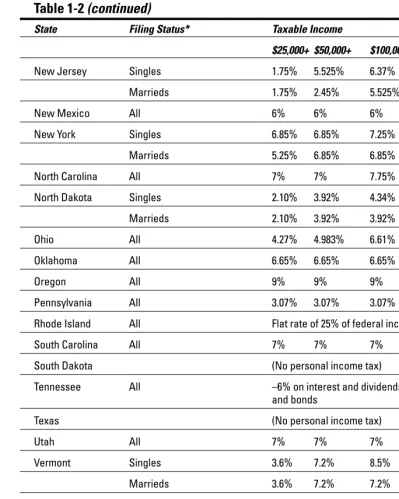
You can look up your state tax rate by getting out your most recent year’s state income tax preparation booklet. Alternatively, we’ve been crazy — but kind — enough to prepare a helpful little (okay, not so little) table that can give you a rough idea of your state tax rates (see Table 1-2). This table reflects state individual income taxes. Some states impose other taxes, such as local, county, or city taxes, special taxes for nonresidents, or capital gains taxes, which aren’t included in this table.
Table 1-2
State Marginal Tax Rates
State Filing Status* Taxable Income
$25,000+ $50,000+ $100,000+ $250,000+
Alabama All 5% 5% 5% 5%
Alaska (No personal income tax)
Arizona Singles 3.74% 4.72% 4.72% 5.04%
Marrieds 3.2% 3.2% 3.74% 4.72%
Arkansas All 6% 7% 7% 7%
California Singles 6% 9.3% 9.3% 9.3%
Marrieds 2% 6% 9.3% 9.3%
State Filing Status* Taxable Income
$25,000+ $50,000+ $100,000+ $250,000+
Connecticut All 5% 5% 5% 5%
Delaware All 5.2% 5.55% 5.95% 5.95%
District of Columbia All 7% 8.7% 8.73% 8.7%
Florida (No personal income tax)
Georgia All 6% 6% 6% 6%
Hawaii Singles 7.60% 8.25% 8.25% 8.25%
Marrieds 6.80% 7.60% 8.25% 8.25%
Idaho Singles 7.8% 7.8% 7.8% 7.8%
Marrieds 7.8% 7.8% 7.8% 7.8%
Illinois All 3% 3% 3% 3%
Indiana All 3.4% 3.4% 3.4% 3.4%
Iowa All 6.8% 8.98% 8.98% 8.98%
Kansas Singles 6.25% 6.45% 6.45% 6.45%
Marrieds 3.5% 6.25% 6.45% 6.45%
Kentucky All 5.8% 5.8% 6% 6%
Louisiana Singles 6% 6% 6% 6%
Marrieds 4% 6% 6% 6%
Maine Singles 8.5% 8.5% 8.5% 8.5%
Marrieds 7.0% 8.5% 8.5% 8.5%
Maryland All 4.75% 4.75% 4.75% 4.75%
Massachusetts All 5.3% 5.3% 5.3% 5.3%
Michigan All 3.9% 3.9% 3.9% 3.9%
Minnesota Singles 7.05% 7.05% 7.85% 7.85%
Marrieds 5.35% 7.05% 7.05% 7.85%
Mississippi All 5% 5% 5% 5%
Missouri All 6% 6% 6% 6%
Montana All 6.9% 6.9% 6.9% 6.9%
Nebraska Singles 5.12% 6.84% 6.84% 6.84%
Marrieds 3.57% 6.84% 6.84% 6.84%
Nevada (No broad-based income tax)
New Hampshire All –5% only on dividend and interest income on
stocks and bonds
Table 1-2 (continued)
State Filing Status* Taxable Income
$25,000+ $50,000+ $100,000+ $250,000+
New Jersey Singles 1.75% 5.525% 6.37% 6.37%
Marrieds 1.75% 2.45% 5.525% 6.37%
New Mexico All 6% 6% 6% 6%
New York Singles 6.85% 6.85% 7.25% 7.25%
Marrieds 5.25% 6.85% 6.85% 7.25%
North Carolina All 7% 7% 7.75% 8.25%
North Dakota Singles 2.10% 3.92% 4.34% 5.04%
Marrieds 2.10% 3.92% 3.92% 5.04%
Ohio All 4.27% 4.983% 6.61% 7.185%
Oklahoma All 6.65% 6.65% 6.65% 6.65%
Oregon All 9% 9% 9% 9%
Pennsylvania All 3.07% 3.07% 3.07% 3.07%
Rhode Island All Flat rate of 25% of federal income tax liability
South Carolina All 7% 7% 7% 7%
South Dakota (No personal income tax)
Tennessee All –6% on interest and dividends from stocks
and bonds
Texas (N