A Comprehensive Field Study of End-User
Programming on Mobile Devices
Sihan Li
North Carolina State University Raleigh NC, USA
Tao Xie
North Carolina State University Raleigh NC, USA
Nikolai Tillmann
Microsoft Research Redmond WA, USA [email protected]Abstract—TouchDevelop represents a radically new programming environment that enables users to develop mobile applications directly on mobile devices. TouchDevelop has successfully drawn a huge number of end users, who have published thousands of TouchDevelop scripts online. To enhance end-user programming on mobile devices, we conduct the first comprehensive field study of 17322 TouchDevelop scripts and 4275 users. Our study consists of an overall study on the characteristics of scripts (e.g., structural features, code reuse) and users (e.g., expertise), and a longitudinal study on how they evolve over time. Our study results show important characteristics of scripts such as dense external method calls, high code reuse ratio, and also reveal interesting evolution patterns of users. The findings and implications in our study provide valuable guidelines for improving tool support or services for end users and increasing the popularity of end-user programming on mobile devices.
I. INTRODUCTION
In recent years, mobile devices especially smartphones have become a prevalent computing platform for most people. A report [1] shows that there were 835 million smartphone users in 2011, and the number will keep increasing. As the usage of mobile devices grows, it becomes a very common activity to create mobile applications (also known as apps). The Apple and Android stores offer around one million apps for download [2].
Traditionally, developers use object-oriented programming languages (e.g., Java, Objective-C, C#) to write programs on their separate PC, with an emulator to simulate the device environment, and then deploy the programs to the mobile device. Such an off-device development manner requires the installation of an SDK on the PC, advanced programming languages, and complex deployment of the apps to the mobile device. These requirements pose high barriers to end-user programming of apps.
Microsoft TouchDevelop [3], [4] represents an emerging development model for mobile applications. It lowers the end-user programming barriers by enabling on-device app development and providing a fairly simple scripting language. With TouchDevelop, anyone can program their mobile device directly on this device; no PC is required for developing and deploying TouchDevelop scripts (i.e., apps). The target users of TouchDevelop are students, hobbyists, power users, and developers. The declared scope of TouchDevelop scripts is for fun (e.g., games), for personalizing mobile devices, and for creating productivity tools (e.g., meeting arrangement).
Due to such a radically new programming environment, TouchDevelop brings up numerous important questions on end-user programming on mobile devices. For example, from the perspective of apps, what kinds of apps can be created by TouchDevelop? What are unique characteristics of the apps created by TouchDevelop, compared to those created with the traditional PC-based approach? From the perspective of end users, how do they learn programming with TouchDevelop? What are their programming behaviors? Answers to these questions may not only provide important guidelines for enhancing end-user programming and improving tool support or services to end users, but also reveal valuable opportunities for drawing more end users and increasing the popularity of on-device app development. Although there have been some studies on the functionalities and code changes of TouchDevelop scripts [5] and the programming productivity with TouchDevelop [6], a lot of questions still remain unaddressed, calling for more efforts for investigation.
In this paper, we present the first comprehensive field study of end-user programming on mobile devices. Our goal is to provide valuable implications for different stakeholders around mobile-device programming, e.g., the improvement of tool support and services for end users, the increase of usage popularity for service providers, and research opportunities for researchers. Our study investigates 17322 TouchDevelop scripts and 4275 users, consisting of two parts: an overall study on the characteristics of scripts and users, and a longitudinal study on their evolution over time. The first part analyzes different aspects of both scripts (e.g., structural features and code reuse) and users (e.g., expertise) to provide basic understandings of them. The second part studies how scripts and users evolve over time, and attempts to find trends or identify patterns of their evolution.
Specifically, our study intends to answer the following research questions:
TABLE I. OUR MAJOR FINDINGS OF END-USER PROGRAMMING ON MOBILE DEVICES AND THEIR IMPLICATIONS
Characteristics of scripts and users Implications
(1) TouchDevelop scripts are typically small; 72.6% of them are less than 100 LOC. However, there are still 5.4% relatively large scripts with more than 500 LOC. The largest script has 5030 LOC and is a rich-feature game.
Users usually write small scripts with TouchDevelop, but it is possible to use TouchDevelop to create large scripts with rich features.
(2) On average, a TouchDevelop script contains 106 external method calls (e.g., built-in TouchDevelop API method calls); every two lines of code contain at least one external method call.
TouchDevelop scripts heavily rely on external methods to achieve functionalities. Enriching the built-in APIs might help further increase the diversity of the scripts and the popularity of TouchDevelop.
(3) TouchDevelop scripts have a high code reuse ratio: 57.9% of them have a parent1.
Users tend to modify existing scripts instead of creating scripts from scratch.
(4) In many cases (74.3%), users reuse their own code, i.e., having their script’s parent as a script written by themselves. Among 50 sampled parent/child pairs, most child scripts (78.0%) are just updated versions of their parents with small modifications.
There is lack of code reuse across different users. A code search engine of the code base may help users find others’ scripts and adding some descriptions on the code may increase the chance of being reused. A version control system might be necessary for managing script updates. (5) In terms of expertise, 74.2% of the users are novices,
21.6% of the users are ordinary users, and 4.2% of the users are experts.
How to engage these novices is crucial to further increase the popularity of TouchDevelop. Since we have a considerable population for each kind of users, we suggest to provide customized rather than uniform services to each kind of users, e.g., different UIs.
Evolution of scripts and users over time Implications (6) The number of scripts published per time period (nearly
3 months) increases with an average rate of 58.8%.
TouchDevelop is increasingly popular.
(7) The average size of the scripts in each time period stays small and stable, but the number of relatively large scripts increases with an average rate of 153.3%.
It is important to better support users to create large scripts. It might be helpful to make the TouchDevelop language more powerful and expressive or enrich the built-in APIs. (8) On average, the code reuse ratio increases by
3.6 percentages; the number of scripts created as libraries2increases with an average rate of 63.0%.
Code reuse is becoming popular. Since more libraries are created by users, it is necessary to provide ways to discover them, document them, and detect duplicates.
(9) In terms of publishing scripts, 22.1% of the users are very active initially and become less active later. 9.6% of the users are not very active initially but become more active some time later. 68.3% of the users try publishing one or two scripts and then stop.
It would be useful to conduct user studies on why many users try TouchDevelop and leave, why those active users become less active, and what motivates those earlier less active users to become more active later. Such information could be used to design better strategies to retain users. (10) 16.3% of the users learn most language features
initially and learn only a few later. 12.4% of the users learn some language features initially and also learn quite a lot at a certain point later. 71.3% of the users learn a few initially and then stop learning.
Users have different learning behaviors. We suggest to provide an adaptive tutoring system that recommends tutorials to users based on their history of language-feature usage and the kind of scripts that they are writing.
each kind of users and better assess their scripts or comments. RQ4: How are TouchDevelop scripts changing over time? Finding the trends of how TouchDevelop scripts change in terms of their size and code reuse could guide future tool development to better accommodate these trends.
RQ5: what is the users’ progress of developing TouchDevelop scripts? We want to investigate users’ programming behaviors and learning process by looking at their published scripts and language-feature usage so as to design strategies for engaging more users.
Our major findings and implications are summarized in Table I. The details of our study are discussed in the later sections. Our paper makes the following main contributions,
1A TouchDevelop script can inherit another script and directly modify its
code. The script being inherited is called the parent.
2A TouchDevelop script can be created as a library for other scripts to reuse
its defined methods. Without causing confusion, in this paper, we refer to such scripts as libraries.
• We discover special characteristics of TouchDevelop scripts on the aspects of structure and code reuse. • We reveal important trends of TouchDevelop scripts
and find interesting patterns of TouchDevelop users’ programming progress.
• We provide valuable implications for improving future tool support or services for end users and increasing the popularity of end-user programming on mobile devices.
II. BACKGROUND: TOUCHDEVELOP
A. The TouchDevelop Programming Environment
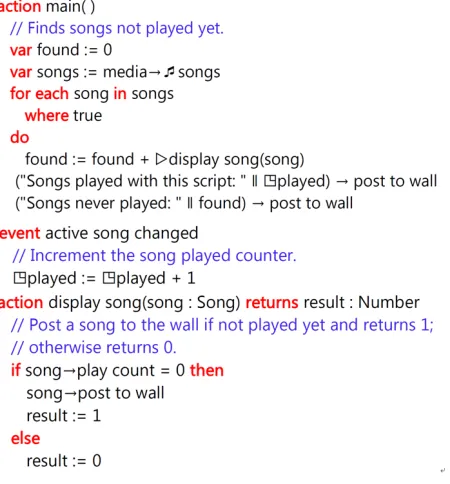
Fig. 1. A ”new song” example that finds songs not played yet and posts them to the wall.
the IDE provides a semi-structured code editor, which presents users with a small number of possible choices (e.g., different types of statement) at each step. In this manner, the users build the skeleton of the script via touching to select choices, leaving only variable names and expressions for typing.
Besides the IDE, TouchDevelop also provides a fairly simple scripting language that has both imperative and object-oriented characteristics. It allows users to not only define methods, modify local variables, but also access properties of objects. However, for simplicity, the language supports only built-in types: primitives and a set of types for objects. In other words, it does not allow users to define new types or properties. One important feature of the TouchDevelop language is that it provides rich interfaces to access a wide range of hardware and resources on the mobile device including various sensors, the camera, media, etc. Such feature largely facilitates the on-device programming.
A TouchDevelop script typically consists ofactions,events, and global data. An action is just like a function in C or a method in Java. It contains a sequence of statements, and can take parameters and return computation results. An event is a special action that is executed whenever the corresponding event occurs (e.g., phone shaking). The global data refer to global variables that are either persistent on the mobile devices or in the cloud. Such variables can be shared by multiple applications. Figure 1 shows a simple TouchDevelop script that finds songs not played yet and posts them to the wall. The script contains two actions and one event. Themainaction is the entry of the script and calls the display song action to determine whether a song has been played. The active song changedevent is executed whenever the player changes a song. This event increases the global variable played, which is the counter of songs played, by one.
TouchDevelop maintains a cloud that provides many
services to users. First, users could publish/download their scripts to/from the cloud. All published scripts are available with source code, and users are encouraged to share their scripts or extend others’ scripts. Each script/user is assigned an unique ID once published/registered. Moreover, the cloud stores many important statistics of every published script and its author and provides public interfaces (cloud API) for retrieving the information of scripts and users. Anyone could write customized queries (e.g., retrieving all scripts IDs published by a certain user) in a program or directly in the address bar of web browsers, and the cloud responds queries with either JSON objects or plain texts.
B. TouchDevelop Scripts and Users
From a database point of view, the script and the user are two critical entities in the TouchDevelop ecosystem. There is a one-to-many relation between the user and the script: one user can publish multiple scripts while one script can only have one user as its author. The script entity and the user entity also have a set of attributes. We next describe some key attributes that are investigated in our study of the script and the user, respectively.
For the script entity, we primarily investigate the attributes related to code reuse. TouchDevelop provides three ways for a script to reuse code. First, a script could inherit a parent script and directly modify the code of the parent script. Second, a script can be created as a library; other scripts can reference the library script and use the actions and events defined in it. Third, a script can reuse the TouchDevelop built-in APIs, which are the properties and methods of object types provided by TouchDevelop. These three code-reuse fashions respectively correspond to three attributes of a script: whether the script has a parent, whether the script is a library, and how many built-in API calls the script includes.
There are three important attributes that reflect the expertise of a user. First, the number of the published scripts indicates the activeness of the user. Second, users can give positive reviews to each other on their published scripts and posted comments. Hence, the number of the received positive reviews indicates the quality of the user’s scripts and comments. Third, TouchDevelop keeps track of what TouchDevelop-language features are used by each user. The TouchDevelop-language features include TouchDevelop build-in APIs as well as basic programming language concepts and keywords such as the concept of using parameters in an action and the if keyword for if statement. The number of language features used by the user indicates how much they have learnt about TouchDevelop programming.
III. METHODOLOGY
A. Subjects
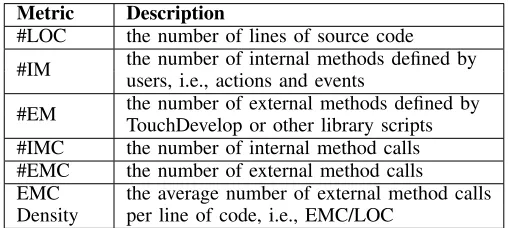
TABLE II. METRICS ON THE SOURCE CODE OFTOUCHDEVELOP SCRIPTS
Metric Description
#LOC the number of lines of source code
#IM the number of internal methods defined by users, i.e., actions and events
#EM the number of external methods defined by TouchDevelop or other library scripts #IMC the number of internal method calls #EMC the number of external method calls EMC
Density
the average number of external method calls per line of code, i.e., EMC/LOC
script (if any), and information on whether the script is a library. For each user, we downloaded the id of the user, the number of scripts published by the user, the number of TouchDevelop-language features used by the user, and the number of positive reviews given to the user’s scripts and comments. We obtained all these data from the TouchDevelop cloud through the cloud APIs.
B. Metrics and Approaches
To answer RQ1 on the structural features of TouchDevelop scripts, we used a set of metrics listed in Table II. All these metrics were calculated on every single TouchDevelop script. The internal methods referred to the actions and events defined in the script by the user, while the external methods were TouchDevelop built-in APIs or actions defined in other library scripts. We constructed the abstract syntax tree (AST) of each script using the TouchDevelop script parser, and traversed the AST to compute IM, EM, IMC, and EMC.
To answer RQ2 on the code reuse of TouchDevelop scripts, we adopted the same definition of code reuse ratio from the previous work [5] for comparison purpose. The code reuse ratio of scripts was defined as the percentage of scripts that had a parent among all scripts. To further study how users reused code, we first investigated where the reused code came from: the user herself or other users. This reused-code ownership was determined by checking whether the author of the parent script was the same author of the child script. We then checked what is the percentage of newly modified code in the child script. We obtained the LOC of modifications in the child script by using an internal cloud API, which compared the code differences between two TouchDevelop scripts, and computed the ratio of the LOC of the modifications to the LOC of the child script. Moreover, to see how users modified the inherited scripts, we randomly sampled 50 parent/child script pairs, and manually went through the source code of each pair to understand the code modifications.
To answer RQ3 on characteristics of TouchDevelop users, we first classified users based on their expertise. We employed the Gaussian Mixture Model (GMM) based clustering algorithm [7] to group users with similar expertise, and chose three important indicators of the user expertise as the input attributes to the clustering algorithm, namely, the number of scripts published by the user, the number of TouchDevelop-language features used by the user, and the number of positive reviews given to the user’s scripts and comments. We used Bayesian Information Criteria (BIC)
to estimate the number of clusters in the input instead of arbitrarily choosing a number. BIC was shown to be effective for Community Question Answering (CQA) datasets to determine how many users should be labeled as experts [8]. After clustering, we then analyze the characteristics of the users from each cluster and compared different clusters.
To answer RQ4 on the evolution of TouchDevelop scripts, we first equally divided the whole time period, ranging from the publish time of the first script to the publish time of the last script, into 6 smaller time periods (nearly 3 months per time period). Then we compared scripts from each time period in different aspects to find the trends of the script evolution. For example, we investigated how the number and the size of the scripts in each time period changed over time, and whether the code reuse ratio increased or not.
To answer RQ5 on the programming progress of TouchDevelop users, we investigated how many scripts or TouchDevelop-language features were published or used over time by each individual user. The number of published scripts could indicate the activeness of the user while the number of newly used TouchDevelop-language features could reflect how much they learned about TouchDevelop. Particularly, we selected users who started publishing scripts more than one year ago, and collected the published scripts and newly used language features in each of their first 12 months (starting from the time when each user published their first script). We used the number of published scripts or newly used language features in each month as 12 attributes and again employed the GMM clustering to group users with similar behaviors. After clustering, we analyzed each cluster to identify common evolution patterns of users. This approach was adopted from previous work [9], where they successfully used it to capture evolution patterns of experts in CQA.
IV. CHARACTERISTICS OFSCRIPTS ANDUSERS
A. Structural Features of TouchDevelop Scripts
Since TouchDevelop provides its own scripting language, we want to see how TouchDevelop scripts look like and what features they have, compared to programs written in other languages from a structural perspective. We apply the set of software metrics listed in Table II to the source code of all TouchDevelop scripts, and find some special characteristics on their structural features.
Table III shows the results of each metrics for all scripts. First, TouchDevelop scripts are typically small and simple. In the LOC column, the majority of the scripts (72.6%) has less than 100 LOC; the average number of LOC is only 133.1. In the IM and IMC columns, 23.1% of the scripts have only one internal method (i.e., each of these scripts has only have the default main action); and 53.1% of the scripts has no internal method call (i.e., only the code in the main action is executed). These results indicate that users usually write small scripts with TouchDevelop, and TouchDevelop is suitable for writing small scripts for fun or for personalizing mobile devices.
TABLE III. RESULTS OF STRUCTURAL METRICS FOR ALLTOUCHDEVELOP SCRIPTS
#LOC Ratio #IM Ratio #EM Ratio #IMC Ratio #EMC Ratio
(0, 100] 72.6% 1 23.1% [0, 10] 44.6% 0 53.1% [0, 50] 66.2%
(100, 500] 22.0% (1, 10] 60.5% (10, 50] 41.8% (0, 10] 30.3% (50, 100] 12.4% (500, 1000] 2.8% (10, 50] 14.8% (50, 100] 10.0% (10, 50] 13.1% (100, 500] 16.6%
>1000 2.6% >50 1.6% >100 3.6% >50 3.5% >500 4.8%
Avg. 133.1 Avg. 6.6 Avg. 23.2 Avg. 8.6 Avg. 105.5
Finding 1: (1) TouchDevelop scripts are typically small; 72.6% of them are less than 100 LOC. However, there are still 5.4% relatively large scripts with more than 500 LOC. The largest script has 5030 LOC and is a rich-feature game. Implication: Users usually write small scripts with TouchDevelop, but it is possible to use TouchDevelop to create large scripts with rich features.
From Table III, we can find that there are lots of external method calls in TouchDevelop scripts. The average number of EMC in a script is 105.5, much larger than the average number of IMC. These EMCs are primarily built-in API methods provided by TouchDevelop (e.g., the properties and methods of TouchDevelop built-in object types) and also a few actions defined in other library scripts. Besides, the average EMC density of all scripts is 0.6, which is very high, meaning that on average there is at least one EMC in every two lines of code. In addition, we also find a strong correlation between the number of lines of code and the number of external method calls. On the entire dataset, the correlation coefficient is 0.9.
These results are within our expectation because the TouchDevelop scripting language is relatively high-level. For those low-level features (e.g., accessing the hardware or resources of the mobile devices), TouchDevelop provides built-in implementations, and users are supposed to utilize the built-in APIs rather than implement them by their own. The implication from these results is that a lot of code logic lies outside the scripts, and the scripts heavily rely on built-in TouchDevelop APIs to achieve functionalities. Enriching the built-in APIs might help further increase the diversity of the scripts and the popularity of TouchDevelop.
Finding 2: On average, a TouchDevelop script contains 106 external method calls (e.g., built-in TouchDevelop API method calls); every two lines of code contain at least one external method call.
Implication:TouchDevelop scripts heavily rely on external methods to achieve functionalities. Enriching the built-in APIs might help further increase the diversity of the scripts and the popularity of TouchDevelop.
B. Code Reuse in TouchDevelop Scripts
Due to the virtual keyboard and limited screen size, programming on a mobile device is much more difficult than programming on a PC. Hence, code reuse becomes extremely helpful for reducing programming burdens on end users. We investigated how TouchDevelop scripts reused code, found some interesting findings, and provided our suggestions based on the findings.
Overall, the code reuse ratio of TouchDevelop scripts is high. 57.9% of all the scripts have a parent script. By inheriting
a parent script, the child script can directly modify the code of the parent script instead of starting from scratch. Such high code reuse ratio is reasonable in the case of on-device programming where users desire to save the typing efforts. It may take less time for users to find the needed code and understand it than to implement it by their own.
Finding 3: TouchDevelop scripts have a high code reuse ratio: 57.9% of them have a parent.
Implication:Users tend to modify existing scripts instead of creating scripts from scratch.
To dig deeper on where the reused code came from, we found that among all the parent/child pairs, there are 74.3% of them with the parent and the child having the same author. This result indicates that in many code-reuse cases, the user just reuse her own code. There is a lack of code reuse across different users. There might be two inhibitors that prevent users from reusing others’ code: (1) there is no effective way for users to find out others’ code that they need to reuse; (2) users have a hard time in understanding others’ code without documentations. To alleviate these problems, a code search engine of the entire code base might help users to find the code they need effectively. In addition, although typing is difficult on mobile devices, users could still add some brief descriptions on their code to help other users to understand it, and thus increase the chance of the code being reused.
We then computed the ratio of the modified code against all the code in the child script and found that on average, for each child script, the modified code accounts for only 8.5% of the entire code. This result indicates that the modifications on the parent scripts are relatively small. Furthermore, from the sampled parent/child pairs, there are 39 out of 50 (78.0%) child scripts that are just updated versions of their parents with small modifications. The average ratio of the modified code in each 39 child script is 7.9%. Many modifications do not implement substantial functionalities. Based on this finding, we suggest to provide a version control system for managing the updates of apps rather than updating apps in a code reuse manner.
Finding 4:In many cases (74.3%), users reuse their own code, i.e., having their script’s parent as a script written by themselves. Among 50 sampled parent/child pairs, most child scripts (78.0%) are just updated versions of their parents with small modifications that for 7.9% of the code in the child scripts on average.
1 10
100 1000
0 10 100 10000
10 100 1000
# scripts # language features
# positive reviews
Novice Ordinary Expert
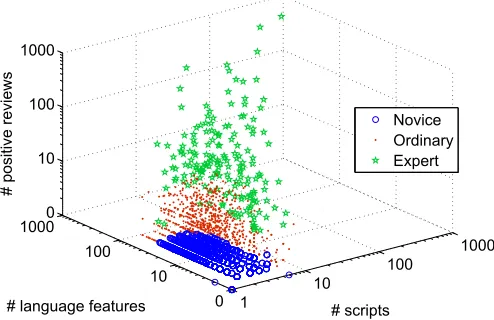
Fig. 2. The classification of users based on their expertise. The stars represent the experts, the dots represent the ordinary users, and the small circles represent the novices.
C. User Classification
Figure 2 shows the results of the GMM clustering on 4275 users, with the number of published scripts, the number of used TouchDevelop-language features, and the number of received positive reviews as the input attributes. Overall, the users are clustered into three groups. We regard the group of users with most published scripts, language features, and positive reviews as experts (represented by stars), the group with least of these metrics as novices (represented by small circles), and the remaining group as ordinary user (represented by dots).
In particular, there are 74.2% novices, 21.6% ordinary users, and 4.2% experts. Although the expert group is relatively small, each group of users has a considerable population. As shown in Figure 2, there are big differences between each kind of users on these three metrics. For example, some experts use hundreds of language features but many novices use only a few. Since we have three very different kinds of users each with a considerable population, we suggest to provide customized services rather than uniform services to each kind of users. For example, we may recommend tutorials very often to the novices, but much less frequently to the experts. We may also keep the UI for the experts compact whereas provide a detailed UI with more descriptions for the novices. Moreover, we can see that the novice group, which has the largest population, is inactive in general: many of them publish fewer than 10 scripts. It would be very useful to investigate these users and understand what keeps them remaining to be a novice, e.g., lack of interest with TouchDevelop or there are difficulties in learning TouchDevelop. Engaging these novices would help TouchDevelop further increase its popularity.
Finding 5: In terms of expertise, 74.2% of the users are novices, 21.6% of the users are ordinary users, and 4.2% of the users are experts.
Implication: How to engage these novices is crucial to further increase the popularity of TouchDevelop. Since we have a considerable population for each kind of users, we suggest to provide customized rather than uniform services to each kind of users, e.g., different UIs.
TABLE IV. INCREASING TRENDS OF SCRIPTS OVER6TIME PERIODS
#Script #L. Script #Library Reuse R.
T1 939 13 0 43.9%
T2 1701 95 0 53.3%
T3 2252 150 257 57.2%
T4 3171 147 377 59.3%
T5 2586 230 175 58.2%
T6 6673 284 518 62.1%
V. EVOLUTION OFSCRIPTS ANDUSERSOVERTIME
A. How Do Scripts Change Over Time?
As described in Section III, we divide the entire time period into 6 smaller time periods, with an equal length of nearly three months. Note that the entire time period starts from the publish time of the very first TouchDevelop script and ends at the time we conducted our experiment. We apply the same set of previous metrics separately on the scripts from each of the 6 time periods and compare the results across time periods to see their changes. Table IV shows the results of metrics that have an increasing trend over time periods. The first column lists the 6 time periods. The other columns represent the number of published scripts, the number of scripts with more than 500 LOC, the number of library scripts, and the code reuse ratio in each time period, respectively.
In general, the number of published scripts per time periods increases with an average rate of 58.8%. Such increase of the script number indicates the growing popularity of TouchDevelop. From the structural perspective, the average size of the scripts in each time period stays small and does not change much. However, there are more and more relatively large scripts published in each time period, with an average increasing rate of 153.3% as shown in the third column. Such trend indicates the growing popularity of writing large scripts with TouchDevelop. We suggest to provide better support for writing large scripts in the future. For example, we could make the TouchDevelop language more powerful and expressive so that it could allow users to create more sophisticated scripts. Enriching the built-in APIs might also be helpful.
Finding 6:The number of scripts published per time period (nearly 3 months) increases with an average rate of 58.8%. Implication:TouchDevelop is becoming popular.
Finding 7: The average size of the scripts in each time period stays small and does not change much, but the number of relatively large scripts increases with an average rate of 153.3%.
Implication:It is important to better support users to create large scripts. It might be helpful to make the TouchDevelop language more powerful and expressive or enrich the built-in APIs.
1 2 3 4 5 6 7 8 9 10 11 12 0
2 4 6 8 10 12 14
month
# published scripts
A B B1 C
Fig. 3. Evolution patterns on the number of the published scripts of the users.
to manage them. For example, in order for users to find their desired libraries, it is necessary to provide search support of library scripts. We also need to provide documents for the libraries so as to help users to better reuse them. Moreover, since any user can create library scripts, it is important to ensure the quality of the libraries and also detect duplicated libraries.
Finding 8: On average, the code reuse ratio increases by 3.6 percentages; the number of scripts created as libraries increases with an average rate of 63.0%.
Implication:Code reuse is becoming popular. Since more libraries are created by users, it is necessary to provide ways to discover them, document them, and detect duplicates.
B. How Is The Evolution of Users?
To investigate how users evolve, we need users that have been using TouchDevelop for long enough time. We select those who started publishing scripts more than one year ago and find 816 such users. We apply the GMM to cluster these 816 users based on the number of their published scripts and the number of their newly used language features, respectively.
Figure 3 shows the mean number of users’ published scripts in their first 12 months for different clusters. Each line represents a cluster and each data point is the mean number of the published scripts in a certain month by each user from a cluster. Although there are 4 clusters found by GMM, they can be summarized into 3 patterns because some clusters are just the variants of each other and they belong to the same cluster. In Figure 3, Line A represents a pattern that 22.1% of the users are very active initially, publishing many scripts, and become less active later, publishing only a few. Lines B and B1 represent anther pattern that 9.6% of the users are not very active initially but become more active at some time later. Line C represents the third pattern that 68.3% of the users try publishing one or two scripts initially and then stop publishing. Since so many users belong to the third pattern, it is very important to know why these users stop publishing so that we could design better strategies or improve TouchDevelop to retain these users. In addition, knowing what motivates those earlier less active users to become more active later may also give hints to increase popularity.
1 2 3 4 5 6 7 8 9 10 11 12
0 10 20 30 40 50 60 70 80 90
month
# newly used language features
D E E1 E2 F
Fig. 4. Evolution patterns on the number of the newly used language features of the users.
Finding 9: In terms of publishing scripts, 22.1% of the users are very active initially and become less active later. 9.6% of the users are not very active initially but become more active some time later. 68.3% of the users try publishing one or two scripts and then stop.
Implication:It would be useful to conduct user studies on why many users try TouchDevelop and leave, why those active users become less active, and what motivates those earlier less active users to become more active later. Such information could be used to design better strategies to retain users.
Figure 4 shows the mean number of users’ newly used language features for different clusters. Note that the clusters in Figures 3 and 4 are not the same. There are also 3 patterns of the users’ learning behaviors. Line D represents the first pattern that 16.3% of the users learn most language features initially and learn only a few later. Lines E, E1, and E2 represent the second pattern that 12.4% of the users learn some language features initially and also learn quite a lot at a certain point later. Line F represents the third pattern that 71.3% of the users learn a few language features initially and then stop learning. We further sample 20 users from the second pattern and check why there is an increase later in their learning curve. We find the major reason to be that users switch their focus from writing one kind of scripts to another so that they use many new built-in APIs related to the new kind of script. Since the users have different learning behaviors, we suggest to provide an adaptive tutoring system that recommends tutorials related to the kind of scripts that the user is writing and also avoids tutorials that the user already knows based on the language features used by the user.
Finding 10: 16.3% of the users learn most language features initially and learn only a few later. 12.4% of the users learn some language features initially and also learn quite a lot at a certain point later. 71.3% of the users learn a few initially and then stop learning.
VI. RELATEDWORK
The most related work was an earlier study on TouchDevelop scripts [5]. Both their work and our work studied the code reuse ratio of TouchDevelop scripts and code modifications between parent scripts and child scripts. We had similar results on code modifications: most of the modifications were minor tweaks to existing functionalities. However, our results on code reuse ratio were quite different. In their paper, they claimed that the code reuse ratio was only 5% because they had to randomly sample about 2000 scripts until they found 100 scripts with a parent. Our results, nevertheless indicated that 57.9% of all scripts had a parent. We informed the authors of this difference and together figured out two possible reasons: the code reuse ratio of scripts was increasing; their sampling might be an “unlucky” one, which sampled more scripts without a parent. Besides different results, their study focused on functionalities of scripts and problems posted by users, whereas our work mainly studied the structural features of scripts and the evolution of scripts and users. Moreover, their entire study was done manually so that they investigated only a small portion of scripts. However, our study was more comprehensive by including all scripts and users.
There were also some other studies on end-user programming with TouchDevelop. Nguyenet al.[6] conducted a user study to compare programming productivity of TouchDevelop with the traditional off-device approach. They found that for small tasks, a programmer was more productive in writing TouchDevelop apps than writing Android apps. Tillmann et al. [10], [11] presented their successful experience on teaching middle and high school students programming using TouchDevelop, and proposed to switch future programming teaching to mobile devices.
Besides the preceding studies, there was some other work related to TouchDevelop on security and programming language. Xiaoet al.[12] used static information-flow analysis to reveal how private information was used inside apps so as to assist users in granting permissions to apps. Burckhardt et al. [13] designed specialized cloud types at the programming language level to achieve consistent data storage for mobile devices. Our study results might serve as motivations for future research on programming on mobile devices.
A lot of research was done by the data-mining community on the users in question-answering forums. Much such research focused on developing algorithms or approaches to either identify experts or analyze the behaviors of experts. Bouguessa et al. [8] developed an approach leveraging Bayesian Information Criterion to determine experts in the Yahoo! Answers forum. Palet al.[9] proposed an approach to identify the evolution patterns of experts in the Stack Overflow forum. We borrowed their approaches in our study to classify TouchDevelop users and analyze their evolution patterns.
There were plenty of studies on end-user programming in other domains including web applications [14], [15], [16], spreadsheets [17], animations [18], and other domain-specific visual languages [19]. Many of them [15], [17], [18], [19] studied what kinds of programs the end users create and what challenges they face, and gave suggestions to tackle these challenges, while others [14], [16] conducted user studies on the behaviors of end users during their programming process.
ACKNOWLEDGEMENTS
This work is supported in part by NSF grants CCF-0845272, CCF-0915400, CNS-0958235, CNS-1160603, an NSA Science of Security Lablet grant, a NIST grant, a Microsoft Research Software Engineering Innovation Foundation Award, and NSF of China No. 61228203. We thank Christopher Scaffidi for discussing with us on code reuse and providing some of their experimental data. We also thank Yuan Yao for his valuable feedback.
VII. CONCLUSION
In this paper, we have presented the first comprehensive field study of end-user programming on mobile devices. We studied 17322 TouchDevelop scripts and 4275 TouchDevelop users, investigating not only the characteristics of scripts and users, but also their evolution. Our findings included: (1) TouchDevelop scripts are small and contain lots of external method calls; (2) the code reuse ratio of TouchDevelop scripts is high; (3) many TouchDevelop users are novices; (4) there are increasing trends of code reuse ratio and the number of large scripts; (5) TouchDevelop users have some patterns in publishing scripts and learning language features. Based on these findings, we have provided a list of implications for improving tool support or services for end users and increasing the popularity of end-user programming on mobile devices.
REFERENCES
[1] “The future of mobile,” Business Insider. [Online]. Available: http://www.businessinsider.com/the-future-of-mobile-deck-2012-3#-1 [2] R. Minelli and M. Lanza, “Software analytics for mobile applications
- insights & lessons learned,” inCSMR, 2013, pp. 144–153. [3] N. Tillmann, M. Moskal, J. de Halleux, and M. Fahndrich,
“TouchDevelop: programming cloud-connected mobile devices via touchscreen,” inSIGPLAN, ONWARD, 2011, pp. 49–60.
[4] N. Tillmann, M. Moskal, J. de Halleux, M. Fahndrich, and S. Burckhardt, “TouchDevelop: app development on mobile devices,” inFSE, Demo, 2012, pp. 39:1–39:2.
[5] B. Athreya, F. Bahmani, A. Diede, and C. Scaffidi, “End-user programmers on the loose: A study of programming on the phone for the phone,” inVL/HCC, 2012, pp. 75–82.
[6] T. A. Nguyen, S. T. Rumee, C. Csallner, and N. Tillmann, “An experiment in developing small mobile phone applications comparing on-phone to off-phone development,” inUSER, 2012, pp. 9–12. [7] C. Stauffer and W. E. L. Grimson, “Adaptive background mixture
models for real-time tracking,” inCVPR, 1999, pp. 246–252. [8] M. Bouguessa, B. Dumoulin, and S. Wang, “Identifying authoritative
actors in question-answering forums: the case of Yahoo! answers,” in KDD, 2008, pp. 866–874.
[9] A. Pal, S. Chang, and J. Konstan, “Evolution of experts in question answering communities,” inAAAI, 2012, pp. 274–281.
[10] N. Tillmann, M. Moskal, J. de Halleux, M. Fahndrich, J. Bishop, A. Samuel, and T. Xie, “The future of teaching programming is on mobile devices,” inITiCSE, 2012, pp. 156–161.
[11] N. Tillmann, M. Moskal, J. de Halleux, M. Fahndrich, and T. Xie, “Engage your students by teaching computer science using only mobile devices with touchDevelop,” inCSEE&T, 2012, pp. 87–89.
[12] X. Xiao, N. Tillmann, M. Fahndrich, J. De Halleux, and M. Moskal, “User-aware privacy control via extended static-information-flow analysis,” inASE, 2012, pp. 80–89.
[13] S. Burckhardt, M. F¨ahndrich, D. Leijen, and B. P. Wood, “Cloud types for eventual consistency,” inECOOP, 2012, pp. 283–307.
[15] C. Bogart, M. Burnett, A. Cypher, and C. Scaffidi, “End-user programming in the wild: A field study of coscripter scripts,” in VL/HCC, 2008, pp. 39–46.
[16] N. Zang and M. B. Rosson, “What’s in a mashup? and why? Studying the perceptions of web-active end users,” inVL/HCC, 2008, pp. 31–38. [17] C. Chambers and C. Scaffidi, “Struggling to Excel: A field study of challenges faced by spreadsheet users,” inVL/HCC, 2010, pp. 187–194. [18] A. Dahotre, Y. Zhang, and C. Scaffidi, “A qualitative study of animation
programming in the wild,” inESEM, 2010, pp. 29:1–29:10.