Volume 2007, Article ID 39586,13pages doi:10.1155/2007/39586
Research Article
Transcoding-Based Error-Resilient Video Adaptation for
3G Wireless Networks
Sertac Eminsoy,1Safak Dogan,2and Ahmet M. Kondoz2
1NEC Electronics (Europe) GmbH, Cygnus House, Sunrise Parkway, Linford Wood, Milton Keynes, Buckinghamshire MK14 6NP, UK
2I-Lab, Centre for Communication Systems Research (CCSR), University of Surrey, Guildford GU2 7XH, Surrey, UK
Received 2 October 2006; Revised 19 February 2007; Accepted 13 May 2007
Recommended by Ming-Ting Sun
Transcoding is an effective method to provide video adaptation for heterogeneous internetwork video access and communication environments, which require the tailoring (i.e., repurposing) of coded video properties to channel conditions, terminal capabili-ties, and user preferences. This paper presents a video transcoding system that is capable of applying a suite of error resilience tools on the input compressed video streams while controlling the output rates to provide robust communications over error-prone and bandwidth-limited 3G wireless networks. The transcoder is also designed to employ a new adaptive intra-refresh algorithm, which is responsive to the detected scene activity inherently embedded into the video content and the reported time-varying chan-nel error conditions of the wireless network. Comprehensive computer simulations demonstrate significant improvements in the received video quality performances using the new transcoding architecture without an extra computational cost.
Copyright © 2007 Sertac Eminsoy et al. This is an open access article distributed under the Creative Commons Attribution License, which permits unrestricted use, distribution, and reproduction in any medium, provided the original work is properly cited.
1. INTRODUCTION
The success of the Internet and mobile systems has motivated the development of various enhanced-capacity fixed and wireless networking technologies (e.g., 3G, WLAN, broad-band Internet, etc.). The services supported by such networks helped to foster the vision of being connected at anywhere, anytime, and with any device for pervasive media applica-tions. However, the coexistence of the different networking infrastructures and services has also led to an increased het-erogeneity of compressed video communication systems and scenarios, in which a wide range of user-terminals with var-ious capabilities access rich video content over a multitude of access networks with different characteristics. The mis-matches between the content properties and several network and/or device-centric features, as well as diverse user prefer-ences, call for efficient video delivery systems featuring eff ec-tive video adaptation mechanisms [1]. In general, this con-cept has been addressed in literature with the theme of the universal multimedia access (UMA) [2, 3]. Several strate-gies have been developed for UMA, which are based on the multimedia content adaptation techniques using the context specifications and descriptions defined in Part 7: digital item adaptation (DIA) of the MPEG-21 standard [4–8].
An effective way of performing video adaptation is to utilise transcoding operations in the networks. Transcod-ing is particularly needed when compressed video streams traverse heterogeneous networks. In such cases, a number of content-specific properties of the coded video informa-tion require adaptainforma-tion to new condiinforma-tions imposed by the different networks and/or terminals to retain an accept-able level of video service quality. Network-based adaptation mechanisms can be employed at the edges or other strate-gic locations of different networks, using a fixed-location video adaptation gateway, node, or proxy as in conventional networking strategies [9–11]. Alternatively, video adapta-tion (i.e., transcoding) can be performed dynamically where and whenever needed using active networking technologies [12,13].
network is not subject to bit errors, thus can be assumed error-free. However, transmission over the wireless network is error-prone. The wireless channel effects of 3G networks are characterised by burst errors, which introduce noise into the transmitted video signal, and thus cause the decoder to misinterpret the received data. Such errors are caused by channel fading, which is defined as the aggregated effects of multipath, shadowing, intra/intercell interference, as well as the number and location of users in a cell [14–16]. The overall resulting effect of such error conditions is the signifi-cant deterioration of the received video quality. Therefore, in addition to the bit-rate matching requirement between the two networks, an error resilience adaptation mechanism is needed to provide robust video transmission and satisfactory levels of quality of service (QoS). For this purpose, a video transcoding architecture is developed, which can be deployed at intermediate points in the networks. It incorporates a rate control mechanism together with a suite of error re-silience tools, which were originally designed for source cod-ing methods, as described by the MPEG-4 video codcod-ing stan-dard [17,18]. However, the transcoder utilises them in har-mony to add necessary amount of error robustness to coded nonresilient video streams prior to transmission over error-prone 3G wireless channels. Furthermore, a new scene activ-ity and channel adaptive intra-refresh (SC-AIR) transcoding algorithm is proposed to enhance the added robustness with respect to the detected video scene activity and the reported time varying channel error conditions. The computer simu-lations performed demonstrate the effectiveness of the new transcoding architecture in terms of providing video adapta-tion for bit-rate controlled error resilience over error-prone 3G (i.e., W-CDMA) channels.
The organisation of the paper is as follows. Section 2
highlights the need for rate-controlled error-resilient video adaptation, and describes the developed transcoding archi-tecture in detail. Section 3 introduces the proposed visual scene activity and channel adaptive error-resilient transcod-ing mechanism (i.e., SC-AIR-based transcodtranscod-ing).Section 4
presents the computer simulation results and provides elab-orate discussions on the resilient video adaptation perfor-mance. Finally,Section 5outlines the concluding remarks.
2. TRANSCODING-BASED VIDEO ADAPTATION
Noisy channel conditions in wireless networks introduce er-rors in the compressed video streams, which are manifested as degradations in the perceived quality of the decoded video. Due to the predictive coding techniques applied in video compression, errors are likely to propagate into the future frames, making video communications perceptually unac-ceptable. To mitigate such effects, MPEG-4 has adopted a number of error resilience tools that make the video streams more robust against error-prone transmission over wireless channels [17,18].
However, there exist numerous video applications all of which may not be optimised for error-resilient transmission. This is due to the fact that most error resilience tools re-duce the coding efficiency, demand more bandwidth, and
in-crease the encoding and decoding complexities. Therefore, users should be provided with error-resilient video adapta-tion by the intermediate video adaptaadapta-tion nodes when and where necessary. The problems addressed above hence call for error-resilient transcoding units to be deployed in the networks.
Video transcoding is the process of converting the for-mat of an input coded video content into another forfor-mat [19–21]. It is primarily used to adapt the bit-rates, tempo-ral, and spatial resolutions of the incoming compressed video streams, as well as to provide syntax translations between dif-ferent video coding standards. Moreover, video transcoding with error resilience properties is particularly popular due to the fixed/wireless internetworking interoperability issues, and hence has been extensively addressed in literature [22–
29].
In general, transcoders are designed to operate either in the discrete cosine transform domain (DCT domain) or in the pixel domain. Working in the pixel domain of-fers higher flexibility in terms of executing various diff er-ent transcoding services simultaneously (i.e., controlling the output rate while inserting necessary amount of error ro-bustness). The transcoding architecture presented in this pa-per is based on a cascaded pixel domain transcoder (CPDT) formation [19–21]. Typically, CPDT operation is computa-tionally more expensive than the DCT domain architectures. Consequently, the reduction of the complexity while provid-ing a highly functional and efficient architecture has been the main driving force behind many research activities in this area.
Figure 1 shows the block diagram of the developed transcoding architecture in this work. In its operation, the in-put compressed video is decoded down to the pixel domain, and then partial reencoding is performed on the decoded video in the required adapted format. Partial reencoding is utilised to reduce the inherent complexity of the CPDT op-eration. It is an operation, whereby the original frame head-ers are reused, and the time consuming reordering of the video frames is avoided. More significantly, motion compen-sation is performed reusing the original motion vectors of the input video stream. This is because, previous research has shown that methods like computationally complex mo-tion reestimamo-tion and refinement can introduce considerable delay to the transcoder’s operation, and yield only a minor video quality gain in the case of transmission over error-prone wireless channels [30]. In return, the overall effect is the significantly reduced computational complexity and pro-cessing time during transcoding.
Scene activity measurement
VLD
input output
mv
Q−1
Sres Sdiff Sdiff
DCT Q RC block
TM5 Target bit-rate
ER options
Sres: residual signal
Sdiff: difference signal
Fprev: previous frame SC-AIR
Channel feedback
AIR
MB P l mode alteration
mv: motion vector VLD: variable length decoding VLC: variable length coding Q: quantization MC: motion compensation DCT: discrete cosine transform MB: macroblock
P: predictive I: intra ER: error resilience RC: rate control AIR: adaptive intra refresh SC-AIR: scene and channel adaptive intra refresh TM5: test model 5
MC
Fprev Frame
buffer
Sres
VLC
DCT−1 + −
Fprev
F
prev
F
prev
MC Framebuffer +
S
diff DCT−1
Q−1
mv mv
ER block DP + VPR + HEC
Figure1: Block diagram of the error resilience and rate control capable video transcoding architecture.
personal requirements, and service level agreements can be accommodated. The mechanism employed for RC is a macroblock-based rate control algorithm, known as test model 5 (TM5) [31]. As shown in Figure 1, the RC block regulates the quantisation step size during partial reencod-ing, so as to compress the input stream at the target bit-rate.
The ER tools are essential in alleviating the artefacts resulting from the transmission errors. However, consid-ering that transcoding needs to be performed with mini-mal latency, error resilience tools are required to be compu-tationally lightweight algorithms. Therefore, the developed transcoding architecture utilises computationally simple, but effective ER tools for mitigating the error effects in the per-ceived video due to the transmission errors that are intro-duced by the 3G wireless channel (i.e., W-CDMA chan-nel). These ER tools are data partitioning (DP), video packet resynchronisation (VPR), header extension code (HEC), adaptive intra-refresh (AIR), and the novel scene activity and channel adaptive intra-refresh (SC-AIR) algorithm. While DP, VPR, and HEC are applied directly on the quantised video information, AIR or SC-AIR algorithms are executed prior to the partial reencoding process in order to alter the macroblock mode decisions extracted from the decoding op-eration. Depending on the operator’s choice, either AIR or SC-AIR algorithms can be chosen as the intra-update mech-anism. As illustrated inFigure 1, both algorithms make use of the input motion vector information to decide which mac-roblocks to update.
3. SCENE ACTIVITY AND CHANNEL ADAPTIVE
INTRA-REFRESH (SC-AIR) TRANSCODING
The standard AIR algorithm uses a fixed and predetermined number of intra-macroblocks per frame for refreshing the frames of a video stream. This means that a specific AIR rate is determined before encoding or transcoding, and not al-tered throughout the encoding/transcoding process. In addi-tion, the AIR algorithm lacks a mechanism for determining the optimum intra-refresh rate and providing adaptation to the spatiotemporal characteristics of the video stream with respect to varying channel conditions. For this reason, the effectiveness of AIR is significantly undermined.
(a)
(b)
Figure2: Intra-refresh of motion-active macroblocks: (a) operation of the standard AIR algorithm with a fixed number of macroblocks per frame; (b) operation of the SC-AIR algorithm with a variable intra-refresh rate.
error resilience scheme [22]. In this approach, the intra-refresh resilience was altered with respect to the output bit-rate and the BER of the channel. Mean-square-error (MSE) measurements were used to calculate the distortion intro-duced due to the lost macroblocks. Based on MSE measure-ments, the intra-refresh mechanism altered the number of intra coded blocks in every frame to provide optimal re-silience. This algorithm involved complex computations, and hence can also be regarded unsuitable for low-latency video communications. Stuhlm¨uller et al. used a similar approach, where intra-refresh was based on a slightly modified ver-sion recommended in H.263 standard [34]. Another adaptive intra-refresh algorithm was proposed by Chiou et al. that re-quired the encoder to extract some distortion information offline before the transmission, which was later used by a two-pass error-resilient video transcoder to decide on a pri-oritised intra-refresh strategy [26]. This idea was then devel-oped into a more comprehensive error-resilient transcoder, which adaptively varied the intra-refresh rate according to the video content and communication channel’s packet-loss rate to protect the most important macroblocks against packet losses over wireless networks [29,35]. Moreover, a profit tracing scheme has recently been proposed by Chen et al. [36], so as to further improve the efficiency of refresh allocation to macroblocks in the content-aware intra-refresh method developed in [29,35]. A more practical intra-refresh method was also introduced by Worrall et al. [37]. In this approach, the intra-refresh mechanism at the encoder was based on a simple motion activity analysis of each frame and different GPRS channel conditions.
In this section, we introduce a video transcoding method using a new intra-refresh algorithm, namely SC-AIR, which
is adaptive to changing channel conditions and source spe-cific characteristics (e.g., motion-based scene activity) of the video stream. The operation of the algorithm is similar to that of the standard AIR algorithm, where a motion map is formed to mark the location of the motion-active mac-roblocks in every frame and intra code (i.e., refresh) them sequentially [17]. This means that the motion-active mac-roblocks are first determined, and a number of them are re-freshed starting from the first one until the end of the ad-missible intra-refresh rate (i.e., the number of macroblocks to be refreshed) in a predictive frame. In the subsequent pre-dictive frame, the refresh algorithm continues from the point where it was left in the previous frame. This process contin-ues in every predictive frame until the whole of the motion-active macroblocks are fully refreshed, and then the algo-rithm goes back to the first active macroblock to start the process again. However, as depicted inFigure 2, the SC-AIR algorithm computes the optimal intra-refresh rate for each video frame in contrast to standard AIR, where the intra-refresh rate is a predetermined fixed number of macroblocks throughout its operation. The information about the ac-tivity levels of a video scene is determined by examining different aspects of the motion-active macroblocks. This in-formation is then coupled with the instantaneous channel condition factor to decide on the optimum number of intra-refresh blocks that is required to obtain the best possible per-formance. The operation of this algorithm has comparable computational complexity to the standard AIR operation, and thus it can be suitable for low-latency or real-time video communications.
of functions, which analyse the scene-activity-related infor-mation from the input video scene. The second step involves the modulation of the activity information with a channel condition function, which represents the signal-to-noise ra-tio experienced at the downlink W-CDMA channel. The out-come of this operation determines the optimum number of intra-refresh blocks required for a frame. The complete SC-AIR algorithm is formulated as
Ω(t,j)=β(t)·IRR(j), (1)
where Ω represents the number of macroblocks that need to be refreshed in the motion map of frame j(as described inFigure 2(b)), for any channel condition at timet. IRR(j) stands for the intra-refresh rate determined from the scene activity analysis andβ(t) is derived from the instantaneous channel condition. The detailed explanations of these func-tions are given in the following subsecfunc-tions.
3.1. Activity measurement
In motion compensation-based video coders, the sensitiv-ity to error can be related to the amount of motion within a scene [37]. Motion is defined by the motion vectors, and the activity is associated with the motion. Based on these as-sumptions, it can be claimed that as the amount of activity increases in a video scene, an increased number of intra-refresh blocks may be required to prevent the temporal er-ror propagation. Thus, activity measurements can be used for developing an adaptation mechanism to counter the ad-verse effects of changing channel conditions on the perceived video quality. The activity measurement technique presented here forms the core of the SC-AIR transcoding algorithm. It reveals the required number of intra-refresh blocks for every predictive frame. In the development of this algorithm, var-ious standard and in-house produced video test sequences with different scene activity levels were used. However, due to space constraints, the discussions of the algorithm presented in this paper are limited to the two standard test sequences, namely, “Foreman” and “Students.”
The SC-AIR algorithm is composed of a number of func-tions which represent the different aspects of the activity in a video scene. The algorithm performs the primary tivity analysis using a function named the normalised ac-tivity index (NAI). In addition, a number of supplemen-tary functions are also used to shape the output obtained by the NAI analysis. These functions are namely the motion macroblock factor and range index. The shaped NAI output is used to determine the optimum number of intra-refresh blocks needed for a frame.
Activity index (AI) is a function, which computes the cu-mulative magnitude of all motion vectors within a frame. NAI is the normalised variation of the AI function with re-spect to the number of macroblocks within a frame. This normalisation is required, so that the NAI measurements of different video sequences can be comparable with each other. If the NAI value is high, it is likely that the frame is a part of a highly active scene, which may indicate the need for more frequent intra-refresh (e.g., as in the “Foreman”
se-1 15 29 43 57 71 85 99 113 127 0
4 8 12 16 20 24 28 32 36 40
N
o
rm
alised
acti
vi
ty
inde
x
Frame number
Figure3: NAI computation for the “Foreman” stream.
1 15 29 43 57 71 85 99 113 127
0 1 2 3 4 5
N
o
rm
alised
acti
vi
ty
inde
x
Frame number
Figure4: NAI computation for the “Students” stream.
quence) than a low-motion scene (e.g., as in the “Students” sequence). The NAI function can be written as
NAI(j)=
τ
n=1mvj(n)
i(j) , (2)
wherei(j) is the number of motion-active macroblocks in frame number j,nis the macroblock number,τ represents the total number of macroblocks in a frame (e.g., 99 for quarter common intermediate format: QCIF), andmvj(n) is the motion vector (both inxandydirections) of thenth macroblock in the jth frame. The NAI computations for the “Foreman” and “Students” sequences are depicted in Figures
3and4, respectively. As can be seen from these figures, the NAI is able to indicate the activity-level characteristics of both video sequences.
then the NAI value will yield a very large value, indicating an extreme activity in the scene. In this case, a high intra-refresh rate will be chosen, which may lead to compromise in the compression efficiency and degradation in the perceptual quality.
The empirical studies performed at the development stage have revealed that the inefficiency of the NAI func-tion in determining the accurate levels of activity in a video scene can be compensated using a function called the mo-tion macroblock factor (δ). The product of the NAI and the
δ(j) functions determines the activity. Theδ(j) function is computed for every frame, and is related to the ratio of the number of motion macroblocks to the total number of mac-roblocks in a frame. The use of this function can alleviate the anomalies in the NAI decision (as in the last 2 seconds of the “Foreman” sequence). The representation of theδ(j) func-tion is given in
δ(j)=α1 +i(j)
τ
, (3)
where,
α= ⎧ ⎪ ⎪ ⎪ ⎪ ⎪ ⎪ ⎪ ⎪ ⎪ ⎪ ⎪ ⎪ ⎪ ⎨ ⎪ ⎪ ⎪ ⎪ ⎪ ⎪ ⎪ ⎪ ⎪ ⎪ ⎪ ⎪ ⎪ ⎩
0.75 ifR(j)≤5, 1 if 5< R(j)≤10, 2 if 10< R(j)≤20, 3 if 20< R(j)≤30, 4 if 30< R(j)≤40, 5 if 40< R(j)≤50, 7 ifR(j)>50,
(4)
αis the scaling coefficient, whose value depends on the com-puted range index (R) function for every frame. The R(j) function is given in
R(j)= i(j)
NAI(j). (5)
R(j) stands for the ratio betweeni(j) and the NAI(j), and is calculated for every predictive frame. The scaling co-efficient of theδ function is directly proportional with the outcome ofR(j) function. In other words,R(j) is useful in scalingδ(j), which shapes the NAI output in a way that an optimum number of refresh blocks are chosen. As seen in (4),R(j) defines seven different ranges for the scaling coef-ficient of theδ(j) function. These ranges and the weights of
δ(j) were determined experimentally by observing the effects of the W-CDMA channel errors on the video quality with re-spect to the number of intra-refresh blocks enabled by the proposed algorithm.
In effect, the ranges defined by theR(j) function corre-spond to seven different levels of confidence on the NAI de-cision. AsR(j) increases, the confidence on the NAI result decreases. Hence, as theR(j) results in higher values, δ(j) function needs to be scaled with a higher coefficient. Conse-quently, these ranges enable a differentiated refreshing prior-ity between frames with different motion characteristics. For instance, if a frame contains macroblocks with higher average
Frame number,j
1 11 21 31 41 51 61 71 81 91 101 111 121 131 0
10 20 30 40 50 60 70 80 90
Range indexR(j)
R
(
j
)o
r
δ
(
j
)v
al
u
es
Motion macroblock factorδ(j)
Figure5: Motion macroblock factor and range index analysis for the “Foreman” stream.
motion vector magnitude than a frame with the same num-ber of motion macroblocks but smaller average motion vec-tor magnitude, then the proposed algorithm will always set a higher refresh rate. In other words,R(j) function maintains a balance between the influence of the number of motion-active macroblocks and their average motion vector magni-tude in determining the optimum intra-refresh rate.
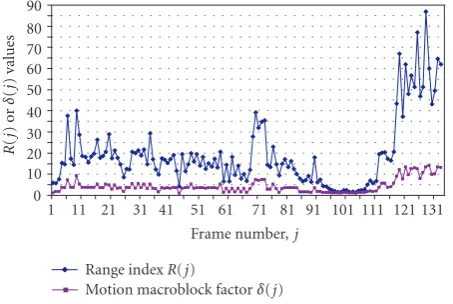
Figure 5shows the computedR(j) andδ(j) functions for the “Foreman” stream. As seen from this figure, the value of theR(j) function falls into its highest range during the last 2 seconds (i.e., between frame numbers 118 and 134) of the “Foreman” sequence, indicating the lowest confidence on the NAI output. That is to say, NAI function indicates low “ac-tivity” if the number of motion macroblocks is high, but the magnitude of their cumulative motion vectors is low. Thus, an appropriateαvalue should be used in theδ(j) function to compensate for the deficiency of the NAI function. Similarly, in the region that was indicated as the highest activity region by the NAI function (i.e., between the 9th and 11th seconds), the output of the R(j) function falls into its lowest range. In this way, over-refreshing and consequently degradation in the compression efficiency are prevented. Other than ac-counting for these extreme cases,R(j) function is utilised to assign an accurate weight to theδ(j) function, such that the best possible intra-refresh strategy can be applied.
On the other hand, the low-motion nature of the “Stu-dents” stream is also reflected on the output of its R(j) function. As depicted inFigure 6, the output values of this function here are far less variable than in the case with the “Foreman” stream. In contrast, theR(j) values for this video stream are occasionally below 5, which indicates that there are only a few motion-active macroblocks, and hence the confidence on the NAI analysis is high.
Having introduced all the functions which play a part in the activity analysis of the input video streams, the intra-refresh rate (IRR) required for a given frame can be cal-culated using the function given in
Frame number,j
1 11 21 31 41 51 61 71 81 91 101 111 121 131 0 4 8 12 16 20 24 28
Range indexR(j)
R ( j )o r δ ( j )v al u es
Motion macroblock factorδ(j)
Figure6: Motion macroblock factor and range index analysis for the “Students” stream.
1 15 29 43 57 71 85 99 113 127
Frame number,j
IRR( j ) 0 4 8 12 16 20 24 28 32 36 40 44 48 Foreman Students
Figure7: The intra-refresh rate computed for the “Foreman” and “Students” streams.
The results of the computation of this function for both the “Foreman” and “Students” streams are shown in
Figure 7. As can be observed from this figure, the activity measurement functions are effective in differentiating be-tween the activity levels of these two streams and assign par-ticular number of intra-refresh macroblocks for each frame accordingly.
3.2. Channel factor
For wireless video communications, the varying channel conditions should also be considered in determining the op-timum number of intra-refresh blocks to be used. In gen-eral, a faster refresh rate is required as the channel conditions worsen, while a limited number of intra-blocks will suffice when the channel conditions become better. The informa-tion on the instantaneous downlink bit-energy-to-noise ra-tio (Eb/No) value of the W-CDMA channel is available to the base station. In the proposed algorithm, this information is thus assumed to be fed back to the network node that per-forms the error-resilient video adaptation (i.e., transcoding). In 3G systems, such feedback can be made available to the
video adaptation node in less than 250 milliseconds of delay [38].
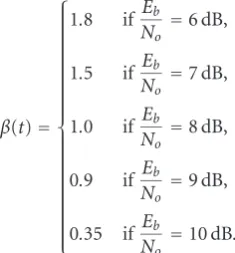
As presented in (7), the channel factorβ(t) is a coeffi -cient, whose values were determined experimentally for var-ious channel conditions (i.e.,Eb/No) in W-CDMA.β(t) is a time-dependent function which implies that channel con-ditions may vary over the time. In the exhaustive number of experiments conducted, only those error patterns corre-sponding toEb/No ranging from 6 dB to 10 dB were used. Considering the performance figures presented in [39], it can be argued that it is not possible to conceive acceptable qual-ity video communications at Eb/No rates below 6 dB, and the intra-refresh application thus becomes ineffective. On the contrary, the effects of errors atEb/Norates above 10 dB reach to saturation, and the channel condition factor can remain the same. As the channel condition worsens, a more aggres-sive intra-refresh rate should be applied to the video streams in order to limit the increased error propagation into the fu-ture frames during transcoding. Conversely, when the chan-nel conditions start to improve (i.e.,Eb/No ≥ 9 dB), intra-refresh should be made less frequent in order not to compro-mise the coding efficiency by the introduction of unnecessary number intra macroblocks.
Having tested the output of the IRR(j) function with var-ious video streams and under different channel conditions, the followingβ(t) values were found to provide the optimum efficiency for the SC-AIR algorithm operating at the follow-ing specified conditions:
β(t)= ⎧ ⎪ ⎪ ⎪ ⎪ ⎪ ⎪ ⎪ ⎪ ⎪ ⎪ ⎪ ⎪ ⎪ ⎪ ⎪ ⎪ ⎪ ⎪ ⎪ ⎪ ⎨ ⎪ ⎪ ⎪ ⎪ ⎪ ⎪ ⎪ ⎪ ⎪ ⎪ ⎪ ⎪ ⎪ ⎪ ⎪ ⎪ ⎪ ⎪ ⎪ ⎪ ⎩
1.8 if Eb
No =6 dB,
1.5 if Eb
No =7 dB,
1.0 if Eb
No =8 dB,
0.9 if Eb
No =9 dB,
0.35 if Eb
No =10 dB.
(7)
The difference between consecutive Eb/No values was chosen to be 1 dB. According to the test results given in [39], 1 dB difference inEb/Novalue represents a noticeable change in the channel conditions. Hence for the SC-AIR algorithm, any intermediateEb/Nofigure can be rounded to its closest integer value.
4. ADAPTATION PERFORMANCE EVALUATION
BY COMPUTER SIMULATIONS
High bandwidth & error-free channel
Error-prone W-CDMA
channel Video server
Foreman@445 kbits/s Students@230 kbits/s
Video adaptation
node
β1(t) 128 kbits/s
128 kbits/s
β2(t) Base station
Fixed network
3G wireless access network
Figure8: Experimentation scenario for the error-resilient video adaptation by transcoding.
shown inFigure 8. In this scenario, the video source lies in the fixed network and transmits live or stored video con-tent to subscribers in the 3G network, which uses W-CDMA technology in its radio access network. The video server sends the video stream through one of the video adaptation nodes, which performs the necessary video adaptation for heterogeneous media transmission. This node operates the transcoder, and is assumed to be aware of the user profile, re-quirements, and channel conditions. Consequently, it is ca-pable of modifying the incoming bit-stream to the required format. Due to their location, speed, and various interference sources, mobile users experience time varying channel con-ditions, as represented byβ(t).
4.1. Simulation setup
In the experiments, two different test sequences were deliber-ately chosen to comprise two different motion activity prop-erties: “Students” and “Foreman” with low and high activ-ity scenes, respectively. The video server depicted inFigure 8
employs an MPEG-4 video encoder, and is set to produce a single base-layer stream without any rate control (with a fixed quantisation step size atQp =2). The server produces QCIF-sized video streams encoded at 10frames/s, and with I-P-P-P. . . . layout for both video sequences. The duration of the encoding operation was limited to 13.4 seconds (i.e., 134 frames) for both video sequences. The error resilience op-tions of the server’s encoder were turned off, as the link be-tween the source and the transcoder is assumed to be error-free.
In the experiments performed, the transcoder was con-figured to convert the incoming variable rate bit-stream (i.e., on average at 230 kbits/s for “Students” and 445 kbits/s for “Foreman”) to a constant bit-rate output at 128 kbits/s. The adaptation to the wireless channel errors was provided us-ing the error resilience modules of the transcoder (i.e., DP, VPR, HEC, and AIR or SC-AIR). It can be argued that if a fixed number of AIR blocks are used for every frame, a video packet size of 700 bits is a reasonable value that can be used for most video sequences given the 128 kbits/s transcoder
output and the W-CDMA channel conditions [25,40]. Sim-ilarly, based on the figures presented in [40] and the prelim-inary study performed, an AIR frequency of 10 blocks was decided to be used in the first set of experiments, where the standard AIR was used for the error-resilient video adapta-tion tests.
The effects of W-CDMA physical link layer on the transcoder’s downlink was simulated by corrupting the transcoded video streams with appropriate error patterns. These error patterns were produced by the in-house devel-oped W-CDMA physical link layer simulator [39]. They are used for emulating the downlink channel conditions for a specificEb/No, channel coding scheme, spreading factor (SF), propagation environments, mobile speed, and power control availability. In the experiments, because of the transcoder’s target output bit-rate selection, the SF was determined as 16. In addition, the channel coding scheme was set to 1/3 con-volutional coding (CC 1/3) in Vehicular-A propagation en-vironment at 50 km/h mobile speed without power control. The video performance in this environment is similar to that in Pedestrian-B environment with power control [41]. The channelEb/Nowas selected as 9 dB, which corresponds to a channel BER of 6×10⁻²[39].
Table1: Error-resilient transcoding test results for different resilience tool combinations.
Avg. PSNR ER Tools
No ER VPR + HEC VPR + HEC + DP VPR + HEC + DP + 10AIR Error-Free
Foreman 25.67 dB 26.29 dB 28.45 dB 31.33 dB 33.98 dB
Students 26.57 dB 27.21 dB 33.24 dB 34.02 dB 36.35 dB
In the preliminary work performed, it was observed that 25 simulation runs for each test are adequate for the cor-rect representation of the overall channel effects on the video quality. In other words, each transcoder output was cor-rupted with channel errors for 25 times with the same set of seeds for each different test. The corrupted video streams were then decoded, and the resulting video quality was mea-sured in terms of average peak-to-peak signal-to-noise ratio (PSNR). The obtained results for the two sets of tests con-ducted (i.e., with standard AIR and SC-AIR) are discussed in the following sections.
4.2. Error-resilient video adaptation performance
with standard AIR transcoding
Exhaustive simulations were run to test the performance of the transcoder with the ER tools. The average PSNR mea-surements of all of the five error resilience tests are pre-sented in Table 1, which demonstrates the relative perfor-mances of the different combinations of transcoding oper-ations. This procedure is applied both to the “Foreman” and “Students” sequences. The PSNR results reveal some inter-esting findings. The use of combined VPR and HEC can pro-vide better pro-video quality than the non-error-resilient stream. The use of these tools improves the PSNR results on aver-age by 0.62 dB for the “Foreman” and 0.64 dB for the “Stu-dents” streams compared to the “No ER” case. In fact, for the given source rate, channel coding and propagation envi-ronment,Eb/Novalue of 9 dB can be considered to represent a moderate channel condition. Therefore, the performance gain obtained from using the combined VPR and HEC tools is expected to become more distinctive as the channel condi-tions worsen (i.e., asEb/Nodecreases).
On the other hand, the use of DP brings in a consider-able performance gain in the decoded video quality. How-ever, it should be noted that DP is always used with VPR, and optionally together with HEC. Here, a combined DP, VPR, and HEC resilience tool is utilised for providing robust transmission of the video streams over the error-prone W-CDMA channel. The addition of DP reduces the amount of video information discarded by the decoder in the case of errors affecting the texture information. As can be observed from the figures presented inTable 1, the DP tool together with VPR and HEC provides an improved PSNR perfor-mance on average by 2.16 dB for the “Foreman” and 6.03 dB for the “Students” streams, over the “VPR + HEC only” case. The difference in the performance gains is due to the mo-tion activity differences between the two sequences. For the bit-rate of 128 kbits/s at the transcoder output, only 3.1% of the total compressed bits are motion information for the
“Students” stream while this figure is 11.3% for the “Fore-man” stream. Thus, the “Students” stream contains much more texture information than “Foreman.” This means that the likelihood of channel errors corrupting the motion infor-mation in the “Foreman” stream is considerably higher than that in the “Students” stream, which has a limiting factor on improving the transcoding video quality using DP.
DP alone is not capable of salvaging the video packet con-tents when an error occurs in the motion partition of this video packet. Thus, the combined DP, VPR, and HEC tool results in an average PSNR figure of 33.24 dB for the “Stu-dents” stream (i.e., around 6.5 dB better than the “No ER” performance), and 28.45 dB for the “Foreman” stream (i.e., around 3 dB better than the “No ER” performance).
The final ER tool used in the experiments was the stan-dard AIR. It is shown that the addition of the AIR tech-nique to the combination of the other tools enables a con-siderable performance gain in the decoded video quality, as can be seen both in the PSNR measurements and subjec-tive tests. The overall performance gains in the transcoded video qualities using all of the ER tools amount up to 5.66 dB for “Foreman” and 7.45 dB for “Students” over transcoding without ER. Furthermore, it can be observed from the objec-tive results that while AIR addition makes a significant dif-ference on the quality of the decoded “Foreman” stream (i.e., average PSNR result is improved by 2.88 dB) compared to the “HEC + VPR + DP” transcoding case, the “Students” stream’s average PSNR result is improved by 0.78 dB only. From this result, it can be argued that video streams with relatively higher motion activity can obtain a higher benefit from AIR than those with lower motion activity. Meanwhile, the effectiveness of the DP tool also decreases as the texture to motion information ratio in a video packet decreases, which in return limits the overall performance.
The PSNR results have also been supported with the as-sociated subjective test results, as shown in Figures9(a)–9(e)
for the “Foreman” stream. These results demonstrate that the use of ER transcoding, particularly with the addition of AIR tool significantly improves the perceptual quality. Sim-ilar subjective test results have also been obtained for “Stu-dents.”
4.3. Error-resilient video adaptation performance
with SC-AIR transcoding
(a) (b) (c)
(d) (e)
Figure9: Subjective test results of the 90th frames of the transcoded “Foreman” stream forEb/No=9 dB: (a) error-free; (b) No ER; (c) HEC
+ VPR; (d) HEC + VPR + DP; (e) HEC + VPR + DP + 10AIR.
to demonstrate the effectiveness of the SC-AIR transcoding algorithm in comparison to the standard AIR algorithm-based video transcoding. Two versions of the same error-resilient transcoder architecture were used; one was set to ex-ecute VPR, HEC, DP, and AIR, as presented inSection 4.2, while the other operated with the VPR, HEC, DP, and SC-AIR algorithms. In this way, it is possible to relate the per-formances of AIR and the proposed SC-AIR algorithms for the aforementioned channel conditions. However, in order to make a fair comparison, the optimum operation point of the AIR algorithm needed to be determined. For this purpose, numerous preliminary tests were performed to find the most effective fixed AIR frequency. The AIR algorithm was tested for each sequence and under various channel conditions (i.e., betweenEb/No =6 dB and 10 dB), and a range of fixed AIR rates were listed experimentally, which produced the highest average PSNR values. Depending on the video sequence, the intra-refresh rate of the standard AIR algorithm was incre-mented in steps of 2 to 4 macroblocks to find the optimum operation points. Having determined four possible optimum operation points for the standard AIR algorithm, the SC-AIR performance was tested with the same video sequences and the channel errors. Tables 2and 3show the results of the comparison tests performed for the SC-AIR and the stan-dard AIR algorithms using the “Foreman” and “Students” se-quences, respectively.
As can be seen from these results, transcoding with the SC-AIR algorithm has resulted in better video qualities (i.e., in terms of PSNR) than those of the transcoding with the standard AIR algorithm in all of the experiments per-formed. However, it should be noted that with the chan-nel condition feedback, the SC-AIR algorithm calculates the
Table2: Transcoding test results for the “Foreman” stream using standard AIR and SC-AIR.
Foreman
Eb/No=6 dB
Intra-refresh algorithm AIR AIR AIR AIR SC-AIR Intra-blocks per frame 24 28 32 36 avg. 29 Avg. PSNR (dB) 21.56 21.81 22.15 22.11 22.37
Eb/No=7 dB
Intra-refresh algorithm AIR AIR AIR AIR SC-AIR Intra-blocks per frame 24 28 32 36 avg. 25 Avg. PSNR (dB) 26.49 26.38 26.43 26.54 26.81
Eb/No=8 dB
Intra-refresh algorithm AIR AIR AIR AIR SC-AIR Intra-blocks per frame 12 16 20 24 avg. 18 Avg. PSNR (dB) 29.93 30.21 30.33 30.06 30.41
Eb/No=9 dB
Intra-refresh algorithm AIR AIR AIR AIR SC-AIR Intra-blocks per frame 8 12 16 20 avg. 17 Avg. PSNR (dB) 31.01 31.25 31.28 31.16 31.36
Eb/No=10 dB
Intra-refresh algorithm AIR AIR AIR AIR SC-AIR Intra-blocks per frame 4 8 12 16 avg. 7 Avg. PSNR (dB) 33.04 33.08 32.86 32.66 33.15
Table3: Transcoding test results for the “Students” stream using standard AIR and SC-AIR.
Students
Eb/No=6 dB
Intra-refresh algorithm AIR AIR AIR AIR SC-AIR Intra-blocks per frame 12 15 18 21 avg. 5 Avg. PSNR (dB) 26.62 26.74 26.83 26.30 26.96
Eb/No=7 dB
Intra-refresh algorithm AIR AIR AIR AIR SC-AIR Intra-blocks per frame 3 6 9 12 avg. 4 Avg. PSNR (dB) 29.80 30.54 30.47 30.45 30.73
Eb/No=8 dB
Intra-refresh algorithm AIR AIR AIR AIR SC-AIR Intra-blocks per frame 3 6 9 12 avg. 3 Avg. PSNR (dB) 32.69 32.76 32.62 32.44 33.13
Eb/No=9 dB
Intra-refresh algorithm AIR AIR AIR AIR SC-AIR Intra-blocks per frame 8 12 16 20 avg. 2 Avg. PSNR (dB) 34.27 34.31 34.23 34.04 34.62
Eb/No=10 dB
Intra-refresh algorithm AIR AIR AIR AIR SC-AIR
Intra-blocks per frame 2 4 6 8 avg. 1
Avg. PSNR (dB) 35.71 34.47 35.39 35.34 35.78
of the SC-AIR as much as possible, as described in the pre-vious paragraph. As can be seen from the results presented in the two tables, maximum of 1.31 dB and 0.81 dB improve-ments were noted for the “Students” and “Foreman” streams, respectively. These results show that even with the manual configuration of intra-refresh rates for each video sequence and the channel condition, the standard AIR-based transcod-ing was outperformed by the SC-AIR transcodtranscod-ing. More-over, in an actual video communications scenario, such man-ual configuration will clearly not be feasible, and the diff er-ence in the performances of the two algorithms will her-ence be much higher.
The major strength of the SC-AIR algorithm comes form its ability to compute the activity levels in a video scene while also taking into account the time varying W-CDMA channel conditions, so as to adjust its refreshing strategy accordingly. In this respect, its advantages are twofold: firstly, temporal error propagation is decreased by intra-refreshing the right number of macroblocks for each frame, and secondly, the compromise in the compression efficiency is minimised by preventing over-refreshing to take place (i.e., in better chan-nel conditions).
4.4. Complexity analysis
In our early work, steps taken to simplify the inherent com-plexity of the error-resilient CPDT architecture were ad-dressed [25]. In this section, the relative run-time complex-ities of different error resilience tools are presented. For this purpose, the rate controlled (i.e., at 128 kbits/s) and
error-resilient transcoding operation was executed on a PC with an Intel Pentium 4 processor at 3.19 GHz, with 512 kbytes of L2 cache, 1Gbyte of memory running the Windows XP operating system. The operation speed of the transcoder is represented with the number of frames transcoded per sec-ond (fps). With the channel csec-ondition set toEb/No =9 dB, the error resilience tools were progressively turned on and operation speed for each case was noted. The run-time com-plexity analysis of the transcoder for both the “Foreman” and “Students” sequences are given inTable 4.
The obtained results reveal that the DP tool is the most complex of all other resilience operations while VPR and HEC tools constitute negligible complexity. These figures also show that the SC-AIR algorithm does not introduce measurable run-time complexity compared to the standard AIR algorithm. In other words, the quality gain that can be obtained by employing the SC-AIR algorithm in the transcoder does not pose an additional computational cost compared to the standard MPEG-4 error resilience intra-refresh tool (i.e., AIR algorithm). As a result, the delay over-head introduced to the end-to-end communications delay is kept to minimum. Thus, it can be argued that the SC-AIR transcoding operation is ideal for use in low-latency video communications over the 3G wireless access networks.
5. CONCLUSIONS
Table4: Complexity analysis of the transcoder’s ER tools.
ER Tools No ER VPR + HEC VPR + HEC + DP VPR + HEC + DP + AIR VPR + HEC + DP + SC-AIR
Foreman@128 kbits/s 204 fps 204 fps 175 fps 168 fps 168 fps
Students@128 kbits/s 232 fps 232 fps 195 fps 195 fps 195 fps
and the video scene activity thoroughly, and thus the oper-ation of the transcoder has been designed to be fully adap-tive to the varying channel conditions as well as to the scene activity inherently embedded into the video information. In addition, it was shown that SC-AIR does not introduce mea-surable run-time complexity compared to the standard AIR algorithm. Thus, it is envisaged that SC-AIR-based transcod-ing can be employed in low-latency video adaptation appli-cations.
ACKNOWLEDGMENTS
The work presented was developed within VISNET I and VISNET II, European Networks of Excellence (http://www .visnet-noe.org), funded under the European Commission IST FP6 programme. The authors would like to thank the special issue guest editors and anonymous reviewers for their constructive suggestions.
REFERENCES
[1] S.-F. Chang and A. Vetro, “Video adaptation: concepts, tech-nologies, and open issues,”Proceedings of the IEEE, vol. 93, no. 1, pp. 148–158, 2005.
[2] “Special Issue on Universal Multimedia Access,”IEEE Signal Processing Magazine, vol. 20, no. 2, March 2003.
[3] “Special Issue on Multimedia Adaptation,”Signal Processing: Image Communication, vol. 18, no. 8, September 2003. [4] MPEG-21—Part-7: ISO/IEC 21000-7, “Information
technol-ogy—multimedia framework—part 7: Digital Item Adapta-tion,” October 2004.
[5] J. Bormans, J. Gelissen, and A. Perkis, “MPEG-21: the 21st century multimedia framework,”IEEE Signal Processing Mag-azine, vol. 20, no. 2, pp. 53–62, 2003.
[6] I. Burnett, R. van de Walle, K. Hill, J. Bormans, and F. Pereira, “MPEG-21: goals and achievements,”IEEE Multime-dia, vol. 10, no. 4, pp. 60–70, 2003.
[7] A. Vetro, “MPEG-21 digital item adaptation: enabling univer-sal multimedia access,”IEEE Multimedia, vol. 11, no. 1, pp. 84–87, 2004.
[8] J. Magalh˜aes and F. Pereira, “Using MPEG standards for mul-timedia customization,”Signal Processing: Image Communica-tion, vol. 19, no. 5, pp. 437–456, 2004.
[9] T. Warabino, S. Ota, D. Morikawa, et al., “Video transcoding proxy for 3G wireless mobile Internet access,”IEEE Communi-cations Magazine, vol. 38, no. 10, pp. 66–71, 2000.
[10] S. Dogan, S. Eminsoy, A. H. Sadka, and A. M. Kondoz, “Personalised multimedia services for real-time video over 3G mobile networks,” inProceedings of the 3rd IEE Interna-tional Conference on 3G Mobile Communication Technologies (3G ’02), no. 489, pp. 366–370, London, UK, May 2002. [11] Z. Lei and N. D. Georganas, “Video transcoding gateway for
wireless video access,” inProceedings of IEEE Canadian
Con-ference on Electrical and Computer Engineering (CCECE ’03), vol. 3, pp. 1775–1778, Montreal, Quebec, Canada, May 2003. [12] E. Amir, S. McCanne, and R. Katz, “An active service
frame-work and its application to real-time multimedia transcod-ing,” inProceedings of the ACM Conference on Applications, Technologies, Architectures, and Protocols for Computer Com-munication (SIGCOMM ’98), pp. 178–189, Vancouver, BC, Canada, August-September 1998.
[13] M. Ott, G. Welling, S. Mathur, D. Reininger, and R. Izmailov, “The JOURNEY active network model,”IEEE Journal on Se-lected Areas in Communications, vol. 19, no. 3, pp. 527–537, 2001.
[14] 3GPP: TR 30.03, “Selection procedures for the choice of radio transmission technologies of the UMTS,” V3.2.0 1998-04. [15] H. Holma and A. Toskala,WCDMA for UMTS: Radio Access for
Third Generation Mobile Communications, John Wiley & Sons, London, UK, 3rd edition, 2004.
[16] C. Kodikara, S. Worrall, A. H. Sadka, and A. M. Kondoz, “Per-formance enhancement of real-time video communications over UTRAN by adaptive resource allocation: system level evaluation,” inProceedings of the 5th IEE International Con-ference on 3G Mobile Communication Technologies (3G ’04), no. 503, pp. 427–431, London, UK, October 2004.
[17] MPEG-4—Part-2: ISO/IEC 14496-2, “Information technol-ogy—generic coding of audio-visual objects—part 2: visual,” July 2001.
[18] R. Talluri, “Error-resilient video coding in the ISO MPEG-4 standard,”IEEE Communications Magazine, vol. 36, no. 6, pp. 112–119, 1998.
[19] A. Vetro, C. Christopoulos, and H. Sun, “Video transcoding architectures and techniques: an overview,”IEEE Signal Pro-cessing Magazine, vol. 20, no. 2, pp. 18–29, 2003.
[20] J. Xin, C.-W. Lin, and M.-T. Sun, “Digital video transcoding,” Proceedings of the IEEE, vol. 93, no. 1, pp. 84–97, 2005. [21] I. Ahmad, X. Wei, Y. Sun, and Y.-Q. Zhang, “Video
transcod-ing: an overview of various techniques and research issues,” IEEE Transactions on Multimedia, vol. 7, no. 5, pp. 793–804, 2005.
[22] G. de los Reyes, A. R. Reibman, S.-F. Chang, and J. C.-I. Chuang, “Error-resilient transcoding for video over wireless channels,”IEEE Journal on Selected Areas in Communications, vol. 18, no. 6, pp. 1063–1074, 2000.
[23] S. Dogan, A. Cellatoglu, M. Uyguroglu, A. H. Sadka, and A. M. Kondoz, “Error-resilient video transcoding for robust in-ternetwork communications using GPRS,”IEEE Transactions on Circuits and Systems for Video Technology, vol. 12, no. 6, pp. 453–464, 2002.
[24] I. K. Kim, N. I. Cho, and J. Nam, “Error resilient video transcoding based on the optimal multiple description of DCT coefficients,” inProceedings of International Workshop on Ad-vanced Image Technology (IWAIT ’03), pp. 77–80, Nagasaki, Japan, January 2003.
[26] H.-J. Chiou, Y.-R. Lee, and C.-W. Lin, “Error-resilient transcoding using adaptive intra refresh for video streaming,” in Proceedings of IEEE International Symposium on Circuits and Systems (ISCAS ’04), vol. 3, pp. 777–780, Vancouver, BC, Canada, May 2004.
[27] M. Xia, A. Vetro, H. Sun, and B. Liu, “Rate-distortion op-timized bit allocation for error resilient video transcoding,” in Proceedings of IEEE International Symposium on Circuits and Systems (ISCAS ’04), vol. 3, pp. 945–948, Vancouver, BC, Canada, May 2004.
[28] A. Vetro, J. Xin, and H. Sun, “Error resilience video trnscoding for wireless communications,”IEEE Wireless Communications, vol. 12, no. 4, pp. 14–21, 2005.
[29] H.-J. Chiou, Y.-R. Lee, and C.-W. Lin, “Content-aware error-resilient transcoding using prioritized intra-refresh for video streaming,”Journal of Visual Communication and Image Rep-resentation, vol. 16, no. 4-5, pp. 563–588, 2005.
[30] S. Dogan and A. H. Sadka, “Video transcoding for inter-network communications,” inCompressed Video Communica-tions by A. H. Sadka, chapter 6, pp. 215–256, John Wiley & Sons, London, UK, 2002.
[31] TM5: ISO/IEC N0400, “Test model 5,” April 1993.
[32] G. C ˆot´e and F. Kossentini, “Optimal intra coding of mac-roblocks for robust H.263 video communication over the In-ternet,”Signal Processing: Image Communication, vol. 15, no. 1-2, pp. 25–34, 1999.
[33] J. Y. Liao and J. Villasenor, “Adaptive intra block update for ro-bust transmission of H.263,”IEEE Transactions on Circuits and Systems for Video Technology, vol. 10, no. 1, pp. 30–35, 2000. [34] K. Stuhlm¨uller, N. F¨arber, M. Link, and B. Girod, “Analysis of
video transmission over lossy channels,”IEEE Journal on Se-lected Areas in Communications, vol. 18, no. 6, pp. 1012–1032, 2000.
[35] C.-H. Chen, Y.-R. Lee, C.-W. Lin, and Y.-C. Chen, “Error re-silience transcoding using prioritized intra-refresh for video multicast over wireless networks,” inProceedings of IEEE Inter-national Conference on Multimedia and Expo (ICME ’05), pp. 1310–1313, Amsterdam, The Netherlands, July 2005. [36] C.-M. Chen, Y.-C. Chen, and C.-W. Lin, “Error-resilience
transcoding using content-aware intra-refresh based on profit tracing,” inProceedings of IEEE International Symposium on Circuits and Systems (ISCAS ’06), pp. 5283–5286, Kos, Greece, May 2006.
[37] S. T. Worrall, A. H. Sadka, A. M. Kondoz, and P. Sweeney, “Motion adaptive intra refresh for MPEG-4,”Electronics Let-ters, vol. 36, no. 23, pp. 1924–1925, 2000.
[38] 3GPP: TS 25.853, “Delay budget within the access stratum,” release 1999, March 2001.
[39] C. Kodikara, S. Worrall, S. N. Fabri, and A. M. Kondoz, “Performance evaluation of MPEG-4 video telephony over UMTS,” inProceedings of the 4th IEE International Conference on 3G Mobile Communication Technologies (3G ’03), no. 494, pp. 73–77, London, UK, June 2003.
[40] L. D. Soares, S. Adachi, and F. Pereira, “Influence of encoder parameters on the decoded video quality for MPEG-4 over W-CDMA mobile networks,” inProceedings of IEEE International Conference on Image Processing (ICIP ’00), vol. 2, pp. 148–151, Vancouver, BC, Canada, September 2000.
[41] C. Kodikara, Multimedia communications over 3G wireless communication systems, Ph.D. thesis, Electronic Engineering Department, University of Surrey, Surrey, UK, January 2004.
Sertac Eminsoy received his B.S. degree in electrical and electronics engineering from the Eastern Mediterranean Univer-sity in North Cyprus, in 1998. In 1999, he completed his M.S. degree in mobile and satellite communications at the University of Surrey, Guildford, UK. He received his Ph.D. degree from the University of Sur-rey in 2005 where he conducted his research on QoS support for multimedia
communi-cations. His main research interests are video transcoding, mul-timedia transmission over packet networks, mulmul-timedia content adaptation, and active networks. Since 2006, he has been work-ing for NEC Electronics (Europe) GmbH, Milton Keynes, UK, where he is a Member of the Multi Media Software Solutions Team.
Safak Doganreceived his B.S. degree with Honors in electronics and communications engineering from the Technical University of Istanbul, Turkey, in 1995, the M.S. de-gree in satellite communications engineer-ing, and the Ph.D. degree in multimedia communications engineering, both from the University of Surrey, Guildford, UK, in 1996 and in 2001, respectively. He has been with the I-Lab Multimedia
Technolo-gies and DSP Research Group of the Centre for Communica-tion Systems Research (CCSR) at the University of Surrey since 2001. His primary research interests are video adaptation, video transcoding, context-based media content adaptation, multimedia communication networks, low bit-rate video communications, er-ror resilience for next generation mobile-wireless video transmis-sions, and multiparty audiovisual collaboration/conferencing tech-nologies. Dr. Dogan has authored several research papers published in various peer-refereed international conferences and prestigious journals. He has acted as a referee for the Research Council of Canada, and has also been serving as a reviewer to a number of international journals and conferences in his research areas. More-over, he has contributed to a technical book with a highly spe-cialised video transcoding chapter. He is a Member of the IEEE.
Ahmet M. Kondozwas born in Cyprus. He received the B.S. degree with Honors in en-gineering, the M.S. degree in telematics, and the Ph.D. degree in communication in 1983, 1984, and 1986, respectively. He became a lecturer in 1988, a Reader in 1995, and then in 1996, a Professor in Multimedia Com-munication Systems and Deputy Director of Centre for Communication Systems Re-search (CCSR), University of Surrey,