Research Article
Combining Low-Level Features for Semantic
Extraction in Image Retrieval
Q. Zhang and E. Izquierdo
Multimedia and Vision Laboratory, Electronic Engineering Department, Queen Mary University of London, London E14NS, UK
Received 9 September 2006; Revised 28 February 2007; Accepted 16 April 2007
Recommended by Hyoung Joong Kim
An object-oriented approach for semantic-based image retrieval is presented. The goal is to identify key patterns of specific objects in the training data and to use them as object signature. Two important aspects of semantic-based image retrieval are considered: retrieval of images containing a given semantic concept and fusion of different low-level features. The proposed approach splits the image into elementary image blocks to obtain block regions close in shape to the objects of interest. A multiobjective optimization technique is used to find a suitable multidescriptor space in which several low-level image primitives can be fused. The visual primitives are combined according to a concept-specific metric, which is learned from representative blocks or training data. The optimal linear combination of single descriptor metrics is estimated by applying the Pareto archived evolution strategy. An empirical assessment of the proposed technique was conducted to validate its performance with natural images.
Copyright © 2007 Q. Zhang and E. Izquierdo. This is an open access article distributed under the Creative Commons Attribution License, which permits unrestricted use, distribution, and reproduction in any medium, provided the original work is properly cited.
1. INTRODUCTION
The problem of retrieving and recognizing patterns in images has been investigated for several decades by the image pro-cessing and computer vision research communities. Learn-ing approaches, such as neural networks, kernel machines, statistical, and probabilistic classifiers, can be trained to ob-tain satisfactory results for very specific applications [1–3]. Unfortunately, fully automatic image recognition using high-level semantic concepts is still an unfeasible task. Though low-level feature extraction algorithms are well understood and able to capture subtle differences between colors, statis-tic and determinisstatis-tic textures, global color layouts, dominant color distributions, and so forth, the link between such low-level primitives and high-low-level semantic concepts remains an open problem. This problem is referred to as “the semantic gap.” To narrow this gap is a challenge that has captured the attention of researchers in computer vision, pattern recog-nition, image processing, and other related fields, evidencing the difficulty and importance of such technology and the fact that the problem remains unsolved [4,5].
In this paper, an object-oriented approach for semantic-based image retrieval is presented. Two important aspects of semantic-based image annotation and retrieval are consid-ered: retrieval of images containing a given semantic
con-cept and fusion of different low-level features. The first as-pect relates to the fact that in most cases users are interested in finding single objects rather than whole scene depicted in an image. Indeed, when watching images, human beings tend to look for single semantical meaningful objects and uncon-sciously filter out surrounding elements and other objects in complex scenes. The second aspect, that is, the joint exploita-tion of different low-level image descriptions is motivated by the fact that single low-level descriptors are not suitable for interpreting human understanding into visual description by machines. Combining them in a concept-specific manner may help to solve the problem, but different visual features and their similarity measures are not designed to be com-bined naturally in a meaningful way. Thus, questions related to the definition of a metric joining several similarity func-tions require careful consideration. The low-level descriptors used in this work are based on specific and different visual cues representing various aspects of the content. The aim is to learn associations between complex combinations of low-level descriptions and semantic concepts. It is expected that low-level visual primitives complement each other and jointly build a multidescriptor that can represent the under-lying visual context in a semantic way.
or describe semantic objects in images. The difficulty of the problem arises from the different nature of the features used as described in [6,7]. Different features are extracted using different algorithms and the corresponding descriptors have individually specific syntaxes. The unavoidable effect is that different descriptors “live” in different feature spaces with their own metrics and statistical behavior. As a consequence, they cannot be naturally mixed to convey semantic mean-ings. Therefore, finding the right mixture of low-level fea-tures and their corresponding metrics is important to bridge the semantic gap. The idea of combining descriptors and their metrics in an effort to represent semantic concepts has been addressed for years in pattern recognition. In [8], se-mantic objects in images were represented by weighted low-level features. Weights were derived from standard deviation over relevant examples. In [9], a similar approach with com-bination of query point movement and weight update was reported. Alternative many computer vision approaches were based on local interest point detectors and descriptors invari-ant to geometric and illumination variations [10]. In [11], two combination mechanisms for MPEG-7 visual descrip-tors were proposed: multiple feature direct combination and multiple feature cascaded combination. They aimed at com-bining the output of five different expert classifiers trained using three different low-level features. In the system intro-duced in [12], several low-level image primitives were com-bined in a suitable multiple feature space modeled in a struc-tured way. SVMs with an adaptive convolution kernel were used to learn the structured multifeature space. However, this approach suffers from an “averaging” effect in the structure construction process so that no much reward is added to the performance.
Contrasting these and other approaches from the liter-ature, in this paper an object-oriented image retrieval ap-proach based on image blocks is presented. The apap-proach is designed to exploit underlying low-level properties of el-ementary image blocks that constitute objects of interest. Images are divided into small blocks with potentially vari-able sizes. The goal is to reduce the influence of noise com-ing from the background and surroundcom-ing objects, in or-der to identify a suitable mixture of low-level patterns that best represent a given semantic object in an image. The ap-proach employs a multiobjective optimization (MOO) tech-nique to find an optimal metric combining several low-level image primitives in a suitable multidescriptor space [13]. Vi-sual primitives are combined according to a concept-specific metric, which is “learned” from some representative blocks. The optimal linear combination of single metrics is estimated by applying multiobjective optimization based on a Pareto archived evolution strategy (PAES) [14]. The final goal is to identify key patterns common to all of the data samples rep-resenting an average signature for the object of interest.
The paper is organized as follows. An overview of the proposed approach and an outline of the framework are given inSection 2. The proposed multiobjective optimiza-tion approach for image retrieval and classificaoptimiza-tion along with related background introductions are presented in Section 3. Selected experiment results from a very com-prehensive empirical study for evaluation are reported in
Section 4. The paper closes with conclusions and future work inSection 5.
2. AN OBJECT-BASED FRAMEWORK FOR IMAGE RETRIEVAL
In most image retrieval scenarios, users’ attention focuses on single objects. For that reason, in this work the emphasis is on single objects rather than on the whole scene depicted in the image. However, segmentation is not assumed, since we ar-gue that segmenting an image into single semantically mean-ingful objects is almost as challenging as the semantic gap problem itself. To deal with objects, a very simple approach is taken based on small image blocks of regular size called ele-mentary building blocks of images. The proposed technique was inspired by three simple observations: users are mostly interested in finding objects in images and do not care about the surroundings in picture; elementary building elements are closer to low-level descriptions than whole scenes; objects are made up of elementary building elements. InFigure 1, an example is presented illustrating these observations. The highlighted elementary blocks are clearly representatives of the concepts “tiger,” “vegetation,” and “stone.” These blocks are small enough to be contained in a single object and large enough to convey information about the underlying seman-tic object.
The proposed framework for object-based semantic im-age retrieval is outlined inFigure 2and consists of three main processing stages: preprocessing, multidescriptor metric esti-mation, and retrieval or classification.
2.1. Preprocessing
Tiger
Vegetation
Stone
Figure1: Elementary building blocks in an image.
Preprocessing stage
Centroid calculation Database of image
blocks
Constructing distance matrix
+ −
Sample selection
Retrieval or classification
stage
Extraction of low-level primitives
Overall database
PAES-multidescriptor
metric estimation
stage
Only training examples Figure2: Framework overview.
representative samples are selected. The first class contains the most relevant samples for the semantic concept. They are referred to as “positive samples.” The second class con-tains “negative samples” which are irrelevant and have little in common with the semantic concept. The combination of both positive and negative samples builds the training set. Once the training set is available, finally a centrod is cal-culated for the positive training sets using each one of the corresponding similarity measures of the considered feature spaces. Thus, forLfeature spaces, a total ofLcentroids are calculated. The training set and its centroids are then used for building a distance matrix for the optimization strategy that will be further described inSection 3.
2.2. Multidescriptor metric estimation and retrieval stages
3. A SIMILARITY MEASURE FOR IMAGE RETRIEVAL USING MULTIOBJECTIVE OPTIMIZATION
In natural images, semantic concepts are complex and can be better described using a mixture of single descriptors. How-ever, low-level visual descriptors have nonlinear behaviors and their direct combination may easily become meaning-less. Among an infinite number of potential ways to combine similarity functions from different feature spaces, the most straightforward candidate for a distance measure in multi-feature space is a linear combination of the distances defined for single descriptors. Even in this case, it is difficult to esti-mate the levels of importance for each feature in the under-lying linear combination. The work described in this paper focuses on obtaining an “optimal” metrics based on a lin-ear combination of single metrics of descriptors in a multi-feature space. It is an expanded work based on the authors’ previous paper [18]. To harmonize a diversity of characteris-tics in low-level visual descriptors, a strategy similar to multi-ple decision making is proposed. This kind of strategies aims at optimizing multiple objectives simultaneously [13]. The challenge here is to find suitable weights for combining sev-eral descriptor metrics.
3.1. Build up the multifeature distance matrix
LetB= {b(k) |k=1,. . .,K}be the training set of
elemen-tary building blocks selected in the preprocessing stage. Here,
K is the number of training blocks.Bis directly linked to a given semantic concept or key word. Clearly, for each new se-mantic concept a new training set needs to be selected by an expert user or annotator. For each low-level descriptor, a cen-troid is calculated inBby finding the block with the minimal sum of distances to all other blocks inB. That is, ifvl rep-resents the centroid of the set for a particular feature space
l, thenV= {v1,v2,. . .,vL}denotes a virtual overall centroid across different features of a particular training setB. Here,L
is the number of low-level features or feature spaces consid-ered.Vis referred to as a “virtual” centroid since in general, it does not necessarily represent a specific block ofB. Depend-ing on the used feature, each centroid may be represented by a different block inB. TakingVas an anchor, the following set of distances can be estimated:
dl(k)=d
vl,v(lk)
, k=1,. . .,K,l=1,. . .,L, (1)
wherevl(k)denotes thelth feature vector of thekth block of the training set,V(k)is the feature vector set of thekth block anddl(k) is the similarity measure for thelth feature space. Using (1), aK×L-matrix of distance values is then gener-ated. For a given key word or semantic concept representing an object and its corresponding training setB, the following matrix is built:
d1(1) d
(1)
2 · · · d
(1) L
d1(2) d
(2)
2 d
(2) L ..
. . .. ...
d1(K) d2(K) · · · d(LK).
(2)
In (2), each row contains distances of different features of the same block, while each column displays distances of a feature for different blocks. The distance matrix (2) is the basis which the objective functions for optimization are built from.
3.2. The need for multiobjective optimization
LetD:V×V→ be the distance between a set of feature vectorsVand the virtual centroidVin the underlying multi-feature space. As mentioned before, the most straightforward candidate for the combined metricDin a multifeature space for an image block is the weighted linear combination of the feature-specific distances:
D(k)V(k),V,A=
L
l=1
αldl(k)
vl,v(lk)
, (3)
where dl(k) is the distance function as defined in (1) and
A= {αl,l=1,. . .,L}is the set of weighting coefficients we
are seeking to optimize. Each row in (2) is reformed into an objective function such as in (3). According to (3), now the problem consists of finding the optimal set Aof weighting factorsα, where optimality is regarded in the sense of both concept representation and discrimination power. The un-derlying argument here is that semantic objects can be more accurately described by a suitable mixture of low-level de-scriptors than by single ones. However, this leads to the diffi -cult question about how descriptors can be mixed and what is the “optimal” contribution of each feature. A simple ap-proach to optimize the weighting factorsαaccording to (3) would consider the following combinative objective func-tion:
DV,V,A=
K
k=1 L
l=1
αldl(k)
vl,vl(k)
, subject to L
l=1
αl=1.
(4)
Unfortunately, an approach based on the optimization of (4) leads to unacceptable results due to the complex na-ture of semantic objects. Semantically, similar objects usually have very dissimilar visual descriptions in some spaces. Even worse, different low-level visual features extracted from the same object class may contradict each other. Consequently, two main aspects need careful consideration when a solution for (3) is sought: firstly, single optimization may lead to bi-ased results; secondly, the contradictory nature of low-level descriptors should be considered in the optimization process. For the sake of clarity, let us consider two simple examples to illustrate these two aspects.
(a) (b) Figure3: 16 examples of image blocks. “letter” group (a) and “hori” group (b).
(a) (b)
Figure4: Examples of image blocks for “building” group (a) and “flower” group (b).
the “letter” group are small, while the EHD distances are large. Optimizing (4) leads to the “Boolean” weights 1 for CLD and 0 for EHD. The same process applied to the “hori” group leads to the “boolean” weights 0 for CLD and 1 for EHD. Actually, it is straightforward to prove that the op-timization of (4) always results in a “boolean” decision in which a single feature get assigned the weight 1 and all the others the weight 0. Basically, the reason behind is this simple approach leads to a “winner takes all” result in which the po-tential contribution of other features to the description of a semantic object is completely ignored. Here, the winner is al-ways the low-level feature with the smallest sum of distances over all training blocks.
The second example aims at illustrating the conflicting nature of descriptors. Here, the blocks illustrated inFigure 4 are considered. The first group consists of 16 blocks selected from images containing buildings and it is called the “build-ing” group. The second group consists of 16 blocks contain-ing red flowers and it is called the “flower” group.
Considering the “flower” group and its intrinsic seman-tic concept (flower), a color descriptor will identify blocks in which the red color is dominant. The dominance of color over other descriptors, such as edge or texture, is less signif-icant than the dominance of color in the “letter” group in Figure 3. Actually, in this case, the edges and textures of the flowers also contribute to the semantic concept “flower.” On the other hand, in the “building” group, texture and edges are dominant while color plays a secondary role. That is, the amount of “edgeness” in the flowers is critical to discriminate a red building from a red flower. In either case increasing the “colorness” or the “edgeness” too much will lead to wrong results. The underlying conflict between descriptors discrim-ination power cannot be solved if a single objective function is considered. An optimal trade-offis needed. Therefore, the optimization model needs to be based on the contribution of each single primitive to the description of the semantic object. Clearly, optimizing a set of potentially contradicting objective functions does not lead to optimum solutions for all objective functions. This is the part where multiple de-cision making plays an important role. The interaction be-tween different objectives leads to a set of compromised
so-lutions, largely known as the Pareto-optimal solutions [13]. Since none of these Pareto-optimal solutions can be declared to be better than others without any further consideration, the initial goal is to find a collection of Pareto-optimal solu-tions. Once the Pareto-optimal solutions are available, a sec-ond processing step is required in which higher-level decision making is performed to choose a single solution among the available solutions. In this paper, PAES is adopted to optimize the metrics combining the visual descriptors. In the second step, the high-level decision making is achieved by selecting the solution for which the sum of all objective solutions is minimal as the final optimal solution. The rationale behind this decision making strategy is that small sums of weighted distances lead to better gathering of all training sample vec-tors in feature space, which is the target of the overall opti-mization approach.
3.3. Multifeature metric optimization
To ensure a minimum comparability requirement, all the L distances dl are normalized using simple min-max normalization. This transforms the distance output into the range [0, 1] by applying
dl(new)=
dl−C
(D−C), l=1,. . .,L, (5)
whereCandDare respectively the minimum and maximum distances between all blocks in the learning set and the cor-responding centroid.
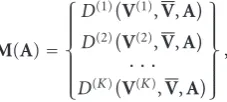
Given a semantic object or corresponding key word, the distance matrix (2) is built. The optimization of (3) is then performed by applying PAES on B. Accordingly, the set of objective functionsM(A) is defined as follows:
M(A)=
⎧ ⎪ ⎪ ⎪ ⎪ ⎨ ⎪ ⎪ ⎪ ⎪ ⎩
D(1)V(1),V,A
D(2)V(2),V,A
· · ·
D(K)V(K),V,A
⎫ ⎪ ⎪ ⎪ ⎪ ⎬ ⎪ ⎪ ⎪ ⎪ ⎭
, (6)
(a)
(b)
Figure5: Positive (a) and negative (b) representative sample blocks oflion.
defined in (3). The goal is to find the best set of coefficients
A= {αl|l=1,. . .,L}subject to the following constraint:
K
l=1
αl=1. (7)
The task at hand boils down to minimizing the objective functions (6) generated for all the positive training samples while maximizing the objective functions (6) generated for all the negative training samples. In both cases, simultane-ous minimization and maximization are conducted subject to the constraint (7). For the sake of illustration, Figure 5 shows some examples of positive and negative representative blocks for the conceptlion.
Observe that, in practice, the virtual centroidV is cal-culated for the positive samples only. As mentioned before, instead of a single solution, a set of Pareto-optimal solu-tions is obtained for the positive and negative samples. Using these sets of Pareto-optimal solutions, a final unique solu-tionA∗is estimated in a second “decision making” step. This estimation ofA∗ can be achieved by minimizing the over-all sum of distances between over-all positive examples and the centroid, while maximizing (spreading) the overall sum of distances between all negative examples and the centroid. In other words, the goal is to minimize the ratio between the overall sum of distances from all positive examples to the centroid and the overall sum of distances from all negative examples to the centroid. Thus,A∗ is the set of parameters minimizing:
min K
k=1D+(k)
V(k),V,A s
K
k=1D (k)
− V(k),V,As
, s=1, 2,. . .,S, (8)
whereD(+k)andD(−k)represent the distances over positive and
negative samples, respectively,Asis thesth solution in the set of Pareto-optimal solutions andSis the cardinality of the set of Pareto-optimal solutions estimated in the first optimiza-tion step.
3.4. Multiple objective optimization and Pareto archived evolution
Multiobjective optimization is defined as the problem of finding a vector of decision variables which satisfies given constraints and optimizes a vector of objective functions. These functions form a mathematical description of perfor-mance criteria which are usually in conflict with each other.
Hence, the term “optimizes” means finding a solution which gives good or acceptable values for all the objective func-tions. It can be mathematically stated as finding a particu-lar vector of decision variablesA∗ = {α∗1,α2∗,. . .,α∗L}T sat-isfyingP constraintsgp(A) ≥ 0, p =1, 2,. . .,Pand at the same time optimizing the set of vector functionsM(A) =
{D1(A),D2(A),. . .,DK(A)}T. Since it is rarely the case that
a single set of decision variables simultaneously optimizes all the objective functions, “trade-offs” between multiple solu-tions for each objective function are sought. The notion of “optimum” is consequently redefined as Pareto optimum. A particular vector of decision variablesA∗∈Fis called Pareto optimal if there exists no feasible vector of decision variables such asA∈F, which could decrease some criterion however without causing a simultaneous increase in at least one of the other criteria. Mathematically, this optimization rule can be expressed as follows: there does not exist anotherA∈Fsuch that
Dk(A)≤Dk
A∗, ∀k=1,. . .,K. (9)
This rule rarely generates Pareto-optimal solutions and its plot is generally referred to as the Pareto front. The vectors
A∗are usually called nondominated set.
PAES is a multiobjective local search method. It com-prises three parts: the candidate solution generator, the can-didate solution acceptance function, and the nondominated solutions (NDS) archive. The candidate solution generator is similar to random mutation hill-climbing. It maintains a sin-gle current solution and, in each iteration, produces a new candidate via random mutation. The design of the accep-tance function is obvious in the case of the mutant domi-nating the current solution or vice versa, but in the nondom-inated case, a comparison set is used to help decide between the mutant and the current solution. Thus, an NDS list is needed to explicitly maintain a limited number of the non-dominated solutions when they are found by the hill-climber, as the aim of multiobjective search is to find a spread of non-dominated solutions. In [19], a pseudocode showing the sim-plest form of PAES was given inAlgorithm 1.
A grid is used in PAES in order to ensure archived points cover a wide extent in objective space and are “well distributed.” It is done by recursively dividing the
(4) else if (m dominates c)
(5) replace c with m, and add m to the archive
(6) else if (m is dominated by any member of the archive) discard m (7) else apply test (c, m, archive) to determine the new solution and
whether it is needed to add m to the archive (8) if (the termination criterion is valid) stop
else go to 2
Algorithm1: PAES algorithm.
(a)
(b)
(c)
Figure6: Three groups of 8 image blocks which well-defined low-level characteristics.
each objective, the required grid location can be found by re-peatedly bisecting the range in each objective and finding the half where the solution lies. The recursive subdivision of the space and assignment of grid location is carried out in AGA by calculating the range in objective space of the current so-lutions in the archive and adjusting the grid so that it covers this range.
In the algorithm, the uniquely extremal vectors are pro-tected from being removed from the archive once they have entered it (except by domination). Thus, vectors in the archive will converge to a set which covers the largest pos-sible range in objective space in each objective. On the other hand, the archiving algorithm will be removing vectors from crowded regions. A comprehensive comparative study of sev-eral well-known algorithms for MOO was conducted in [20]. As a result, PAES appears as one of the best techniques show-ing very low complexity.
3.5. Similarity matching in optimal multifeature space
For a particular predefined concept, an optimal multifeature combination factor setAis obtained from the optimization step. Using this set of combination factors, the similarity dis-tance for any block can be calculated by
D(V,V,A)=
L
l=1
αldl
vl,vl
. (10)
These distance estimations are supposed to be represent-ing how likely an image block region contains a particular concept. Using these distances alone, a complete image re-trieval process can be achieved without following steps of the work. In this approach, the mapping from block level to im-age level is achieved by using the similarity of the most sim-ilar block of an image to the concept as the simsim-ilarity of the image to the concept.
4. EXPERIMENTS
As mentioned inSection 2, seven image low-level primitives were used to assess the performance of the proposed ap-proach: CLD, CSD, DCD, EHD [6], TGF [15], GLC [16], and HSV [17]. It is important to stress that the proposed ap-proach is not tailored to a given number of low-level descrip-tors. Any descriptor bank can be used.
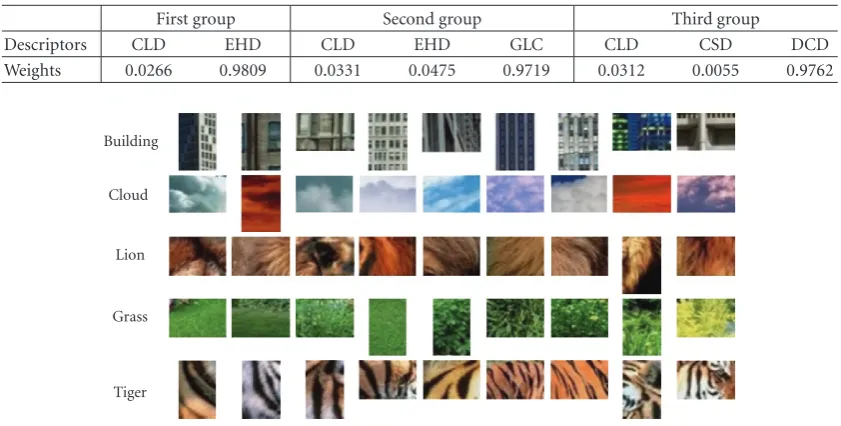
Table1: Weights obtained for the three groups of blocks depicted inFigure 6using different descriptors.
First group Second group Third group
Descriptors CLD EHD CLD EHD GLC CLD CSD DCD
Weights 0.0266 0.9809 0.0331 0.0475 0.9719 0.0312 0.0055 0.9762
Tiger Grass Lion Cloud Building
Figure7: Samples of representative blocks considered for concepts:building, cloud, lion, grass, andtiger.
and assigned to the edge descriptor. Clearly, all other descrip-tors were ignored. It could be concluded that using MOO to find the optimal metric in multidescriptor space for im-age classification safely outperformed techniques using the “best” single descriptors. To consolidate this early conclu-sion, additional experiments were run.Figure 6shows three groups of 8 image blocks each.
The first group at the top row inFigure 6featured clear horizontal edges and a diversity of colors. The CLD and EHD descriptors were tested on this group. The weights for each descriptor as estimated by the MOO approach were shown in Table 1. The second group of blocks featured similar texture and a variety of colors and edge orientations. The CLD, EHD, and GLC descriptors were combined in this case. The weights for each descriptor as returned by the MOO approach were shown inTable 1. Experiments on the next group aimed at showing that even for different descriptors based on the same visual cue (color), the proposed approach showed a good discriminative power. The third group showed a group of 8 blocks consisting of exactly the same set of pixels: 100 yellow and 1500 blue pixels. However, the distribution and arrange-ment of the pixels were different in each block. The weights for each descriptor returned by the proposed approach were shown inTable 1. Clearly, the DCD should dominate in this case while the CLD and CSD present a clear coefficient vari-ation across the group.
From these experiments it could be observed that the proposed approach assigned suitable weights to each feature space according to the low-level characteristics of the date set. This set of experiments also showed that for images with similar low-level characteristics, the best descriptor was se-lected from the descriptor bank and the approach reduced to a single objective optimization.
In the second round of experiments a small dataset con-taining 700 natural images with known ground truths were
considered. This annotated set was created using natural pic-tures from theCoreldatabase. All images were manually se-lected and labelled according to five predefined concepts: building, cloud, lion, grass, andtiger. The images represent-ing these five different semantic concepts were then mixed to create the dataset.
Since ground truths were available in this case, precision and recall of the retrieval performance were estimated. Four groups of 20 elementary representative blocks were manually selected to represent each concept: 10 positive and 10 nega-tive samples. For each group, the distance matrix (3) was de-fined using these 20 blocks and the 7 descriptors mentioned at the beginning of this section: CLD, CSD, DCD, EHD, TGF, GLC and HSV [6,15–17]. Thus, 20 multiobjective functions of 7 variables were defined. Some of the sample blocks for the different concepts were depicted inFigure 7. The set of weights obtained after 10000 iterations of the PAES algo-rithm were shown inTable 2. To guarantee a good perfor-mance of the metric build with the coefficients returned by PAES, while keeping the computation cost, 10000 iterations were considered as a good (empirically estimated) trade-off. Using these weights, the similarity between each block in the dataset and the virtual centroid of a concept was esti-mated. A similarity ranking list of blocks was then generated. If a block of an image was relevant to a concept, the image it-self was considered relevant to that concept. Using this rule, images were ranked according to the ranking of single blocks. Finally, the precision-recall curves for each concept were es-timated. Precision and recall values were used as the major evaluation criteria in this paper. They are commonly defined as follows:
precision= retrieved and relevant
retrieved , (11)
recall=retrieved and relevant
Building 0.6736 0.0537 0.0095 0.0353 0.0804 0.0858 0.0646 Cloud 0.0252 0.7780 0.0914 0.0761 0.1833 0.0293 0.0315
Grass 0.130 0.1941 0.1526 0.3296 0.0460 0.1830 0.0039
Lion 0.196 0.4684 0.0677 0.0599 0.1176 0.0516 0.0415
Tiger 0.0380 0.0604 0.0040 0.3474 0.3004 0.1689 0.0895
0 10 20 30 40 50 60 70 80 90 100
P
recision
(%)
10 20 30 40 50 60 70 80 90 100
Recall (%) Multi
CLD CSD DCD
EHD TGF GLC HSV
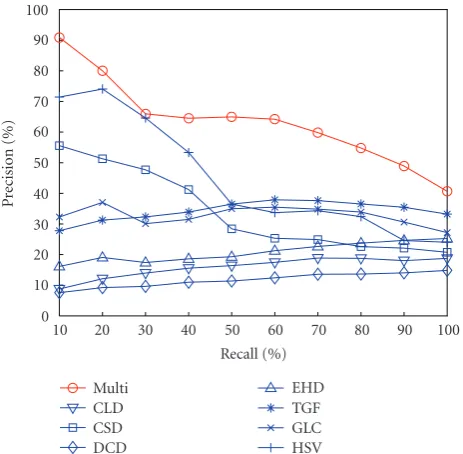
Figure 8: Precision-recall curves for concept building using the multifeature combination metric and using single descriptors.
In order to prove that the multifeature combination met-ric performs better than any of the combined single descrip-tors, the precision-recall curves using single descriptors were also plotted in the same diagrams for comparison. These curves were depicted in Figures8–12, each of which plotted curves for one of the 5 predefined concepts.
In Figures8–12, the curves obtained using our proposed approach was plotted with mark “o,” and they were labelled as “multi” since the major outcome of our method was to find out the optimised multifeature space. The curves ob-tained using each of the single descriptors were plotted with other marks.
It could be observed from Figures8–12that the retrieval performance using the proposed approach was only slightly outperformed in a single case: forbuilding using EHD, but the disadvantage of the proposed approach is not big. This is due to the prevailing dominance of EHD for building pic-tures. However, EHD cannot be prevailing dominant for any concept, and there is no such a “super descriptor” can really do so. This is why an approach such as the proposed one is needed, which approximates the “super descriptor” by com-bining several properly selected descriptors. It is not required that this approximated “super descriptor” outperforms any single descriptor when searching for any concept. Rather, the
0 10 20 30 40 50 60 70 80 90 100
P
recision
(%)
10 20 30 40 50 60 70 80 90 100
Recall (%) Multi
CLD CSD DCD
EHD TGF GLC HSV
Figure9: Precision-recall curves for conceptcloudusing the multi-feature combination metric and using single descriptors.
aim is to have it perform not worse than, if not better than, any single descriptor when searching for any concept. There-fore, the result given inFigure 8is acceptable given the aim of the proposed approach. In other cases shown in Figures9– 12, the proposed approach performed better than using any single descriptor in the sense of both precision and recall.
When the multifeature space was applied in a complete image retrieval system, usually the results were displayed in a graphical user interface. Retrieved images were presented to the user in a ranking order according to their visual similar-ity. Here, a threshold was needed to define how many most similar images were to be displayed. In our framework, this threshold value was modifiable, but it was set to be 50 by de-fault. The precision value was redefined as follows:
precision=retrieved-by-threshold and relevant
retrieved-by-threshold . (13)
Table3: Precision values for the first page of retrieved images with a threshold of 50.
Multifeature metric CLD CSC DCD EHD TGF GLC HSV
Building 90% 65.00% 30.00% 20.00% 90.00% 50.00% 25.00% 55.00%
Cloud 95% 75.00% 95.00% 40.00% 75.00% 25.00% 35.00% 100.00%
Grass 100% 95.00% 95.00% 30.00% 95.00% 65.00% 90.00% 95.00%
Lion 85% 65.00% 55.00% 20.00% 65.00% 25.00% 45.00% 75.00%
Tiger 70% 5.00% 55.00% 5.00% 25.00% 30.00% 25.00% 65.00%
Table4: Our results comparing with precision values at the second iteration, presented in [12].
Proposed multifeature metric LK (CONC) in [12] RBF (CONC) in [12] ACK in [12]
Building 90% 62% 73% 75%
Cloud 95% 61% 73% 92%
Grass 100% 29% 28% 42%
Lion 85% 37% 46% 59%
Tiger 70% 64% 49% 60%
0 10 20 30 40 50 60 70 80 90 100
P
recision
(%)
10 20 30 40 50 60 70 80 90 100
Recall (%) Multi
CLD CSD DCD
EHD TGF GLC HSV
Figure10: Precision-recall curves for conceptgrassusing the mul-tifeature combination metric and using single descriptors.
comparison was almost infeasible [8]. Since in [12], a set of experiments used the same dataset as we used here, their re-sults were taken as a comparison with our approach. These results were presented inTable 4. In [12], the authors pre-sented approaches employing several different combinations of low-level features and SVM kernels. Among these kernels, the approaches using RBF kernel, Laplace kernel, and the adaptive convolution kernel (ACK) for combining the same 7 visual descriptors generally performed best. Moreover, the method in [12] was based on user relevance feedback. The precisions were generally the highest at the second iteration of relevance feedback. For the sake of comparability, the
re-0 10 20 30 40 50 60 70 80 90 100
P
recision
(%)
10 20 30 40 50 60 70 80 90 100
Recall (%) Multi
CLD CSD DCD
EHD TGF GLC HSV
Figure11: Precision-recall curves for conceptlionusing the multi-feature combination metric and using single descriptors.
sults obtained using the above three kernels at the second it-eration were chosen and presented.
As shown inTable 3, retrievals using the proposed multi-feature metric generally outperformed retrievals using any of the single descriptors in the perspective of precision. Com-paring with the approach proposed in [12], our approach was relatively more accurate. Besides, results listed inTable 4 were obtained after 2 iterations of relevance feedback, while our approach was fully automatic.
0 10 20 30 40 50 60 70 80
P
recision
(%)
10 20 30 40 50 60 70 80 90 100
Recall (%) Multi
CLD CSD DCD
EHD TGF GLC HSV
Figure12: Precision-recall curves for concepttigerusing the mul-tifeature combination metric and using single descriptors.
proposed approach within a realistic natural image retrieval scenario. The goal of our approach in such scenarios was to effectively gather the relevant images at the beginning of im-age ranking list, so that users could find a dense collection of images on their demand in the retrieved images.
This dataset contained a large number of images and many kinds of objects including animals, plants, human, sceneries, and events. Even for the most common concepts likegrass, the images containing each concept were sparsely spread over in the whole set. Because no ground truth was available here due to the dataset size, only the first several hundreds retrieved images were judged as relevant or irrele-vant in a subjective fashion by a human evaluator. The first 500 retrieved images were manually judged for performance evaluation. Starting from 10, when every 10 more images were retrieved, a precision value was estimated as in (13). To compensate for the sparseness of the relevant images for each concept, the obtained precision values were compared with the percentages of each concept in the dataset. These percentages were manually calculated from a random subset of 1000 images in the whole dataset.
Figure 13showed the precisions curves against the num-ber of retrieved images for a few concepts. The straight lines inFigure 13indicated the percentages of images in the dataset for the corresponding concept, that is, curves and lines with the same colors and marks represented the same concepts. However, these curves were not the complete pre-cision curves for the concepts. They were just very small seg-ments at the beginning of the complete curves, that is, the segments of first 500/12700 of the complete curves.
Figure 14showed the retrieval recall curves against the number of retrieved images for conceptslionandtiger. Recall values were estimated as in (12) based on the known fact that there were 100 images containing each of these two concepts
10 20 30 40 50 60 70
P
recision
(%)
0 100 200 300 400 500
Number of retrieved images Cloud
Building
Figure13: The retrieval precisions curves for 3 concepts compared with the average percentages.
0 10 20 30 40 50 60 70
Re
ca
ll
(%
)
0 500 1000 1500 2000
Number of retrieved images Lion
Tiger
Figure14: The retrieval recall curves of 2 concepts.
in the dataset. Same as experiments presented inFigure 13, no ground truth was available for these experiments. There-fore, only 2000 images were considered as a good representa-tion since there were only over 100 images for each concept in the database. However similarly, these curves were not the complete recall curves for the concepts. They were just very small segments at the beginning of the complete curves, that is, the segments of first 2000/12700 of the complete curves.
It could be observed from Figures13and14that relevant images for each concept were effectively gathered within the first few hundreds in the ranking list. It can be concluded that the proposed approach has good discriminative power and it is suitable for retrieving natural images in large datasets.
5. CONCLUSIONS
metric per semantic concept is obtained. The core of the pro-posed approach is a multiobjective optimization technique to estimate weights for a linear combination of single met-rics in multifeature space. The proposed approach has been tested by retrieving natural images in representative datasets. A comprehensive evaluation of the proposed technique is presented. Based on the evaluation, we proved the ability of the proposed approach to effectively retrieve images accord-ing to semantic concepts from large natural image databases.
ACKNOWLEDGMENT
This research was partially supported by the European Com-mission under the Contract FP6-045189, RUSHES.
REFERENCES
[1] C. Bishop and C. M. Bishop, Neural Networks for Pattern Recognition, Oxford University Press, Oxford, Miss, USA, 1995.
[2] O. Chapelle, P. Haffner, and V. N. Vapnik, “Support vector ma-chines for histogram-based image classification,”IEEE Trans-actions on Neural Networks, vol. 10, no. 5, pp. 1055–1064, 1999. [3] N. Friedman, D. Geiger, and M. Goldszmidt, “Bayesian net-work classifiers,”Machine Learning, vol. 29, no. 2, pp. 131–163, 1997.
[4] A. W. M. Smeulders, M. Worring, S. Santini, A. Gupta, and R. Jain, “Content-based image retrieval at the end of the early years,”IEEE Transactions on Pattern Analysis and Machine In-telligence, vol. 22, no. 12, pp. 1349–1380, 2000.
[5] Y. Rui, T. S. Huang, and S.-F. Chang, “Image retrieval: current techniques, promising directions, and open issues,” Journal of Visual Communication and Image Representation, vol. 10, no. 1, pp. 39–62, 1999.
[6] S.-F. Chang, T. Sikora, and A. Purl, “Overview of the MPEG-7 standard,”IEEE Transactions on Circuits and Systems for Video Technology, vol. 11, no. 6, pp. 688–695, 2001.
[7] A. Mojsilovi´c, “A computational model for color naming and describing color composition of images,”IEEE Transactions on Image Processing, vol. 14, no. 5, pp. 690–699, 2005.
[8] Y. Rui, T. S. Huang, M. Ortega, and S. Mehrotra, “Relevance feedback: a power tool for interactive content-based image re-trieval,”IEEE Transactions on Circuits and Systems for Video Technology, vol. 8, no. 5, pp. 644–655, 1998.
[9] S. Newsam, B. Sumengen, and B. S. Manjunath, “Category-based image retrieval,” inProceedings of IEEE International Conference on Image Processing (ICIP ’01), vol. 3, pp. 596–599, Thessaloniki, Greece, October 2001.
[10] C. Schmid and R. Mohr, “Local grayvalue invariants for image retrieval,”IEEE Transactions on Pattern Analysis and Machine Intelligence, vol. 19, no. 5, pp. 530–535, 1997.
[11] M. Soysal and A. A. Alatan, “Combining MPEG-7 based vi-sual experts for reaching semantics,” inProceedings of the 8th International Workshop on Visual Content Processing and Rep-resentation (VLBV ’03), vol. 2849 ofLecture Notes in Computer Science, pp. 66–75, Madrid, Spain, September 2003.
[12] D. Djordjevic and E. Izquierdo, “An object- and user-driven system for semantic-based image annotation and retrieval,” IEEE Transactions on Circuits and Systems for Video Technol-ogy, vol. 17, no. 3, pp. 313–323, 2007.
[13] R. E. Steuer,Multiple Criteria Optimization: Theory, Computa-tion, and ApplicaComputa-tion, John Wiley & Sons, New York, NY, USA, 1986.
[14] J. Knowles and D. Corne, “Approximating the nondominated front using the pareto archived evolution strategy,” Evolution-ary Computation, vol. 8, no. 2, pp. 149–172, 2000.
[15] B. S. Manjunath and W. Y. Ma, “Texture features for brows-ing and retrieval of image data,”IEEE Transactions on Pattern Analysis and Machine Intelligence, vol. 18, no. 8, pp. 837–842, 1996.
[16] M. Tuceryan and A. K. Jain, “Texture analysis,” inThe Hand-book of Pattern Recognition and Computer Vision, pp. 207–248, World Scientific, River Edge, NJ, USA, 2nd edition, 1998. [17] M. J. Swain and D. H. Ballard, “Color indexing,”International
Journal of Computer Vision, vol. 7, no. 1, pp. 11–32, 1991. [18] Q. Zhang and E. Izquierdo, “A multi-feature optimization
ap-proach to object-based image classification,” in Proceedings the 5th International Conference on Image and Video Retrieval (CIVR ’06), vol. 4071 ofLecture Notes in Computer Science, pp. 310–319, Tempe, Ariz, USA, July 2006.
[19] J. Knowles and D. Corne, “Properties of an adaptive archiving algorithm for storing nondominated vectors,”IEEE Transac-tions on Evolutionary Computation, vol. 7, no. 2, pp. 100–116, 2003.