R E S E A R C H
Open Access
Stochastic analysis of neural network modeling
and identification of nonlinear memoryless MIMO
systems
Mohamed Ibnkahla
*Abstract
Neural network (NN) approaches have been widely applied for modeling and identification of nonlinear multiple-input multiple-output (MIMO) systems. This paper proposes a stochastic analysis of a class of these NN algorithms. The class of MIMO systems considered in this paper is composed of a set of single-input nonlinearities followed by a linear combiner. The NN model consists of a set of single-input memoryless NN blocks followed by a linear combiner. A gradient descent algorithm is used for the learning process. Here we give analytical expressions for the mean squared error (MSE), explore the stationary points of the algorithm, evaluate the misadjustment error due to weight fluctuations, and derive recursions for the mean weight transient behavior during the learning process. The paper shows that in the case of independent inputs, the adaptive linear combiner identifies the linear combining matrix of the MIMO system (to within a scaling diagonal matrix) and that each NN block identifies the corresponding unknown nonlinearity to within a scale factor. The paper also investigates the particular case of linear identification of the nonlinear MIMO system. It is shown in this case that, for independent inputs, the adaptive linear combiner identifies a scaled version of the unknown linear combining matrix. The paper is supported with
computer simulations which confirm the theoretical results.
Keywords:Nonlinear system identification, Neural networks, Gradient descent, Statistical analysis
Introduction
Neural network [1] approaches have been extensively used in the past few years for nonlinear MIMO system modeling, identification and control where they have shown very good performances compared to classical techniques [2-6].
If these NN approaches are to be used in real systems, it is important for the algorithm designer and the user to understand their learning behavior and performance cap-abilities. Several authors have analyzed NN algorithms during the last two decades which considerably helped the neural network community to better understand the mechanisms of neural networks [1,7-15]. For example, the authors in [13] have studied a simple structure con-sisting of two inputs and a single neuron. The authors in [8] studied a memoryless single-input single-output (SISO) system identification model for the single neuron
case. In [9] the authors proposed a stochastic analysis of gradient adaptive identification of nonlinear Wiener sys-tems composed of a linear filter followed with a Zero-memory nonlinearity. The model was composed of a lin-ear adaptive filter followed by an adaptive parameterized version of the nonlinearity. This study has been later generalized [16] for the analysis of stochastic gradient tracking of time-varying polynomial Wiener systems. In [12] the author analyzed NN identification of nonlinear SISO Wiener systems with memory for the case where the adaptive nonlinearity is a memoryless NN with an ar-bitrary number of neurons. The case of a nonlinear SISO Wiener-Hammerstein system (i.e., an adaptive filter fol-lowed by an adaptive Zero-memory NN folfol-lowed by an adaptive filter) has been analyzed in [11].
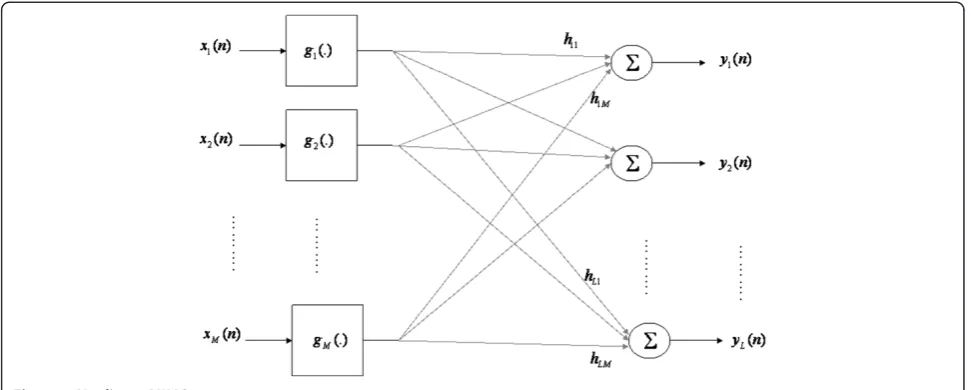
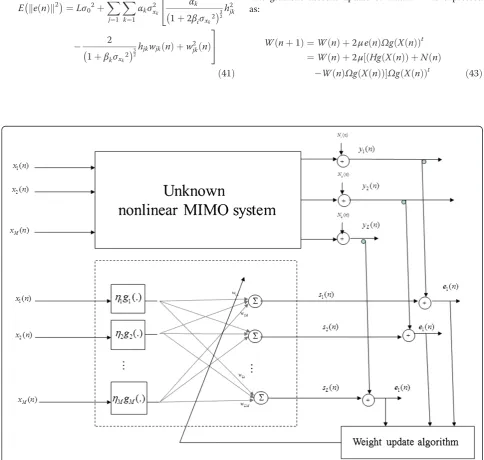
This paper deals with a typical class of nonlinear MIMO systems (Figure 1) which is composed of M
inputs, M memoryless nonlinearities, a linear combiner, andLoutputs. This corresponds, for example, to MIMO channels used in wireless terrestrial communications
Correspondence:[email protected]
Electrical and Computer Engineering Department, Queen’s University, Kingston, Ontario K7L 3N6, Canada
[17-22], satellite communications [23,24], amplifier mod-eling [25], control of nonlinear MIMO systems [6], etc. Recently, a neural network approach has been proposed to adaptively identify the overall input–output transfer function of this class of MIMO systems and to characterize each component of the system (i.e., the memoryless nonlinearities and the linear combiner) [4]. The proposed NN model is composed of a set of mem-oryless NN blocks followed by an adaptive linear com-biner. Each part of the adaptive system aims at identifying the corresponding part in the unknown MIMO system. The algorithm has been successfully ap-plied to system modeling, channel tracking, and fault detection.
The purpose of this paper is to provide a stochastic analysis of NN modeling of this class of MIMO systems. The paper provides a general methodology that may be used to solve other problems in stochastic NN learning analysis. The methodology consists of splitting the study into simple structures, before studying the complete structure. Here, as a first step we start by analyzing a simple linear adaptive MIMO scheme (consisting of an adaptive matrix) that identifies the nonlinear MIMO sys-tem (i.e., problem of linear identification of a nonlinear MIMO system). Then we analyze a nonlinear adaptive system in which the nonlinearities are assumed to be known and frozen during the learning process, only the linear combiner is made adaptive. Finally, the complete adaptive scheme is analyzed taking into account the insights given by the analysis of the simpler structures. In our analytical approach, we derive the general formu-las and recursions, which we apply to a case study that we believe is illustrative to the reader.
The paper is organized as follows. The problem state-ment is given in Section 2. The study of the simple
structures is detailed in Section 3. Section 4 presents the analysis for the complete structure. Simulation results and illustrations are given in Section 5. Finally, conclu-sions and future work are given in Section 6.
Problem statement Nonlinear MIMO system
The class of nonlinear MIMO systems discussed in this paper is presented in Figure 1. Each inputxi(n) (i =1,. . .,
M) is nonlinearly transformed by a memoryless nonlinear-ity gi (.). The outputs of these nonlinearities are then linearly combined by an L×Mmatrix H =[hji] (assumed in this paper to be constant). Matrix His defined by the unknown system to be identified. For example, in wireless MIMO communication systems, M is the propagation matrix representing the channel between M transmitting antennas andLreceiving antennas.
Thejthoutput of the MIMO system is expressed as:
yjð Þ ¼n XM
i¼1
hjið Þgn iðxið Þn Þ þNjð Þn ð1Þ
whereNjis a white Gaussian noise with varianceσ02.
Let X nð Þ¼ x1ð Þn x2ð Þn . . .xMð Þn t;g X nð ð ÞÞ¼
g1ðx1ð ÞnÞ ½
g2ðx2ð ÞnÞ. . .gMðxMð ÞnÞt;Y nð Þ ¼ y1ð Þny2ð Þn . . .yLð Þn t;
and N nð Þ ¼ N1ð ÞN2n ð Þn . . .NLð Þn t:
The system input–output relationship can be expressed in a matrix form as:
Y nð Þ ¼Hg X nð ð ÞÞ þN nð Þ: ð2Þ
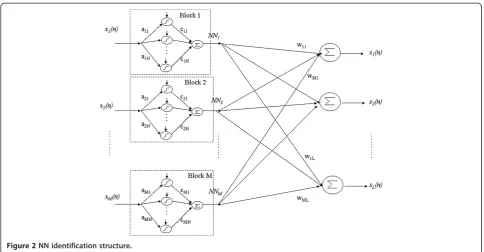
Neural Network identification structure and algorithm
neurons and a scalar output. The output of the kthblock is expressed as:
NNkð Þ ¼n XN
i¼1
ckif að kixkð Þ þn bkiÞ;k¼1; ::::;M ð3Þ
Where fis the NN activation function. aki, cki, bki are, respectively, the input weight, bias term, and output weight of the ith neuron in the kth block. The output
NNkof thekthblock is connected to thejthoutput of the system through weightwjk. The systemjthoutput is then
expressed as:
sjð Þ ¼n XM
k¼1
wjkNNkð Þn;j¼1; ;L ð4Þ
Weights wjk will be represented by an LxM matrix:
W = [wjk].
Let S nð Þ¼ s1ð Þs2n ð Þn . . .sLð Þn t and NN nð Þ¼
NN1ð Þn ½ NN2ð Þn . . .NNMð Þn t:
Equations (4) can then be expressed in a matrix form as:
S nð Þ ¼WNN nð Þ: ð5Þ
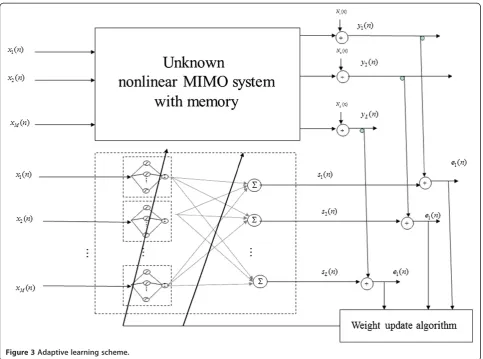
For the learning process, the NN parameters are updated so that to minimize the sum of the squared errors between the unknown system outputs and the corresponding outputs of the model (Figure 3):
e nð Þ
k k2¼XL
j¼1
e2jð Þn: ð6Þ
Here ejð Þ ¼n yjð Þ n sjð Þn and e nð Þ ¼½e1ð Þe2n ð Þn . . .
eLð Þn t:
The gradient descent recursions for weight adaptation are:
W nð þ1Þ ¼W nð Þ þ2μe nð ÞNNtð Þn ð7Þ
ckiðnþ1Þ ¼ckið Þ þn 2μf að kixkð Þ þn bkiÞ XL
l¼1
wlkelð Þn
ð8Þ
akiðnþ1Þ ¼akið Þ þn 2μckixkð Þn f
0
akixkð Þn
ð þbkiÞ
XL
l¼1wlkelð Þn ð9Þ
bkiðnþ1Þ ¼bkið Þþn 2μckif
0
akixkð Þþbn ki
ð Þ
XLl¼1wlkelð Þn ð10Þ
whereμ is a small positive constant and f0ðÞ represents the derivative:f0ð Þ ¼x @f x@ð Þx :
Case study
In this case study, the inputs xi (n) will be assumed uncorrelated Zero-mean Gaussian variables with variance
σ2
xi. The NN activation function will be taken as theerf function. The unknown nonlinear transfer functions are taken from a family of nonlinear functions of the form
gið Þ ¼x αixexp βix
2 2
, where αi and βi are positive
con-stants. These nonlinear functions are reasonable models for amplitude conversions of nonlinear high power amplifiers (HPA) used in digital communications [12,25,26]. Note that other nonlinear functions may be considered, however, explicit closed-form solutions of the different derivations may not be possible.
Study of simplified structures: Linear adaptation
Before analyzing the full structure, we will analyze the following simplified schemes which will help us under-stand the complete structure:
1. The adaptive system is composed of an adaptive
linear combinerW(Section 3.1).
2. The adaptive system is composed ofWand scaled
versions of the unknown nonlinearities (Section 3.2).
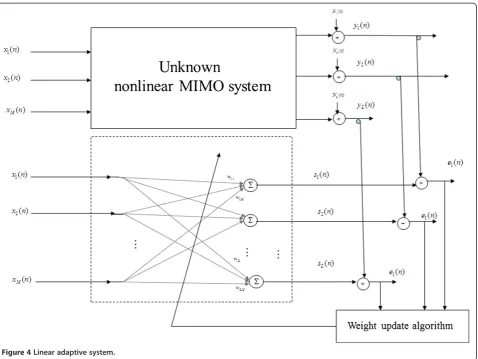
Linear adaptive system
This section studies the linear adaptive system that tries to model the nonlinear MIMO system (Figure 4):
Mean weight behavior and Wiener solution
Since matrix W is linear, it will not be able to identify the nonlinear blocks. However, we will see that it is able to identify matrix H to within a diagonal scaling matrix if the inputs are Zero-mean and independent.
The gradient descent update of matrixWis expressed as:
W nð þ1Þ ¼W nð Þ þ2μe nð ÞXtð Þn ¼W nð Þ þ2μððHgX nð Þ þN nð Þ
W nð ÞX nð ÞÞXtð Þn ð11Þ
Averaging both sides of (11) and using the standard LMS assumption of smallμ[10], we obtain:
E W nð ð þ1ÞÞ E W nð ð ÞÞ þ2μ HRg Xð ÞX
E W nð ð ÞÞRXXÞ
¼E W nð ð ÞÞðI2μRXXÞ þ2μHRg Xð ÞX
ð12Þ WhereRXX¼E XXð tÞ;Rg Xð ÞX ¼E g Xð ð ÞXtÞ:
By setting the updating gradient term to Zero, it can be shown that this equation has a single stationary point (Wiener solution [10]) which is expressed by:
W ¼W0¼HU where U¼Rg Xð ÞXR1XX ð13Þ
Following Equation (12), the mean weights can be expressed as a function of the initial condition as:
E W nð ð ÞÞ ¼Wð Þ0 ðI2μRXXÞn
þ2μHRg Xð ÞX Xn1
p¼0
I2μRXX
ð Þp ð
14Þ
If μ is sufficiently small, the first term converges to 0 and the second term converges toHRg Xð ÞXR1XX.
Hence, the mean weights converge to the Wiener solution:
Wð Þ ¼1 W0¼HRg Xð ÞXR1XX ð15Þ
It can be easily shown that the stability condition onμ is [10]:
0<μ< 1
λmax ð
16Þ
where λmax is the largest eigenvalue of the covariance
matrixRXX.
Note that for Zero-mean independent inputs,Uis a di-agonal matrix:
U¼Rg Xð ÞXR1XX
¼
E g½ 1ð Þx1 x1 σ2
x1
0. . . 0
0 E g2½ ð Þx2x2
σ2
x2
. . .
0 0. . . E g½ Mð ÞxM xM
σ2
xM 2
6 6 6 6 6 6 6 6 4
3 7 7 7 7 7 7 7 7 5
ð17Þ
expected, the scaling matrix reduces to the identity matrix ifgk(xk) =xk.
Application to the case study:
For the particular nonlinear functions given in the case study (see Section 2.3), it is easy to show:
E xð ið Þgn iðxið Þn ÞÞ ¼ αiσxi
2
1þβiσxi2
3
2 and
E gi2ðxið ÞnÞ
¼ α2iσxi
2
1þ2βiσxi2
3
2 ð
18Þ
The mean weight transient recursions are expressed as:
E wjkðnþ1Þ
¼E wjkð Þn
12μσ2xk
þ2μhjk
αkσ2xk
1þβkσ2
xk
3
2
ð19Þ
MatrixUreduces to the following diagonal matrix:
U¼
α1
1þβ1σ2
x1
3
2
0. . . 0
0 α2
1þβ2σ2
x2
3
2 . . .
0 0. . . αM
1þβMσ2
xM
3
2
2 6 6 6 6 6 6 6 6 6 6 4
3 7 7 7 7 7 7 7 7 7 7 5
ð20Þ
Transient MSE and Wiener MSE
The transient MSE is determined by:
Eke nð Þk2¼EkHg X nð ð ÞÞ þN nð Þ W nð ÞX nð Þk2
¼X
L
j¼1
E e2jð Þn
h i
ð21Þ
where:
E e 2jð Þn¼E Hjg X nð ð ÞÞ þNjð Þ n Wjð Þn X nð Þ
2
ð22Þ
where Wjð Þ ¼n wj1ð Þn wj2ð Þn . . . wjMð Þ n t and Hj¼
hj1hj2. . .hjMt:
Using the independence of noise and weights at time
n, we get:
E e j2ð Þn¼σ20þE ðHjg X nð ð ÞÞ Wjð Þn X nð Þ
2
¼σ2
0þHjtRg Xð Þg Xð ÞHj2HjtRg Xð ÞXE Wjð Þn
þE Wjð ÞnRXXWjtð Þn
ð23Þ
The total MSE is therefore expressed as:
Eke nð Þk2¼Lσ20þX
L
j¼1
HjtRg Xð Þg Xð ÞHj
2HjtRg Xð ÞXE Wjð Þn
þE Wjtð ÞnRXXWjð Þn
: ð24Þ
Wiener MSE:
The Wiener MSE, ζ0¼E keW0ð Þnk 2
, is the minimum MSE that can be reached by the system if W is equal to the Wiener solutionW0=HU. It can be easily shown that:
ζ0¼E keW0ð Þn k 2
¼Lσ20þEkHg X nð ð ÞÞ W0X nð Þk2
¼Lσ20þEkH g X nð ð ð ÞÞ UX nð ÞÞk2 ð25Þ
It is clear from this equation that if the unknown func-tions are linear, then the Wiener MSE reduces to the noise power. The MSE is always larger than ζ0 because
of the misadjustment error introduced by the weight fluctuations.
Now we can write the MSE as a function of the Wiener MSE:
Eke nð Þk2¼EkH g X nð ð ð ÞÞ þN nð ÞW nð ÞX nð ÞÞk2 ¼E keW0ð Þ n ðW nð Þ W0ÞX nð Þk
2
ð26Þ Let the instantaneous deviation of the matrix weights with respect to the Wiener solution be denoted by:
V nð Þ ¼ vjkð Þn
¼W nð Þ W0: ð27Þ
We have:
Eke nð Þk2¼E keW0ð Þ n V nð ÞX nð Þk 2
: ð28Þ
This expression is similar to that of the well-known LMS algorithm [10], and can be evaluated as the sum of the minimum error and excess error (or misadjustment) as:
Eke nð Þk2¼ζ0þ
XL
j¼1
tr RXXKVjVjð Þn
ð29Þ
where Vjð Þ ¼n vj1vj2. . .vjM
t
and KVjVjð Þ ¼n E Vjð Þn
The misadjustment is expressed as:
Δð Þ ¼n tr RXX XL
j¼1
RVjVjð Þn !
: ð30Þ
At the convergence, we have:
Ekeð Þ1k2¼ζ0þΔð Þ1: ð31Þ
Derivation of the misadjustment:
From Equation (11) it is easy to show that the weight fluctuations follow the recursion:
V nð þ1Þ ¼V nð Þ þ2μðeW0ð Þ n V nð ÞX nð ÞÞX
tð Þn
ð32Þ Taking the mean of this equation and applying the or-thogonality principle between the input vector and the Wiener error, we get:
E V nð ð þ1ÞÞ ¼E V nð ð ÞÞð12μRXXÞ ð33Þ Thus, as expected, ifμis sufficiently smallE(V(n)) con-verges to 0.
Similarly, for each vectorVjwe can obtain the follow-ing recursion:
Vjðnþ1Þ ¼Vjð Þ þn 2μ eW0jð Þ n X
tð Þn V jð Þn
X nð Þ Þ ð34Þ The evaluation of the covariance matrix of the weight fluctuations is obtained by multiplying both sides of Equation (34) byVt
jðnþ1Þand averaging:
KVjVjtðnþ1Þ ¼KVjtVjtð Þ n 2μRXXKVjVjð Þn
2μKVjVjð ÞRn XX
þ2μE eW0jð Þn XV
t
jðI2μXXtÞ
h i
þ2μE eW0jð ÞXVn
t
jðI2μXXtÞ
h it
þ4μ2E XXtK VjVjXX
t
þ4μ2E e2W0jð Þn XXt
h i
ð35Þ
These expectations are derived in Appendix III, which yields:
KVjVjtðnþ1Þ ¼KVjtVjtð Þ n 2μRXXKVjVjð Þn
2μKVjVjð ÞnRXX
þ4μ2 E Hjtg Xð ÞXE Vjtð Þn
XXt
h i
þtr RXXW0E Vjtð Þn
RXX
þRXXW0E Vjtð Þn
RXX
þ4μ2 E Hjtg Xð ÞXE Vjtð Þn
XXt
h i
þtr RXXW0E Vjtð Þn
RXX
þRXXW0E Vjtð Þn
RXX t
þ4μ2 tr RXXKVjVjð Þn
RXX
þ2RXXKVjVjð ÞnRXX
þ4μ2 E g Xð Þgtð ÞX HjHjtXXt
h i
þσ2
0RXXtr RXXW0tjW0tj
RXX
2RXXW0tjW0tjRXX
ð36Þ
Taking into account that E(Vj(∞)) = 0, KVjVj can be
obtained by solving the following equation:
RXXKVjVjð Þþ1 KVjVjð Þ1RXX2μtr RXXKVjVjð Þ1
RXX
4μRXXKVjVjð ÞR1 XX
¼2μ E g Xð Þgtð ÞX HjHjtXXt
h i
þ2μσ20RXX h
2μtr RXXW0tjW0tj
RXX4μRXXW0tjW0tjRXX i
ð37Þ
This expression holds for any input signal. It can be simplified ifRXX ¼σ2xI. In this case we have:
tr RXXKVjVjð Þ1
¼μσ 2
0σ2xMþtr E g Xð Þgtð ÞHX jHjtXXt
σ4
xðMþ2Þtr W0jW0tj
1μσ2
xðMþ2Þ
ð38Þ
It is now easy to determine the total misadjustment:
Δð Þ ¼1 XL
j¼1
tr RXXKVjVjð Þ1
¼μ
σ2
0σ2xMLþtr E g Xð Þgtð ÞX PL j¼1
HjHjtXXt !
" #
σ4
xðMþ2Þtr W0W0t
1μσ2
xðMþ2Þ
Note that, as expected, in the case of linear functions Δ(∞) reduces to:
Δð Þj1 g Xð Þ¼X¼
μσ2 0σ2xML 1μσ2
xðMþ2Þ
: ð40Þ
The additional terms are due to the nonlinearities and they should be calculated specifically for each nonlinearity.
Application to the case study: The MSE is expressed as:
Eke nð Þk2¼Lσ02þ
XL
j¼1 XM
k¼1 αkσ2xk
αk 1þ2βiσxk2
3
2 h2jk
2 4
2
1þβkσxk2
3
2
hjkwjkð Þ þn w2jkð Þn 3 5
ð41Þ
The Wiener MSE is expressed in this case as:
ζ0¼Lσ02þ
XM
i¼1
α2
iσ2xi
1þ2βiσxi
2
3
21
1þβiσxi2
3
XL
j¼1
h2ji
ð42Þ
Adaptive W, the nonlinearities are frozen and known with scale factors
In this section, matrix W is adaptive, the nonlinearities are frozen and known with scale factors (Figure 5).
Mean weight behavior and stationary points
The gradient descent update of matrix W is expressed as:
W nð þ1Þ ¼W nð Þ þ2μe nð ÞΩg X nð ð ÞÞt ¼W nð Þ þ2μ½ðHg X nð ð ÞÞ þN nð Þ
W nð ÞΩg X nð ð ÞÞΩg X nð ð ÞÞt ð43Þ
whereΩ¼
η1 0 0
0 . . . 0
0 ηM
2 4
3 5.
Averaging both sides of (43) and using the standard LMS assumption of smallμ, we obtain:
E W nð ð þ1ÞÞ E W nð ð ÞÞ þ2μ HΩRg Xð Þg Xð Þ
E W nð ð ÞÞΩ2R
g Xð Þg Xð Þ ¼E W nð ð ÞÞ I2μΩ2Rg Xð Þg Xð Þ
þ2μHΩRg Xð Þg Xð Þ ð44Þ These recursions have a single stationary point (Wiener solution) which is:
W ¼W0¼HΩ1 ð45Þ
Following Equation (44), the mean weight behavior can be expressed as function of the initial condition as:
E W nð ð ÞÞ¼Wð Þ0 I2μΩ2Rg Xð Þg Xð Þ
n
þ2μHΩRg Xð Þg Xð Þ
Xn1
p¼0
I2μΩ2Rg Xð Þg Xð Þ
p
ð46Þ
Hence, if μ is sufficiently small, it can be shown that the mean weights converge to the Wiener solution:
Wð Þ ¼1 W0¼HΩ1: ð47Þ
The stability condition onμis: 0<μ< 1
λmax
Where λmaxis the largest eigenvalue of the covariance
matrixΩ2Rg(X)g(X).
Thus, if each nonlinear functiongk (.) is known with a scaling factor ηk, then weights hjk will be identified by wjk(to the inverse of the scaling factor).
MSE
We have:
Eke nð Þk2¼E Hg X nðk ð ð ÞÞ þN nð Þ W nð ÞΩg X nð ð ÞÞk2
¼XL
j¼1
E e2jð Þn
h i
ð48Þ
where:
E e2jð Þn
¼E Hjg X nð ð ÞÞ þNjð Þn
Wjð Þn Ωg X nð ð ÞÞ2
ð49Þ
Using the independence of noise and weights at time
n, we obtain:
E e2jð Þn
¼σ2
0þE HjΩWjð Þn
g X nð ð ÞÞ
2
¼σ2
0þHjtRg Xð Þg Xð ÞHj
2HjtΩRg Xð Þg Xð ÞE Wjð Þn
þE Wjtð Þn Ω2Rg Xð Þg Xð ÞWjð Þn
The MSE is therefore expressed as:
Eke nð Þk2¼Lσ20þX
L
j¼1
HjtRg Xð Þg Xð ÞHj
2HjtΩRg Xð Þg Xð ÞE Wjð Þn
þE Wjtð ÞnΩ2Rg Xð Þg Xð ÞWjð Þn
ð50Þ
Wiener MSE:
The Wiener MSE can be easily expressed as:
ζ0¼E e2W0ð Þn
¼Lσ20þEkðHW0ΩÞg X nð ð ÞÞk2¼Lσ20 ð51Þ Therefore the Wiener MSE is equal to the noise floor: There are no terms due to the nonlinearities. This is expected since the nonlinearities are known with a scal-ing matrix Ω (we have seen that the scaling matrix is canceled byW0sinceW0= HΩ-1).
Let Z (n) = Ω g(X(n)), we can then express the MSE as a function ofζ0, the weight fluctuation vector V(n) =
W(n)–W0, and Z(n):
Eke nð Þk2¼E keW0ð Þ n ðW nð Þ W0ÞZ nð Þk 2
¼ζ0þE kV nð ÞZ nð Þk2
¼ζ0þ
XL
j¼1
tr RZZKVjVjð Þn
ð52Þ
Similarly to Equation (29), the misadjustment is expressed as:
Δð Þ ¼n tr RZZ XL
j¼1
KVjVjð Þn !
: ð53Þ
The steady state MSE is then expressed as:
Ekeð Þ1k2¼ζ0þΔð Þ1: ð54Þ
Derivation of the misadjustment:
It is easy to show that the weight fluctuations follow the recursion:
V nð þ1Þ ¼V nð Þ þ2μðeW0ð Þ n V nð ÞZ nð ÞÞZ
tð Þ Þn :
Taking the mean of this equation and applying the or-thogonality principle between the input vector and the Wiener error, we obtain:
E V nð ð þ1ÞÞ ¼E V nð ð ÞÞ ð12μRZZÞ: ð56Þ Thus, as expected, if μ is sufficiently small, E(V(n)) converges to 0.
For each vectorVjwe have similar recursions:
Vjðnþ1Þ ¼Vjð Þ þn 2μ eW0jð Þ n Z nð Þ
t
Vjð Þn
Z nð Þ Þ: ð57Þ
The evaluation of the covariance matrix of the weight fluctuations is obtained by multiplying both sides of Equation (57) byVt
jðnþ1Þand averaging:
KVjVjtðnþ1Þ
¼KVt jV
t
jð Þ n 2μRZZKVjVjð Þ n 2μKVjVjð ÞRn ZZ
þ2μE eW0jð ÞZ nn ð ÞV
t
j I2μZ nð ÞZ nð Þ t
h i
þ2μE eW0jð ÞZ nn ð ÞV
t
j I2μZ nð ÞZ nð Þ t
h it
þ4μ2E Z nð ÞZ nð ÞtKVjVjZ nð ÞZ nð Þ t
þ4μ2E e2W0jð ÞZ nn ð ÞZ nð Þt
h i
ð58Þ
In a similar way as in Appendix III, KVjVj (∞) can be obtained by solving the following equation:
RZZKVjVjð Þ þ1 KVjVjð Þ1RZZ2μtr RZZKVjVjð Þ1
RZZ
4μRZZKVjVjð ÞR1 ZZ
¼2μ E g Xð Þgtð ÞX HjHjtZZt
h i
þ2μσ20RZZ h
2μtr RZZW0tjW0tj
RZZ4μRZZW0tjW0tjRZZ i
ð59Þ
This expression can not be further simplified because
RZZis not necessarily of the formσ2
zI.
Therefore, tr(RZZ KVjVj (∞)) should be calculated for each nonlinearity and for eachΩ.
It is interesting to study the case where nonlinearities are known with the same scaling factor, i.e., Ω =ηI. In this case, and if the input vectors are independent and the outputs of the nonlinearities are Zero-mean and of equal varianceσ2
g, we have:
tr RZZKVjVjð Þ1
¼μ σ20η2σ2gM 1μη2σ2
gðMþ2Þ
ð60Þ
As expected, the total misadjustment reduces to:
Δð Þ¼1 XL
j¼1
tr RZZKVjVjð Þ1
¼μ σ
2 0η2σ2gML 1μη2σ2
gðMþ2Þ :
ð61Þ
Here the value of the misadjustment is similar to that of linear identification of a linear system (LMS algo-rithm). This is expected since in this case there are no errors due to the approximation of the nonlinearities.
Case study
For the case study, it is easy to show that Gii¼
E g x2
ið Þn
¼ αi2σx2
1þ2βiσxi2
ð Þ3
2:This yields:
E e2jð Þn
¼σ02þ
XM
i
αi2σxi
2
1þ2βiσxi2
3
2
hjiwjið Þn ηi
2
ð62Þ
Study of the full structure
This section deals with the full structure (Figures 2, 3). All the NN and matrixWweights are updated.
Mean weight transient behavior
We take the following notations for the weights:
E wjkð Þn
¼wjkð Þn;E cðkið Þn Þ ¼ckið Þn ;E að kið Þn Þ ¼akið Þn;
E bð kið Þn Þ ¼bkið Þn .
The update of matrix W is expressed as:
W nð þ1Þ ¼W nð Þ þ2μe nð ÞNN X nð ð ÞÞt ¼W nð Þ þ2μ½Hg X nð ð ÞÞ þN nð Þ
W nð ÞNN X nð ð ÞÞNN X nð ð ÞÞt ð63Þ
Averaging both sides of (63) and using the standard LMS assumption of smallμ, we obtain:
E W nð ð þ1ÞÞ E W nð ð ÞÞ þ2μHRg Xð ÞNN Xð Þð Þn E W nð ð ÞÞRNN Xð ÞNN Xð Þð Þn
¼E W nð ð ÞÞI2μRNN Xð ÞNN Xð Þð Þn þ2μHRg Xð ÞNN Xð Þð Þn ð64Þ
Where RN N Xð ÞN N Xð Þð Þ ¼n E NN X nð ð ÞÞN N X nð ð ÞÞt
; Rg Xð ÞNN Xð Þð Þ ¼n E g X n ð ð ÞÞNN X nð ð ÞÞt.
Using the scalar notation we have:
wjkðnþ1Þ ¼wjkð Þn
þ2μE X
M
i¼1
hjigiðxið ÞnÞ XM
l¼1
wjlNNlð Þn !
" !
XN
m¼1
ckmf að kmxkð Þ þn bkmÞ #
wjkð Þþn 2μ X M;N
i;m
hjickmE giðxið Þn Þf akmxkð Þþn bkm
"
X
M;N;N
l;m;i
wjlclickmE f alixlð Þ þn bli
f akmxkð Þ þn bkm
#
ð65Þ
Let: Kiðakm;bkmÞ ¼E gð iðxið ÞnÞf að kmxkð Þ þn bkmÞÞ;and
Flkðali;bli;akm;bkmÞ¼E f að ð lixlð Þþn bliÞf að kmxkð Þþn bkmÞÞ With these notations we have:
wjkðnþ1Þ ¼wjkð Þ þn 2μ X M;N
i;m
hjickmKi akm;bkm
"
X
M;N;N
l;m;i
wjlclickmFlk ali;bli;akm;bkm
#
ð66Þ
For the NN block weights we have:
ckiðnþ1Þ¼ckið Þþn 2μE XL
l¼1
wlkelð Þn f að kixkð Þþn bkiÞ !
ckið Þþn 2μ XL
l¼1
wlkE XM
p¼1
hlpgpðx nð ÞÞf akix nð Þþbki
XM m¼1 wlm XN q¼1
cmqf amqx nð Þþbmq
!
f akix nð Þþbki
!
¼ckið Þ þn 2μ XL l¼1 wlk XM p¼1
hlpKp aki;bki
XM m¼1 wlm XN q¼1
cmqFmk amq;bmq;aki;bki
!!
ð67Þ
akiðnþ1Þ ¼akið Þn
þ2μE cki XL
l¼1
wlkelð Þx nn ð Þf
0
akix nð Þ þbki
ð Þ
" #
akið Þ þn 2μcki XL l¼1 wlk XM p¼1
hlpE gpðx nð ÞÞx nð Þ
f0 akix nð Þ þbki
XM m¼1 wlm XN q¼1
cmqE f amqx nð Þ
þbmq
x nð Þf0 akix nð Þ þbki
¼akið Þ þn 2μcki XL l¼1 wlk XM p¼1 hlp
@Kp aki;bki
@aki
X
M;N
m;q;ðm;qÞ6¼ð Þk;i
wlmcmq@
Fmk amq;bmq;aki;bki
@aki
1
2wlkcki
@Fki aki;bki;aki;bki
@aki ð
68Þ
bkiðnþ1Þ ¼bkið Þn
þ2μE cki XL
l¼1
wlkelð Þn f
0
akix nð Þ þbki
ð Þ
" #
bkið Þ þn 2μcki XL l¼1 wlk XM p¼1
hlpE gpðx nð ÞÞf
0
akix nð Þ
ð
þbki XM m¼1 wlm XN q¼1
cmqE f amqx nð Þ
þbmq
f0 akix nð Þ þbki
¼bkið Þ þn 2μcki XL l¼1 wlk XM p¼1
hlp@
Kp aki;bki
@bki
X
M;N
m;q
wlmcmq@
Fmk amq;bmq;aki;bki
@bki
!
ð69Þ
These equations hold for any nonlinearity. In the fol-lowing, we will calculate them explicitly for the case study described in Section 2.3
Application to the case study:
Since the inputs are independent and Zero-mean, we haveKi(akm,bkm)=0,k6¼i, and (see Appendix I)
Kiðaim;bimÞ ¼E gð iðxið Þn Þf að imx nð Þ þbimÞÞ
¼
ffiffiffi 2
π
r
αiσ2x 1þβiσ2
x
ffiffiffiffiffiffiffiffiffiffiffiffiffiffiffiffiffiffiffiffiffiffiffiffiffiffiffiffiffiffiffiffiffiffiaim
σ2
x a2imþβi
þ1 q 1 2 ffiffiffi 2 π r
αiσ2xb2im
aim
1þσ2
x βiþa2im
3
2
In the other hand we have: Flkðali;bli;akm;bkmÞ ¼0;
l≠k, and (see Appendix I)
Fkkðaki;bki;akm;bkmÞ
¼E f að ð kix nð Þ þbkiÞf að kmx nð Þ þbkmÞÞ
¼π2 sin1 akiakmσ
2
x
ffiffiffiffiffiffiffiffiffiffiffiffiffiffiffiffiffiffiffiffiffiffiffiffiffiffiffiffiffiffiffiffiffiffiffiffiffiffiffiffiffiffiffiffiffiffiffiffiffiffiffiffiffiffiffiffiffiffiffi 1þσ2
xa2kiþσ2xakm2 þσ4xa2kia2km q 0 B @ 1 C A
1πb2ki σ
2
xakiakm
1þσ2
xa2ki
ffiffiffiffiffiffiffiffiffiffiffiffiffiffiffiffiffiffiffiffiffiffiffiffiffiffiffiffiffiffiffiffiffiffiffiffi 1þσ2
x a2kiþa2km
q
1πb2km σ
2
xakiakm
1þσ2
xa2km
ffiffiffiffiffiffiffiffiffiffiffiffiffiffiffiffiffiffiffiffiffiffiffiffiffiffiffiffiffiffiffiffiffiffiffiffi 1þσ2
x a2kiþa2km
q
þbkibkm 2
π
1
ffiffiffiffiffiffiffiffiffiffiffiffiffiffiffiffiffiffiffiffiffiffiffiffiffiffiffiffiffiffiffiffiffiffiffiffi 1þσ2
x a2kiþa2km
q ð71Þ
Inserting these expressions in equations (66)-(69), we obtain:
wjkðnþ1Þ ¼wjkð Þ þn 2μ hjk XN
m¼1
ckmKk akm;bkm
"
wjk XN
m;i
ckickmFkk aki;bki;akm;bkm
#
ð72Þ
ckiðnþ1Þ ¼ckið Þ þn 2μ XL
l¼1
wlk hlkKk aki;bki
wlk XN
q¼1
ckqFkk akq;bkq;aki;bki
!!
ð73Þ
akiðnþ1Þ ¼akið Þ þn 2μcki XL
l¼1
wlk hlk
@Kk aki;bki
@aki
wlk XN
q6¼k
ckq@
Fkk akq;bkq;aki;bki
@aki
1
2wlkckk
@Fkk akk;bkk;aki;bki
@akk ð
74Þ
bkiðnþ1Þ ¼bkið Þ þn 2μcki XL
l¼1
wlk hlk
@Kk aki;bki
@bki
XN
q
wlkckq
@Fkk akq;bkq;aki;bki
@bki
!
ð75Þ
The explicit expressions of the different derivatives are detailed in Appendix II.
Stationary points
We obtain the stationary points by setting to 0 the expectations of the updating gradient terms in (64) and (4.5-7).
For W, we obtain:
W0¼HRg Xð ÞNN Xð ÞR1NN Xð ÞNN Xð Þ¼HU;where
U¼Rg Xð ÞNN Xð ÞR1NN Xð ÞNN Xð Þ: ð76Þ
Forckiwe obtain the equations: XL
l¼1
wlkðhlkKkðaki;bkiÞ
wlk XN
q¼1
ckqFkk akq;bkq;aki;bki
!!
¼0 ð77Þ
Forakiwe obtain the equations: XL
l¼1
wlk hlk@
Kkðaki;bkiÞ @aki
wlk XN
q6¼k
ckq
@Fkk akq;bkq;aki;bki
@aki
1
2wlkckk
@Fkkðakk;bkk;aki;bkiÞ
@akk ¼
0 ð78Þ
Forbkiwe obtain: XL
l¼1
wlk hlk@
Kkðaki;bkiÞ @bki
XN
q
wlkckq@
Fkk akq;bkq;aki;bki
@bki
!
¼0 ð79Þ
The above equations are nonlinear in the NN variables. They can be solved numerically, but they are very diffi-cult to solve analytically.
Convergence of the algorithm to the stationary points: It is always interesting to show whether an algorithm is capable of converging to its stationary points or not. In our case it is difficult to establish this, since the up-dating equations of the weights are nonlinear, except for W.
In the case where the NN weights are frozen we can establish the convergence condition forW.
In this case we have:
E W nð ð þ1ÞÞ ¼E W nð ð ÞÞI2μRNN Xð ÞNN Xð Þ
þ2μHRg Xð ÞNN Xð Þ ð80Þ
E(W(n)) can be expressed as a function of the initial condition as:
E W nð ð ÞÞ¼Wð Þ0 I2μRNN Xð ÞNN Xð Þnþ2μHRg Xð ÞNN Xð Þ Xn1
p¼0
I2μRNN Xð ÞNN Xð Þ
p
ð81Þ
If μ is sufficiently small, the steady state solution to (81) is:
Wð Þ ¼1 W0¼HRg Xð ÞNN Xð ÞR1NN Xð ÞNN Xð Þ: ð82Þ
Hence, the mean weights converge to the stationary pointW0, and the stability condition onμis:
0<μ< 1
λmax ð
83Þ
Whereλmaxis the largest eigenvalue of the correlation
matrixRNN(X)NN(X).
Application to the case study:
For the case study it can be shown thatUreduces to a diagonal matrix:
U ¼Rg Xð ÞNN Xð ÞR1NN Xð ÞNN Xð Þ
¼
γ1 0. . . 0
0 γ2. . . 0 0 0. . . γM 2
6 4
3 7
5; ð84Þ
where:
γk ¼
PN
mKkðakm;bkmÞ PN;M
m;i ckickmFkkðaki;bki;akm;bkmÞ
ð85Þ
This indicates that weights wjk are scaled versions of the unknown weights hjk, the scale factorγkis the same
for all the weights connecting the kth NN block to the outputs and it depends only on block k weights. If the error is sufficiently small, thekthblock NN will approxi-mate the kth nonlinearity to the inverse of the scale factor.
MSE expression
The transient MSE is determined by:
Eke nð Þk2¼XL
j¼1E e
2
jð Þn
h i
¼E Hg X nðk ð ð ÞÞ þN nð Þ
W nð ÞNN X nð ð ÞÞk2 ð86Þ
where:
E e2jð Þn
¼E Hjg X nð ð ÞÞ þNjð Þn
Wjð ÞNN X nn ð ð ÞÞ2
¼E X
M
i¼1
hjigiðxið ÞnÞ þNjð Þn
XM
k1 wjk
XN
i¼1
ckif að kixkð Þ þn bkiÞ !2!
ð87Þ Which can be expressed as:
E e2jð Þn
¼σ02þ
XM
i;l
hjihjlE gð iðxið ÞnÞglðxlð ÞnÞÞ
2X
M
i;k
hjið Þwn jk XN
m¼1
ckmE gðiðxið Þn Þf að kmxkð Þþbn kmÞÞ !
þXM
k;l XN
i;m
wjlwjkclickiE f að ð lixlð Þþn bliÞf að kmxkð Þþn bkmÞÞ
ð88Þ Let Gil = E(gi(xi (n))gl(xi (n))). Using the notations of
Section 4.1, we have:
E e2jð Þn
¼σ02þ
XM
i;l
hjihjlGil
2X
M
i;k
hjiwjk XN
m¼1
ckmKiðakm;bkmÞ !
þX
M
k;l XN
i;m
wjlwjkclickmFlkðali;bli;akm;bkmÞ
ð89Þ Application to the case study:
It can be easily shown that:
E e2jð Þn
¼σ02þ
XM
i
h2jiGii
2X
M
k
hjkwjk XN
m¼1
ckmKkðakm;bkmÞ !
þXM
k
w2jkX
N
i;m
cki2Fkkðaki;bki;akm;bkmÞ:
ð90Þ
The 1st term of E e2
jð Þn
neurons inside the same block weighed by W. Note that since the inputs are Zero-mean and independent, there are no coupling terms between neurons in different blocks (as in Eq. (89)).
The total MSE is then expressed as:
Eke nð Þk2¼Lσ02þ
XM
j;i
h2jiGii
2X
M
j;k
hjkwjk XN
m¼1
ckmKkðakm;bkmÞ !
þXM
j;k
w2jkX
N
i;m
cki2Fkkðaki;bki;akm;bkmÞ:
ð91Þ Case of frozen NN weights:
It is interesting to see the behavior of the MSE in the case where the NN weights are frozen.
In this case we have:
ζ0¼E keW0ð Þn k 2
¼Lσ20þEkHg X nð ð ÞÞ W0NN X nð ð ÞÞk2: ð92Þ Here the minimum MSE depends on the noise floor and on the NN approximation error of the nonlinearities. It is clear from this equation and from Section 3.2 that, if the NN blocks ideally identify the nonlinearities (to within scale factors), thenζ0reduces to the noise floor.
The MSE can be written as a function ofζ0as:
Eke nð Þk2¼E keW0ð Þn ðW nð ÞW0ÞNN X nð ð ÞÞk 2
¼E keW0ð ÞV nn ð ÞX nð Þk 2
ð93Þ
The steady state MSE is in this case:
Ekeð Þ1 k2¼ζ0þ
XL
j¼1
tr RNN Xð ÞNN Xð ÞKVjVjð Þ1
:
ð94Þ The misadjustment can be derived similarly as in Sec-tions 3.1 and 3.2. We obtain a similar equation as (53), by replacing RZZ by RNN(X)NN(X). The equation can not be simplified further.
It is interesting to notice, however, that if the NN blocks perfectly identify the nonlinearities and if the con-ditions above equation (60) are fulfilled, then:
Δð Þ ¼1 XL
j¼1
tr RNN Xð ÞNN Xð ÞKVjVjð Þ1
¼μ σ
2 0σ2gML 1μσ2
gðMþ2Þ
ð95Þ
Simulation examples
In this section we present some simulation results which are applied to the case study described in Section 2.3. In these simulations, we have considered a 2 × 2 MIMO sys-tem (i.e.,M = L = 2). For the parameterized nonlineari-ties we have chosen α1=α2=1, β1=1, β2=2. Unless
otherwise specified, the inputs are uncorrelated Zero-mean white Gaussian processes with σxi = 1. In the
simulations, the unknown combining matrix was fixed and was taken as H¼ 1 0:3
0:3 1
. For example, in a MIMO communication system, H can be seen as the propagation matrix between 2 transmitting antennas and 2 receiving antennas.
Linear adaptation
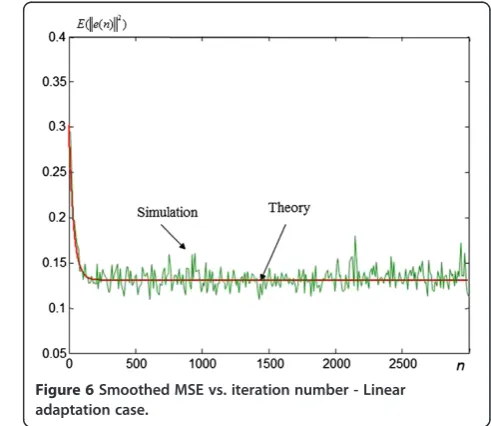
For the linear adaptation case (Section 3.1), the adaptive system is composed of a 2x2 matrix W. For the noise we have taken σ0 = 0.001. The mean weight recursions and
the MSE transient behaviors (Figures 6, 7) have been estimated over 20 Monte Carlo (MC) simulations and compared to the theoretical derivations (Equations (19) and (41)). This chosen number of MC simulations shows excellent fit between the Theory and MC estimations which confirms the validity of the different assumptions made. A larger number of MC simulations allows a bet-ter smoothing of the curves, but the conclusions remain the same.
Matrix W converges to a scaled version of H: W0¼
0:3536 0:0577 0:1061 0:1925
¼H U; U¼ 0:3536 0:0000
0:0000 0:1925
:
Note the typical behavior of the LMS algorithm: A time constant controls the transient part of the learning curve
and the mean weight curve. This is fundamentally differ-ent from the full NN system learning which is governed by several time constants and presents plateau regions (Section 5.2). It should be noted that the steady state MSE is high because of the error caused by the fact that the nonlinearities are not approximated (actually they are modeled by the identity function) (Equation (25)).
MSE surface for the full NN algorithm
We move now to the study of the full NN algorithm. In this simulation, we have taken N = 3 neurons in each of the two NN blocks. The learning rate was fixed toμ=0.0045. Figure 8 shows the MSE surface (i.e., Eq. (90), with no time dependence) as a function of w11
andw12(the other parameters were fixed). It is clear that
the MSE is quadratic inw11andw21. It presents a single
global minimum (as shown in Equations (76 and 84)).
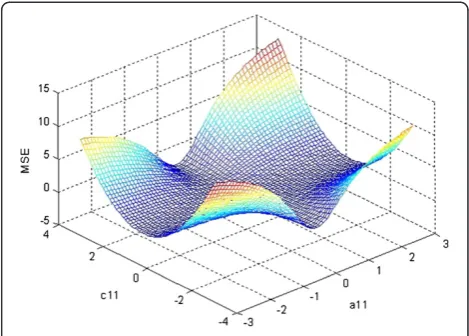
Figure 9 (resp. Figure 10) shows the MSE surface as a function of a11 and c11 (resp. a11 and a12) (the other
parameters were fixed). It can be noted the flat areas (plateau regions) around the minima of the MSE sur-face. This explains the slow evolution of the NN weights when the algorithm gets close to its conver-gence point.
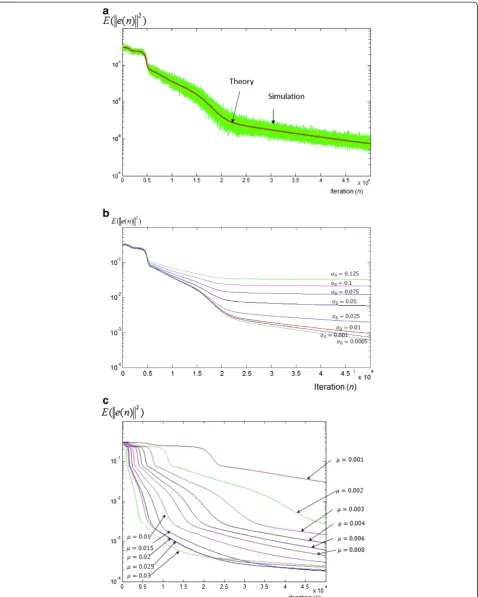
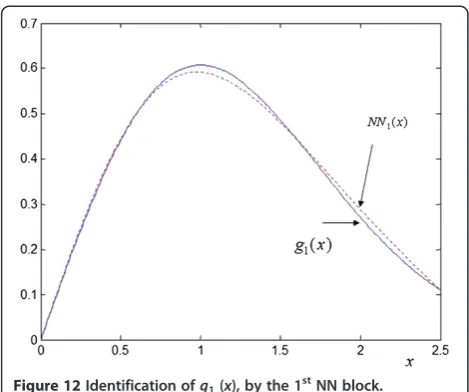
The MSE evolution during the learning process (Equa-tion (90)) has been compared to 20 MC estima(Equa-tions (Figure 11a): The theory shows very good fit with the simulation results. In the Figure, we notice that the MSE presents several phases (each phase is controlled by a time constant) which end by a plateau phase where the MSE decreases very slowly. This is a typical behavior of the backpropagation algorithm [1] which is fundamen-tally different from that of the linear adaptation scheme (Figure 6). Here the MSE error is much smaller. This is expected, since here the additional MSE error due to the nonlinearities (Eq. 92) is highly reduced because our NN
Figure 9MSE surface,MSE(a11,c21).
Figure 7Mean weight transient behavior - Linear adaptation case.
Figure 11a: MSE during the learning process (theory and simulation),σ0=0.001 andμ=0.0045. b: MSE for different values of noise variance, the learning rate wasμ=0.0045 (theoretical results).c: MSE for different values of learning rateμ(the noise variance was set toσ0=0.001),
blocks have correctly identified the unknown nonlineari-ties (Figure 12, 13). Here we are in a situation close to that of Section 3.2 (Equations 51-52).
Figure 11b shows the MSE evolution during the learn-ing process for different values of the noise varianceσ0.
It can be seen that, as the noise variance decreases, the MSE decreases. However, below a certain value of σ0
(here σ0=0.0005), the MSE curves are almost identical.
This is because in this case, the weight misadjustment error (for the linear part) and the nonlinear approxima-tion error (of the nonlinear memoryless part) are much higher than the error caused by the presence of noise (see Eqs. 92-93).
Figure 11c investigates the influence of the learning rateμ. It can be seen that asμincreases (up toμ=0.002), the algorithm is faster and the MSE is lower at the end
of the simulation time. However, for μ>0.002, as μ increases, the algorithm is faster at the beginning of the learning process, but the MSE is higher at the end of the simulation time. This is due to the misadjustment error which is higher for higherμ(see, e.g., Eq. 95).
Mean weight transient behavior for the full NN algorithm
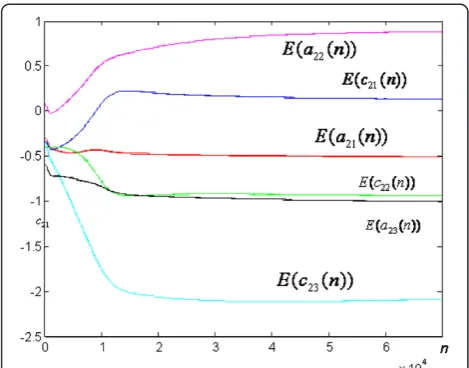
Here we keep the system described in Section 5.2. The mean weight recursions for the linear combiner W and the two NN blocks are shown in Figure 14, 15, 16 for both theory and MC estimations. The theoretical and estimated curves are indistinguishable. This confirms the validity of the different assumptions made in Sections 4.1 and 4.2.
Figure 12Identification ofg1(x), by the 1stNN block.
Figure 13Identification ofg2(x) by the 2ndNN block.
Figure 14Mean weight behavior: Matrix W (theory and simulation).
Notice that, in Figure 14, W weights have a fast evolution at the beginning of the learning process (with values approaching H×U(n) where U is a diag-onal matrix). They then evolve slowly till the end of the learning process. The slow evolution is justified by the plateau regions presented by the MSE surface. At the end of this simulation, matrix U was close to a diagonal matrix: USim¼ 10::27020003 10::00010946
; (and
UTheory¼ 1:2700 1:0950
). This result is expected since the inputs are uncorrelated (Equations 84-85).
Figure 12, 13 show that functionsg1(x) andg2(x) have
been correctly identified by the corresponding NN blocks (the NN functions are normalized by the scaling factorsγ1=1/1.2702,γ1=1/1.0946, respectively).
Impact of correlated inputs
In the simulations below we study the impact of corre-lated inputs. The input signal vector is chosen here as a 2D Gaussian process with covariance matrix of the form
RXX ¼ 1ρ ρ1
: The number of neurons in each NN block was taken as N = 5 neurons. The learning rate
μ=0.0075. We have run several simulations for different
values of the cross correlation. Note that (ρ=0) corre-sponds to independent inputs, and (ρ=1) corresponds to the same input (i.e., x1=x2). The values of matrix U
and the MSE after n=2105 iterations are shown in Table 1. It can be seen from Table 1 that, in practice, matrix U remains very close to a diagonal matrix, even for high correlation between inputs. This indi-cates that the system is capable of correctly identifying the nonlinearities even when the inputs are highly correlated. The identification performances for the cases (ρ=0.6) and ( ρ=0.99) are illustrated in Figures 17, 18 and 19, 20, respectively. As expected, the MSE increases as the correlation between inputs increases (Table 1). When ρ=1 (i.e., the two inputs are the same) the system is capable of correctly identifying the overall MIMO input–output transfer function. However, in this case, it is not capable of separating the nonlinearities (as U is not diagonal). The reason is that in this case, the system is seen by the learning algorithm as a 1x2 SIMO system which has several equivalent structures. Figure 21 shows an example of two equivalent structures. There-fore, the adaptive system is structurally not able to separ-ate the nonlinearities. It is worth to note that for the case (ρ=0.999), the inputs look like noisy versions of each other (i.e., this is equivalent to a 1x2 system identifica-tion problem with noisy inputs). Thus, the MSE for the case (ρ=0.999 ) is larger than the MSE for the case (ρ=1).
Conclusion and future work
The paper provides a statistical analysis of NN model-ing and identification of a class of nonlinear MIMO systems. The study investigates the MSE error, mean weight behavior, stationary points, misadjustment error, and stability conditions. The unknown system is com-posed of a set of single-input memoryless nonlinearities followed by a combining matrix. The NN model is composed of a set of single-input memoryless NN blocks followed by an adaptive linear combiner. The paper is supported with simulation results which show good agreement between the theoretical recursions and MC simulations. Future work will focus on 3 research directions. The first will explore the theoretical findings in order to express the effect of the number of neu-rons on the transient and steady state behavior of the algorithm. The second research axis will investigate the Figure 16Mean weight behavior: Second NN block (theory and
simulation vs. iterations).
Table 1 Effect of correlated inputs
ρ=0 ρ=0.6 ρ=0.9 ρ=0.99 ρ=0.999 ρ=1 (same input)
E(U(n)), for
n=2 × 10⁵ 1:228 0:0000
0:0004 1:066
1:2245 0:0004
0:001 1:1331
1:23 0:001
0:0025 1:12
1:24 0:019
0:023 1:08
0:324 1:07 1:002 0:03
0:023 1:24 1:14 0:15
case where matrix H is time-varying and/or with mem-ory (this may have applications, for example, in adap-tive control of nonlinear dynamical MIMO systems). Finally, we will study the algorithm behavior and per-formance for specific inputs (such as space-time coded signals used in wireless communications and their im-pact on the system capacity).
Endnotes
This work has been supported by The Natural Sciences and Engineering Research Council of Canada (NSERC).
The time index of the weights has been omitted from the right hand side of the equations to make them easier to read.
Appendix I
1)Calculation ofFkk
Letx1andx2be two zero-mean Gaussian variables
such thatσ2
x1 ¼σ
2 x2¼σ
2
x and E xð 1x2Þ ¼ρ
Therefore,Fkkðaki;bki;akm;bkmÞ ¼E f akixð ð kð Þþn
bkiÞf akmxð kð Þ þn bkmÞÞρ¼σ2
x:
Using Price’s theorem we have:
E @2f að kix1þbkiÞf aðkmx2þbkmÞ @x1@x2
h i
¼@E f a½ðkix1þbkiÞf wð kmx2þbkmÞ
@ρ :
LetUð Þ ¼ρ E @2f aðkix1þbkiÞf wð kmx2þbkmÞ @x1@x2
h i
;
Then:E f akix½ ð 1þbkiÞf akmxð 2þbkmÞρ¼σ2
x
E f a½ ð kix1þbkiÞf að kmx2þbkmÞρ¼0¼ Rσ2
x
0 Uð Þρdρ:
Thus, using the un-correlation criteria betweenx1
andx2forρ=0 , we have:E f a½ ð kix1þbkiÞf að kmx2þ
bkmÞρ¼0¼E f a½ ð kix1þbkiÞE f a½ ð kmx2þbkmÞ:Thus:
Figure 17Identification ofg1(x), caseρ=0.6.
Figure 18Identification ofg2(x), caseρ=0.6.
Figure 19Identification ofg1(x), caseρ=0.99.
F að ki;bki;akm;bkmÞ ¼E f a½ ð kix1þbkiÞE f a½ ð kmx2þ
bkmÞ þRσ2x
0 Uð Þρ dρ:
We have:Uð Þ ¼ρ E @2f aðkix1þbkiÞf aðkmx2þbkmÞ @x1@x2
h i
¼
2
πakiakm2π1j jR1 2 Rþ1 1 Rþ1 1 e 1
2ðakix1þbkiÞ2e12ðakmx2þbkmÞ2
e12XtR1Xdx1dx2 whereX¼½x1x2tand R¼ σ
2 x ρ
ρ σ2
x
:
Combining the terms in the exponentials and completing the squares, the integrals can be calculated:Uð Þ ¼ρ 2
π ffiffiffiffiffiffiffiffiffiffiffiffiffiffiffiffiffiffiffiffiffiffiffiffiffiffiffiffiffiffiffiffiffiffiffiffiffiffiffiffiffiffiffiffiffiffiffi1þσ2 akiakm
xa2kiþσ2xa2kmþðσx4 ρ2Þa2kia2km
p
exp 12 b2kib2kmþ 1
a2
kiþ σ2
x σ2
xρ2
"
b2kia2kiþ
" "
bkiaki a2kiþ σ2
x σ2
xρ2
þbkmakmσ2ρ
xρ2
2 a2 kiþ σ2 x σ2
xρ2
a2 kmþ σ2 x σ2
xρ2
a2
km ρ
2
σ2
xρ2
3 5 3 5 3 5:
Note that in the biasless case (i.e. all the bias terms are set to 0) this expression reduces to:
Uð Þ ¼ρ 2 π
akiakm
ffiffiffiffiffiffiffiffiffiffiffiffiffiffiffiffiffiffiffiffiffiffiffiffiffiffiffiffiffiffiffiffiffiffiffiffiffiffiffiffiffiffiffiffiffiffiffiffiffiffiffiffiffiffiffiffiffiffiffiffiffiffiffiffiffiffiffiffiffiffiffiffiffi
1þσ2
xa2kiþσ2xa2kmþ σ4xρ2
a2
kia2km
q :
The integral is then simple to calculate:
Z σ2
x
0
Uð Þρ dρ¼2 πsin1
akiakmσ2x
ffiffiffiffiffiffiffiffiffiffiffiffiffiffiffiffiffiffiffiffiffiffiffiffiffiffiffiffiffiffiffiffiffiffiffiffiffiffiffiffiffiffiffiffiffiffiffiffiffiffiffiffiffi
1þσ2
xa2kiþσ2xakm2 þσ4xa2kia2km
q 0 B @ 1 C A
In the other hand, sinceE f w½ ð kx1Þ ¼E f w½ ð ix2Þ ¼0,
then:
F að ki;akm;0;0Þ ¼2πsin1 akiakmσ 2
x
ffiffiffiffiffiffiffiffiffiffiffiffiffiffiffiffiffiffiffiffiffiffiffiffiffiffiffiffiffiffiffiffiffiffiffiffiffiffi 1þσ2
xa2kiþσ2xakm2 þσ4xa2kia2km p
:
When the bias terms are not set to 0, a Taylor series expansion on the bias terms can be used in order to avoid the calculation of the integral.
2) Calculation ofK
Kkðakm;bkmÞ ¼E g½kð Þxk f akmxð kþakmÞ
¼ 1ffiffiffiffiffiffi
2π
p σ1
x Z þ1
1 αkx e βk x22e
x2
2σ2
x
Z akmxþbkm
0
eu 2 2du dx:
The inside integral can be eliminated by integrating
by parts on variablex.
The integral is then evaluated by combining the terms in the exponentials and completing the squares. This yields:
Kkðakm;bkmÞ ¼ ffiffiffi 2 π r αk 1 σ2
xþβk
akm
ffiffiffiffiffiffiffiffiffiffiffiffiffiffiffiffiffiffiffiffiffiffiffiffiffiffiffiffiffiffiffiffiffiffiffi
σ2
x a2kmþβk
þ1
q
exp b
2
km
2 1
σ2 x
1þσ2
x βkþa2km
!! :
Again, a Taylor series expansion can be used to simplify this expression.
Note that in the biasless case we have:
Kkðakm;0Þ ¼
ffiffiffi 2 π r α 1 σ2
xþβk
akm
ffiffiffiffiffiffiffiffiffiffiffiffiffiffiffiffiffiffiffiffiffiffiffiffiffiffiffiffiffiffiffiffiffiffiffi
σ2
x a2kmþβk
þ1
Appendix II
The derivatives needed to compute the different recursions are expressed as follows:
@Kkðakm;0Þ @akm ¼
ffiffiffi 2 π r ασ2 x σ2
x a2kmþβk
þ1
3
2;
@Kkðakm;bkmÞ @akm ¼
@Kkðakm;0Þ @akm
ffiffiffi 2
π
r
αk σ2x
b2
km 2
1þσ2
xβk2σ2xa2km 1þσ2
x βkþa2km
5
2 @Fkkðaki;0;aki;0Þ
@aki ¼ 4
π
σ2
xaki
σ2
xa2kiþ1
ffiffiffiffiffiffiffiffiffiffiffiffiffiffiffiffiffiffiffiffiffiffi 1þ2σ2
xa2ki
q ;
@Fkkðaki;aki;bki;bkiÞ
@aki ¼
@F að ki;0;aki;0Þ
@aki
2
πb2kiσ2xaki
5σ2xa2kiþ3 1þσ2
xa2ki
2
1þ2σ2
xa2ki
3
2 @F að ki;0;akm;0Þ
@aki ¼ 2
π
σ2
xakm
σ2
xa2kiþ1
ffiffiffiffiffiffiffiffiffiffiffiffiffiffiffiffiffiffiffiffiffiffiffiffiffiffiffiffiffiffiffiffiffiffiffiffi 1þσ2
x a2kiþa2km
q
@F að ki;akm;bki;bkmÞ
@aki ¼
@F að ki;aki;0;0Þ
@aki
1
πb2ki
σ2
xakm
1þσ2
xa2ki
ffiffiffiffiffiffiffiffiffiffiffiffiffiffiffiffiffiffiffiffiffiffiffiffiffiffiffiffiffiffiffiffiffiffiffiffi 1þσ2
x a2kmþa2ki
q 1þσ2xa2km
1þσ2
x a2kmþa2ki
2σ2xa2ki 1þσ2
xa2ki !
π1a2km σ
2
xakm 1þσ2
x a2kmþa2ki
3
2 bkibkm
2
π
σ2
xaki 1þσ2
x a2kmþa2ki
3
2 @F að ki;akm;bki;bkmÞ
@bkm ¼
2
πbki σ
2
xakiakm
1þσ2
xa2ki
ffiffiffiffiffiffiffiffiffiffiffiffiffiffiffiffiffiffiffiffiffiffiffiffiffiffiffiffiffiffiffiffiffiffiffiffi 1þσ2
x a2kmþa2ki
q bkm
2
π
1
ffiffiffiffiffiffiffiffiffiffiffiffiffiffiffiffiffiffiffiffiffiffiffiffiffiffiffiffiffiffiffiffiffiffiffiffi 1þσ2
x a2kmþa2ki
q
Appendix III
KVjVjtðnþ1Þ ¼KVjtVjtð Þ n 2μRXXKVjVjð Þn
2μKVjVjð ÞRn XX
þ2μE eW0jð Þn XV
t
jðI2μXXtÞ
h i
þ2μE eW0jð ÞXVn
t
jðI2μXXtÞ
h it
þ4μ2E XXtKVjVjXX t
þ4μ2E e2W0jð ÞXXn t
h i
ð96Þ The calculations are similar to [9] Appendix, the main difference is that here we deal with a multi-dimensional input. Therefore, we will follow the same methodology as in [9].
Following [10] the expectation before the last one can be calculated as:
E XXtKVjVjð ÞnXX t
¼tr RXXKVjVjð Þn
RXX
þ2RXXKVjVjð ÞRn XX: ð97Þ
The first expectation is expressed as:
E eW0jð ÞXVn t
jðIμXXtÞ
h i
¼E eW0jð ÞnXV t j
h i
μE eW0jð ÞnXV t jXXt
h i
ð98Þ
The first term is Zero (orthogonality principle). The second term is:
E eW0jð ÞnXV t jXXt
h i
¼E Hjtgj xj þNjð Þn
h
Wt
0jX nð Þ
XVjtXXt
i
ð99Þ
The middle term is Zero (Zero-mean white noise), the last expectation is:
E W0tjX nð ÞXVjtXXt
h i
¼E X nð ÞXW0Vjtð Þn XXt
h i
tr RXXW0E Vjtð Þn
RXX
þ2RXXW0E Vjtð Þn
RXX
ð100Þ
The first expectation in Eq. (99)E Ht
jg Xð ÞXVjtð ÞXXn t
h i
E Ht
jg Xð ÞXE Vjtð Þn
XXt
h i
involves the nonlinearity gj
(xj) and should be evaluated explicitly. The remaining expectation in (96) is:E e2
ojð ÞnXXt
h i
:
E eh 2ojð ÞnXXti¼E Hjtg Xð Þ W0tjX2XXt
þσ2 0RXX
We have
E W0tjX2XXt
¼E XXh tW0tjW0tjXXti
¼tr RXXW0tjW0tj
RXX
þ2RXXW0tjW t
0jRXX ð102Þ
The first term in (102) is:
E Hjtg Xð Þ2XXt
¼E HjHjtg Xð Þg tð ÞX XXt
h i
¼E g Xð Þgtð ÞX HjHjtXX t
h i
(96) is then expressed as:
KVjVjtðnþ1Þ ¼KVjtVjtð Þ n 2μRXXKVjVjð Þn
2μKVjVjð ÞnRXXþ4μ
2 E Ht
jg Xð ÞXE Vjtð Þn
XXt
h i
þtr RXXW0E Vjtð Þn
RXXþRXXW0E Vjtð Þn
RXX
þ4μ2 E Hjtg Xð ÞXE Vjtð Þn
XXt
h i
þtr RXXW0E Vjtð Þn
RXXþRXXW0E Vjtð Þn
RXX t
þ4μ2 tr RXXKVjVjð Þn
RXX þ2RXXKVjVjð ÞRn XX
þ4μ2 E g Xð Þgtð ÞHX jHjtXXt
h i
þσ2 0RXX
tr RXXW0tW0t
RXX2RXXW0tjW0tjRXX
Competing interests
The author declares that he has no competing interests.
Received: 6 December 2011 Accepted: 13 July 2012 Published: 21 August 2012
References
1. S. Haykin,Neural Networks: A Comprehensive Foundation(Prentice Hall, 1999) 2. Y. Gao, M. Er, Online adaptive fuzzy neural identification and control of a
class of MIMO nonlinear systems. IEEE Trans. Fuzzy Systems, 462–476 (2003) 3. S.S. Ge, C. Wang, Adaptive neural control of uncertain nonlinear MIMO
systems. IEEE Trans. Neural Networks15, 674–692 (2004)
4. M. Ibnkahla, A. Al-Hinai, Adaptive modeling and identification of nonlinear MIMO channels using neural networks, inAdaptive Signal Processing in Wireless Communications, ed. by M. Ibnkahla (CRC Press, Boca Raton, FL, USA, 2008)
5. K.S. Narendra, K. Parthasarathy, Identification and control of dynamical systems using neural networks. IEEE Trans. Neural Networks1, 4–27 (1990) 6. H. Xu, P. Ioannou, Robust adaptive control for a class of MIMO nonlinear
systems with guaranteed error bounds. IEEE Trans. Automatic Control, 718–742 (2003)
7. S. Amari, Mathematical foundations of neurocomputing. Proc. IEEE 78(9), 1443–1463 (September 1990)
8. N.J. Bershad, M. Ibnkahla, F. Castanié, Statistical analysis of a two-layer back propagation algorithm used for modeling non linear memoryless channels: The single neuron case. IEEE Trans. Signal Processing45(3), 747–756 (March 1997)
9. N. Bershad, P. Celka, J.M. Vesin, Stochastic analysis of gradient adaptive identification of nonlinear systems with memory for Gaussian data and noisy input and output measurements. IEEE Trans. Signal Processing 47(3), 675–689 (March 1999)
10. S. Haykin,Adaptive Filter Theory(Prentice Hall, 1996)
11. M. Ibnkahla, N.J. Bershad, J. Sombrin, F. Castanié, Neural network modeling and identification of non linear channels with memory: Algorithms, applications and analytic models. IEEE Trans. Signal Processing46, 5 (1998) 12. M. Ibnkahla, Statistical analysis of neural network modeling and
identification of nonlinear channels with memory. IEEE Trans. Signal Processing, 1508–1517 (2002)
13. J. Shynk, S. Roy, Convergence properties and stationary points of a perceptron learning algorithm. Proc. IEEE70, 1599–1604 (Oct. 1990) 14. J.G. Taylor,Mathematical Approaches to Neural Networks(North-Holland,
Amsterdam, 1993)
15. H. White, learning in artificial neural networks: A statistical perspective. Neural Comput.1, 425–464 (1989)
16. N. Bershad, P. Celka, J.M. Vesin, Analysis of stochastic gradient tracking of time-varying polynomial Wiener systems. IEEE Trans. Signal Processing 48(6), 1676–1686 (June 2000)
17. H. Bolcskei, MIMO systems: Principles and trends, inSignal Processing for. Mobile Communications Handbook, ed. by M. Ibnkahla, 12th edn. (CRC Press, 2004)
18. T. Javornik, G. Kandus, S. Plevel, G. White, A. Burr, V-BLAST algorithm performance in non-linear channel. IEEE Computer as a Tool Conference 1, 183–187 (September 2003)
19. G. Poitau, A. Kouki, Impact of realistic amplification models on dynamic VBLAST optimization. Proc. Vehicular Technology Conference Spring, 894–897 (2004)
20. S. Woo, D. Lee, K. Kim, H. Hur, C. Lee, J. Laskar, Combined effects of RF impairments in the future IEEE 802.11n WLAN systems. Proc. IEEE Vehicular Technology Conference Spring2, 1346–1349 (May 2005)
21. S. Yang, J. Xi, X. Mu, Decision aided joint compensation of clipping noise and nonlinearity for MIMO-OFDM systems. Proc. IEEE International Symposium on Communications and Information Technology (ISCIT) 1, 725–728 (2005)
22. S. Yang, J. Xi, F. Wang, X. Mu, H. Kobayashi, Decision aided compensation of residual frequency offset for MIMO-OFDM systems with nonlinear channel. Proc. International Symposium on Intelligent Signal Processing and Communication Systems (ISPACS), 113–116 (2005)
23. A. Sulyman, M. Ibnkahla, Performance of MIMO systems with antenna selection over nonlinear fading channels. IEEE Journal in Selected Topics in Signal Processing2, 159–170 (April 2008)
24. A. Sulyman, M. Ibnkahla, Performance analysis of nonlinearly amplified M-QAM signals in MIMO channels. European Transactions in Communications 19(1), 15–22 (January 2008)
25. J. Pedro, S. Maas, A comparative overview of microwave and wireless power amplifier behavioral modeling approaches. IEEE Trans. Microwave Theory and Techniques53(4), 1150–1163 (2005)
26. A. Saleh, Frequency-independent and frequency–dependent nonlinear models of TWT amplifiers. IEEE Trans. Communications29, 11 (1981)
doi:10.1186/1687-6180-2012-179
Cite this article as:Ibnkahla:Stochastic analysis of neural network modeling and identification of nonlinear memoryless MIMO systems.
EURASIP Journal on Advances in Signal Processing20122012:179.
Submit your manuscript to a
journal and benefi t from:
7Convenient online submission
7Rigorous peer review
7Immediate publication on acceptance
7Open access: articles freely available online
7High visibility within the fi eld
7Retaining the copyright to your article