R E S E A R C H
Open Access
Robust digital image watermarking scheme using
wave atoms with multiple description coding
Hon Yin Leung
*, Lee Ming Cheng and Fang Liu
Abstract
In this article, a robust blind watermarking scheme using wave atoms with multiple descriptions is proposed. In the presented scheme, the watermark image is embedded in the wave atom transform domain. One of the sub-bands is used to carry watermark data. The experimental results indicate that superiority of the proposed method against common attacks such as JPEG compression, Gaussian noise addition, median filtering, salt and pepper noise, etc., compared with the existing watermarking schemes using multi-scale transformations.
Keywords:Digital watermarking, Wave atoms, Security
1. Introduction
Along with the rapid development and widespread use of multimedia and computer network technologies, various multimedia products such as image, audio, video are in-creasingly exposed to illegal possession, reproduction, and dissemination. Unrestricted copying and convenient digital media manipulation cause considerable financial loss and show up an issue of intellectual property rights [1,2]. Digital watermarking provides a way to imperceptibly embed digital information into both digital (images, video, audio) and conventional (printed material) media contents. By extracting this secret digital data, the copyright of digital media can be protected and authentication to digital media can also be provided as well [3,4].
Robustness and imperceptibility are two fundamental but contradicting properties in robust digital watermar-king. Robustness means that the watermarked data can withstand different image processing attacks and imper-ceptibility means that the watermark would not introduce any perceptible artifacts [1]. Watermarking systems can be classified to three main types which are non-blind, semi-blind, and blind according to whether the original media is required or not during the extracting processes [5]. Non-blind technique requires the original image; semi-blind technique only needs the watermark; and blind technique requires neither the original image nor the watermark.
Majority of watermarking schemes are implemented in spatial domain or in frequency domain. Large numbers of literatures show that the performance of watermark-ing schemes based on frequency domain is far better than those operating in the spatial domain. For this rea-son, large numbers of transformation-based watermark-ing algorithms are proposed uswatermark-ing discrete cosine transform (DCT) [6], discrete Fourier transform [7], and wavelets [8] in the past few decades.
It is known that natural images do not simply include 1D piecewise scan-line, and have many discontinuity points. In fact, wavelet as a separable 2D multi-resolution transform does not possess directional property and simply follows the curves as horizontal–vertical lines and essentially cannot represent 2D directional discontinuity which is common in as image edges [9]. In 1999, Candes and Donoho [10] introduced a new multi-scale transform called the curvelet transform which can use a few samples to represent edges and other singularities along curves much more efficiently than traditional transforms like wavelet [11]. After this, certain watermarking schemes based on curvelet domain have been proposed [12,13].
In 2006, Demanet [14] introduced a generalization of curvelets called wave atoms and it can greatly be matched with warped oscillatory functions [15]. By using this spe-cific transform, oriented textures have a significantly sparser expansion than in other fixed standard representa-tions like Gabor filters, wavelets, and curvelets. In the area of image processing, there have been some preliminary studies done on image denoising using wave atom * Correspondence:[email protected]
Department of Electronic Engineering, City University of Hong Kong, Kowloon Tong, Hongkong, Republic of China
transform and the relative results have proved its great po-tential [16,17]. Due to its great performance in image denoising, one becomes naturally wondering if wave atom transform can be extended to the field of watermarking. Until now, there is little research exploring the applica-tions of wave atom transform related to the watermarking aspect.
In [18], it is pointed out that senisitivity of human eye to noises is less in textured area and more in the smooth areas according to the HVS characteristics, litlle modifica-tion of textures area should be unrecognizable by human eye. From our point of view, most of the watermark en-ergy can be kept if the watermark is embedded in the tex-ture area rather than the smooth one after common image processing attacks. As the sparse property of wave atom coefficients is well suited for the texture area, we, there-fore, try to embed the watermark into wave atoms domain to see whether a comprising result comes out.
In this article, we present a blind watermarking method using wave atom transform based on the multiple descrip-tion coding (MDC) [19]. A number of experiments are conducted to investigate the feasibility of wave atom transform in the area of watermarking through capacity and robustness tests. Finally, the experimental results verify our assumption that the watermarking scheme based on wave atom domain can be robust against com-mon signal processing attacks. The remainder of this article is organized as follows: In Section 2, wave atom transform is presented. In Section 3, MDC is described. The details of embedding and extracting approaches are given in Section 4. In Section 5, the robustness tests for the proposed method and comparisons with other water-marking schemes are presented. Besides, the capacity and security analyses of the proposed method are provided in Sections 6 and 7, respectively. The conclusion is addressed in Section 8.
2. Wave atom transform
Demanet and Ying [15] introduced wave atoms that can be seen as a variant of 2D wavelet packets and obey the parabolic scaling law, i.e., wavelength ~ (diameter)2. They proved that oscillatory functions or oriented textures (e.g., fingerprint, seismic profile, engineering surfaces) have a significantly sparser expansion in wave atoms than in other fixed standard representations like Gabor filters, wavelets, and curvelets.
Wave atoms have the ability to adapt to arbitrary local directions of a pattern, and to sparsely represent aniso-tropic patterns aligned with the axes. Wave atoms pre-cisely interpolate between Gabor atoms and directional wavelets in the sense that the period of oscillations of each wave packet (wavelength) is related to the size of essential support via parabolic scaling, i.e., wavelength is directly proportional to the square of the diameter.
2.1 1D discrete wave atoms
Letψmj ,n(x) represent a 1D family of wave packets, wherej, m≥0,n∈Zcentered in frequency around ±wj,m= ±π2jm
with C12j≤m≤C22j and centered in space around xj,n=
2−jn. Dyadic scaled and translated versions ofψ^0mare com-bined in the frequency domain and the basis function can be written as
ψj
m;nð Þ ¼x ψjm x2jn
¼2j=2ψ0m22xn ð1Þ For each wave number wj,m, the coefficientcj,m,n can be
seen as a decimated convolution at scale 2–j. Input sampleu
is discretized at xk¼kh;h¼N1;k¼1;. . .;N and discrete
coefficientsCjD,m,nare computed using a reduced inverse FFT
inside an interval of size 2j+ 1πcentered about the origin.
CjD;m;n¼
X
k¼2π 2j
2þ1: 1:2j
2
ei2jnk
X
p∈2πZψ^Jmðk þ 2JpÞu^ðkþ2 jpÞ
ð2Þ
A simple wrapping technique is used for the imple-mentation of discrete wavelet packets and the steps are shown as follows.
1. Perform an FFT of sizeNof the samplesu(k). 2. For each pair (j,m), wrap the productψ^J
mu^by
periodicity inside the interval [−2jπ, 2jπ] and perform an inverse FFT of size 2jto obtainCjD,m,n
3. Repeat step 2 for all pairs (j,m).
2.2 2D discrete wave atoms
2D orthonormal basis functions with four bumps in the frequency plane can be formed by individually taking products of 1D wave packets. 2D wave atoms are indexed byu= (j,m,n), wherem= (m1,m2) andn= (n1,n2). In 2D case, Equation (1) is modified as follows.
ϕþ
μðx1;x2Þ ¼ψmj1 x12jn1
ψj
m2 x22jn2
ð3Þ
A dual orthonormal basis can be defined from the
“Hilbert-transformed”wavelet packets
ϕ
μðx1;x2Þ ¼Hψjm1 x12jn1
Hψjm2 x22jn2
ð4Þ
The combination of Equations (3) and (4) provides basis functions with two bumps in the frequency do-main, symmetric with respect to the origin and thus dir-ectional wave packets oscillate in one single direction.
φð Þ1
u ¼ φþu þφu
=2;φð Þu2 ¼φþu φu=2 ð5Þ φu(1)andφu(2)form the wave atom frame and are denoted
jointly as ϕu. The wave atom algorithm is based on the
3. MDC
MDC can be applied to digital image watermarking as suggested by Chandramouli et al. [19] and has been worked with DCT and contourlet transform domain [19,20]. The idea of multiple descriptions (MD) is to div-ide the source information into various descriptions such that a receiver is able to reconstruct the original source by using one or more of these source descriptions within
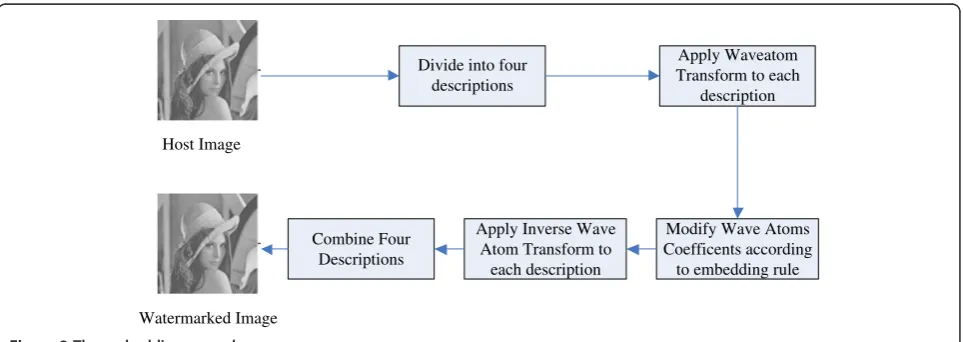
some prescribed distortion constraints [19]. For example, a host image is decomposed into two descriptions, i.e., odd and even pixel intensities (two descriptions). These descriptions are chosen in such a way that there are some correlations between them. One description can be used for watermark insertion, while the other one is taken as a reference for watermark extraction. After watermark embedding, two descriptions are combined to form the
Figure 1Two descriptions for the image Lena (a) Odd description.(b) Even description.
Host Image
Divide into four descriptions
Apply Waveatom Transform to each
description
Modify Wave Atoms Coefficents according to embedding rule Apply Inverse Wave
Atom Transform to each description
Watermarked Image
Combine Four Descriptions
watermarked image. The following two figures show the odd and even descriptions for the image Lena. The differ-ences between these two images Figure 1a,b are almost in-distinguishable.
4. Proposed method
Imperceptibility is one of the most important features to evaluate the performance of the watermarking algo-rithm. In this study, the fourth scale band is selected to be embedded instead of the lowest or the highest sub-bands. The multiplicative-based approach is adopted to embed data. The original image in which the watermark to be embedded is first decomposed into four sub-image descriptions by MDC. The watermark can only be extracted by collecting all these descriptions. The main idea of the proposed method is to adjust the en-ergy of certain squares within the wave atom tiling for different descriptions according to the watermark bit value. By comparing the energy differences between the square pairs in the wave atom tiling corresponding to odd and even descriptions, the embedded watermark can be extracted.
First, suppose that I denotes the host image of size
N×N. The host image is then decomposed into four descriptions as follows.
I1ðp;pÞ ¼I pð ;2p1ÞI2ðp;qÞ ¼I pð ;2qÞ
I3ðp;qÞ ¼I N
2 þp;2q1
I4ðp;qÞ ¼ N 2 þp;2q
ð6Þ
wherep= 1,2,. . .,N/2,q= 1,2,. . .,N/2.I1, I2,I3, andI4 de-note four descriptions, namely upper odd description, upper even description, lower odd description, and lower even description, respectively.
As can be seen in Equation (6), the descriptionsI1and
I3are similar toI2andI4, respectively. After applying the wave atom transform to four descriptions, the wave atom coefficients corresponding to odd and even descriptions are approximately equal or similar.
In the embedding process, according to the value of to-be-embedded bit and the characteristic of descriptions, the means of certain squares in the wave atom tiling are adjusted to be larger or smaller. Similarly, in the extracting
Decompose into 4
descriptions Divide into 5 bands Discrete Waveatom
Transform
Compute the local mean for each wedge and compare the corresponding one in the other
description Final
watermark
Watermarked
image The fourth scale
band (Middle High Frequency band)
Figure 3The extraction procedure.
0 1 2 3 4 0 1 2 3 25 30 35 40 45 50
a
b
c
d
e
f
b a X: 0.8 Y: 1.2 Z: 45.77 PSN R v a lu e =10 =20 =30 =40 =50 0 24 0 1
2 3 0 0.2 0.4 0.6 0.8 1 b X: 1.6 Y: 2 Z: 1 a NC v a lu e =10 =20 =30 =40 =50 0 0.5 1 1.5 2 0 1 2 32 33 34 35 36 37 38 39 d X: 0.9 Y: 0.9 Z: 38.15 c P S NR v a lu e =10 =20 =30 =40 =50 0 50 100 40 60 80 100 120 0 5 10 15 20 25 30 35 40 r PSN R v a lu e α α α α α α δ δ δ δ δ α α δ δ δ δ δ δ δ δ δ δ 0 0.5 1 1.5 2 0 1 2 0 0.2 0.4 0.6 0.8 1 d c NC v a lu e =10 =20 =30 =40 =50 0 20 40 60 80 40 60 80 100 120 0 0.2 0.4 0.6 0.8 1 r NC v a lu e δ δ δ δ δ δ δ
Figure 5These images showing the robustness for the watermark and the imperceptibility for the watermarked image affected by selecting various embedding parameters (a) Effect ofαa,αb, andδon PSNR value.(b) Effect ofαa,αb, andδon NC value. (c) Effect ofαc,
procedure, the means of those squares are compared be-tween the odd and the even descriptions corresponding to the same position to obtain the secret bits. The details of the proposed method are shown below.
4.1 The embedding procedure
The proposed embedding scheme is shown in Figure 2. Let I denotes the original image and wc denotes the
watermark message, wherewc = (w1,w2,. . .,wp) and pis
the length of watermark. To enhance the security of watermarkwc, Arnold transform is applied at first. The
function of Arnold transform is given by
x0
y0 ¼ 1k k1þ1
x
y mod H ð7Þ
Point (x,y) is shifted to another point x',y'. Thus, the origin watermarkwc is permuted by this transform. The
embedding procedure is described as follows.
1. Apply Arnold transforms to origin watermarkwcfor
Htimes, wherekandHare used as secret keys. 2. Divide the original imageIof sizeN×Nto form four
descriptions,I1,I2,I3, andI4, by MDC using Equation (6).
3. Wave atom transform is then applied to these four descriptions, namely upper odd description, upper even description, lower odd description, and lower even description. Four coefficient setsS1,S2,S3, and
S4corresponding to these descriptions are then
obtained. Five scale bands are generated for each description via wave atom transform. In this study, the fourth scale band is selected to embed the permuted watermark, since it is placed in the middle high-frequency band.
4. Among the setsS1,S2,S3, andS4, the coefficientsCu
in the fourth sub-band are selected to be modified provided that their absolute values are smaller than the thresholdr, i.e.,Cu≤|r|, whereu= (j,m1,m2,n1,n2)
of integer-valued quantities indexes a point (xu,ωu)
in phase space andris to determine the number of
coefficients for embedding.
5. Embed the first half of the permuted watermark in
S1andS2, whileS3andS4are used to embed the
rest, each of lengthp/2 bits. In the fourth scale band, two blocks are selected as demonstrated in Figure2, one from the odd description (S1orS3)
and the other from the even one (S2orS4), to
embed one secret bit, where the phase positions of these two squares are equal. If the bit to be embedded is "1", the coefficients in the odd description of the selected blocks will be enlarged while the coefficients in the even description of the corresponding block will be minimized. In case, the bit to be embedded is "0", the embedded process is Table 1 Results against different attacks (NC values)
Image NC values
Boat Lena Pepper Baboon
Laplacian sharpening 1 1 1 1
Gaussian noise (standard variance = 10) 0.9926 1 1 1
Salt and Pepper noises addition (noise density = 0.02) 0.9486 0.9553 0.9602 1
Gaussian low pass filter (standard variance = 1.5, window = 5) 0.5971 0.677 0.6442 0.660
JPEG 80 0.974 1 1 1
JPEG 40 0.8723 0.8977 0.8824 0.9963
JPEG 25 0.8074 0.8296 0.8001 0.9478
Histogram equalization 1 1 1 1
Scale (512 - > 448) 0.5495 0.5904 0.6389 0.6234
Scale (512 - > 576) 0.5594 0.5974 0.6226 0.6154
Rotate 5 0.5207 0.4896 0.5532 0.4423
Rotate 10 0.5634 0.5489 0.4853 0.5325
Cropping (half of image) 0.8637 0.8783 0.8758 0.8783
Table 2 PSNR values of watermarked images without any attacks
Image(s) Boat Lena Pepper Baboon
PSNR (dB) 35.96 36.29 36.18 32.09
Table 3 The values of PSNR
PSNR value of watermarked Lena image (dB)
[21] 44.8
[12] 42.8
[22] 35.8
[23] 44.7
reversed, i.e., the coefficients in the odd descriptions are minimized and the ones in the even descriptions are enlarged.
For all non-empty squares inS1andS2,
Fori¼1:p=2
IFwi¼bit 1
In S1;
IF absð ÞCu >δ
Cu¼Cuαa
ELSE Cu¼Cuαb
In S2;
IF absð ÞCu >δ
Cu¼Cuαc
ELSE
Cu¼Cuαd
ELSE In S2;
IF absð ÞCu >δ
Cu¼Cuαa
ELSE
Cu¼Cuαb
In S1;
IF absð ÞCu >δ
Cu¼Cuαc
ELSE
Cu¼Cuαd
ð8Þ
whereabs(.) is the absolute value of (.),u=(j,m1,m2,n1,
n2) of integer-valued quantities,αa,αb,αc, andαdare
the strength factors used to control robustness and perceptual quality, andδis the embedding threshold. Similarly, the modification of coefficients withinS3
andS4is as same as the above operation, in whichS1
andS2are replaced byS3andS4, respectively. Four
altered wave atom coefficient setsS1’,S2’,S3’, andS4’
are obtained at last.
6. Apply the inverse wave atom transform to the modified coefficient setsS1’,S2’,S3’, andS4’.
7. Obtain the output watermarked imageI’by collecting the four modified descriptions.
4.2 The extracting procedure
When extracting the watermarks, the original imageIis not required. The proposed watermark extraction scheme is shown in Figure 3. Denote I’ as the water-marked image for watermark detection. The extracting process is described as follows.
1. DivideI’to four descriptions,I1’,I’2,I3’, andI4’, by
MDC using Equation (6).
2. Wave atom transform is then applied to these descriptionsI1’,I2’,I3’, andI4’ and form four coefficient
sets,S1’,S2’,S3’, andS4’.
3. Within the fourth scale band, a number of blocks are created by the wave atom transform. By comparing the means of these blocks between the odd and even descriptions at the corresponding position, the
watermark sequencewis extracted. The squares of
S1’ (odd description) andS2’ (even descriptions) are
denoted asW1(j,m,n) andW2(j,m,n), respectively. It
is described as follows: For all non-empty squares in
S1’ andS2’,
wg ¼ 10;;if meanif meanððabsabsððW1W1ððjj;;mm;;nnÞÞÞÞÞÞ>≤meanmeanððabsabsððW2W2ððjj;;mm;;nnÞÞÞÞÞÞ
n o
ð9Þ
wherejis the scale,m,nrepresent the phase, and mean(.) represents the mean value of (.) andabs(.) is the absolute values of (.). Referring to Equation (9), half of the watermarkwgis extracted first.
Accordingly, the rest will be extracted by replacingS1’
andS2’ withS3’ andS4’, respectively, in Equation (9).
Table 4 Experiment results comparison under Gaussian noises (NC values)
Standard variance of Gaussian noises 6 8 10 12 14 16 18 20 25 30
[21] 0.9963 0.9926 0.974 0.9738 0.9706 0.9481 0.9447 0.9324 0.9157 0.8963
[12] 1 0.9963 0.9889 0.9813 0.9702 0.9481 0.9456 0.9179 0.8372 0.7926
[22] 0.8583 0.8217 0.7962 0.7781 0.7658 0.755 0.7489 0.7396 0.7312 0.7283
Proposed scheme 1 1 1 1 0.9963 0.9778 0.9813 0.9665 0.91 0.8897
Table 5 Experiment results comparison under JPEG compression (NC values)
JPEG compression parameter 80 60 40 35 30 25 20 15 10 5
[21] 0.9668 0.9064 0.9198 0.8465 0.7836 0.8645 0.6717 0.7259 0.6967 0.611
[12] 1 1 0.9963 0.9963 1 0.9853 0.9704 0.9289 0.7761 0.6138
[22] 0.9704 0.9245 0.891 0.881 0.8682 0.8558 0.8382 0.818 0.7858 0.7413
[23] 0.9547 0.7550 0.5314 N/A N/A N/A N/A N/A N/A N/A
The watermarkw’ccan then be reconstructed by the
merging of these two segments.
4. Use Arnold transform to the obtained watermarkwc
for (T-H) times, whereTis the period of Arnold transform.
5. Experimental results
In this section, not only robustness test of the proposed scheme is investigated, analysis of various embedding parameters and comparisons with other novel conven-tional schemes are also made. First, we introduce the common quality metric used for evaluating the robustness of watermarking algorithm, namely normalized cross-correlation (NC), usually representing the cross-correlation be-tween the embedded watermark W and the extracted watermarkW’. Its definition is shown as below.
NC¼
XMW
p¼1 XNW
q¼1 W pð ;qÞW
0ðp;qÞ
½
XMW
p¼1 XNW
q¼1½W pð ;qÞ
2 ð10Þ
where MW and NW denote the width and height of the
watermark, respectively.
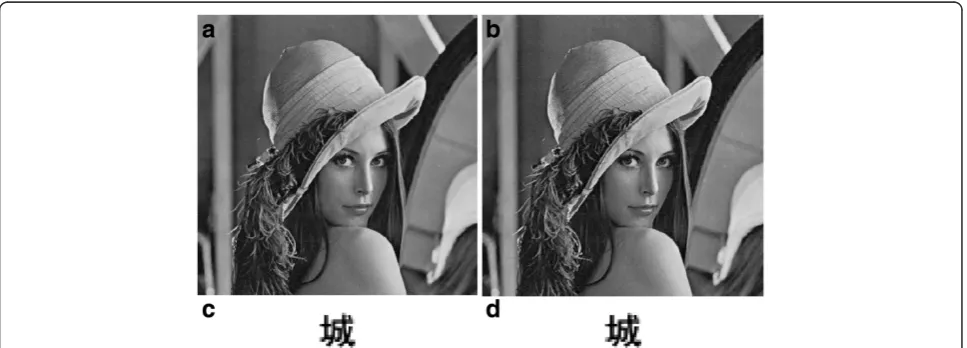
In the following experiment, 512 × 512 gray-scale image, Lena as shown in Figure 4a, is served as a test image. The watermarked image for our scheme is illustrated in Figure 4b and the binary watermark of size 16 × 16 is shown in Figure 4c. The extracted watermark is shown in Figure 4d. The experimental system is composed of an Intel Core-Quad CPU with a 2.66 GHz core and 3 GB DDR2.
The watermarked image quality is represented by the peak-signal-to-noise ratio (PSNR) between the original and watermarked images, which is calculated by
PNSR¼10log10 255 2
MSE
dB
ð Þ ð11Þ
where the mean squared error (MSE) between the ori-ginal and watermarked images is defined by
MSE¼ 1
NN
XN
p¼1 XN
q¼1
I pð ;qÞ I0ðp;qÞ
2
ð12Þ
where I(p,q) and I’(p,q) denote the pixel value at pos-ition (p,q) of the original imageI and the watermarked imageI’with size ofN×Npixels, respectively.
5.1 Analysis of embedding parameter
In the proposed method, various embedding parameters
αa, αb, αc, αd, and δ have critical role on the quality of
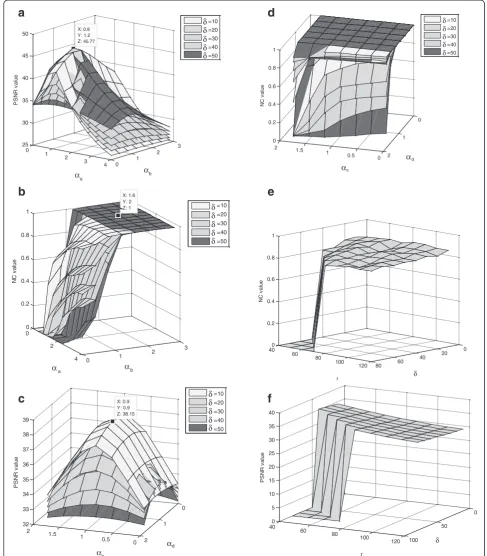
watermarked image and the robustness of the watermark. In general, it is possible to obtain the best compromise between the robustness and invisibility with optimal para-meters. However, it is rather difficult to determine a truly optimal parameter value, as these parameters are basically influenced to each other when we change one of them. In the rest of this section, evaluation tests are then carried out so as to determine the suitable values for each param-eter used. An Image‘Lena’is used in this study as shown in Figure 4a. It is expected that using other images per-form most likely the same as the presented one. Figure 5a–f shows the mutual relationships between the parameters αa, αb, αc, αd, r, and δ, respectively. Consider that they all are critical to determine the robustness for the watermark and the imperceptibility for the water-marked image, which are described as below.
We plot four graphs to show the performance of our scheme by choosing distinct parameter values αa,αb, αc,
αd, andδin terms of PSNR and NC values, as shown in Figure 5a–d. Notice that the optimal PSNR value can be identified with a particular combination of αa and αb, while δ represents a threshold for distinguishing the condition to useαaorαb. In Figure 5a,b, the parameters
αc, αd, and rare fixed to 0.8, 0.8, and 60 separately, for Table 6 Experiment results comparison under cropping (NC values)
Cropping Type 1 (Figure5f) Type 2 (Figure5g) Type 3 (Figure5h) Type 4 (Figure5i) Type 5 (Figure5j)
[21] 0.7641 0.8897 0.752 0.8579 0.8983
[12] 0.9118 0.9158 0.8888 0.869 0.8748
[22] 0.678 0.8611 0.6788 0.6758 0.6768
Proposed scheme 0.9889 0.9744 0.7865 0.8783 0.9133
Table 7 Experiment results comparison under Salt and Pepper noises (NC values)
Density parameter“Salt and Pepper noises” 0.02 0.04 0.06 0.08 0.1 0.12 0.14 0.16 0.18 0.2
[21] 0.9478 0.9048 0.8553 0.8222 0.8148 0.7699 0.7729 0.7361 0.7574 0.7303
[12] 0.9134 0.8699 0.7897 0.7698 0.6971 0.6972 0.6262 0.6492 0.6851 0.6392
[22] 0.9784 0.9579 0.9386 0.9209 0.9035 0.8869 0.8714 0.8559 0.8437 0.8301
determination of the best parameter set forαa,αb, andδ. It can be seen from Figure 5a that our scheme can ob-tain the maximum PSNR value whenαaandαbare set at 0.8 and 1.2, respectively. In addition, five irregular planes are demonstrated in Figure 5a, each with a uniqueδ ran-ging from 10 to 50. The shape of these planes looks like a series of mountains, each carrying distinct characteris-tic. Refer to the plane with respect toδ= 50, it is obvi-ous that the corresponding PSNR values are mostly higher than those in other planes with respect to δ = {10. . .40}. Clearly, only when δ = 50, the maximum PSNR value can be determined.
Figure 5b illustrates that NC values are equal to 1 only if
αaand αb are larger than 1. Besides, NC values can also keep up 1 provided thatαbis large enough such asαb≥2. Considering these facts, we suggest to use 0.8 and 1.2 as the optimal values ofαaandαb. In Figure 5c,d, we plot the NC and PSNR values as a function of parameters αc, αd, andδwhile other parametersαa,αb, andrare fixed at 1.6, 2, and 60, respectively. As can be seen in Figure 5c, the maximum PSNR value can be obtained when αc and αd are both set at 0.9 and PSNR values start to decline sharply around this position.
Figure 5a–d demonstrates that one of the planes with respect to δ = 50 andδ = 10, in turn, is to be the top layer. Note that the quality metric to evaluate the abil-ities of imperceptibility and robustness are referred to PSNR and NC values, respectively. Obviously, whenδis set at 50, the proposed algorithm performs the best im-perceptibility as shown in Figure 5a. On the contrary, when δ = 10, it leads to the best robustness for the watermark as shown in Figure 5b,d. Note that there should be a trade-off between imperceptibility and robustness. We consider that the temporary best choice of δ would be the average of these two values, that is,
δ= 30.
To the best of the authors’ knowledge, the relation-ship between δandrcannot simply be studied without adding noises. Hence, the best choice would be to intro-duce a distortion on the watermarked image to some extents. JPEG compression is taken into achieve this purpose. We plot two graphs to show the impact of PSNR and NC with respect to the change ofrandδas shown in Figure 5e,f. Clearly, they show that there are two inclined planes. As can be seen in Figure 5e, de-creasing the parameter δ increases NC values while adjusting the parameterrdoes not cause the significant change of NC values in spite of several fluctuations. Figure 5f shows that the smallerrandδare, the higher PSNR values are. Note that certain regions are of null values in these figures, as δmust be set smaller than r
according to Equation (8). From Figure 5e,f, we prefer a small value of δ to a larger one, due to a better water-marked image’s quality and better robustness. In this study, the parameter sets are fixed toαa= 1.6, αb= 2,αc = 0.7, andαd= 0.7, respectively.
To make a good balance between visibility and robust-ness, r should not be selected too small and be larger than 50 at least based on the facts of Figure 5e,f. It is known that δ= 50 can yield a great robustness as illu-strated in Figure 5a andδ≤r. This suggests that the op-timal value ofrtends to be 60. As mentioned above, the temporary choice forδis 30. However, it must be noted that a relative largerδcan lead to a worse NC and PSNR value as shown in Figure 5e,f. As for the optimal value ofδ, it is suggested to make the previous choice smaller to yield a better performance. It appears that δ = 20 would be a promising choice.
For a compromise between robustness and invisibility, a little modification is made on those parameters based on the above result. Finally, the optimal values we con-sidered forαa,αb,αc,αd,r, andδare 1.6, 2.1, 0.8, 0.8, 60,
Table 8 Experiment results comparison under Laplacian sharpening (NC values)
Laplacian parameter 0.1 0.2 0.3 0.4 0.5 0.6 0.7 0.8 0.9 1
[21] 1 1 1 1 1 1 1 1 1 1
[12] 0.9963 0.9963 0.9963 0.9963 0.9963 0.9963 0.9963 0.9963 0.9963 0.9963
22] 0.7967 0.7975 0.8007 0.8028 0.8044 0.8083 0.8082 0.8095 0.8109 0.8215
Proposed scheme 1 1 1 1 1 1 1 1 1 1
Table 9 Experiment results comparison under low pass filtering (NC values)
Standard variance (window)“low pass filtering” 0.5(3) 1.5(3) 0.5(5) 1.5(5) 3(5)
[21] 0.9963 0.9816 0.9963 0.9305 0.851
[12] 1 1 1 1 1
[22] 0.9697 0.912 0.9695 0.8741 0.8582
and 20, respectively. And these values are adopted in the following tests.
5.2 Robustness tests
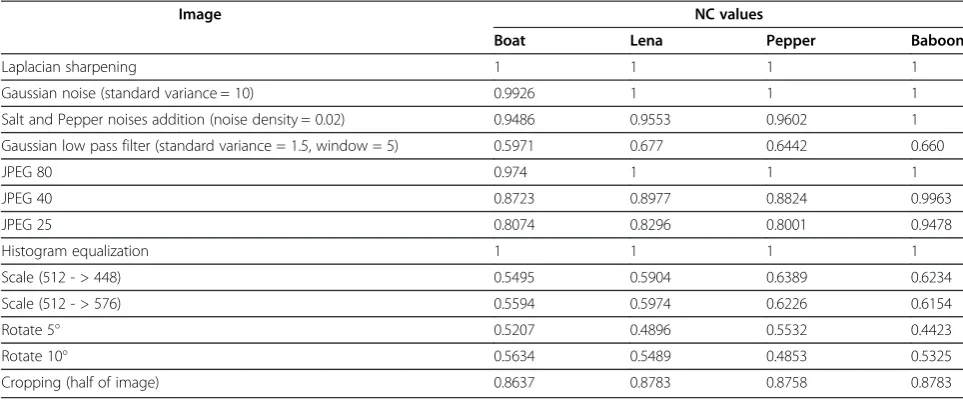
In this section, we evaluate the proposed method against Gaussian low pass filtering, Gaussian additive noise, Laplacian image enhancement, JPEG compression, Salt and Pepper noises, etc. The simulation results are listed in Table 1. The performance of the proposed technique is evaluated in terms of NC and PSNR values.
Table 1 demonstrates that the proposed method is robust against the Laplacian sharpening, Gaussian noise, Salt and Pepper noises, JPEG compression and histogram equalization, cropping attacks. In particular, it performs very well in histogram equalization and Laplacian shar-pening and stays NC = 1 for all images, but exhibits weak robustness against low pass filtering. The reason why our scheme can resist most common signal processing attacks is that the energy of embedded watermark spreads all over the image via the wave atom transform. The watermark can be recovered only if the distorted watermarked image contains enough watermark information.
For JPEG compression attacks, Table 1 shows that our scheme can resist JPEG compression up to a quality factor of 25. However, it exhibits weak robustness under low pass filtering attacks, as this type of attacks like median filtering greatly reduces the difference of wave atom coeffi-cient values between the odd and even descriptions, thereby weakening the watermark strength. Therefore, the watermark cannot survive basically.
On the other hand, the biggest weakness of our scheme is that it cannot resist against geometric manipulations as indicated in Table 1, where NC values are always below 0.6. Traditionally, most geometric-invariant watermarking algorithms use a synchronization technique to estimate the rotation angle, rotate back the image, and then detect the watermark. However, the proposed technique does not include such side information for the synchronization purpose. So, the rotation attacks can destroy the spatial correlation between odd and even descriptions. Lack of synchronization information causes the proposed method being unable to recover the angle change. As a result, the comparisons between the descriptions for watermark ex-traction become no longer meaningful. So, the watermark cannot survive under such attacks.
Besides, Table 2 shows that PSNRs between the original and the watermarked images are 35.96, 36.29, 36.18, 32.09 dB, respectively. Basically, the watermark invisibility is satisfied.
5.3 Comparisons with related watermarking methods Besides, we have studied the performance of the proposed wave atom base method over similar DWT or curvelet-based approaches to find the efficiency of implementation of wave atoms. These methods are proposed by Xiao et al. [21], Leung et al. [12], Tao and Eskicioglu [22], and Ni et al. [23], respectively. Table 3 shows that the water-marked image of our scheme has good visual fidelity but is slightly inferior to other watermarking schemes. Clearly, Ni et al.’s scheme preserves the best watermarked image’s quality, while Tao and Eskicioglu’s scheme is the worst one among these schemes.
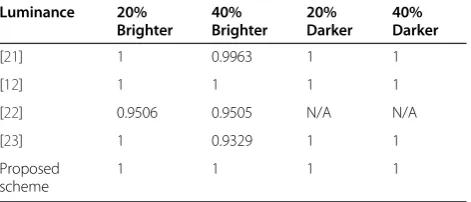
We have tested the performance of these watermarking schemes against several common watermarking attacks. The simulation results are shown in Tables 4, 5, 6, 7, 8, 9,
Table 10 Experiment results comparison under luminance attacks (NC values)
Luminance 20%
Brighter
40% Brighter
20% Darker
40% Darker
[21] 1 0.9963 1 1
[12] 1 1 1 1
[22] 0.9506 0.9505 N/A N/A
[23] 1 0.9329 1 1
Proposed scheme
1 1 1 1
Table 11 Experiment results comparison under contrast attacks (NC values)
Contrast 20%
Increase 40% Increase
20% Decrease
30% Decrease
[21] 1 0.9927 1 1
[12] 1 1 1 1
[22] 0.6041 0.5742 0.8297 0.6995
[23] 1 1 0.976 0.6809
Proposed scheme
1 1 1 1
Table 12 Experiment results comparison under histogram equalization (NC values)
Attacks Histogram equalization
[21] 0.9963
[12] 1
[22] 0.8877
Proposed scheme 1
Table 13 The processing time for watermark embedding and retrieval
Processing time Watermark
embedding (s)
Watermark retrieval (s)
[21] 6.22 2.31
[12] 6.41 5.37
[22] 0.9 9.45
10, 11, 12, and 13. For Gaussian noises, JPEG compres-sion, and cropping attacks, Tables 4, 5, 6 show that the proposed scheme relatively outperforms other schemes in terms of NC values, whereas it is less robust against Salt and Pepper noises than Xiao et al.’s and Tao and Eskicioglu’s algorithms except Leung et al.’s one as shown in Table 7. As shown in Table 8, our scheme provides ex-cellent robustness against Laplacian sharpening, and is comparable to other schemes for low pass filtering as shown in Table 9. Tables 10 and 11 highlight the results achieved for luminance and contrast attacks. It can be seen that the proposed method outperforms other four watermarking schemes. Table 12 shows that our scheme provides great robustness for histogram equalization.
Table 13 illustrates the comparison of processing time between the proposed scheme and other schemes [12,21-23]. It shows that the processing time of ours can achieve 2.41 and 0.92 s with respect to embedding and extracting process, respectively, which is also the short-est one among these schemes.
In addition, the above comparisons may not completely reflect the robustness of proposed method, as only compar-isons with spread spectrum-based methods are made. Since there are certain watermarking schemes different from spread spectrum-based methods such as content-based or quantization index modulation (QIM) watermarking algorithms, it is desirable to make a comparison with these kinds for us to draw a fair conclusion. Hence, two more watermarking techniques are suggested to be compared, which are proposed by Ramanjaneyulu and Rajarajeswari [24] and Tang and Hang [25]. As expected, one of them is content-based scheme, whereas the other is based on QIM method and MD. The simulation results are shown in Table 14. Overall, the performance of proposed scheme is comparable to Ramanjaneyulu and Rajarajeswari’s scheme [24], but is rather better than Tang and Hang’s scheme [25]. Specifically, Ramanjaneyulu and Rajarajeswari’s scheme is too weak against histogram equalization, while Tang and Hang’s scheme cannot fully resist median filtering. However, our scheme performs
better than these schemes with respect to these attacks as shown in Table 14.
To conclude, we have made a complete robustness test and compared with a number of conventional schemes in this section. In a word, simulation results are satisfied, and it demonstrated that our scheme is more robust and has shorter computation time compared with other schemes.
6. Capacity
For certain watermarking schemes, we have to consider the trade-off between imperceptibility and robustness. Thus, estimating the watermark capacity inserted into the original media is an important issue. In this section, the capacity of proposed method is investigated.
Zhang and Zhang [26] suggest to use a traditional in-formation theory to solve the capacity problem of water-marking scheme. They claim that a watermarked image
Table 14 Comparison between our watermarking method Ramanjaneyulu and Rajarajeswari’s scheme [24] and Tang and Hang’s scheme [25]
NC
Ramanjaneyulu and Rajarajeswari [24] Tang and Hang [25] Proposed scheme
Median filtering 3 × 3 0.7466 0.125 0.3328
Gaussian filter 3 × 3 0.8055 0.625 0.7262
Salt and Pepper noise (scale = 0.1) N/A 0.625 0.7693
JPEG 60 0.9983 0.75 0.9963
JPEG 40 0.7880 0.375 0.9145
Median filtering 3 × 3 + JPEG 90 N/A 0.125 0.8865
Gaussian filtering 3 × 3 + JPEG 90 N/A 0.625 0.5498
Histogram equalization 0.0192 N/A 1
can be viewed as an AWGN channel to transmit mes-sages and the watermark is the message to be transmit-ted. By applying Shannon’s well-known channel, the watermarking capacity in non-blind watermarking algo-rithm can be computed by
C¼Wlog 1þPS
PN
ð13Þ
whereWis the bandwidth of channel.
Assume the size of image isN×N, the number of pix-els isM=N×N. According to Nyquist sampling theory, the bandwidth of an image is W = M/2. Zhang and Zhang [26] considered that the watermarking capacity should be associated with the image’s content. Hence, they further developed a new equation with respect to the maximum watermark’s amplitude. Assume σw2
denotes the variance of the MWI and σw2 denotes the
variance of the noises, so the image watermarking cap-acityCcan be defined as
C¼Wlog 1þσ 2
w
σ2
n
ð14Þ
whereWis the bandwidth of the imageW=M/2. Costa [27] has studied the channel capacity problem of the so-called dirty paper communication in 1983. Zhang and Zhang [26] considered that the capacity problem of blind watermarking is the same as the prob-lem described by Costa. Notice that our scheme is a blind watermarking scheme, no reference images are needed at the detector. To compare with Zhang’s
scheme in a fair manner, a Fishing-boat image of size 256 × 256 is used as well, as shown in Figure 6. Zhang and Zhang [26] used a biorthogonal 9/7 DWT for water-marking, whereas a wave atom transform domain is uti-lized in our case.
As can be seen in Figure 7, the theoretical watermark-ing capacity of wave atom domain is larger than that of wavelet domain. This is because more energy of image concentrates in low-frequency sub-bands in wavelet do-main rather than in wave atom dodo-main. In practice, for the proposed algorithm, 256 bits are embedded into the middle high-frequency component within wave atom transform domain, yielding an average PNSR value of watermarked image at 39 dB. In this study, the max-imum watermark capacity can be up to 364 bits by using the fourth scale band only, for a host image of size 512 × 512. The size of watermark can be extended if more scale bands are included for embedding, but it would result in lowering the visual quality of the water-marked image.
It may not make a good sense as experimental results are inconsistent with the theoretical values, implying that wave atoms coefficients may not efficiently be used to hide secret data. It could be explained that each secret bit is associated with excessive wave atom coefficients for the proposed method, in which it requires nearly 493 wave atom coefficients, on average, to embed one bit. It could be optimized by employing less wave atom coeffi-cients to represent one bit, but the complexity computa-tion may be increased accordingly or may weaken the algorithm’s robustness. To conclude, in term of the
1 2 3 4 5 6 7 8 9 10
0 0.5 1 1.5 2 2.5
3x 10
5
Noise Variance
C
apac
it
y
Waveatom domain Wavelet domain
capacity, wave atom transform shows its superiority over the wavelet transform based on the simulation results.
7. Security analysis
Cayre et al. [28] proposed a definition of watermarking security and emphasized that the importance of water-marking security should be the same as robustness. They developed a method to measure the security level of spread-spectrum-based watermarking with the help of Fisher Information Matrix (FIM). By using the spread spectrum technique, their concept for the security ana-lysis of spread-spectrum-based watermarking in [28] can also be applied to our case. Zhang et al. [29] mentioned that two statistical methods are commonly adopted to examine information leakage, one being based on the Shannon’s information theory. Information leakage about secret carriers can be evaluated by the mutual information between carriers and watermarked image which also indi-cates the decrease of uncertainty of carriers due to water-marking communications. The other one uses FIM to measure information leakage, in particular, by measuring the accuracy of estimation of the carriers with the help of maximum likelihood. The security of the proposed scheme is described below.
7.1 Mathematical model
According to [29], the embedding model for spread-spectrum-based algorithms can be expressed in Equation (13).
Yj¼Xjþ γffiffiffiffiffiffi Nc
p XN0
i¼1
Ziaji ð15Þ
where Yj¼ yj
1;y
j
2;. . .;y
j Nv
T
is the watermarked
sig-nal from the jth observation.
Denote Xj¼ xj
1;x
j
2;. . .;x
j Nv
T
as the host of the jth
observation. Theith carrier vector is denoted asZi.aijis
employed to denote theith bit of embedding message in the jth observation. γ is denoted as the embedding strength. Nc,No, and Nvdenote the number of carriers,
the number of observations, and the dimension of the host in each observation, respectively.
7.2 Perfect covering
The Bayes rule indicates that spread-spectrum-based watermarking does not provide perfect covering. If an attacker is able to access to the watermarked content, some information about the watermark signal may be leaked from these observations. As a result, our scheme cannot offer perfect covering. According to [28], three types of attacks are defined: watermarked only attack
(WOA), Known Message Attack (KMA), and Known Original Attack (KOA).
In this study, MD are employed for embedding water-mark. Note that it is not meaningful to analyze the KOA for this study, since the watermark extraction of the pro-posed method does not require the original image. Be-sides, the attacker can deduce more knowledge about the secret key from the watermarked content than from pairs of original and watermarked contents, so WOA context deserves much more attentions than the KOA. Thus, only the case of KMA and WOA are considered in this study. The following section will investigate if our scheme can withstand KMA and WOA.
7.3 Known message attack
Under KMA, the attacker knows which messages have been embedded into the watermarked content by obser-vations. Assume that the distribution of the host
xjkis N 0;σ2
xINv
. The attacker owns N0-independent observations and corresponding embedded messages. Mentioned in [28], the log-likelihood with sample set
YNo ¼ðY1;Y2;. . .;YN0Þis given by
logL¼K 1
2σ2
x
XN0
j¼1yj γffiffiffiffiffiffiffi
NC
p Zjaj2 ð16Þ
The attacker can estimate the private carriers ZNC
with the help of FIM. The FIM can be calculated by Equation (17).
FIM¼E ∂logL
∂ ZT
1;. . .;ZNCT
T 2 6 4 3 7
5 ∂logL
∂ ZT
1;. . .;ZTNC
T 2 6 4 3 7 5 T 8 > < > : 9 > = > ;
¼ γ2
NCσ2x
Fuu
ð Þ1;1 ⋯ðFuuÞ1;NC
⋮ ⋮
Fuu
ð ÞNC;1⋯ðFuuÞNC;NC
2 4
3 5
¼ γ2
NCσ2x
Fuu→
N0→þ1
N0 γ 2σ2
a NCσ2x
INv;NC
ð17Þ
whereðFuuÞℓ;k¼
XN0
j¼1ajð Þℓ ajð Þk ΙNv.
Finally, the security level of our scheme under KMA can be calculated byN0*=Ncσx2/γ2. After some
manipula-tions, the security level can be estimated as (131072*6303)/(1.325*1.325)∼4.7 × 108.
7.4 WOA
spread-spectrum-based watermarking under WOA can be evaluated by the Cramér-Rao Bound (CRB) to find out the CRB of estimation of the carriers. It is expected that the attacker knowsNmmessages first. Otherwise, CRB
can-not be found. Cayre et al.’s results show that whenNm
mes-sages are known by an attacker, the security level of secret carriers isN0*=Ncσx2/(σa2γ2). Again, the security level can be
computed as (131072 × 6303)/(1 × 1.3252)∼4.7 × 10⁸. Based on the above result, it can be concluded that the proposed method is secure due to the high security level.
8. Conclusion
In this article, a robust watermarking scheme based on wave atom transform is presented. To determine the best compromise between robustness and imperceptibil-ity, a number of experiments have been conducted. Overall, the experimental results demonstrate that our scheme provides excellent robustness against histogram equalization, Gaussian noises, cropping, luminance, and contrast attacks, but fails against rotation and low pass filtering attacks. Besides, the quality of the watermarked image is satisfactory in term of perceptibility (the PSNR per watermarked image is over 35 dB). The comparison results between the proposed method and the existing watermarking schemes show that the proposed method is comparable in terms of robustness and the processing time. And the security analysis result proved that the proposed method is secure. So far, a fixed model of the human visual system has not been developed, which would be studied in the future.
9. Consent
The 515x512 BMP grayscale image Lena and other images are obtained from http://sipi.usc.edu/database/. Written informed consent was obtained from the person for publication of the images.
Competing interests
The authors declare that they have no competing interests.
Received: 25 May 2011 Accepted: 22 August 2012 Published: 26 November 2012
References
1. CI Podilchuk, EJ Delp, Digital watermarking: algorithms and applications. IEEE Signal Process. Mag.18(4), 33–46 (2001)
2. IJ Cox, ML Miller, JA Bloom,Digital Watermarking(Morgan Kaufmann, San Francisco, 2002)
3. GC Langelaar, I Setyawan, RL Lagendijk, Watermarking digital image and video data: a state-of-the-art overview. IEEE Signal Process. Mag. 17(5), 20–46 (2000)
4. IJ Cox, J Kilian, FT Leighton, T Shamoon, Secure spread spectrum watermarking for multimedia. IEEE Trans. Image Process.6(12), 1673–1687 (1997)
5. S Katzenbeisser, FAP Petitcolas,Information Hiding Techniques for Steganography and Digital Watermarking(Artech House, Boston, 2000) 6. CS Shieh, HC Huang, FH Wang, JS Pan, Genetic watermarking based on
transform domain techniques. Pattern Recognit.37, 555–565 (2004) 7. V Solachidis, I Pitas, Circularly symmetric watermark embedding in 2-D DFT
domain. IEEE Trans. Image Process.10, 1741–1753 (2001)
8. P Tao, A Eskicioglu, A robust multiple watermarking scheme in the discrete wavelet transform domain. Proc. SPIE5601, 133–144 (2004)
9. MA Akhaee, SME Sahraeian, F Marvasti, Contourlet-based image watermarking using optimum detector in a noisy environment. IEEE Trans. Image Process.19(4), 967–980 (2010)
10. EJ Candes, DL Donoho, New tight frames of curvelets and optimal representations of objects with C2 singularities. Commun. Pure Appl. Math. 57(2), 219–266 (2004)
11. EJ Candès, L Demanet, DL Donoho, L Ying, Fast discrete curvelet transforms. SIAM Multiscale Model. Simul.5(3), 861–899 (2006)
12. HY Leung, LM Cheng, LL Cheng, A robust watermarking scheme using selective curvelet coefficients. Int. J. Wavelets Multiresolution Inf. Process. 7(2), 163–181 (2009)
13. P Tao, S Dexterb, AM Eskicioglu, Robust digital image watermarking in curvelet domain, inProc. SPIE, Security, Forensics, Steganography, and Watermarking of Multimedia Contents, ed. by (, 2008).6819, 68191B–68191B-12
14. L Demanet,Curvelets, wave atoms, and wave equations(, ). Ph.D. Thesis, Caltech http://math.stanford.edu/~laurent/papers/ThesisDemanet.pdf 15. L Demanet, L Ying, Wave atoms and sparsity of oscillatory patterns. Appl.
Comput. Harmon Anal.23, 368–387 (2007)
16. J Rajeesh, RS Moni, S Palanikumar, Noise reduction in magnetic resonance images using wave atom shrinkage. IJIP4(2), 131–141 (2010)
17. A Federico, GH Kaufmann, Denoising in digital speckle pattern interferometry using wave atoms. Opt. Lett.32, 1232–1234 (2007) 18. AS Lewis, G Knowles, Image compression using the 2-D wavelet transform.
IEEE Trans. Image Process1(2), 244–250 (1992)
19. R Chandramouli, BM Graubard, CR Richmond,A multiple description framework for oblivious watermarking(Proc. SPIE Security and Watermarking for Multimedia Contents, San Jose, 2001). Jan 2001
20. BC Mohan, SS Kumar, Robust digital watermarking scheme using contourlet transform. IJCSNS Int. J. Comput. Sci. Netw. Secur.8, 43–51 (2008) 21. Y Xiao, LM Cheng, LL Cheng, A robust image watermarking scheme based
on a novel HVS model in curvelet domain, inInternational Conference on Intelligent Information Hiding and Multimedia Signal Processing, ed. by (, Harbin, China, 2008), pp. 343–346. August
22. P Tao, AM Eskicioglu, A robust multiple watermarking scheme in the discrete wavelet transform domain, inInternet Multimedia Management Systems V Conference on Optics East 2004 Symposium, ed. by, 5601st edn. (, Philadelphia, 2004), pp. 133–144
23. R Ni, Q Ruan, HD Cheng, Secure semi-blind watermarking based on iteration mapping and image features. Pattern Recognit.38, 357–368 (2005) 24. K Ramanjaneyulu, K Rajarajeswari, An oblivious and robust multiple image
watermarking scheme using genetic algorithm. IJMA2(3), 19–38 (2010) 25. CW Tang, HM Hang, A feature-based robust digital image watermarking
scheme. IEEE Trans. Signal Process.51(4), 950–959 (2003)
26. F Zhang, H Zhang, Wavelet domain watermarking capacity analysis. P Soc. Photo-opt. Ins.5637, 657–664 (2005). Beijing, China
27. M Costa, Writing on dirty paper. IEEE Trans. Inf. Theory29(3), 439–441 (1983) 28. F Cayre, C Fontaine, T Furon, Watermarking security: theory and practice.
IEEE Trans. Signal Process.53, 3976–3987 (2005)
29. D Zhang, J Ni, DJ Lee, Security analysis for spread-spectrum watermarking incorporating statistics of natural images. Adv. Visual Comput.
5359, 400–409 (2008)
doi:10.1186/1687-6180-2012-245